normflows
normflows: A PyTorch Package for Normalizing Flows - Published in JOSS (2023)
Science Score: 100.0%
This score indicates how likely this project is to be science-related based on various indicators:
-
✓CITATION.cff file
Found CITATION.cff file -
✓codemeta.json file
Found codemeta.json file -
✓.zenodo.json file
Found .zenodo.json file -
✓DOI references
Found 13 DOI reference(s) in README and JOSS metadata -
✓Academic publication links
Links to: arxiv.org, joss.theoj.org -
✓Committers with academic emails
4 of 14 committers (28.6%) from academic institutions -
○Institutional organization owner
-
✓JOSS paper metadata
Published in Journal of Open Source Software
Keywords
Scientific Fields
Repository
PyTorch implementation of normalizing flow models
Basic Info
- Host: GitHub
- Owner: VincentStimper
- License: mit
- Language: Python
- Default Branch: master
- Homepage: https://joss.theoj.org/papers/10.21105/joss.05361
- Size: 7.44 MB
Statistics
- Stars: 873
- Watchers: 13
- Forks: 129
- Open Issues: 12
- Releases: 12
Topics
Metadata Files
README.md
normflows: A PyTorch Package for Normalizing Flows







normflows is a PyTorch implementation of discrete normalizing flows. Many popular flow architectures are implemented,
see the list below. The package can be easily installed via pip.
The basic usage is described here, and a full documentation
is available as well. A more detailed description of this package is given in our
accompanying paper.
Several sample use cases are provided in the
examples folder,
including Glow,
a VAE, and
a Residual Flow.
Moreover, two simple applications are highlighed in the examples section. You can run them
yourself in Google Colab using the links below to get a feeling for normflows.
| Link | Description |
|-------------------------------------------------------------------------------------------------------------------------------------------------------------------------------------------------------------------------------------------------------|-------------------------------------------------------------------------|
|  | Real NVP applied to a 2D bimodal target distribution |
| | Modeling a distribution on a cylinder surface with a neural spline flow |
| | Modeling and generating CIFAR-10 images with Glow |
| Real NVP applied to a 2D bimodal target distribution |
| | Modeling a distribution on a cylinder surface with a neural spline flow |
| | Modeling and generating CIFAR-10 images with Glow |
Implemented Flows
| Architecture | Reference | |--------------|---------------------------------------------------------------------------------------------------------------------------| | Planar Flow | Rezende & Mohamed, 2015 | | Radial Flow | Rezende & Mohamed, 2015 | | NICE | Dinh et al., 2014 | | Real NVP | Dinh et al., 2017 | | Glow | Kingma et al., 2018 | | Masked Autoregressive Flow | Papamakarios et al., 2017 | | Neural Spline Flow | Durkan et al., 2019 | | Circular Neural Spline Flow | Rezende et al., 2020 | | Residual Flow | Chen et al., 2019 | | Stochastic Normalizing Flow | Wu et al., 2020 |
Note that Neural Spline Flows with circular and non-circular coordinates are supported as well.
Installation
The latest version of the package can be installed via pip
pip install normflows
At least Python 3.7 is required. If you want to use a GPU, make sure that PyTorch is set up correctly by following the instructions at the PyTorch website.
To run the example notebooks clone the repository first
git clone https://github.com/VincentStimper/normalizing-flows.git
and then install the dependencies.
pip install -r requirements_examples.txt
Usage
A normalizing flow consists of a base distribution, defined in
nf.distributions.base,
and a list of flows, given in
nf.flows.
Let's assume our target is a 2D distribution. We pick a diagonal Gaussian
base distribution, which is the most popular choice. Our flow shall be a
Real NVP model and, therefore, we need
to define a neural network for computing the parameters of the affine coupling
map. One dimension is used to compute the scale and shift parameter for the
other dimension. After each coupling layer we swap their roles.
```python import normflows as nf
Define 2D Gaussian base distribution
base = nf.distributions.base.DiagGaussian(2)
Define list of flows
numlayers = 32 flows = [] for i in range(numlayers): # Neural network with two hidden layers having 64 units each # Last layer is initialized by zeros making training more stable parammap = nf.nets.MLP([1, 64, 64, 2], initzeros=True) # Add flow layer flows.append(nf.flows.AffineCouplingBlock(param_map)) # Swap dimensions flows.append(nf.flows.Permute(2, mode='swap')) ```
Once they are set up, we can define a
nf.NormalizingFlow
model. If the target density is available, it can be added to the model
to be used during training. Sample target distributions are given in
nf.distributions.target.
```python
If the target density is not given
model = nf.NormalizingFlow(base, flows)
If the target density is given
target = nf.distributions.target.TwoMoons() model = nf.NormalizingFlow(base, flows, target) ```
The loss can be computed with the methods of the model and minimized.
```python
When doing maximum likelihood learning, i.e. minimizing the forward KLD
with no target distribution given
loss = model.forward_kld(x)
When minimizing the reverse KLD based on the given target distribution
loss = model.reversekld(numsamples=512)
Optimization as usual
loss.backward() optimizer.step() ```
Examples
We provide several illustrative examples of how to use the package in the
examples
directory. Among them are implementations of
Glow,
a VAE, and
a Residual Flow.
More advanced experiments can be done with the scripts listed in the
repository about resampled base distributions,
see its experiments
folder.
Below, we consider two simple 2D examples.
Real NVP applied to a 2D bimodal target distribution
In this notebook, which can directly be opened in Colab, we consider a 2D distribution with two half-moon-shaped modes as a target. We approximate it with a Real NVP model and obtain the following results.
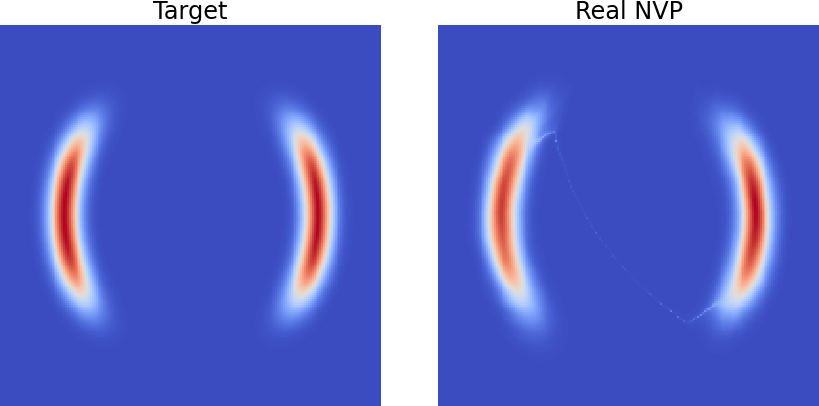
Note that there might be a density filament connecting the two modes, which is due to an architectural limitation of normalizing flows, especially prominent in Real NVP. You can find out more about it in this paper.
Modeling a distribution on a cylinder surface with a neural spline flow
In another example, which is available in Colab as well, we apply a Neural Spline Flow model to a distribution defined on a cylinder. The resulting density is visualized below.
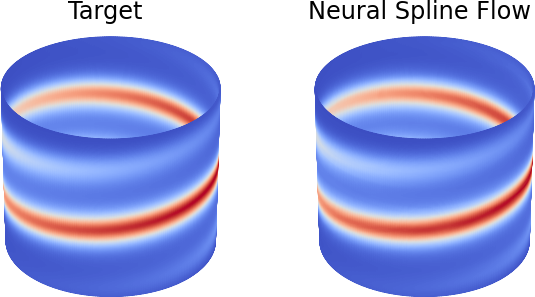
This example is considered in the paper accompanying this repository.
Support
If you have problems, please read the package documentation and check out the examples section above. You are also welcome to create issues on GitHub to get help. Note that it is worthwhile browsing the existing open and closed issues, which might address the problem you are facing.
Contributing
If you find a bug or have a feature request, please file an issue on GitHub.
You are welcome to contribute to the package by fixing the bug or adding the feature yourself. If you want to
contribute, please add tests for the code you added or modified and ensure it passes successfully by running pytest.
This can be done by simply executing
pytest
within your local version of the repository. Make sure you code is well documented, and we also encourage contributions
to the existing documentation. Once you finished coding and testing, please
create a pull request on GitHub.
Used by
The package has been used in several research papers. Some of them are listed below.
Andrew Campbell, Wenlong Chen, Vincent Stimper, José Miguel Hernández-Lobato, and Yichuan Zhang. A gradient based strategy for Hamiltonian Monte Carlo hyperparameter optimization. In Proceedings of the 38th International Conference on Machine Learning, pp. 1238–1248. PMLR, 2021.
Vincent Stimper, Bernhard Schölkopf, and José Miguel Hernández-Lobato. Resampling Base Distributions of Normalizing Flows. In Proceedings of The 25th International Conference on Artificial Intelligence and Statistics, volume 151, pp. 4915–4936, 2022.
Laurence I. Midgley, Vincent Stimper, Gregor N. C. Simm, Bernhard Schölkopf, and José Miguel Hernández-Lobato. Flow Annealed Importance Sampling Bootstrap. The Eleventh International Conference on Learning Representations, 2023.
Arnau Quera-Bofarull, Joel Dyer, Anisoara Calinescu, J. Doyne Farmer, and Michael Wooldridge. BlackBIRDS: Black-Box Inference foR Differentiable Simulators. Journal of Open Source Software, 8(89), 5776, 2023.
Utkarsh Singhal, Carlos Esteves, Ameesh Makadia, and Stella X. Yu. Learning to Transform for Generalizable Instance-wise Invariance. Proceedings of the IEEE/CVF International Conference on Computer Vision (ICCV), pp. 6211-6221, 2023.
Ba-Hien Tran, Giulio Franzese, Pietro Michiardi, and Maurizio Filippone. One-Line-of-Code Data Mollification Improves Optimization of Likelihood-based Generative Models. Advances in Neural Information Processing Systems 36, pp. 6545–6567, 2023.
Moreover, the boltzgen package
has been build upon normflows.
Citation
If you use normflows, please cite the
corresponding paper as follows.
Stimper et al., (2023). normflows: A PyTorch Package for Normalizing Flows. Journal of Open Source Software, 8(86), 5361, https://doi.org/10.21105/joss.05361
Bibtex
@article{Stimper2023,
  author = {Vincent Stimper and David Liu and Andrew Campbell and Vincent Berenz and Lukas Ryll and Bernhard Schölkopf and José Miguel Hernández-Lobato},
  title = {normflows: A PyTorch Package for Normalizing Flows},
  journal = {Journal of Open Source Software},
  volume = {8},
  number = {86},
  pages = {5361},
  publisher = {The Open Journal},
  doi = {10.21105/joss.05361},
  url = {https://doi.org/10.21105/joss.05361},
  year = {2023}
}
Owner
- Name: Vincent Stimper
- Login: VincentStimper
- Kind: user
- Location: Lausanne, Switzerland
- Company: Isomorphic Labs
- Website: https://vincentstimper.com/
- Twitter: VStimper
- Repositories: 6
- Profile: https://github.com/VincentStimper
Research Scientist @ Isomorphic Labs
JOSS Publication
normflows: A PyTorch Package for Normalizing Flows
Authors

University of Cambridge, Cambridge, United Kingdom, Max Planck Institute for Intelligent Systems, Tübingen, Germany
University of Cambridge, Cambridge, United Kingdom
University of Cambridge, Cambridge, United Kingdom
Max Planck Institute for Intelligent Systems, Tübingen, Germany
University of Cambridge, Cambridge, United Kingdom
Max Planck Institute for Intelligent Systems, Tübingen, Germany
University of Cambridge, Cambridge, United Kingdom
Editor
Marcel Stimberg
Tags
PyTorch Machine Learning Normalizing Flows Density EstimationCitation (CITATION.cff)
cff-version: "1.2.0"
authors:
- family-names: Stimper
  given-names: Vincent
  orcid: "https://orcid.org/0000-0002-4965-4297"
- family-names: Liu
  given-names: David
- family-names: Campbell
  given-names: Andrew
- family-names: Berenz
  given-names: Vincent
- family-names: Ryll
  given-names: Lukas
- family-names: Schölkopf
  given-names: Bernhard
  orcid: "https://orcid.org/0000-0002-8177-0925"
- family-names: Hernández-Lobato
  given-names: José Miguel
doi: 10.5281/zenodo.8027667
message: If you use this software, please cite our article in the
  Journal of Open Source Software.
preferred-citation:
  authors:
  - family-names: Stimper
    given-names: Vincent
    orcid: "https://orcid.org/0000-0002-4965-4297"
  - family-names: Liu
    given-names: David
  - family-names: Campbell
    given-names: Andrew
  - family-names: Berenz
    given-names: Vincent
  - family-names: Ryll
    given-names: Lukas
  - family-names: Schölkopf
    given-names: Bernhard
    orcid: "https://orcid.org/0000-0002-8177-0925"
  - family-names: Hernández-Lobato
    given-names: José Miguel
  date-published: 2023-06-24
  doi: 10.21105/joss.05361
  issn: 2475-9066
  issue: 86
  journal: Journal of Open Source Software
  publisher:
    name: Open Journals
  start: 5361
  title: "normflows: A PyTorch Package for Normalizing Flows"
  type: article
  url: "https://joss.theoj.org/papers/10.21105/joss.05361"
  volume: 8
title: "normflows: A PyTorch Package for Normalizing Flows"
GitHub Events
Total
- Issues event: 3
- Watch event: 160
- Issue comment event: 2
- Pull request event: 2
- Fork event: 23
Last Year
- Issues event: 3
- Watch event: 160
- Issue comment event: 2
- Pull request event: 2
- Fork event: 23
Committers
Last synced: 11 months ago
Top Committers
| Name | Commits | |
|---|---|---|
| Vincent Stimper | v****r@g****m | 597 |
| Lukas Ryll | 4****l | 40 |
| VincentStimper | v****8@c****k | 27 |
| davindicode | D****9@g****m | 20 |
| Vincent Berenz | v****z | 8 |
| L Ryll | l****7@w****k | 7 |
| Andrew Campbell | b****k | 5 |
| mattcleigh | 3****h | 2 |
| Timothy Gebhard | t****d | 1 |
| Kaze Wong | k****s@g****m | 1 |
| Adam Li | a****2@g****m | 1 |
| laurence | l****y@i****m | 1 |
| Vincent Berenz | v****z@t****e | 1 |
| Vincent Berenz | v****z@t****e | 1 |
Committer Domains (Top 20 + Academic)
Issues and Pull Requests
Last synced: 11 months ago
All Time
- Total issues: 45
- Total pull requests: 27
- Average time to close issues: about 2 months
- Average time to close pull requests: 5 days
- Total issue authors: 37
- Total pull request authors: 14
- Average comments per issue: 1.84
- Average comments per pull request: 0.89
- Merged pull requests: 20
- Bot issues: 0
- Bot pull requests: 0
Past Year
- Issues: 4
- Pull requests: 2
- Average time to close issues: N/A
- Average time to close pull requests: N/A
- Issue authors: 4
- Pull request authors: 2
- Average comments per issue: 0.25
- Average comments per pull request: 0.0
- Merged pull requests: 0
- Bot issues: 0
- Bot pull requests: 0
Top Authors
Issue Authors
- maulberto3 (4)
- kazewong (3)
- guzy0324 (2)
- matejgrcic (2)
- timothygebhard (1)
- prclibo (1)
- ybernaerts (1)
- 12jerek34jeremi (1)
- mjack3 (1)
- yarinbar (1)
- ZhengtingJiang (1)
- alexmiltenberger (1)
- dgjung0220 (1)
- adam2392 (1)
- odunkel (1)
Pull Request Authors
- VincentStimper (8)
- vincentberenz (5)
- prclibo (2)
- adam2392 (2)
- jonas-eschle (2)
- mstoelzle (2)
- timothygebhard (1)
- lollcat (1)
- mbaddar1 (1)
- mattcleigh (1)
- Donglin-Wang2 (1)
- kazewong (1)
- arc82 (1)
- rudolfwilliam (1)
Top Labels
Issue Labels
Pull Request Labels
Packages
- Total packages: 3
-
Total downloads:
- pypi 2,923 last-month
-
Total dependent packages: 1
(may contain duplicates) -
Total dependent repositories: 2
(may contain duplicates) - Total versions: 22
- Total maintainers: 1
proxy.golang.org: github.com/VincentStimper/normalizing-flows
- Documentation: https://pkg.go.dev/github.com/VincentStimper/normalizing-flows#section-documentation
- License: mit
-
Latest release: v1.7.3
published over 2 years ago
Rankings
proxy.golang.org: github.com/vincentstimper/normalizing-flows
- Documentation: https://pkg.go.dev/github.com/vincentstimper/normalizing-flows#section-documentation
- License: mit
-
Latest release: v1.7.3
published over 2 years ago
Rankings
pypi.org: normflows
Pytorch implementation of normalizing flows
- Homepage: https://github.com/VincentStimper/normalizing-flows
- Documentation: https://normflows.readthedocs.io/
- License: MIT
-
Latest release: 1.7.3
published over 2 years ago
Rankings
Maintainers (1)
Dependencies
- numpy *
- torch *
- ipywidgets *
- jupyterlab *
- matplotlib *
- sklearn *
- tqdm *
- x.strip *
- actions/checkout v2 composite
- actions/setup-python v2 composite
- JamesIves/github-pages-deploy-action v4 composite
- actions/checkout v3 composite
- actions/setup-python v3 composite
- tj-actions/coverage-badge-py v1.8 composite