pydynpd
pydynpd: A Python package for dynamic panel model - Published in JOSS (2023)
Science Score: 93.0%
This score indicates how likely this project is to be science-related based on various indicators:
-
○CITATION.cff file
-
✓codemeta.json file
Found codemeta.json file -
✓.zenodo.json file
Found .zenodo.json file -
✓DOI references
Found 3 DOI reference(s) in README and JOSS metadata -
✓Academic publication links
Links to: zenodo.org -
○Committers with academic emails
-
○Institutional organization owner
-
✓JOSS paper metadata
Published in Journal of Open Source Software
Keywords
Scientific Fields
Repository
This python package estimates dynamic panel data model using difference GMM and system GMM.
Basic Info
Statistics
- Stars: 30
- Watchers: 1
- Forks: 8
- Open Issues: 3
- Releases: 22
Topics
Metadata Files
README.md
pydynpd: A python package for dynamic panel model


pydynpd is the first python package to implement Difference and System GMM [1][2][3] to estimate dynamic panel data models.
Below is a typical dynamic panel data model:
In the equation above, x is a predetermined variable that is potentially correlated with past errors, s is a strictly exogenous variable, and u is fixed effect.
This software has been published in Journal of Open Source Software:
Wu et al., (2023). pydynpd: A Python package for dynamic panel model.
Journal of Open Source Software, 8(83), 4416, https://doi.org/10.21105/joss.04416
Features supported:
- Differene and System GMM
- One-step, two-step, and iterative estimates
- First-difference and forward orthogonal deviation transformations
- Robust standard errors. For two-step GMM, the calculation suggested by Windmeijer (2005) is used.
- Hansen over-identification test
- Arellano-Bond test for autocorrelation
- Time dummies
- Collapse GMM instruments to limit instrument proliferation
- Search for models based on users' request, rather than just run the model specified by users as other packages do
Installation:
pip install pydynpd
This package requires: numpy, scipy, pandas, and PrettyTable
Usage:
``` import pandas as pd from pydynpd import regression
df = pd.readcsv("data.csv")
commandstr='n L(1:2).n w k | gmm(n, 2:4) gmm(w, 1:3) iv(k) | timedumm nolevel'
mydpd = regression.abond(commandstr, df, ['id', 'year'])
result:
Dynamic panel-data estimation, two-step difference GMM
Group variable: id Number of obs = 611
Time variable: year Number of groups = 140
Number of instruments = 42
+-----------+------------+---------------------+------------+-----------+
| n | coef. | Corrected Std. Err. | z | P>|z| |
+-----------+------------+---------------------+------------+-----------+
| L1.n | 0.2710675 | 0.1382542 | 1.9606462 | 0.0499203 |
| L2.n | -0.0233928 | 0.0419665 | -0.5574151 | 0.5772439 |
| w | -0.5668527 | 0.2092231 | -2.7093219 | 0.0067421 |
| k | 0.3613939 | 0.0662624 | 5.4539824 | 0.0000000 |
| year1979 | 0.0011898 | 0.0092322 | 0.1288765 | 0.8974554 |
| year1980 | -0.0316432 | 0.0116155 | -2.7242254 | 0.0064453 |
| year1981 | -0.0900163 | 0.0206593 | -4.3571693 | 0.0000132 |
| year1982 | -0.0996210 | 0.0296036 | -3.3651654 | 0.0007650 |
| year1983 | -0.0693308 | 0.0404276 | -1.7149347 | 0.0863572 |
| year_1984 | -0.0614505 | 0.0475525 | -1.2922666 | 0.1962648 |
+-----------+------------+---------------------+------------+-----------+
Hansen test of overid. restrictions: chi(32) = 32.666 Prob > Chi2 = 0.434
Arellano-Bond test for AR(1) in first differences: z = -1.29 Pr > z =0.198
Arellano-Bond test for AR(2) in first differences: z = -0.31 Pr > z =0.760
```
Tutorial
A detailed tutorial is given in the following two documents:
inputs of the abond command.
outputs of the abond command.
Similar packages
The objective of the package is similar to the following open-source packages:
Package | Language | version
--- | --- | ---
plm | R | 2.6-1
panelvar | R| 0.5.3
pdynmc | R| 0.9.7
To compare pydynpd with similar packages, we performed performance tests. More specifically, in each test for each package we run 100 times to estimate the same model with the same data. For verification, the tests also include Stata package xtabond2 though Stata is a commercial software. We use xtabond2 for regression result verification because it is the most popular package in estimating dynamic panel models. Figure below is from one of the tests. Note that directly comparing xtabond2's speed with R or Python packages is a little unfair because the calculation part of xtabond2 was compiled while pydynpd and the three R packages are interpreted; xtabond2 should have a clear advantage on speed.
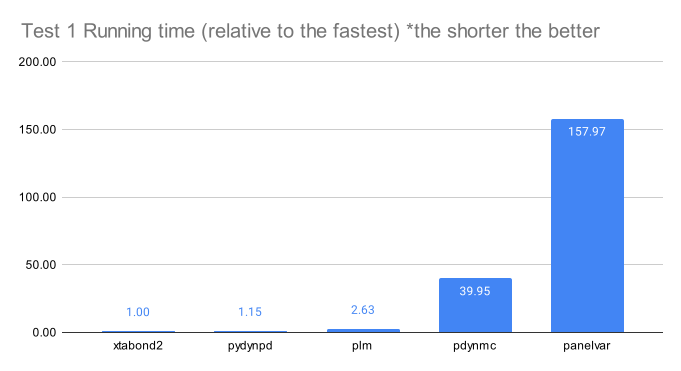
Though developed in pure python, pydynpd is not far behind of xtabond2. Moreover, it is significanly faster than the three R packages which are interpreted scripts just like pydynpd.
A detailed description of the tests can be found here
FAQs
How to extract coefficients from regression?
For example, if you run:
df = pd.read_csv("data.csv")
mydpd = regression.abond('n L(1:2).n w k  | gmm(n, 2:4) gmm(w, 1:3)  iv(k)  ', df, ['id', 'year'])
The output regression table will be
+------+------------+---------------------+------------+-----------+-----+
|  n   |   coef.    | Corrected Std. Err. |     z      |   P>|z|   |     |
+------+------------+---------------------+------------+-----------+-----+
| L1.n | 0.9453810  |      0.1429764      | 6.6121470  | 0.0000000 | *** |
| L2.n | -0.0860069 |      0.1082318      | -0.7946553 | 0.4268140 |     |
|  w   | -0.4477795 |      0.1521917      | -2.9422068 | 0.0032588 |  ** |
|  k   | 0.1235808  |      0.0508836      | 2.4286941  | 0.0151533 |  *  |
| _con | 1.5630849  |      0.4993484      | 3.1302492  | 0.0017466 |  ** |
+------+------------+---------------------+------------+-----------+-----+
If you want to programably extract a value, for example, the first z value (6.6121470) then you can add the following:
```
mydpd.models[0].regressiontable.iloc[0]['z_value'] 6.6121469997085915
Basically, the object mydpd returned above contains models because pydynpd allows us to run and compare multiple models at the same time. By default, it only contains one model which is models[0]. A model has a regression table which is a pandas dataframe:mydpd.models[0].regressiontable
variable coefficient stderr zvalue p_value sig
0 L1.n 0.945381 0.142976 6.612147 3.787856e-11 ***
1 L2.n -0.086007 0.108232 -0.794655 4.268140e-01
2 w -0.447780 0.152192 -2.942207 3.258822e-03 **
3 k 0.123581 0.050884 2.428694 1.515331e-02 *
4 _con 1.563085 0.499348 3.130249 1.746581e-03 **
``` So you can extract any value from this dataframe.
How to use pydynpd with R?
First, you need to install Python on your computer; then install pydynpd.
pip install pydynpd
Second, in R environment install package reticulate:
install.packages("reticulate")
Third, you configure Rstudio so that it can communicate with Python installed in step 1. You can find instruction at
https://www.rstudio.com/blog/rstudio-v1-4-preview-python-support/
Finally, you can use the following template to call pydynpd from R. For comparision, the corresponding Python code is also incuded.
| R |
library(reticulate)
dynpd <- import("pydynpd.regression", convert = TRUE)
fd <- import("pandas", convert=TRUE)
df <- fd$read_csv("data.csv")
|
| Python |
import pandas as pd
from  pydynpd import regression
df = pd.read_csv("data.csv")
mydpd = regression.abond('n L(1:2).n w k | gmm(n, 2:4) gmm(w, 1:3) iv(k)', df, ['id', 'year'])
|
Code above generates the following result:
 Dynamic panel-data estimation, two-step system GMM
 Group variable: id                               Number of obs = 611
 Time variable: year                              Min obs per group: 4
 Number of instruments = 51                       Max obs per group: 6
 Number of groups = 140                           Avg obs per group: 4.36
+------+------------+---------------------+------------+-----------+-----+
|  n   |   coef.    | Corrected Std. Err. |     z      |   P>|z|   |     |
+------+------------+---------------------+------------+-----------+-----+
| L1.n | 0.9453810  |      0.1429764      | 6.6121470  | 0.0000000 | *** |
| L2.n | -0.0860069 |      0.1082318      | -0.7946553 | 0.4268140 |     |
|  w   | -0.4477795 |      0.1521917      | -2.9422068 | 0.0032588 |  ** |
|  k   | 0.1235808  |      0.0508836      | 2.4286941  | 0.0151533 |  *  |
| _con | 1.5630849  |      0.4993484      | 3.1302492  | 0.0017466 |  ** |
+------+------------+---------------------+------------+-----------+-----+
Hansen test of overid. restrictions: chi(46) = 96.442 Prob > Chi2 = 0.000
Arellano-Bond test for AR(1) in first differences: z = -2.35 Pr > z =0.019
Arellano-Bond test for AR(2) in first differences: z = -1.15 Pr > z =0.251
As you can see, you don't need to change the command string in R. The only parameter you have to change is the identifiers; ['id', 'year'] in Python is changed to c('id', 'year') in R. Also, from R you can access the properties of the result above the same way you work on Python. For example, after running code above if you run the following R script:
reg_table=result$models[[1]]$regression_table
print(reg_table)
The output is:
  variable coefficient    std_err    z_value      p_value sig
1     L1.n  0.94538100 0.14297640  6.6121470 3.787856e-11 ***
2     L2.n -0.08600694 0.10823176 -0.7946553 4.268140e-01
3        w -0.44777955 0.15219173 -2.9422068 3.258822e-03  **
4        k  0.12358078 0.05088363  2.4286941 1.515331e-02   *
5     _con  1.56308487 0.49934839  3.1302492 1.746581e-03  **
In the example above, reg_table is an R data frame.
Contributing
There are several ways to contribute to pydynpd:
Submit issue/bug reports here, or try to fix the problem yourself and then submit a pull request.
Browse the source code and see if anything looks out of place - let us know!
References
[1] Arellano, M., & Bond, S. (1991). Some tests of specification for panel data: Monte Carlo evidence and an application to employment equations. The review of economic studies, 58(2), 277-297.
[2] Arellano, M., & Bover, O. (1995). Another look at the instrumental variable estimation of error-components models. Journal of econometrics, 68(1), 29-51.
[3] Blundell, R., & Bond, S. (1998). Initial conditions and moment restrictions in dynamic panel data models. Journal of econometrics, 87(1), 115-143.
[4] Roodman, D. (2009). How to do xtabond2: An introduction to difference and system GMM in Stata. The stata journal, 9(1), 86-136.
[5] Windmeijer, F. (2005). A finite sample correction for the variance of linear efficient two-step GMM estimators. Journal of econometrics, 126(1), 25-51.
Owner
- Login: dazhwu
- Kind: user
- Repositories: 2
- Profile: https://github.com/dazhwu
JOSS Publication
pydynpd: A Python package for dynamic panel model
Authors
Department of Business Management, School of Business and Public Administration, University of the District of Columbia, USA
Department of Business Management, School of Business and Public Administration, University of the District of Columbia, USA
Department of Business Management, School of Business and Public Administration, University of the District of Columbia, USA
Editor
Chris Hartgerink
Tags
dynamic panel modelGitHub Events
Total
- Issues event: 1
- Watch event: 10
- Issue comment event: 1
- Push event: 1
- Fork event: 1
Last Year
- Issues event: 1
- Watch event: 10
- Issue comment event: 1
- Push event: 1
- Fork event: 1
Committers
Last synced: 11 months ago
Top Committers
| Name | Commits | |
|---|---|---|
| dazhwu | 6****u | 341 |
| Encephala | j****d@h****m | 3 |
| Arfon Smith | a****n | 1 |
Issues and Pull Requests
Last synced: 10 months ago
All Time
- Total issues: 9
- Total pull requests: 4
- Average time to close issues: about 1 month
- Average time to close pull requests: 10 days
- Total issue authors: 7
- Total pull request authors: 2
- Average comments per issue: 2.0
- Average comments per pull request: 2.0
- Merged pull requests: 4
- Bot issues: 0
- Bot pull requests: 0
Past Year
- Issues: 1
- Pull requests: 0
- Average time to close issues: N/A
- Average time to close pull requests: N/A
- Issue authors: 1
- Pull request authors: 0
- Average comments per issue: 0.0
- Average comments per pull request: 0
- Merged pull requests: 0
- Bot issues: 0
- Bot pull requests: 0
Top Authors
Issue Authors
- mas0088 (2)
- nataliamayumi (2)
- econometricsfanboy (1)
- fpbhamba (1)
- markusfritsch (1)
- jpweytjens (1)
- Paq70 (1)
Pull Request Authors
- Encephala (6)
- arfon (1)
Top Labels
Issue Labels
Pull Request Labels
Packages
- Total packages: 1
-
Total downloads:
- pypi 738 last-month
- Total dependent packages: 0
- Total dependent repositories: 1
- Total versions: 20
- Total maintainers: 1
pypi.org: pydynpd
A package to estimate dynamic panel data model using difference GMM and system GMM.
- Homepage: https://github.com/dazhwu/pydynpd
- Documentation: https://pydynpd.readthedocs.io/
- License: MIT
-
Latest release: 0.2.1
published over 2 years ago
Rankings
Maintainers (1)
Dependencies
- numpy *
- pandas *
- prettytable *
- scipy *