https://github.com/argilla-io/llm-blender
[ACL2023] We introduce LLM-Blender, an innovative ensembling framework to attain consistently superior performance by leveraging the diverse strengths of multiple open-source LLMs. LLM-Blender cut the weaknesses through ranking and integrate the strengths through fusing generation to enhance the capability of LLMs.
Science Score: 10.0%
This score indicates how likely this project is to be science-related based on various indicators:
-
○CITATION.cff file
-
○codemeta.json file
-
○.zenodo.json file
-
○DOI references
-
✓Academic publication links
Links to: arxiv.org -
○Academic email domains
-
○Institutional organization owner
-
○JOSS paper metadata
-
○Scientific vocabulary similarity
Low similarity (10.4%) to scientific vocabulary
Repository
[ACL2023] We introduce LLM-Blender, an innovative ensembling framework to attain consistently superior performance by leveraging the diverse strengths of multiple open-source LLMs. LLM-Blender cut the weaknesses through ranking and integrate the strengths through fusing generation to enhance the capability of LLMs.
Basic Info
- Host: GitHub
- Owner: argilla-io
- License: apache-2.0
- Language: Python
- Default Branch: main
- Homepage: https://yuchenlin.xyz/LLM-Blender/
- Size: 74.7 MB
Statistics
- Stars: 0
- Watchers: 0
- Forks: 0
- Open Issues: 7
- Releases: 0
https://github.com/argilla-io/LLM-Blender/blob/main/
# LLM-Blender: Ensembling LLMs with Pairwise Ranking & Generative Fusion [ACL2023]


Authors: Dongfu Jiang, Xiang Ren, Bill Yuchen Lin @ AI2-Mosaic USC-INK ## News - [2024/1/5] PairRM can now be directly loaded using Hugging face Wrapper `DebertaV2PairRM.from_pretrained("llm-blender/PairRM-hf")`, see more in our [Model page](https://huggingface.co/llm-blender/PairRM-hf) - [2023/11/10] Glad to announce that our pairwise reward-model, [PairRM](https://huggingface.co/llm-blender/PairRM), has released. It's trained on high-quality and large-scale human reference dataset and approaches GPT-4's alignment with human preference with a extremly small model size (0.4B). - [2023/10/24] Pre-trained PairRanker is able to be loaded directly from Hugging face Models [llm-blender/PairRM](https://huggingface.co/llm-blender/PairRM) within 3 lines of code. See Guidance for [Rank & Fusion](#rank-and-fusion) for details. ## Overview ## Usage ### Installation ```bash git clone https://github.com/yuchenlin/LLM-Blender.git cd LLM-Blender pip install -e . ``` or ```bash pip install git+https://github.com/yuchenlin/LLM-Blender.git ``` Then you are good to go through our LLM-Blender with `import llm_blender`. ### Use case 1: (Re-)Ranking model outputs by pairwise comparisons ```python import llm_blender blender = llm_blender.Blender() blender.loadranker("llm-blender/PairRM") # load ranker checkpoint ``` - Then you can rank with the following function ```python inputs = ["hello, how are you!", "I love you!"] candidates_texts = [["get out!", "hi! I am fine, thanks!", "bye!"], ["I love you too!", "I hate you!", "Thanks! You're a good guy!"]] ranks = blender.rank(inputs, candidates_texts, return_scores=False, batch_size=1) # ranks is a list of ranks where ranks[i][j] represents the ranks of candidate-j for input-i """ ranks --> array([[3, 1, 2], # it means "hi! I am fine, thanks!" ranks the 1st, "bye" ranks the 2nd, and "get out!" ranks the 3rd. [1, 3, 2]], # it means "I love you too"! ranks the the 1st, and "I hate you!" ranks the 3rd. dtype=int32) """ ``` - Using llm-blender to directly compare two candidates ```python inputs = ["hello!", "I love you!"] candidates_A = ["hi!", "I hate you!"] candidates_B = ["f**k off!", "I love you, too!"] comparison_results = blender.compare(inputs, candidates_A, candidates_B) # comparison_results is a list of bool, where comparison_results[i] denotes whether candidates_A[i] is better than candidates_B[i] for inputs[i] # comparison_results[0]--> True ``` - You can also fuse the top-ranked candidates with the following code ```python blender.loadfuser("llm-blender/gen_fuser_3b") # load fuser checkpoint if you want to use pre-trained fuser; or you can use ranker only from llm_blender.blender.blender_utils import get_topk_candidates_from_ranks topk_candidates = get_topk_candidates_from_ranks(ranks, candidates_texts, top_k=3) fuse_generations = blender.fuse(inputs, topk_candidates, batch_size=2) # fuse_generations are the fused generations from our fine-tuned checkpoint # You can also do the rank and fusion with a single function fuse_generations, ranks = blender.rank_and_fuse(inputs, candidates_texts, return_scores=False, batch_size=2, top_k=3) ``` ### Use case 2: Best-of-N Sampling (Re-ranking) **Best-of-n Sampling**, aka, rejection sampling, is a strategy to enhance the response quality by selecting the one that was ranked highest by the reward model (Learn more at[OpenAI WebGPT section 3.2](https://arxiv.org/pdf/2112.09332.pdf) and [OpenAI Blog](https://openai.com/research/measuring-goodharts-law)). Best-of-n sampling is a easy way to improve your LLMs by sampling and re-ranking with just a few lines of code. An example of applying on Zephyr-7b is as follows. ```python import llm_blender from transformers import AutoTokenizer, AutoModelForCausalLM tokenizer = AutoTokenizer.from_pretrained("HuggingFaceH4/zephyr-7b-beta") model = AutoModelForCausalLM.from_pretrained("HuggingFaceH4/zephyr-7b-beta", device_map="auto") system_message = {"role": "system", "content": "You are a friendly chatbot."} inputs = ["can you tell me a joke about OpenAI?"] messages = [[system_message, {"role": "user", "content": _input}] for _input in inputs] prompts = [tokenizer.apply_chat_template(m, tokenize=False, add_generation_prompt=True) for m in messages] # standard sampling generation input_ids = tokenizer(prompts[0], return_tensors="pt").input_ids sampled_outputs = model.generate(input_ids, do_sample=True, top_k=50, top_p=0.95, num_return_sequences=1) print(tokenizer.decode(sampled_outputs[0][len(input_ids[0]):], skip_special_tokens=False)) # --> `Sure` # using our PairRM for best-of-n sampling blender = llm_blender.Blender() blender.loadranker("llm-blender/PairRM") # load ranker checkpoint outputs = blender.best_of_n_generate(model, tokenizer, prompts, n=10) print("### Prompt:") print(prompts[0]) print("### best-of-n generations:") print(outputs[0]) # --> """ Sure, here's a joke about OpenAI: Why did OpenAI decide to hire a mime as their new AI researcher? Because they wanted someone who could communicate complex ideas without making a sound! (Note: This is a joke, not a reflection of OpenAI's actual hiring practices.) """ ``` ### Use case 3: Used as a local Pairwise Evaluator and for better RLHF Our latest [PairRM](https://huggingface.co/llm-blender/PairRM), which has been further trained on various high-quality and large-scale dataset with human preference annotations, has shown great correlation with human preferences with an extremely small model size (0.4B), approaching the performance of GPT-4. (See detailed comparison in [PairRM](https://huggingface.co/llm-blender/PairRM)) To get scalar rewards, you can use `blender.rank_with_ref` method (see the example below). This method compares all the candidates with the reference and returns the relative scalar rewards. ```python import llm_blender blender = llm_blender.Blender() blender.loadranker("llm-blender/PairRM") # load ranker checkpoint inputs = ["hello, how are you!", "I love you!"] candidates_texts = [["get out!", "hi! I am fine, thanks!", "bye!"], ["I love you too!", "I hate you!", "Thanks! You're a good guy!"]] rewards = blender.rank_with_ref(inputs, candidates_texts, return_scores=True, batch_size=2, mode="longest") print("Rewards for input 1:", rewards[0]) # rewards of candidates for input 1 """ rewards is a List[List[float]] of shape (len(inputs), len(candidates_texts[0])). representing the rewards of each candidate for each input. By default, the rewards are calculated based on the the comparison with the longest generation as a reference.(mode="longest"). other supported modes are "shortest" "median_length" "first" "last" """ ``` You can also pass a list of references to compare with, instead of automatically selecting one from the candidates as the fixed reference. ```python ref_candidates = [_c[0] for _c in candidates_texts] # use the first candidate as the reference, same as mode="first" rewards = blender.rank_with_ref(inputs, candidates_texts, return_scores=True, batch_size=2, ref_candidates=ref_candidates) """ ref_candidates = [ref1, ref2, ref3, ...] # ref_candidates is a List[str], shape (len(inputs),) this parameter will override the mode parameter, and use the ref_candidates as the reference for reward calculation. rewards is a List[List[float]] of shape (len(inputs), len(candidates_texts[0])). """ ``` You can easily integrate PairRM to popular RLHF toolkits like [trl](https://huggingface.co/docs/trl/index). ### Use case 4: DPO (Direct Preference Optimization) with PairRM PairRM's `blender.compare` naturally supports DPO, which is a direct preference optimization method to optimize the model with the pairwise comparison signal. ### Load PairRM with hugging face `from_pretrained()` In this way, you don't need to install `llm-blender` to use `PairRM`. More custom development can be achived based on the model ```python import os os.environ["CUDA_VISIBLE_DEVICES"] = "0" from llm_blender.pair_ranker.pairrm import DebertaV2PairRM # or copy the DebertaV2PairRM definition here, https://github.com/yuchenlin/LLM-Blender/blob/main/llm_blender/pair_ranker/pairrm.py from transformers import AutoTokenizer from typing import List pairrm = DebertaV2PairRM.from_pretrained("llm-blender/PairRM-hf", device_map="cuda:0").eval() tokenizer = AutoTokenizer.from_pretrained('llm-blender/PairRM-hf') source_prefix = "<|source|>" cand1_prefix = "<|candidate1|>" cand2_prefix = "<|candidate2|>" inputs = ["hello!", "I love you!"] candidates_A = ["hi!", "I hate you!"] candidates_B = ["f**k off!", "I love you, too!"] def tokenize_pair(sources:List[str], candidate1s:List[str], candidate2s:List[str], source_max_length=1224, candidate_max_length=412): ids = [] assert len(sources) == len(candidate1s) == len(candidate2s) max_length = source_max_length + 2 * candidate_max_length for i in range(len(sources)): source_ids = tokenizer.encode(source_prefix + sources[i], max_length=source_max_length, truncation=True) candidate_max_length = (max_length - len(source_ids)) // 2 candidate1_ids = tokenizer.encode(cand1_prefix + candidate1s[i], max_length=candidate_max_length, truncation=True) candidate2_ids = tokenizer.encode(cand2_prefix + candidate2s[i], max_length=candidate_max_length, truncation=True) ids.append(source_ids + candidate1_ids + candidate2_ids) encodings = tokenizer.pad({"input_ids": ids}, return_tensors="pt", padding="max_length", max_length=max_length) return encodings encodings = tokenize_pair(inputs, candidates_A, candidates_B) encodings = {k:v.to(pairrm.device) for k,v in encodings.items()} outputs = pairrm(**encodings) logits = outputs.logits.tolist() comparison_results = outputs.logits > 0 print(logits) # [1.9003021717071533, -1.2547134160995483] print(comparison_results) # tensor([ True, False], device='cuda:0'), which means whether candidate A is better than candidate B for each input ``` ### Demo ** Check more details on our example Jupyter notebook usage: [`blender_usage.ipynb`](./blender_usage.ipynb)** ## Data Release - To facilitate large-scale evaluation, we introduce a benchmark dataset, **MixInstruct**, which is a mixture of multiple instruction datasets featuring oracle pairwise comparisons for testing purposes. - MixInstruct is the first large-scale dataset consisting of responses from 11 popular open-source LLMs on the instruction-following dataset. Each split of train/val/test contains 100k/5k/5k examples. - MixInstruct instruct is collected from 4 famous instruction dataset: Alpaca-GPT4, Dolly-15k, GPT4All-LAION and ShareGPT. The ground-truth outputs comes from either ChatGPT, GPT-4 or human annotations. - MixInstruct is evaluated by both auto-metrics including BLEURT, BARTScore, BERTScore, etc. and ChatGPT. We provide 4771 examples on test split that is evaluated by ChatGPT through pairwise comparison. - Code to construct the dataset: [`get_mixinstruct.py`](./llm_blender/download_dataset/get_mixinstruct.py) - HuggingFace [Dataset link](https://huggingface.co/datasets/llm-blender/mix-instruct)Abstract
- We introduce LLM-Blender, an innovative ensembling framework to attain consistently superior performance by leveraging the diverse strengths of multiple open-source large language models (LLMs). LLM-Blender cut the weaknesses through ranking and integrate the strengths through fusing generation to enhance the capability of LLMs. - Our framework consists of two complementary modules: **PairRanker** and **GenFuser**, addressing the observation that optimal LLMs for different examples can significantly vary. **PairRanker** employs a specialized pairwise comparison method to distinguish subtle differences between candidate outputs. **GenFuser** aims to merge the top-ranked candidates from the aggregation of PairRanker's pairwise comparisons into an improved output by capitalizing on their strengths and mitigating their weaknesses. - To facilitate large-scale evaluation, we introduce a benchmark dataset, [**MixInstruct**](#data_release), which is a mixture of multiple instruction datasets featuring oracle pairwise comparisons for testing purposes. Our **LLM-Blender** significantly surpasses the best LLMs and baseline ensembling methods across various metrics on **MixInstruct**, establishing a substantial performance gap.## Training ## Resources **Toolkits** - [LLM-Gen](https://github.com/jdf-prog/LLM-Gen): A simple generation script used to get large-scale responses from various large language models. **Model checkpoints** - [PairRanker checkpoint](https://huggingface.co/llm-blender/PairRM) fine-tuned on DeBERTa-v3-Large (304m) - [GenFuser checkpoint](https://huggingface.co/llm-blender/gen_fuser_3b) fine-tuned on Flan-T5-XL (3b) ## PairRM Community PairRM has been widely used in various applications, including but not limited to: - [snorkelai/Snorkel-Mistral-PairRM-DPO](https://huggingface.co/snorkelai/Snorkel-Mistral-PairRM-DPO) (SOTA in Alpaca-eval leaderboard) - [argilla/OpenHermesPreferences](https://huggingface.co/datasets/argilla/OpenHermesPreferences) (1M+ preference datasets annotated by PairRM) We are looking forward to more applications and contributions from the community ! ## Star History [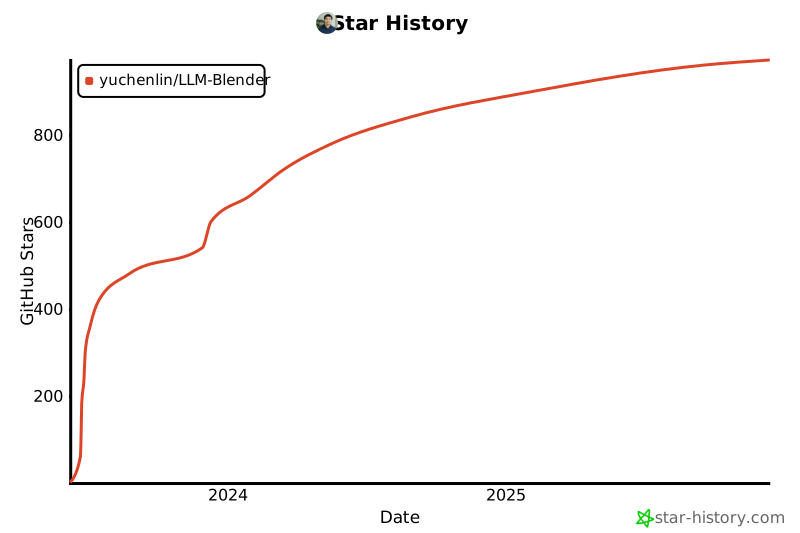](https://star-history.com/#yuchenlin/LLM-Blender&Date) ## Citation ```bibtex @inproceedings{llm-blender-2023, title = "LLM-Blender: Ensembling Large Language Models with Pairwise Comparison and Generative Fusion", author = "Jiang, Dongfu and Ren, Xiang and Lin, Bill Yuchen", booktitle = "Proceedings of the 61th Annual Meeting of the Association for Computational Linguistics (ACL 2023)", year = "2023" } ```
## Resources **Toolkits** - [LLM-Gen](https://github.com/jdf-prog/LLM-Gen): A simple generation script used to get large-scale responses from various large language models. **Model checkpoints** - [PairRanker checkpoint](https://huggingface.co/llm-blender/PairRM) fine-tuned on DeBERTa-v3-Large (304m) - [GenFuser checkpoint](https://huggingface.co/llm-blender/gen_fuser_3b) fine-tuned on Flan-T5-XL (3b) ## PairRM Community PairRM has been widely used in various applications, including but not limited to: - [snorkelai/Snorkel-Mistral-PairRM-DPO](https://huggingface.co/snorkelai/Snorkel-Mistral-PairRM-DPO) (SOTA in Alpaca-eval leaderboard) - [argilla/OpenHermesPreferences](https://huggingface.co/datasets/argilla/OpenHermesPreferences) (1M+ preference datasets annotated by PairRM) We are looking forward to more applications and contributions from the community ! ## Star History [](https://star-history.com/#yuchenlin/LLM-Blender&Date) ## Citation ```bibtex @inproceedings{llm-blender-2023, title = "LLM-Blender: Ensembling Large Language Models with Pairwise Comparison and Generative Fusion", author = "Jiang, Dongfu and Ren, Xiang and Lin, Bill Yuchen", booktitle = "Proceedings of the 61th Annual Meeting of the Association for Computational Linguistics (ACL 2023)", year = "2023" } ```Train PairRanker
See more details in [`train_ranker.sh`](./train_ranker.sh) Please follow the guide in the script to train the ranker. Here are some explanations for the script parameters: **Changing the torchrun cmd** ```bash TORCHRUN_CMD=``` Normally, it's just `torchrun` with proper conda env activated. **Changing the dataset** ```bash dataset=" ` ``` **Changing the ranker backbone** ```bash backbone_type="deberta" # "deberta" or "roberta" backbone_name="microsoft/deberta-v3-large" # "microsoft/deberta-v3-large" or "roberta-large" ``` **Changing the ranker type** ```bash ranker="Pairranker" # "PairRanker" or "Summaranker" or "SimCLS" ``` **Filter the candidates used** ```bash candidate_model="flan-t5-xxl" # or "alpaca-native" candidate_decoding_method="top_p_sampling" n_candidates=15 # number of candidates to generate using_metrics="rouge1,rouge2,rougeLsum,bleu" # metrics used to train the signal ``` **Do Training or Inference** ```bash do_inference=False # training do_inference=True # inference ``` When doing inference, you can change `inference_mode` to `bubble` or `full` to select difference pairwise inference model **Limit the datasize used for training, dev and test** ```bash max_train_data_size=-1 # -1 means no limit max_eval_data_size=-1 # -1 means no limit max_predict_data_size=-1 # -1 means no limit ``` **Do inference on dataset A with ranker training on dataset B** ```bash dataset= checkpoint_trained_dataset= do_inference=True ```
Owner
- Name: Argilla
- Login: argilla-io
- Kind: organization
- Email: contact@argilla.io
- Website: https://argilla.io
- Twitter: argilla_io
- Repositories: 12
- Profile: https://github.com/argilla-io
Building the open-source tool for data-centric NLP
GitHub Events
Total
- Fork event: 1
Last Year
- Fork event: 1