DistributedSparseGrids.jl
DistributedSparseGrids.jl: A Julia library implementing an Adaptive Sparse Grid collocation method - Published in JOSS (2023)
Science Score: 95.0%
This score indicates how likely this project is to be science-related based on various indicators:
-
○CITATION.cff file
-
✓codemeta.json file
Found codemeta.json file -
✓.zenodo.json file
Found .zenodo.json file -
✓DOI references
Found 5 DOI reference(s) in README and JOSS metadata -
✓Academic publication links
Links to: arxiv.org, sciencedirect.com, joss.theoj.org -
✓Committers with academic emails
1 of 3 committers (33.3%) from academic institutions -
○Institutional organization owner
-
✓JOSS paper metadata
Published in Journal of Open Source Software
Repository
An hierarchical adaptive sparse-grid implementation in the julia language
Basic Info
- Host: GitHub
- Owner: baxmittens
- License: mit
- Language: Julia
- Default Branch: main
- Size: 935 KB
Statistics
- Stars: 20
- Watchers: 2
- Forks: 2
- Open Issues: 1
- Releases: 9
Metadata Files
README.md
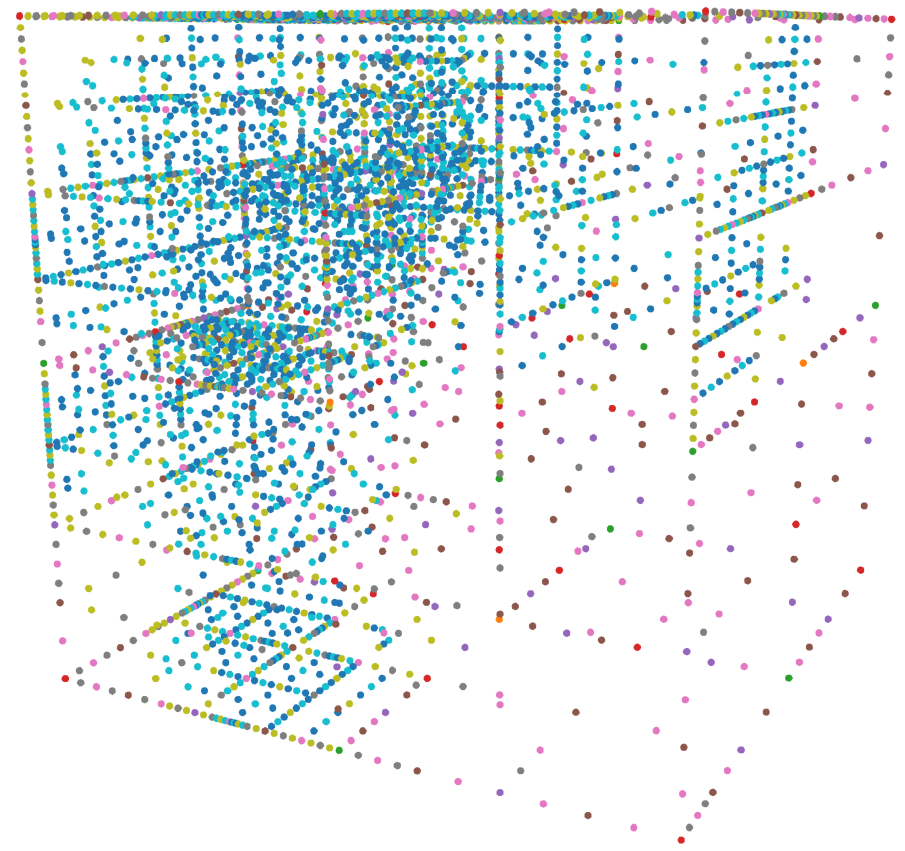
DistributedSparseGrids.jl



A Julia library implementing an Adaptive Sparse Grid collocation method for integrating memory-heavy objects generated on distributed workers.
For an alternative implementation, see AdaptiveSparseGrids.jl.
Introduction
Efficient methods for the numerical integration (or interpolation) of one-dimensional functions can be directly applied to the multidimensional case via tensor-product constructions. However, the higher the number of dimensions, the less efficient this approach is. A problem which is also known as the curse of dimensionality.
Any integral
$$ \int{a1}^{b1}\cdot\cdot\cdot\int{an}^{bn} f(x1,...,xn) \mathrm{d}x1\cdot\cdot\cdot\mathrm{d}xn $$
can be mapped onto the hypercube $[-1,1]^n$ by means of coordinate transformation. Therefore, the problem of integrating multidimensional functions can be studied on the hypercube without loss of generality.
To mitigate the curse of dimensionality that occurs in the integration or interpolation of multidimensional functions on the hypercube, sparse grids use Smolyak's quadrature rule. This is particularly useful if the evaluation of the underlying function is costly. In this library, an Adaptive Sparse Grid Collocation method with a local hierarchical Lagrangian basis, first proposed by Ma and Zabaras (2010), is implemented. For more information about the construction of Sparse Grids, see e.g. Gates and Bittens (2015).
Citing this package
There exists a JOSS paper about this package. You can cite it if you are using this software for academic purposes.
Install
julia
import Pkg
Pkg.add("DistributedSparseGrids")
Implemented features
- Nested one-dimensional Clenshaw-Curtis rule
- Smolyak's sparse grid construction
- local hierarchical Lagrangian basis
- different pointsets (open, closed, halfopen)
- adaptive refinement
- distributed function evaluation with
Distributed.remotecall_fetch - multi-threaded calculation of basis coefficients with
Threads.@threads - usage of arbitrary input, collocation point, and return types
- integration
- experimental: integration over $X{\sim (i)}$ (the $X{\sim (i)}$ notation indicates the set of all variables except $X_{i}$).
Usage
General remarks
- The quality of the error prediction depends on the number of collocation points. Therefore, for only a few collocation points, adaptive refinement may fail. Therefore it is recommended to generate some initial levels before using adaptive refinement (see examples).
- The interpolation is based on a local Lagrangian basis. Functions with discontinuities cannot be approximated.
- Sparse grid interpolation and integration will work best with a number of dimension between 1 and 6.
- The domain of the sparse grid is always $[-1,1]^n$. The user is responsible to map the input onto this domain.
Point sets
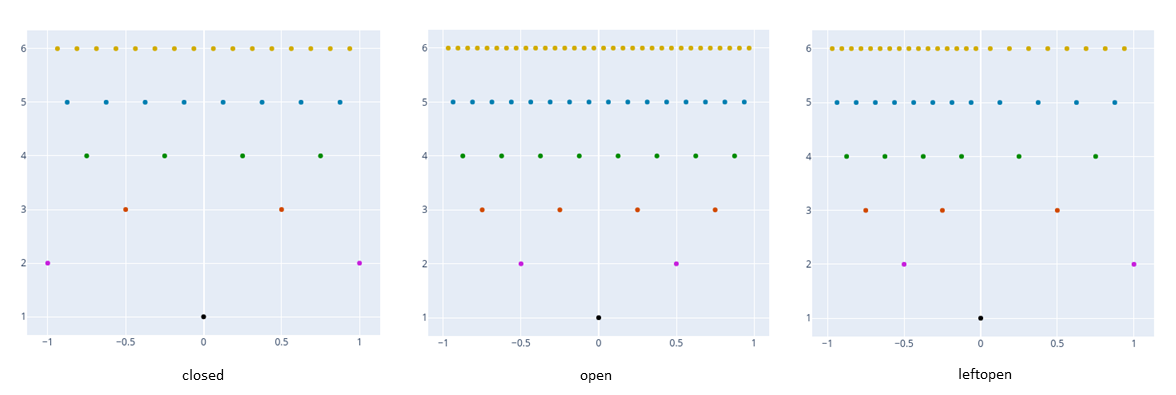
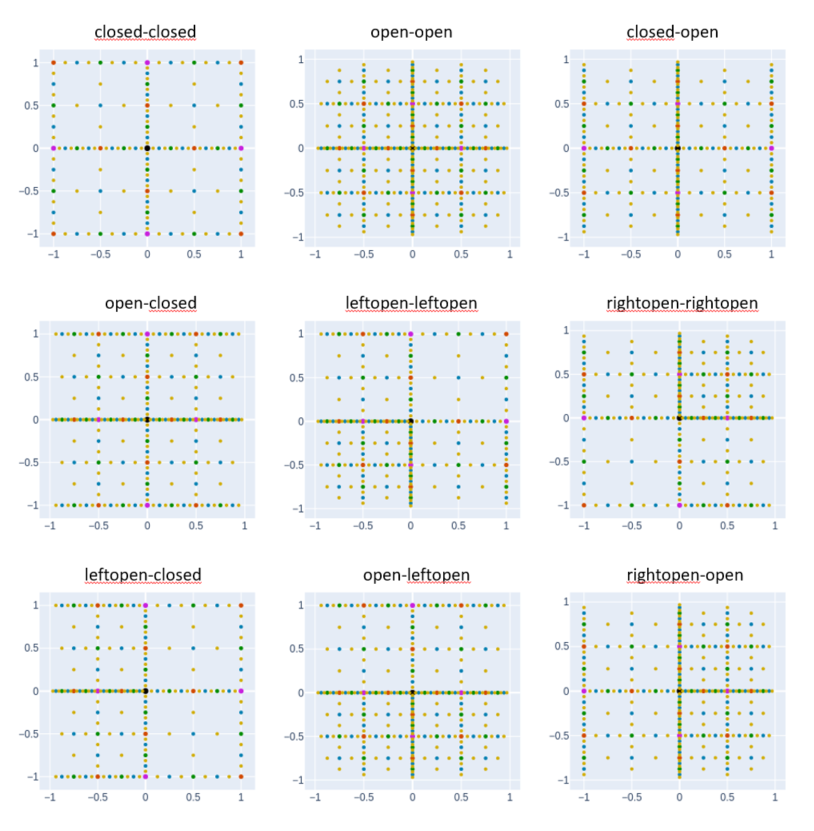
When using sparse grids, one can choose whether the $2d$ second-level collocation points should lay on the boundary of the domain or in the middle between the origin and the boundary. (There are other choices as well.) This results in two different sparse grids, the former with almost all points on the boundary and on the coordinate axes, the latter with all points in the interior of the domain. Since one can choose for both one-dimensional children of the root point individually, there exist a multitude of different point sets for Sparse Grids.
```julia using DistributedSparseGrids using StaticArrays
function sparsegrid(N::Int,pointprops,nlevel=6,RT=Float64,CT=Float64) # define collocation point CPType = CollocationPoint{N,CT} # define hierarchical collocation point HCPType = HierarchicalCollocationPoint{N,CPType,RT} # init grid asg = init(AHSG{N,HCPType},pointprops) #set of all collocation points cpts = Set{HierarchicalCollocationPoint{N,CPType,RT}}(collect(asg)) # fully refine grid nlevel-1 times for i = 1:nlevel-1 union!(cpts,generatenext_level!(asg)) end return asg end
define point properties
1->closed point set
2->open point set
3->left-open point set
4->right-open point set
asg01 = sparsegrid(1, @SVector [1]) asg02 = sparsegrid(1, @SVector [2]) asg03 = sparse_grid(1, @SVector [3])
asg04 = sparsegrid(2, @SVector [1,1]) asg05 = sparsegrid(2, @SVector [2,2]) asg06 = sparsegrid(2, @SVector [1,2]) asg07 = sparsegrid(2, @SVector [2,1]) asg08 = sparsegrid(2, @SVector [3,3]) asg09 = sparsegrid(2, @SVector [4,4]) asg10 = sparsegrid(2, @SVector [3,1]) asg11 = sparsegrid(2, @SVector [2,3]) asg12 = sparse_grid(2, @SVector [4,2]) ```
Integration and Interpolation
```julia asg = sparse_grid(4, @SVector [1,1,1,1])
define function: input are the coordinates x::SVector{N,CT} and an unique id ID::String (e.g. "111_1")
fun1(x::SVector{N,CT},ID::String) = sum(x.^2)
initialize weights
@time init_weights!(asg, fun1)
integration
integrate(asg)
interpolation
x = rand(4)*2.0 .- 1.0
val = interpolate(asg,x)
```
Distributed function evaluation
```julia asg = sparse_grid(4, @SVector [1,1,1,1])
add worker and register function to all workers
using Distributed addprocs(2) ar_worker = workers() @everywhere begin using StaticArrays fun2(x::SVector{4,Float64},ID::String) = 1.0 end
Evaluate the function on 2 workers
distributedinitweights!(asg, fun2, ar_worker) ```
Using custom return types
For custom return type T to work, following functions have to be implemented
```julia import Base: +,-,*,/,^,zero,zeros,one,ones,copy,deepcopy
+(a::T, b::T) +(a::T, b::Float64) *(a::T, b::Float64) -(a::T, b::Matrix{Float64}) -(a::T, b::Float64) zero(a::T) zeros(a::T) one(a::T) one(a::T) copy(a::T) deepcopy(a::T) ```
This is already the case for many data types. Below RT=Matrix{Float64} is used.
```julia
sparse grid with 5 dimensions and levels
pointprops = @SVector [1,2,3,4,1] asg = sparse_grid(5, pointprops, 6, Matrix{Float64})
define function: input are the coordinates x::SVector{N,CT} and an unique id ID::String (e.g. "111111111_1"
for the root poin in five dimensions)
fun3(x::SVector{N,CT},ID::String) = ones(100,100).*x[1]
initialize weights
@time init_weights!(asg, fun3) ```
In-place operations
There are many mathematical operations executed which allocate memory while evaluting the hierarchical interpolator. Many of these allocations can be avoided by additionally implementing the inplace operations interface for data type T.
```julia import LinearAlgebra, AltInplaceOpsInterface
LinearAlgebra.mul!(a::T, b::Float64) LinearAlgebra.mul!(a:T, b::T, c::Float64) AltInplaceOpsInterface.add!(a::T, b::T) AltInplaceOpsInterface.add!(a::T, b::Float64) AltInplaceOpsInterface.minus!(a::T, b::Float64) AltInplaceOpsInterface.minus!(a::T, b::T) AltInplaceOpsInterface.pow!(a::T, b::Float64) ```
For Matrix{Float64} this interface is already implemented.
```julia
initialize weights
@time initweightsinplace_ops!(asg, fun3) ```
Distributed function evaluation and in-place operations
```julia
initialize weights
@time distributedinitweightsinplaceops!(asg, fun3, ar_worker) ```
Adaptive Refinement
```julia
Sparse Grid with 4 initial levels
pp = @SVector [1,1] asg = sparse_grid(2, pp, 4)
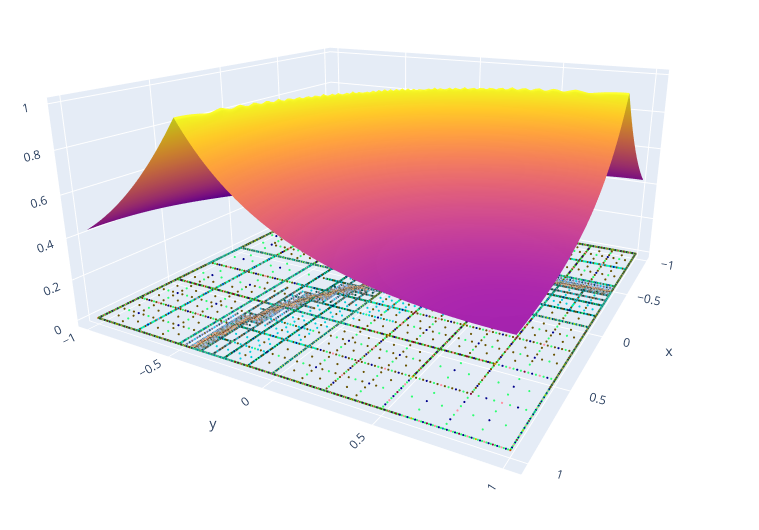
Function with curved singularity
fun1(x::SVector{2,Float64},ID::String) = (1.0-exp(-1.0*(abs(2.0 - (x[1]-1.0)^2.0 - (x[2]-1.0)^2.0) +0.01)))/(abs(2-(x[1]-1.0)^2.0-(x[2]-1.0)^2.0)+0.01)
init_weights!(asg, fun1)
adaptive refine
for i = 1:20
call generatenextlevel! with tol=1e-5 and maxlevels=20
cpts = generatenextlevel!(asg, 1e-5, 20) init_weights!(asg, collect(cpts), fun1) end
plot
import PlotlyJS surfplot = PlotlyJS.surface(asg, 100) gridplot = PlotlyJS.scatter3d(asg) PlotlyJS.plot([surfplot, gridplot]) ```
Plotting
1d
```julia
grid plots
PlotlyJS.scatter(sg::AbstractHierarchicalSparseGrid{1,HCP}, lvloffset::Bool=false; kwargs...) UnicodePlots.scatterplot(sg::AbstractHierarchicalSparseGrid{1,HCP}, lvloffset::Bool=false)
response function plots
UnicodePlots.lineplot(asg::AbstractHierarchicalSparseGrid{1,HCP}, npts = 1000, stoplevel::Int=numlevels(asg)) PlotlyJS.surface(asg::SG, npts = 1000, stoplevel::Int=numlevels(asg); kwargs...) ```
2d
```julia
grid plots
PlotlyJS.scatter(sg::AbstractHierarchicalSparseGrid{2,HCP}, lvloffset::Float64=0.0, colororder::Bool=false) UnicodePlots.scatterplot(sg::AbstractHierarchicalSparseGrid{2,HCP}) PlotlyJS.scatter3d(sg::AbstractHierarchicalSparseGrid{2,HCP}, color_order::Bool=false, maxp::Int=1)
response function plot
PlotlyJS.surface(asg::AbstractHierarchicalSparseGrid{2,HCP}, npts = 20; kwargs...) ```
3d
```julia
grid plot
PlotlyJS.scatter3d(sg::AbstractHierarchicalSparseGrid{3,HCP}, color_order::Bool=false, maxp::Int=1) ```
Next steps
- nonlinear basis functions
- wavelet basis
Contributions, report bugs and support
Contributions to or questions about this project are welcome. Feel free to create a issue or a pull request on GitHub.
Owner
- Name: Max Bittens
- Login: baxmittens
- Kind: user
- Repositories: 7
- Profile: https://github.com/baxmittens
Scientific coworker @ BGR
JOSS Publication
DistributedSparseGrids.jl: A Julia library implementing an Adaptive Sparse Grid collocation method
Authors

Federal Institute for Geosciences and Natural Resources (BGR), Germany
Independent Researcher, Germany
Editor
Vincent Knight
Tags
stochastics sparse grids high-performance computingGitHub Events
Total
- Release event: 1
- Watch event: 2
- Issue comment event: 5
- Push event: 1
Last Year
- Release event: 1
- Watch event: 2
- Issue comment event: 5
- Push event: 1
Committers
Last synced: 12 months ago
Top Committers
| Name | Commits | |
|---|---|---|
| Bittens | B****M@b****l | 271 |
| Max Bittens | 1****s | 32 |
| Daniel S. Katz | d****z@i****g | 2 |
Committer Domains (Top 20 + Academic)
Issues and Pull Requests
Last synced: 11 months ago
All Time
- Total issues: 12
- Total pull requests: 4
- Average time to close issues: 24 days
- Average time to close pull requests: 2 minutes
- Total issue authors: 4
- Total pull request authors: 2
- Average comments per issue: 4.83
- Average comments per pull request: 0.0
- Merged pull requests: 3
- Bot issues: 0
- Bot pull requests: 0
Past Year
- Issues: 0
- Pull requests: 0
- Average time to close issues: N/A
- Average time to close pull requests: N/A
- Issue authors: 0
- Pull request authors: 0
- Average comments per issue: 0
- Average comments per pull request: 0
- Merged pull requests: 0
- Bot issues: 0
- Bot pull requests: 0
Top Authors
Issue Authors
- ericneiva (5)
- matt-graham (5)
- baxmittens (1)
- JuliaTagBot (1)
Pull Request Authors
- baxmittens (5)
- danielskatz (1)
Top Labels
Issue Labels
Pull Request Labels
Packages
- Total packages: 1
-
Total downloads:
- julia 3 total
- Total dependent packages: 1
- Total dependent repositories: 0
- Total versions: 9
juliahub.com: DistributedSparseGrids
An hierarchical adaptive sparse-grid implementation in the julia language
- Documentation: https://docs.juliahub.com/General/DistributedSparseGrids/stable/
- License: MIT
-
Latest release: 0.1.10
published over 1 year ago
Rankings
Dependencies
- julia 0.7
- actions/cache v1 composite
- actions/checkout v2 composite
- codecov/codecov-action v1 composite
- julia-actions/julia-buildpkg v1 composite
- julia-actions/julia-processcoverage v1 composite
- julia-actions/julia-runtest v1 composite
- julia-actions/setup-julia v1 composite
- JuliaRegistries/TagBot v1 composite
- actions/checkout v2 composite
- julia-actions/setup-julia latest composite
- actions/checkout v2 composite
- actions/upload-artifact v1 composite
- openjournals/openjournals-draft-action master composite