triqxnet
Forecasting Dst Index from Solar Wind Data Using an Interpretable Parallel Classical-Quantum Framework with Uncertainty Quantification
Science Score: 67.0%
This score indicates how likely this project is to be science-related based on various indicators:
-
✓CITATION.cff file
Found CITATION.cff file -
✓codemeta.json file
Found codemeta.json file -
✓.zenodo.json file
Found .zenodo.json file -
✓DOI references
Found 6 DOI reference(s) in README -
✓Academic publication links
Links to: zenodo.org -
○Academic email domains
-
○Institutional organization owner
-
○JOSS paper metadata
-
○Scientific vocabulary similarity
Low similarity (7.7%) to scientific vocabulary
Repository
Forecasting Dst Index from Solar Wind Data Using an Interpretable Parallel Classical-Quantum Framework with Uncertainty Quantification
Basic Info
- Host: GitHub
- Owner: Abrar2652
- License: mit
- Language: Jupyter Notebook
- Default Branch: main
- Size: 43.3 MB
Statistics
- Stars: 0
- Watchers: 1
- Forks: 0
- Open Issues: 0
- Releases: 1
Metadata Files
README.md
TriQXNet: Forecasting Dst Index from Solar Wind Data 🌌🪐
Background Information
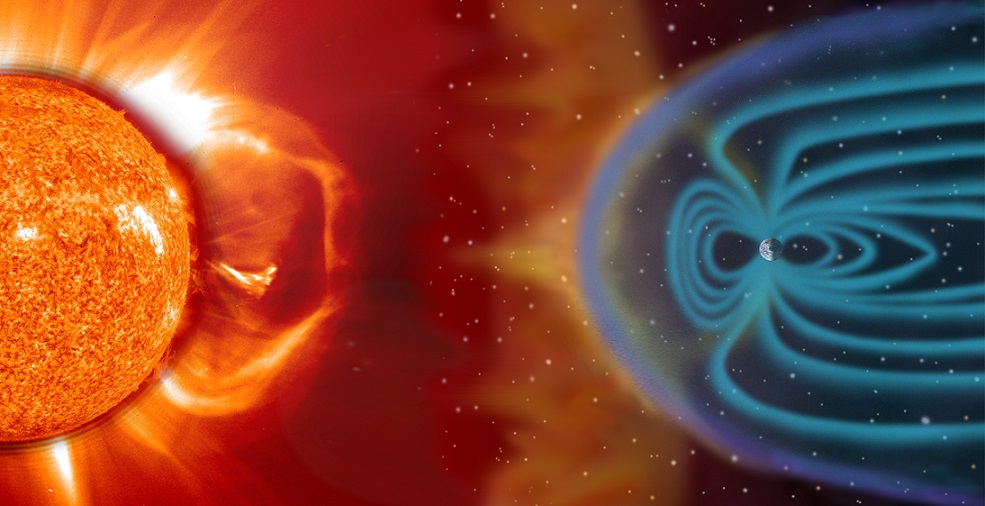
When solar winds from the sun interacts with the magnetic field of the Earth, a phenomenon known as a geomagnetic storm occurs. This phenomenon can be fatal to critical infrastructures such as power grids, satellites, GPS etc. Therefore, forecasting geomagnetic storms is an important task that can impact millions of people worldwide.
The strength of a geomagnetic storm is measured using the DST (Disturbance Storm-Time) index | | Quiet-Minor | Moderate storm | Intense Storm | Superintense storm | | - | - | - | - | - | | DST index | >-50 | -50 to -100 | <-100 | <-250 |
Challenge
As part of NASA SpaceApps Challenge 2023, our project uses Deep Learning to use solar wind data to predict the DST values for the current hour ($t0$) and forecast the DST value for the next hour ($t+1$)
Dataset Description
The dataset used to predict the intensity of geomagnetic storms is taken from NOAA's website.
(Click here to download the dataset.)
The dataset consists hourly values of solar wind data measured by instruments on two of NASA's satellites (ACE and DSCOVR) and an average of the DST values measured by 4 ground-based observatories near the equator.
Description of Solar Wind features:
- (bx/by/bz)_gse: Interplanetary-magnetic-field (IMF) components (in X, Y & Z axes) in geocentric solar ecliptic (GSE) coordinate.
- (bx/by/bz)_gsm: IMF components (in X, Y & Z axes) in geocentric solar magnetospheric (GSM) coordinates.
- theta_(gse/gsm): IMF latitude in GSE and GSM coordinates.
- phi_(gse/gsm): IMF longitude in GSE and GSM coordinates.
- bt: IMF component magnitude.
- density: Solar wind proton density.
- speed: Solar wind bulk speed.
- temperature: Solar wind ion temperature.
Evaluation metric
The evaluation metric used is Root Mean Squared Error (RMSE). The RMSE is calculated on DST value for $t0$ hour and $t+1$ hour simultaneously $$\text{RMSE} = \sqrt{\frac{1}{N}\sum{i=0}^{N} (yi - \hat yi)^2}$$ where, - $\hat yi$ is the predicted DST value for $t0$ and $t+1$ - $y_i$ is the actual DST value for $t0$ and $t+1$ - $N$ is the number of samples
XAI Implementation
In the pursuit of transparency and interpretability, we conducted ShapTime and Permutation Feature Importance analysis for the Conv1DTimeDistributedNet model.

Owner
- Name: Md. Abrar Jahin
- Login: Abrar2652
- Kind: user
- Location: Bangladesh
- Company: OIST
- Website: https://devpost.com/abrar-jahin-2652?ref_content=user-portfolio&ref_feature=portfolio&ref_medium=global-nav
- Twitter: AbrarJa02766068
- Repositories: 7
- Profile: https://github.com/Abrar2652
Citation (CITATION.cff)
cff-version: 1.1.0
message: "If you use this software, please cite it as below."
authors:
- family-names: Md Abrar
  given-names: Jahin
orcid: https://orcid.org/0000-0002-1623-3859
title:
version: v1.0.0
date-released: 2024-07-09
GitHub Events
Total
- Public event: 1
Last Year
- Public event: 1