https://github.com/astrogilda/tensorflow-cookbook
Simple Tensorflow Cookbook for easy-to-use
Science Score: 10.0%
This score indicates how likely this project is to be science-related based on various indicators:
-
○CITATION.cff file
-
○codemeta.json file
-
○.zenodo.json file
-
○DOI references
-
✓Academic publication links
Links to: arxiv.org -
○Academic email domains
-
○Institutional organization owner
-
○JOSS paper metadata
-
○Scientific vocabulary similarity
Low similarity (8.5%) to scientific vocabulary
Last synced: 10 months ago
·
JSON representation
Repository
Simple Tensorflow Cookbook for easy-to-use
Basic Info
- Host: GitHub
- Owner: astrogilda
- License: mit
- Default Branch: master
- Size: 3.02 MB
Statistics
- Stars: 0
- Watchers: 1
- Forks: 0
- Open Issues: 0
- Releases: 0
Fork of taki0112/Tensorflow-Cookbook
Created over 6 years ago
· Last pushed over 6 years ago
https://github.com/astrogilda/Tensorflow-Cookbook/blob/master/
# [Web page](http://bit.ly/jhkim_tf_cookbook) # [Tensorflow 2 Cookbook](https://github.com/taki0112/Tensorflow2-Cookbook) ## Contributions In now, this repo contains general architectures and functions that are useful for the GAN and classificstion. I will continue to add useful things to other areas. Also, your pull requests and issues are always welcome. And write what you want to implement on the issue. I'll implement it. # How to use ## Import * `ops.py` * **operations** * from ops import * * `utils.py` * **image processing** * from utils import * ## Network template ```python def network(x, is_training=True, reuse=False, scope="network"): with tf.variable_scope(scope, reuse=reuse): x = conv(...) ... return logit ``` ## Insert data to network using DatasetAPI ```python Image_Data_Class = ImageData(img_size, img_ch, augment_flag) trainA_dataset = ['./dataset/cat/trainA/a.jpg', './dataset/cat/trainA/b.png', './dataset/cat/trainA/c.jpeg', ...] trainA = tf.data.Dataset.from_tensor_slices(trainA_dataset) trainA = trainA.map(Image_Data_Class.image_processing, num_parallel_calls=16) trainA = trainA.shuffle(buffer_size=10000).prefetch(buffer_size=batch_size).batch(batch_size).repeat() trainA_iterator = trainA.make_one_shot_iterator() data_A = trainA_iterator.get_next() logit = network(data_A) ``` * See [this](https://github.com/taki0112/Tensorflow-DatasetAPI) for more information. ## Option * `padding='SAME'` * pad = ceil[ (kernel - stride) / 2 ] * `pad_type` * 'zero' or 'reflect' * `sn` * use [spectral_normalization](https://arxiv.org/pdf/1802.05957.pdf) or not ## Caution * If you don't want to share variable, **set all scope names differently.** --- ## Weight ```python weight_init = tf.truncated_normal_initializer(mean=0.0, stddev=0.02) weight_regularizer = tf.contrib.layers.l2_regularizer(0.0001) weight_regularizer_fully = tf.contrib.layers.l2_regularizer(0.0001) ``` ### Initialization * `Xavier` : tf.contrib.layers.xavier_initializer() ```python USE """tf.contrib.layers.variance_scaling_initializer()""" if uniform : factor = gain * gain mode = 'FAN_AVG' else : factor = (gain * gain) / 1.3 mode = 'FAN_AVG' ``` * `He` : tf.contrib.layers.variance_scaling_initializer() ```python if uniform : factor = gain * gain mode = 'FAN_IN' else : factor = (gain * gain) / 1.3 mode = 'FAN_OUT' ``` * `Normal` : tf.random_normal_initializer(mean=0.0, stddev=0.02) * `Truncated_normal` : tf.truncated_normal_initializer(mean=0.0, stddev=0.02) * `Orthogonal` : tf.orthogonal_initializer(1.0) / # if relu = sqrt(2), the others = 1.0 ### Regularization * `l2_decay` : tf.contrib.layers.l2_regularizer(0.0001) * `orthogonal_regularizer` : orthogonal_regularizer(0.0001) & orthogonal_regularizer_fully(0.0001) ## Convolution ### basic conv ```python x = conv(x, channels=64, kernel=3, stride=2, pad=1, pad_type='reflect', use_bias=True, sn=True, scope='conv') ``` ### partial conv (NVIDIA [Partial Convolution](https://github.com/NVIDIA/partialconv)) ```python x = partial_conv(x, channels=64, kernel=3, stride=2, use_bias=True, padding='SAME', sn=True, scope='partial_conv') ```   ### dilated conv ```python x = dilate_conv(x, channels=64, kernel=3, rate=2, use_bias=True, padding='VALID', sn=True, scope='dilate_conv') ```
### partial conv (NVIDIA [Partial Convolution](https://github.com/NVIDIA/partialconv)) ```python x = partial_conv(x, channels=64, kernel=3, stride=2, use_bias=True, padding='SAME', sn=True, scope='partial_conv') ```   ### dilated conv ```python x = dilate_conv(x, channels=64, kernel=3, rate=2, use_bias=True, padding='VALID', sn=True, scope='dilate_conv') ``` --- ## Deconvolution ### basic deconv ```python x = deconv(x, channels=64, kernel=3, stride=1, padding='SAME', use_bias=True, sn=True, scope='deconv') ```
 --- ## Fully-connected ```python x = fully_connected(x, units=64, use_bias=True, sn=True, scope='fully_connected') ```
 --- ## Pixel shuffle ```python x = conv_pixel_shuffle_down(x, scale_factor=2, use_bias=True, sn=True, scope='pixel_shuffle_down') x = conv_pixel_shuffle_up(x, scale_factor=2, use_bias=True, sn=True, scope='pixel_shuffle_up') ``` * `down` ===> [height, width] -> [**height // scale_factor, width // scale_factor**] * `up` ===> [height, width] -> [**height \* scale_factor, width \* scale_factor**]  --- ## Block ### residual block ```python x = resblock(x, channels=64, is_training=is_training, use_bias=True, sn=True, scope='residual_block') x = resblock_down(x, channels=64, is_training=is_training, use_bias=True, sn=True, scope='residual_block_down') x = resblock_up(x, channels=64, is_training=is_training, use_bias=True, sn=True, scope='residual_block_up') ``` * `down` ===> [height, width] -> [**height // 2, width // 2**] * `up` ===> [height, width] -> [**height \* 2, width \* 2**]
--- ## Pixel shuffle ```python x = conv_pixel_shuffle_down(x, scale_factor=2, use_bias=True, sn=True, scope='pixel_shuffle_down') x = conv_pixel_shuffle_up(x, scale_factor=2, use_bias=True, sn=True, scope='pixel_shuffle_up') ``` * `down` ===> [height, width] -> [**height // scale_factor, width // scale_factor**] * `up` ===> [height, width] -> [**height \* scale_factor, width \* scale_factor**]  --- ## Block ### residual block ```python x = resblock(x, channels=64, is_training=is_training, use_bias=True, sn=True, scope='residual_block') x = resblock_down(x, channels=64, is_training=is_training, use_bias=True, sn=True, scope='residual_block_down') x = resblock_up(x, channels=64, is_training=is_training, use_bias=True, sn=True, scope='residual_block_up') ``` * `down` ===> [height, width] -> [**height // 2, width // 2**] * `up` ===> [height, width] -> [**height \* 2, width \* 2**] ### dense block ```python x = denseblock(x, channels=64, n_db=6, is_training=is_training, use_bias=True, sn=True, scope='denseblock') ``` * `n_db` ===> The number of dense-block
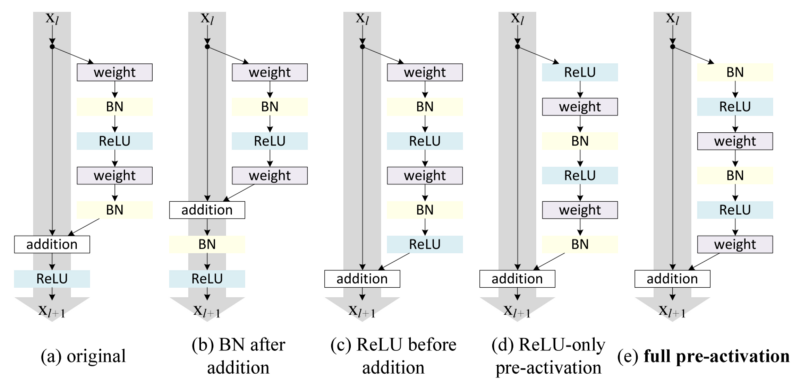 ### residual-dense block ```python x = res_denseblock(x, channels=64, n_rdb=20, n_rdb_conv=6, is_training=is_training, use_bias=True, sn=True, scope='res_denseblock') ``` * `n_rdb` ===> The number of RDB * `n_rdb_conv` ===> per RDB conv layer
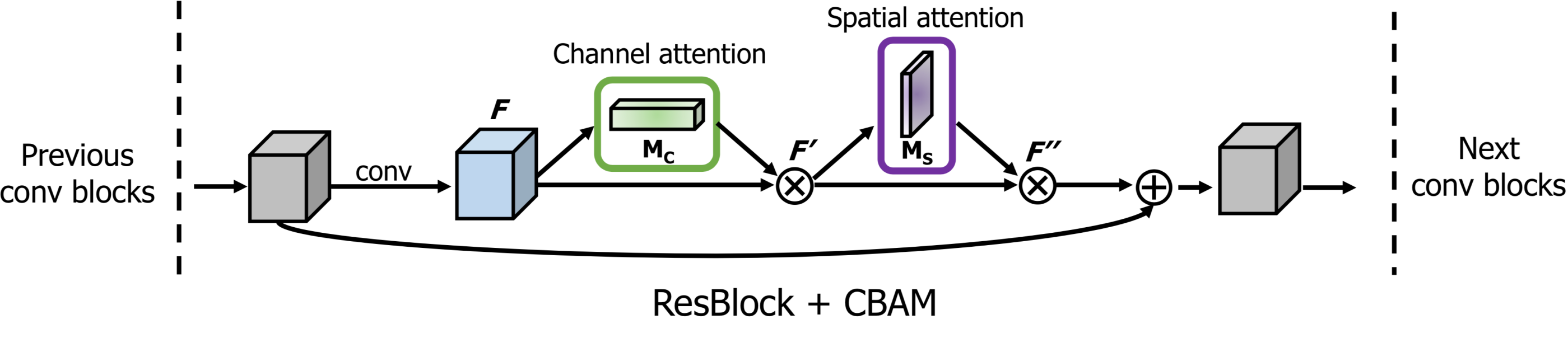
 ### attention block ```python x = self_attention(x, use_bias=True, sn=True, scope='self_attention') x = self_attention_with_pooling(x, use_bias=True, sn=True, scope='self_attention_version_2') x = squeeze_excitation(x, ratio=16, use_bias=True, sn=True, scope='squeeze_excitation') x = convolution_block_attention(x, ratio=16, use_bias=True, sn=True, scope='convolution_block_attention') x = global_context_block(x, use_bias=True, sn=True, scope='gc_block') x = srm_block(x, use_bias=False, is_training=is_training, scope='srm_block') ```

 ---
--- ---
---
 ---
---
 ---
--- --- ## Normalization ```python x = batch_norm(x, is_training=is_training, scope='batch_norm') x = layer_norm(x, scope='layer_norm') x = instance_norm(x, scope='instance_norm') x = group_norm(x, groups=32, scope='group_norm') x = pixel_norm(x) x = batch_instance_norm(x, scope='batch_instance_norm') x = layer_instance_norm(x, scope='layer_instance_norm') x = switch_norm(x, scope='switch_norm') x = condition_batch_norm(x, z, is_training=is_training, scope='condition_batch_norm'): x = adaptive_instance_norm(x, gamma, beta) x = adaptive_layer_instance_norm(x, gamma, beta, smoothing=True, scope='adaLIN') ``` * See [this](https://github.com/taki0112/BigGAN-Tensorflow) for how to use `condition_batch_norm` * See [this](https://github.com/taki0112/MUNIT-Tensorflow) for how to use `adaptive_instance_norm` * See [this](https://github.com/taki0112/UGATIT) for how to use `adaptive_layer_instance_norm` & `layer_instance_norm`
 --- ## Activation ```python x = relu(x) x = lrelu(x, alpha=0.2) x = tanh(x) x = sigmoid(x) x = swish(x) x = elu(x) ``` --- ## Pooling & Resize ```python x = nearest_up_sample(x, scale_factor=2) x = bilinear_up_sample(x, scale_factor=2) x = nearest_down_sample(x, scale_factor=2) x = bilinear_down_sample(x, scale_factor=2) x = max_pooling(x, pool_size=2) x = avg_pooling(x, pool_size=2) x = global_max_pooling(x) x = global_avg_pooling(x) x = flatten(x) x = hw_flatten(x) ``` --- ## Loss ### classification loss ```python loss, accuracy = classification_loss(logit, label) loss = dice_loss(n_classes=10, logit, label) ``` ### regularization loss ```python g_reg_loss = regularization_loss('generator') d_reg_loss = regularization_loss('discriminator') ``` * If you want to use `regularizer`, then you should write it ### pixel loss ```python loss = L1_loss(x, y) loss = L2_loss(x, y) loss = huber_loss(x, y) loss = histogram_loss(x, y) loss = gram_style_loss(x, y) loss = color_consistency_loss(x, y) ``` * `histogram_loss` means the difference in the color distribution of the image pixel values. * `gram_style_loss` means the difference between the styles using gram matrix. * `color_consistency_loss` means the color difference between the generated image and the input image. ### gan loss ```python d_loss = discriminator_loss(Ra=True, loss_func='wgan-gp', real=real_logit, fake=fake_logit) g_loss = generator_loss(Ra=True, loss_func='wgan-gp', real=real_logit, fake=fake_logit) ``` * `Ra` * use [relativistic gan](https://arxiv.org/pdf/1807.00734.pdf) or not * `loss_func` * gan * lsgan * hinge * wgan-gp * dragan * See [this](https://github.com/taki0112/BigGAN-Tensorflow/blob/master/BigGAN_512.py#L180) for how to use `gradient_penalty`
 ### [vdb loss](https://arxiv.org/abs/1810.00821) ```python d_bottleneck_loss = vdb_loss(real_mu, real_logvar, i_c) + vdb_loss(fake_mu, fake_logvar, i_c) ``` ### kl-divergence (z ~ N(0, 1)) ```python loss = kl_loss(mean, logvar) ``` --- ## Author [Junho Kim](http://bit.ly/jhkim_ai)
Owner
- Name: Sankalp Gilda
- Login: astrogilda
- Kind: user
- Location: Gainesville, FL
- Website: www.linkedin.com/in/sankalp-gilda/
- Twitter: astrogilda
- Repositories: 141
- Profile: https://github.com/astrogilda
Machine Learning Engineer | Ph.D., Astronomy