https://github.com/bergmanlab/ngs_te_mapper2
Software for detecting transposable element insertions from next-generation sequencing data
Science Score: 23.0%
This score indicates how likely this project is to be science-related based on various indicators:
-
○CITATION.cff file
-
○codemeta.json file
-
○.zenodo.json file
-
✓DOI references
Found 3 DOI reference(s) in README -
○Academic publication links
-
✓Committers with academic emails
7 of 12 committers (58.3%) from academic institutions -
○Institutional organization owner
-
○JOSS paper metadata
-
○Scientific vocabulary similarity
Low similarity (11.2%) to scientific vocabulary
Repository
Software for detecting transposable element insertions from next-generation sequencing data
Basic Info
- Host: GitHub
- Owner: bergmanlab
- License: bsd-2-clause
- Language: Python
- Default Branch: main
- Size: 695 KB
Statistics
- Stars: 9
- Watchers: 3
- Forks: 1
- Open Issues: 2
- Releases: 0
Metadata Files
README.md
ngstemapper2: A program to identify transposable element insertions using next generation sequencing data
Table of Contents
Introduction
ngstemapper2 is a method for detecting transposable element (TE) insertions from short-read next-generation sequencing (NGS) data described in Han et al. (2021) Genetics 219(2):iyab113. ngstemapper2 is a Python re-implementation of the ngstemapper method originally described in Linheiro and Bergman (2012) PLoS ONE 7(2): e30008. ngstemapper2 uses a three-stage procedure to annotate non-reference TEs as the span of target site duplication (TSD), following the framework described in Bergman (2012) Mob Genet Elements. 2:51-54.
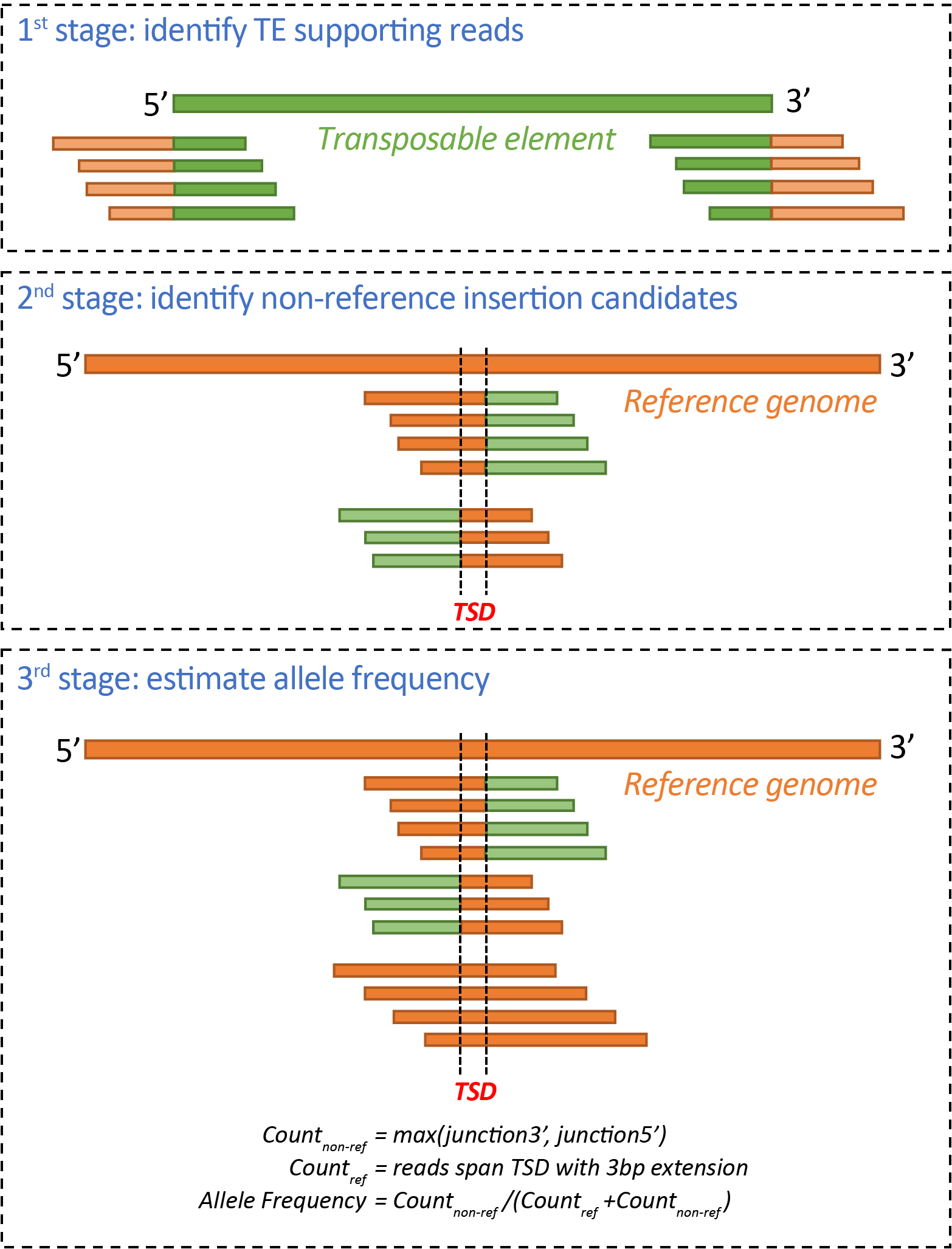
In the first stage, WGS reads are queried against a library of TE sequences to identify 'junction reads' that span the start/end of TE and genomic flanking sequences are retained. Such reads are often referred as 'split reads', although in reality these reads are not split in the resequenced genome.
In the second stage, junction reads from each side of TE insertion identified in the first stage are separately aligned to a reference genome that is hard-masked with RepeatMasker (http://www.repeatmasker.org/) using the same TE library from stage one. Genome-wide coverage profiles are computed using samtools v1.9 and genomic intervals with enriched coverage from junction read clusters on the 5' and 3' side of TEs are annotated in bed format. Regions of overlap between intervals of junction read clusters on the 5' and 3' side of TEs define the locations of the TSDs for candidate non-reference TE insertions. The orientation of the TE is determined from the relative orientation of alignments of the junction reads to the reference genome and TE library.
In the third stage, all reads from the original whole genome shotgun sequence data are used to query against the same hard-masked reference genome as in stage two. This additional mapping step is necessary to obtain all reads that span the TE-flank junction, as well as identify if any reads are present for the alternative ``reference" haplotype that does not carry the TE insertion. For each candidate non-reference TE insertion site, number of junction reads covering 5' and 3' side of each candidate TE insertion are estimated as the number of soft-clipped reads overlapping a 10bp window on the 5' and 3' side of the TSD, respectively (Countjunction5' and Countjunction3'). Number of non-reference reads (Countnonref) were estimated as max(Countjunction5', Countjunction3'). Number of reference reads (Countref) were estimated as number of non-soft-clipped reads spanning the TSD with at least 3bp extension on both side. The allele frequency for non-reference TEs is heuristically estimated as Countnon-ref/(Countnonref + Count_ref).
Reference TE insertions are detected using a similar strategy to non-reference insertions, independently of any reference TE annotation. The first stage in detecting reference TE insertions is identical to the first stage of detecting non-reference TE insertions described above. The second stage in identifying reference TE insertions involves alignment of the renamed, but otherwise unmodified, junction reads to the reference genome. Alignments of the complete junction read (i.e. non-TE and TE components) are clustered to identify the two ends of the reference TE insertion. The orientation of the reference TE is then determined from the relative orientation of alignments of the junction reads to the reference genome and TE library.
ngstemapper2 is written in python3 and is designed to run on a Linux operating system.
Installation
Install Miniconda
To install ngstemapper2, the recommended way is using conda. If your system doesn't have conda installed, you could use following steps to install Miniconda (Python 3.X). For more on Conda: see the Conda User Guide. ``` wget https://repo.continuum.io/miniconda/Miniconda3-latest-Linux-x86_64.sh -O $HOME//miniconda.sh bash ~/miniconda.sh -b -p $HOME/miniconda # silent mode echo "export PATH=\$PATH:\$HOME/miniconda/bin" >> $HOME/.bashrc # add to .bashrc source $HOME/.bashrc
conda init # this step requires you to close and open a new terminal before it take effect conda update conda # update conda ```
Install ngstemapper2 using conda
ngstemapper2 and all software dependencies can be installed using conda. ```
We recommended installing ngstemapper2 in a new conda environment
conda create -n ngstemapper2 --channel bioconda ngstemapper2
Alternatively, you can install ngstemapper2 in current active environment
conda install --channel bioconda ngstemapper2 ```
Run ngstemapper2 on test dataset
A test dataset is provided in the test/ directory, you can test whether your ngstemapper2 installation is successful by running ngstemapper2 on this dataset, which should take less than one minute to finish on a single thread machine.
conda activate ngs_te_mapper2
cd test
ngs_te_mapper2 -o test_output -f reads.fastq -r ref_1kb.fasta -l library.fasta
NOTE: Sometimes activating conda environments does not work via conda activate myenv when run through a script submitted to a queueing system, this can be fixed by activating the environment in the script as shown below
CONDA_BASE=$(conda info --base)
source ${CONDA_BASE}/etc/profile.d/conda.sh
conda activate ngs_te_mapper2
Usage
ngstemapper2 required input files
- FASTQ File (
-f/--reads)- Raw reads from paired-end or single-end sequencing run in fastq or fastq.gz format.
- Multiple fastq/fastq.gz files can be provided separated by comma (ep.
-f R1.fasta,R2.fasta).
- TE library FASTA (
-l/--library)- A FASTA file containing a consensus sequence for each TE family. Note: Each family should only be represented in one sequence in this file.
- Example consensus FASTA file
- Reference FASTA (
-r/--reference)- The genome sequence of the reference genome in FASTA format.
Command line help page
``` usage: ngstemapper2 [-h] -f READS -l LIBRARY -r REFERENCE [-a ANNOTATION] [-n REGION] [-w WINDOW] [--minmapq MINMAPQ] [--minaf MINAF] [--tsdmax TSDMAX] [--gapmax GAPMAX] [-m MAPPER] [-t THREAD] [-o OUT] [-p PREFIX] [-k]
Script to detect non-reference TEs from single end short read data
required arguments: -f READS, --reads READS raw reads in fastq or fastq.gz format, separated by comma -l LIBRARY, --library LIBRARY TE concensus sequence -r REFERENCE, --reference REFERENCE reference genome
optional arguments:
-h, --help show this help message and exit
-a ANNOTATION, --annotation ANNOTATION
reference TE annotation in GFF3 format (must have
'Target' attribute in the 9th column)
-w WINDOW, --window WINDOW
merge window for identifying TE clusters (default =
10)
--minmapq MINMAPQ minimum mapping quality of alignment (default = 20)
--minaf MINAF minimum allele frequency (default = 0.1)
--tsdmax TSDMAX maximum TSD size (default = 25)
--gapmax GAPMAX maximum gap size (default = 5)
-t THREAD, --thread THREAD
thread (default = 1)
-o OUT, --out OUT output dir (default = '.')
-p PREFIX, --prefix PREFIX
output prefix
-k, --keepfiles If provided then all intermediate files will be kept
(default: remove intermediate files)
```
Note: The optional reference TE annotation input should in theory speed up the program. ngste_mapper2 expects the TE annotation to be in GFF3 format and Target attribute must be included in the 9th column that represents TE family name. If you have *.out annotation generated by RepeatMasker, you can use this utility script to convert from *.out to GFF3 format.
Output
ngstemapper2 outputs reference and non-referece TE insertion predictions in BED format (0-based).
- <sample>.nonref.bed: non-reference TE insertion annotation predicted by ngstemapper2 pipeline in BED format (0-based).
- <sample>.ref.bed: reference TE insertion annotation predicted by ngstemapper2 pipeline in BED format (0-based).
TE insertion annotation in bed format
ngstemapper2 generates standard BED file <sample>.nonref.bed and <sample>.ref.bed that have detailed information for each reference and non-reference TE insertion.
Column | Description -- | -- chromosome | The chromosome name where the TE insertion occurred position | Starting breakpoint position of the TE insertions. end | Ending breakpoint position of the TE insertions. info | Includes TE family, TSD, Allele Frequency, 3' support, 5' support and reference reads. Separated by '|'. score | '.' strand | Strand that TE insertion occurs
Log file output by ngstemapper2
For each ngstemapper2 run, a log file called <sample>.log is generated that records all the major steps in the program and error messages.
Getting help
Please use the Github Issue page if you have questions.
Citation
To cite ngstemapper2 in publications, please use:
S. Han, P.J. Basting, G.B. Dias, A. Luhur, A.C. Zelhof, C.M. Bergman (2021) Transposable element profiles reveal cell line identity and loss of heterozygosity in Drosophila cell culture. Genetics 219(2):iyab113
Owner
- Name: bergmanlab
- Login: bergmanlab
- Kind: organization
- Website: http://bergman-lab.org
- Repositories: 19
- Profile: https://github.com/bergmanlab
GitHub Events
Total
Last Year
Committers
Last synced: over 3 years ago
All Time
- Total Commits: 172
- Total Committers: 12
- Avg Commits per committer: 14.333
- Development Distribution Score (DDS): 0.628
Top Committers
| Name | Commits | |
|---|---|---|
| raquels95 | r****5@g****m | 64 |
| Shunhua Han | s****1@s****u | 49 |
| Casey Bergman | c****n@m****k | 23 |
| shunhuahan | h****9@g****m | 13 |
| Shunhua Han | s****1@s****u | 8 |
| Shunhua | s****1@u****u | 5 |
| Shunhua Han | s****1@s****u | 4 |
| Casey Bergman | c****n@u****m | 2 |
| Michael Nelson | 4****n@g****m | 1 |
| Shunhua Han | s****1@s****u | 1 |
| Casey Bergman | c****n@g****m | 1 |
| pbasting | p****7@u****u | 1 |
Committer Domains (Top 20 + Academic)
Issues and Pull Requests
Last synced: 11 months ago
All Time
- Total issues: 5
- Total pull requests: 3
- Average time to close issues: 2 months
- Average time to close pull requests: 4 days
- Total issue authors: 5
- Total pull request authors: 2
- Average comments per issue: 2.2
- Average comments per pull request: 0.0
- Merged pull requests: 3
- Bot issues: 0
- Bot pull requests: 0
Past Year
- Issues: 0
- Pull requests: 0
- Average time to close issues: N/A
- Average time to close pull requests: N/A
- Issue authors: 0
- Pull request authors: 0
- Average comments per issue: 0
- Average comments per pull request: 0
- Merged pull requests: 0
- Bot issues: 0
- Bot pull requests: 0
Top Authors
Issue Authors
- ealler (1)
- afeurtey (1)
- dgodin19 (1)
- jsitarka (1)
- Unalibun (1)
Pull Request Authors
- shunhuahan (2)
- pbasting (1)
Top Labels
Issue Labels
Pull Request Labels
Packages
- Total packages: 1
-
Total downloads:
- pypi 13 last-month
- Total dependent packages: 0
- Total dependent repositories: 1
- Total versions: 2
- Total maintainers: 1
pypi.org: ngs-te-mapper2
A program to identify transposable element insertions using next generation sequencing data
- Homepage: https://github.com/bergmanlab/ngs_te_mapper2
- Documentation: https://ngs-te-mapper2.readthedocs.io/
- License: BSD License
-
Latest release: 1.0.2
published almost 5 years ago