https://github.com/bgmeulem/reconstruct_carto
Reconstructs a simulatable 3D mesh from in-vivo CARTO mapping data
Science Score: 13.0%
This score indicates how likely this project is to be science-related based on various indicators:
-
○CITATION.cff file
-
✓codemeta.json file
Found codemeta.json file -
○.zenodo.json file
-
○DOI references
-
○Academic publication links
-
○Academic email domains
-
○Institutional organization owner
-
○JOSS paper metadata
-
○Scientific vocabulary similarity
Low similarity (14.9%) to scientific vocabulary
Keywords
Repository
Reconstructs a simulatable 3D mesh from in-vivo CARTO mapping data
Basic Info
Statistics
- Stars: 0
- Watchers: 1
- Forks: 0
- Open Issues: 0
- Releases: 0
Topics
Metadata Files
README.md
Reconstruct_CARTO
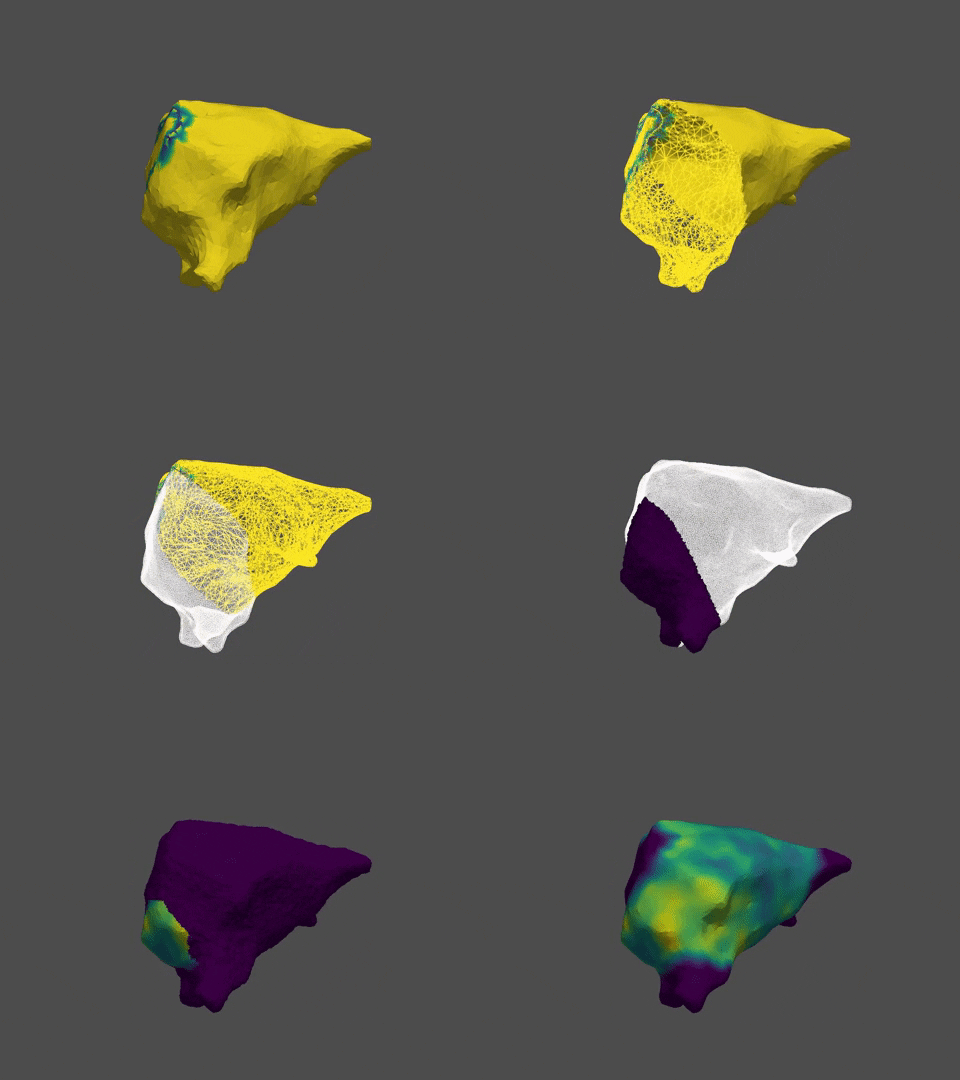
This repository provides code capable of reconstructing a simulatable 3D mesh from clinical CARTO mapping data, providing control over mesh resolution, conduction velocity distributions and non-conductive regions. The mesh thickness is currently fixed at 5 mm
Requirements:
Some requirements are not automatically installable. These requirements are:
- tetgen 1.6.0 (Download here)
- The tetgen command should be aliased to the tetgen executable, located at
<tetgen_installation_folder>/tetgen1.6.0/build/tetgen
- PyMesh 0.3 (Download here)
- Do NOT install PyMesh with pip. This is another module with the same name. Download, build and install according to the setup as provided by the PyMesh docs.
- Installing the third-party dependencies can be done as specified in the docs, but also by running ./build.py all in the directory third_party.
To install the remaining requirements, run
shell
pip install -r requirements.txt
This will install the following modules, or update them if they are not already installed:
- PyVista
- tqdm
- matplotlib
- numpy
- sklearn
- pandas
Usage
Reconstructing involves taking an input .mesh file and making it into a tetrahedron mesh with user-defined
resolution. Conduction velocities can already be interpolated on this mesh if a .csv file containing point coordinates
and speed values is passed as an optional argument.
shell
python reconstruct.py <carto name> --<speed_file>
Interpolating conduction velocities can also be done after reconstruction, e.g. in case you want to select
non-conductive regions on the mesh after the reconstruction. To this end, a .csv file with point coordinates and
conduction velocity values need to be passed as an argument to the runfile apply_cv.py.
shell
python apply_cv.py <reconstructed .vtk mesh name> --<speed_file> --<write_adjust> --<region_dir>  --<ncv> --<speed_col> --<writeVTK>
Keep in mind that using command-line arguments will override any setting defined in the settings.ini file.
Alternatively, if you want full control over the mesh reconstruction and its intermediate steps, you can also import the
CartoMesh class and its dependencies. This provides more control over the reconstruction process than just the two
runfiles reconstruct.py and apply_cv.py along with the settings file settings.ini.
```python
from carto_mesh import * m = CartoMesh('filename.mesh') m.reconstruct() ```
Documentation
Documentation can be found here
Contact
Feel free to report any bugs, issues or propose features either directly via github, or per mail
Owner
- Name: Bjorge Meulemeester
- Login: bgmeulem
- Kind: user
- Location: Bonn, Germany
- Company: @mpinb
- Website: https://mpinb.mpg.de/en/research-groups/groups/in-silico-brain-sciences/group-members.html
- Repositories: 2
- Profile: https://github.com/bgmeulem
Doctoral researcher at Max-Planck Institute for Neurobiology of Behaviour (MPINB).
GitHub Events
Total
- Watch event: 1
Last Year
- Watch event: 1
Dependencies
- matplotlib *
- numpy *
- pandas *
- pyvista *
- sklearn *
- tqdm *