https://github.com/biboyd/pynucastro
a python library for nuclear astrophysics
Science Score: 23.0%
This score indicates how likely this project is to be science-related based on various indicators:
-
○CITATION.cff file
-
○codemeta.json file
-
○.zenodo.json file
-
✓DOI references
Found 6 DOI reference(s) in README -
✓Academic publication links
Links to: joss.theoj.org, zenodo.org -
○Academic email domains
-
○Institutional organization owner
-
○JOSS paper metadata
-
○Scientific vocabulary similarity
Low similarity (11.6%) to scientific vocabulary
Last synced: 10 months ago
·
JSON representation
Repository
a python library for nuclear astrophysics
Basic Info
- Host: GitHub
- Owner: biboyd
- License: bsd-3-clause
- Language: Python
- Default Branch: main
- Homepage: http://pynucastro.github.io/pynucastro/
- Size: 112 MB
Statistics
- Stars: 0
- Watchers: 0
- Forks: 0
- Open Issues: 0
- Releases: 0
Fork of pynucastro/pynucastro
Created almost 2 years ago
· Last pushed over 1 year ago
https://github.com/biboyd/pynucastro/blob/main/
# pynucastro
[](https://pypi.org/project/pynucastro)
[](https://anaconda.org/conda-forge/pynucastro)
[](https://github.com/pynucastro/pynucastro/actions/workflows/pytest-all.yml)
[](https://github.com/pynucastro/pynucastro/actions/workflows/pylint.yml)
[](https://github.com/pynucastro/pynucastro/actions/workflows/flake8.yml)
[](https://github.com/pynucastro/pynucastro/actions/workflows/docs-test.yml)
[](http://pynucastro.github.io/pynucastro/)
[](https://opensource.org/licenses/BSD-3-Clause)
[](https://doi.org/10.21105/joss.00588)
[](https://doi.org/10.5281/zenodo.1202434)
[](https://mybinder.org/v2/gh/pynucastro/pynucastro/main?filepath=examples%2Fpynucastro-examples.ipynb)

pynucastro is a python library for interactively creating and
exploring nuclear reaction networks. It provides interfaces to
nuclear reaction rate databases, including the JINA Reaclib nuclear
reactions database.
The main features are:
* Ability to create a reaction network based on a collection of rates, a set of nuclei,
or an arbitrary filter applied to a library.
* Interactive exploration of rates and networks in Jupyter notebooks.
* Many different ways of visualizing a network.
* An NSE solver to find the equilibrium abundance of a set of nuclei given a
thermodynamic state.
* Ability to write out python or C++ code needed to integrate the network.
* Support for tabular weak rates.
* Rate approximations and the derivation of reverse rates via detailed balance.
* Easy access to nuclear properties, including T-dependent partition
functions, spins, masses, etc.
## Documentation
Documentation for pynucastro is available here:
https://pynucastro.github.io/pynucastro/
## Examples
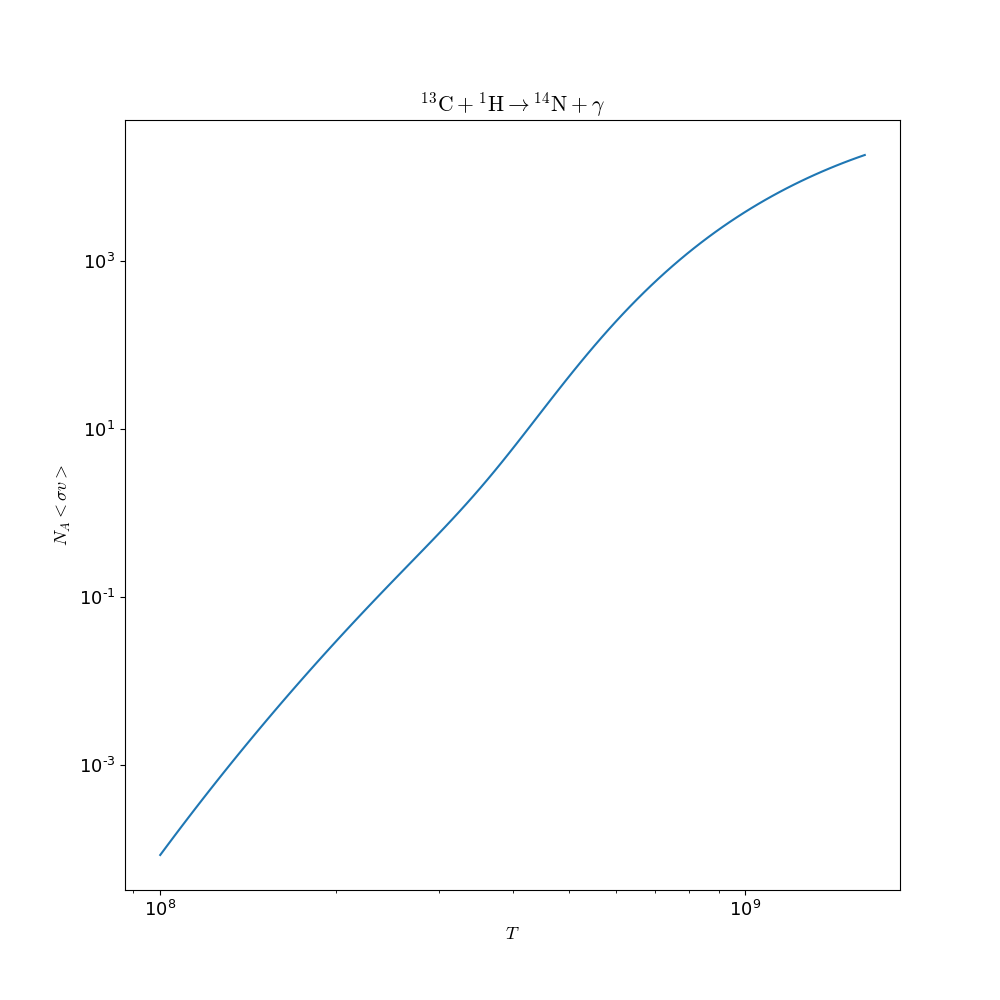
The following example reads in the ReacLib rate database and
gets the rate for C13(p,g)N14 and evaluates it at a
temperature of 1.e9 K and makes a plot of the T dependence:
```
In [1]: import pynucastro as pyna
In [2]: rl = pyna.ReacLibLibrary()
In [3]: c13pg = rl.get_rate_by_name("c13(p,g)n14")
In [4]: c13pg.eval(1.e9)
Out[4]: 3883.4778216250666
In [5]: fig = c13pg.plot()
In [6]: fig.savefig("c13pg.png")
```
The resulting figure is:
An extensive demonstration of the capabilities of pynucastro is shown in this notebook:
[](https://mybinder.org/v2/gh/pynucastro/pynucastro/main?filepath=examples%2Fpynucastro-examples.ipynb)
[pynucastro-examples.ipynb](https://github.com/pynucastro/pynucastro/blob/main/examples/pynucastro-examples.ipynb)
We can also interactively explore a reaction network. Here's an example of hot-CNO with breakout reactions:
[](https://mybinder.org/v2/gh/pynucastro/pynucastro/HEAD?labpath=examples%2Fhot-CNO-breakout-example.ipynb)
by increasing the temperature, you can see the transition from CNO to
hot-CNO (proton captures on C13 become faster than the beta decay) and
then the breakout of hot-CNO when the alpha capture on O14 becomes
faster than its decay.
## Installation
pynucastro is available on PyPI and can be installed via:
```
pip install pynucastro
```
Alternately, to install via source, you can do:
```
pip install .
```
for a systemwide install, or
```
pip install --user .
```
for a single-user install. This will put the pynucastro modules and library in
the default location python searches for packages.
### Requirements
pynucastro is supported on Python 3.10 or later and the following libraries:
* `numpy`
* `sympy`
* `scipy`
* `matplotlib`
* `networkx`
* `ipywidgets`
* `numba`
To build the documentation or run the unit tests, `sphinx` and
`pytest` are additionally required along with some supporting
packages. See the included `requirements.txt` file for a list of these
packages and versions. To install the packages from the requirements
file, do:
```
pip install -r requirements.txt
```
Is important to stress out that all the dependencies should be
installed before `pynucastro`, otherwise the installation should be
repeated.
## Contributing
We welcome contributions from anyone, including posting issues or
submitting pull requests to the [pynucastro github][1]. For more details
on how to contribute to pynucastro, please see [CONTRIBUTING.md][2].
[1]: https://github.com/pynucastro/pynucastro
[2]: https://github.com/pynucastro/pynucastro/blob/main/CONTRIBUTING.md
### Core Developers
People who make a number of substantive contributions (new features,
bug fixes, etc.) will be named "core developers" of pynucastro.
Core developers will be recognized in the following ways:
* invited to the group's slack team
* listed in the User's Guide and website as a core developer
* listed in the author list on the Zenodo DOI for the project
(as given in the .zenodo.json file)
* invited to co-author general code papers / proceedings describing
pynucastro. (Note: science papers that use pynucastro will always
be left to the science paper lead author to determine authorship).
If a core developer is inactive for 3 years, we may reassess their
status as a core developer.
## Getting Help
We use our [Github Discussions][3] page for requesting help and
interacting with the community.
[3]: https://github.com/pynucastro/pynucastro/discussions
Owner
- Name: Brendan Boyd
- Login: biboyd
- Kind: user
- Repositories: 3
- Profile: https://github.com/biboyd
Physics grad student at Stony Brook University
GitHub Events
Total
- Push event: 2
Last Year
- Push event: 2