https://github.com/biocomputingup/ensembletools
IDPEnsembleTools is a Python package designed to facilitate the loading, analysis, and comparison of multiple conformational ensembles of intrinsically disordered proteins (IDPs).
Science Score: 39.0%
This score indicates how likely this project is to be science-related based on various indicators:
-
○CITATION.cff file
-
✓codemeta.json file
Found codemeta.json file -
✓.zenodo.json file
Found .zenodo.json file -
✓DOI references
Found 3 DOI reference(s) in README -
○Academic publication links
-
○Committers with academic emails
-
○Institutional organization owner
-
○JOSS paper metadata
-
○Scientific vocabulary similarity
Low similarity (12.2%) to scientific vocabulary
Repository
IDPEnsembleTools is a Python package designed to facilitate the loading, analysis, and comparison of multiple conformational ensembles of intrinsically disordered proteins (IDPs).
Basic Info
Statistics
- Stars: 2
- Watchers: 2
- Forks: 1
- Open Issues: 0
- Releases: 0
Metadata Files
README.md
IDPEnsembleTools

 <!--
<!-- 
IDPEnsembleTools: An Open-Source Library for Analysis of Conformational Ensembles of Disordered Proteins
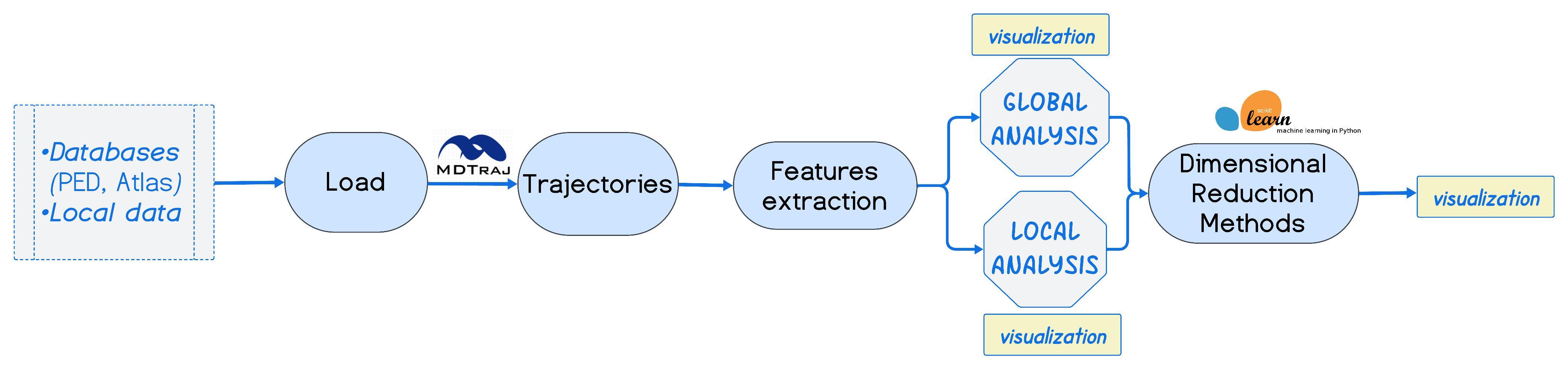
IDPEnsembleTools is a Python package designed to facilitate the loading, analysis, and comparison of multiple conformational ensembles of intrinsically disordered proteins (IDPs).
It supports various input formats such as .pdb, .xtc, and .dcd, and enables users to extract both global and local structural features, perform dimensionality reduction, and compute similarity scores between ensembles.
Documentation
Full documentation is available at:
https://bioComputingUP.github.io/EnsembleTools
Features
With IDPEnsembleTools, you can:
Extract global features of structural ensembles:
- Radius of gyration (Rg)
- Asphericity
- Prolateness
- End-to-end distance
Extract local features:
- Interatomic distances
- Phi–psi angles
- Alpha-helix content
Perform dimensionality reduction on ensemble features:
- PCA
- UMAP
- t-SNE
Compare structural ensembles using:
- Jensen-Shannon (JS) divergence
- Visualize similarity matrices
Example Notebooks
The notebooks/ directory contains a collection of Jupyter notebooks that demonstrate how to use the EnsembleTools package. These examples cover key functionalities such as ensemble comparison, dimensionality reduction (PCA, t-SNE, UMAP), feature extraction, and visualization customization. They serve both as tutorials and reproducible workflows for analyzing disordered protein ensembles.
| Notebook | Description | Link |
|------------------------------|-----------------------------------------------------------------------------------------------|------|
| comparing_ensembles.ipynb | Compare multiple conformational ensembles using selected metrics and visualizations. | View |
| featurization.ipynb | Generate numerical features from protein ensembles for downstream analysis. | View |
| kpca_analysis.ipynb | Perform Kernel PCA to capture non-linear variance in ensemble structures. | View |
| loading_data.ipynb | Load and preprocess ensemble data from various formats. | View |
| pca_analysis.ipynb | Principal Component Analysis (PCA) for dimensionality reduction and visualization. | View |
| plot_customization.ipynb | Customize plots for clarity and publication-quality visualizations. | View |
| sh3_example.ipynb | Case study: global and local analysis of the SH3 domain of the Drk protein. | View |
| tsne_analysis.ipynb | t-SNE embedding of ensemble features to explore local structure. | View |
| umap_analysis.ipynb | UMAP embedding of ensemble features and visualization. | View |
Installation
It is recommended to install idpet in a clean virtual environment to avoid conflicts with existing packages.
🔹 Option 1: Using conda (if you use Anaconda/Miniconda)
```bash
Create and activate a new conda environment
conda create -n idpet-env python=3.9 conda activate idpet-env
Install the package from PyPI
pip install idpet ```
🔹 Option 2: Using venv (standard Python)
```bash
Create a new virtual environment (Python 3.7+)
python -m venv idpet-env
Activate the environment
On Linux/macOS:
source idpet-env/bin/activate
On Windows:
idpet-env\Scripts\activate
Upgrade pip and install the package
pip install --upgrade pip pip install idpet ```
Developer Installation (from source)
bash
git clone https://github.com/BioComputingUP/EnsembleTools.git
cd idpet
pip install -e .
License
This project is licensed under the MIT License.
Owner
- Name: BioComputing Group, University of Padova
- Login: BioComputingUP
- Kind: organization
- Email: biocomp@bio.unipd.it
- Location: Italy
- Website: https://biocomputingup.it/
- Repositories: 31
- Profile: https://github.com/BioComputingUP
GitHub Events
Total
- Delete event: 7
- Push event: 31
- Fork event: 1
- Create event: 2
Last Year
- Delete event: 7
- Push event: 31
- Fork event: 1
- Create event: 2
Committers
Last synced: about 1 year ago
Top Committers
| Name | Commits | |
|---|---|---|
| Hamidreza Ghafouri | 8****h | 26 |
| AlexanderMon | m****r@g****m | 1 |
| Mojtaba Amini | m****i@g****e | 1 |
| Hamidreza Ghafouri | h****i@s****t | 1 |
Committer Domains (Top 20 + Academic)
Issues and Pull Requests
Last synced: 11 months ago
All Time
- Total issues: 0
- Total pull requests: 0
- Average time to close issues: N/A
- Average time to close pull requests: N/A
- Total issue authors: 0
- Total pull request authors: 0
- Average comments per issue: 0
- Average comments per pull request: 0
- Merged pull requests: 0
- Bot issues: 0
- Bot pull requests: 0
Past Year
- Issues: 0
- Pull requests: 0
- Average time to close issues: N/A
- Average time to close pull requests: N/A
- Issue authors: 0
- Pull request authors: 0
- Average comments per issue: 0
- Average comments per pull request: 0
- Merged pull requests: 0
- Bot issues: 0
- Bot pull requests: 0
Top Authors
Issue Authors
Pull Request Authors
Top Labels
Issue Labels
Pull Request Labels
Packages
- Total packages: 1
-
Total downloads:
- pypi 13 last-month
- Total dependent packages: 0
- Total dependent repositories: 0
- Total versions: 13
- Total maintainers: 1
pypi.org: idpet
A Python package for analysis of conformational ensembles of intrinsically disordered proteins
- Homepage: https://github.com/BioComputingUP/EnsembleTools
- Documentation: https://idpet.readthedocs.io/
- License: MIT License Copyright (c) [2025] [BioComputing UP] Permission is hereby granted, free of charge, to any person obtaining a copy of this software and associated documentation files (the "Software"), to deal in the Software without restriction, including without limitation the rights to use, copy, modify, merge, publish, distribute, sublicense, and/or sell copies of the Software, and to permit persons to whom the Software is furnished to do so, subject to the following conditions: The above copyright notice and this permission notice shall be included in all copies or substantial portions of the Software. THE SOFTWARE IS PROVIDED "AS IS", WITHOUT WARRANTY OF ANY KIND, EXPRESS OR IMPLIED, INCLUDING BUT NOT LIMITED TO THE WARRANTIES OF MERCHANTABILITY, FITNESS FOR A PARTICULAR PURPOSE AND NONINFRINGEMENT. IN NO EVENT SHALL THE AUTHORS OR COPYRIGHT HOLDERS BE LIABLE FOR ANY CLAIM, DAMAGES OR OTHER LIABILITY, WHETHER IN AN ACTION OF CONTRACT, TORT OR OTHERWISE, ARISING FROM, OUT OF OR IN CONNECTION WITH THE SOFTWARE OR THE USE OR OTHER DEALINGS IN THE SOFTWARE.
-
Latest release: 0.1.4
published 11 months ago