https://github.com/bioconductor-source/tadcompare
Science Score: 26.0%
This score indicates how likely this project is to be science-related based on various indicators:
-
○CITATION.cff file
-
✓codemeta.json file
Found codemeta.json file -
○.zenodo.json file
-
✓DOI references
Found 2 DOI reference(s) in README -
○Academic publication links
-
○Academic email domains
-
○Institutional organization owner
-
○JOSS paper metadata
-
○Scientific vocabulary similarity
Low similarity (9.8%) to scientific vocabulary
Repository
Basic Info
- Host: GitHub
- Owner: bioconductor-source
- License: other
- Language: R
- Default Branch: devel
- Size: 33.4 MB
Statistics
- Stars: 0
- Watchers: 2
- Forks: 0
- Open Issues: 0
- Releases: 0
Metadata Files
README.md
Cresswell, Kellen G., and Mikhail G. Dozmorov. “TADCompare: An R Package for Differential and Temporal Analysis of Topologically Associated Domains.” Frontiers in Genetics 11 (March 10, 2020): 158.
TADCompare is an R package for differential Topologically Associated Domain (TAD) boundary detection between two Hi-C contact matrices and across a time course. It also ecables consensus TAD boundary calling across multiple Hi-C replicates. It has three main functions, TADCompare for differential TAD analysis, TimeCompare for time course analysis, and ConsensusTADs for consensus boundary identification. The DiffPlot function allows for visualizing the differences between two contact matrices.
Installation
``` install.packages(c('dplyr', 'PRIMME', 'cluster', 'Matrix', 'magrittr', 'HiCcompare'))
if (!requireNamespace("BiocManager", quietly=TRUE)) install.packages("BiocManager") BiocManager::install("TADCompare", version = "devel") library(TADCompare) ```
Input
There are three types of input accepted:
- n x n contact matrices
- n x (n+3) contact matrices
- 3-column sparse contact matrices
It is required that the same format be used for each of the inputs to a given function, or an error will occur. These formats are explained in depth in the Input Data vignette.
Usage
Please, refer to the TADCompare vignette for an in depth tutorial.
TADcompare
Differential TAD detection (TADCompare) involves identifying differing TAD boundaries between two contact matrices. Accordingly, the input is the two contact matrices that we would like to find these boundaries in and their corresponding resolution. The output is a dataset containing boundary scores for all regions and a dataset containing all differential and non-differential TAD boundaries.
```
Load example contact matrices
data("GM12878.40kb.raw.chr2") data("IMR90.40kb.raw.chr2")
Find differential TADs
TD_Compare <- TADCompare(GM12878.40kb.raw.chr2, IMR90.40kb.raw.chr2, resolution = 40000) ```
We can then print the set of regions with at least one TAD boundary:
``` head(TDCompare$TADFrame)
Boundary GapScore TADScore1 TADScore2 Differential EnrichedIn Type
1 8200000 -2.0245884 0.02537611 1.596684 Differential Matrix 2
And, visualize a specific region on a chromosome:
```
Visualizing the results
DiffPlot(taddiff = TDCompare, contmat1 = GM12878.40kb.raw.chr2, contmat2 = IMR90.40kb.raw.chr2, resolution = 40000, startcoord = 8000000, endcoord = 16000000, showtypes = TRUE, pointsize = 5, palette = "RdYlBu", rel_heights = c(1, 2)) ```
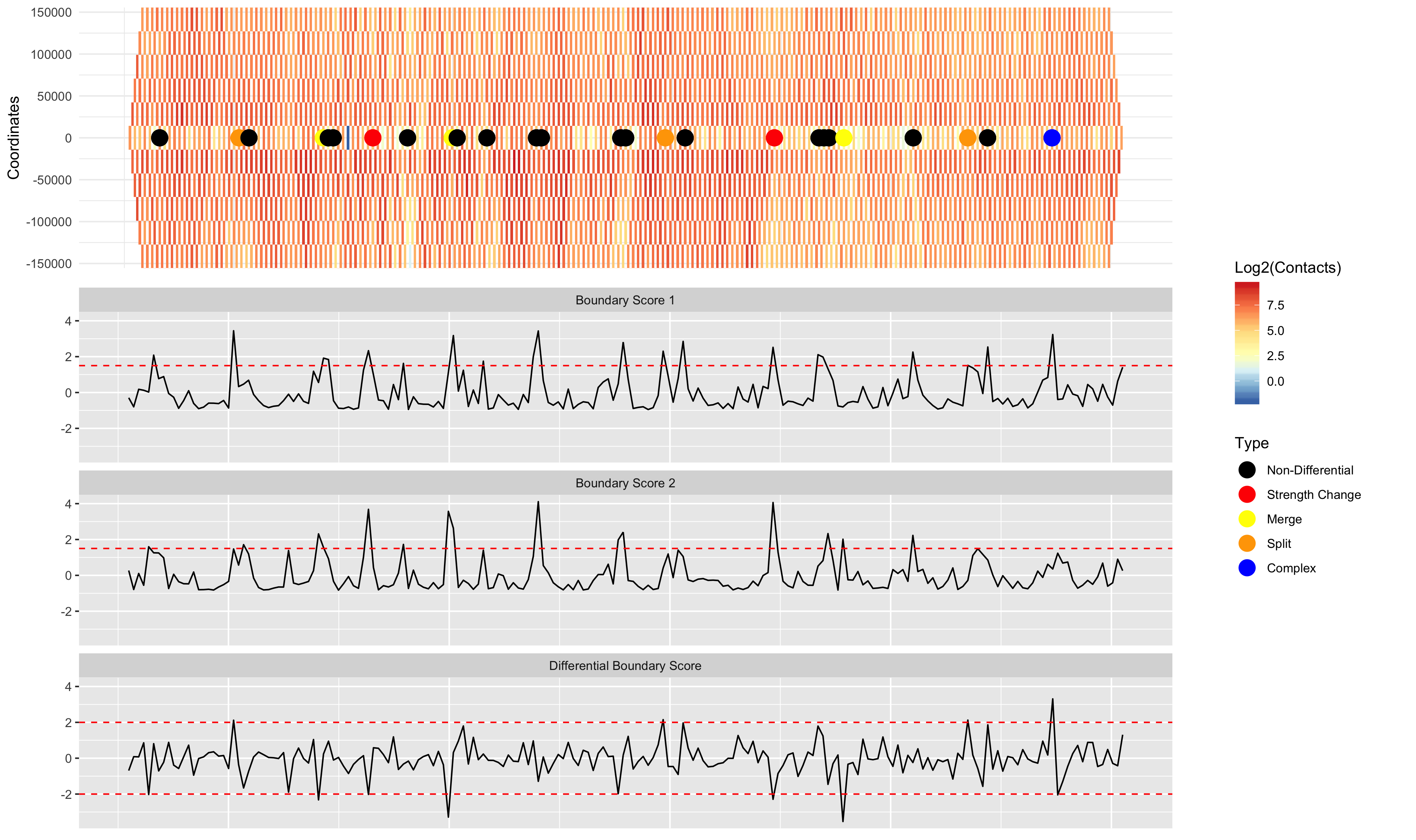
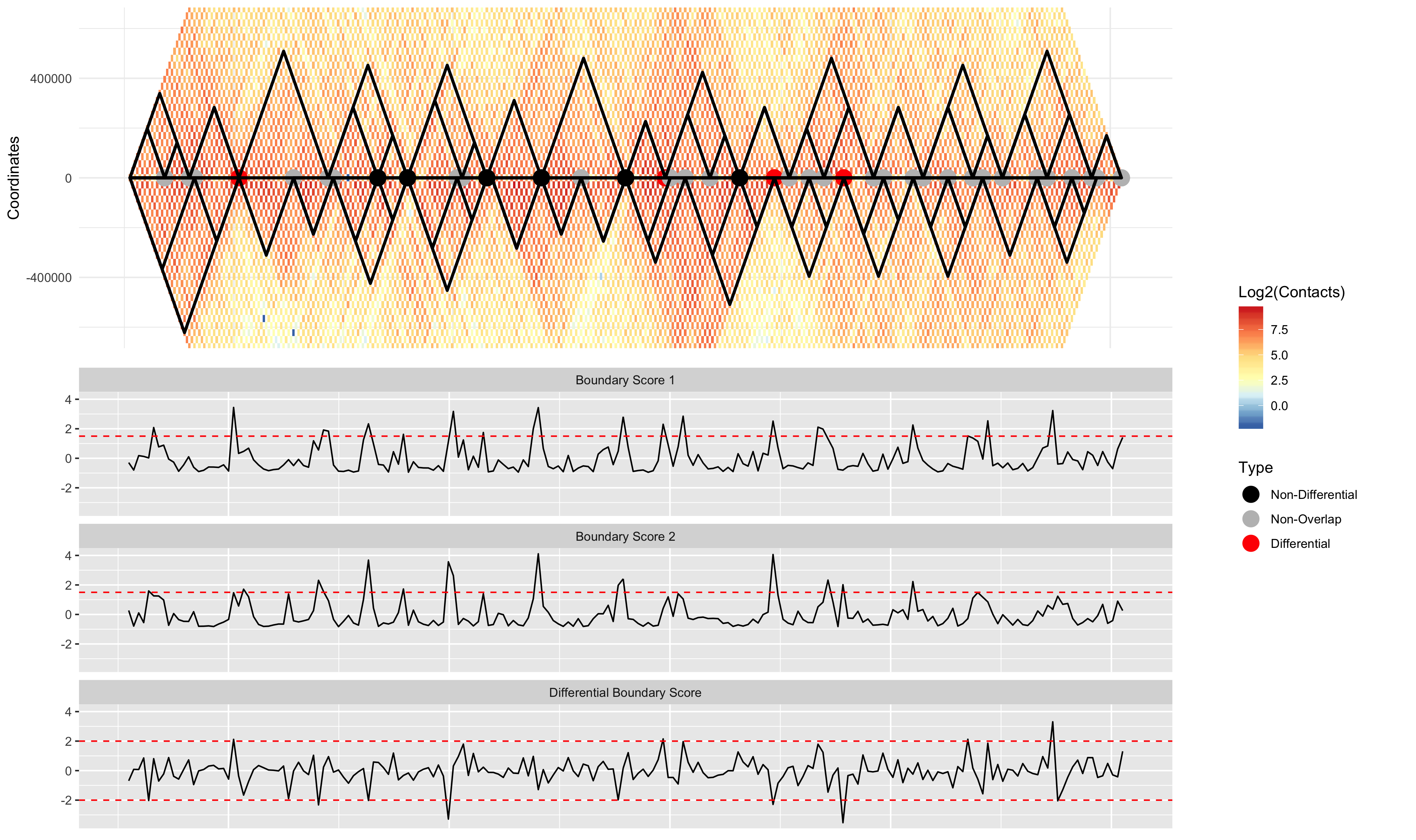
TADCompare detects TAD boundaries by selecting regions with TAD boundary scores above a threshold (1.5 by default). An alternative way of running TADCompare is to call TAD boundaries using a separate TAD caller, and then compare those pre-defined TAD boundaries. The example below uses the SpectralTAD TAD caller to pre-define TAD boundaries.
```
Call TADs using SpectralTAD
bedcoords1 = bindrows(SpectralTAD(GM12878.40kb.raw.chr2, chr = "chr2", levels = 3)) bedcoords2 = bindrows(SpectralTAD(IMR90.40kb.raw.chr2, chr = "chr2", levels = 3))
Placing the data in a list for the plotting procedure
CombinedBed = list(bedcoords1, bed_coords2)
Running TADCompare with pre-specified TADs
TDCompare <- TADCompare(GM12878.40kb.raw.chr2, IMR90.40kb.raw.chr2, resolution = 40000, pretads = Combined_Bed)
Visualizing the results
DiffPlot(taddiff = TDCompare, contmat1 = GM12878.40kb.raw.chr2, contmat2 = IMR90.40kb.raw.chr2, resolution = 40000, startcoord = 8000000, endcoord = 16000000, pretad = CombinedBed, showtypes = FALSE, pointsize = 5, palette = "RdYlBu", rel_heights = c(1, 1)) ```
TimeCompare
TimeCompare takes data from at least four time points and identifies all regions with at least one TAD. Using this information, it then classifies each region, based on how they change over time, into 6 categories (Dynamic, Highly Common, Early Appearing/Disappearing, and Late Appearing/Disappearing).
data("time_mats")
Time_Mats = TimeCompare(time_mats, resolution = 50000)
head(Time_Mats$TAD_Bounds)
The resulting output is:
  Coordinate   Sample 1   Sample 2   Sample 3   Sample 4 Consensus_Score               Category
1   16900000 -0.6733709 -0.7751516 -0.7653696 15.1272253     -0.71937026     Late Appearing TAD
2   17350000  3.6406563  2.3436229  3.0253018  0.7840556      2.68446232 Early Disappearing TAD
3   18850000  0.6372268  6.3662245 -0.7876844  6.9255446      3.50172563    Early Appearing TAD
4   20700000  1.5667926  3.0968633  2.9130479  2.8300136      2.87153075            Dynamic TAD
5   22000000 -1.0079676 -0.7982571  0.6007264  3.1909178     -0.09876534     Late Appearing TAD
6   22050000 -1.0405532 -0.9892242 -0.2675822  4.2737511     -0.62840320     Late Appearing TAD
For each coordinate, we have the individual boundary score for each sample (Sample x), consensus boundary score (Consensus_Score), and category (Category).
ConsensusTADs
ConsensusTADs uses a novel metric called the consensus boundary score to identify TAD boundaries consistently defined across multiple contact matrices. It can operate on an unlimited number of replicates, time points, or conditions.
data("time_mats")
con_tads = ConsensusTADs(time_mats, resolution = 50000)
head(con_tads$Consensus)
 Coordinate  Sample 1 Sample 2   Sample 3 Sample 4 Consensus_Score
1   18850000 0.6372268 6.366224 -0.7876844 6.925545        3.501726
2   28450000 3.1883107 3.313883  3.1711743 3.913620        3.251097
3   30000000 2.0253285 3.477652  2.9314321 3.926354        3.204542
4   32350000 2.6978488 2.455860  3.5131909 3.550942        3.105520
5   36900000 3.0731406 3.153978  3.1861296 4.489285        3.170054
The results are a set of coordinates with significant consensus TADs. Columns starting with "Sample" refer to the individual boundary scores. Consensus_Score is the consensus boundary score across all samples.
Downstream analysis
The output of TADcompare and TimeCompare functions may be used for a range of analyses on genomic regions. One common one is gene ontology enrichment analysis to determine the pathways in which genes near TAD boundaries occur in. An example is shown in the Ontology_Analysis vignette
Availability
The developmental version is available at https://github.com/cresswellkg/TADCompare, the stable version is available at https://github.com/dozmorovlab/TADCompare. The master branch contains code that can be installed into the current R version 3.6 and above. The Bioconductor branch contains code with the Depends: R (>= 4.0) requirement needed for the Bioconductor submission.
Contributions and Support
Suggestions for new features and bug reports are welcome. Please, create a new issue for any of these or contact the author directly: @mdozmorov (mdozmorov[at]vcu[dot]edu)
Contributors
Authors: @cresswellkg (cresswellkg[at]vcu[dot]edu) & @mdozmorov (mikhail.dozmorov[at]vcuhealth[dot]org)
Owner
- Name: (WIP DEV) Bioconductor Packages
- Login: bioconductor-source
- Kind: organization
- Email: maintainer@bioconductor.org
- Website: https://bioconductor.org
- Repositories: 1
- Profile: https://github.com/bioconductor-source
Source code for packages accepted into Bioconductor
GitHub Events
Total
Last Year
Dependencies
- R >= 4.0 depends
- HiCcompare * imports
- Matrix * imports
- PRIMME * imports
- RColorBrewer * imports
- cluster * imports
- cowplot * imports
- dplyr * imports
- ggplot2 * imports
- ggpubr * imports
- magrittr * imports
- reshape2 * imports
- tidyr * imports
- BiocStyle * suggests
- SpectralTAD * suggests
- covr * suggests
- knitr * suggests
- magick * suggests
- microbenchmark * suggests
- pheatmap * suggests
- qpdf * suggests
- rmarkdown * suggests
- testthat * suggests