radioactivedecay
radioactivedecay: A Python package for radioactive decay calculations - Published in JOSS (2022)
Science Score: 46.0%
This score indicates how likely this project is to be science-related based on various indicators:
-
○CITATION.cff file
-
✓codemeta.json file
Found codemeta.json file -
○.zenodo.json file
-
✓DOI references
Found 11 DOI reference(s) in README -
✓Academic publication links
Links to: joss.theoj.org -
✓Committers with academic emails
1 of 5 committers (20.0%) from academic institutions -
○Institutional organization owner
-
○JOSS paper metadata
-
○Scientific vocabulary similarity
Low similarity (15.7%) to scientific vocabulary
Keywords
Scientific Fields
Repository
A Python package for radioactive decay modelling that supports 1252 radionuclides, decay chains, branching, and metastable states.
Basic Info
- Host: GitHub
- Owner: radioactivedecay
- License: mit
- Language: Python
- Default Branch: main
- Homepage: https://pypi.org/project/radioactivedecay/
- Size: 24.8 MB
Statistics
- Stars: 102
- Watchers: 11
- Forks: 30
- Open Issues: 6
- Releases: 47
Topics
Metadata Files
README.md










radioactivedecay is a Python package for radioactive decay calculations.
It supports decay chains of radionuclides, metastable states and branching
decays. By default it uses the decay data from ICRP Publication 107, which
contains 1252 radionuclides of 97 elements, and atomic mass data from the
Atomic Mass Data Center.
The code solves the radioactive decay differential equations analytically using NumPy and SciPy linear algebra routines. There is also a high numerical precision calculation mode employing SymPy routines. This gives more accurate results for decay chains containing radionuclides with orders of magnitude differences between the half-lives.
This is free-to-use open source software. It was created for engineers, technicians and researchers who work with radioactivity, and for educational use.
- Full Documentation: https://radioactivedecay.github.io/
Installation
radioactivedecay requires Python 3.9+. Install radioactivedecay from
the Python Package Index using
pip:
console
$ pip install radioactivedecay
or from conda-forge:
console
$ conda install -c conda-forge radioactivedecay
Either command will attempt to install the dependencies (Matplotlib, NetworkX, NumPy, Pandas, SciPy, Setuptools & SymPy) if they are not already present in the environment.
Usage
Decay calculations
Create an Inventory of radionuclides and decay it as follows:
```pycon
import radioactivedecay as rd Mo99t0 = rd.Inventory({'Mo-99': 2.0}, 'Bq') Mo99t1 = Mo99t0.decay(20.0, 'h') Mo99t1.activities('Bq') {'Mo-99': 1.6207863893776937, 'Ru-99': 0.0, 'Tc-99': 9.05304236308454e-09, 'Tc-99m': 1.3719829376710406} ```
An Inventory of 2.0 Bq of Mo-99 was decayed for 20 hours, producing the
radioactive progeny Tc-99m and Tc-99, and the stable nuclide Ru-99.
We supplied 'h' as an argument to decay() to specify the decay time
period had units of hours. Supported time units include 'μs', 'ms',
's', 'm', 'h', 'd', 'y' etc. Note seconds ('s') is the
default if no unit is supplied to decay().
Use cumulative_decays() to calculate the total number of atoms of each
radionuclide that decay over the decay time period:
```pycon
Mo99t0.cumulativedecays(20.0, 'h') {'Mo-99': 129870.3165339939, 'Tc-99m': 71074.31925850797, 'Tc-99': 0.0002724635511147602} ```
Radionuclides can be specified in four equivalent ways in radioactivedecay:
three variations of nuclide strings or by
canonical ids. For example, the
following are equivalent ways of specifying 222Rn and
192nIr:
'Rn-222','Rn222','222Rn',862220000,'Ir-192n','Ir192n','192nIr',771920002.
Inventories can be created by supplying activity ('Bq', 'Ci',
'dpm'...), mass ('g', 'kg'...), mole ('mol', 'kmol'...)
units, or numbers of nuclei ('num') to the Inventory() constructor. Use
the methods activities(), masses(), moles(), numbers(),
activity_fractions(), mass_fractions() and mole_fractions() to
obtain the contents of the inventory in different formats:
```pycon
H3t0 = rd.Inventory({'H-3': 3.0}, 'g') H3t1 = H3t0.decay(12.32, 'y') H3t1.masses('g') {'H-3': 1.5, 'He-3': 1.4999900734297729} H3t1.massfractions() {'H-3': 0.5000016544338455, 'He-3': 0.4999983455661545}
C14t0 = rd.Inventory({'C-14': 3.2E24}, 'num') C14t1 = C14t0.decay(3000, 'y') C14t1.moles('mol') {'C-14': 3.6894551567795797, 'N-14': 1.6242698581767292} C14t1.molefractions() {'C-14': 0.6943255713073281, 'N-14': 0.3056744286926719} ```
Plotting decay graphs
Use the plot() method to graph of the decay of an inventory over time:
```pycon
Mo99_t0.plot(20, 'd', yunits='Bq') ```
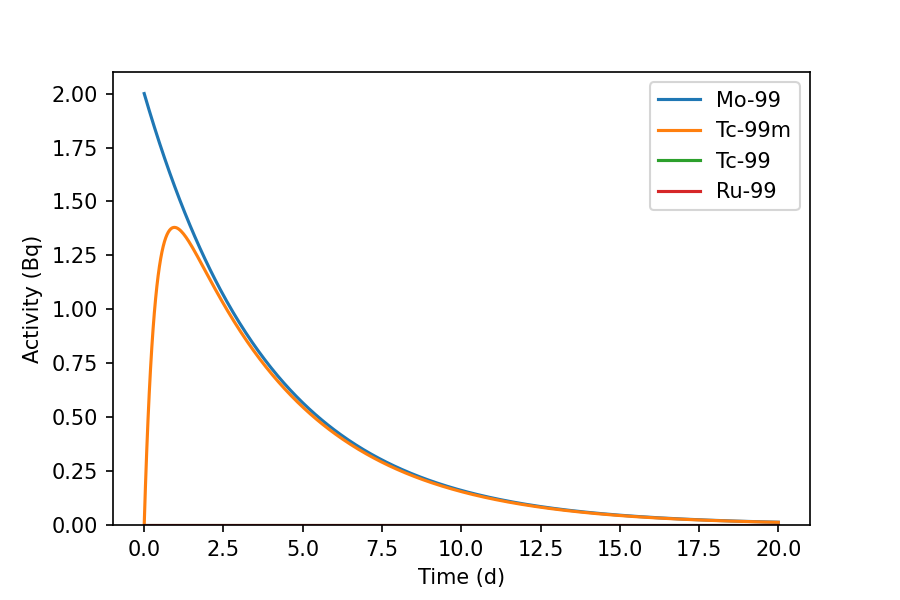
The graph shows the decay of Mo-99 over 20 days, leading to the ingrowth of Tc-99m and a trace quantity of Tc-99. The activity of Ru-99 is strictly zero as it is the stable nuclide at the end of the decay chain. Graphs are drawn using Matplotlib.
Fetching decay data
The Nuclide class can be used to fetch decay information for
individual radionuclides, e.g. for Rn-222:
```pycon
nuc = rd.Nuclide('Rn-222') nuc.halflife('s') 330350.4 nuc.halflife('readable') '3.8235 d' nuc.progeny() ['Po-218'] nuc.branchingfractions() [1.0] nuc.decaymodes() ['α'] nuc.Z # proton number 86 nuc.A # nucleon number 222 nuc.atomic_mass # atomic mass in g/mol 222.01757601699998 ```
There are similar inventory methods for fetching decay data:
```pycon
Mo99t1.halflives('readable') {'Mo-99': '65.94 h', 'Ru-99': 'stable', 'Tc-99': '0.2111 My', 'Tc-99m': '6.015 h'} Mo99t1.progeny() {'Mo-99': ['Tc-99m', 'Tc-99'], 'Ru-99': [], 'Tc-99': ['Ru-99'], 'Tc-99m': ['Tc-99', 'Ru-99']} Mo99t1.branchingfractions() {'Mo-99': [0.8773, 0.1227], 'Ru-99': [], 'Tc-99': [1.0], 'Tc-99m': [0.99996, 3.7e-05]} Mo99t1.decay_modes() {'Mo-99': ['β-', 'β-'], 'Ru-99': [], 'Tc-99': ['β-'], 'Tc-99m': ['IT', 'β-']} ```
Decay chain diagrams
The Nuclide class includes a plot() method for drawing decay chain
diagrams:
```pycon
nuc = rd.Nuclide('Mo-99') nuc.plot() ```
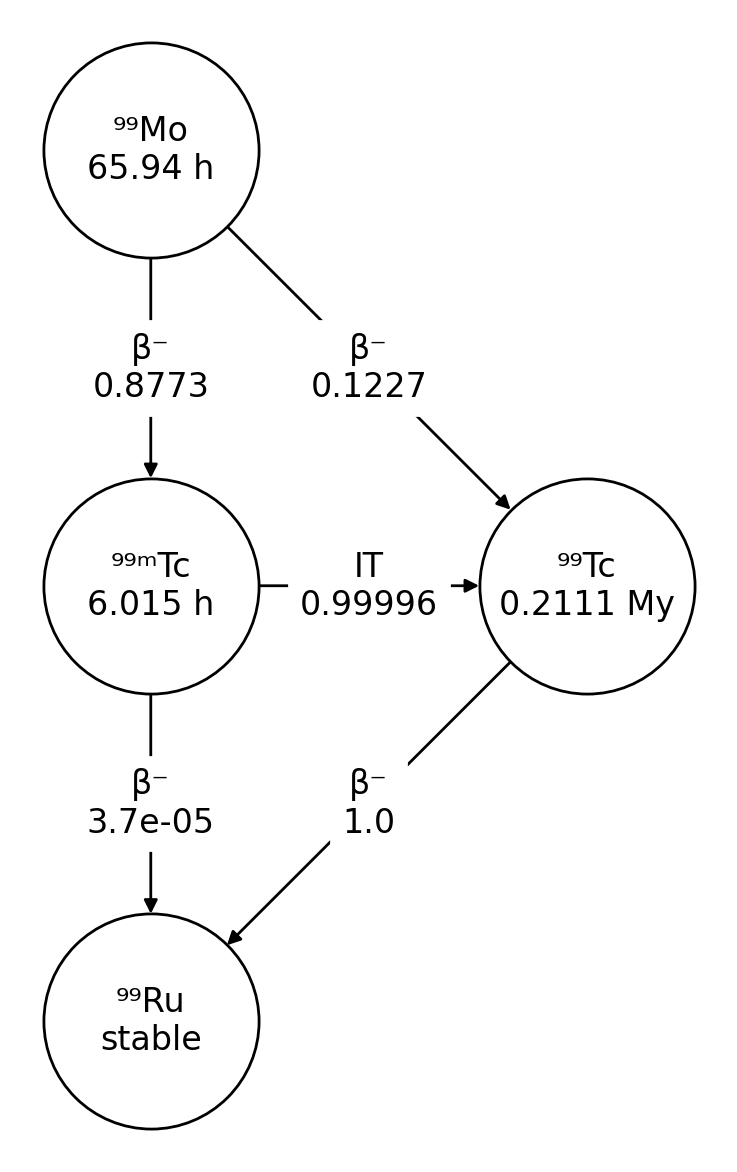
These diagrams are drawn using NetworkX and Matplotlib.
High numerical precision decay calculations
radioactivedecay includes an InventoryHP class for high numerical
precision calculations. This class can give more reliable decay calculation
results for chains containing long- and short-lived radionuclides:
```pycon
U238t0 = rd.InventoryHP({'U-238': 1.0}) U238t1 = U238t0.decay(10.0, 'd') U238t1.activities() {'At-218': 1.4511675857141352e-25, 'Bi-210': 1.8093327888942224e-26, 'Bi-214': 7.09819414496093e-22, 'Hg-206': 1.9873081129046843e-33, 'Pa-234': 0.00038581180879502017, 'Pa-234m': 0.24992285949158477, 'Pb-206': 0.0, 'Pb-210': 1.0508864357335218e-25, 'Pb-214': 7.163682655782086e-22, 'Po-210': 1.171277829871092e-28, 'Po-214': 7.096704966148592e-22, 'Po-218': 7.255923469955255e-22, 'Ra-226': 2.6127168262000313e-21, 'Rn-218': 1.4511671865210924e-28, 'Rn-222': 7.266530698712501e-22, 'Th-230': 8.690585458641225e-16, 'Th-234': 0.2499481473619856, 'Tl-206': 2.579902288672889e-32, 'Tl-210': 1.4897029111914831e-25, 'U-234': 1.0119788393651999e-08, 'U-238': 0.9999999999957525} ```
How radioactivedecay works
radioactivedecay calculates an analytical solution to the radioactive decay
differential equations using linear algebra operations. It implements the
method described in this paper:
M Amaku, PR Pascholati & VR Vanin, Comp. Phys. Comm. 181, 21-23
(2010). See the
theory docpage for more
details.
It uses NumPy and SciPy routines for standard decay calculations (double-precision floating-point operations), and SymPy for arbitrary numerical precision calculations.
By default radioactivedecay uses decay data from
ICRP Publication 107
(2008) and atomic mass
data from the Atomic Mass Data Center
(AMDC - AME2020 and Nubase2020 evaluations).
The datasets repo contains
Jupyter Notebooks for creating decay datasets that can be used by
radioactivedecay, e.g. ICRP
107.
The comparisons repo
contains some checks of radioactivedecay against
PyNE
and Radiological
Toolbox.
Tests
From the base directory run:
console
$ python -m unittest discover
License
radioactivedecay is open source software released under the MIT License.
See LICENSE
file for details.
The default decay data used by radioactivedecay (ICRP-107) is copyright
2008 A. Endo and K.F. Eckerman and distributed under a separate
license.
The default atomic mass data is from AMDC
(license).
Citation
If you find this package useful for your research, please consider citing the
paper on radioactivedecay published in the
Journal of Open Source Software:
Alex Malins & Thom Lemoine, radioactivedecay: A Python package for radioactive decay calculations. Journal of Open Source Software, 7 (71), 3318 (2022). DOI: 10.21105/joss.03318.
Contributing
Contributors are welcome to fix bugs, add new features or make feature requests. Please open an Issue, Pull Request or new Discussions thread at GitHub repository.
Please read the contribution guidelines.
Owner
- Name: radioactivedecay
- Login: radioactivedecay
- Kind: organization
- Email: radioactivedecay@alexmalinsREMOVETHIS.com
- Website: radioactivedecay.github.io
- Repositories: 3
- Profile: https://github.com/radioactivedecay
Radioactive decay calcuations in Python
GitHub Events
Total
- Create event: 3
- Release event: 2
- Issues event: 7
- Watch event: 18
- Delete event: 3
- Issue comment event: 32
- Push event: 9
- Pull request review event: 10
- Pull request review comment event: 12
- Pull request event: 7
- Fork event: 9
Last Year
- Create event: 3
- Release event: 2
- Issues event: 7
- Watch event: 18
- Delete event: 3
- Issue comment event: 32
- Push event: 9
- Pull request review event: 10
- Pull request review comment event: 12
- Pull request event: 7
- Fork event: 9
Committers
Last synced: over 1 year ago
Top Committers
| Name | Commits | |
|---|---|---|
| Alex Malins | g****b@a****m | 258 |
| Thom Lemoine | l****m@w****u | 36 |
| Ian Cullen | i****n@g****m | 15 |
| Bernardo Gameiro | 3****0 | 1 |
| Alberto | 4****3 | 1 |
Committer Domains (Top 20 + Academic)
Issues and Pull Requests
Last synced: 11 months ago
All Time
- Total issues: 21
- Total pull requests: 89
- Average time to close issues: 21 days
- Average time to close pull requests: 1 day
- Total issue authors: 16
- Total pull request authors: 6
- Average comments per issue: 2.9
- Average comments per pull request: 0.85
- Merged pull requests: 87
- Bot issues: 0
- Bot pull requests: 0
Past Year
- Issues: 5
- Pull requests: 8
- Average time to close issues: 1 day
- Average time to close pull requests: 3 days
- Issue authors: 4
- Pull request authors: 3
- Average comments per issue: 1.2
- Average comments per pull request: 2.0
- Merged pull requests: 6
- Bot issues: 0
- Bot pull requests: 0
Top Authors
Issue Authors
- danieldjewell (3)
- alexmalins (2)
- BishopWolf (2)
- munkm (2)
- exaos (1)
- radioactivedecay-github (1)
- atharva-2001 (1)
- lemointm (1)
- shenbo (1)
- JWingUtk (1)
- jvavrek (1)
- shyamd (1)
- tabaker99 (1)
- Cs137 (1)
- snuetzmann (1)
Pull Request Authors
- alexmalins (82)
- lemointm (6)
- php1ic (3)
- tristan-gardner (2)
- alberto743 (2)
- BGameiro2000 (1)
Top Labels
Issue Labels
Pull Request Labels
Packages
- Total packages: 2
-
Total downloads:
- pypi 7,638 last-month
-
Total dependent packages: 2
(may contain duplicates) -
Total dependent repositories: 3
(may contain duplicates) - Total versions: 66
- Total maintainers: 1
pypi.org: radioactivedecay
A Python package for radioactive decay modelling that supports 1252 radionuclides, decay chains, branching, and metastable states.
- Homepage: https://github.com/radioactivedecay/radioactivedecay
- Documentation: https://radioactivedecay.github.io
- License: MIT License,Other/Proprietary License
-
Latest release: 0.6.1
published over 1 year ago
Rankings
Maintainers (1)
conda-forge.org: radioactivedecay
A Python package for radioactive decay modelling that supports 1252 radionuclides, decay chains, branching, and metastable states.
- Homepage: https://github.com/radioactivedecay/radioactivedecay
- License: MIT AND LicenseRef-AMDC AND LicenseRef-ICRP-07
-
Latest release: 0.4.16
published over 3 years ago
Rankings
Dependencies
- importlib_resources *
- matplotlib *
- networkx *
- numpy *
- scipy *
- setuptools *
- sympy *
- black * development
- coverage * development
- sphinx *
- sphinx-rtd-theme *
- actions/checkout v2 composite
- actions/setup-python v2 composite
- actions/checkout v2 composite
- actions/setup-python v2 composite
- codecov/codecov-action v2 composite
- actions/checkout v2 composite
- actions/setup-python v2 composite
- isort/isort-action master composite
- psf/black stable composite
- actions/checkout v2 composite
- actions/setup-python v2 composite
- actions/checkout v2 composite
- actions/setup-python v2 composite
- actions/checkout v2 composite
- actions/setup-python v2 composite