madminer
Machine learning–based inference toolkit for particle physics
Science Score: 77.0%
This score indicates how likely this project is to be science-related based on various indicators:
-
✓CITATION.cff file
Found CITATION.cff file -
✓codemeta.json file
Found codemeta.json file -
✓.zenodo.json file
Found .zenodo.json file -
✓DOI references
Found 5 DOI reference(s) in README -
✓Academic publication links
Links to: arxiv.org, zenodo.org -
✓Committers with academic emails
6 of 23 committers (26.1%) from academic institutions -
○Institutional organization owner
-
○JOSS paper metadata
-
○Scientific vocabulary similarity
Low similarity (15.6%) to scientific vocabulary
Keywords from Contributors
Repository
Machine learning–based inference toolkit for particle physics
Basic Info
- Host: GitHub
- Owner: madminer-tool
- License: mit
- Language: Python
- Default Branch: main
- Homepage: https://arxiv.org/abs/1907.10621
- Size: 105 MB
Statistics
- Stars: 87
- Watchers: 8
- Forks: 45
- Open Issues: 32
- Releases: 49
Metadata Files
README.md
MadMiner: ML based inference for particle physics
By Johann Brehmer, Felix Kling, Irina Espejo, Sinclert Pérez, and Kyle Cranmer







Introduction
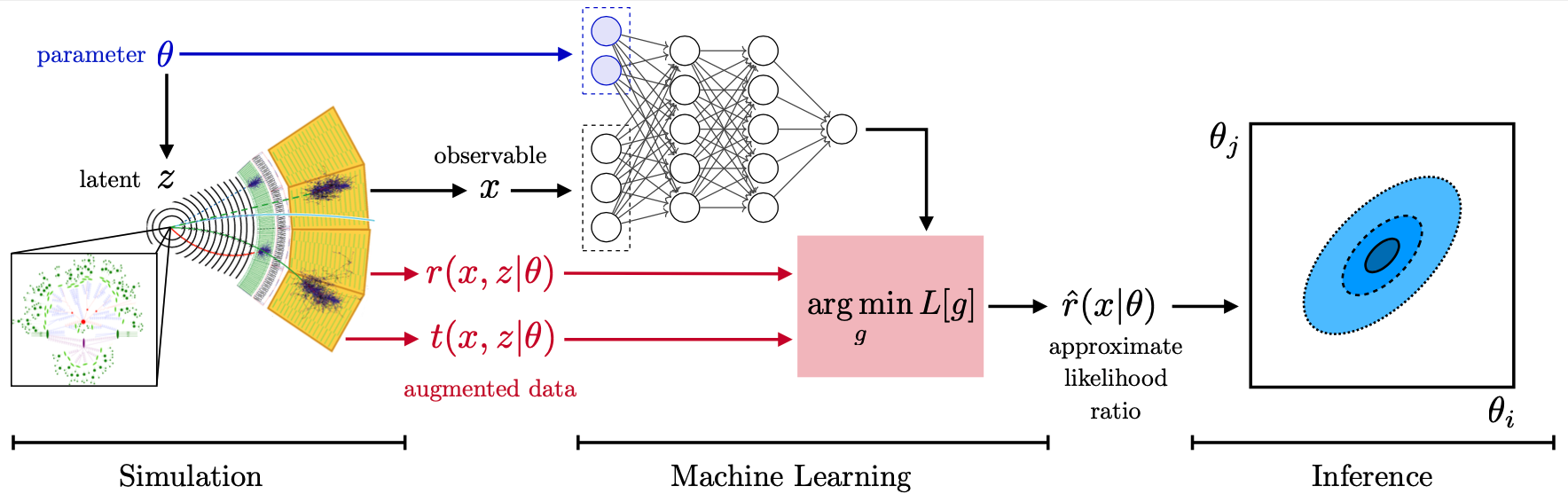
Particle physics processes are usually modeled with complex Monte-Carlo simulations of the hard process, parton shower, and detector interactions. These simulators typically do not admit a tractable likelihood function: given a (potentially high-dimensional) set of observables, it is usually not possible to calculate the probability of these observables for some model parameters. Particle physicists usually tackle this problem of "likelihood-free inference" by hand-picking a few "good" observables or summary statistics and filling histograms of them. But this conventional approach discards the information in all other observables and often does not scale well to high-dimensional problems.
In the three publications "Constraining Effective Field Theories with Machine Learning", "A Guide to Constraining Effective Field Theories with Machine Learning", and "Mining gold from implicit models to improve likelihood-free inference", a new approach has been developed. In a nutshell, additional information is extracted from the simulations that is closely related to the matrix elements that determine the hard process. This "augmented data" can be used to train neural networks to efficiently approximate arbitrary likelihood ratios. We playfully call this process "mining gold" from the simulator, since this information may be hard to get, but turns out to be very valuable for inference.
But the gold does not have to be hard to mine: MadMiner automates these modern multivariate inference strategies. It wraps around the simulators MadGraph and Pythia, with different options for the detector simulation. It streamlines all steps in the analysis chain from the simulation to the extraction of the augmented data, their processing, the training and evaluation of the neural networks, and the statistical analysis are implemented.
Resources
Paper
Our main publication MadMiner: Machine-learning-based inference for particle physics provides an overview over this package. We recommend reading it first before jumping into the code.
Installation instructions
Please have a look at our [installation instructions][docs-installation-guide].
Tutorials
In the examples folder in this repository, we provide two tutorials. The first is called Toy simulator, and it is based on a toy problem rather than a full particle-physics simulation. It demonstrates inference with MadMiner without spending much time on the more technical steps of running the simulation. The second, called Particle physics, shows all steps of a particle-physics analysis with MadMiner.
These examples are the basis of the online tutorial built on Jupyter Books. It also walks through how to run MadMiner using Docker so that you do not have to install Fortran, MadGraph, Pythia, Delphes, etc. You can even run it with no install using Binder.
Documentation
The madminer API is documented on Read the Docs.
Support
If you have any questions, please chat to us in our Gitter community.
Citations
If you use MadMiner, please cite our main publication,
@article{Brehmer:2019xox,
      author         = "Brehmer, Johann and Kling, Felix and Espejo, Irina and Cranmer, Kyle",
      title          = "{MadMiner: Machine learning-based inference for particle physics}",
      journal        = "Comput. Softw. Big Sci.",
      volume         = "4",
      year           = "2020",
      number         = "1",
      pages          = "3",
      doi            = "10.1007/s41781-020-0035-2",
      eprint         = "1907.10621",
      archivePrefix  = "arXiv",
      primaryClass   = "hep-ph",
      SLACcitation   = "%%CITATION = ARXIV:1907.10621;%%"
}
The code itself can be cited as
@misc{MadMiner_code,
      author         = "Brehmer, Johann and Kling, Felix and Espejo, Irina and Perez, Sinclert and Cranmer, Kyle",
      title          = "{MadMiner}",
      doi            = "10.5281/zenodo.1489147",
      url            = {https://github.com/madminer-tool/madminer}
}
The main references for the implemented inference techniques are the following:
- CARL: 1506.02169.
- MAF: 1705.07057.
- CASCAL, RASCAL, ROLR, SALLY, SALLINO, SCANDAL:
- ALICE, ALICES: 1808.00973.
Acknowledgements
We are immensely grateful to all contributors and bug reporters! In particular, we would like to thank Zubair Bhatti, Philipp Englert, Lukas Heinrich, Alexander Held, Samuel Homiller and Duccio Pappadopulo.
The SCANDAL inference method is based on Masked Autoregressive Flows, where our implementation is a PyTorch port of the original code by George Papamakarios, available at this repository.

Owner
- Name: Madminer
- Login: madminer-tool
- Kind: organization
- Website: https://madminer-tool.github.io/madminer-tutorial
- Repositories: 6
- Profile: https://github.com/madminer-tool
Machine learning–based inference toolkit for particle physics
Citation (CITATION.cff)
cff-version: 1.2.0
message: "If you use this software, please cite it as below."
type: software
authors:
- family-names: "Brehmer"
  given-names: "Johann"
  affiliation: "New York University"
- family-names: "Kling"
  given-names: "Felix"
  affiliation: "University of Arizona"
- family-names: "Espejo"
  given-names: "Irina"
  affiliation: "New York University"
- family-names: "Perez"
  given-names: "Sinclert"
  affiliation: "New York University"
- family-names: "Cranmer"
  given-names: "Kyle"
  affiliation: "New York University"
title: "MadMiner"
doi: 10.5281/zenodo.1489147
url: https://github.com/madminer-tool/madminer
license: "MIT"
GitHub Events
Total
- Watch event: 1
- Delete event: 2
- Issue comment event: 2
- Pull request event: 4
- Fork event: 1
- Create event: 2
Last Year
- Watch event: 1
- Delete event: 2
- Issue comment event: 2
- Pull request event: 4
- Fork event: 1
- Create event: 2
Committers
Last synced: over 3 years ago
All Time
- Total Commits: 1,833
- Total Committers: 23
- Avg Commits per committer: 79.696
- Development Distribution Score (DDS): 0.338
Top Committers
| Name | Commits | |
|---|---|---|
| Johann Brehmer | m****l@j****e | 1,213 |
| Sinclert Pérez | S****t@h****m | 342 |
| FelixKling | f****g@u****u | 157 |
| irinaespejo | i****4@n****u | 42 |
| Zhe | w****0@g****m | 18 |
| wangzhe04 | 6****4@u****m | 10 |
| KlingFelix | f****g@g****m | 8 |
| Kyle Cranmer | k****r@n****u | 7 |
| Alexander Held | a****d@c****h | 6 |
| Sinclert Pérez | s****t@h****m | 6 |
| Matthew Feickert | m****t@c****h | 5 |
| Simonas | s****s@g****m | 4 |
| Sinclert Pérez | s****z@s****m | 3 |
| Felix Kling | 3****x@u****m | 2 |
| smphengl | p****t@h****m | 2 |
| Ricardo Barrué | 6****e@u****m | 1 |
| dependabot[bot] | 4****]@u****m | 1 |
| Massimiliano Galli | m****5@g****m | 1 |
| Kyle Cranmer | k****r@c****h | 1 |
| Zubair | z****i@u****m | 1 |
| Alexander Held | 4****d@u****m | 1 |
| Zubair Bhatti | d****h@g****m | 1 |
| dpappadopulo | d****o@b****t | 1 |
Committer Domains (Top 20 + Academic)
Issues and Pull Requests
Last synced: 12 months ago
All Time
- Total issues: 26
- Total pull requests: 95
- Average time to close issues: 2 months
- Average time to close pull requests: 10 days
- Total issue authors: 15
- Total pull request authors: 10
- Average comments per issue: 3.04
- Average comments per pull request: 0.95
- Merged pull requests: 82
- Bot issues: 0
- Bot pull requests: 18
Past Year
- Issues: 1
- Pull requests: 8
- Average time to close issues: N/A
- Average time to close pull requests: 14 days
- Issue authors: 1
- Pull request authors: 3
- Average comments per issue: 0.0
- Average comments per pull request: 0.75
- Merged pull requests: 0
- Bot issues: 0
- Bot pull requests: 6
Top Authors
Issue Authors
- Sinclert (7)
- matthewfeickert (4)
- samiur06 (2)
- konda111 (2)
- wangzhe04 (1)
- rbarrue (1)
- sbrass (1)
- rmastand (1)
- mmenen (1)
- rebassoo (1)
- kys-sheng (1)
- lyazj (1)
- alexander-held (1)
- roshan-mammen-abraham (1)
- rruizdeaustri (1)
Pull Request Authors
- Sinclert (52)
- dependabot[bot] (26)
- matthewfeickert (13)
- johannbrehmer (6)
- wangzhe04 (3)
- alexander-held (3)
- tueda (2)
- maxgalli (1)
- rmastand (1)
- rbarrue (1)
Top Labels
Issue Labels
Pull Request Labels
Packages
- Total packages: 1
-
Total downloads:
- pypi 343 last-month
- Total docker downloads: 153
- Total dependent packages: 0
- Total dependent repositories: 4
- Total versions: 50
- Total maintainers: 3
pypi.org: madminer
Mining gold from MadGraph to improve limit setting in particle physics.
- Homepage: https://github.com/madminer-tool/madminer
- Documentation: https://madminer.readthedocs.io/en/latest/
- License: MIT
-
Latest release: 0.9.6
published over 3 years ago
Rankings
Maintainers (3)
Dependencies
- actions/checkout v3 composite
- actions/setup-python v4 composite
- actions/checkout v3 composite
- actions/setup-python v4 composite
- actions/checkout v3 composite
- actions/setup-python v4 composite
- pypa/gh-action-pypi-publish v1.6.4 composite
- particle >=0.16.0
- uproot >=4.0.0
- vector >=0.8.4