AMAT
AMAT: A Python package for rapid conceptual design of aerocapture and atmospheric Entry, Descent, and Landing (EDL) missions in a Jupyter environment - Published in JOSS (2021)
Science Score: 93.0%
This score indicates how likely this project is to be science-related based on various indicators:
-
○CITATION.cff file
-
✓codemeta.json file
Found codemeta.json file -
✓.zenodo.json file
Found .zenodo.json file -
✓DOI references
Found 19 DOI reference(s) in README and JOSS metadata -
✓Academic publication links
Links to: joss.theoj.org -
○Committers with academic emails
-
○Institutional organization owner
-
✓JOSS paper metadata
Published in Journal of Open Source Software
Keywords from Contributors
Scientific Fields
Repository
Home of the Aerocapture Mission Analysis Tool (AMAT). For project documentation visit:
Basic Info
- Host: GitHub
- Owner: athulpg007
- License: other
- Language: Jupyter Notebook
- Default Branch: master
- Homepage: https://amat.readthedocs.io/en/latest/
- Size: 243 MB
Statistics
- Stars: 15
- Watchers: 2
- Forks: 3
- Open Issues: 1
- Releases: 7
Metadata Files
README.md
AMAT
Aerocapture Mission Analysis Tool (AMAT) is designed to provide rapid mission analysis capability for aerocapture and atmospheric Entry, Descent, and Landing (EDL) mission concepts to the planetary science community. AMAT was developed at the Advanced Astrodynamics Concepts (AAC) research group at Purdue University.
See AMAT documentation for more details.


If you find AMAT useful in your work, please consider citing us: Girija et al., (2021). AMAT: A Python package for rapid conceptual design of aerocapture and atmospheric Entry, Descent, and Landing (EDL) missions in a Jupyter environment. Journal of Open Source Software, 6(67), 3710, DOI: 10.21105/joss.03710
Capabilities
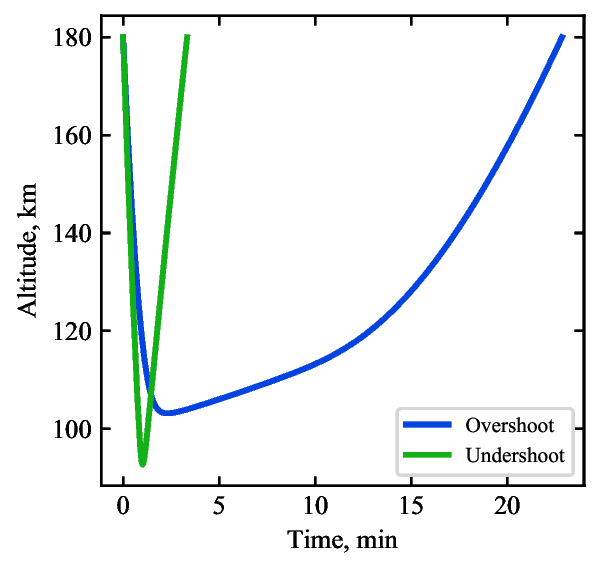
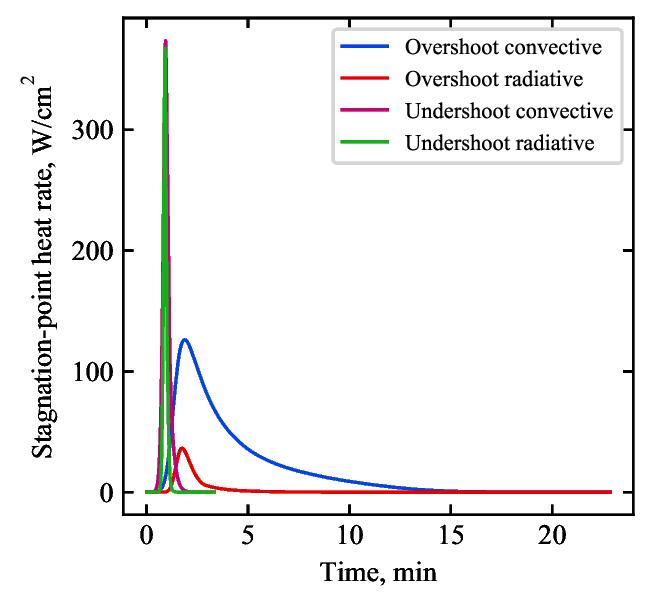
AMAT allows the user to simulate atmospheric entry trajectories, compute deceleration and heating loads, compute aerocapture entry corridors and simulate aerocapture trajectories. AMAT supports analysis for all atmosphere-bearing destinations in the Solar System: Venus, Earth, Mars, Jupiter, Saturn, Titan, Uranus, and Neptune. AMAT allows the calculation of launch performance for a set of launch vehicles. AMAT allows the calculation of V-inf vector from a Lambert arc for an interplanetary transfer. AMAT allows calculation of planetary approach trajectories for orbiters and entry systems from a given V_inf vector, B-plane targeting, and deflection maneuvers. AMAT allows the calculation of visibility of landers to Earth and relay orbiters and compute telecom link budgets.
Venus Aerocapture Trajectories
Neptune Aerocapture Feasibility Chart

Monte Carlo Simulations


Examples
AMAT comes with a number of example Jupyter notebooks to help users get started. The examples inculde:
- Venus aerocapture assesssment study
- Titan aerocapture assessment study
- Neptune aerocapture using blunt-body aeroshells
- Drag modulation aerocapture asssessment
- Planetary probe entry at various Solar System destinations
Features
- Easy installation,
- Many examples and recreation of results from published literature
- Extensive documented source code
- Can be used for probe and lander Entry, Descent, Landing (EDL) calculations
- Comes with a standard set of nominal atmospheric models
Installation
Note: AMAT is currently supported on Python 3.8, 3.9, and 3.10.
There are two ways to install AMAT.
Option 1: Install from pip (recommended for most users)
This is the recommended method if you do not plan or need to make changes to the source code.
Note: Python Package Index limits the amount of additional data that can be packaged in the distribution, hence all data cannot be included in the built version. You will need to clone the GitHub repository to get the required data files, examples, and start using AMAT.
Create a virtual environment and activate it. It is strongly recommended you install AMAT inside a virtual environment to prevent it from affecting your global python packages.
Change directory to where you want the virtual environment to be created.
* $ cd home/path
On Linux/MacOS machines:
$ python3 -m venv env1$ source env1/bin/activate
On Windows machines (from Anaconda Prompt):
$ conda create --name env1$ conda activate env1$ conda install pip
Clone the repository and install AMAT:
$ git clone https://github.com/athulpg007/AMAT.git$ pip install AMAT
Once AMAT is installed, run an example Jupyter notebook to check everything works correctly.
* $ cd AMAT/examples
* $ jupyter-notebook
Note that you will need jupyterlab and pandas (for some examples) to run
the example notebooks. Use pip install jupyterlab pandas to
install Jupyter and pandas if it is not already installed on your system.
This will display the full list of example Jupyter notebooks included with AMAT.
Open and run the example-01-hello-world notebook to get started with AMAT.
Option 2: Install from setup.py (recommended for developers)
This is the recommended method if you need to make changes to the source code.
Create a virtual environment and activate it following the steps at the beginning of Option 1.
Clone the GitHub repository and install AMAT using setup.py. The -e editable
flag allows changes you make to take effect when using AMAT.
* $ git clone https://github.com/athulpg007/AMAT.git
* $ cd AMAT
* $ python setup.py install -e
* $ cd examples
* $ jupyter-notebook
Note that you will need jupyterlab and pandas (for some examples)
to run the example notebooks. Use pip install jupyterlab pandas
to install Jupyter and pandas if it is not already installed on your system.
If you want to create a new distribution package:
* $ python3 setup.py sdist bdist_wheel
To build docs locally if you made changes to the source code
(you must have the dependencies in docs/requirements.txt installed):
* $ cd AMAT/docs
* $ make html
License
AMAT is an open source project licensed under the GNU General Public License Version 3.
Credits
Parts of the AMAT source code were originally developed in support of contracts between AAC and the Jet Propulsion Laboratory for various aerocapture mission studies between 2016 and 2020. Samples of atmospheric data from Global Reference Atmospheric Model (GRAM) software is used for illustration purpose only, and was developed by NASA Marshall Space Flight Center. The use of these GRAM models does not imply endorsement by NASA in any way whatsoever. A minimal working set of atmospheric profiles is included with AMAT to run the example notebooks. A minimal working interplanetary trajctory dataset is included with AMAT. The dataset was generated at Purdue University using the STOUR software package by Alec Mudek, and is also derived from trajectories published in the NASA Ice Giants Pre-Decadal Mission Study. The author plans to augment the interplanetary dataset with more publicly available information as it becomes available.
Support and Contribution
If you wish to contribute or report an issue, feel free to contact me or to use the issue tracker and pull requests from the code repository.
If you wish to make a contribution, you can do as follows:
- fork the GitHub repository
- create a feature branch from master
- add your feature and document it
- add tests to verify your feature is implemented correctly
- run all the tests to verify your change does not break something else
- open a pull request
Extras
The AMAT repository includes representative atmospheric profiles for Solar System bodies, an Excel sheet with a comprehensive literature review of aerocapture, sample feasibility charts for aerocapture at all destinations, reference journal articles (by the author).
Reference Articles
Results from these articles are used as benchmark examples.
Craig, Scott, and James Evans Lyne. "Parametric Study of Aerocapture for Missions to Venus." Journal of Spacecraft and Rockets Vol. 42, No. 6, pp. 1035-1038. DOI: 10.2514/1.2589
Putnam and Braun, "Drag-Modulation Flight-Control System Options for Planetary Aerocapture", Journal of Spacecraft and Rockets, Vol. 51, No. 1, 2014. DOI:10.2514/1.A32589
Lu, Ye, and Sarag J. Saikia. "Feasibility Assessment of Aerocapture for Future Titan Orbiter Missions." Journal of Spacecraft and Rockets Vol. 55, No. 5, pp. 1125-1135. DOI: 10.2514/1.A34121
Girija, A. P., Lu, Y., & Saikia, S. J. "Feasibility and Mass-Benefit Analysis of Aerocapture for Missions to Venus". Journal of Spacecraft and Rockets, Vol. 57, No. 1, pp. 58-73. DOI: 10.2514/1.A34529
Girija, A. P. et al. "Feasibility and Performance Analysis of Neptune Aerocapture Using Heritage Blunt-Body Aeroshells", Journal of Spacecraft and Rockets, Vol. 57, No. 6, pp. 1186-1203. DOI: 10.2514/1.A34719
Girija A. P. et al. "Quantitative Assessment of Aerocapture and Applications to Future Missions", Journal of Spacecraft and Rockets, 2022. DOI: 10.2514/1.A35214
Owner
- Name: Athul Pradeepkumar Girija
- Login: athulpg007
- Kind: user
- Location: Lakewood, CO
- Company: LeoLabs
- Website: athulpg007.github.io
- Repositories: 3
- Profile: https://github.com/athulpg007
Planetary science, mission formulation and systems engineering, open source software.
JOSS Publication
AMAT: A Python package for rapid conceptual design of aerocapture and atmospheric Entry, Descent, and Landing (EDL) missions in a Jupyter environment
Authors

School of Aeronautics and Astronautics, Purdue University, West Lafayette, IN 47907, United States
School of Aeronautics and Astronautics, Purdue University, West Lafayette, IN 47907, United States
School of Aeronautics and Astronautics, Purdue University, West Lafayette, IN 47907, United States
Jet Propulsion Laboratory, California Institute of Technology, Pasadena, CA 91109, United States
Editor
Mehmet Hakan Satman
Tags
aerocapture atmospheric entry mission design planetary probeGitHub Events
Total
- Watch event: 2
Last Year
- Watch event: 2
Committers
Last synced: 12 months ago
Top Committers
| Name | Commits | |
|---|---|---|
| Athul P. Girija | a****7@g****m | 373 |
| dependabot[bot] | 4****] | 4 |
| Mehmet Hakan Satman | m****n@g****m | 4 |
| Dimitri Scheftelowitsch | d****i@s****u | 2 |
Committer Domains (Top 20 + Academic)
Issues and Pull Requests
Last synced: 11 months ago
All Time
- Total issues: 8
- Total pull requests: 46
- Average time to close issues: 26 days
- Average time to close pull requests: about 2 hours
- Total issue authors: 4
- Total pull request authors: 4
- Average comments per issue: 1.75
- Average comments per pull request: 0.13
- Merged pull requests: 43
- Bot issues: 0
- Bot pull requests: 7
Past Year
- Issues: 0
- Pull requests: 0
- Average time to close issues: N/A
- Average time to close pull requests: N/A
- Issue authors: 0
- Pull request authors: 0
- Average comments per issue: 0
- Average comments per pull request: 0
- Merged pull requests: 0
- Bot issues: 0
- Bot pull requests: 0
Top Authors
Issue Authors
- athulpg007 (4)
- astrojuanlu (2)
- imu2326 (1)
- helgee (1)
Pull Request Authors
- athulpg007 (36)
- dependabot[bot] (6)
- jbytecode (2)
- dsche (1)
Top Labels
Issue Labels
Pull Request Labels
Packages
- Total packages: 1
-
Total downloads:
- pypi 515 last-month
- Total dependent packages: 0
- Total dependent repositories: 1
- Total versions: 33
- Total maintainers: 1
pypi.org: amat
Aerocapture Mission Analysis Tool
- Homepage: https://github.com/athulpg007/AMAT
- Documentation: https://amat.readthedocs.io/
- License: GPL-3.0-or-later
-
Latest release: 2.3.0
published over 2 years ago
Rankings
Maintainers (1)
Dependencies
- actions/checkout v2 composite
- actions/setup-python v2 composite
- astropy ==6.0.0
- docutils ==0.20.1
- ipykernel ==6.28.0
- jinja2 ==3.1.2
- jplephem ==2.21
- markupsafe ==2.1.3
- matplotlib ==3.8.2
- nbsphinx ==0.6.1
- numpy ==1.26.2
- scipy ==1.11.4
- sphinx ==7.2.6
- sphinx_rtd_theme ==2.0.0
- astropy ==6.0.0
- jplephem ==2.21
- matplotlib ==3.8.2
- numpy ==1.26.2
- pandas ==2.1.4
- scipy ==1.11.4