mpds-aiida
Automated computational workflows based on the MPDS data platform using the CRYSTAL first-principles engine
Science Score: 67.0%
This score indicates how likely this project is to be science-related based on various indicators:
-
✓CITATION.cff file
Found CITATION.cff file -
✓codemeta.json file
Found codemeta.json file -
✓.zenodo.json file
Found .zenodo.json file -
✓DOI references
Found 2 DOI reference(s) in README -
✓Academic publication links
Links to: zenodo.org -
○Academic email domains
-
○Institutional organization owner
-
○JOSS paper metadata
-
○Scientific vocabulary similarity
Low similarity (11.5%) to scientific vocabulary
Keywords
Repository
Automated computational workflows based on the MPDS data platform using the CRYSTAL first-principles engine
Basic Info
- Host: GitHub
- Owner: mpds-io
- License: mit
- Language: Python
- Default Branch: master
- Homepage: https://mpds.io/search/ab%20initio%20calculations
- Size: 1.01 MB
Statistics
- Stars: 3
- Watchers: 2
- Forks: 3
- Open Issues: 3
- Releases: 2
Topics
Metadata Files
README.md
Cloud factory for the accurate materials data

using the MPDS data platform, AiiDA workflows, and CRYSTAL simulation engine.



Rationale
- get accurate encyclopedic, reference, and benchmarking scientific data
- get vast systematic training data for machine learning
- use the cheap commodity cloud environment (not necessarily the HPC cluster)
- ensure provenance tracking and reproducibility of simulations with AiiDA
Installation
The code in this repo requires the aiida-crystal-dft, yascheduler, and mpds-ml-labs Python packages installed. In their turn, they depend on the aiida, mpds_client, and other Python packages.
Thus, installation is as follows (replace pip with pip3 if needed and mind virtual env):
shell
pip install git+https://github.com/tilde-lab/aiida-crystal-dft
pip install git+https://github.com/tilde-lab/yascheduler
pip install git+https://github.com/mpds-io/mpds-ml-labs
git clone https://github.com/mpds-io/mpds-aiida
pip install mpds-aiida/
Here some reader's AiiDA experience is assumed. Note, since the AiiDA does not support cloud environments, the custom cloud scheduler engine yascheduler should be employed. This scheduler manages the CRYSTAL simulation engine at the cloud VPS instances and encapsulates all the details, concerning the remote computer task submission, queue, and results retrieval, as well as the VPS management. This scheduler runs its own daemon and lives together with the AiiDA at the same machine. However, AiiDA considers it as a remote service, accessible via the ssh transport, so the command ssh $USER@localhost should pass. To achieve that, the reader might run e.g.:
shell
ssh-keygen -t rsa
cat ~/.ssh/id_rsa.pub >> ~/.ssh/authorized_keys
ssh $USER@localhost
(Note, that the AiiDA should be aware of the ~/.ssh/id_rsa.pub key file while SSH setup!)
For simplicity the yascheduler can share the database with AiiDA. Setting up the yascheduler looks like:
shell
vi /etc/yascheduler/yascheduler.conf
yainit
service yascheduler start
The AiiDA should be set up normally, and the stub remote computer (e.g. cluster: yascheduler), as well as the stub CRYSTAL code (e.g. codes: Pcrystal) should be added:
shell
reentry scan
verdi setup
verdi computer setup
verdi computer configure ssh $COMPUTER
verdi computer test $COMPUTER --print-traceback
verdi code setup
Why stub? Because the computer and code management is delegated to the yascheduler, taking care of the on-demand cloud resources management.
The Gaussian basis sets used by CRYSTAL engine should be added to the AiiDA database. We download the entire basis set library from the CRYSTAL website and save some selected basis sets as *.basis files using the script scripts/bs_unito_download.py. Then, in a subfolder with the *.basis files, one runs:
shell
verdi data crystal_dft uploadfamily --name=$BASIS_FAMILY
or, to add the internal basis sets predefined in CRYSTAL:
shell
verdi data crystal_dft createpredefined
Then the desired name ($BASISFAMILY) should be used in the calculation settings inside `mpdsaiida/calc_templates` (see below).
Usage
The MPDS platform is the main data source for generating the simulation inputs and checking the simulation results. An access to the binary compounds data subset is free, one should login at the MPDS and get the MPDS API key:
shell
export MPDS_KEY=...
(Please do not forget to withdraw i.e. invalidate the API key after finishing the work.)
A template system is used to control the calculation parameters, see the mpds_aiida/calc_templates subfolder. Note, that the options: resources template directive makes no sense with our custom cloud scheduler. The cluster, codes, and basis_family template directives have to be specified exactly as defined above.
The following on-demand cloud providers are currently supported (resp. yascheduler directives given in brackets):
- Hetzner (
hetzner_token,hetzner_max_nodes), API token must be issued for a project - Upcloud (
upcloud_login,upcloud_pass,upcloud_max_nodes), API permissions are set in account settings
At the moment of writing, the chosen default Hetzner configuration (CX51) runs a test task for 2-2.5 hours on average and costs EUR 35.88 per month, the chosen default Upcloud configuration (8 cores, 4Gb memory) runs a test task for 1.5 hours on average and costs $89 per month.
More examples are given in the scripts subfolder.
An operation principle is briefly illustrated below.
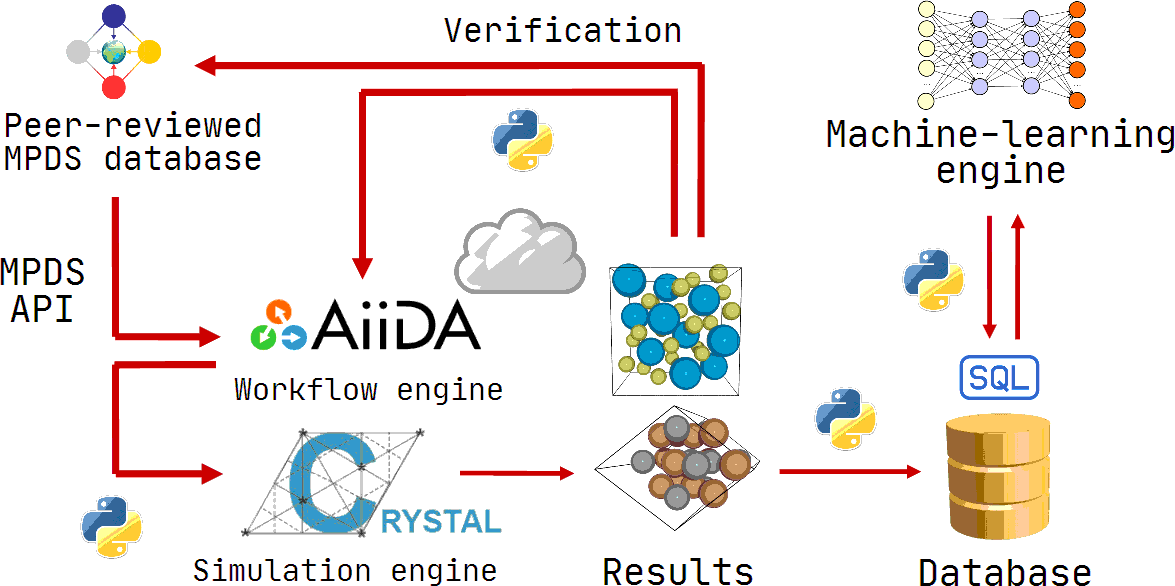
Note: this repo is subject to change and presents an ongoing work in progress.
Licensing
- This code: MIT
- CRYSTAL engine: commercial
The resulting data are available at the MPDS platform, according to the CC BY 4.0 license.
Issues and troubleshooting
Please, report any issues in the respective repositories: aiida-crystal-dft, yascheduler, mpds-ml-labs, aiida, mpds_client, etc.
The Google Cloud machines need first to be prepared via the web-browser SSH console (note sudo -i). The file /etc/ssh/sshd_config should be changed to allow root user to log in.
The Amazon EC2 machines need first to be accessed with the admin user (note sudo -i). Then the file /root/.ssh/authorized_keys needs to be cleaned to allow root user to log in.
Owner
- Name: MPDS
- Login: mpds-io
- Kind: organization
- Email: support@mpds.io
- Location: The Internet
- Website: https://mpds.io
- Repositories: 14
- Profile: https://github.com/mpds-io
MPDS stands for Materials Platform for Data Science. It provides curated high-quality materials data, manually extracted from about 400k scientific publications
Citation (CITATION.cff)
cff-version: 1.2.0
title: mpds-aiida
type: software
license: MIT
authors:
  - given-names: Andrey
    family-names: Sobolev
    orcid: 'https://orcid.org/0000-0001-5086-6601'
  - given-names: Evgeny
    family-names: Blokhin
    orcid: 'https://orcid.org/0000-0002-5333-3947'
doi: 10.5281/zenodo.7693214
url: 'https://github.com/mpds-io/mpds-aiida'
keywords:
  - AiiDA
  - materials science
  - ab initio
  - first-priniples
  - materials informatics
  - MPDS platform
GitHub Events
Total
- Member event: 1
- Issue comment event: 1
- Push event: 5
- Pull request review comment event: 2
- Pull request review event: 3
- Pull request event: 3
- Create event: 2
Last Year
- Member event: 1
- Issue comment event: 1
- Push event: 5
- Pull request review comment event: 2
- Pull request review event: 3
- Pull request event: 3
- Create event: 2
Issues and Pull Requests
Last synced: over 1 year ago
All Time
- Total issues: 0
- Total pull requests: 4
- Average time to close issues: N/A
- Average time to close pull requests: about 1 month
- Total issue authors: 0
- Total pull request authors: 3
- Average comments per issue: 0
- Average comments per pull request: 1.5
- Merged pull requests: 1
- Bot issues: 0
- Bot pull requests: 2
Past Year
- Issues: 0
- Pull requests: 1
- Average time to close issues: N/A
- Average time to close pull requests: N/A
- Issue authors: 0
- Pull request authors: 1
- Average comments per issue: 0
- Average comments per pull request: 3.0
- Merged pull requests: 0
- Bot issues: 0
- Bot pull requests: 0
Top Authors
Issue Authors
- akvatol (1)
Pull Request Authors
- akvatol (3)
- imgbot[bot] (2)
- blokhin (1)
- fossabot (1)