diy-smartcube
A proof-of-concept proposal for turning standard Rubik's Cubes into smartcubes by embedding speakers into the cube's centercaps.
Science Score: 26.0%
This score indicates how likely this project is to be science-related based on various indicators:
-
○CITATION.cff file
-
✓codemeta.json file
Found codemeta.json file -
✓.zenodo.json file
Found .zenodo.json file -
○DOI references
-
○Academic publication links
-
○Academic email domains
-
○Institutional organization owner
-
○JOSS paper metadata
-
○Scientific vocabulary similarity
Low similarity (10.4%) to scientific vocabulary
Keywords
Repository
A proof-of-concept proposal for turning standard Rubik's Cubes into smartcubes by embedding speakers into the cube's centercaps.
Basic Info
Statistics
- Stars: 9
- Watchers: 3
- Forks: 1
- Open Issues: 0
- Releases: 0
Topics
Metadata Files
README.md
D.I.Y. Smartcube
A proof-of-concept proposal for turning standard Rubik's Cubes into smartcubes by embedding speakers into the cube's centercaps.


D.I.Y. Smartcube was created as part of Joseph Hale's undergraduate honors thesis in Software Engineering for Barrett, The Honors College at Arizona State University from Spring 2020 through Spring 2022.
Introductory Poster

Detailed Poster

Video Explanation
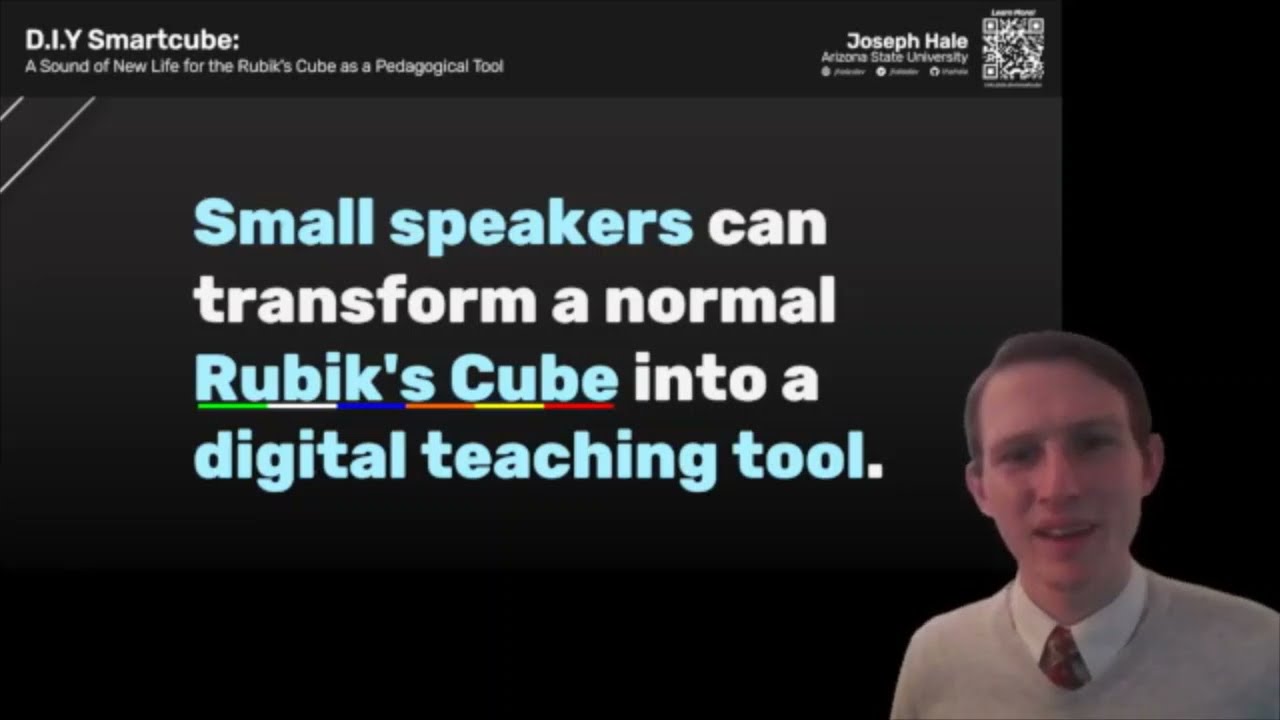 https://youtu.be/fckqMlKTW2Q
Abstract
Speedsolving, the art of solving twisty puzzles like the Rubik's Cube as fast as possible, has recently benefitted from the arrival of smartcubes which have special hardware for tracking the cube's face turns and transmitting them via Bluetooth. However, due to their embedded electronics, existing smartcubes cannot be used in competition, reducing their utility in personal speedcubing practice.
This thesis proposes a sound-based design for tracking the face turns of a standard, non-smart speedcube consisting of an audio processing receiver in software and a small physical speaker configured as a transmitter. Special attention has been given to ensuring that installing the transmitter requires only a reversible centercap replacement on the original cube. This allows the cube to benefit from smartcube features during practice, while still maintaining compliance with competition regulations.
Within a controlled test environment, the software receiver perfectly detected a variety of transmitted move sequences. Furthermore, all components required for the physical transmitter were demonstrated to fit within the centercap of a Gans 356 speedcube.
How to Use this Repository
This repository has a LOT of information at varying levels of complexity. I recommend reading the contents of this repository in the following order:
- The Summary Posterboard (1 page) used to explain the core concepts of the D.I.Y. Smartcube at an academic poster session.
- The Defense Presentation (30 slides + commentary) used to provide a detailed overview of the proposal in my Honors Thesis Defense.
- The Thesis Document (98 pages) containing the full proposal including requirements, designs, specifications, and examples.
License
Copyright (c) 2022-2024 Joseph Hale, All Rights Reserved
Provided under the terms of the Mozilla Public License, version 2.0
What does the MPL-2.0 license allow/require?
### TL;DR You can use files from this project in both open source and proprietary applications, provided you include the above attribution. However, if you modify any code in this project, or copy blocks of it into your own code, you must publicly share the resulting files (note, not your whole program) under the MPL-2.0. The best way to do this is via a Pull Request back into this project. If you have any other questions, you may also find Mozilla's [official FAQ](https://www.mozilla.org/en-US/MPL/2.0/FAQ/) for the MPL-2.0 license insightful. If you dislike this license, you can contact me about negotiating a paid contract with different terms. **Disclaimer:** This TL;DR is just a summary. All legal questions regarding usage of this project must be handled according to the official terms specified in the `LICENSE` file. ### Why the MPL-2.0 license? I believe that an open-source software license should ensure that code can be used everywhere. Strict copyleft licenses, like the GPL family of licenses, fail to fulfill that vision because they only permit code to be used in other GPL-licensed projects. Permissive licenses, like the MIT and Apache licenses, allow code to be used everywhere but fail to prevent proprietary or GPL-licensed projects from limiting access to any improvements they make. In contrast, the MPL-2.0 license allows code to be used in any software project, while ensuring that any improvements remain available for everyone.Owner
- Name: Joseph Hale, MS SE
- Login: thehale
- Kind: user
- Location: Greater Phoenix Area, Arizona
- Company: @SpeedcuberOSS
- Website: jhale.dev
- Repositories: 44
- Profile: https://github.com/thehale
Striving to ensure that everything I create is improvable by a novice.
GitHub Events
Total
- Watch event: 3
- Push event: 5
Last Year
- Watch event: 3
- Push event: 5
Issues and Pull Requests
Last synced: over 1 year ago
All Time
- Total issues: 0
- Total pull requests: 0
- Average time to close issues: N/A
- Average time to close pull requests: N/A
- Total issue authors: 0
- Total pull request authors: 0
- Average comments per issue: 0
- Average comments per pull request: 0
- Merged pull requests: 0
- Bot issues: 0
- Bot pull requests: 0
Past Year
- Issues: 0
- Pull requests: 0
- Average time to close issues: N/A
- Average time to close pull requests: N/A
- Issue authors: 0
- Pull request authors: 0
- Average comments per issue: 0
- Average comments per pull request: 0
- Merged pull requests: 0
- Bot issues: 0
- Bot pull requests: 0