PathSim - A System Simulation Framework
PathSim - A System Simulation Framework - Published in JOSS (2025)
Science Score: 98.0%
This score indicates how likely this project is to be science-related based on various indicators:
-
✓CITATION.cff file
Found CITATION.cff file -
✓codemeta.json file
Found codemeta.json file -
✓.zenodo.json file
Found .zenodo.json file -
✓DOI references
Found 4 DOI reference(s) in README and JOSS metadata -
✓Academic publication links
Links to: joss.theoj.org -
○Academic email domains
-
○Institutional organization owner
-
✓JOSS paper metadata
Published in Journal of Open Source Software
Keywords
Scientific Fields
Repository
A Python native dynamical system simulation framework in the block diagram paradigm.
Basic Info
- Host: GitHub
- Owner: milanofthe
- License: mit
- Language: Python
- Default Branch: master
- Homepage: https://pathsim.readthedocs.io/en/latest/
- Size: 9.47 MB
Statistics
- Stars: 157
- Watchers: 5
- Forks: 12
- Open Issues: 5
- Releases: 37
Topics
Metadata Files
README.md

PathSim - A System Simulation Framework





Overview
PathSim is a flexible block-based time-domain system simulation framework in Python with automatic differentiation capabilities and an event handling mechanism! It provides a variety of classes that enable modeling and simulation of complex interconnected dynamical systems through Python scripting in the block diagram paradigm.
All of that with minimal dependencies, only numpy, scipy and matplotlib (and dill if you want to use serialization)!
Key Features:
- Dynamic system modification at simulation runtime, i.e. triggered through events
- Automatic block- and system-level linearization at runtime
- Wide range of numerical integrators (implicit, explicit, high order, adaptive), able to handle stiff systems
- Modular and hierarchical modeling with (nested) subsystems
- Event handling system to detect and resolve discrete events (zero-crossing detection)
- Automatic differentiation for end-to-end differentiable simulations
- Extensibility by subclassing the base
Blockclass and implementing just a handful of methods
For the full documentation, tutorials and API-reference visit Read the Docs!
The source code can be found in the GitHub repository and is fully open source under MIT license. Consider starring PathSim to support its development.
Contributing and Future
If you want to contribute to PathSims development, check out the community guidelines. If you are curious about what the future holds for PathSim, check out the roadmap!
Installation
The latest release version of PathSim is available on PyPi and installable via pip:
console
pip install pathsim
Example - Harmonic Oscillator
There are lots of examples of dynamical system simulations in the GitHub repository that showcase PathSim's capabilities.
But first, lets have a look at how we can simulate the harmonic oscillator (a spring mass damper 2nd order system) using PathSim. The system and its corresponding equivalent block diagram are shown in the figure below:
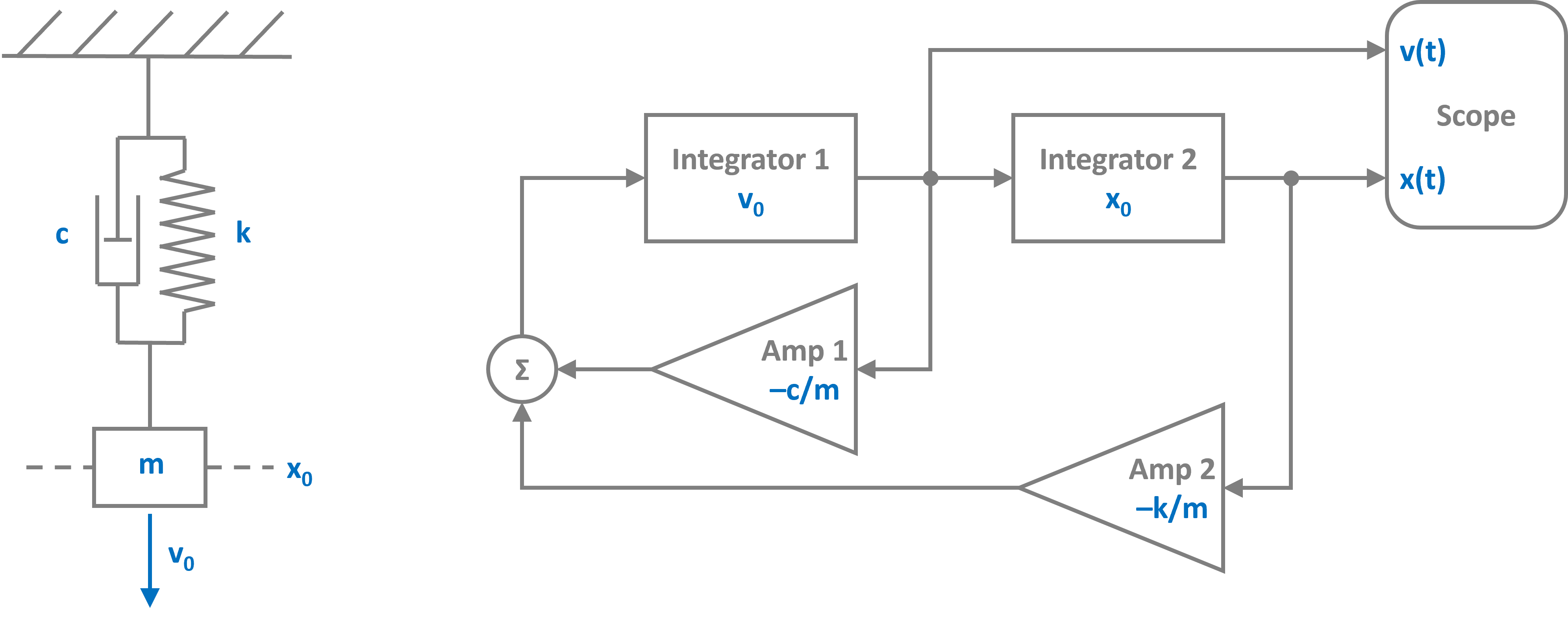
The equation of motion that defines the harmonic oscillator it is give by
$$ \ddot{x} + \frac{c}{m} \dot{x} + \frac{k}{m} x = 0 $$
where $c$ is the damping, $k$ the spring constant and $m$ the mass together with the initial conditions $x0$ and $v0$ for position and velocity.
The topology of the block diagram above can be directly defined as blocks and connections in the PathSim framework. First we initialize the blocks needed to represent the dynamical systems with their respective arguments such as initial conditions and gain values, then the blocks are connected using Connection objects, forming two feedback loops.
The Simulation instance manages the blocks and connections and advances the system in time with the timestep (dt). The log flag for logging the simulation progress is also set. Finally, we run the simulation for some number of seconds and plot the results using the plot() method of the scope block.
```python from pathsim import Simulation, Connection
import the blocks we need for the harmonic oscillator
from pathsim.blocks import Integrator, Amplifier, Adder, Scope
initial position and velocity
x0, v0 = 2, 5
parameters (mass, damping, spring constant)
m, c, k = 0.8, 0.2, 1.5
define the blocks
I1 = Integrator(v0) # integrator for velocity I2 = Integrator(x0) # integrator for position A1 = Amplifier(-c/m) A2 = Amplifier(-k/m) P1 = Adder() Sc = Scope(labels=["v(t)", "x(t)"])
blocks = [I1, I2, A1, A2, P1, Sc]
define the connections between the blocks
connections = [ Connection(I1, I2, A1, Sc), # one to many connection Connection(I2, A2, Sc[1]), Connection(A1, P1), # default connection to port 0 Connection(A2, P1[1]), # specific connection to port 1 Connection(P1, I1) ]
create a simulation instance from the blocks and connections
Sim = Simulation(blocks, connections, dt=0.05)
run the simulation for 30 seconds
Sim.run(duration=30.0)
plot the results directly from the scope
Sc.plot()
read the results from the scope for further processing
time, data = Sc.read() ```
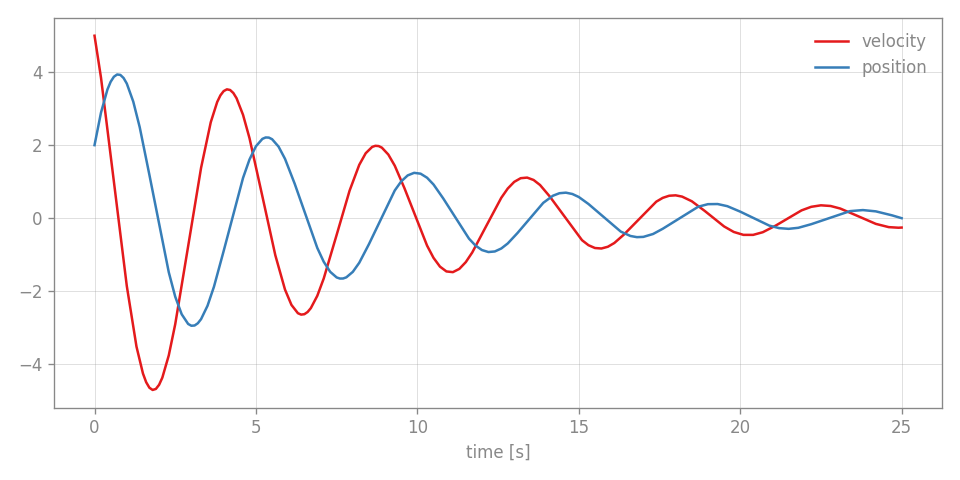
Stiff Systems
PathSim implements a large variety of implicit integrators such as diagonally implicit runge-kutta (DIRK2, ESDIRK43, etc.) and multistep (BDF2, GEAR52A, etc.) methods. This enables the simulation of very stiff systems where the timestep is limited by stability and not accuracy of the method.
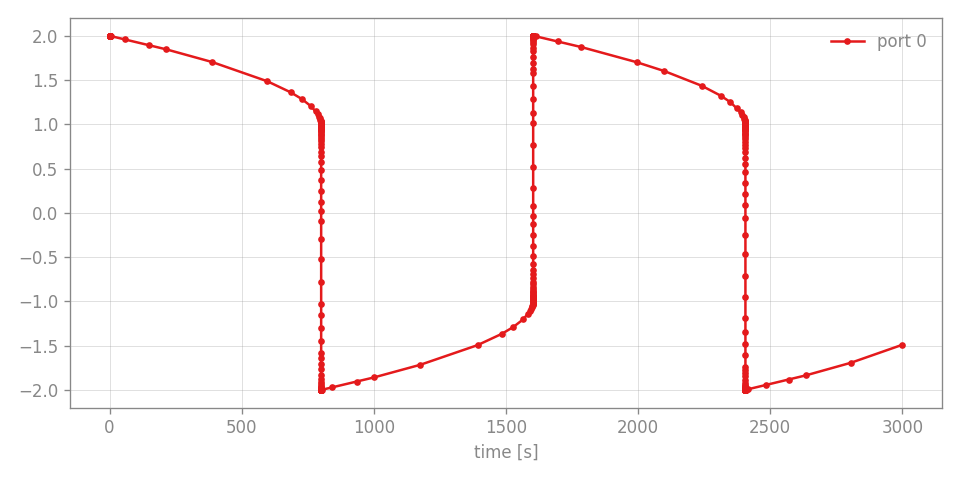
A common example for a stiff system is the Van der Pol oscillator where the parameter $\mu$ "controls" the severity of the stiffness. It is defined by the following second order ODE:
$$ \ddot{x} + \mu (1 - x^2) \dot{x} + x = 0 $$
The Van der Pol ODE can be translated into a block diagram like the one below, where the two states are handled by two distinct integrators.
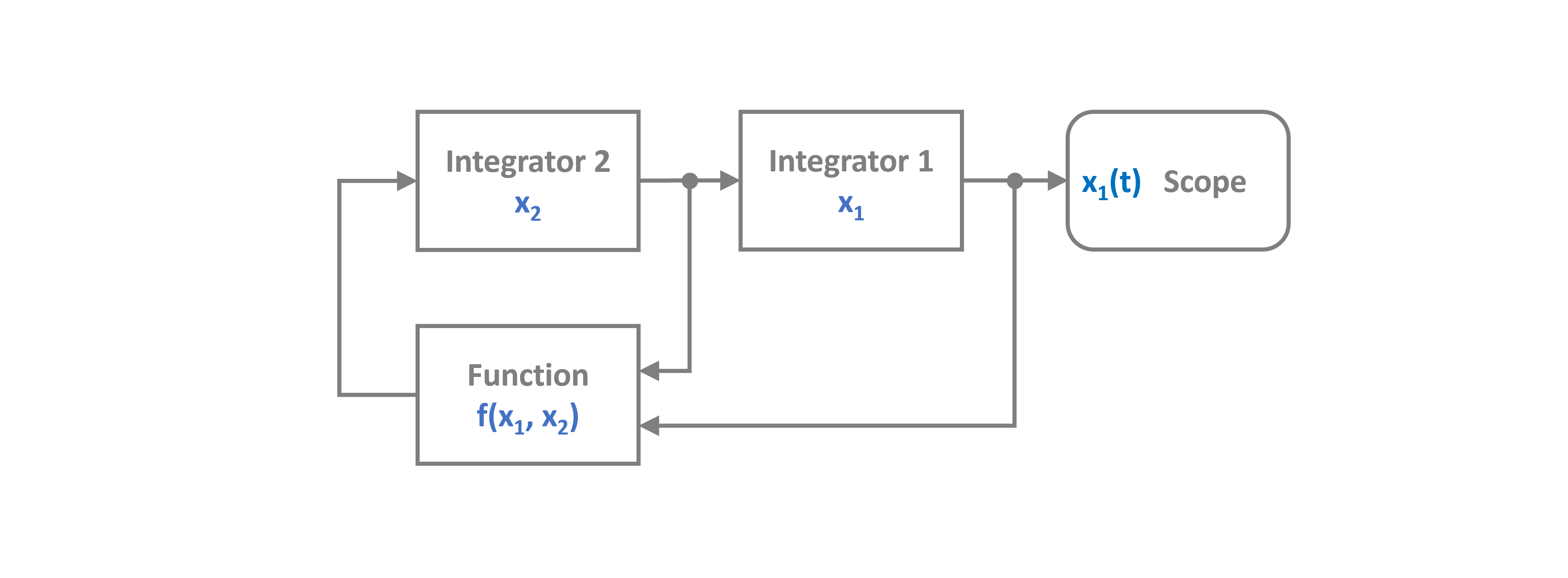
Lets translate it to PathSim using two Integrator blocks and a Function block. The parameter is set to $\mu = 1000$ which means severe stiffness.
```python from pathsim import Simulation, Connection from pathsim.blocks import Integrator, Scope, Function
implicit adaptive timestep solver
from pathsim.solvers import ESDIRK54
initial conditions
x1, x2 = 2, 0
van der Pol parameter (1000 is very stiff)
mu = 1000
blocks that define the system
Sc = Scope(labels=["$x_1(t)$"]) I1 = Integrator(x1) I2 = Integrator(x2) Fn = Function(lambda x1, x2: mu(1 - x12)x2 - x1)
blocks = [I1, I2, Fn, Sc]
the connections between the blocks
connections = [ Connection(I2, I1, Fn[1]), Connection(I1, Fn, Sc), Connection(Fn, I2) ]
initialize simulation with the blocks, connections, timestep and logging enabled
Sim = Simulation( blocks, connections, dt=0.05, Solver=ESDIRK54, tolerancelteabs=1e-5, tolerancelterel=1e-3 )
run simulation for some number of seconds
Sim.run(3*mu)
plot the results directly (steps highlighted)
Sc.plot(".-") ```
Differentiable Simulation
PathSim also includes a fully fledged automatic differentiation framework based on a dual number system with overloaded operators and numpy ufunc integration. This makes the system simulation fully differentiable end-to-end with respect to a predefined set of parameters. Works with all integrators, adaptive, fixed, implicit, explicit.
To demonstrate this lets consider the following linear feedback system and perform a sensitivity analysis on it with respect to some system parameters.
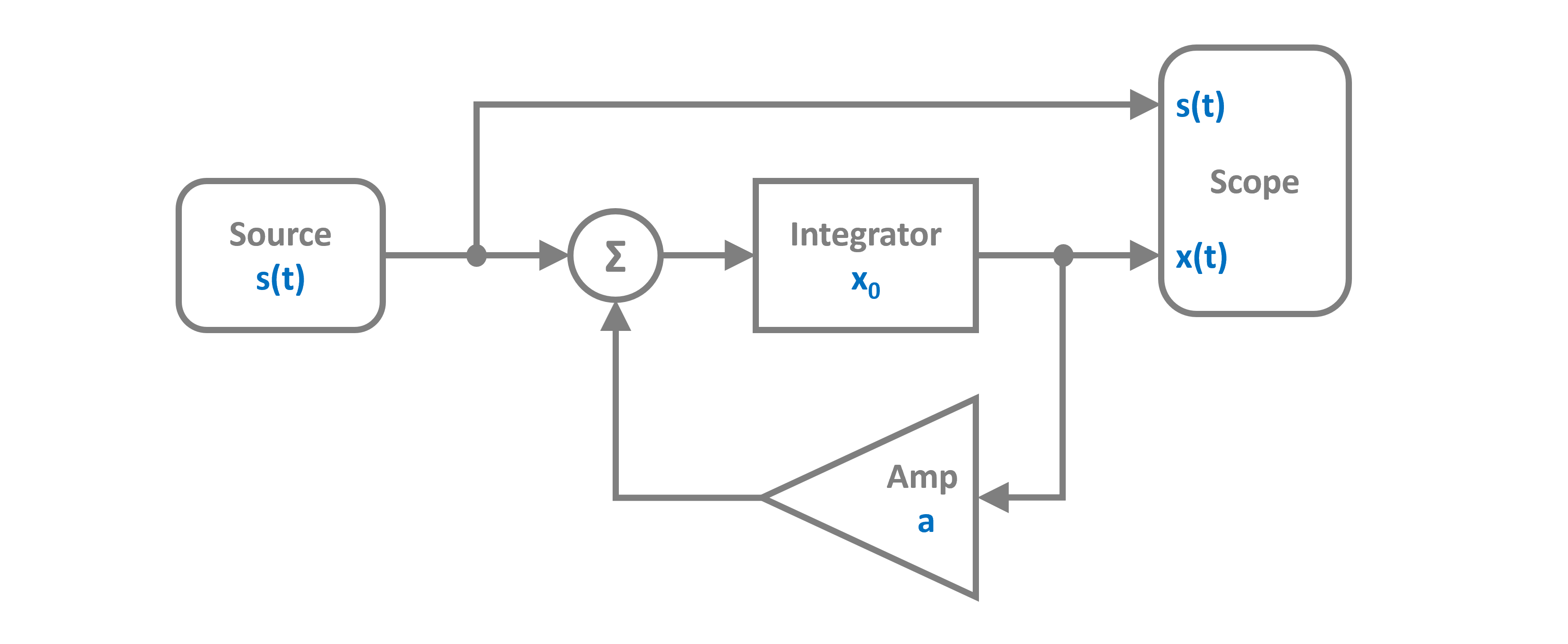
The source term is a scaled unit step function (scaled by $b$). In this example, the parameters for the sensitivity analysis are the feedback term $a$, the initial condition $x_0$ and the amplitude of the source term $b$.
```python from pathsim import Simulation, Connection from pathsim.blocks import Source, Integrator, Amplifier, Adder, Scope
AD module
from pathsim.optim import Value, der
values for derivative propagation / parameters for sensitivity analysis
a = Value(-1) b = Value(1) x0 = Value(2)
simulation timestep
dt = 0.01
step function
tau = 3 def s(t): return b*int(t>tau)
blocks that define the system
Src = Source(s) Int = Integrator(x0) Amp = Amplifier(a) Add = Adder() Sco = Scope(labels=["step", "response"])
blocks = [Src, Int, Amp, Add, Sco]
the connections between the blocks
connections = [ Connection(Src, Add[0], Sco[0]), Connection(Amp, Add[1]), Connection(Add, Int), Connection(Int, Amp, Sco[1]) ]
initialize simulation with the blocks, connections, timestep
Sim = Simulation(blocks, connections, dt=dt)
run the simulation for some time
Sim.run(4*tau)
Sco.plot() ```
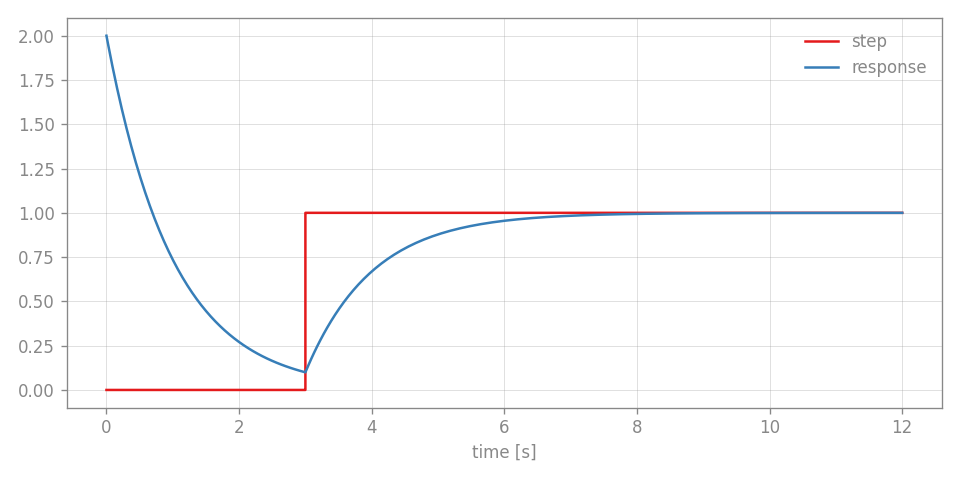
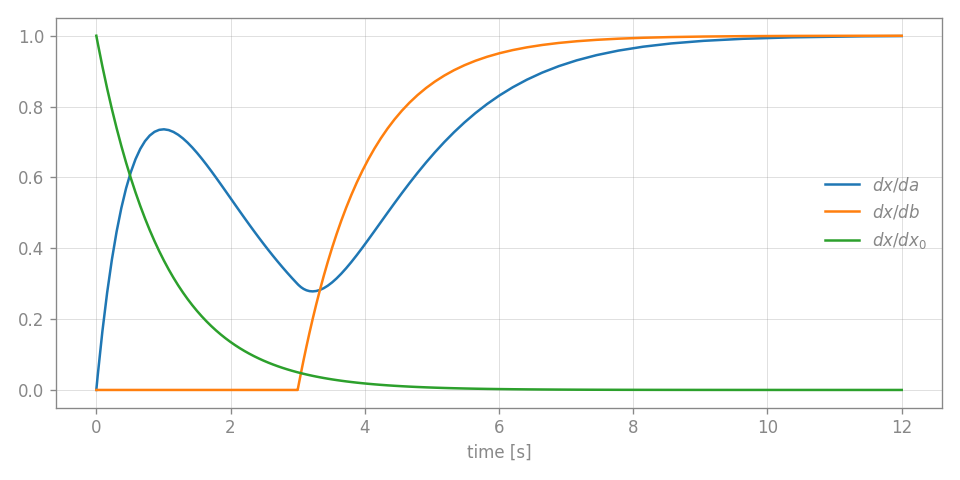
Now the recorded time series data is of type Value and we can evaluate the automatically computed partial derivatives at each timestep. For example the response, differentiated with respect to the linear feedback parameter $\partial x(t) / \partial a$ can be extracted from the data like this der(data, a).
```python import matplotlib.pyplot as plt
read data from the scope
time, [step, data] = Sco.read()
fig, ax = plt.subplots(nrows=1, tight_layout=True, figsize=(8, 4), dpi=120)
evaluate and plot partial derivatives
ax.plot(time, der(data, a), label=r"$\partial x / \partial a$") ax.plot(time, der(data, x0), label=r"$\partial x / \partial x_0$") ax.plot(time, der(data, b), label=r"$\partial x / \partial b$")
ax.set_xlabel("time [s]") ax.grid(True) ax.legend(fancybox=False) ```
Event Detection
PathSim has an event handling system that monitors the simulation state and can find and locate discrete events by evaluating an event function and trigger callbacks or state transformations. Multiple event types are supported such as ZeroCrossing or Schedule.
This enables the simulation of hybrid continuous time systems with discrete events.
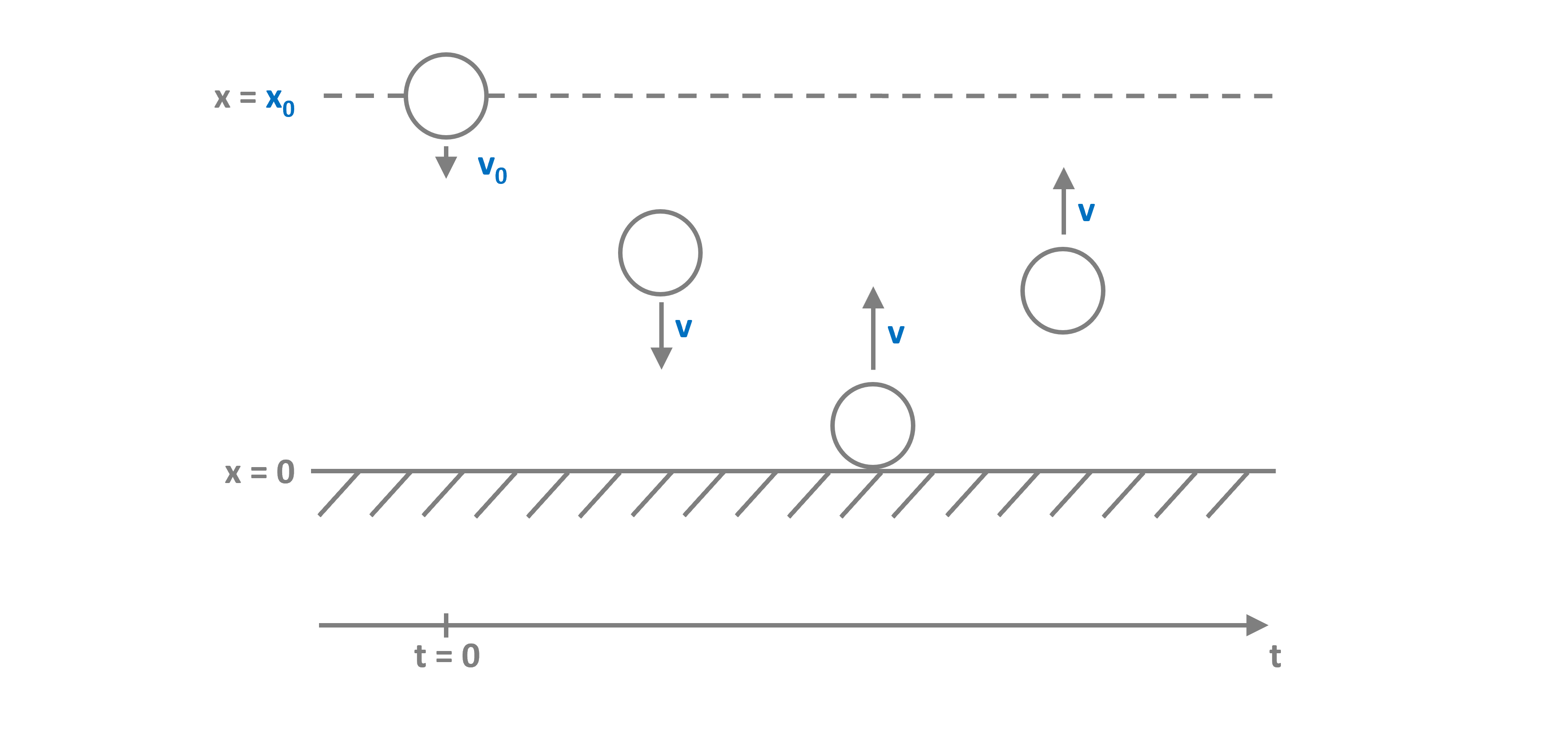
Probably the most popular example for this is the bouncing ball (see figure above) where discrete events occur whenever the ball touches the floor. The event in this case is a zero-crossing.
The dynamics of this system can be translated into a block diagramm in the following way:
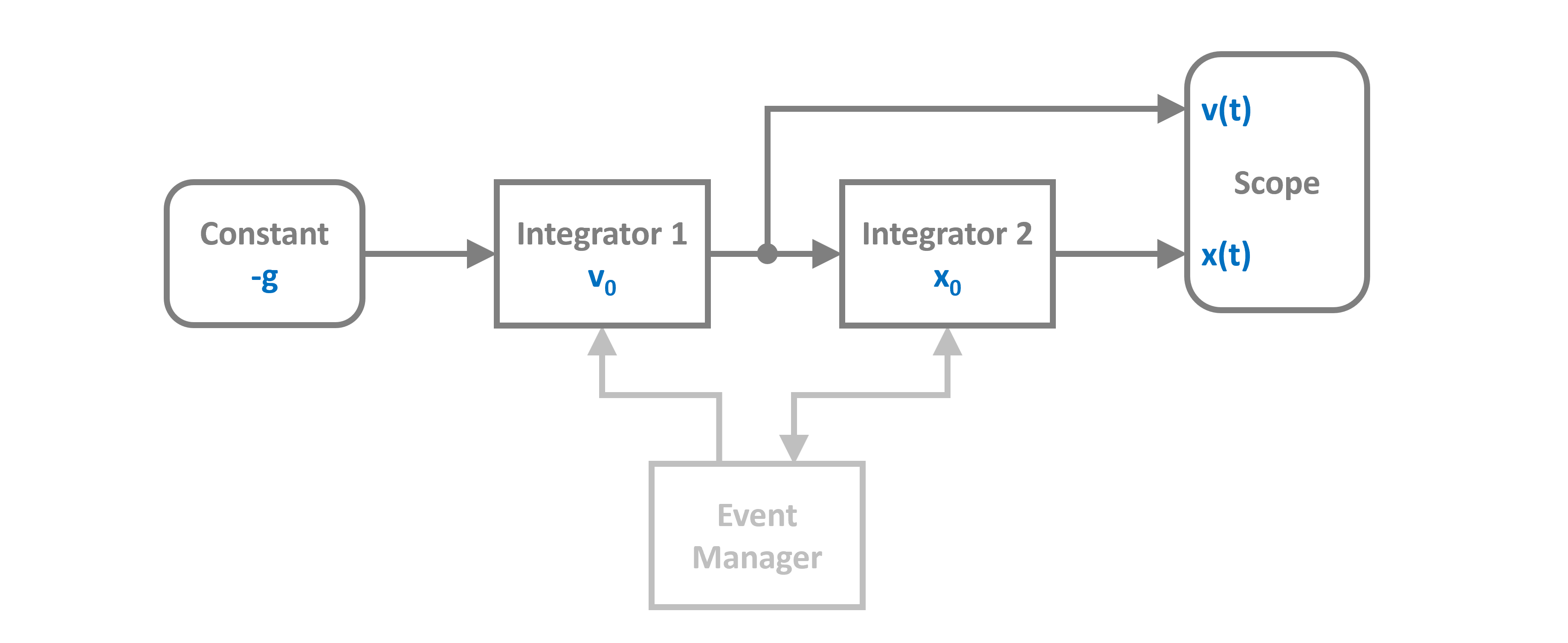
And built and simulated with PathSim like this:
```python from pathsim import Simulation, Connection from pathsim.blocks import Integrator, Constant, Scope from pathsim.solvers import RKBS32
event library
from pathsim.events import ZeroCrossing
initial values
x0, v0 = 1, 10
blocks that define the system
Ix = Integrator(x0) # v -> x Iv = Integrator(v0) # a -> v Cn = Constant(-9.81) # gravitational acceleration Sc = Scope(labels=["x", "v"])
blocks = [Ix, Iv, Cn, Sc]
the connections between the blocks
connections = [ Connection(Cn, Iv), Connection(Iv, Ix), Connection(Ix, Sc) ]
event function for zero crossing detection
def func_evt(t): i, o, s = Ix() #get block inputs, outputs and states return s
action function for state transformation
def func_act(t): i1, o1, s1 = Ix() i2, o2, s2 = Iv() Ix.engine.set(abs(s1)) Iv.engine.set(-0.9*s2)
event (zero-crossing) -> ball makes contact
E1 = ZeroCrossing(
funcevt=funcevt,
funcact=funcact,
tolerance=1e-4
)
events = [E1]
initialize simulation with the blocks, connections, timestep
Sim = Simulation( blocks, connections, events, dt=0.1, Solver=RKBS32, dt_max=0.1 )
run the simulation
Sim.run(20)
plot the recordings from the scope
Sc.plot() ```
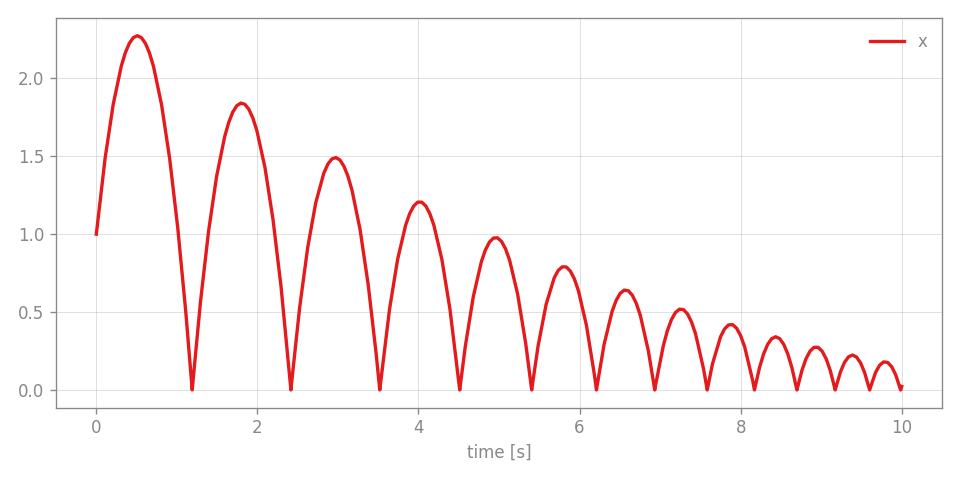
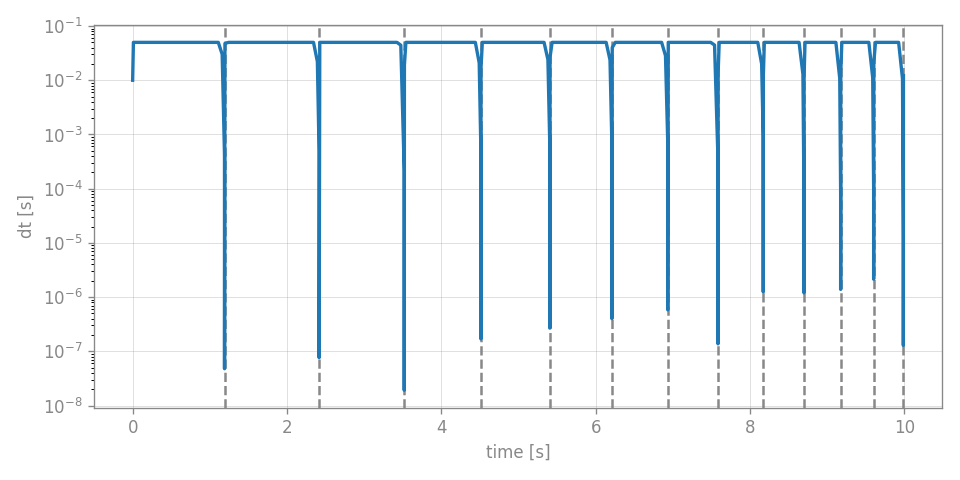
During the event handling, the simulator approaches the event until the specified tolerance is met. You can see this by analyzing the timesteps taken by the adaptive integrator RKBS32.
```python import numpy as np import matplotlib.pyplot as plt
fig, ax = plt.subplots(figsize=(8,4), tight_layout=True, dpi=120)
time, _ = Sc.read()
add detected events
for t in E1: ax.axvline(t, ls="--", c="k")
plot the timesteps
ax.plot(time[:-1], np.diff(time))
ax.setyscale("log") ax.setylabel("dt [s]") ax.set_xlabel("time [s]") ax.grid(True) ```
Owner
- Name: Milan Rother
- Login: milanofthe
- Kind: user
- Repositories: 1
- Profile: https://github.com/milanofthe
PhD student EE at TUBS
JOSS Publication
PathSim - A System Simulation Framework
Authors

Technische Universität Braunschweig, Germany
Editor
Daniel S. Katz
Tags
system simulation dynamical systems block diagram ODE solver automatic differentiation event handling hybrid systems scientific computing numerical integrationCitation (CITATION.cff)
cff-version: "1.2.0"
authors:
- family-names: Rother
  given-names: Milan
  orcid: "https://orcid.org/0009-0006-5964-6115"
doi: 10.5281/zenodo.15367933
message: If you use this software, please cite our article in the
  Journal of Open Source Software.
preferred-citation:
  authors:
  - family-names: Rother
    given-names: Milan
    orcid: "https://orcid.org/0009-0006-5964-6115"
  date-published: 2025-05-13
  doi: 10.21105/joss.08158
  issn: 2475-9066
  issue: 109
  journal: Journal of Open Source Software
  publisher:
    name: Open Journals
  start: 8158
  title: PathSim - A System Simulation Framework
  type: article
  url: "https://joss.theoj.org/papers/10.21105/joss.08158"
  volume: 10
title: PathSim - A System Simulation Framework
GitHub Events
Total
- Create event: 64
- Issues event: 25
- Release event: 33
- Watch event: 137
- Delete event: 32
- Issue comment event: 114
- Push event: 320
- Pull request review event: 2
- Pull request event: 73
- Fork event: 14
Last Year
- Create event: 64
- Issues event: 25
- Release event: 33
- Watch event: 137
- Delete event: 32
- Issue comment event: 114
- Push event: 320
- Pull request review event: 2
- Pull request event: 73
- Fork event: 14
Issues and Pull Requests
Last synced: 10 months ago
All Time
- Total issues: 16
- Total pull requests: 42
- Average time to close issues: 4 days
- Average time to close pull requests: about 16 hours
- Total issue authors: 4
- Total pull request authors: 6
- Average comments per issue: 1.88
- Average comments per pull request: 1.26
- Merged pull requests: 30
- Bot issues: 0
- Bot pull requests: 0
Past Year
- Issues: 16
- Pull requests: 42
- Average time to close issues: 4 days
- Average time to close pull requests: about 16 hours
- Issue authors: 4
- Pull request authors: 6
- Average comments per issue: 1.88
- Average comments per pull request: 1.26
- Merged pull requests: 30
- Bot issues: 0
- Bot pull requests: 0
Top Authors
Issue Authors
- RemDelaporteMathurin (8)
- milanofthe (4)
- sea-bass (3)
- Pimss (1)
Pull Request Authors
- milanofthe (30)
- RemDelaporteMathurin (6)
- Pimss (3)
- jhillairet (1)
- wzaghloul (1)
- danielskatz (1)
Top Labels
Issue Labels
Pull Request Labels
Packages
- Total packages: 1
-
Total downloads:
- pypi 1,549 last-month
- Total dependent packages: 0
- Total dependent repositories: 0
- Total versions: 39
- Total maintainers: 1
pypi.org: pathsim
A differentiable block based hybrid system simulation framework.
- Homepage: https://github.com/milanofthe/pathsim
- Documentation: https://pathsim.readthedocs.io/
- License: MIT
-
Latest release: 0.8.3
published 11 months ago
Rankings
Maintainers (1)
Dependencies
- matplotlib >=3.1
- numpy >=1.15
- scipy >=1.2
- matplotlib *
- numpy *
- scipy *