stif
"Space-Time Interpolation and Forecasting" - Predicting spatio-temporally distributed variables via space-time regression kriging using numpy and numba.
Science Score: 67.0%
This score indicates how likely this project is to be science-related based on various indicators:
-
✓CITATION.cff file
Found CITATION.cff file -
✓codemeta.json file
Found codemeta.json file -
✓.zenodo.json file
Found .zenodo.json file -
✓DOI references
Found 8 DOI reference(s) in README -
✓Academic publication links
Links to: zenodo.org -
○Academic email domains
-
○Institutional organization owner
-
○JOSS paper metadata
-
○Scientific vocabulary similarity
Low similarity (14.0%) to scientific vocabulary
Keywords
Repository
"Space-Time Interpolation and Forecasting" - Predicting spatio-temporally distributed variables via space-time regression kriging using numpy and numba.
Basic Info
- Host: GitHub
- Owner: johanneskopton
- License: mit
- Language: Python
- Default Branch: main
- Homepage: https://johannes.kopton.org/stif/
- Size: 23.2 MB
Statistics
- Stars: 9
- Watchers: 1
- Forks: 1
- Open Issues: 5
- Releases: 1
Topics
Metadata Files
README.md
STIF: Space-Time Interpolation and Forecasting


Package for predicting spatio-temporally distributed variables via space-time regression Kriging, using numpy and numba.
Resources

What you can do with this package:
- create space-time variograms (even on very large datasets)
- fit space-time variogram models (e.g. using
product_sumorsum_metricmodels) - fit regression models on covariates
- perform space-time variogram Kriging to interpolate/extrapolate from the input data
- do all this with binary (presence/absence) indicators, e.g. for dynamic species distribution modeling
Examples
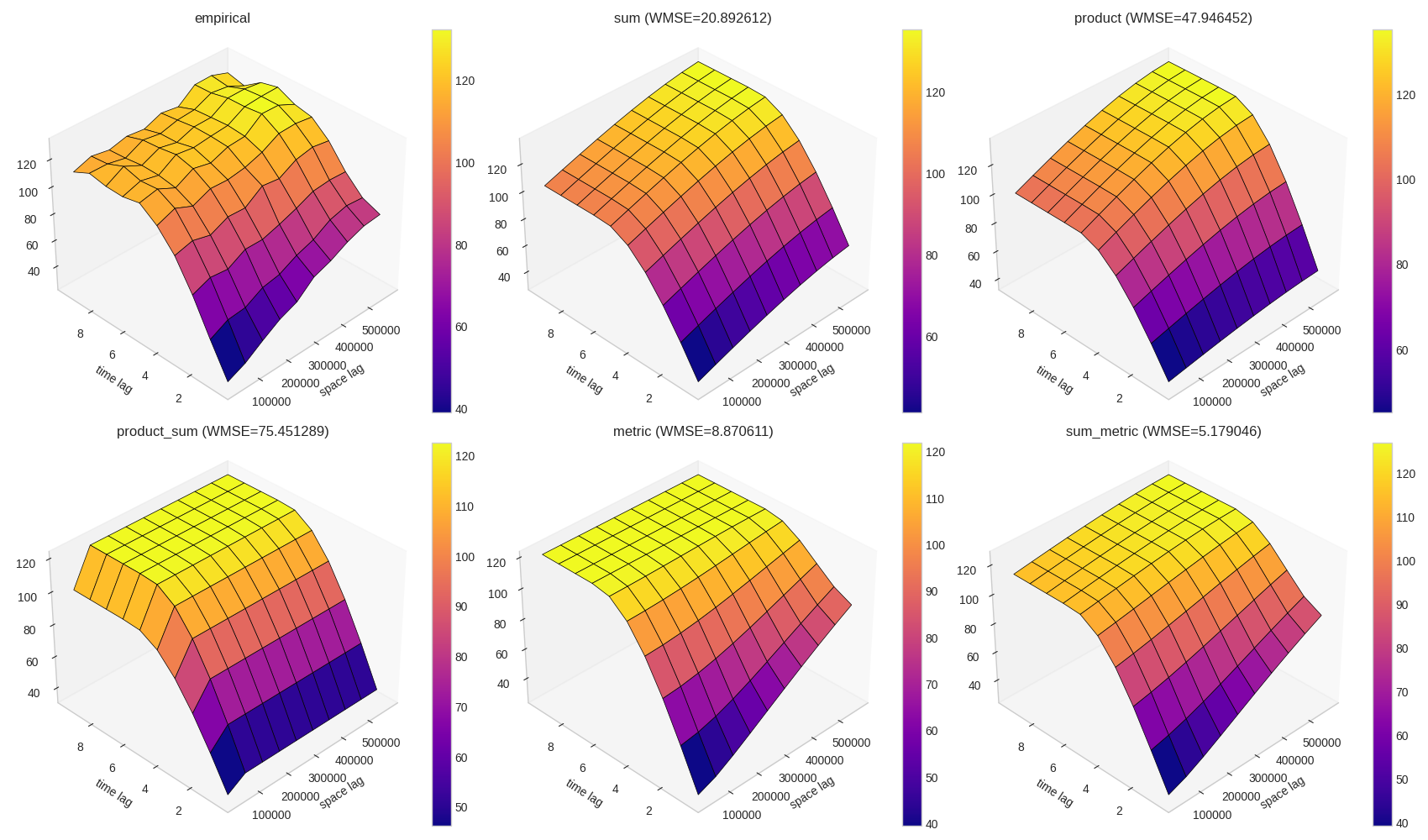
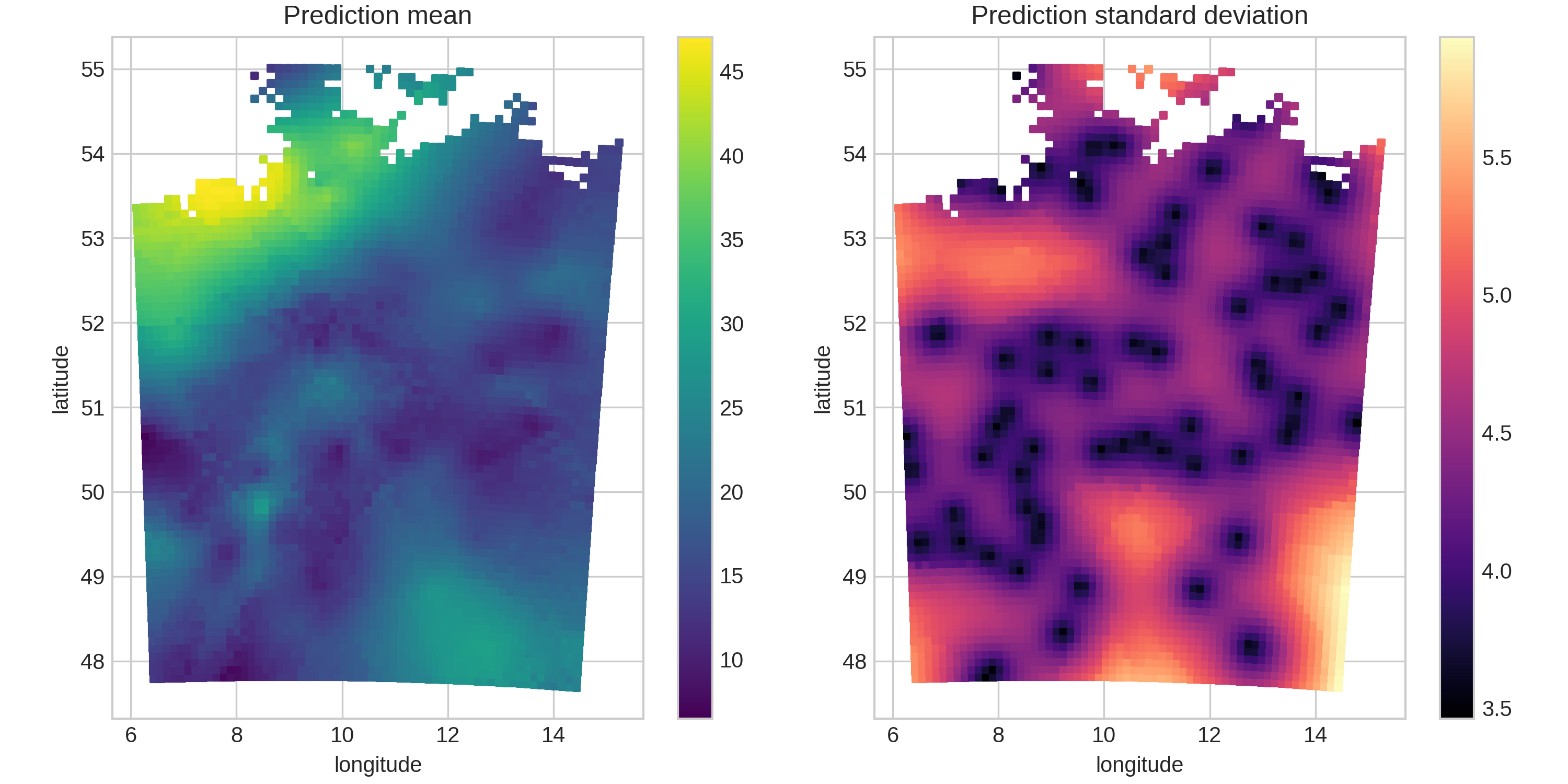
Space-time regression Kriging
Using this package, you can do space-time regression Kriging. But what is it exactly? Imagine you have measurements on different days and distributed over a geographical region (basically a table with latitude, longitude, time and the measured variable of interest). And now you want to estimate the value of this variable at locations and dates, at which you didn't measure. This can be the future (forecasting) or just some day in between, where no measurement was taken (interpolation). You may have some other variables (external covariates), that can explain some of the variation of you variable of interest via some form of regression. In this case, it makes sense to do the Kriging only on the residuals of this regression (i.e. regression Kriging). All of this, you can do using this package (and hopefully as simple as possible).
Why this package?
To my knowledge, there is no other Python package for space-time variogram Kriging on unstructured spatio-temporal data. While the R package gstat [^1] can do space-time Kriging, there can be problems with large datasets. Furthermore, the R package obviously doesn't play well with the Python ecosystem, e.g. using Keras/tensorflow for the regression part of regression Kriging.
There is the excellent scikit-gstat [^2], but as for now it can not create variograms for unstructured spatio-temporal data and I didn't have the time yet to dive into it and add this feature. So perhaps for now, you may find this package useful.
You can also do something like space-time regression Kriging using one of the more mature Gaussian process libraries out there (since Kriging is actually just Gaussian process regression), but they won't provide you with nice variograms and all the other geostats stuff.
Installation
Via pip:
sh
pip install .                   # for the core package
pip install .[tensorflow]       # for using tensorflow/keras models for covariate regression
pip install .[geo]              # for using coordinate transformations and geo I/O
pip install .[interactive]      # for running the example jupyter notebooks
pip install .[dev]              # for all the development tools used in this project
Development
Installing via pip for development:
sh
pip install -e .[dev]
Testing:
sh
pytest --cov=stif --junitxml=docs/source/_static/reports/junit/junit.xml --html=docs/source/_static/reports/junit/report.html
Reports and badges:
sh
coverage html -d docs/source/_static/reports/htmlcov
coverage xml -o docs/source/_static/reports/coverage.xml
flake8 --statistics --tee --output-file docs/source/_static/reports/flake8stats.txt
flake8 --format=html --htmldir=docs/source/_static/reports/flake8
genbadge tests -i docs/source/_static/reports/junit/junit.xml -o docs/source/_static/tests-badge.svg
genbadge coverage -i docs/source/_static/reports/coverage.xml -o docs/source/_static/coverage-badge.svg
genbadge flake8 -i docs/source/_static/reports/flake8stats.txt -o docs/source/_static/flake8-badge.svg
Check dependencies:
sh
tox
Build sphinx documentation:
sh
sphinx-build -M html docs/source/ docs/build/
Build package:
sh
python -m build
Publish package on PyPI:
sh
twine upload dist/*
How to cite
Kopton, J. (2024). STIF: Space-Time Interpolation and Forecasting (1.0.1). Zenodo. https://doi.org/10.5281/zenodo.13271982
Acknowledgements
Heavily inspired by [^3] and the space-time variogram implementation in the R package gstat. Thanks a lot to Sytze de Bruin from Wageningen University for a lot of help with the geostatistics.
[^1]: B. Graeler, E. Pebesma, and G. Heuvelink, “Spatio-Temporal Interpolation using gstat,” The R Journal, vol. 8, pp. 204–218, Jan. 2016, doi: 10.32614/RJ-2016-014.
[^2]: M. Mälicke, “SciKit-GStat 1.0: a SciPy-flavored geostatistical variogram estimation toolbox written in Python,” Geoscientific Model Development, vol. 15, no. 6, pp. 2505–2532, Mar. 2022, doi: 10.5194/gmd-15-2505-2022.
[^3]: G. B. M. Heuvelink, E. Pebesma, and B. Gräler, “Space-Time Geostatistics,” in Encyclopedia of GIS, S. Shekhar, H. Xiong, and X. Zhou, Eds., Cham: Springer International Publishing, 2017, pp. 1919–1926. doi: 10.1007/978-3-319-17885-1_1647.
Owner
- Name: Johannes Kopton
- Login: johanneskopton
- Kind: user
- Location: Bonn
- Company: @hortibonn
- Twitter: cyber_oeko
- Repositories: 6
- Profile: https://github.com/johanneskopton
Cybernetics engineer 🦾 PhD student interested in multi-objective optimization, LCA 🌍️ and Bayesian modeling in bioeconomy and agriculture 🌱
Citation (CITATION.bib)
@software{kopton_2024_13271982,
  author       = {Kopton, Johannes},
  title        = {STIF: Space-Time Interpolation and Forecasting},
  month        = aug,
  year         = 2024,
  publisher    = {Zenodo},
  version      = {1.0.1},
  doi          = {10.5281/zenodo.13271982},
  url          = {https://doi.org/10.5281/zenodo.13271982}
}
GitHub Events
Total
- Issues event: 6
- Watch event: 6
- Issue comment event: 17
- Push event: 1
- Pull request event: 2
- Fork event: 1
- Create event: 1
Last Year
- Issues event: 6
- Watch event: 6
- Issue comment event: 17
- Push event: 1
- Pull request event: 2
- Fork event: 1
- Create event: 1
Issues and Pull Requests
Last synced: 11 months ago
All Time
- Total issues: 8
- Total pull requests: 2
- Average time to close issues: 3 days
- Average time to close pull requests: 6 days
- Total issue authors: 4
- Total pull request authors: 1
- Average comments per issue: 2.0
- Average comments per pull request: 0.0
- Merged pull requests: 2
- Bot issues: 0
- Bot pull requests: 0
Past Year
- Issues: 5
- Pull requests: 2
- Average time to close issues: 6 days
- Average time to close pull requests: 6 days
- Issue authors: 3
- Pull request authors: 1
- Average comments per issue: 2.6
- Average comments per pull request: 0.0
- Merged pull requests: 2
- Bot issues: 0
- Bot pull requests: 0
Top Authors
Issue Authors
- Shmuppel (3)
- johanneskopton (3)
- qbk666 (1)
- LiYeD (1)
Pull Request Authors
- johanneskopton (2)
Top Labels
Issue Labels
Pull Request Labels
Packages
- Total packages: 1
-
Total downloads:
- pypi 33 last-month
- Total dependent packages: 0
- Total dependent repositories: 0
- Total versions: 3
- Total maintainers: 1
pypi.org: stif
Space-Time Interpolation and Forecasting
- Homepage: https://github.com/johanneskopton/stif
- Documentation: https://stif.readthedocs.io/
- License: MIT
-
Latest release: 1.0.2
published over 1 year ago
Rankings
Maintainers (1)
Dependencies
- geopandas *
- matplotlib *
- numpy *
- pandas *