https://github.com/cosima/ocean-ic
Create MOM or NEMO initial conditions from GODAS or ORAS4. Uses ESMF for regridding.
Science Score: 36.0%
This score indicates how likely this project is to be science-related based on various indicators:
-
○CITATION.cff file
-
✓codemeta.json file
Found codemeta.json file -
✓.zenodo.json file
Found .zenodo.json file -
○DOI references
-
○Academic publication links
-
✓Committers with academic emails
1 of 6 committers (16.7%) from academic institutions -
○Institutional organization owner
-
○JOSS paper metadata
-
○Scientific vocabulary similarity
Low similarity (12.6%) to scientific vocabulary
Keywords from Contributors
Repository
Create MOM or NEMO initial conditions from GODAS or ORAS4. Uses ESMF for regridding.
Basic Info
- Host: GitHub
- Owner: COSIMA
- Language: Python
- Default Branch: master
- Size: 278 KB
Statistics
- Stars: 2
- Watchers: 5
- Forks: 6
- Open Issues: 4
- Releases: 0
Metadata Files
README.md
ocean-ic
Create ocean initial conditions by regridding GODAS or ORAS4 reanalysis to MOM 0.25 degree, MOM 1 degree or NEMO grids.
Build status: 
Install
This tool is written in Python and depends a few different Python packages. It also depends on ESMF_RegridWeightGen program to perform regridding between non-rectilinear grids.
Download
Download ocean-ic:
{bash}
$ git clone --recursive https://github.com/COSIMA/ocean-ic.git
$ cd ocean-ic
$ wget http://s3-ap-southeast-2.amazonaws.com/dp-drop/ocean-regrid/grid_defs.tar.gz
$ tar zxvf grid_defs.tar.gz
Or see the section 'Tarballs' below.
Python dependencies
Use Anaconda as described below or an existing Python setup.
- Download and install Anaconda for your platform.
- Setup the Anaconda environment. This will download all the necessary Python packages.
{bash}
$ cd ocean-ic
$ conda env create -f regridder/regrid.yml
$ source activate regrid
ESMF dependencies
Install ESMF_RegridWeightGen. ESMF releases can be found here.
There is a bash script regridder/contrib/build_esmf.sh which the testing system uses to build ESMF. This may be useful in addition to the ESMF installation docs.
Tarballs
Executable tarballs that include all Python dependencies but not ESMFRegridWeightGen. It does not include the 'makeicsimple.py' described below, only more complete 'makeic.py'.
- http://s3-ap-southeast-2.amazonaws.com/dp-drop/ocean-ic/release/makeic-0.0.4.tar.gz
{bash}
$ wget http://s3-ap-southeast-2.amazonaws.com/dp-drop/ocean-ic/release/makeic-0.0.4.tar.gz
$ tar zxvf makeic-0.0.4.tar.gz
$ export PATH=$(pwd)/makeic-0.0.4/:$PATH
$ makeic --help
Use
Download ORAS4 or GODAS reanalysis dataset, data can be found here:
- GODAS: http://www.esrl.noaa.gov/psd/data/gridded/data.godas.html
- ORAS4: ftp://ftp.icdc.zmaw.de/EASYInit/ORA-S4/monthly_orca1/
The examples below use preprepared inputs and outputs.
MOM 0.25 degree IC from GODAS
{bash}
$ cd test
$ wget http://s3-ap-southeast-2.amazonaws.com/dp-drop/ocean-ic/test/test_data.tar.gz
$ tar zxvf test_data.tar.gz
$ cd test_data/input
$ export GRID_DEFS=../../../grid_defs
$ ../../../makeic.py GODAS $GRID_DEFS/pottmp.2016.nc $GRID_DEFS/pottmp.2016.nc \
    pottmp.2016.nc salt.2016.nc \
    MOM $GRID_DEFS/ocean_hgrid.nc $GRID_DEFS/ocean_vgrid.nc \
    --model_mask $GRID_DEFS/ocean_mask.nc mom_godas_ic.nc
$ ncview mom_godas_ic.nc
Rather than 'makeic.py' there is also 'makeic_simple.py' which does not require the full paths to grid definitions are given.
$ cd test
$ wget http://s3-ap-southeast-2.amazonaws.com/dp-drop/ocean-ic/test/test_data.tar.gz
$ tar zxvf test_data.tar.gz
$ cd test_data/input
$ ../../../makeic_simple.py GODAS pottmp.2016.nc salt.2016.nc MOM mom_godas_ic.nc
$ ncview mom_godas_ic.nc
To verify your output:
$ mkdir -p test/example_output
$ cd test/example_output
$ wget http://s3-ap-southeast-2.amazonaws.com/dp-drop/ocean-ic/test/example_output/mom_godas_ic.nc
$ ncdiff mom_godas_ic.nc ../test_data/input/mom_godas_ic.nc diff.nc
MOM 1 degree IC from GODAS
{bash}
$ cd test
$ wget http://s3-ap-southeast-2.amazonaws.com/dp-drop/ocean-ic/test/test_data.tar.gz
$ tar zxvf test_data.tar.gz
$ cd test_data/input
$ export GRID_DEFS=../../../grid_defs
$ ../../../makeic.py GODAS $GRID_DEFS/pottmp.2016.nc $GRID_DEFS/pottmp.2016.nc \
    pottmp.2016.nc salt.2016.nc \
    MOM1 $GRID_DEFS/grid_spec.nc $GRID_DEFS/grid_spec.nc \
    --model_mask $GRID_DEFS/grid_spec.nc mom1_godas_ic.nc
$ ncview mom_godas_ic.nc
Note that the model name is now MOM1 instead of MOM as above. 'makeic_simple.py' can also be used as above.
NEMO IC from GODAS
Download the test data and set the GRID_DEFS environment variable as above.
$ cd test_data/input
$ ../../../makeic.py ORAS4 $GRID_DEFS/coordinates_grid_T.nc $GRID_DEFS/coordinates_grid_T.nc \
    pottmp.2016.nc salt.2016.nc \
    NEMO $GRID_DEFS/coordinates.nc $GRID_DEFS/data_1m_potential_temperature_nomask.nc \
    nemo_godas_ic.nc
MOM IC from ORAS4
Download the test data and set the GRID_DEFS environment variable as above.
$ cd test_data/input
$ ../../../makeic.py ORAS4 $GRID_DEFS/coordinates_grid_T.nc $GRID_DEFS/coordinates_grid_T.nc \
    thetao_oras4_1m_2014_grid_T.nc so_oras4_1m_2014_grid_T.nc \
    MOM $GRID_DEFS/ocean_hgrid.nc $GRID_DEFS/ocean_vgrid.nc \
    --model_mask $GRID_DEFS/ocean_mask.nc mom_oras4_ic.nc
NEMO IC from ORAS4
Download the test data as above.
$ cd test_data/input
$  ../../../makeic.py ORAS4 $GRID_DEFS/coordinates_grid_T.nc $GRID_DEFS/coordinates_grid_T.nc \
    thetao_oras4_1m_2014_grid_T.nc so_oras4_1m_2014_grid_T.nc \
    NEMO $GRID_DEFS/coordinates.nc $GRID_DEFS/data_1m_potential_temperature_nomask.nc \
    nemo_oras4_ic.nc
$ ncview nemo_oras4_ic.nc
All of the above tests in one go
$ python -m pytest
$ ls test/test_data/output/
How to use the output
MOM
Overwrite the output from the tool to the MOM initial condition file in the INPUT directory:
{bash}
$ cp mom_oras4_ic.nc INPUT/ocean_temp_salt.res.nc
NEMO
Overwrite the output from the tool to the NEMO initial condition file in the model run directory:
{bash}
$ cp nemo_oras4_ic.nc data_1m_potential_temperature_nomask.nc
$ cp nemo_oras4_ic.nc data_1m_salinity_nomask.nc
Then check the following namelist options:
```{fortran} &namrun ! parameters of the run !----------------------------------------------------------------------- ln_rstart = .false. ! start from rest (F) or from a restart file (T)
&namtsd ! data : Temperature & Salinity !----------------------------------------------------------------------- ! ! file name ! frequency (hours) ! variable ! time interp. ! clim ! 'yearly'/ ! weights ! rotation ! land/sea mask ! ! ! ! (if <0 months) ! name ! (logical) ! (T/F) ! 'monthly' ! filename ! pairing ! filename ! sntem = 'data1mpotentialtemperaturenomask', -1 ,'votemper' , .false. , .true. , 'yearly' , '' , '' , '' snsal = 'data1msalinitynomask' , -1 ,'vosaline' , .false. , .true. , 'yearly' , '' , '' , '' lntsdinit = .true. ! Initialisation of ocean T & S with T &S input data (T) or not (F) lntsd_tradmp = .false. ! damping of ocean T & S toward T &S input data (T) or not (F)
!----------------------------------------------------------------------- &namtradmp ! tracer: T & S newtonian damping !----------------------------------------------------------------------- lntradmp = .false. ! add a damping termn (T) or not (F) ```
Note that nudging / Newtownian damping (lntsdtradmp and ln_tradmp) has been turned off and there is no time interpolation done on the input. The model output should then contain something like:
dta_tsd: deallocte T & S arrays as they are only use to initialize the run
If you do wish to do nudging / Newtownian damping then the initial condition must contain a time-series. One way to create this is using the ocean-nudge tool.
How it works
The reanalysis/obs dataset is regridded in the vertical to have the same depth and levels as the model grid. Linear interpolation is used for this. If the model is deeper than the obs then the deepest value is extended.
In the case of GODAS since the obs dataset is limited latitudinally it is extended to cover the whole globe. This is done based on nearest neighbours.
The obs dataset is then regridded onto the model grid using weights calculated with ESMF_RegridWeightGen. Various regridding schemes are supported includeing distance weighted nearest neighbour, bilinear and conservative.
The model land sea mask is applied and initial condition written out.
Limitations
- When using GODAS reanalysis the values at high latitudes are unphysical due to limited observations.
- Only 'cold-start' initial conditions are created consisting of temperature and salt fields. This means that the model will need to be spun up (possibly) with a reduced timestep. For example if you see output like the following from MOM it may be addressed by halving or quartering the timestep for a few months.
FATAL from PE 450: Error: temperature out of range with value 6.041772359369E+01 at (i,j,k) = ( 133, 520, 15), (lon,lat,dpt) = ( -246.8750, 5.3672, 164.1139 m)
Example output
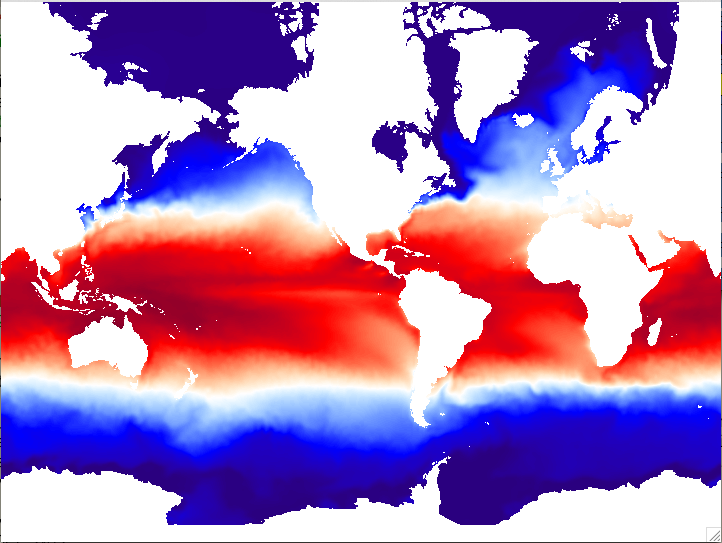
MOM IC temperature field based on ORAS4 reanalysis
MOM IC salt field based on GODAS reanalysis
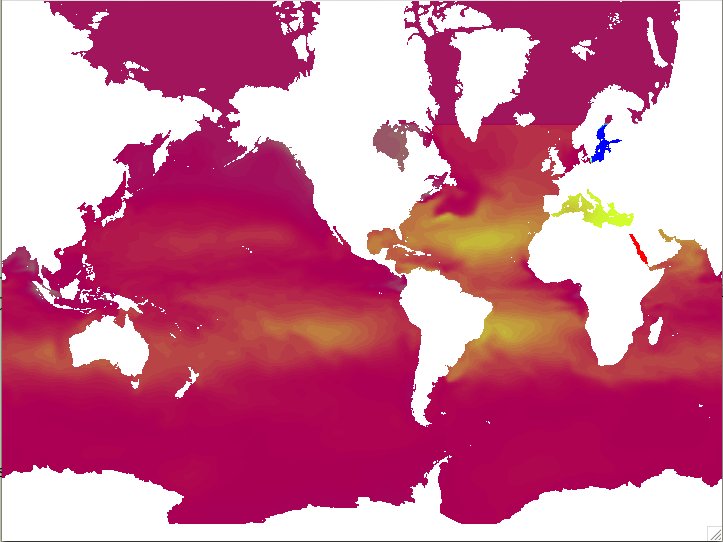
Note that because GODAS has a limited domain the salt in the Arctic has been filled with a 'representational value', in this case taken from the Bering Strait.
Developer notes
Package ocean-ic into a tarball using PyInstaller
Be aware of this issue https://github.com/pyinstaller/pyinstaller/issues/1781. It may be necessary to downgrade setuptools with the following command:
{bash}
$ conda install setuptools==19.2
First install pyinstaller:
{bash}
$ pip install pyinstaller
Create release:
{bash}
$ cd release
$ pyinstaller makeic.spec
$ mv dist/makeic ./makeic-x.x.x
$ tar czvf makeic-x.x.x.tar.gz makeic-x.x.x
Upload tarball to s3:
{bash}
$ s3put -b dp-drop -p /short/v45/nah599/more_home/ ./makeic-x.x.x.tar.gz
$ s3cmd setacl --acl-public --guess-mime-type s3://dp-drop/ocean-ic/release/makeic-x.x.x.tar.gz
Download ocean-ic tarball and test
{bash}
$ wget http://s3-ap-southeast-2.amazonaws.com/dp-drop/ocean-ic/release/makeic-0.0.4.tar.gz
$ tar zxvf makeic-0.0.4.tar.gz
$ export PATH=$(pwd)/makeic-0.0.4/:$PATH
$ makeic_simple --help
$ mkdir -p test
$ cd test/
$ wget http://s3-ap-southeast-2.amazonaws.com/dp-drop/ocean-ic/test/test_data.tar.gz
$ tar zxvf test_data.tar.gz
$ cd test_data/input
$ makeic_simple GODAS pottmp.2016.nc salt.2016.nc NEMO nemo_godas_ic.nc
Compare to known output:
{bash}
$ mkdir example_output
$ cd example_output
$ wget http://s3-ap-southeast-2.amazonaws.com/dp-drop/ocean-ic/test/example_output/nemo_godas_ic.nc
$ ncdiff nemo_godas_ic.nc ../nemo_godas_ic.nc diff.nc
$ ncview diff.nc
Owner
- Name: COSIMA
- Login: COSIMA
- Kind: organization
- Location: Australia
- Website: http://cosima.org.au
- Repositories: 70
- Profile: https://github.com/COSIMA
Consortium for Ocean-Sea Ice Modelling in Australia
GitHub Events
Total
- Delete event: 2
- Issue comment event: 2
- Member event: 4
- Push event: 6
- Pull request review comment event: 2
- Pull request review event: 6
- Pull request event: 5
- Fork event: 2
Last Year
- Delete event: 2
- Issue comment event: 2
- Member event: 4
- Push event: 6
- Pull request review comment event: 2
- Pull request review event: 6
- Pull request event: 5
- Fork event: 2
Committers
Last synced: over 2 years ago
Top Committers
| Name | Commits | |
|---|---|---|
| Nicholas Hannah | n****h@g****m | 55 |
| Andrew Kiss | 3****s | 6 |
| Nic Hannah | n****h@g****m | 5 |
| Nicholas Hannah | n****c@d****u | 3 |
| Aidan Heerdegen | a****n@a****u | 1 |
| Nic Hannah | n****n | 1 |
Committer Domains (Top 20 + Academic)
Issues and Pull Requests
Last synced: over 2 years ago
All Time
- Total issues: 4
- Total pull requests: 2
- Average time to close issues: almost 2 years
- Average time to close pull requests: about 17 hours
- Total issue authors: 4
- Total pull request authors: 1
- Average comments per issue: 2.0
- Average comments per pull request: 1.0
- Merged pull requests: 1
- Bot issues: 0
- Bot pull requests: 0
Past Year
- Issues: 0
- Pull requests: 0
- Average time to close issues: N/A
- Average time to close pull requests: N/A
- Issue authors: 0
- Pull request authors: 0
- Average comments per issue: 0
- Average comments per pull request: 0
- Merged pull requests: 0
- Bot issues: 0
- Bot pull requests: 0
Top Authors
Issue Authors
- nichannah (1)
- FanghuaWu (1)
- utkarshut7 (1)
Pull Request Authors
- aidanheerdegen (2)
- minghangli-uni (1)
- anton-seaice (1)
- ezhilsabareesh8 (1)