IFermi
IFermi: A python library for Fermi surface generation and analysis - Published in JOSS (2021)
Science Score: 95.0%
This score indicates how likely this project is to be science-related based on various indicators:
-
○CITATION.cff file
-
✓codemeta.json file
Found codemeta.json file -
✓.zenodo.json file
Found .zenodo.json file -
✓DOI references
Found 5 DOI reference(s) in README and JOSS metadata -
○Academic publication links
-
✓Committers with academic emails
2 of 15 committers (13.3%) from academic institutions -
○Institutional organization owner
-
✓JOSS paper metadata
Published in Journal of Open Source Software
Keywords
Keywords from Contributors
Scientific Fields
Repository
Fermi surface generation, analysis and visualisation.
Basic Info
- Host: GitHub
- Owner: fermisurfaces
- License: mit
- Language: Python
- Default Branch: main
- Homepage: https://fermisurfaces.github.io/IFermi/
- Size: 136 MB
Statistics
- Stars: 95
- Watchers: 8
- Forks: 36
- Open Issues: 16
- Releases: 15
Topics
Metadata Files
README.md

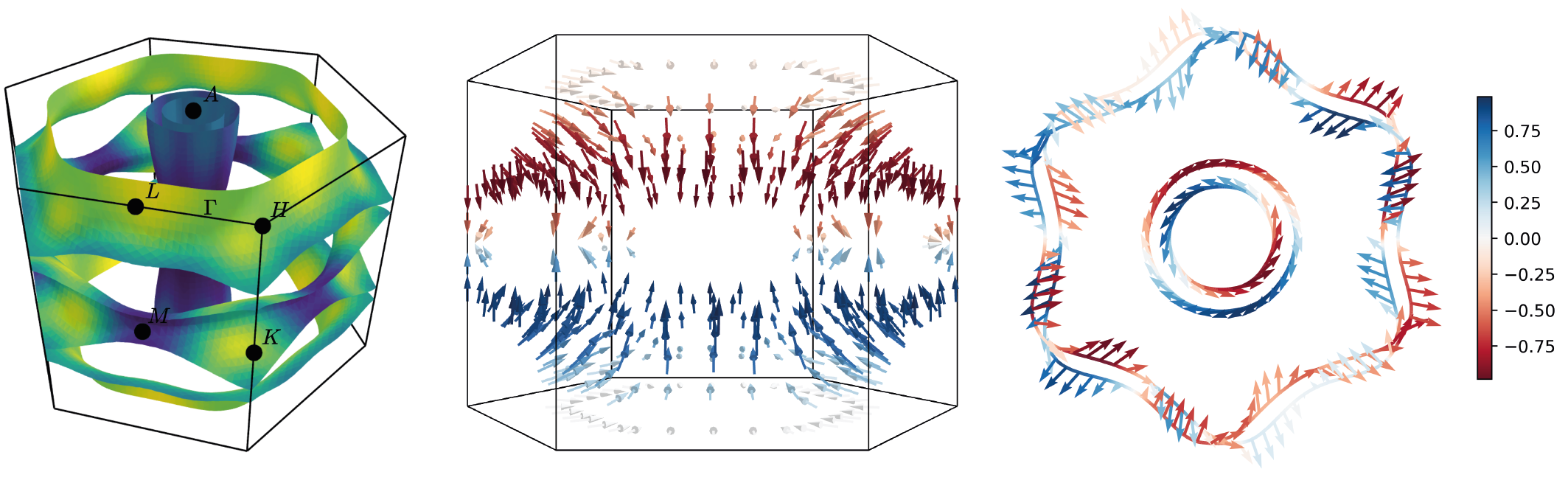
IFermi is a Python (3.9+) library and set of command-line tools for the generation, analysis, and visualisation of Fermi surfaces and Fermi slices. The goal of the library is to provide fully featured FermiSurface and FermiSlice objects that allow for easy manipulation and analysis. The main features include:
- Interpolation of electronic band structures onto dense k-point meshes.
- Extraction of Fermi surfaces and Fermi slices from electronic band structures.
- Projection of arbitrary properties onto Fermi surfaces and Fermi slices.
- Tools to calculate Fermi surface dimensionality, orientation, and averaged projections, including Fermi velocities.
- Interactive visualisation of Fermi surfaces and slices, with support for mayavi, plotly and matplotlib.
- Generation and visualisation of spin-texture.
IFermi's command-line tools only work with VASP calculations but support for additional DFT packages will be added in the future.
Quick start
The online documentation provides a full description of the available command-line options.
Analysis
Fermi surface properties, including dimensionality and orientation can be extracted from a vasprun.xml file using:
bash
ifermi info --property velocity
```
Fermi Surface Summary
# surfaces: 5 Area: 32.75 Å⁻² Avg velocity: 9.131e+05 m/s
Isosurfaces ~~~~~~~~~~~
  Band    Area [Å⁻²]    Velocity avg [m/s]   Dimensionality    Orientation
------  ------------  --------------------  ----------------  -------------
     6         1.944             7.178e+05         2D           (0, 0, 1)
     7         4.370             9.092e+05      quasi-2D        (0, 0, 1)
     7         2.961             5.880e+05         2D           (0, 0, 1)
     8         3.549             1.105e+06      quasi-2D        (0, 0, 1)
     8         3.549             1.105e+06      quasi-2D        (0, 0, 1)
```
Visualisation
Three-dimensional Fermi surfaces can be visualized from a vasprun.xml file using:
bash
ifermi plot
The two-dimensional slice of a Fermi surface along the plane specified by the miller
indices (j k l) and distance d can be plotted from a vasprun.xml file using:
bash
ifermi plot --slice j k l d
Python library
The ifermi command line tools are build on the IFermi Python library. Here is an
example of how to load DFT calculation outputs, interpolate the energies onto a dense mesh,
generate a Fermi surface, calculate Fermi surface properties, and visualise the surface.
A more complete summary of the API is given in the API introduction page
and in the API Reference page in the documentation.
```python from pymatgen.io.vasp.outputs import Vasprun from ifermi.surface import FermiSurface from ifermi.interpolate import FourierInterpolator from ifermi.plot import FermiSlicePlotter, FermiSurfacePlotter, saveplot, showplot from ifermi.kpoints import kpointsfrombandstructure
load VASP calculation outputs
vr = Vasprun("vasprun.xml") bs = vr.getbandstructure()
interpolate the energies onto a dense k-point mesh
interpolator = FourierInterpolator(bs) densebs, velocities = interpolator.interpolatebands(return_velocities=True)
generate the Fermi surface and calculate the dimensionality
fs = FermiSurface.frombandstructure( densebs, mu=0.0, wignerseitz=True, calculate_dimensionality=True )
generate the Fermi surface and calculate the group velocity at the
center of each triangular face
densekpoints = kpointsfrombandstructure(densebs) fs = FermiSurface.frombandstructure( densebs, mu=0.0, wignerseitz=True, calculatedimensionality=True, propertydata=velocities, propertykpoints=densekpoints )
number of isosurfaces in the Fermi surface
fs.n_surfaces
number of isosurfaces for each Spin channel
fs.nsurfacesper_spin
the total area of the Fermi surface
fs.area
the area of each isosurface
fs.area_surfaces
loop over all isosurfaces and check their properties
the isosurfaces are given as a list for each spin channel
for spin, isosurfaces in fs.isosurfaces.items(): for isosurface in isosurfaces: # the dimensionality (does the surface cross periodic boundaries) isosurface.dimensionality
    # what is the orientation
    isosurface.orientation

    # does the surface have face properties
    isosurface.has_properties

    # calculate the norms of the properties
    isosurface.properties_norms

    # calculate scalar projection of properties on to [0 0 1] vector
    isosurface.scalar_projection((0, 0, 1))

    # uniformly sample the surface faces to a consistent density
    isosurface.sample_uniform(0.1)
plot the Fermi surface
fsplotter = FermiSurfacePlotter(fs) plot = fsplotter.get_plot()
generate Fermi slice along the (0 0 1) plane going through the Γ-point.
fermislice = fs.getfermi_slice((0, 0, 1))
number of isolines in the slice
fermislice.nlines
do the lines have segment properties
fermislice.hasproperties
plot slice
sliceplotter = FermiSlicePlotter(fermislice) plot = sliceplotter.getplot()
saveplot(plot, "fermi-slice.png") # saves the plot to a file showplot(plot) # displays an interactive plot ```
Citing IFermi
If you find IFermi useful, please encourage its development by citing the following paper in your research output:
Ganose, A. M., Searle, A., Jain, A., Griffin, S. M., IFermi: A python library for Fermi
surface generation and analysis. Journal of Open Source Software, 2021, 6 (59), 3089
Installation
The recommended way to install IFermi is in a conda environment.
bash
conda create --name ifermi pip cmake numpy
conda activate ifermi
conda install -c conda-forge pymatgen boltztrap2 pyfftw
pip install ifermi
`
IFermi is currently compatible with Python 3.9+ and relies on a number of open-source python packages, specifically:
- pymatgen for parsing DFT calculation outputs.
- BoltzTrap2 for band structure interpolation.
- trimesh for manipulating isosurfaces.
- matplotlib, mayavi, and plotly for three-dimensional plotting.
Running tests
The integration tests can be run to ensure IFermi has been installed correctly. First download the IFermi source and install the test requirements.
git clone https://github.com/fermisurfaces/IFermi.git
cd IFermi
pip install .[tests]
The tests can be run in the IFermi folder using:
bash
pytest
Need Help?
Ask questions about the IFermi Python API and command-line tools on the IFermi support forum. If you've found an issue with IFermi, please submit a bug report here.
What’s new?
Track changes to IFermi through the changelog.
Contributing
We greatly appreciate any contributions in the form of a pull request. Additional information on contributing to IFermi can be found here. We maintain a list of all contributors here.
License
IFermi is made available under the MIT License (see LICENSE file).
Acknowledgements
Developed by Amy Searle and Alex Ganose. Sinéad Griffin designed and led the project.
Owner
- Name: Fermi Surfaces
- Login: fermisurfaces
- Kind: organization
- Repositories: 1
- Profile: https://github.com/fermisurfaces
Software for the generation, analysis and visualisation of Fermi surfaces.
JOSS Publication
IFermi: A python library for Fermi surface generation and analysis
Authors

Energy Technologies Area, Lawrence Berkeley National Laboratory, Berkeley, California 94720, USA
Materials Science Division, Lawrence Berkeley National Laboratory, Berkeley, California 94720, USA, Molecular Foundry, Lawrence Berkeley National Laboratory, Berkeley, California 94720, USA, Clarendon Laboratory, Department of Physics, University of Oxford, OX1 3PU, UK
Energy Technologies Area, Lawrence Berkeley National Laboratory, Berkeley, California 94720, USA
Materials Science Division, Lawrence Berkeley National Laboratory, Berkeley, California 94720, USA, Molecular Foundry, Lawrence Berkeley National Laboratory, Berkeley, California 94720, USA
Editor
Daniel S. Katz
Tags
electronic structure fermi surface spin texture materials science chemistry physicsGitHub Events
Total
- Issues event: 5
- Watch event: 7
- Delete event: 30
- Issue comment event: 11
- Push event: 40
- Pull request review event: 31
- Pull request event: 69
- Fork event: 4
- Create event: 40
Last Year
- Issues event: 5
- Watch event: 7
- Delete event: 30
- Issue comment event: 11
- Push event: 40
- Pull request review event: 31
- Pull request event: 69
- Fork event: 4
- Create event: 40
Committers
Last synced: 11 months ago
Top Committers
| Name | Commits | |
|---|---|---|
| Alex Ganose | a****e@g****m | 332 |
| dependabot[bot] | 4****] | 313 |
| Amy Searle | 4****7 | 39 |
| ajsearle97 | a****e@g****m | 35 |
| dependabot-preview[bot] | 2****] | 17 |
| utf | a****e@g****m | 10 |
| Matthew Horton | m****n@g****m | 9 |
| Amy Jade Searle | a****e@A****l | 8 |
| Paul Neves | p****7@g****m | 5 |
| Amy | a****e@b****u | 3 |
| Amy Jade Searle | a****e@A****l | 2 |
| Patrick Huck | p****k@l****v | 1 |
| Anubhav Jain | a****r@g****m | 1 |
| Katherine Inzani | k****i@K****l | 1 |
| Amy Jade Searle | a****e@a****n | 1 |
Committer Domains (Top 20 + Academic)
Issues and Pull Requests
Last synced: 11 months ago
All Time
- Total issues: 15
- Total pull requests: 363
- Average time to close issues: 6 months
- Average time to close pull requests: 16 days
- Total issue authors: 15
- Total pull request authors: 5
- Average comments per issue: 1.07
- Average comments per pull request: 0.46
- Merged pull requests: 221
- Bot issues: 1
- Bot pull requests: 356
Past Year
- Issues: 6
- Pull requests: 90
- Average time to close issues: 2 days
- Average time to close pull requests: 9 days
- Issue authors: 6
- Pull request authors: 1
- Average comments per issue: 0.67
- Average comments per pull request: 0.14
- Merged pull requests: 54
- Bot issues: 1
- Bot pull requests: 90
Top Authors
Issue Authors
- bfield1 (1)
- paulneves77 (1)
- Rahullmp (1)
- alealv11 (1)
- Dongsheng-Wen (1)
- weotao (1)
- utf (1)
- krmtenzin (1)
- KYZeng111 (1)
- Lattay (1)
- dependabot[bot] (1)
- JaeMinHan24 (1)
- houzf (1)
- 230182 (1)
- Moon121212 (1)
Pull Request Authors
- dependabot[bot] (355)
- utf (3)
- paulneves77 (2)
- tschaume (2)
- dependabot-preview[bot] (1)
Top Labels
Issue Labels
Pull Request Labels
Packages
- Total packages: 2
-
Total downloads:
- pypi 255 last-month
-
Total dependent packages: 1
(may contain duplicates) -
Total dependent repositories: 4
(may contain duplicates) - Total versions: 19
- Total maintainers: 2
pypi.org: ifermi
Fermi surface plotting tool from DFT output
- Documentation: https://ifermi.readthedocs.io/
- License: MIT
-
Latest release: 0.3.6
published almost 2 years ago
Rankings
Maintainers (2)
conda-forge.org: ifermi
IFermi is a Python (3.6+) library and set of command-line tools for the generation, analysis, and visualisation of Fermi surfaces and Fermi slices. The goal of the library is to provide fully featured FermiSurface and FermiSlice objects that allow for easy manipulation and analysis.
- Homepage: https://github.com/fermisurfaces/IFermi
- License: MIT
-
Latest release: 0.3.1
published over 3 years ago
Rankings
Dependencies
- actions/checkout v2 composite
- actions/setup-python v2 composite
- peaceiris/actions-gh-pages v3 composite
- actions/checkout v3 composite
- actions/create-release v1 composite
- actions/setup-python v4 composite
- peaceiris/actions-gh-pages v3 composite
- pypa/gh-action-pypi-publish master composite
- actions/checkout v3 composite
- actions/setup-python v4 composite
- fastify/github-action-merge-dependabot v3 composite
- pre-commit/action v3.0.0 composite
- BoltzTraP2 *
- click *
- matplotlib *
- meshcut *
- monty *
- networkx *
- numpy *
- plotly *
- psutil *
- pyfftw *
- pymatgen >=2017.12.30
- scikit-image *
- scipy *
- spglib *
- tabulate *
- trimesh *