https://github.com/ctf-for-science/chronos-forecasting
Science Score: 54.0%
This score indicates how likely this project is to be science-related based on various indicators:
-
✓CITATION.cff file
Found CITATION.cff file -
✓codemeta.json file
Found codemeta.json file -
✓.zenodo.json file
Found .zenodo.json file -
○DOI references
-
✓Academic publication links
Links to: arxiv.org -
○Academic email domains
-
○Institutional organization owner
-
○JOSS paper metadata
-
○Scientific vocabulary similarity
Low similarity (13.7%) to scientific vocabulary
Repository
Basic Info
- Host: GitHub
- Owner: CTF-for-Science
- License: apache-2.0
- Language: Python
- Default Branch: main
- Size: 838 KB
Statistics
- Stars: 0
- Watchers: 0
- Forks: 0
- Open Issues: 0
- Releases: 0
Metadata Files
README.md

CTF Notes
- Install the packages in
pyproject.toml:pip install . - Main codes are in the
ctf/folder, userun.py
bash
pyenv install 3.11.11
pyenv local 3.11.11
python -m venv ~/.virtualenvs/chronos
source ~/.virtualenvs/chronos/bin/activate
pip install .
cd ../../
pip install -e .[all]
🚀 News
- 14 Feb 2025: 🚀 Chronos-Bolt is now available on Amazon SageMaker JumpStart! Check out the tutorial notebook to learn how to deploy Chronos endpoints for production use in 3 lines of code.
- 12 Dec 2024: 📊 We released
fev, a lightweight package for benchmarking time series forecasting models based on the Hugging Facedatasetslibrary. - 26 Nov 2024: ⚡️ Chronos-Bolt models released on HuggingFace. Chronos-Bolt models are more accurate (5% lower error), up to 250x faster and 20x more memory efficient than the original Chronos models of the same size!
- 27 Jun 2024: 🚀 Released datasets used in the paper and an evaluation script to compute the WQL and MASE scores reported in the paper.
- 17 May 2024: 🐛 Fixed an off-by-one error in bin indices in the
output_transform. This simple fix significantly improves the overall performance of Chronos. We will update the results in the next revision on ArXiv. - 10 May 2024: 🚀 We added the code for pretraining and fine-tuning Chronos models. You can find it in this folder. We also added a script for generating synthetic time series data from Gaussian processes (KernelSynth; see Section 4.2 in the paper for details). Check out the usage examples.
- 19 Apr 2024: 🚀 Chronos is now supported on AutoGluon-TimeSeries, the powerful AutoML package for time series forecasting which enables model ensembles, cloud deployments, and much more. Get started with the tutorial.
- 08 Apr 2024: 🧪 Experimental MLX inference support added. If you have an Apple Silicon Mac, you can now obtain significantly faster forecasts from Chronos compared to CPU inference. This provides an alternative way to exploit the GPU on your Apple Silicon Macs together with the "mps" support in PyTorch.
- 25 Mar 2024: 🚀 v1.1.0 released with inference optimizations and
pipeline.embedto extract encoder embeddings from Chronos. - 13 Mar 2024: 🚀 Chronos paper and inference code released.
✨ Introduction
Chronos is a family of pretrained time series forecasting models based on language model architectures. A time series is transformed into a sequence of tokens via scaling and quantization, and a language model is trained on these tokens using the cross-entropy loss. Once trained, probabilistic forecasts are obtained by sampling multiple future trajectories given the historical context. Chronos models have been trained on a large corpus of publicly available time series data, as well as synthetic data generated using Gaussian processes.
For details on Chronos models, training data and procedures, and experimental results, please refer to the paper Chronos: Learning the Language of Time Series.

Fig. 1: High-level depiction of Chronos. (Left) The input time series is scaled and quantized to obtain a sequence of tokens. (Center) The tokens are fed into a language model which may either be an encoder-decoder or a decoder-only model. The model is trained using the cross-entropy loss. (Right) During inference, we autoregressively sample tokens from the model and map them back to numerical values. Multiple trajectories are sampled to obtain a predictive distribution.
Architecture
The models in this repository are based on the T5 architecture. The only difference is in the vocabulary size: Chronos-T5 models use 4096 different tokens, compared to 32128 of the original T5 models, resulting in fewer parameters.
Zero-Shot Results
The following figure showcases the remarkable zero-shot performance of Chronos and Chronos-Bolt models on 27 datasets against local models, task-specific models and other pretrained models. For details on the evaluation setup and other results, please refer to the paper.
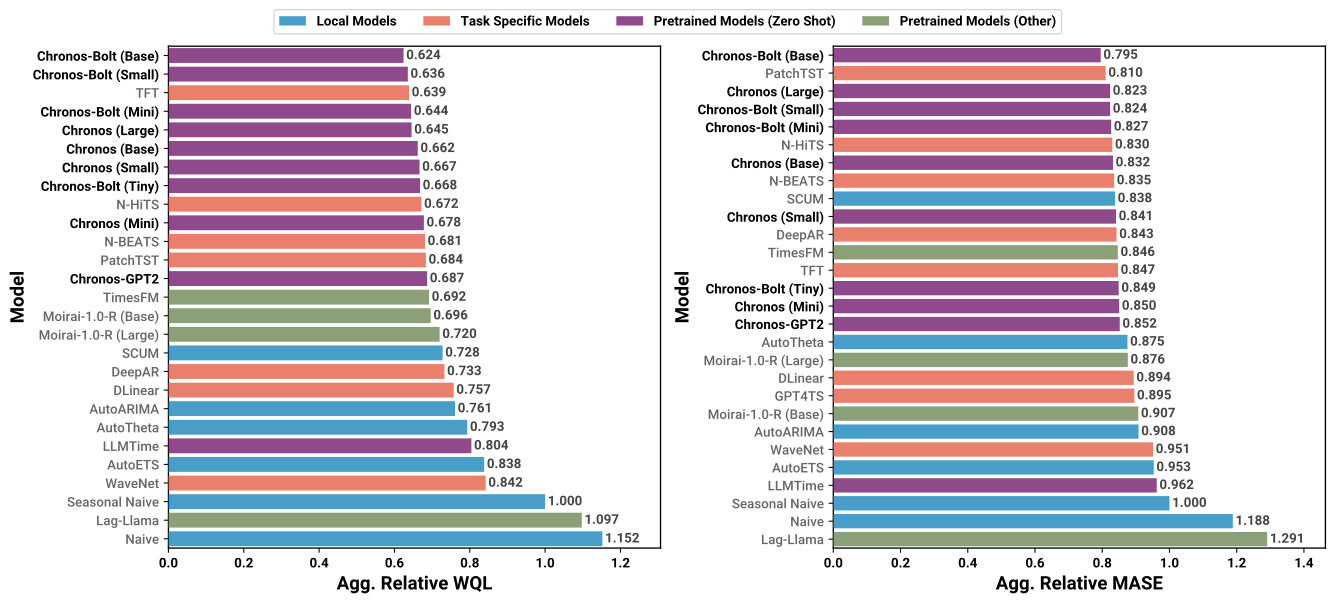
Fig. 2: Performance of different models on Benchmark II, comprising 27 datasets not seen by Chronos and Chronos-Bolt models during training. This benchmark provides insights into the zero-shot performance of Chronos and Chronos-Bolt models against local statistical models, which fit parameters individually for each time series, task-specific models trained on each task, and pretrained models trained on a large corpus of time series. Pretrained Models (Other) indicates that some (or all) of the datasets in Benchmark II may have been in the training corpus of these models. The probabilistic (WQL) and point (MASE) forecasting metrics were normalized using the scores of the Seasonal Naive baseline and aggregated through a geometric mean to obtain the Agg. Relative WQL and MASE, respectively.
📈 Usage
To perform inference with Chronos or Chronos-Bolt models, the easiest way is to install this package through pip:
sh
pip install chronos-forecasting
If you're interested in pretraining, fine-tuning, and other research & development, clone and install the package from source:
```sh
Clone the repository
git clone https://github.com/amazon-science/chronos-forecasting.git
Install in editable mode with extra training-related dependencies
cd chronos-forecasting && pip install --editable ".[training]" ```
[!TIP] This repository is intended for research purposes and provides a minimal interface to Chronos models. For reliable production use, we recommend the following options: - AutoGluon provides effortless fine-tuning, augmenting Chronos models with exogenous information through covariate regressors, ensembling with other statistical and machine learning models. Check out the AutoGluon Chronos tutorial. - SageMaker JumpStart makes it easy to deploy Chronos inference endpoints to AWS with just a few lines of code. Check out this tutorial for more details.
Forecasting
A minimal example showing how to perform forecasting using Chronos and Chronos-Bolt models:
```python import pandas as pd # requires: pip install pandas import torch from chronos import BaseChronosPipeline
pipeline = BaseChronosPipeline.frompretrained( "amazon/chronos-t5-small", # use "amazon/chronos-bolt-small" for the corresponding Chronos-Bolt model devicemap="cuda", # use "cpu" for CPU inference torch_dtype=torch.bfloat16, )
df = pd.read_csv( "https://raw.githubusercontent.com/AileenNielsen/TimeSeriesAnalysisWithPython/master/data/AirPassengers.csv" )
context must be either a 1D tensor, a list of 1D tensors,
or a left-padded 2D tensor with batch as the first dimension
quantiles is an fp32 tensor with shape [batchsize, predictionlength, numquantilelevels]
mean is an fp32 tensor with shape [batchsize, predictionlength]
quantiles, mean = pipeline.predictquantiles( context=torch.tensor(df["#Passengers"]), predictionlength=12, quantile_levels=[0.1, 0.5, 0.9], ) ```
For the original Chronos models, pipeline.predict can be used to draw forecast samples. More options for predict_kwargs in pipeline.predict_quantiles can be found with:
```python from chronos import ChronosPipeline, ChronosBoltPipeline
print(ChronosPipeline.predict.doc) # for Chronos models print(ChronosBoltPipeline.predict.doc) # for Chronos-Bolt models ```
We can now visualize the forecast:
```python import matplotlib.pyplot as plt # requires: pip install matplotlib
forecast_index = range(len(df), len(df) + 12) low, median, high = quantiles[0, :, 0], quantiles[0, :, 1], quantiles[0, :, 2]
plt.figure(figsize=(8, 4)) plt.plot(df["#Passengers"], color="royalblue", label="historical data") plt.plot(forecastindex, median, color="tomato", label="median forecast") plt.fillbetween(forecast_index, low, high, color="tomato", alpha=0.3, label="80% prediction interval") plt.legend() plt.grid() plt.show() ```
Extracting Encoder Embeddings
A minimal example showing how to extract encoder embeddings from Chronos models:
```python import pandas as pd import torch from chronos import ChronosPipeline
pipeline = ChronosPipeline.frompretrained( "amazon/chronos-t5-small", devicemap="cuda", torch_dtype=torch.bfloat16, )
df = pd.read_csv("https://raw.githubusercontent.com/AileenNielsen/TimeSeriesAnalysisWithPython/master/data/AirPassengers.csv")
context must be either a 1D tensor, a list of 1D tensors,
or a left-padded 2D tensor with batch as the first dimension
context = torch.tensor(df["#Passengers"]) embeddings, tokenizer_state = pipeline.embed(context) ```
Pretraining, fine-tuning and evaluation
Scripts for pretraining, fine-tuning and evaluating Chronos models can be found in this folder.
:floppy_disk: Datasets
Datasets used in the Chronos paper for pretraining and evaluation (both in-domain and zero-shot) are available through the HuggingFace repos: autogluon/chronos_datasets and autogluon/chronos_datasets_extra. Check out these repos for instructions on how to download and use the datasets.
🔥 Coverage
- Adapting language model architectures for time series forecasting (Amazon Science blog post)
- Amazon AI Researchers Introduce Chronos: A New Machine Learning Framework for Pretrained Probabilistic Time Series Models (Marktechpost blog post)
- Chronos: The Rise of Foundation Models for Time Series Forecasting (Towards Data Science blog post by Luís Roque and Rafael Guedes)
- Moirai: Time Series Foundation Models for Universal Forecasting (Towards Data Science blog post by Luís Roque and Rafael Guedes, includes comparison of Chronos with Moirai)
- Chronos: The Latest Time Series Forecasting Foundation Model by Amazon (Towards Data Science blog post by Marco Peixeiro)
- The original article had a critical bug affecting the metric computation for Chronos. We opened a pull request to fix it.
- How to Effectively Forecast Time Series with Amazon's New Time Series Forecasting Model (Towards Data Science blog post by Eivind Kjosbakken)
- Chronos: Learning the Language of Time Series (Minimize Regret blog post by Tim Radtke)
- Chronos: Another Zero-Shot Time Series Forecaster LLM (Level Up Coding blog post by Level Up Coding AI TutorMaster)
- Paper Review: Chronos: Learning the Language of Time Series (Review by Andrey Lukyanenko)
- Foundation Models for Forecasting: the Future or Folly? (Blog post by Radix)
- Learning the Language of Time Series with Chronos (Medium post by Manuele Caddeo)
- The latest advancement in Time Series Forecasting from AWS: Chronos (Medium post by Abish Pius)
- Decoding the Future: How Chronos Redefines Time Series Forecasting with the Art of Language (Medium post by Zamal)
- Comparison of Chronos against the SCUM ensemble of statistical models (Benchmark by Nixtla)
- We opened a pull request extending the analysis to 28 datasets (200K+ time series) and showing that zero-shot Chronos models perform comparably to this strong ensemble of 4 statistical models while being significantly faster on average. Our complete response can be found here.
- Comparison of Chronos against a variety of forecasting models (Benchmark by ReadyTensor)
📝 Citation
If you find Chronos models useful for your research, please consider citing the associated paper:
@article{ansari2024chronos,
  title={Chronos: Learning the Language of Time Series},
  author={Ansari, Abdul Fatir and Stella, Lorenzo and Turkmen, Caner and Zhang, Xiyuan, and Mercado, Pedro and Shen, Huibin and Shchur, Oleksandr and Rangapuram, Syama Syndar and Pineda Arango, Sebastian and Kapoor, Shubham and Zschiegner, Jasper and Maddix, Danielle C. and Mahoney, Michael W. and Torkkola, Kari and Gordon Wilson, Andrew and Bohlke-Schneider, Michael and Wang, Yuyang},
  journal={Transactions on Machine Learning Research},
  issn={2835-8856},
  year={2024},
  url={https://openreview.net/forum?id=gerNCVqqtR}
}
🛡️ Security
See CONTRIBUTING for more information.
📃 License
This project is licensed under the Apache-2.0 License.
Owner
- Name: CTF for Science
- Login: CTF-for-Science
- Kind: organization
- Repositories: 1
- Profile: https://github.com/CTF-for-Science
Citation (CITATION.cff)
cff-version: 1.2.0
title: "Chronos: Learning the Language of Time Series"
message: "If you find Chronos models useful for your research, please consider citing the associated paper."
authors:
  - family-names: Ansari
    given-names: Abdul Fatir
  - family-names: Stella
    given-names: Lorenzo
  - family-names: Turkmen
    given-names: Caner
  - family-names: Zhang
    given-names: Xiyuan
  - family-names: Mercado
    given-names: Pedro
  - family-names: Shen
    given-names: Huibin
  - family-names: Shchur
    given-names: Oleksandr
  - family-names: Rangapuram
    given-names: Syama Syndar
  - family-names: Arango
    given-names: Sebastian Pineda
  - family-names: Kapoor
    given-names: Shubham
  - family-names: Zschiegner
    given-names: Jasper
  - family-names: Maddix
    given-names: Danielle C.
  - family-names: Mahoney
    given-names: Michael W.
  - family-names: Torkkola
    given-names: Kari
  - family-names: Wilson
    given-names: Andrew Gordon
  - family-names: Bohlke-Schneider
    given-names: Michael
  - family-names: Wang
    given-names: Yuyang
preferred-citation:
  type: article
  authors:
    - family-names: Ansari
      given-names: Abdul Fatir
    - family-names: Stella
      given-names: Lorenzo
    - family-names: Turkmen
      given-names: Caner
    - family-names: Zhang
      given-names: Xiyuan
    - family-names: Mercado
      given-names: Pedro
    - family-names: Shen
      given-names: Huibin
    - family-names: Shchur
      given-names: Oleksandr
    - family-names: Rangapuram
      given-names: Syama Syndar
    - family-names: Arango
      given-names: Sebastian Pineda
    - family-names: Kapoor
      given-names: Shubham
    - family-names: Zschiegner
      given-names: Jasper
    - family-names: Maddix
      given-names: Danielle C.
    - family-names: Mahoney
      given-names: Michael W.
    - family-names: Torkkola
      given-names: Kari
    - family-names: Wilson
      given-names: Andrew Gordon
    - family-names: Bohlke-Schneider
      given-names: Michael
    - family-names: Wang
      given-names: Yuyang
  title: "Chronos: Learning the Language of Time Series"
  journal: "arXiv preprint arXiv:2403.07815"
  year: 2024
GitHub Events
Total
- Push event: 2
- Create event: 1
Last Year
- Push event: 2
- Create event: 1
Dependencies
- accelerate >=0.32,<2
- torch >=2.0,<3
- transformers >=4.48,<5