https://github.com/daniel-furman/scattertext
Beautiful visualizations of how language differs among document types.
Science Score: 10.0%
This score indicates how likely this project is to be science-related based on various indicators:
-
○CITATION.cff file
-
○codemeta.json file
-
○.zenodo.json file
-
○DOI references
-
✓Academic publication links
Links to: arxiv.org -
○Academic email domains
-
○Institutional organization owner
-
○JOSS paper metadata
-
○Scientific vocabulary similarity
Low similarity (9.0%) to scientific vocabulary
Last synced: 9 months ago
·
JSON representation
Repository
Beautiful visualizations of how language differs among document types.
Basic Info
Statistics
- Stars: 0
- Watchers: 0
- Forks: 0
- Open Issues: 0
- Releases: 0
Fork of JasonKessler/scattertext
Created almost 4 years ago
· Last pushed about 4 years ago
https://github.com/daniel-furman/scattertext/blob/master/
[](https://travis-ci.org/JasonKessler/scattertext)
[]()
[](https://gitter.im/scattertext/Lobby)
[](https://twitter.com/jasonkessler)
# Scattertext 0.1.6
A tool for finding distinguishing terms in corpora and displaying them in an
interactive HTML scatter plot. Points corresponding to terms are selectively labeled
so that they don't overlap with other labels or points.
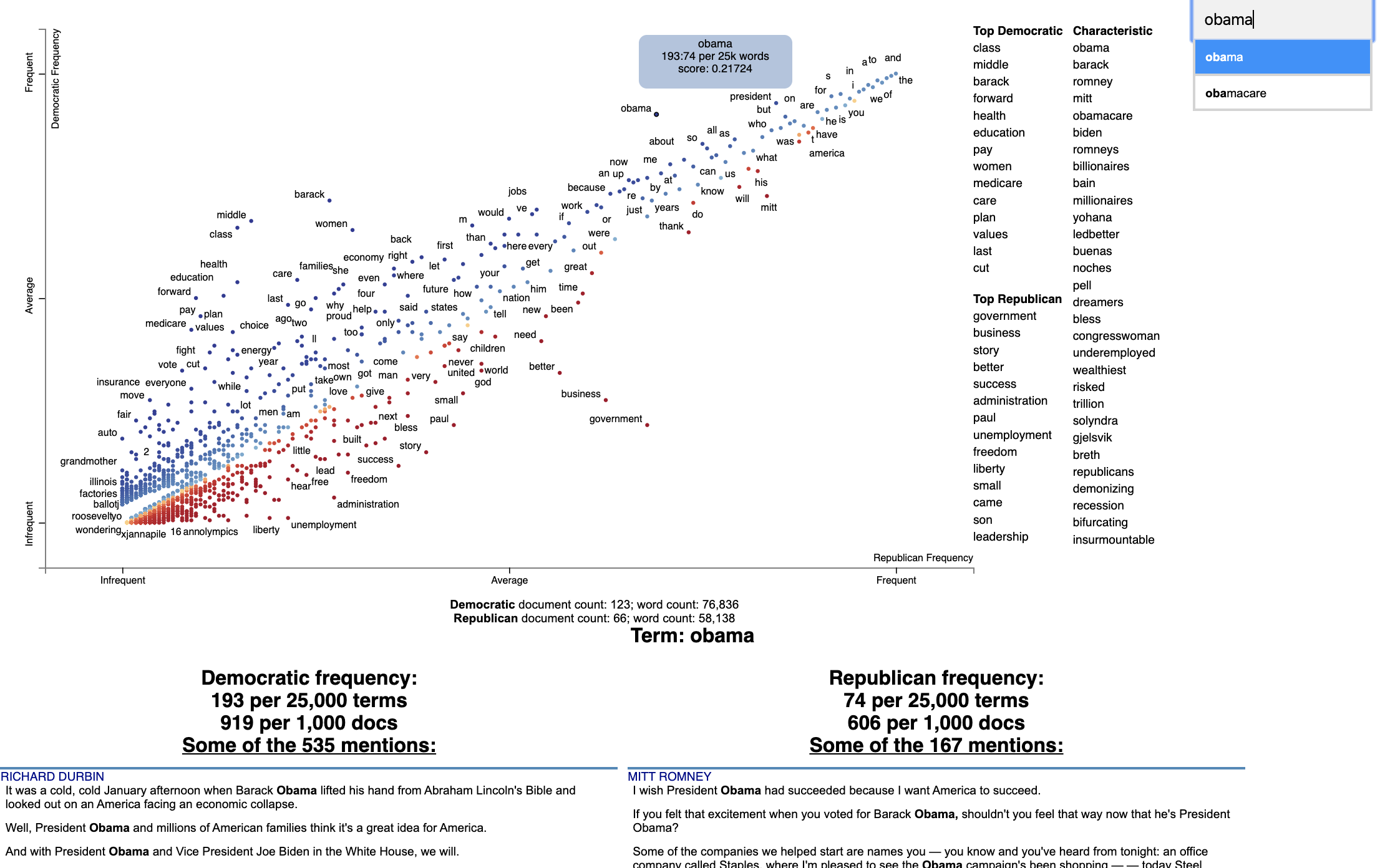
Below is an example of using Scattertext to create visualize terms used in 2012 American
political conventions. The 2,000 most party-associated unigrams are displayed as
points in the scatter plot. Their x- and y- axes are the dense ranks of their usage by
Republican and Democratic speakers respectively.
```pydocstring
import scattertext as st
df = st.SampleCorpora.ConventionData2012.get_data().assign(
parse=lambda df: df.text.apply(st.whitespace_nlp_with_sentences)
)
corpus = st.CorpusFromParsedDocuments(
df, category_col='party', parsed_col='parse'
).build().get_unigram_corpus().compact(st.AssociationCompactor(2000))
html = st.produce_scattertext_explorer(
corpus,
category='democrat', category_name='Democratic', not_category_name='Republican',
minimum_term_frequency=0, pmi_threshold_coefficient=0,
width_in_pixels=1000, metadata=corpus.get_df()['speaker'],
transform=st.Scalers.dense_rank
)
open('./demo_compact.html', 'w').write(html)
```
The HTML file written would look like the image below. Click on it for the actual interactive visualization.
[](https://jasonkessler.github.io/demo_compact.html)
**Table of Contents**
- [Citation](#citation)
- [Installation](#installation)
- [Overview](#overview)
- [Customizing the Visualization and Plotting Dispersion](#customizing-the-visualization-and-plotting-dispersion)
- [Tutorial](#tutorial)
- [Help! I don't know Python but I still want to use Scattertext](#help-i-dont-know-python-but-i-still-want-to-use-scattertext)
- [Using Scattertext as a text analysis library: finding characteristic terms and their associations](#using-scattertext-as-a-text-analysis-library-finding-characteristic-terms-and-their-associations)
- [Visualizing term associations](#visualizing-term-associations)
- [Visualizing phrase associations](#visualizing-phrase-associations)
- [Visualizing Empath topics and categories](#visualizing-empath-topics-and-categories)
- [Visualizing the Moral Foundations 2.0 Dictionary](#visualizing-the-moral-foundations-2.0-dictionary)
- [Ordering Terms by Corpus Characteristicness](#ordering-terms-by-corpus-characteristicness)
- [Document-Based Scatterplots](#document-based-scatterplots)
- [Using Cohen's d or Hedge's r to visualize effect size](#using-cohens-d-or-hedges-r-to-visualize-effect-size)
- [Using Custom Background Word Frequences](#using-custom-background-word-frequences)
- [Understanding Scaled F-Score](#understanding-scaled-f-score)
- [Alternative term scoring methods](#alternative-term-scoring-methods)
- [The position-select-plot process](#the-position-select-plot-process)
- [Advanced Uses](#advanced-uses)
- [Visualizing differences based on only term frequencies](#visualizing-differences-based-on-only-term-frequencies)
- [Visualizing query-based categorical differences](#visualizing-query-based-categorical-differences)
- [Visualizing any kind of term score](#visualizing-any-kind-of-term-score)
- [Custom term positions](#custom-term-positions)
- [Emoji analysis](#emoji-analysis)
- [Visualizing SentencePiece tokens](#visualizing-sentencepiece-tokens)
- [Visualizing scikit-learn text classification weights](#visualizing-scikit-learn-text-classification-weights)
- [Creating lexicalized semiotic squares](#creating-lexicalized-semiotic-squares)
- [Visualizing topic models](#visualizing-topic-models)
- [Creating T-SNE-style word embedding projection plots](#creating-T-SNE-style-word-embedding-projection-plots)
- [Using SVD to visualize any kind of word embeddings](#using-svd-to-visualize-any-kind-of-word-embeddings)
- [Using the same scale for both axes](#using-the-same-scale-for-both-axes)
- [Examples](#examples)
- [A note on chart layout](#a-note-on-chart-layout)
- [What's new](#whats-new)
- [Sources](#sources)
## Citation
Jason S. Kessler. Scattertext: a Browser-Based Tool for Visualizing how Corpora Differ. ACL System Demonstrations. 2017.
Link to preprint: [arxiv.org/abs/1703.00565](https://arxiv.org/abs/1703.00565)
```
@article{kessler2017scattertext,
author = {Kessler, Jason S.},
title = {Scattertext: a Browser-Based Tool for Visualizing how Corpora Differ},
booktitle = {Proceedings of ACL-2017 System Demonstrations},
year = {2017},
address = {Vancouver, Canada},
publisher = {Association for Computational Linguistics},
}
```
## Installation
Install Python 3.4 or higher and run:
`$ pip install scattertext`
If you cannot (or don't want to) install spaCy, substitute `nlp = spacy.load('en')` lines with
`nlp = scattertext.WhitespaceNLP.whitespace_nlp`. Note, this is not compatible
with `word_similarity_explorer`, and the tokenization and sentence boundary detection
capabilities will be low-performance regular expressions. See `demo_without_spacy.py`
for an example.
It is recommended you install `jieba`, `spacy`, `empath`, `astropy`, `flashtext`, `gensim` and `umap-learn` in order to
take full advantage of Scattertext.
Scattertext should mostly work with Python 2.7, but it may not.
The HTML outputs look best in Chrome and Safari.
## Style Guide
The name of this project is Scattertext. "Scattertext" is written as a single word
and should be capitalized. When used in Python, the package `scattertext` should be defined
to the name `st`, i.e., `import scattertext as st`.
## Overview
This is a tool that's intended for visualizing what words and phrases
are more characteristic of a category than others.
Consider the example at the top of the page.
Looking at this seem overwhelming. In fact, it's a relatively simple visualization of word use
during the 2012 political convention. Each dot corresponds to a word or phrase mentioned by Republicans or Democrats
during their conventions. The closer a dot is to the top of the plot, the more frequently it was used by
Democrats. The further right a dot, the more that word or phrase was used by Republicans. Words frequently
used by both parties, like "of" and "the" and even "Mitt" tend to occur in the upper-right-hand corner. Although very low
frequency words have been hidden to preserve computing resources, a word that neither party used, like "giraffe"
would be in the bottom-left-hand corner.
The interesting things happen close to the upper-left and lower-right corners. In the upper-left corner,
words like "auto" (as in auto bailout) and "millionaires" are frequently used by Democrats but infrequently or never used
by Republicans. Likewise, terms frequently used by Republicans and infrequently by Democrats occupy the
bottom-right corner. These include "big government" and "olympics", referring to the Salt Lake City Olympics in which
Gov. Romney was involved.
Terms are colored by their association. Those that are more associated with Democrats are blue, and those
more associated with Republicans red.
Terms that are most characteristic of the both sets of documents are displayed
on the far-right of the visualization.
The inspiration for this visualization came from Dataclysm (Rudder, 2014).
Scattertext is designed to help you build these graphs and efficiently label points on them.
The documentation (including this readme) is a work in
progress. Please see the tutorial below as well as the [PyData 2017 Tutorial](https://github.com/JasonKessler/Scattertext-PyData).
Poking around the code and tests should give you a good idea of how things work.
The library covers some novel and effective term-importance formulas, including **Scaled F-Score**.
## Customizing the Visualization and Plotting Dispersion
New in Scattertext 0.1.0, one can use a dataframe for term/metadata positions and other term-specific data. We
can also use it to determine term-specific information which is shown after a term is clicked.
Note that it is possible to disable the use of document categories in Scattertext, as we shall see in this example.
This example covers plotting term dispersion against word frequency and identifying the terms which are most and least
dispersed given their frequencies. Using the Rosengren's S dispersion measure (Gries 2021), terms tend to increase in their
dispersion scores as they get more frequent. We'll see how we can both plot this effect and factor out the effect
of frequency.
This, along with a number of other dispersion metrics presented in Gries (2021), are available and documented
in the `Dispersion` class, which we'll use later in the section.
Let's start by creating a Convention corpus, but we'll use the `CorpusWithoutCategoriesFromParsedDocuments` factory
to ensure that no categories are included in the corpus. If we try to find document categories, we'll see that
all documents have the category '_'.
```python
import scattertext as st
df = st.SampleCorpora.ConventionData2012.get_data().assign(
parse=lambda df: df.text.apply(st.whitespace_nlp_with_sentences))
corpus = st.CorpusWithoutCategoriesFromParsedDocuments(
df, parsed_col='parse'
).build().get_unigram_corpus().remove_infrequent_words(minimum_term_count=6)
corpus.get_categories()
# Returns ['_']
```
Next, we'll create a dataframe for all terms we'll plot. We'll just start by creating a dataframe where we capture
the frequency of each term and various dispersion metrics. These will be shown after a term is activated in the plot.
```python
dispersion = st.Dispersion(corpus)
dispersion_df = dispersion.get_df()
dispersion_df.head(3)
```
Which returns
```
Frequency Range SD VC Juilland's D Rosengren's S DP DP norm KL-divergence
thank 363 134 3.108113 1.618274 0.707416 0.694898 0.391548 0.391560 0.748808
you 1630 177 12.383708 1.435902 0.888596 0.898805 0.233627 0.233635 0.263337
so 549 155 3.523380 1.212967 0.774299 0.822244 0.283151 0.283160 0.411750
```
These are discussed in detail in [Gries 2021](http://www.stgries.info/research/ToApp_STG_Dispersion_PHCL.pdf).
We'll use Rosengren's S to find the dispersion of each term. It's which a metric designed for corpus parts
(convention speeches in our case) of varying length. Where n is the number of documents in the corpus, s_i is the
percentage of tokens in the corpus found in document i, v_i is term count in document i, and f is the total number
of tokens in the corpus of type term type.
Rosengren's S: [^2}{f})](https://render.githubusercontent.com/render/math?math=\frac{\Sum_{i=1}^{n}\sqrt{s_i%20\cdot%20\v_i})^2}{f})
In order to start plotting, we'll need to add coordinates for each term to the data frame.
To use the `dataframe_scattertext` function, you need, at a minimum a dataframe with 'X' and 'Y' columns.
The `Xpos` and `Ypos` columns indicate the positions of the original `X` and `Y` values on the scatterplot, and
need to be between 0 and 1. Functions in `st.Scalers` perform this scaling. Absent `Xpos` or `Ypos`,
`st.Scalers.scale` would be used.
Here is a sample of values:
* `st.Scalers.scale(vec)` Rescales the vector to where the minimum value is 0 and the maximum is 1.
* `st.Scalers.log_scale(vec)` Rescales the lgo of the vector
* `st.Scalers.dense_ranke(vec)` Rescales the dense rank of the vector
* `st.Scalers.scale_center_zero_abs(vec)` Rescales a vector with both positive and negative values such that the 0 value in the original vector is plotted at 0.5, negative values are projected from [-argmax(abs(vec)), 0] to [0, 0.5] and positive values projected from [0, argmax(abs(vec))] to [0.5, 1].
```python
dispersion_df = dispersion_df.assign(
X=lambda df: df.Frequency,
Xpos=lambda df: st.Scalers.log_scale(df.X),
Y=lambda df: df["Rosengren's S"],
Ypos=lambda df: st.Scalers.scale(df.Y),
)
```
Note that the `Ypos` column here is not necessary since `Y` would automatically be scaled.
Finally, since we are not distinguishing between categories, we can set `ignore_categories=True`.
We can now plot this graph using the `dataframe_scattertext` function:
```python
html = st.dataframe_scattertext(
corpus,
plot_df=dispersion_df,
metadata=corpus.get_df()['speaker'] + ' (' + corpus.get_df()['party'].str.upper() + ')',
ignore_categories=True,
x_label='Log Frequency',
y_label="Rosengren's S",
y_axis_labels=['More Dispersion', 'Medium', 'Less Dispersion'],
)
```
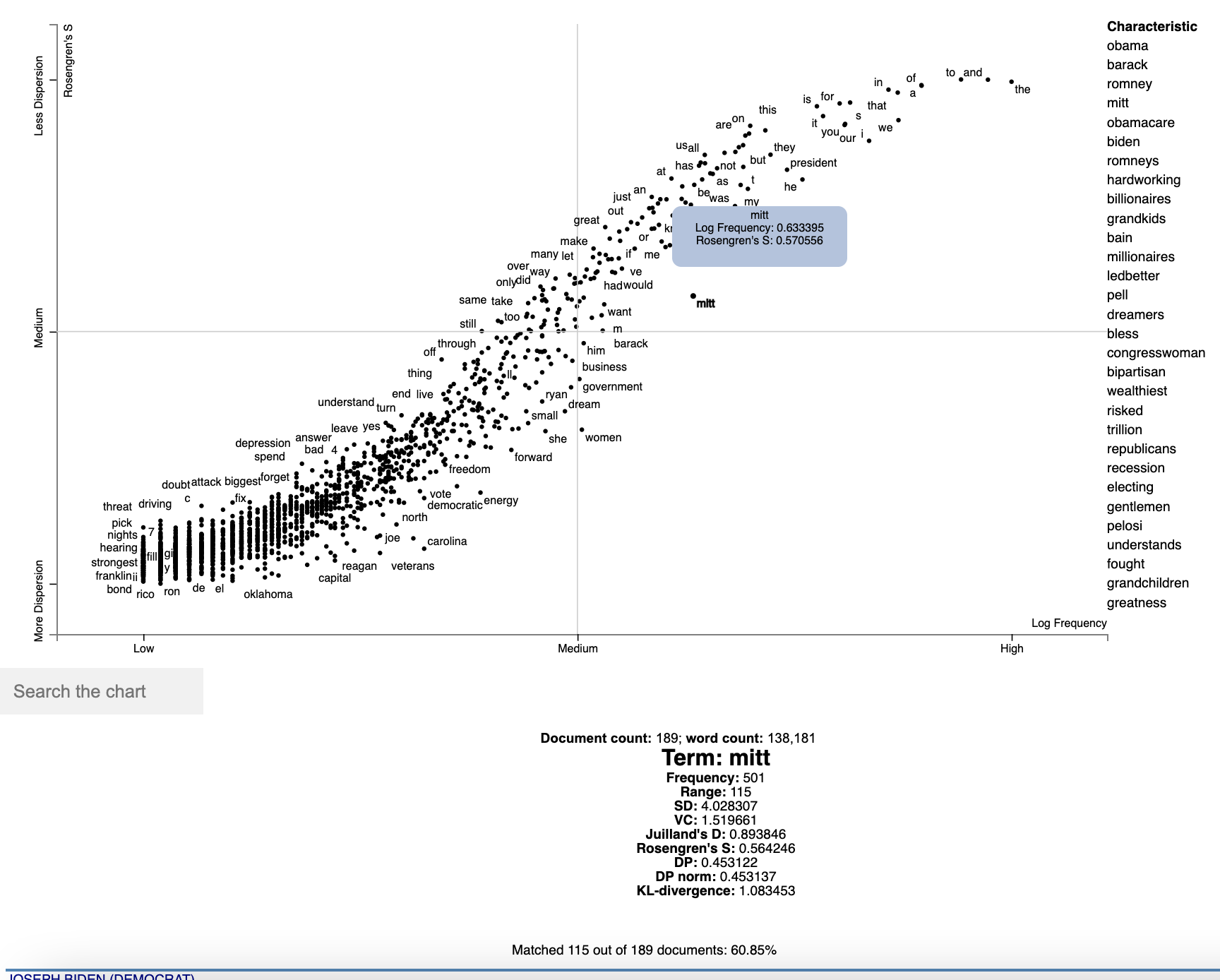
Which yields (click for an interactive version):
[](https://jasonkessler.github.io/dispersion-basic.html)
Note that we can see various dispersion statistics under a term's name, in addition to the standard usage statistics. To
customize the statistics which are displayed, set the `term_description_column=[...]` parameter with a list of column
names to be displayed.
One issue in this dispersion chart, which tends to be common to dispersion metrics in general, is that dispersion
and frequency tend to have a high correlation, but with a complex, non-linear curve. Depending on the metric,
this correlation curve could be power, linear, sigmoidal, or typically, something else.
In order to factor out this correlation, we can predict the dispersion from frequency using a non-parametric regressor,
and see which terms have the highest and lowest residuals with respect to their expected dispersions based on their
frequencies.
In this case, we'll use a KNN regressor with 10 neighbors to predict Rosengren'S from term frequencies
(`dispersion_df.X` and `.Y` respectively), and compute the residual.
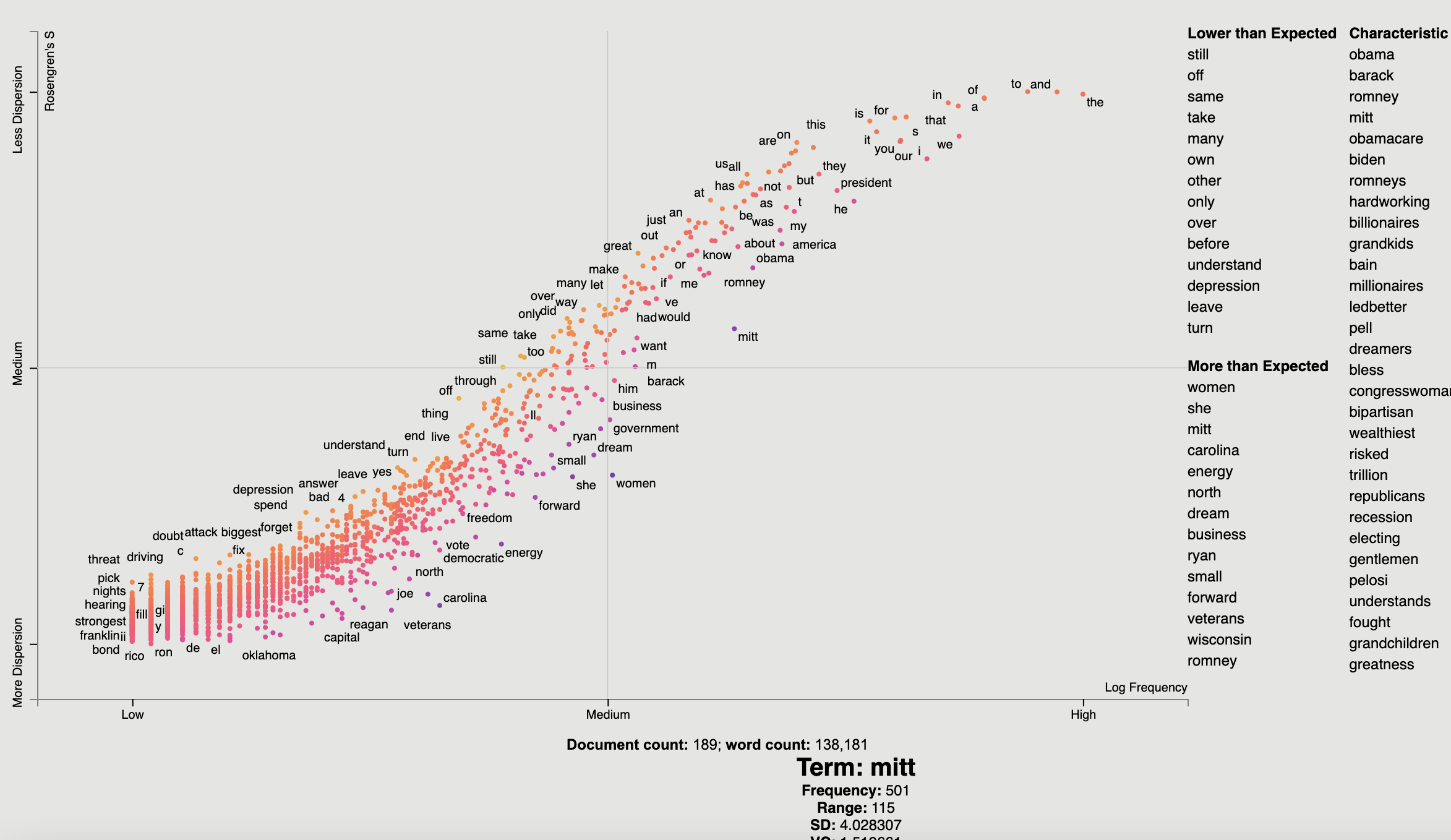
We'll the residual to color points, with a neutral color for residuals around 0 and other colors for positive and
negative values. We'll add a column in the data frame for point colors, and call it ColorScore. It is populated
with values between 0 and 1, with 0.5 as a netural color on the `d3 interpolateWarm` color scale. We use
`st.Scalers.scale_center_zero_abs`, discussed above, to make this transformation.
```python
from sklearn.neighbors import KNeighborsRegressor
dispersion_df = dispersion_df.assign(
Expected=lambda df: KNeighborsRegressor(n_neighbors=10).fit(
df.X.values.reshape(-1, 1), df.Y
).predict(df.X.values.reshape(-1, 1)),
Residual=lambda df: df.Y - df.Expected,
ColorScore=lambda df: st.Scalers.scale_center_zero_abs(df.Residual)
)
```
Now we are ready to plot our colored dispersion chart. We assign the ColorScore column name to the `color_score_column`
paramter in `dataframe_scattertext`.
Additionally, We'd like to populate the two term lists on the
left with terms that have high and low residual values, indicating terms which have the most dispersion relative to
their frequency-expected level and the lowest. We can do this by the `left_list_column` parameter. We can specify
the upper and lower term list names using the `header_names` parameter. Finally, we can spiff-up the plot by
adding an appealing background color.
```python
html = st.dataframe_scattertext(
corpus,
plot_df=dispersion_df,
metadata=corpus.get_df()['speaker'] + ' (' + corpus.get_df()['party'].str.upper() + ')',
ignore_categories=True,
x_label='Log Frequency',
y_label="Rosengren's S",
y_axis_labels=['More Dispersion', 'Medium', 'Less Dispersion'],
color_score_column='ColorScore',
header_names={'upper': 'Lower than Expected', 'lower': 'More than Expected'},
left_list_column='Residual',
background_color='#e5e5e3'
)
```
Which yields (click for an interactive version):
[](https://jasonkessler.github.io/dispersion-residual.html)
## Tutorial
### Help! I don't know Python but I still want to use Scattertext.
While you should learn Python fully use Scattertext, I've put some of the basic
functionality in a commandline tool. The tool is installed when you follow the procedure laid out
above.
Run `$ scattertext --help` from the commandline to see the full usage information. Here's a quick example of
how to use vanilla Scattertext on a CSV file. The file needs to have at least two columns,
one containing the text to be analyzed, and another containing the category. In the example CSV below,
the columns are text and party, respectively.
The example below processes the CSV file, and the resulting HTML visualization into cli_demo.html.
Note, the parameter `--minimum_term_frequency=8` omit terms that occur less than 8
times, and `--regex_parser` indicates a simple regular expression parser should
be used in place of spaCy. The flag `--one_use_per_doc` indicates that term frequency
should be calculated by only counting no more than one occurrence of a term in a document.
If you'd like to parse non-English text, you can use the `--spacy_language_model` argument to configure which
spaCy language model the tool will use. The default is 'en' and you can see the others available at
[https://spacy.io/docs/api/language-models](https://spacy.io/docs/api/language-models).
```bash
$ curl -s https://cdn.rawgit.com/JasonKessler/scattertext/master/scattertext/data/political_data.csv | head -2
party,speaker,text
democrat,BARACK OBAMA,"Thank you. Thank you. Thank you. Thank you so much.Thank you.Thank you so much. Thank you. Thank you very much, everybody. Thank you.
$
$ scattertext --datafile=https://cdn.rawgit.com/JasonKessler/scattertext/master/scattertext/data/political_data.csv \
> --text_column=text --category_column=party --metadata_column=speaker --positive_category=democrat \
> --category_display_name=Democratic --not_category_display_name=Republican --minimum_term_frequency=8 \
> --one_use_per_doc --regex_parser --outputfile=cli_demo.html
```
### Using Scattertext as a text analysis library: finding characteristic terms and their associations
The following code creates a stand-alone HTML file that analyzes words
used by Democrats and Republicans in the 2012 party conventions, and outputs some notable
term associations.
First, import Scattertext and spaCy.
```pydocstring
>>> import scattertext as st
>>> import spacy
>>> from pprint import pprint
```
Next, assemble the data you want to analyze into a Pandas data frame. It should have
at least two columns, the text you'd like to analyze, and the category you'd like to
study. Here, the `text` column contains convention speeches while the `party` column
contains the party of the speaker. We'll eventually use the `speaker` column
to label snippets in the visualization.
```pydocstring
>>> convention_df = st.SampleCorpora.ConventionData2012.get_data()
>>> convention_df.iloc[0]
party democrat
speaker BARACK OBAMA
text Thank you. Thank you. Thank you. Thank you so ...
Name: 0, dtype: object
```
Turn the data frame into a Scattertext Corpus to begin analyzing it. To look for differences
in parties, set the `category_col` parameter to `'party'`, and use the speeches,
present in the `text` column, as the texts to analyze by setting the `text` col
parameter. Finally, pass a spaCy model in to the `nlp` argument and call `build()` to construct the corpus.
```pydocstring
# Turn it into a Scattertext Corpus
>>> nlp = spacy.load('en')
>>> corpus = st.CorpusFromPandas(convention_df,
... category_col='party',
... text_col='text',
... nlp=nlp).build()
```
Let's see characteristic terms in the corpus, and terms that are most associated Democrats and
Republicans. See slides
[52](http://www.slideshare.net/JasonKessler/turning-unstructured-content-into-kernels-of-ideas/52) to [59](http://www.slideshare.net/JasonKessler/turning-unstructured-content-into-kernels-of-ideas/59) of the [Turning Unstructured Content ot Kernels of Ideas](http://www.slideshare.net/JasonKessler/turning-unstructured-content-into-kernels-of-ideas/) talk for more details on these approaches.
Here are the terms that differentiate the corpus from a general English corpus.
```pydocstring
>>> print(list(corpus.get_scaled_f_scores_vs_background().index[:10]))
['obama',
'romney',
'barack',
'mitt',
'obamacare',
'biden',
'romneys',
'hardworking',
'bailouts',
'autoworkers']
```
Here are the terms that are most associated with Democrats:
```pydocstring
>>> term_freq_df = corpus.get_term_freq_df()
>>> term_freq_df['Democratic Score'] = corpus.get_scaled_f_scores('democrat')
>>> pprint(list(term_freq_df.sort_values(by='Democratic Score', ascending=False).index[:10]))
['auto',
'america forward',
'auto industry',
'insurance companies',
'pell',
'last week',
'pell grants',
"women 's",
'platform',
'millionaires']
```
And Republicans:
```pydocstring
>>> term_freq_df['Republican Score'] = corpus.get_scaled_f_scores('republican')
>>> pprint(list(term_freq_df.sort_values(by='Republican Score', ascending=False).index[:10]))
['big government',
"n't build",
'mitt was',
'the constitution',
'he wanted',
'hands that',
'of mitt',
'16 trillion',
'turned around',
'in florida']
```
### Visualizing term associations
Now, let's write the scatter plot a stand-alone HTML file. We'll make the y-axis category "democrat", and name
the category "Democrat" with a capital "D" for presentation
purposes. We'll name the other category "Republican" with a capital "R". All documents in the corpus without
the category "democrat" will be considered Republican. We set the width of the visualization in pixels, and label
each excerpt with the speaker using the `metadata` parameter. Finally, we write the visualization to an HTML file.
```pydocstring
>>> html = st.produce_scattertext_explorer(corpus,
... category='democrat',
... category_name='Democratic',
... not_category_name='Republican',
... width_in_pixels=1000,
... metadata=convention_df['speaker'])
>>> open("Convention-Visualization.html", 'wb').write(html.encode('utf-8'))
```
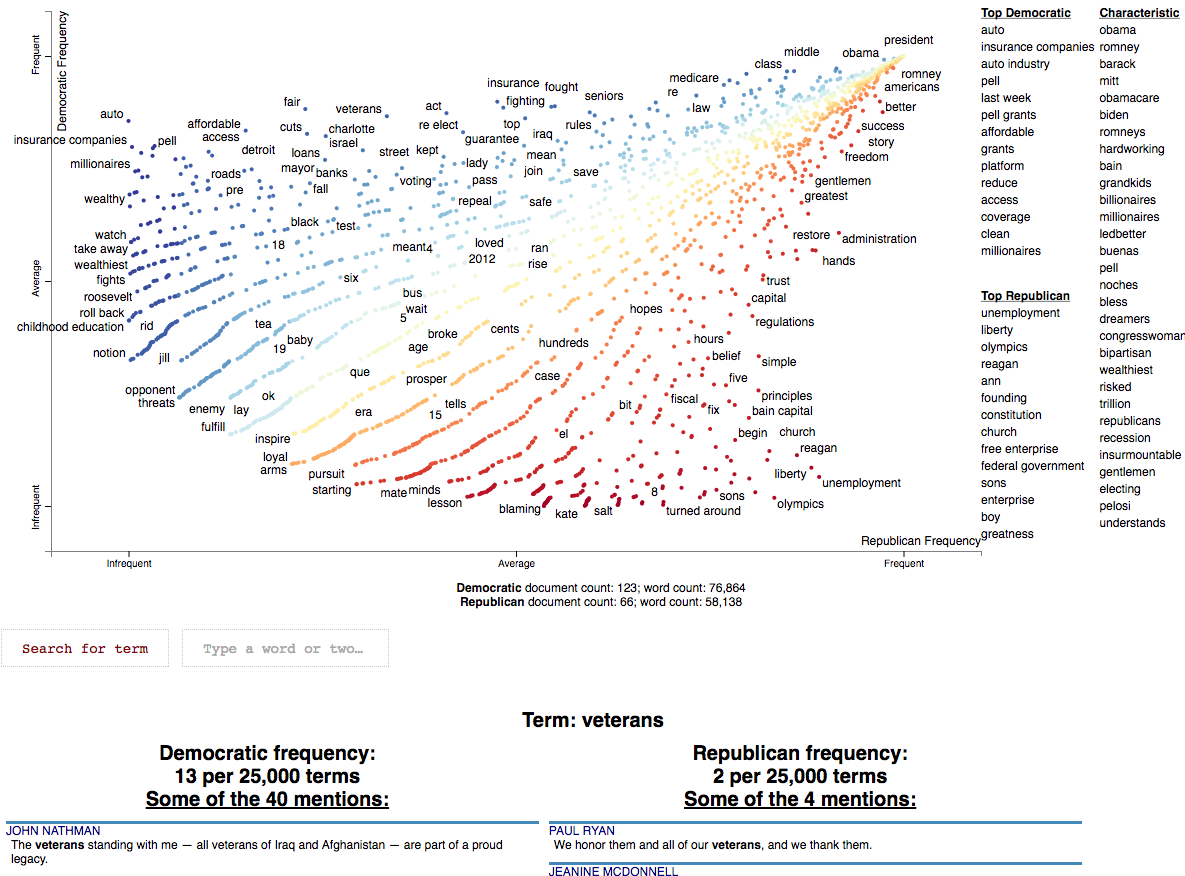
Below is what the webpage looks like. Click it and wait a few minutes for the interactive version.
[](https://jasonkessler.github.io/Conventions-Visualization.html)
### Visualizing Phrase associations
Scattertext can also be used to visualize the category association of a variety of different phrase types. The word
"phrase" denotes any single or multi-word collocation.
#### Using PyTextRank
[PyTextRank](https://github.com/DerwenAI/pytextrank), created by Paco Nathan, is an implementation of
a modified version of the TextRank algorithm (Mihalcea and Tarau 2004). It involves graph centrality
algorithm to extract a scored list of the most prominent phrases in a document. Here,
named entities recognized by spaCy. As of spaCy version 2.2, these are from an NER system trained on
[Ontonotes 5](https://catalog.ldc.upenn.edu/LDC2013T19).
Please install pytextrank `$ pip3 install pytextrank` before continuing with this tutorial.
To use, build a corpus as normal, but make sure you use spaCy to parse each document as opposed a built-in
`whitespace_nlp`-type tokenizer. Note that adding PyTextRank to the spaCy pipeline is not needed, as it
will be run separately by the `PyTextRankPhrases` object. We'll reduce the number of phrases displayed in the
chart to 2000 using the `AssociationCompactor`. The phrases generated will be treated like non-textual features
since their document scores will not correspond to word counts.
```pydocstring
import pytextrank, spacy
import scattertext as st
nlp = spacy.load('en')
nlp.add_pipe("textrank", last=True)
convention_df = st.SampleCorpora.ConventionData2012.get_data().assign(
parse=lambda df: df.text.apply(nlp),
party=lambda df: df.party.apply({'democrat': 'Democratic', 'republican': 'Republican'}.get)
)
corpus = st.CorpusFromParsedDocuments(
convention_df,
category_col='party',
parsed_col='parse',
feats_from_spacy_doc=st.PyTextRankPhrases()
).build(
).compact(
AssociationCompactor(2000, use_non_text_features=True)
)
```
Note that the terms present in the corpus are named entities, and, as opposed to frequency counts, their scores
are the eigencentrality scores assigned to them by the TextRank algorithm. Running `corpus.get_metadata_freq_df('')`
will return, for each category, the sums of terms' TextRank scores. The dense ranks of these scores will be used to
construct the scatter plot.
```pydocstring
term_category_scores = corpus.get_metadata_freq_df('')
print(term_category_scores)
'''
Democratic Republican
term
our future 1.113434 0.699103
your country 0.314057 0.000000
their home 0.385925 0.000000
our government 0.185483 0.462122
our workers 0.199704 0.210989
her family 0.540887 0.405552
our time 0.510930 0.410058
...
'''
```
Before we construct the plot, let's some helper variables Since the aggregate TextRank scores aren't particularly
interpretable, we'll display the per-category rank of each score in the `metadata_description` field. These will be
displayed after a term is clicked.
```pydocstring
term_ranks = np.argsort(np.argsort(-term_category_scores, axis=0), axis=0) + 1
metadata_descriptions = {
term: '
' + '
'.join(
'%s TextRank score rank: %s/%s' % (cat, term_ranks.loc[term, cat], corpus.get_num_metadata())
for cat in corpus.get_categories())
for term in corpus.get_metadata()
}
```
We can construct term scores in a couple ways. One is a standard dense-rank difference, a score which is used in most
of the two-category contrastive plots here, which will give us the most category-associated phrases. Another is to use
the maximum category-specific score, this will give us the most prominent phrases in each category, regardless of the
prominence in the other category. We'll take both approaches in this tutorial, let's compute the second kind of score,
the category-specific prominence below.
```pydocstring
category_specific_prominence = term_category_scores.apply(
lambda r: r.Democratic if r.Democratic > r.Republican else -r.Republican,
axis=1
)
```
Now we're ready output this chart. Note that we use a `dense_rank` transform, which places identically scalled phrases
atop each other. We use `category_specific_prominence` as scores, and set `sort_by_dist` as `False` to ensure the
phrases displayed on the right-hand side of the chart are ranked by the scores and not distance to the upper-left or
lower-right corners. Since matching phrases are treated as non-text features, we encode them as single-phrase topic
models and set the `topic_model_preview_size` to `0` to indicate the topic model list shouldn't be shown. Finally,
we set ensure the full documents are displayed. Note the documents will be displayed in order of phrase-specific score.
```pydocstring
html = produce_scattertext_explorer(
corpus,
category='Democratic',
not_category_name='Republican',
minimum_term_frequency=0,
pmi_threshold_coefficient=0,
width_in_pixels=1000,
transform=dense_rank,
metadata=corpus.get_df()['speaker'],
scores=category_specific_prominence,
sort_by_dist=False,
use_non_text_features=True,
topic_model_term_lists={term: [term] for term in corpus.get_metadata()},
topic_model_preview_size=0,
metadata_descriptions=metadata_descriptions,
use_full_doc=True
)
```
[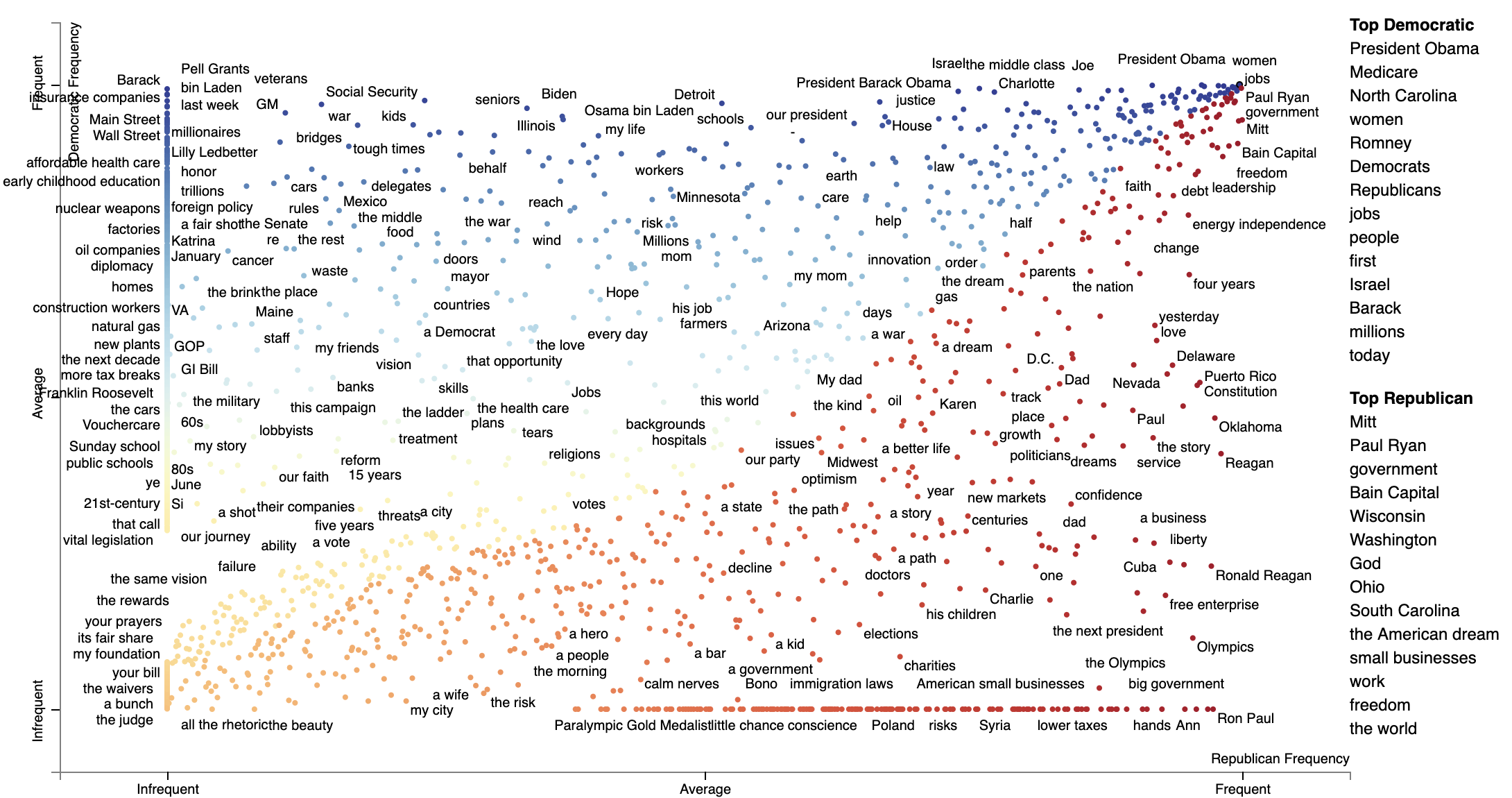](https://jasonkessler.github.io/PyTextRankProminenceScore.html)
The most associated terms in each category make some sense, at least on a post hoc analysis. When referring to (then)
Governor Romney, Democrats used his surname "Romney" in their most central mentions of him, while Republicans used the
more familiar and humanizing "Mitt". In terms of the President Obama, the phrase "Obama" didn't show up as a top term i
n either, the but the first name "Barack" was one of the the most central phrases in Democratic speeches,
mirroring "Mitt."
Alternatively, we can Dense Rank Difference in scores to color phrase-points and determine the top phrases to be
displayed on the right-hand side of the chart. Instead of setting `scores` as category-specific prominence scores,
we set `term_scorer=RankDifference()` to inject a way determining term scores into the scatter plot creation process.
```pydocstring
html = produce_scattertext_explorer(
corpus,
category='Democratic',
not_category_name='Republican',
minimum_term_frequency=0,
pmi_threshold_coefficient=0,
width_in_pixels=1000,
transform=dense_rank,
use_non_text_features=True,
metadata=corpus.get_df()['speaker'],
term_scorer=RankDifference(),
sort_by_dist=False,
topic_model_term_lists={term: [term] for term in corpus.get_metadata()},
topic_model_preview_size=0,
metadata_descriptions=metadata_descriptions,
use_full_doc=True
)
```
[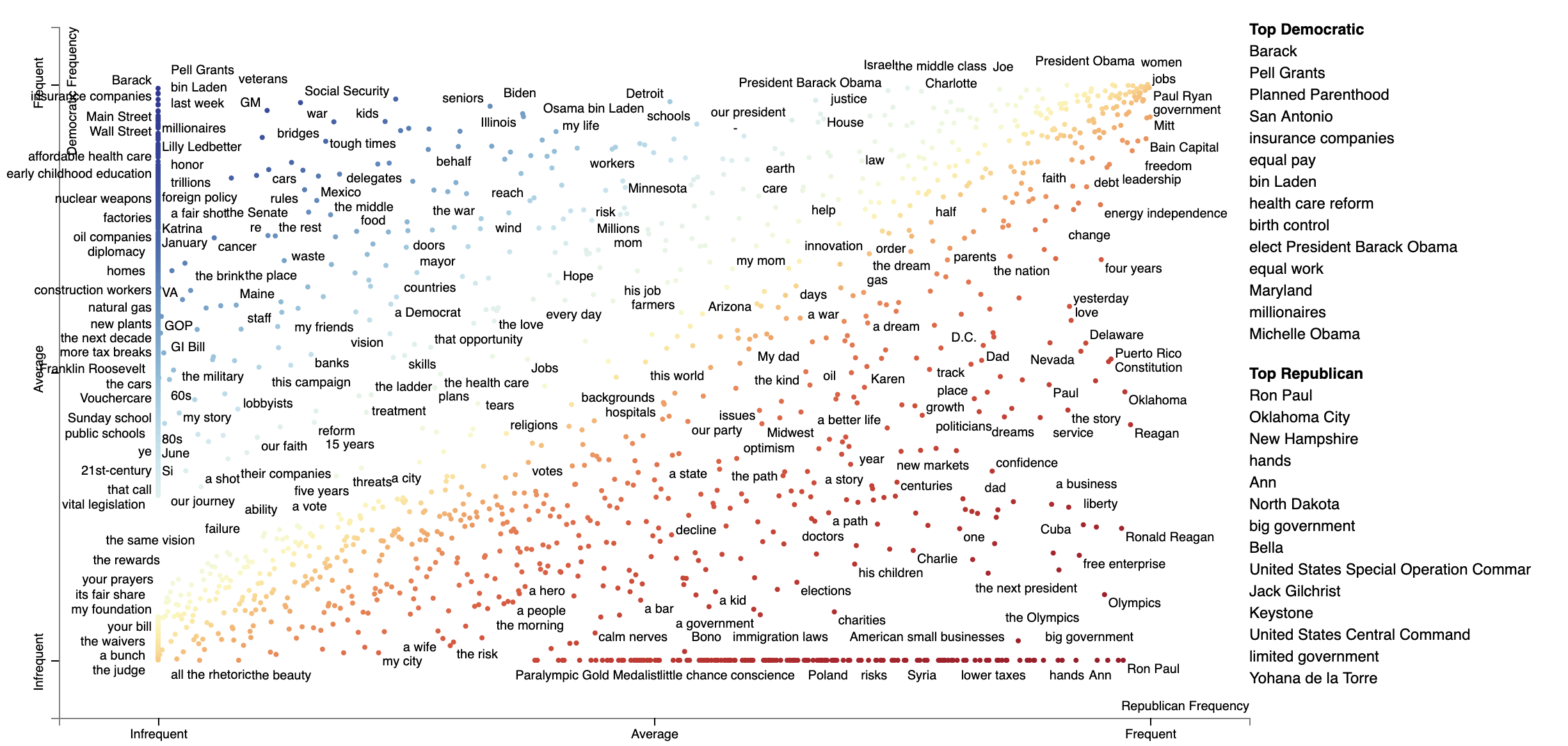](https://jasonkessler.github.io/PyTextRankRankDiff.html)
#### Using Phrasemachine to find phrases.
Phrasemachine from [AbeHandler](https://github.com/AbeHandler) (Handler et al. 2016) uses regular expressions over
sequences of part-of-speech tags to identify noun phrases. This has the advantage over using spaCy's NP-chunking
in that it tends to isolote meaningful, large noun phases which are free of appositives.
A opposed to PyTextRank, we'll just use counts of these phrases, treating them like any other term.
```pydocstring
import spacy
from scattertext import SampleCorpora, PhraseMachinePhrases, dense_rank, RankDifference, AssociationCompactor, produce_scattertext_explorer
from scattertext.CorpusFromPandas import CorpusFromPandas
corpus = (CorpusFromPandas(SampleCorpora.ConventionData2012.get_data(),
category_col='party',
text_col='text',
feats_from_spacy_doc=PhraseMachinePhrases(),
nlp=spacy.load('en', parser=False))
.build().compact(AssociationCompactor(4000)))
html = produce_scattertext_explorer(corpus,
category='democrat',
category_name='Democratic',
not_category_name='Republican',
minimum_term_frequency=0,
pmi_threshold_coefficient=0,
transform=dense_rank,
metadata=corpus.get_df()['speaker'],
term_scorer=RankDifference(),
width_in_pixels=1000)
```
[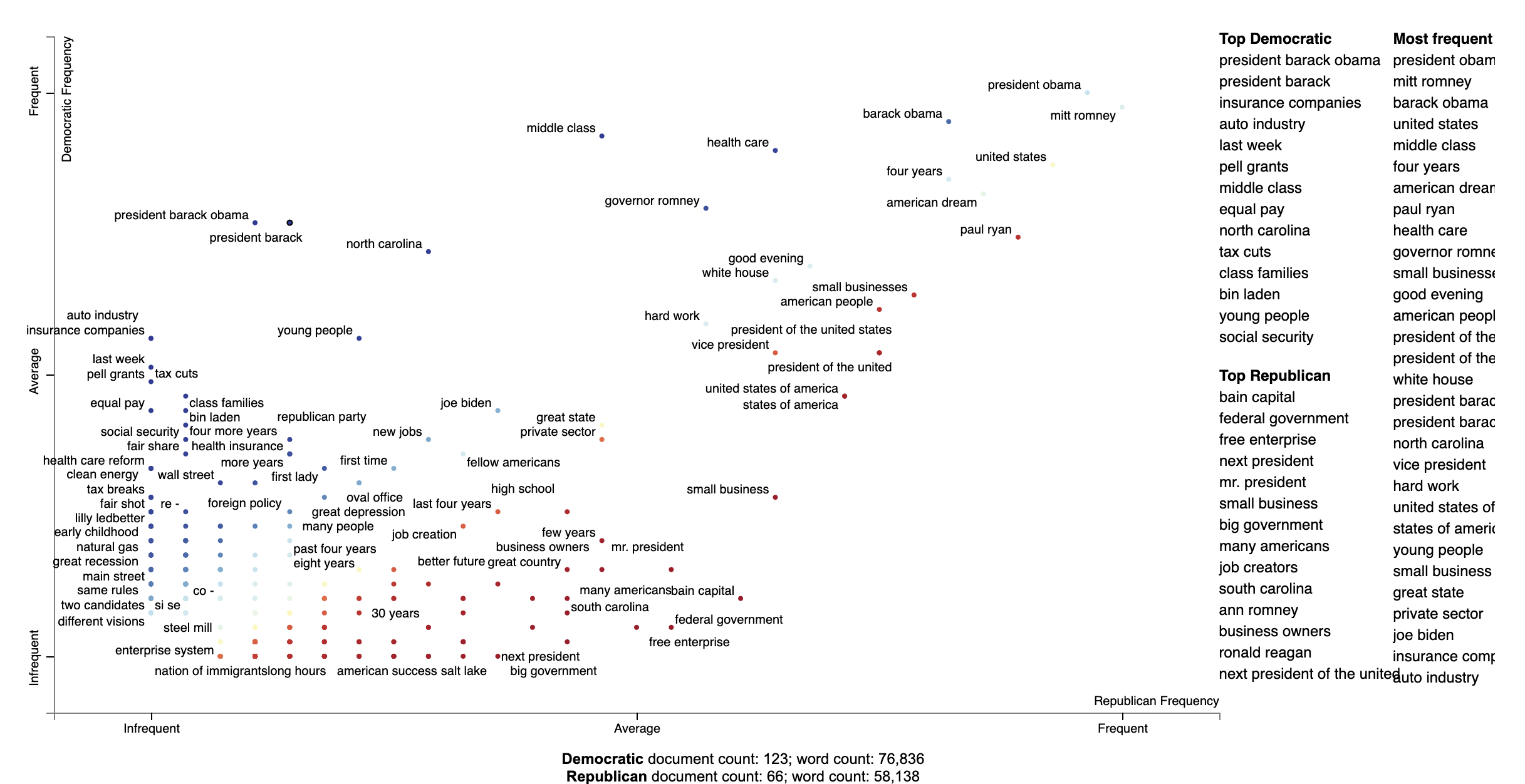](https://jasonkessler.github.io/Phrasemachine.html)
### Visualizing Empath topics and categories
In order to visualize Empath (Fast et al., 2016) topics and categories instead of terms, we'll need to
create a `Corpus` of extracted topics and categories rather than unigrams and
bigrams. To do so, use the `FeatsOnlyFromEmpath` feature extractor. See the source code for
examples of how to make your own.
When creating the visualization, pass the `use_non_text_features=True` argument into
`produce_scattertext_explorer`. This will instruct it to use the labeled Empath
topics and categories instead of looking for terms. Since the documents returned
when a topic or category label is clicked will be in order of the document-level
category-association strength, setting `use_full_doc=True` makes sense, unless you have
enormous documents. Otherwise, the first 300 characters will be shown.
(New in 0.0.26). Ensure you include `topic_model_term_lists=feat_builder.get_top_model_term_lists()`
in `produce_scattertext_explorer` to ensure it bolds passages of snippets that match the
topic model.
```pydocstring
>>> feat_builder = st.FeatsFromOnlyEmpath()
>>> empath_corpus = st.CorpusFromParsedDocuments(convention_df,
... category_col='party',
... feats_from_spacy_doc=feat_builder,
... parsed_col='text').build()
>>> html = st.produce_scattertext_explorer(empath_corpus,
... category='democrat',
... category_name='Democratic',
... not_category_name='Republican',
... width_in_pixels=1000,
... metadata=convention_df['speaker'],
... use_non_text_features=True,
... use_full_doc=True,
... topic_model_term_lists=feat_builder.get_top_model_term_lists())
>>> open("Convention-Visualization-Empath.html", 'wb').write(html.encode('utf-8'))
```
[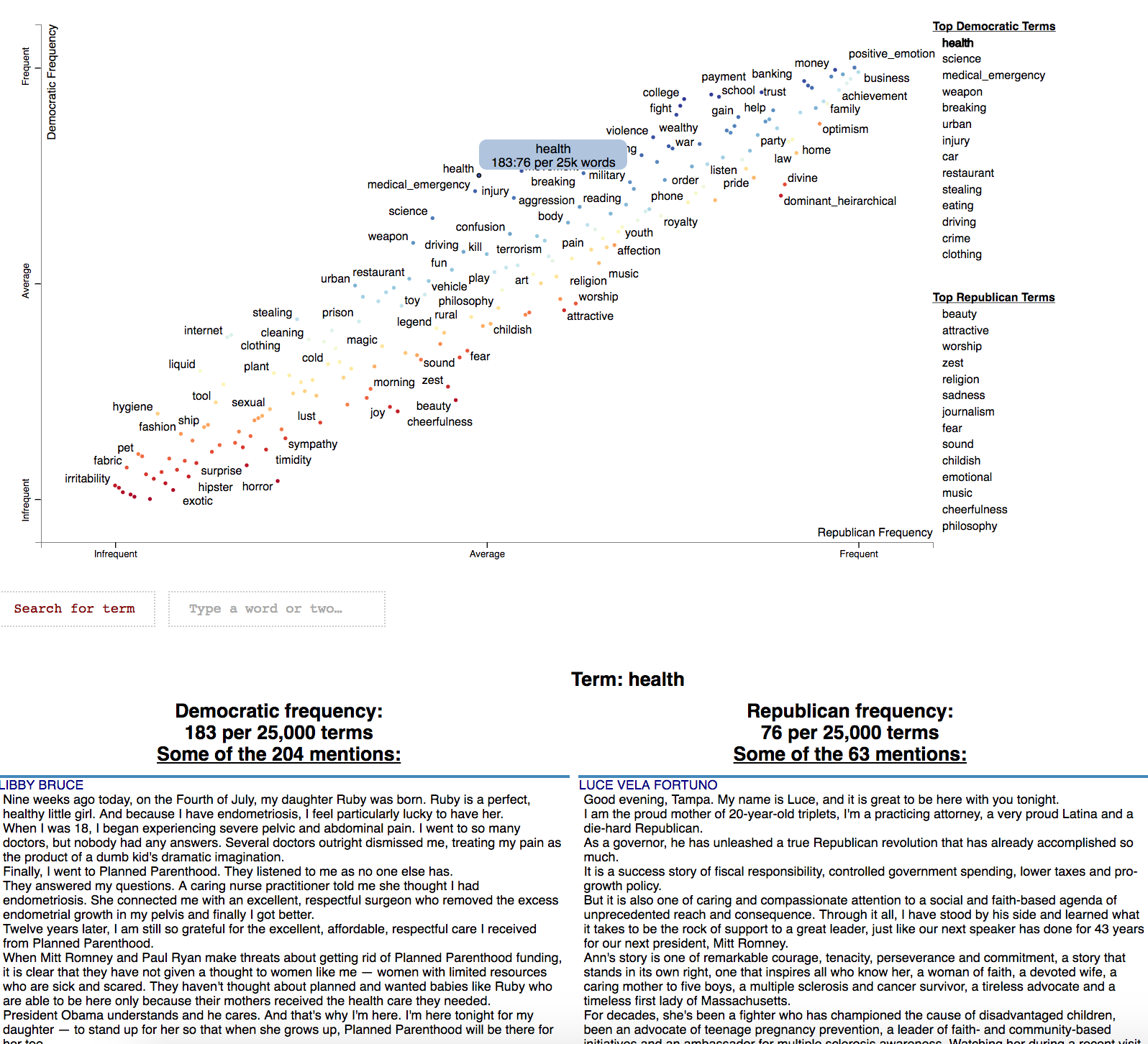](https://jasonkessler.github.io/Convention-Visualization-Empath.html)
### Visualizing General Inquirer Tag Categories and Document Categories
Scattertext also includes a feature builder to explore the relationship between General Inquirer Tag Categoires
and Document Categories. We'll use a slightly different approach, looking at relationship of GI Tag Categories to political parties by using the
Z-Scores of the Log-Odds-Ratio with Uninformative Dirichlet Priors (Monroe 2008). We'll use the `produce_frequency_explorer` plot
variation to visualize this relationship, setting the x-axis as the number of times a word in the tag category occurs,
and the y-axis as the z-score.
For more information on the General Inquirer, please see the [General Inquirer Home Page](http://www.wjh.harvard.edu/~inquirer/).
We'll use the same data set as before, except we'll use the `FeatsFromGeneralInquirer` feature builder.
```pydocstring
>>> general_inquirer_feature_builder = st.FeatsFromGeneralInquirer()
>>> corpus = st.CorpusFromPandas(convention_df,
... category_col='party',
... text_col='text',
... nlp=st.whitespace_nlp_with_sentences,
... feats_from_spacy_doc=general_inquirer_feature_builder).build()
```
Next, we'll call `produce_frequency_explorer` in a similar way we called `produce_scattertext_explorer` in the previous section.
There are a few differences, however. First, we specify the `LogOddsRatioUninformativeDirichletPrior` term scorer, which
scores the relationships between the categories. The `grey_threshold` indicates the points scoring between [-1.96, 1.96]
(i.e., p > 0.05) should be colored gray. The argument `metadata_descriptions=general_inquirer_feature_builder.get_definitions()`
indicates that a dictionary mapping the tag name to a string definition is passed. When a tag is clicked, the definition
in the dictionary will be shown below the plot, as shown in the image following the snippet.
```pydocstring
>>> html = st.produce_frequency_explorer(corpus,
... category='democrat',
... category_name='Democratic',
... not_category_name='Republican',
... metadata=convention_df['speaker'],
... use_non_text_features=True,
... use_full_doc=True,
... term_scorer=st.LogOddsRatioUninformativeDirichletPrior(),
... grey_threshold=1.96,
... width_in_pixels=1000,
... topic_model_term_lists=general_inquirer_feature_builder.get_top_model_term_lists(),
... metadata_descriptions=general_inquirer_feature_builder.get_definitions())
```
Here's the resulting chart.
[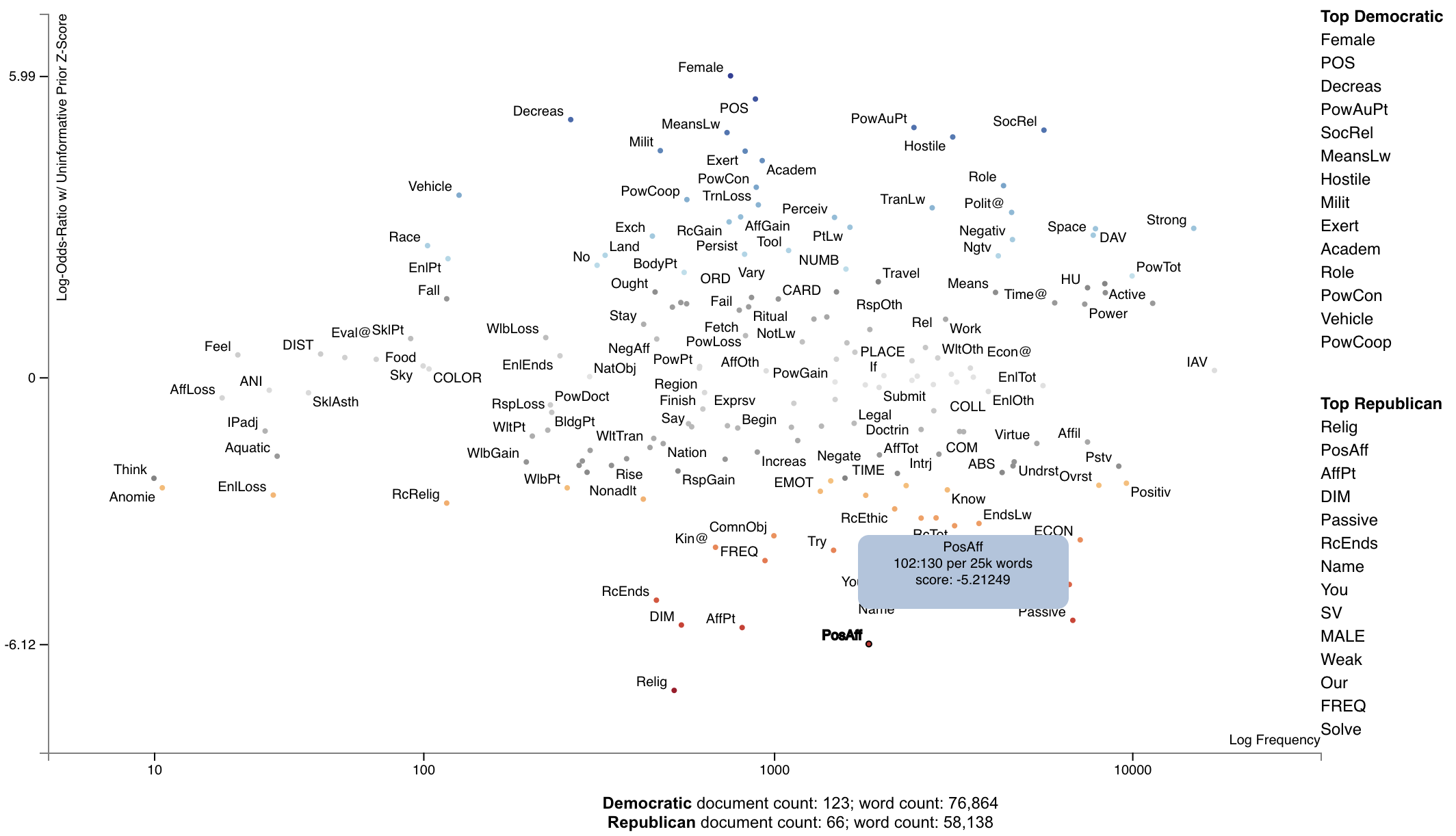](https://jasonkessler.github.io/demo_general_inquirer_frequency_plot.html)
[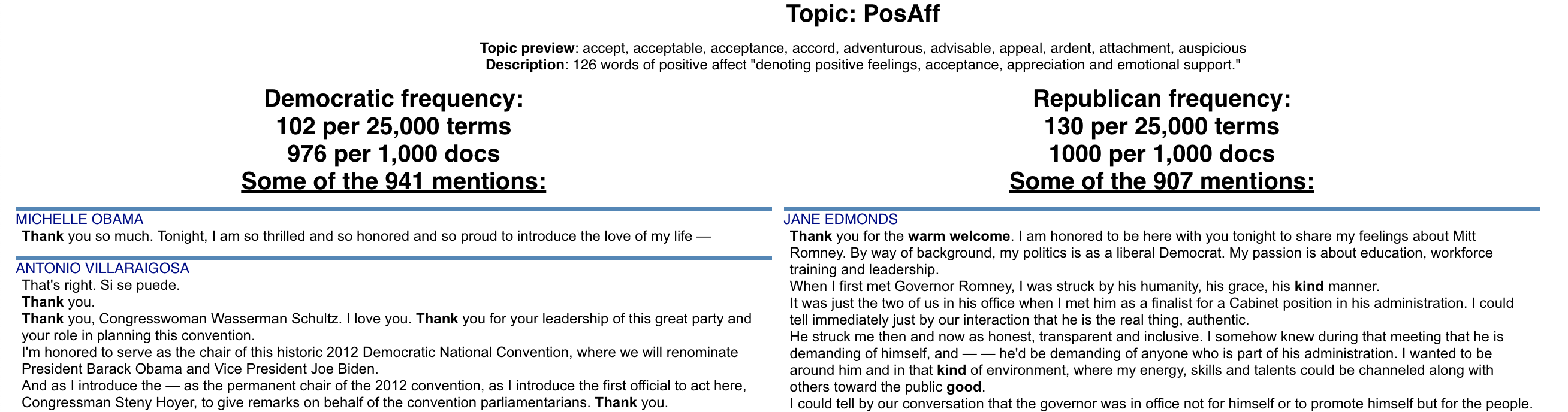](https://jasonkessler.github.io/demo_general_inquirer_frequency_plot.html)
### Visualizing the Moral Foundations 2.0 Dictionary
The [[Moral Foundations Theory]](https://moralfoundations.org/) proposes six psychological constructs
as building blocks of moral thinking, as described in Graham et al. (2013). These foundations are,
as described on [[moralfoundations.org]](https://moralfoundations.org/): care/harm, fairness/cheating, loyalty/betrayal,
authority/subversion, sanctity/degradation, and liberty/oppression. Please see the site for a more in-depth discussion
of these foundations.
Frimer et al. (2019) created the Moral Foundations Dictionary 2.0, or a lexicon of terms which invoke a moral foundation
as a virtue (favorable toward the foundation) or a vice (in opposition to the foundation).
This dictionary can be used in the same way as the General Inquirer. In this example, we can plot the Cohen's d scores of
foundation-word counts relative to the frequencies words involving those foundations were invoked.
We can first load the the corpus as normal, and use `st.FeatsFromMoralFoundationsDictionary()` to extract features.
```python
import scattertext as st
convention_df = st.SampleCorpora.ConventionData2012.get_data()
moral_foundations_feats = st.FeatsFromMoralFoundationsDictionary()
corpus = st.CorpusFromPandas(convention_df,
category_col='party',
text_col='text',
nlp=st.whitespace_nlp_with_sentences,
feats_from_spacy_doc=moral_foundations_feats).build()
```
Next, let's use Cohen's d term scorer to analyze the corpus, and describe a set of Cohen's d association scores.
```python
cohens_d_scorer = st.CohensD(corpus).use_metadata()
term_scorer = cohens_d_scorer.set_categories('democrat', ['republican']).term_scorer.get_score_df()
```
Which yields the following data frame:
| | cohens_d | cohens_d_se | cohens_d_z | cohens_d_p | hedges_r | hedges_r_se | hedges_r_z | hedges_r_p | m1 | m2 | count1 | count2 | docs1 | docs2 |
|:-----------------|-----------:|--------------:|-------------:|-------------:|-----------:|--------------:|-------------:|-------------:|-----------:|-----------:|---------:|---------:|--------:|--------:|
| care.virtue | 0.662891 | 0.149425 | 4.43629 | 4.57621e-06 | 0.660257 | 0.159049 | 4.15129 | 1.65302e-05 | 0.195049 | 0.12164 | 760 | 379 | 115 | 54 |
| care.vice | 0.24435 | 0.146025 | 1.67335 | 0.0471292 | 0.243379 | 0.152654 | 1.59432 | 0.0554325 | 0.0580005 | 0.0428358 | 244 | 121 | 80 | 41 |
| fairness.virtue | 0.176794 | 0.145767 | 1.21286 | 0.112592 | 0.176092 | 0.152164 | 1.15725 | 0.123586 | 0.0502469 | 0.0403369 | 225 | 107 | 71 | 39 |
| fairness.vice | 0.0707162 | 0.145528 | 0.485928 | 0.313509 | 0.0704352 | 0.151711 | 0.464273 | 0.321226 | 0.00718627 | 0.00573227 | 32 | 14 | 21 | 10 |
| authority.virtue | -0.0187793 | 0.145486 | -0.12908 | 0.551353 | -0.0187047 | 0.15163 | -0.123357 | 0.549088 | 0.358192 | 0.361191 | 1281 | 788 | 122 | 66 |
| authority.vice | -0.0354164 | 0.145494 | -0.243422 | 0.596161 | -0.0352757 | 0.151646 | -0.232619 | 0.591971 | 0.00353465 | 0.00390602 | 20 | 14 | 14 | 10 |
| sanctity.virtue | -0.512145 | 0.147848 | -3.46399 | 0.999734 | -0.51011 | 0.156098 | -3.26788 | 0.999458 | 0.0587987 | 0.101677 | 265 | 309 | 74 | 48 |
| sanctity.vice | -0.108011 | 0.145589 | -0.74189 | 0.770923 | -0.107582 | 0.151826 | -0.708585 | 0.760709 | 0.00845048 | 0.0109339 | 35 | 28 | 23 | 20 |
| loyalty.virtue | -0.413696 | 0.147031 | -2.81367 | 0.997551 | -0.412052 | 0.154558 | -2.666 | 0.996162 | 0.259296 | 0.309776 | 1056 | 717 | 119 | 66 |
| loyalty.vice | -0.0854683 | 0.145549 | -0.587213 | 0.72147 | -0.0851287 | 0.151751 | -0.560978 | 0.712594 | 0.00124518 | 0.00197022 | 5 | 5 | 5 | 4 |
This data frame gives us Cohen's d scores (and their standard errors and z-scores), Hedge's r scores (ditto),
the mean document-length normalized topic usage per category (where the in-focus category is m1 [in this case Democrats]
and the out-of-focus is m2), the raw number of words used in for each topic (count1 and count2), and the number of documents
in each category with the topic (docs1 and docs2).
Note that Cohen's d is the difference of m1 and m2 divided by their pooled standard deviation.
Now, let's plot the d-scores of foundations vs. their frequencies.
```python
html = st.produce_frequency_explorer(
corpus,
category='democrat',
category_name='Democratic',
not_category_name='Republican',
metadata=convention_df['speaker'],
use_non_text_features=True,
use_full_doc=True,
term_scorer=st.CohensD(corpus).use_metadata(),
grey_threshold=0,
width_in_pixels=1000,
topic_model_term_lists=moral_foundations_feats.get_top_model_term_lists(),
metadata_descriptions=moral_foundations_feats.get_definitions()
)
```
[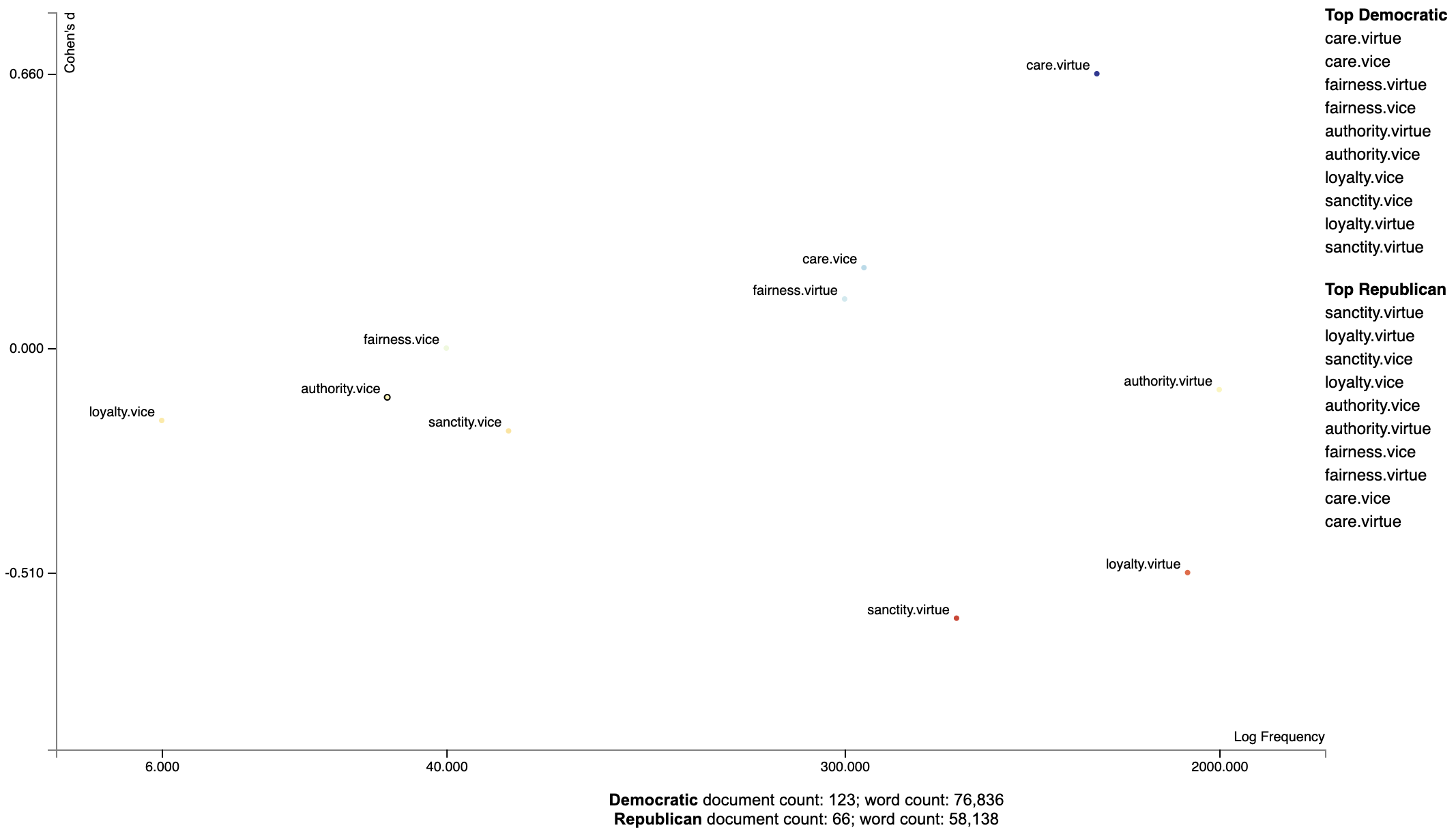](https://jasonkessler.github.io/demo_moral_foundations.html)
### Ordering Terms by Corpus Characteristicness
Often the terms of most interest are ones that are characteristic to the corpus as a whole. These are terms which occur
frequently in all sets of documents being studied, but relatively infrequent compared to general term frequencies.
We can produce a plot with a characteristic score on the x-axis and class-association scores on the y-axis using the
function `produce_characteristic_explorer`.
Corpus characteristicness is the difference in dense term ranks between the words in all of the documents in the study
and a general English-language frequency list. See this [Talk on Term-Class Association Scores](http://nbviewer.jupyter.org/github/JasonKessler/PuPPyTalk/blob/master/notebooks/Class-Association-Scores.ipynb)
for a more thorough explanation.
```python
import scattertext as st
corpus = (st.CorpusFromPandas(st.SampleCorpora.ConventionData2012.get_data(),
category_col='party',
text_col='text',
nlp=st.whitespace_nlp_with_sentences)
.build()
.get_unigram_corpus()
.compact(st.ClassPercentageCompactor(term_count=2,
term_ranker=st.OncePerDocFrequencyRanker)))
html = st.produce_characteristic_explorer(
corpus,
category='democrat',
category_name='Democratic',
not_category_name='Republican',
metadata=corpus.get_df()['speaker']
)
open('demo_characteristic_chart.html', 'wb').write(html.encode('utf-8'))
```
[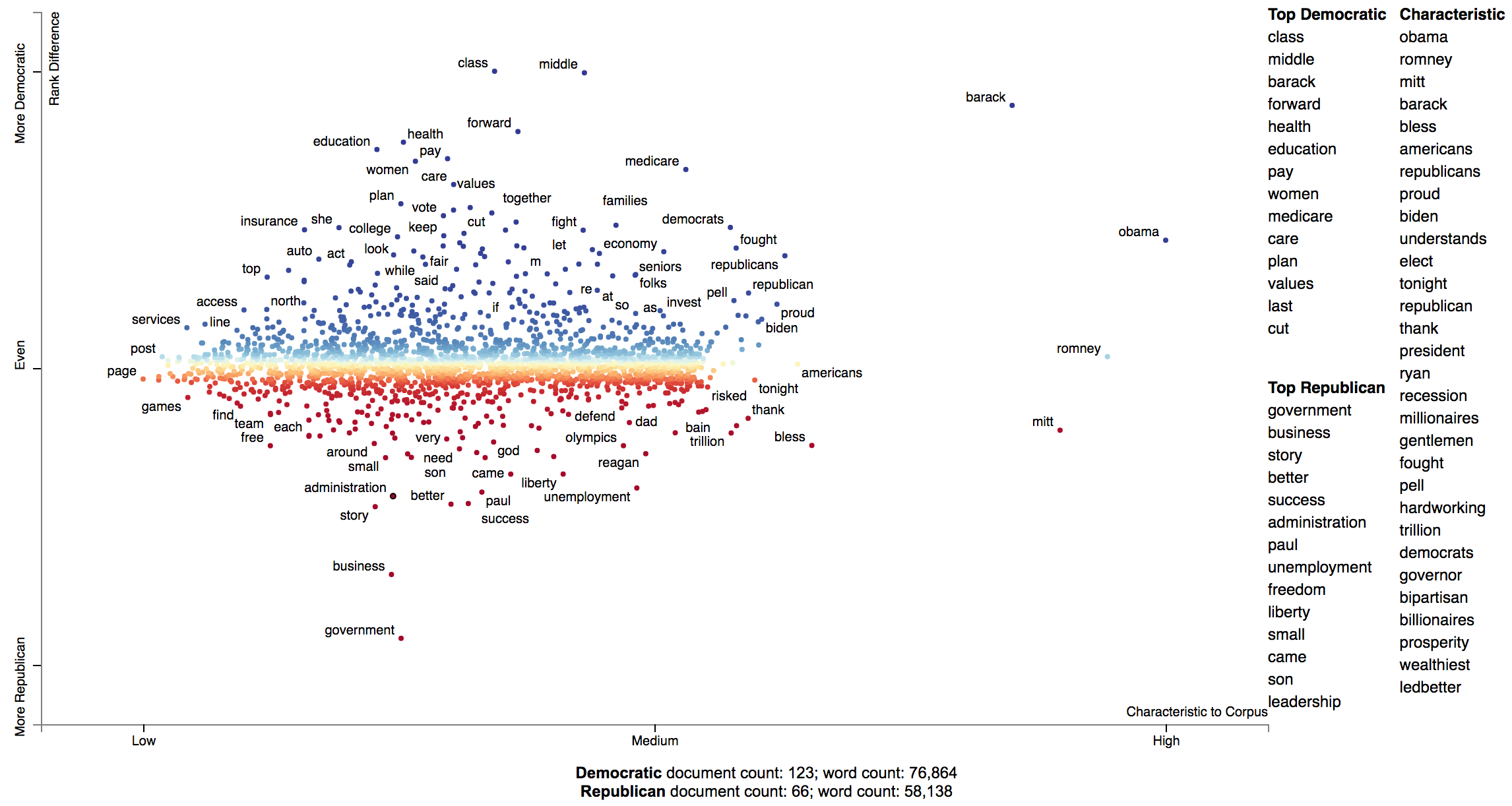](https://jasonkessler.github.io/demo_characteristic_chart.html)
### Document-Based Scatterplots
In addition to words, phases and topics, we can make each point correspond to a document. Let's first create
a corpus object for the 2012 Conventions data set. This explanation follows `demo_pca_documents.py`
```python
import pandas as pd
from sklearn.feature_extraction.text import TfidfTransformer
import scattertext as st
from scipy.sparse.linalg import svds
convention_df = st.SampleCorpora.ConventionData2012.get_data()
convention_df['parse'] = convention_df['text'].apply(st.whitespace_nlp_with_sentences)
corpus = (st.CorpusFromParsedDocuments(convention_df,
category_col='party',
parsed_col='parse')
.build()
.get_stoplisted_unigram_corpus())
```
Next, let's add the document names as meta data in the corpus object. The `add_doc_names_as_metadata` function
takes an array of document names, and populates a new corpus' meta data with those names. If two documents have the
same name, it appends a number (starting with 1) to the name.
```python
corpus = corpus.add_doc_names_as_metadata(corpus.get_df()['speaker'])
```
Next, we find tf.idf scores for the corpus' term-document matrix, run sparse SVD, and add them to a projection
data frame, making the x and y-axes the first two singular values, and indexing it on the corpus' meta data, which
corresponds to the document names.
```python
embeddings = TfidfTransformer().fit_transform(corpus.get_term_doc_mat())
u, s, vt = svds(embeddings, k=3, maxiter=20000, which='LM')
projection = pd.DataFrame({'term': corpus.get_metadata(), 'x': u.T[0], 'y': u.T[1]}).set_index('term')
```
Finally, set scores as 1 for Democrats and 0 for Republicans, rendering Republican documents as red points and
Democratic documents as blue. For more on the `produce_pca_explorer` function,
see [Using SVD to visualize any kind of word embeddings](#using-svd-to-visualize-any-kind-of-word-embeddings).
```python
category = 'democrat'
scores = (corpus.get_category_ids() == corpus.get_categories().index(category)).astype(int)
html = st.produce_pca_explorer(corpus,
category=category,
category_name='Democratic',
not_category_name='Republican',
metadata=convention_df['speaker'],
width_in_pixels=1000,
show_axes=False,
use_non_text_features=True,
use_full_doc=True,
projection=projection,
scores=scores,
show_top_terms=False)
```
Click for an interactive version
[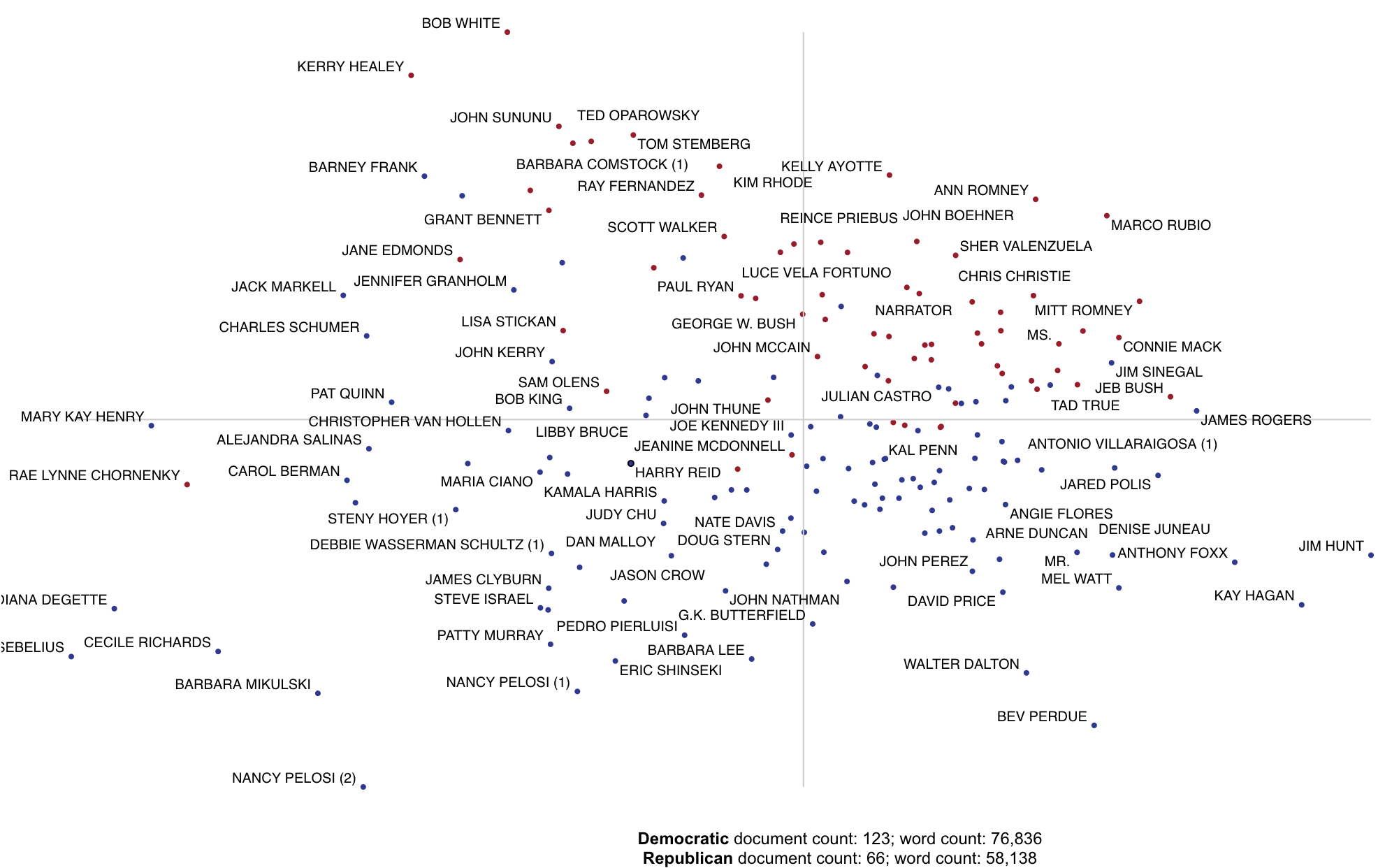](https://jasonkessler.github.io/demo_pca_documents.html)
### Using Cohen's d or Hedge's r to visualize effect size.
Cohen's d is a popular metric used to measure effect size. The definitions of Cohen's d and Hedge's r
from (Shinichi and Cuthill 2017) are implemented in Scattertext.
```python
>>> convention_df = st.SampleCorpora.ConventionData2012.get_data()
>>> corpus = (st.CorpusFromPandas(convention_df,
... category_col='party',
... text_col='text',
... nlp=st.whitespace_nlp_with_sentences)
... .build()
... .get_unigram_corpus())
```
We can create a term scorer object to examine the effect sizes and other metrics.
```python
>>> term_scorer = st.CohensD(corpus).set_categories('democrat', ['republican'])
>>> term_scorer.get_score_df().sort_values(by='cohens_d', ascending=False).head()
cohens_d cohens_d_se cohens_d_z cohens_d_p hedges_r hedges_r_se hedges_r_z hedges_r_p m1 m2
obama 1.187378 0.024588 48.290444 0.000000e+00 1.187322 0.018419 64.461363 0.0 0.007778 0.002795
class 0.855859 0.020848 41.052045 0.000000e+00 0.855818 0.017227 49.677688 0.0 0.002222 0.000375
middle 0.826895 0.020553 40.232746 0.000000e+00 0.826857 0.017138 48.245626 0.0 0.002316 0.000400
president 0.820825 0.020492 40.056541 0.000000e+00 0.820786 0.017120 47.942661 0.0 0.010231 0.005369
barack 0.730624 0.019616 37.245725 6.213052e-304 0.730589 0.016862 43.327800 0.0 0.002547 0.000725
```
Our calculation of Cohen's d is not directly based on term counts. Rather, we divide each document's term counts by the total number
of terms in the document before calculating the statistics. `m1` and `m2` are, respectively the mean portions of words
in speeches made by Democrats and Republicans that were the term in question. The effect size (`cohens_d`) is the
difference between these means divided by the pooled standard standard deviation. `cohens_d_se` is the standard error
of the statistic, while `cohens_d_z` and `cohens_d_p` are the Z-scores and p-values indicating the statistical
significance of the effect. Corresponding columns are present for Hedge's r, and unbiased version of Cohen's d.
```python
>>> st.produce_frequency_explorer(
corpus,
category='democrat',
category_name='Democratic',
not_category_name='Republican',
term_scorer=st.CohensD(corpus),
metadata=convention_df['speaker'],
grey_threshold=0
)
```
Click for an interactive version.
[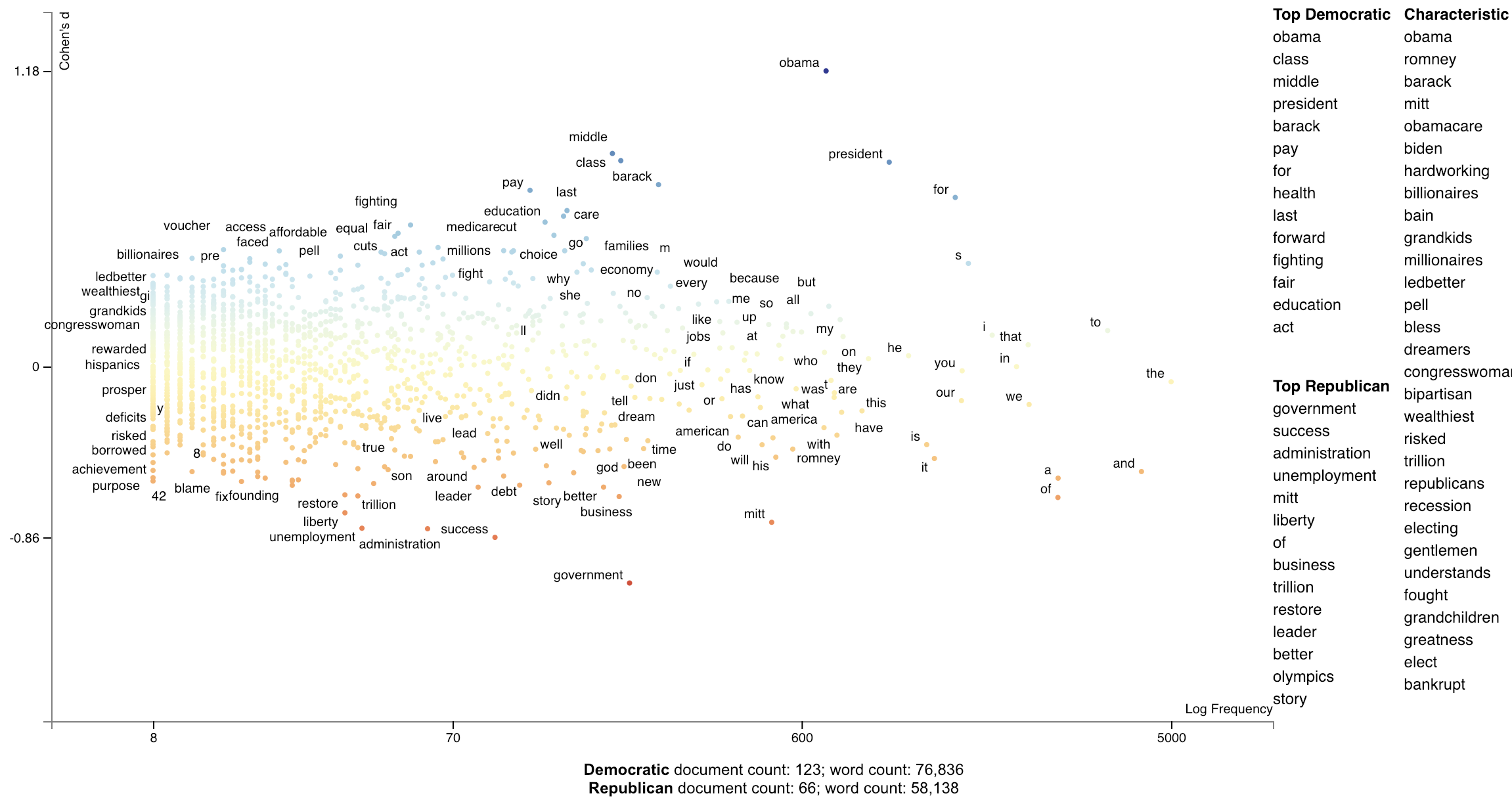](https://jasonkessler.github.io/demo_cohens_d.html)
### Using Custom Background Word Frequences
Scattertext relies on a set of general-domain English word frequencies when computing unigram characteristic
scores. When using running Scattertext on non-English data or in a specific domain, the quality of the scores
will degrade.
Ensure that you are on Scattertext 0.1.6 or higher.
To remedy this, one can add a custom set of background scores to a Corpus-like object,
using the `Corpus.set_background_corpus` function. The function takes a `pd.Series` object, indexed on
terms with numeric count values.
By default, [!understanding-scaled-f-score](Scaled F-Score) is used to rank how characteristic
terms are.
The example below illustrates using Polish background word frequencies.
First, we produce a Series object mapping Polish words to their frequencies using a list from
the [https://github.com/oprogramador/most-common-words-by-language](most-common-words-by-language) repo.
```python
polish_word_frequencies = pd.read_csv(
'https://raw.githubusercontent.com/hermitdave/FrequencyWords/master/content/2016/pl/pl_50k.txt',
sep = ' ',
names = ['Word', 'Frequency']
).set_index('Word')['Frequency']
```
Note the composition of the Series
```python
>>> polish_word_frequencies
Word
nie 5875385
to 4388099
si 3507076
w 2723767
na 2309765
Name: Frequency, dtype: int64
```
Next, we build a DataFrame, `reviews_df`, consisting of document which appear (to a non-Polish speaker) to be
positive and negative hotel reviews from the [https://klejbenchmark.com/tasks/](PolEmo2.0) corpus
(Koco, et al. 2019). Note this data is under a CC BY-NC-SA 4.0 license. These are labeled as
"__label__meta_plus_m" and "__label__meta_minus_m". We will use Scattertext to compare those
reviews and determine
```python
nlp = spacy.blank('pl')
nlp.add_pipe('sentencizer')
with ZipFile(io.BytesIO(urlopen(
'https://klejbenchmark.com/static/data/klej_polemo2.0-in.zip'
).read())) as zf:
review_df = pd.read_csv(zf.open('train.tsv'), sep='\t')[
lambda df: df.target.isin(['__label__meta_plus_m', '__label__meta_minus_m'])
].assign(
Parse = lambda df: df.sentence.apply(nlp)
)
```
Next, we wish to create a `ParsedCorpus` object from `review_df`. In preparation, we first assemble a
list of Polish stopwords from the [stopwords](https://github.com/bieli/stopwords/) repository. We also
create the `not_a_word` regular expression to filter out terms which do not contain a letter.
```python
polish_stopwords = {
stopword for stopword in
urlopen(
'https://raw.githubusercontent.com/bieli/stopwords/master/polish.stopwords.txt'
).read().decode('utf-8').split('\n')
if stopword.strip()
}
not_a_word = re.compile(r'^\W+$')
```
With these present, we can build a corpus from `review_df` with the category being the binary
"target" column. We reduce the term space to unigrams and then run the `filter_out` which
takes a function to determine if a term should be removed from the corpus. The function identifies
terms which are in the Polish stoplist or do not contain a letter. Finally, terms occurring
less than 20 times in the corpus are removed.
We set the background frequency Series we created early as the background corpus.
```python
corpus = st.CorpusFromParsedDocuments(
review_df,
category_col='target',
parsed_col='Parse'
).build(
).get_unigram_corpus(
).filter_out(
lambda term: term in polish_stopwords or not_a_word.match(term) is not None
).remove_infrequent_words(
minimum_term_count=20
).set_background_corpus(
polish_word_frequencies
)
```
Note that a minimum word count of 20 was chosen to ensure that only around 2,000 terms would be displayed
```python
>>> corpus.get_num_terms()
2023
```
Running `get_term_and_background_counts` shows us total term counts in the corpus compare to background
frequency counts. We limit this to terms which only occur in the corpus.
```python
>>> corpus.get_term_and_background_counts()[
... lambda df: df.corpus > 0
... ].sort_values(by='corpus', ascending=False)
background corpus
m 341583838.0 4819.0
hotelu 33108.0 1812.0
hotel 297974790.0 1651.0
doktor 154840.0 1534.0
polecam 0.0 1438.0
... ... ...
szoku 0.0 21.0
badaniem 0.0 21.0
balkonu 0.0 21.0
stopnia 0.0 21.0
wobec 0.0 21.0
```
Interesting, the term "polecam" appears very frequently in the corpus, but does not appear at all
in the background corpus, making it highly characteristic. Judging from Google Translate, it appears to
mean something related to "recommend".
We are now ready to display the plot.
```python
html = st.produce_scattertext_explorer(
corpus,
category='__label__meta_plus_m',
category_name='Plus-M',
not_category_name='Minus-M',
minimum_term_frequency=1,
width_in_pixels=1000,
transform=st.Scalers.dense_rank
)
```
[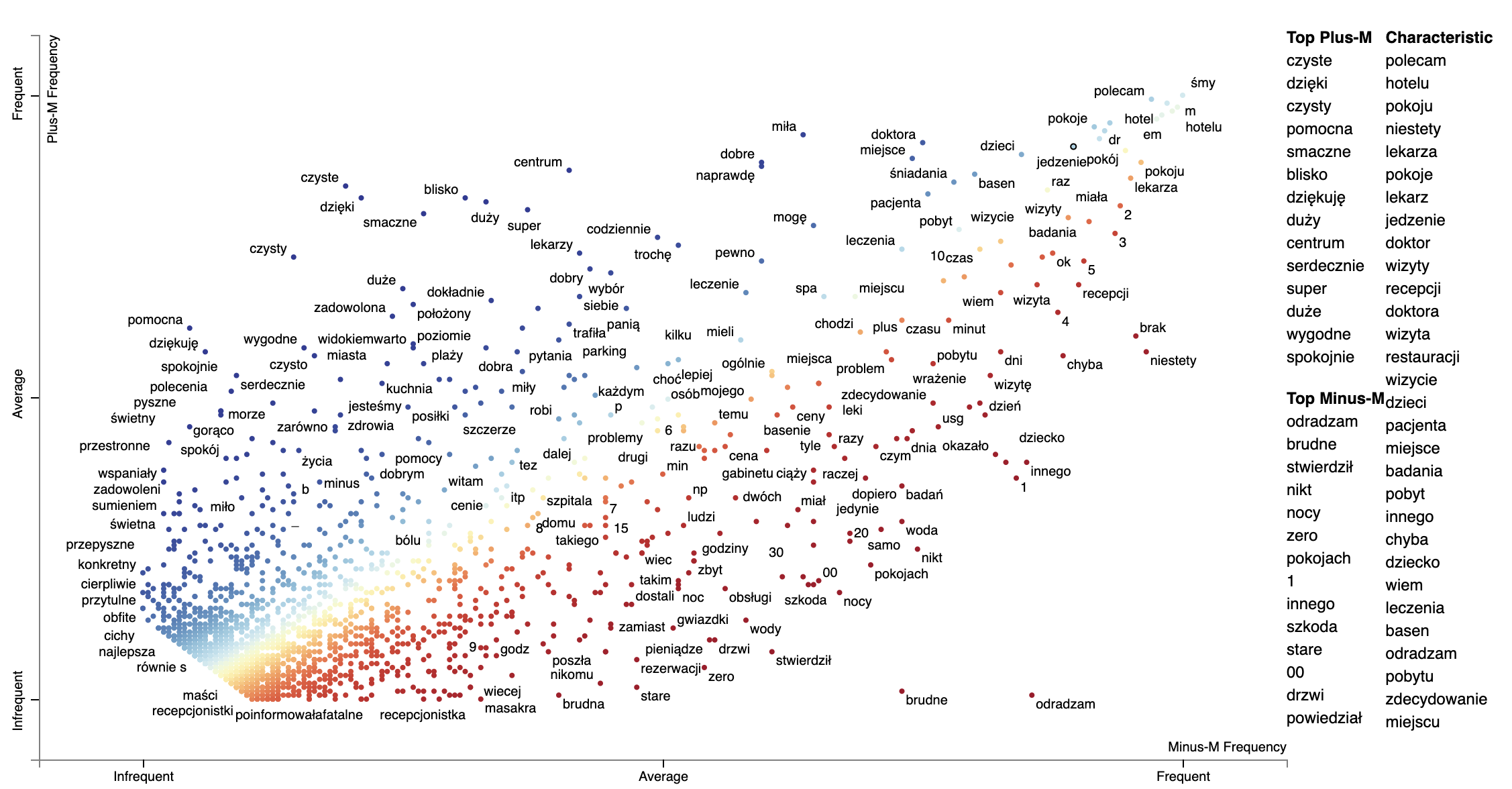](https://raw.githubusercontent.com/JasonKessler/jasonkessler.github.io/master/polish_pos_neg_scattertext.html)
We can change the formula which is used to produce the Characteristic scores
using the `characteristic_scorer` parameter to `produce_scattertext_explorer`.
It takes a instance of a descendant of the `CharacteristicScorer` class. See
[DenseRankCharacteristicness.py](https://github.com/JasonKessler/scattertext/blob/8ddff82f670aa2ed40312b2cdd077e7f0a98a873/scattertext/characteristic/DenseRankCharacteristicness.py#L36)
for an example of how to make your own.
Example of plotting with a modified characteristic scorer,
```python
html = st.produce_scattertext_explorer(
corpus,
category='__label__meta_plus_m',
category_name='Plus-M',
not_category_name='Minus-M',
minimum_term_frequency=1,
transform=st.Scalers.dense_rank,
characteristic_scorer=st.DenseRankCharacteristicness(),
```
[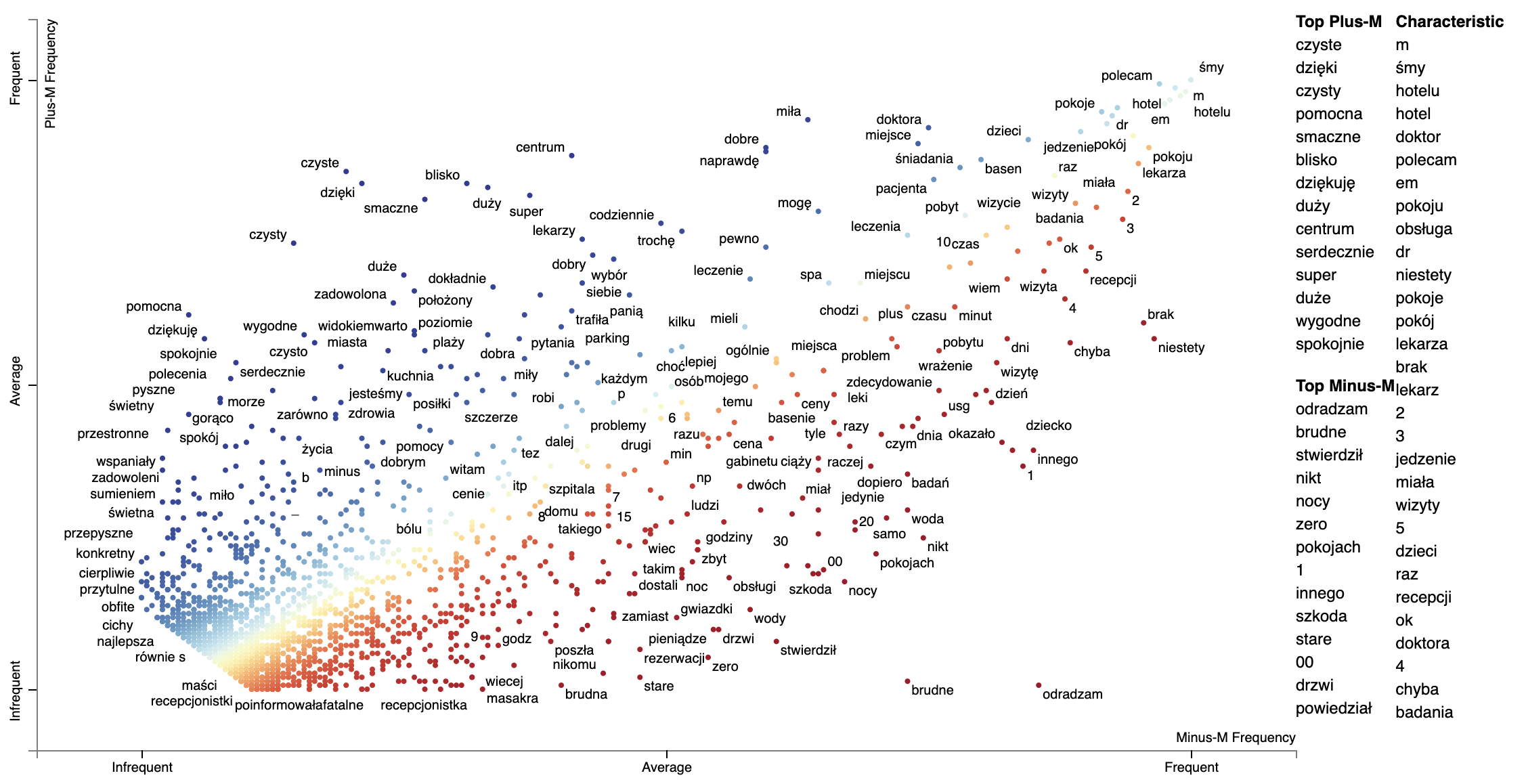](https://raw.githubusercontent.com/JasonKessler/jasonkessler.github.io/master/polish_dense_rank_characteristic.png)
Note that numbers show up as more characteristic using the Dense Rank Difference. It may be they occur
unusually frequently in this corpus, or perhaps the background word frequencies under counted mumbers.
### Understanding Scaled F-Score
Let's now turn our attention to a novel term scoring metric, Scaled F-Score. We'll examine this on a unigram
version of the Rotten Tomatoes corpus (Pang et al. 2002). It contains excerpts of
positive and negative movie reviews.
Please see [Scaled F Score Explanation](http://nbviewer.jupyter.org/github/JasonKessler/GlobalAI2018/blob/master/notebook/Scaled-F-Score-Explanation.ipynb)
for a notebook version of this analysis.
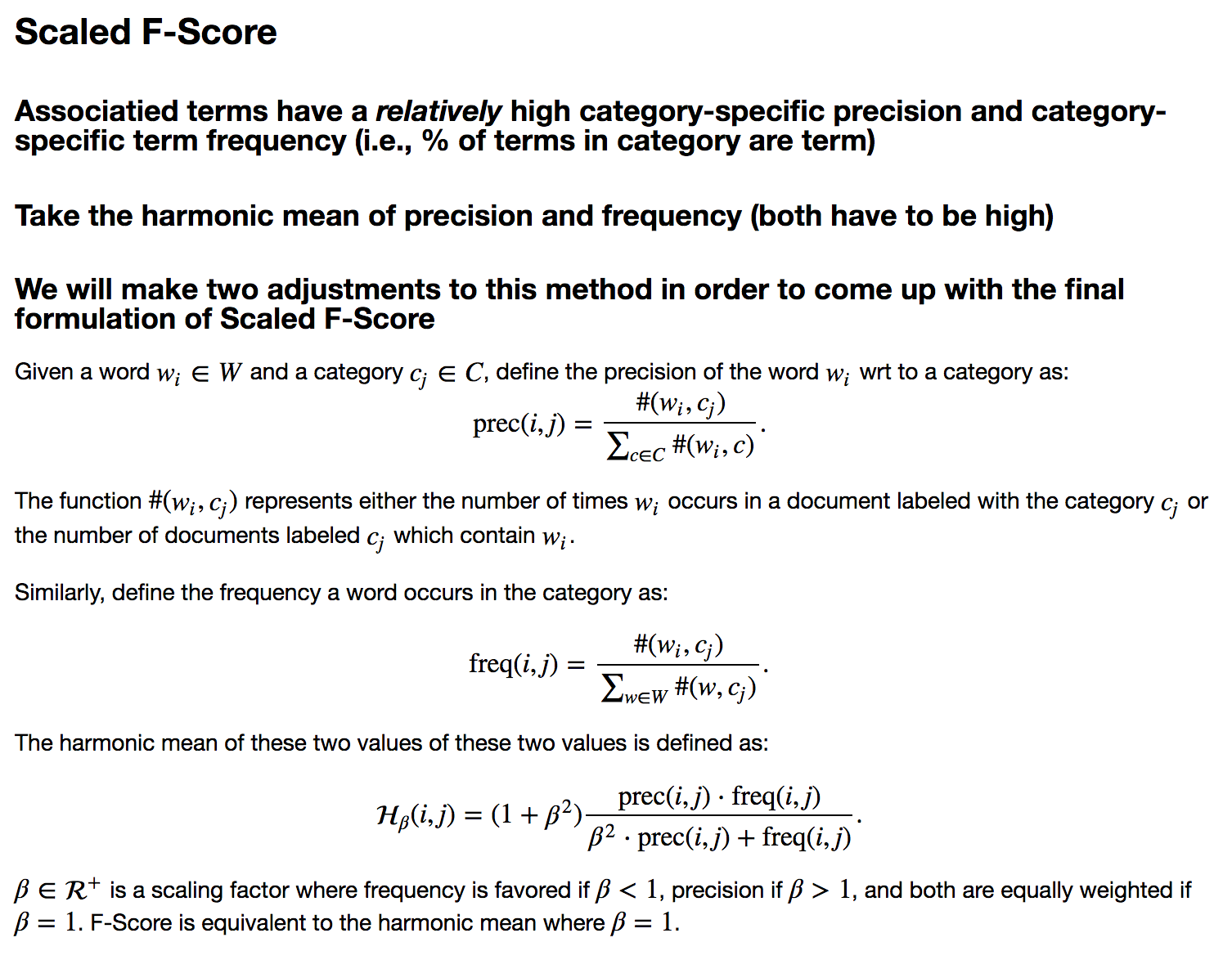
```python
from scipy.stats import hmean
term_freq_df = corpus.get_unigram_corpus().get_term_freq_df()[['Positive freq', 'Negative freq']]
term_freq_df = term_freq_df[term_freq_df.sum(axis=1) > 0]
term_freq_df['pos_precision'] = (term_freq_df['Positive freq'] * 1./
(term_freq_df['Positive freq'] + term_freq_df['Negative freq']))
term_freq_df['pos_freq_pct'] = (term_freq_df['Positive freq'] * 1.
/term_freq_df['Positive freq'].sum())
term_freq_df['pos_hmean'] = (term_freq_df
.apply(lambda x: (hmean([x['pos_precision'], x['pos_freq_pct']])
if x['pos_precision'] > 0 and x['pos_freq_pct'] > 0
else 0), axis=1))
term_freq_df.sort_values(by='pos_hmean', ascending=False).iloc[:10]
```
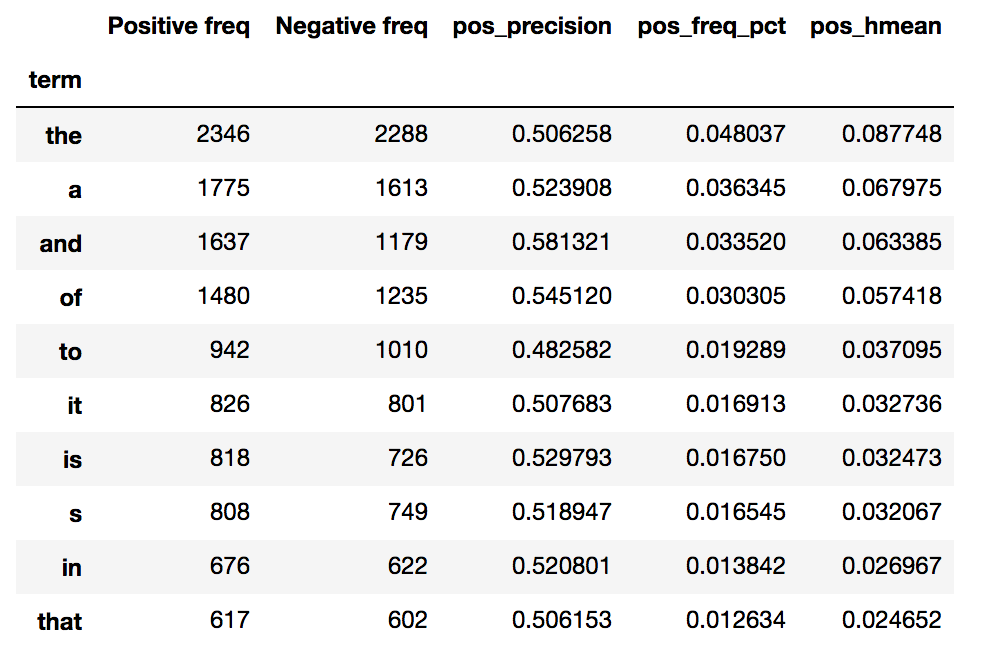
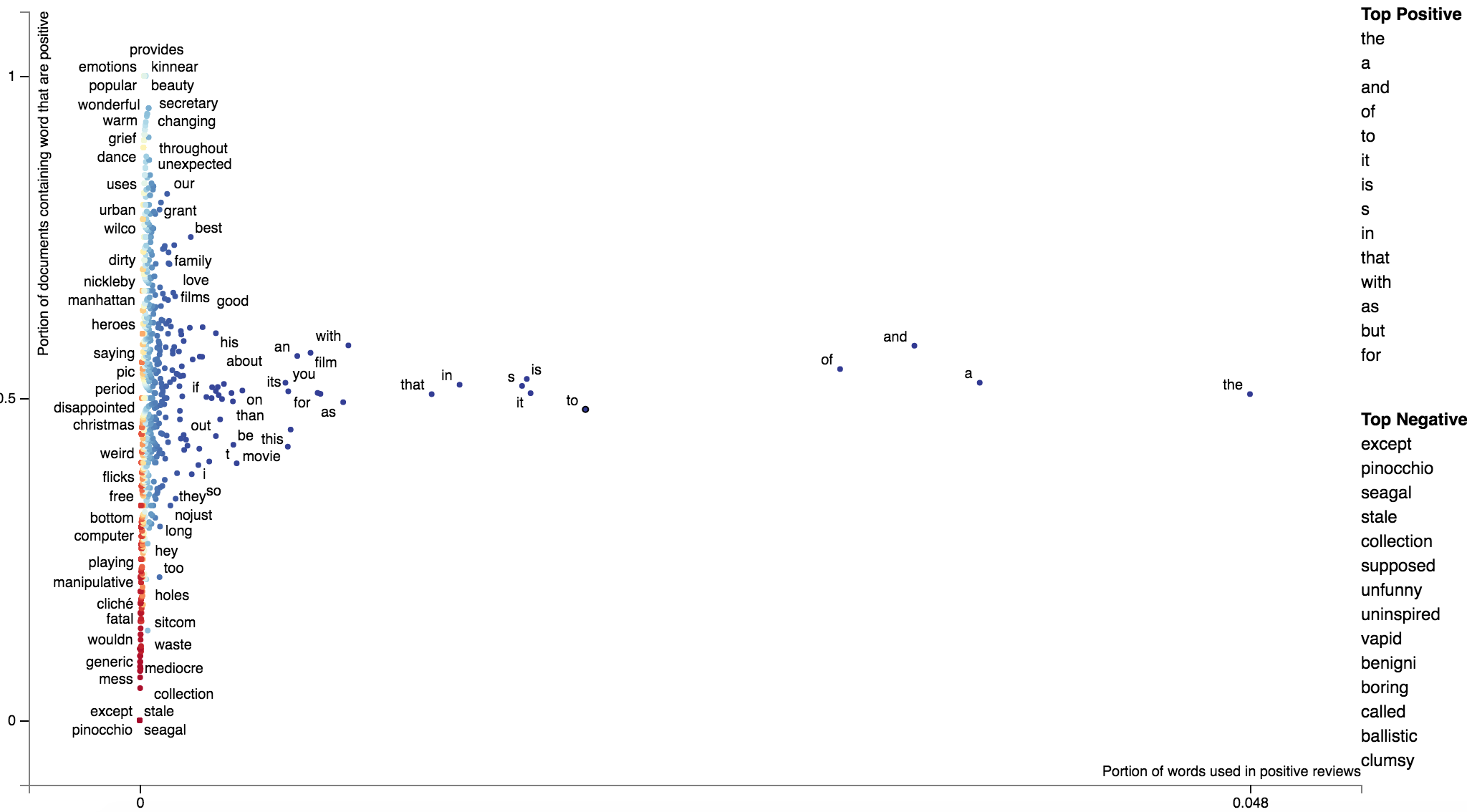
If we plot term frequency on the x-axis and the percentage of a term's occurrences
which are in positive documents (i.e., its precision) on the y-axis, we can see
that low-frequency terms have a much higher variation in the precision. Given these terms have
low frequencies, the harmonic means are low. Thus, the only terms which have a high harmonic mean
are extremely frequent words which tend to all have near average precisions.
```python
freq = term_freq_df.pos_freq_pct.values
prec = term_freq_df.pos_precision.values
html = st.produce_scattertext_explorer(
corpus.remove_terms(set(corpus.get_terms()) - set(term_freq_df.index)),
category='Positive',
not_category_name='Negative',
not_categories=['Negative'],
x_label = 'Portion of words used in positive reviews',
original_x = freq,
x_coords = (freq - freq.min())/freq.max(),
x_axis_values = [int(freq.min()*1000)/1000.,
int(freq.max() * 1000)/1000.],
y_label = 'Portion of documents containing word that are positive',
original_y = prec,
y_coords = (prec - prec.min())/prec.max(),
y_axis_values = [int(prec.min() * 1000)/1000.,
int((prec.max()/2.)*1000)/1000.,
int(prec.max() * 1000)/1000.],
scores = term_freq_df.pos_hmean.values,
sort_by_dist=False,
show_characteristic=False
)
file_name = 'not_normed_freq_prec.html'
open(file_name, 'wb').write(html.encode('utf-8'))
IFrame(src=file_name, width = 1300, height=700)
```
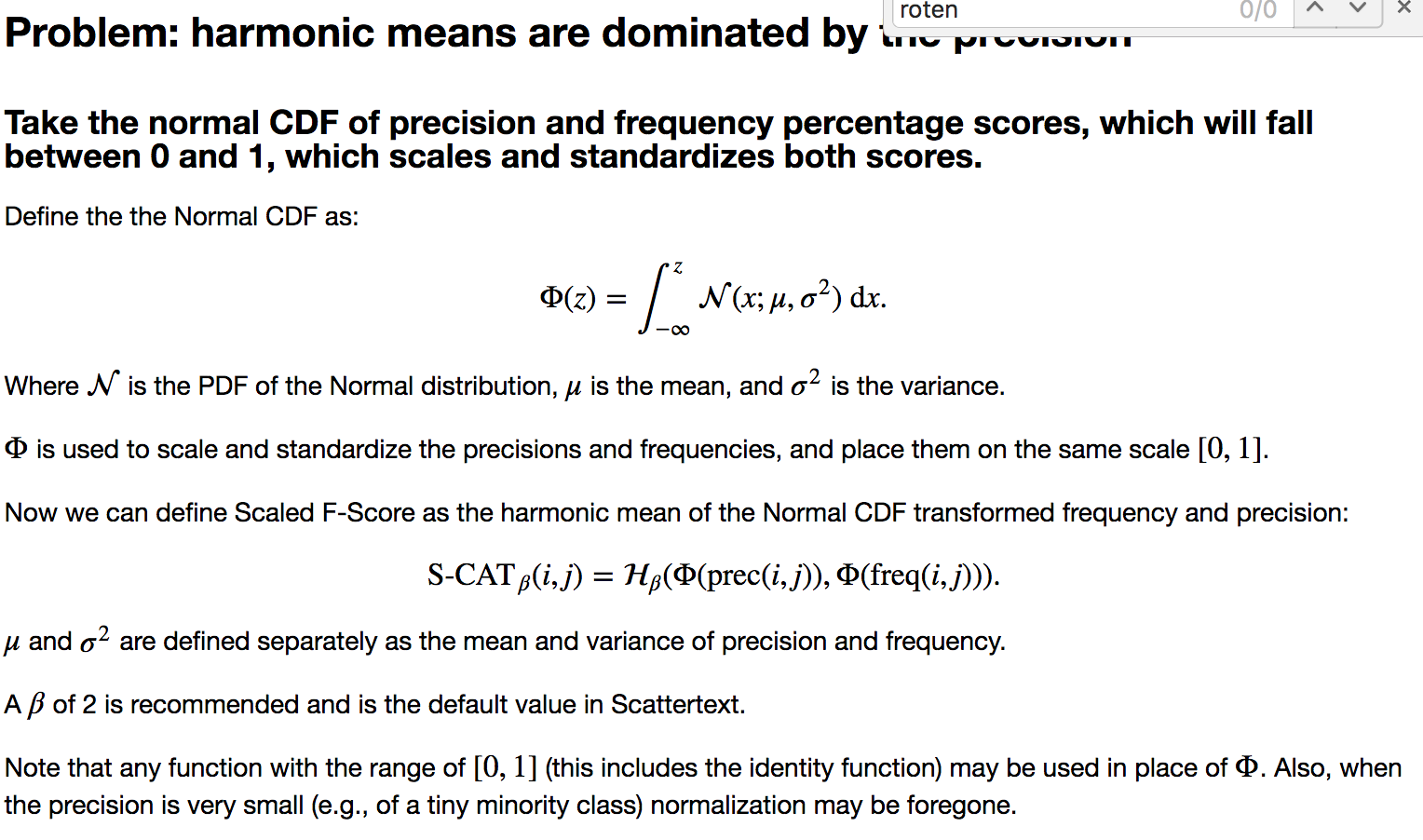
```python
from scipy.stats import norm
def normcdf(x):
return norm.cdf(x, x.mean(), x.std ())
term_freq_df['pos_precision_normcdf'] = normcdf(term_freq_df.pos_precision)
term_freq_df['pos_freq_pct_normcdf'] = normcdf(term_freq_df.pos_freq_pct.values)
term_freq_df['pos_scaled_f_score'] = hmean([term_freq_df['pos_precision_normcdf'], term_freq_df['pos_freq_pct_normcdf']])
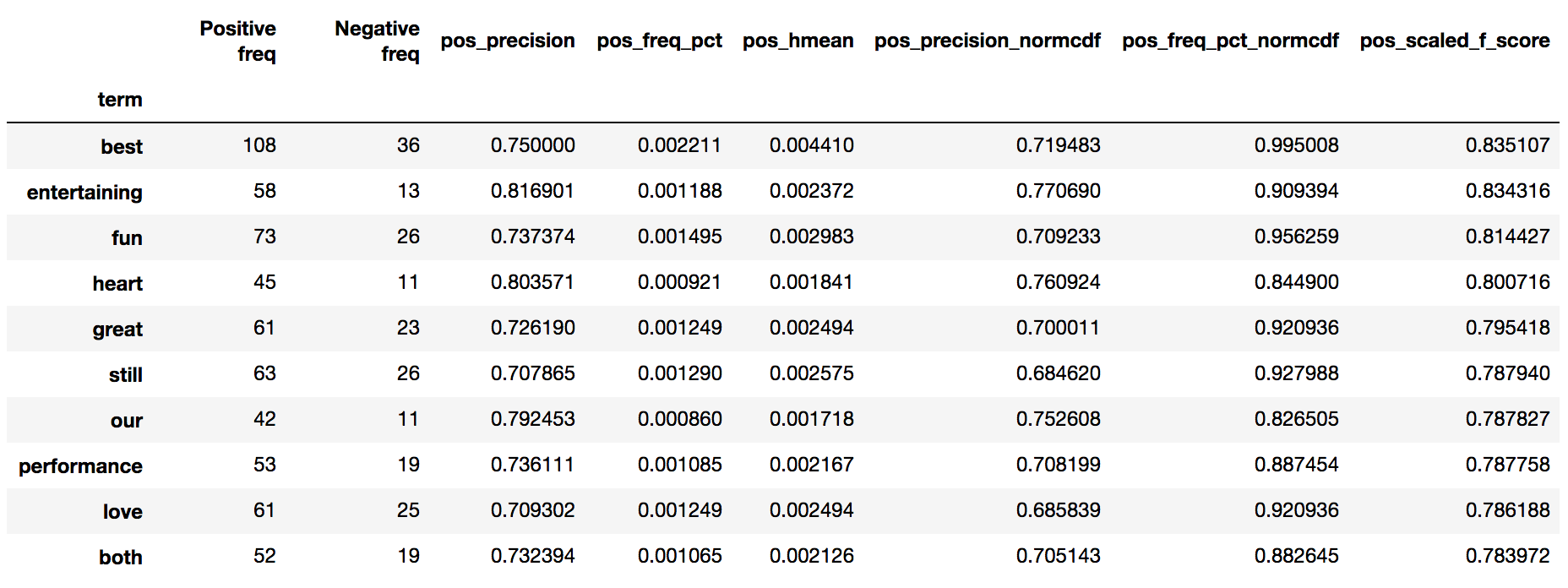
term_freq_df.sort_values(by='pos_scaled_f_score', ascending=False).iloc[:10]
```
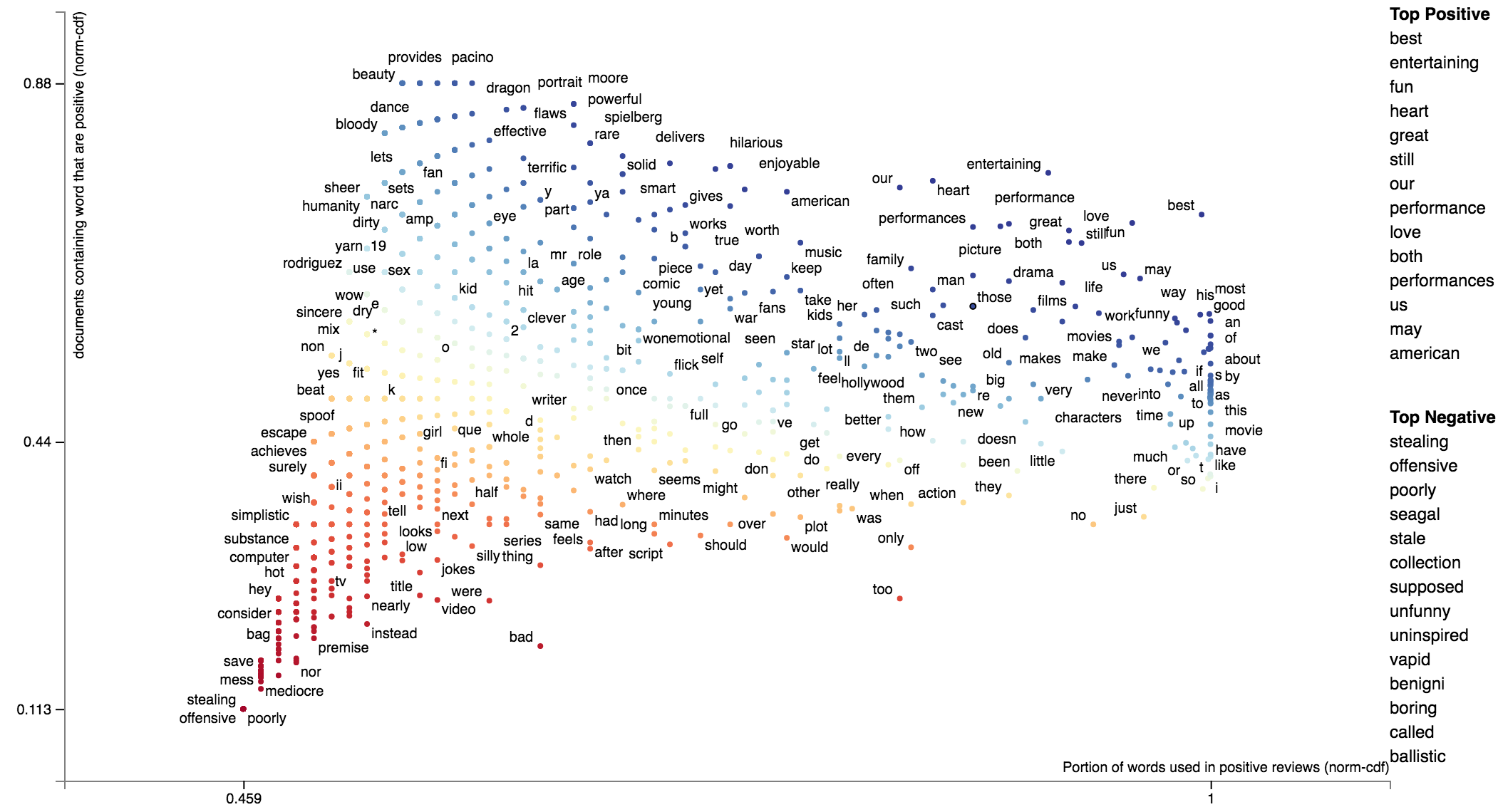
```python
freq = term_freq_df.pos_freq_pct_normcdf.values
prec = term_freq_df.pos_precision_normcdf.values
html = st.produce_scattertext_explorer(
corpus.remove_terms(set(corpus.get_terms()) - set(term_freq_df.index)),
category='Positive',
not_category_name='Negative',
not_categories=['Negative'],
x_label = 'Portion of words used in positive reviews (norm-cdf)',
original_x = freq,
x_coords = (freq - freq.min())/freq.max(),
x_axis_values = [int(freq.min()*1000)/1000.,
int(freq.max() * 1000)/1000.],
y_label = 'documents containing word that are positive (norm-cdf)',
original_y = prec,
y_coords = (prec - prec.min())/prec.max(),
y_axis_values = [int(prec.min() * 1000)/1000.,
int((prec.max()/2.)*1000)/1000.,
int(prec.max() * 1000)/1000.],
scores = term_freq_df.pos_scaled_f_score.values,
sort_by_dist=False,
show_characteristic=False
)
```
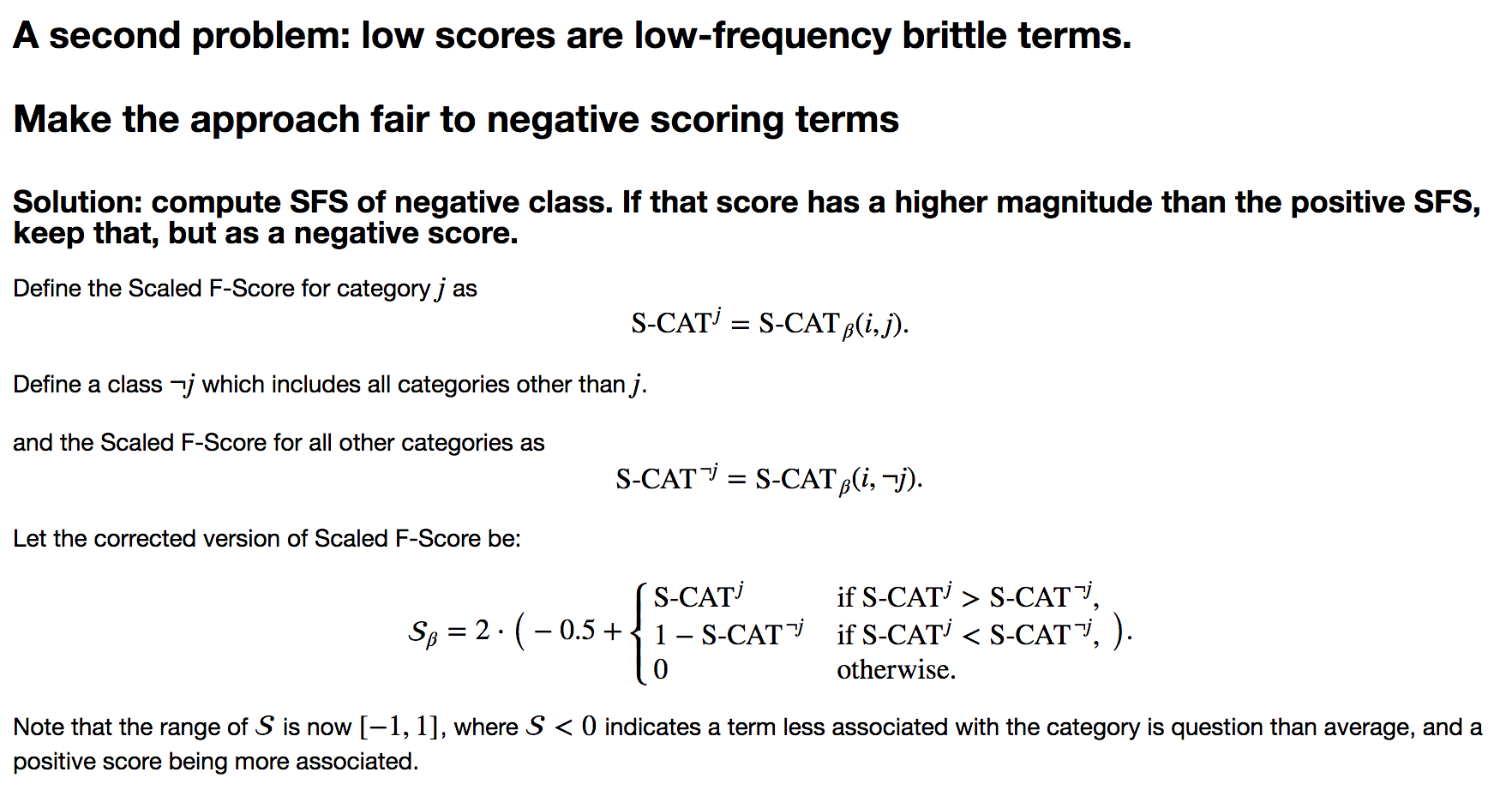
```python
term_freq_df['neg_precision_normcdf'] = normcdf((term_freq_df['Negative freq'] * 1./
(term_freq_df['Negative freq'] + term_freq_df['Positive freq'])))
term_freq_df['neg_freq_pct_normcdf'] = normcdf((term_freq_df['Negative freq'] * 1.
/term_freq_df['Negative freq'].sum()))
term_freq_df['neg_scaled_f_score'] = hmean([term_freq_df['neg_precision_normcdf'], term_freq_df['neg_freq_pct_normcdf']])
term_freq_df['scaled_f_score'] = 0
term_freq_df.loc[term_freq_df['pos_scaled_f_score'] > term_freq_df['neg_scaled_f_score'],
'scaled_f_score'] = term_freq_df['pos_scaled_f_score']
term_freq_df.loc[term_freq_df['pos_scaled_f_score'] < term_freq_df['neg_scaled_f_score'],
'scaled_f_score'] = 1-term_freq_df['neg_scaled_f_score']
term_freq_df['scaled_f_score'] = 2 * (term_freq_df['scaled_f_score'] - 0.5)
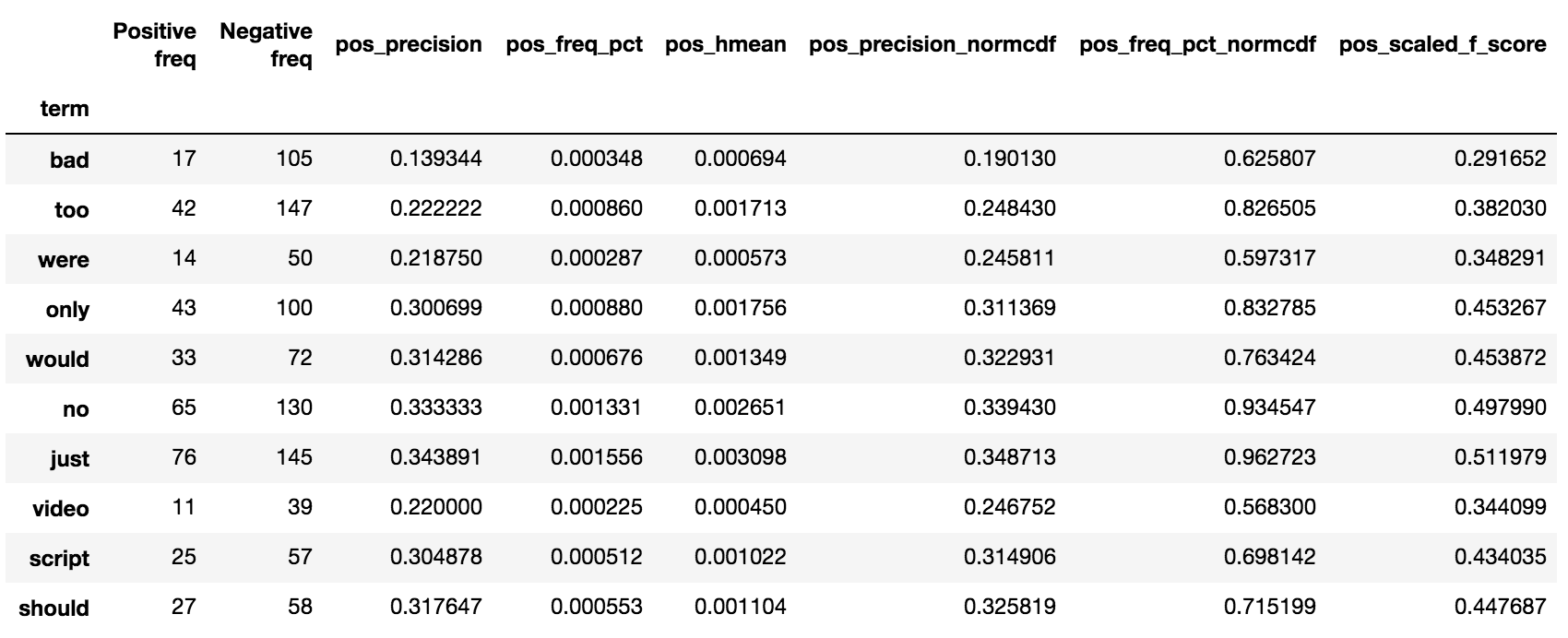
term_freq_df.sort_values(by='scaled_f_score', ascending=True).iloc[:10]
```
```python
is_pos = term_freq_df.pos_scaled_f_score > term_freq_df.neg_scaled_f_score
freq = term_freq_df.pos_freq_pct_normcdf*is_pos - term_freq_df.neg_freq_pct_normcdf*~is_pos
prec = term_freq_df.pos_precision_normcdf*is_pos - term_freq_df.neg_precision_normcdf*~is_pos
def scale(ar):
return (ar - ar.min())/(ar.max() - ar.min())
def close_gap(ar):
ar[ar > 0] -= ar[ar > 0].min()
ar[ar < 0] -= ar[ar < 0].max()
return ar
html = st.produce_scattertext_explorer(
corpus.remove_terms(set(corpus.get_terms()) - set(term_freq_df.index)),
category='Positive',
not_category_name='Negative',
not_categories=['Negative'],
x_label = 'Frequency',
original_x = freq,
x_coords = scale(close_gap(freq)),
x_axis_labels = ['Frequent in Neg',
'Not Frequent',
'Frequent in Pos'],
y_label = 'Precision',
original_y = prec,
y_coords = scale(close_gap(prec)),
y_axis_labels = ['Neg Precise',
'Imprecise',
'Pos Precise'],
scores = (term_freq_df.scaled_f_score.values + 1)/2,
sort_by_dist=False,
show_characteristic=False
)
```
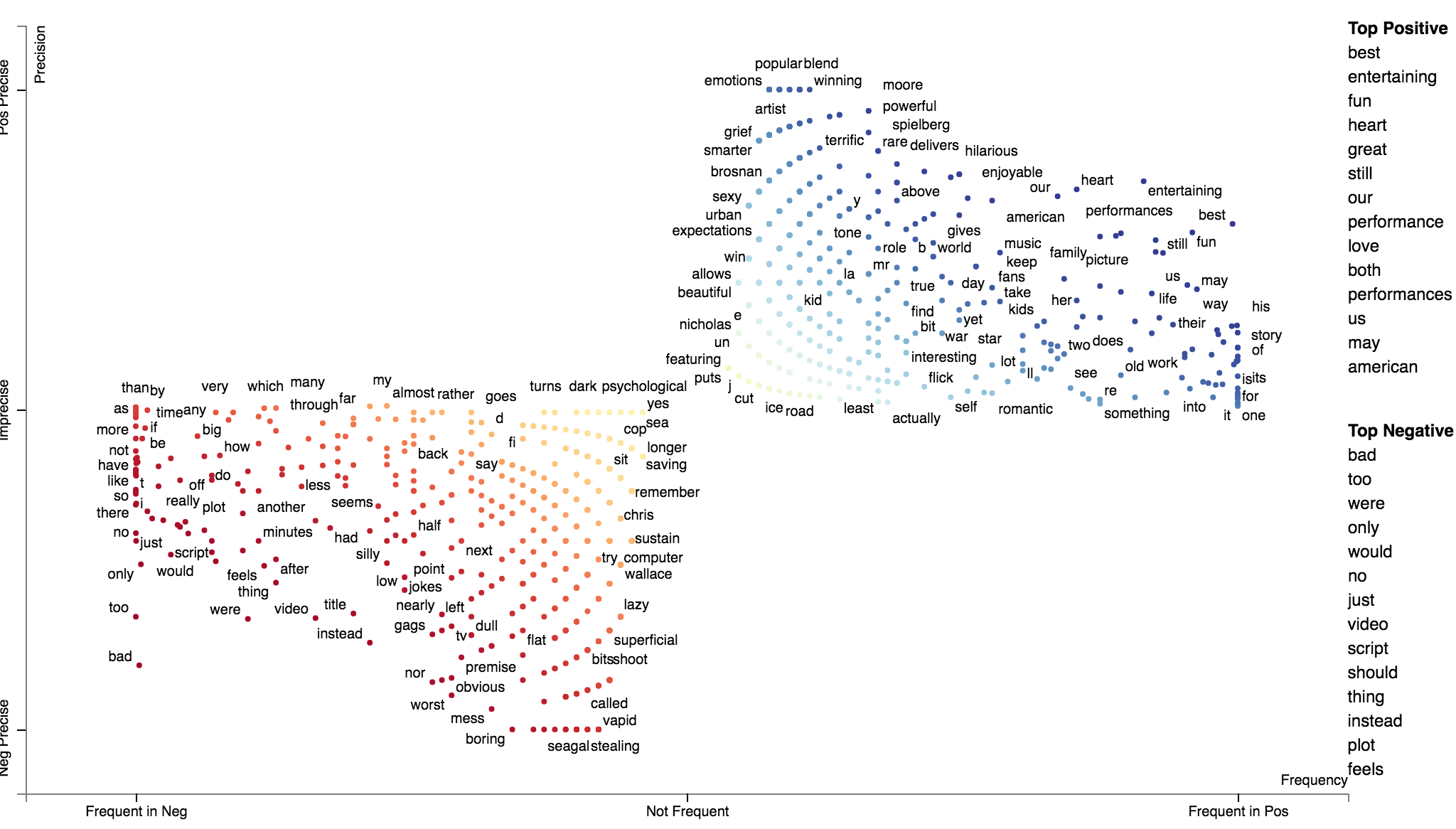
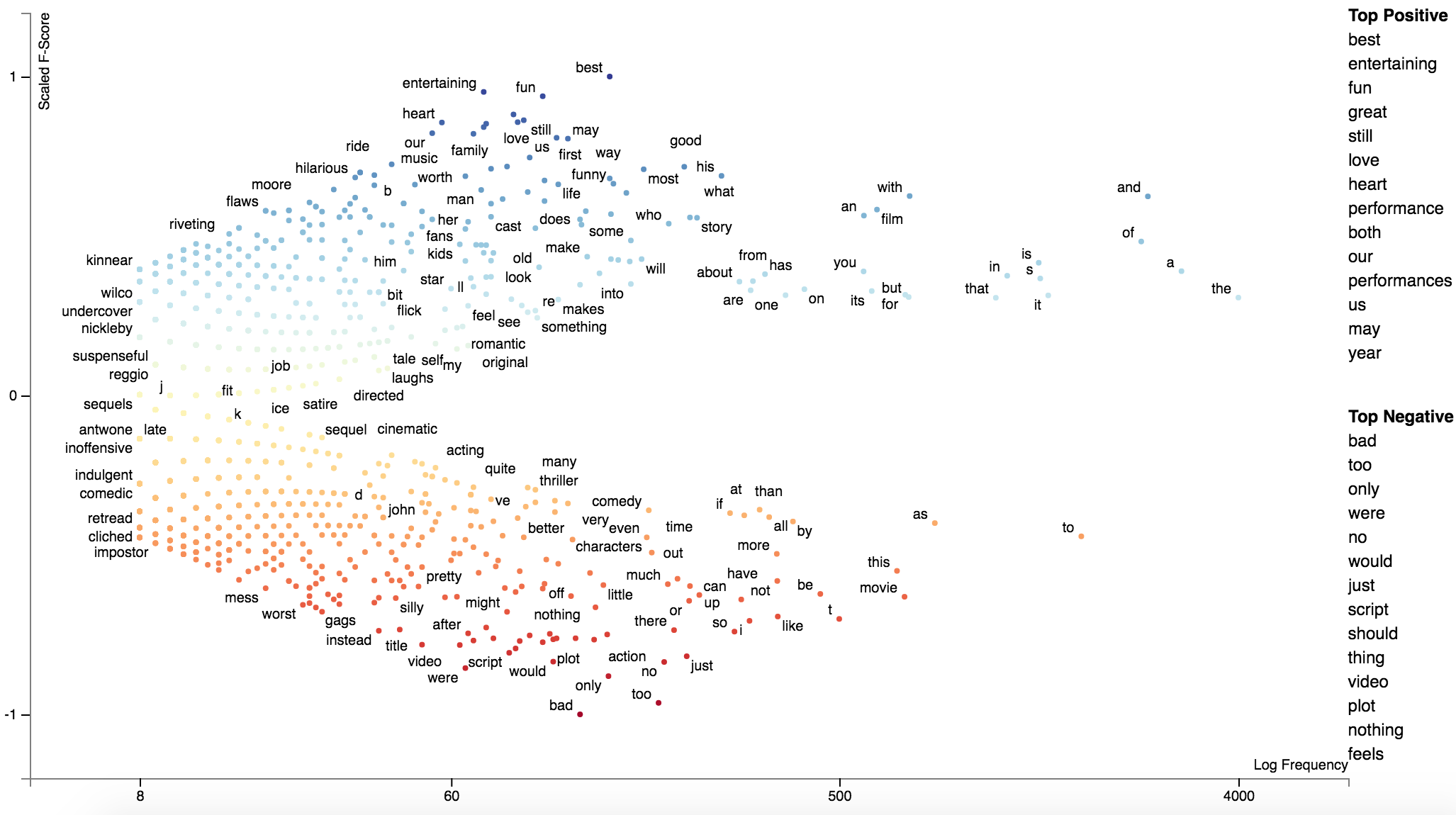
We can use `st.ScaledFScorePresets` as a term scorer to display terms' Scaled F-Score on the y-axis and
term frequencies on the x-axis.
```python
html = st.produce_frequency_explorer(
corpus.remove_terms(set(corpus.get_terms()) - set(term_freq_df.index)),
category='Positive',
not_category_name='Negative',
not_categories=['Negative'],
term_scorer=st.ScaledFScorePresets(beta=1, one_to_neg_one=True),
metadata = rdf['movie_name'],
grey_threshold=0
)
```
### Alternative term scoring methods
Scaled F-Score is not the only scoring method included in Scattertext. Please click on one of the links below to
view a notebook which describes how other class association scores work and can be visualized through Scattertext.
* [Google Colab Notebook](https://colab.research.google.com/drive/1snxAP8X6EIDi42FugJ_h5U-fBGDCqtyS) (recommend).
* [Jupyter Notebook via NBViewer](https://colab.research.google.com/drive/1snxAP8X6EIDi42FugJ_h5U-fBGDCqtyS).
New in 0.0.2.73 is the delta JS-Divergence scorer `DeltaJSDivergence` scorer (Gallagher et al. 2020), and its
corresponding compactor (JSDCompactor.) See `demo_deltajsd.py` for an example usage.
### The position-select-plot process
New in 0.0.2.72
Scattertext was originally set up to visualize corpora objects, which are connected sets of documents and
terms to visualize. The "compaction" process allows users to eliminate terms which may not be associated with a
category using a variety of feature selection methods. The issue with this is that the terms eliminated during
the selection process are not taken into account when scaling term positions.
This issue can be mitigated by using the position-select-plot process, where term positions are pre-determined
before the selection process is made.
Let's first use the 2012 conventions corpus, update the category names, and create a unigram corpus.
```python
import scattertext as st
import numpy as np
df = st.SampleCorpora.ConventionData2012.get_data().assign(
parse=lambda df: df.text.apply(st.whitespace_nlp_with_sentences)
).assign(party=lambda df: df['party'].apply({'democrat': 'Democratic', 'republican': 'Republican'}.get))
corpus = st.CorpusFromParsedDocuments(
df, category_col='party', parsed_col='parse'
).build().get_unigram_corpus()
category_name = 'Democratic'
not_category_name = 'Republican'
```
Next, let's create a dataframe consisting of the original counts and their log-scale positions.
```python
def get_log_scale_df(corpus, y_category, x_category):
term_coord_df = corpus.get_term_freq_df('')
# Log scale term counts (with a smoothing constant) as the initial coordinates
coord_columns = []
for category in [y_category, x_category]:
col_name = category + '_coord'
term_coord_df[col_name] = np.log(term_coord_df[category] + 1e-6) / np.log(2)
coord_columns.append(col_name)
# Scale these coordinates to between 0 and 1
min_offset = term_coord_df[coord_columns].min(axis=0).min()
for coord_column in coord_columns:
term_coord_df[coord_column] -= min_offset
max_offset = term_coord_df[coord_columns].max(axis=0).max()
for coord_column in coord_columns:
term_coord_df[coord_column] /= max_offset
return term_coord_df
# Get term coordinates from original corpus
term_coordinates = get_log_scale_df(corpus, category_name, not_category_name)
print(term_coordinates)
```
Here is a preview of the `term_coordinates` dataframe. The `Democrat` and
`Republican` columns contain the term counts, while the `_coord` columns
contain their logged coordinates. Visualizing 7,973 terms is difficult (but
possible) for people running Scattertext on most computers.
```
Democratic Republican Democratic_coord Republican_coord
term
thank 158 205 0.860166 0.872032
you 836 794 0.936078 0.933729
so 337 212 0.894681 0.873562
much 84 76 0.831380 0.826820
very 62 75 0.817543 0.826216
... ... ... ... ...
precinct 0 2 0.000000 0.661076
godspeed 0 1 0.000000 0.629493
beauty 0 1 0.000000 0.629493
bumper 0 1 0.000000 0.629493
sticker 0 1 0.000000 0.629493
[7973 rows x 4 columns]
```
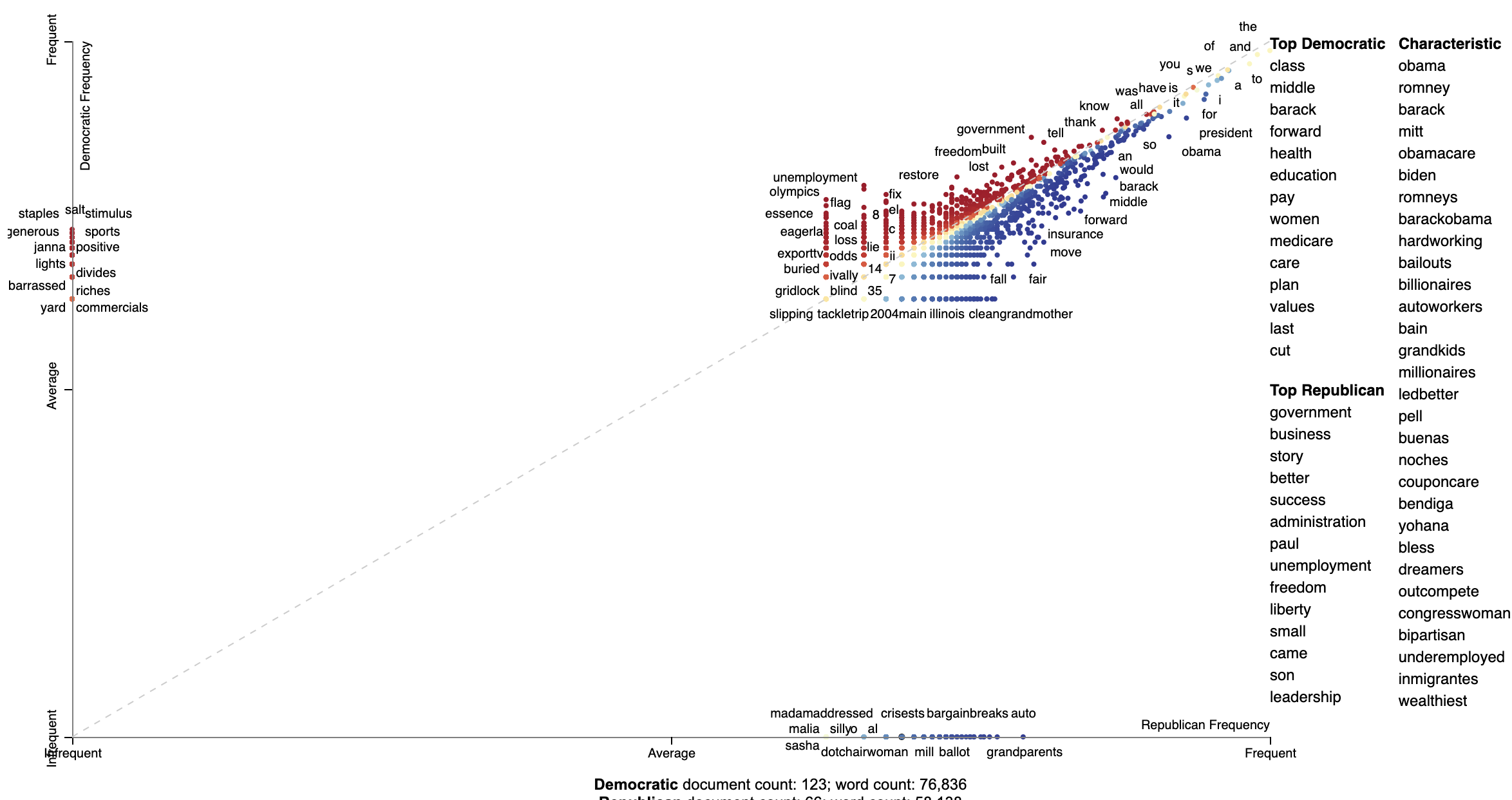
We can visualize this full data set by running the following code block. We'll create a custom
Javascript function to populate the tooltip with the original term counts, and create a
Scattertext Explorer where the x and y coordinates and original values are specified from the data
frame. Additionally, we can use `show_diagonal=True` to draw a dashed diagonal line across the plot area.
You can click the chart below to see the interactive version. Note that it will take a while to load.
```
# The tooltip JS function. Note that d is is the term data object, and ox and oy are the original x- and y-
# axis counts.
get_tooltip_content = ('(function(d) {return d.term + "
' + not_category_name + ' Count: " ' +
'+ d.ox +"
' + category_name + ' Count: " + d.oy})')
html_orig = st.produce_scattertext_explorer(
corpus,
category=category_name,
not_category_name=not_category_name,
minimum_term_frequency=0,
pmi_threshold_coefficient=0,
width_in_pixels=1000,
metadata=corpus.get_df()['speaker'],
show_diagonal=True,
original_y=term_coordinates[category_name],
original_x=term_coordinates[not_category_name],
x_coords=term_coordinates[category_name + '_coord'],
y_coords=term_coordinates[not_category_name + '_coord'],
max_overlapping=3,
use_global_scale=True,
get_tooltip_content=get_tooltip_content,
)
```
[](https://jasonkessler.github.io/demo_global_scale_log_orig.html)
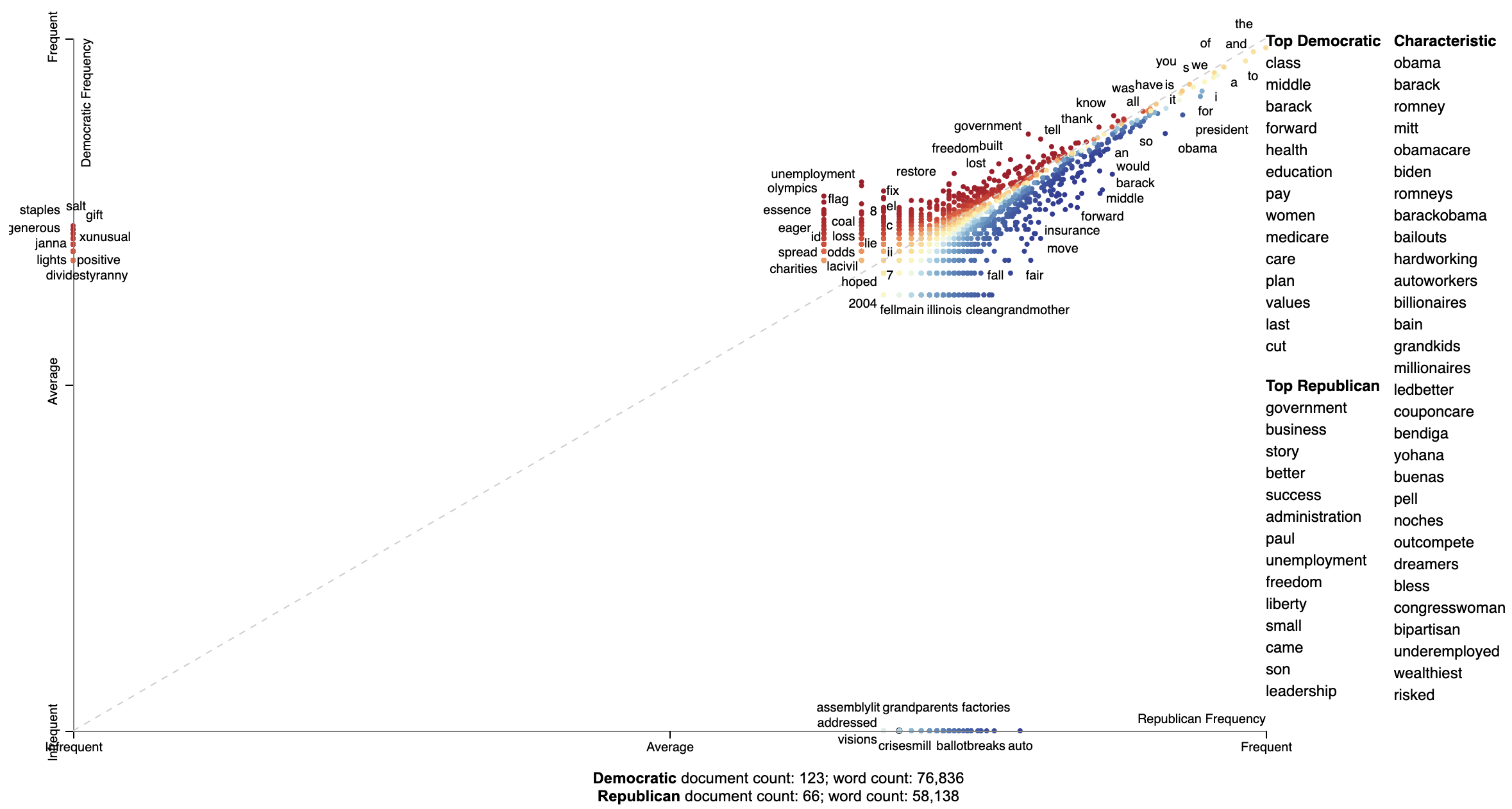
Next, we can visualize the compacted version of the corpus. The compaction, using `ClassPercentageCompactor`,
selects terms which frequently in each category. The `term_count` parameter, set to 2, is used to determine
the percentage threshold for terms to keep in a particular category. This is done using by calculating the
percentile of terms (types) in each category which appear more than two times. We find the smallest percentile,
and only include terms which occur above that percentile in a given category.
Note that this compaction leaves only 2,828 terms. This number is much easier for Scattertext to display
in a browser.
```python
# Select terms which appear a minimum threshold in both corpora
compact_corpus = corpus.compact(st.ClassPercentageCompactor(term_count=2))
# Only take term coordinates of terms remaining in corpus
term_coordinates = term_coordinates.loc[compact_corpus.get_terms()]
html_compact = st.produce_scattertext_explorer(
compact_corpus,
category=category_name,
not_category_name=not_category_name,
minimum_term_frequency=0,
pmi_threshold_coefficient=0,
width_in_pixels=1000,
metadata=corpus.get_df()['speaker'],
show_diagonal=True,
original_y=term_coordinates[category_name],
original_x=term_coordinates[not_category_name],
x_coords=term_coordinates[category_name + '_coord'],
y_coords=term_coordinates[not_category_name + '_coord'],
max_overlapping=3,
use_global_scale=True,
get_tooltip_content=get_tooltip_content,
)
```
[](https://jasonkessler.github.io/demo_global_scale_log.html)
## Advanced uses
### Visualizing differences based on only term frequencies
Occasionally, only term frequency statistics are available. This may happen in the case of very large,
lost, or proprietary data sets. `TermCategoryFrequencies` is a corpus representation,that can accept this
sort of data, along with any categorized documents that happen to be available.
Let use the [Corpus of Contemporary American English](https://corpus.byu.edu/coca/) as an example.
We'll construct a visualization
to analyze the difference between spoken American English and English that occurs in fiction.
```python
df = (pd.read_excel('https://www.wordfrequency.info/files/genres_sample.xls')
.dropna()
.set_index('lemma')[['SPOKEN', 'FICTION']]
.iloc[:1000])
df.head()
'''
SPOKEN FICTION
lemma
the 3859682.0 4092394.0
I 1346545.0 1382716.0
they 609735.0 352405.0
she 212920.0 798208.0
would 233766.0 229865.0
'''
```
Transforming this into a visualization is extremely easy. Just pass a dataframe indexed on
terms with columns indicating category-counts into the the `TermCategoryFrequencies` constructor.
```python
term_cat_freq = st.TermCategoryFrequencies(df)
```
And call `produce_scattertext_explorer` normally:
```python
html = st.produce_scattertext_explorer(
term_cat_freq,
category='SPOKEN',
category_name='Spoken',
not_category_name='Fiction',
)
```
[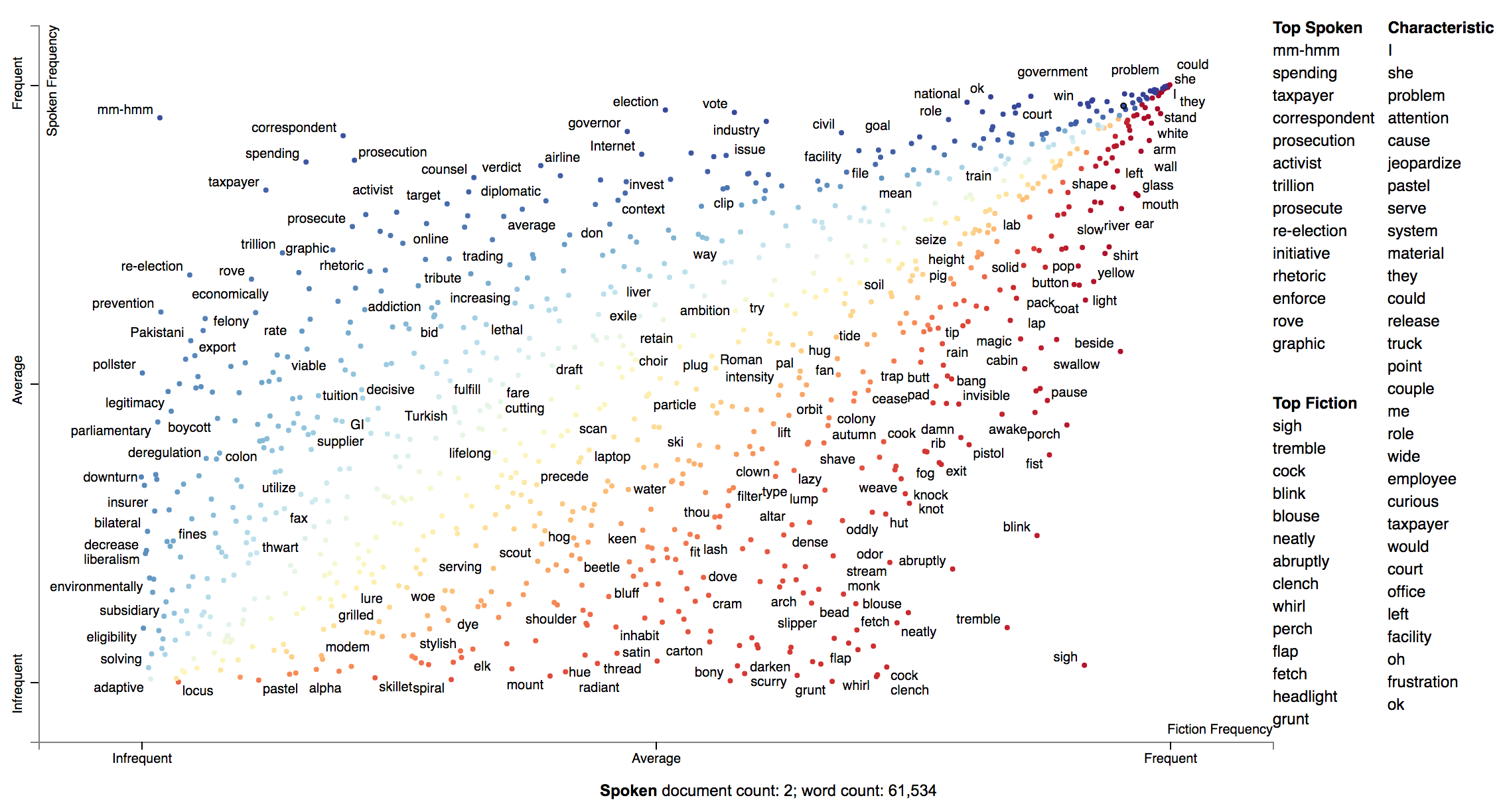](https://jasonkessler.github.io/demo_category_frequencies.html)
If you'd like to incorporate some documents into the visualization, you can add them into to the
`TermCategoyFrequencies` object.
First, let's extract some example Fiction and Spoken documents from the sample COCA corpus.
```python
import requests, zipfile, io
coca_sample_url = 'http://corpus.byu.edu/cocatext/samples/text.zip'
zip_file = zipfile.ZipFile(io.BytesIO(requests.get(coca_sample_url).content))
document_df = pd.DataFrame(
[{'text': zip_file.open(fn).read().decode('utf-8'),
'category': 'SPOKEN'}
for fn in zip_file.filelist if fn.filename.startswith('w_spok')][:2]
+ [{'text': zip_file.open(fn).read().decode('utf-8'),
'category': 'FICTION'}
for fn in zip_file.filelist if fn.filename.startswith('w_fic')][:2])
```
And we'll pass the `documents_df` dataframe into `TermCategoryFrequencies` via the `document_category_df`
parameter. Ensure the dataframe has two columns, 'text' and 'category'. Afterward, we can
call `produce_scattertext_explorer` (or your visualization function of choice) normally.
```python
doc_term_cat_freq = st.TermCategoryFrequencies(df, document_category_df=document_df)
html = st.produce_scattertext_explorer(
doc_term_cat_freq,
category='SPOKEN',
category_name='Spoken',
not_category_name='Fiction',
)
```
### Visualizing query-based categorical differences
Word representations have recently become a hot topic in NLP. While lots of work has been done visualizing
how terms relate to one another given their scores
(e.g., [http://projector.tensorflow.org/](http://projector.tensorflow.org/)),
none to my knowledge has been done visualizing how we can use these to examine how
document categories differ.
In this example given a query term, "jobs", we can see how Republicans and
Democrats talk about it differently.
In this configuration of Scattertext, words are colored by their similarity to a query phrase.
This is done using [spaCy](https://spacy.io/)-provided GloVe word vectors (trained on
the Common Crawl corpus). The cosine distance between vectors is used,
with mean vectors used for phrases.
The calculation of the most similar terms associated with each category is a simple heuristic. First,
sets of terms closely associated with a category are found. Second, these terms are ranked
based on their similarity to the query, and the top rank terms are displayed to the right of the
scatterplot.
A term is considered associated if its p-value is less than 0.05. P-values are
determined using Monroe et al. (2008)'s difference in the weighted log-odds-ratios with an
uninformative Dirichlet prior. This is the only model-based method discussed in Monroe et al.
that does not rely on a large, in-domain background corpus. Since we are scoring
bigrams in addition to the unigrams scored by Monroe, the size of the corpus would have to be larger
to have high enough bigram counts for proper penalization. This function
relies the Dirichlet distribution's parameter alpha, a vector, which is uniformly set to 0.01.
Here is the code to produce such a visualization.
```pydocstring
>>> from scattertext import word_similarity_explorer
>>> html = word_similarity_explorer(corpus,
... category='democrat',
... category_name='Democratic',
... not_category_name='Republican',
... target_term='jobs',
... minimum_term_frequency=5,
... pmi_threshold_coefficient=4,
... width_in_pixels=1000,
... metadata=convention_df['speaker'],
... alpha=0.01,
... max_p_val=0.05,
... save_svg_button=True)
>>> open("Convention-Visualization-Jobs.html", 'wb').write(html.encode('utf-8'))
```
[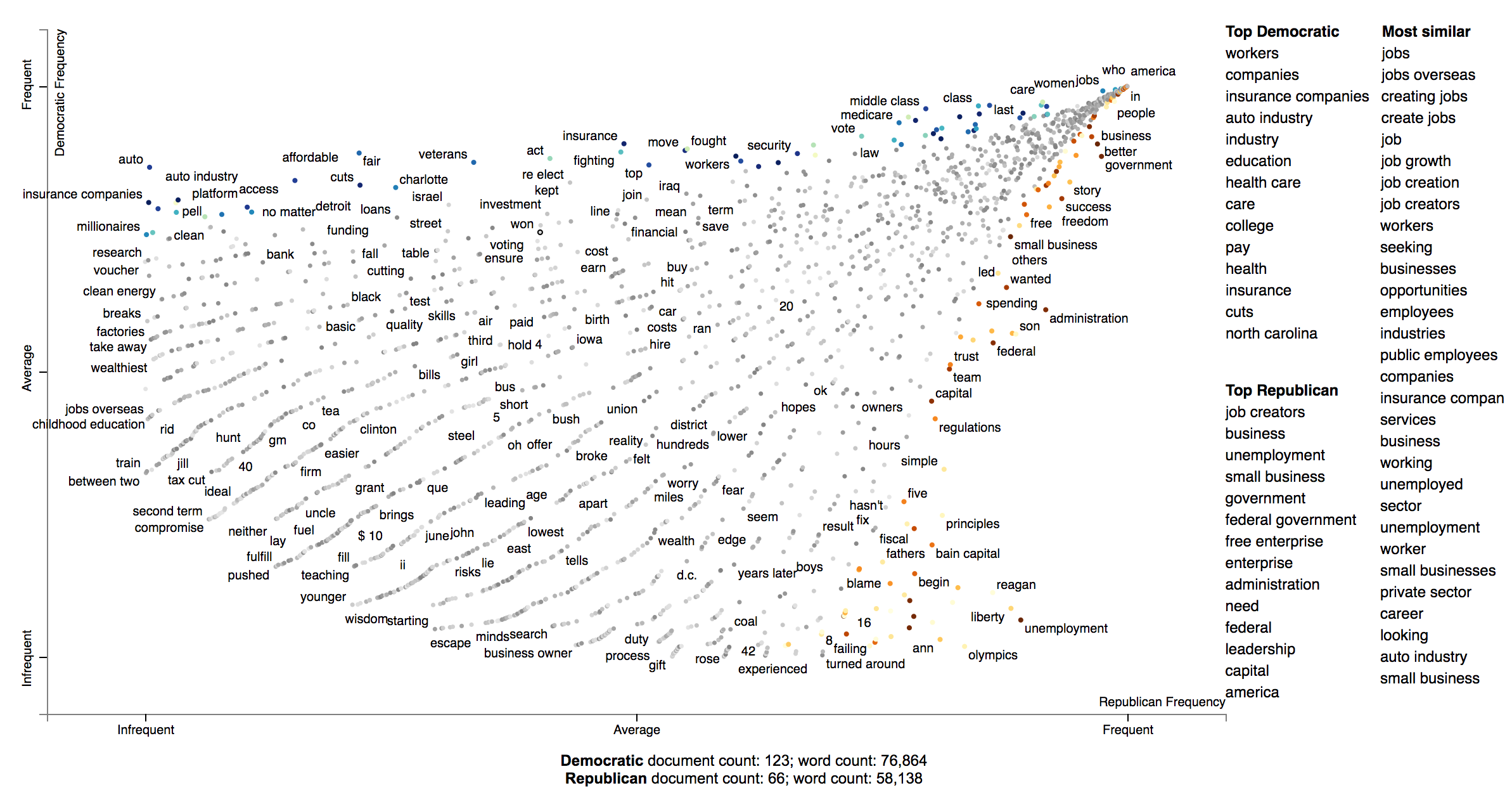](https://jasonkessler.github.io/Convention-Visualization-Jobs.html)
#### Developing and using bespoke word representations
Scattertext can interface with Gensim Word2Vec models. For example, here's a snippet from `demo_gensim_similarity.py`
which illustrates how to train and use a word2vec model on a corpus. Note the similarities produced
reflect quirks of the corpus, e.g., "8" tends to refer to the 8% unemployment rate at the time of the
convention.
```python
import spacy
from gensim.models import word2vec
from scattertext import SampleCorpora, word_similarity_explorer_gensim, Word2VecFromParsedCorpus
from scattertext.CorpusFromParsedDocuments import CorpusFromParsedDocuments
nlp = spacy.en.English()
convention_df = SampleCorpora.ConventionData2012.get_data()
convention_df['parsed'] = convention_df.text.apply(nlp)
corpus = CorpusFromParsedDocuments(convention_df, category_col='party', parsed_col='parsed').build()
model = word2vec.Word2Vec(size=300,
alpha=0.025,
window=5,
min_count=5,
max_vocab_size=None,
sample=0,
seed=1,
workers=1,
min_alpha=0.0001,
sg=1,
hs=1,
negative=0,
cbow_mean=0,
iter=1,
null_word=0,
trim_rule=None,
sorted_vocab=1)
html = word_similarity_explorer_gensim(corpus,
category='democrat',
category_name='Democratic',
not_category_name='Republican',
target_term='jobs',
minimum_term_frequency=5,
pmi_threshold_coefficient=4,
width_in_pixels=1000,
metadata=convention_df['speaker'],
word2vec=Word2VecFromParsedCorpus(corpus, model).train(),
max_p_val=0.05,
save_svg_button=True)
open('./demo_gensim_similarity.html', 'wb').write(html.encode('utf-8'))
```
How Democrats and Republicans talked differently about "jobs" in their 2012 convention speeches.
[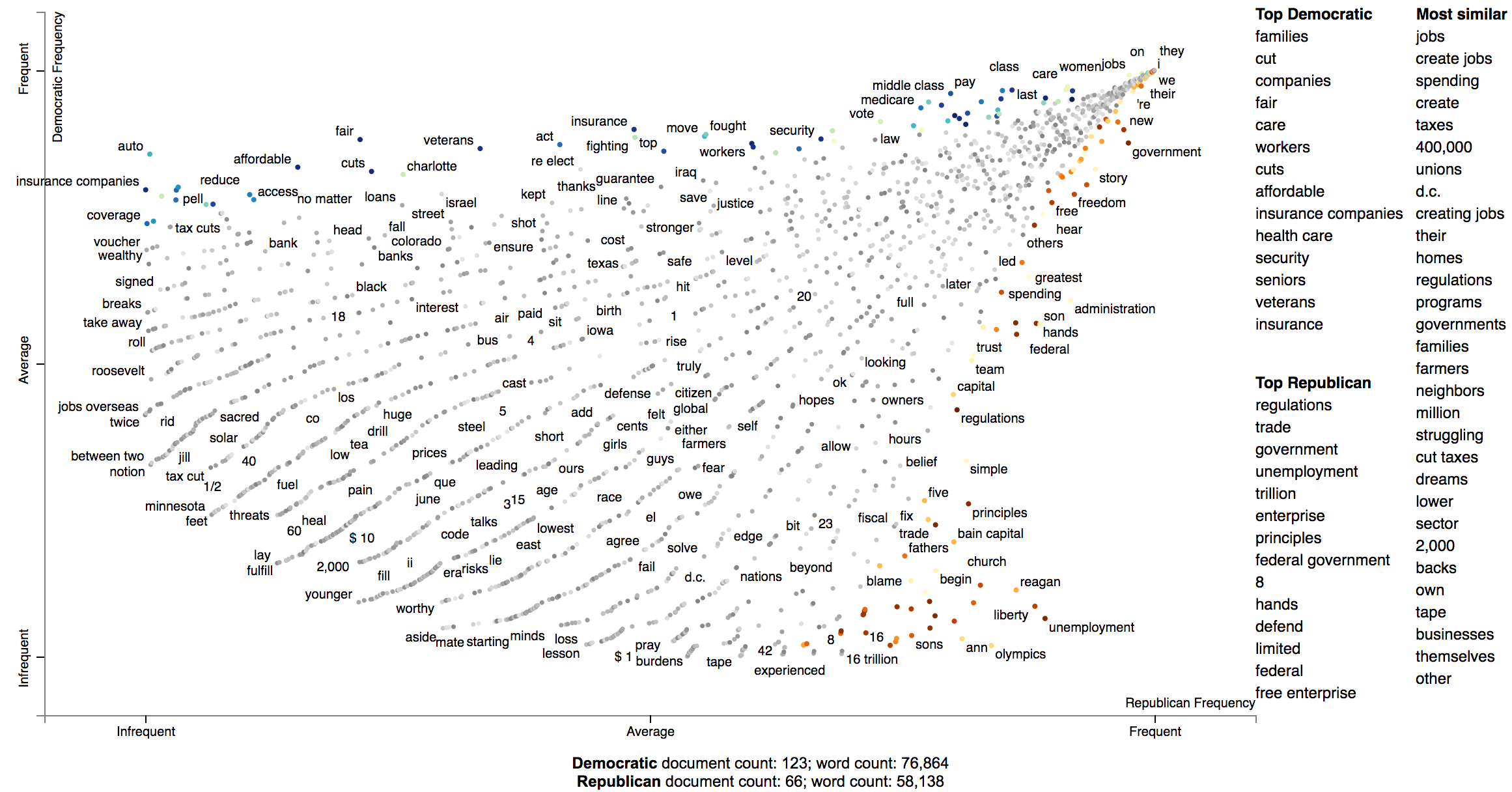](https://jasonkessler.github.io/demo_gensim_similarity.html)
### Visualizing any kind of term score
We can use Scattertext to visualize alternative types of word scores, and ensure that 0 scores are greyed out. Use the `sparse_explroer` function to acomplish this, and see its source code for more details.
```pydocstring
>>> from sklearn.linear_model import Lasso
>>> from scattertext import sparse_explorer
>>> html = sparse_explorer(corpus,
... category='democrat',
... category_name='Democratic',
... not_category_name='Republican',
... scores = corpus.get_regression_coefs('democrat', Lasso(max_iter=10000)),
... minimum_term_frequency=5,
... pmi_threshold_coefficient=4,
... width_in_pixels=1000,
... metadata=convention_df['speaker'])
>>> open('./Convention-Visualization-Sparse.html', 'wb').write(html.encode('utf-8'))
```
[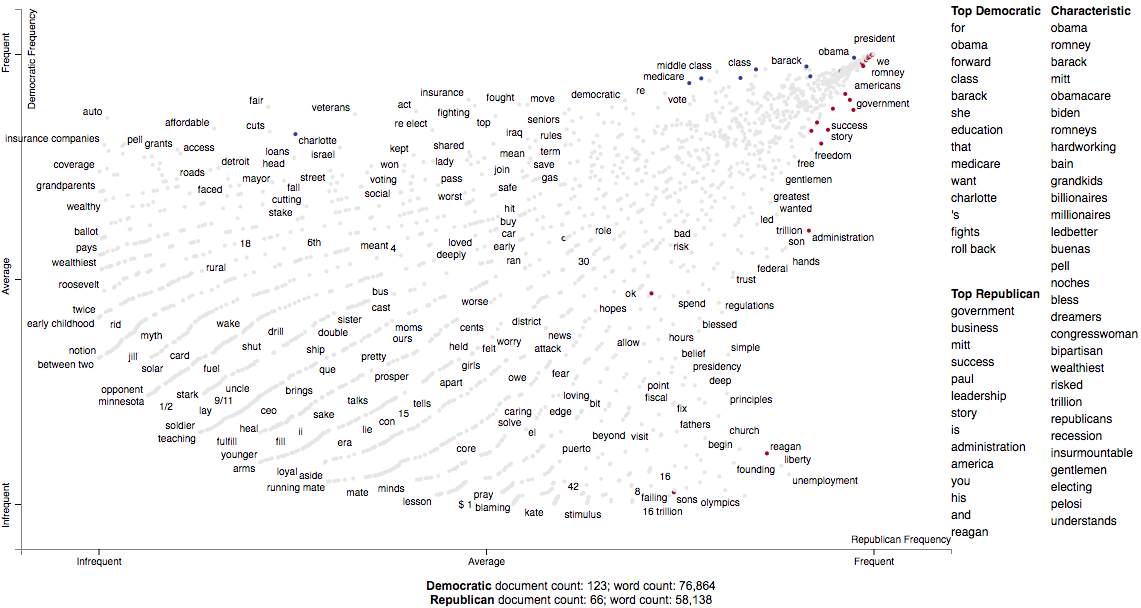](https://jasonkessler.github.io/Convention-Visualization-Sparse.html)
### Custom term positions
You can also use custom term positions and axis labels. For example, you can base terms' y-axis
positions on a regression coefficient and their x-axis on term frequency and label the axes
accordingly. The one catch is that axis positions must be scaled between 0 and 1.
First, let's define two scaling functions: `scale` to project positive values to \[0,1\], and
`zero_centered_scale` project real values to \[0,1\], with negative values always \<0.5, and
positive values always \>0.5.
```pydocstring
>>> def scale(ar):
... return (ar - ar.min()) / (ar.max() - ar.min())
...
>>> def zero_centered_scale(ar):
... ar[ar > 0] = scale(ar[ar > 0])
... ar[ar < 0] = -scale(-ar[ar < 0])
... return (ar + 1) / 2.
```
Next, let's compute and scale term frequencies and L2-penalized regression coefficients. We'll
hang on to the original coefficients and allow users to view them by mousing over terms.
```pydocstring
>>> from sklearn.linear_model import LogisticRegression
>>> import numpy as np
>>>
>>> frequencies_scaled = scale(np.log(term_freq_df.sum(axis=1).values))
>>> scores = corpus.get_logreg_coefs('democrat',
... LogisticRegression(penalty='l2', C=10, max_iter=10000, n_jobs=-1))
>>> scores_scaled = zero_centered_scale(scores)
```
Finally, we can write the visualization. Note the use of the `x_coords` and `y_coords`
parameters to store the respective coordinates, the `scores` and `sort_by_dist` arguments
to register the original coefficients and use them to rank the terms in the right-hand
list, and the `x_label` and `y_label` arguments to label axes.
```pydocstring
>>> html = produce_scattertext_explorer(corpus,
... category='democrat',
... category_name='Democratic',
... not_category_name='Republican',
... minimum_term_frequency=5,
... pmi_threshold_coefficient=4,
... width_in_pixels=1000,
... x_coords=frequencies_scaled,
... y_coords=scores_scaled,
... scores=scores,
... sort_by_dist=False,
... metadata=convention_df['speaker'],
... x_label='Log frequency',
... y_label='L2-penalized logistic regression coef')
>>> open('demo_custom_coordinates.html', 'wb').write(html.encode('utf-8'))
```
[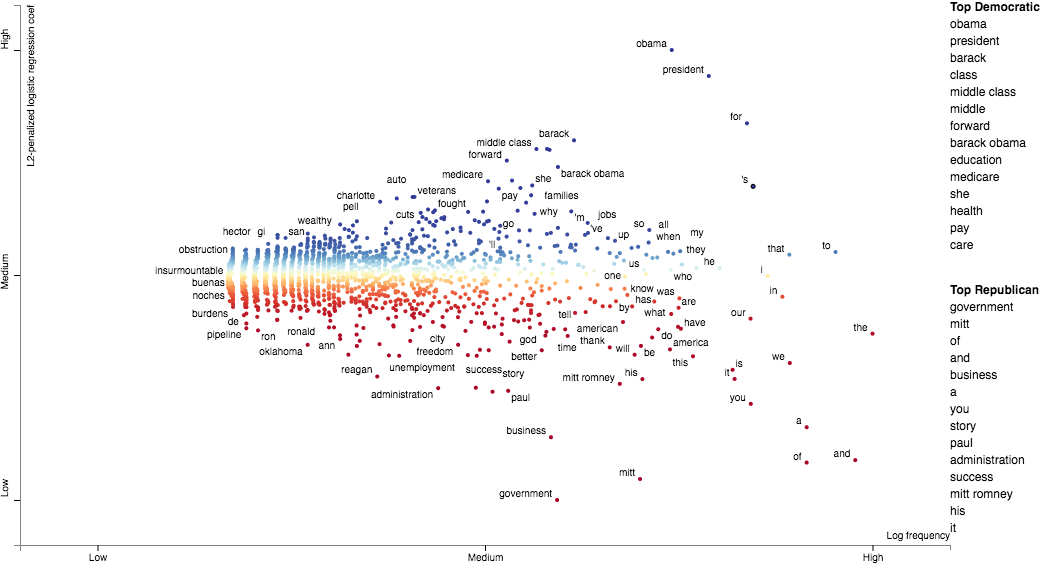](https://jasonkessler.github.io/demo_custom_coordinates.html)
### Emoji analysis
The Emoji analysis capability displays a chart of the category-specific distribution
of Emoji. Let's look at a new corpus, a set of tweets. We'll build a visualization
showing how men and women use emoji differently.
Note: the following example is implemented in `demo_emoji.py`.
First, we'll load the dataset and parse it using NLTK's tweet tokenizer. Note, install NLTK
before running this example. It will take some time for the dataset to download.
```python
import nltk, urllib.request, io, agefromname, zipfile
import scattertext as st
import pandas as pd
with zipfile.ZipFile(io.BytesIO(urllib.request.urlopen(
'http://followthehashtag.com/content/uploads/USA-Geolocated-tweets-free-dataset-Followthehashtag.zip'
).read())) as zf:
df = pd.read_excel(zf.open('dashboard_x_usa_x_filter_nativeretweets.xlsx'))
nlp = st.tweet_tokenzier_factory(nltk.tokenize.TweetTokenizer())
df['parse'] = df['Tweet content'].apply(nlp)
df.iloc[0]
'''
Tweet Id 721318437075685382
Date 2016-04-16
Hour 12:44
User Name Bill Schulhoff
Nickname BillSchulhoff
Bio Husband,Dad,GrandDad,Ordained Minister, Umpire...
Tweet content Wind 3.2 mph NNE. Barometer 30.20 in, Rising s...
Favs NaN
RTs NaN
Latitude 40.7603
Longitude -72.9547
Country US
Place (as appears on Bio) East Patchogue, NY
Profile picture http://pbs.twimg.com/profile_images/3788000007...
Followers 386
Following 705
Listed 24
Tweet language (ISO 639-1) en
Tweet Url http://www.twitter.com/BillSchulhoff/status/72...
parse Wind 3.2 mph NNE. Barometer 30.20 in, Rising s...
Name: 0, dtype: object
'''
```
Next, we'll use the [AgeFromName](https://github.com/JasonKessler/agefromname) package to find the probabilities of the gender of
each user given their first name. First, we'll find a dataframe indexed on first names
that contains the probability that each someone with that first name is male (`male_prob`).
```python
male_prob = agefromname.AgeFromName().get_all_name_male_prob()
male_prob.iloc[0]
'''
hi 1.00000
lo 0.95741
prob 1.00000
Name: aaban, dtype: float64
'''
```
Next, we'll extract the first names of each user, and use the `male_prob` data frame
to find users whose names indicate there is at least a 90% chance they are either male or female,
label those users, and create new data frame `df_mf` with only those users.
```python
df['first_name'] = df['User Name'].apply(lambda x: x.split()[0].lower() if type(x) == str and len(x.split()) > 0 else x)
df_aug = pd.merge(df, male_prob, left_on='first_name', right_index=True)
df_aug['gender'] = df_aug['prob'].apply(lambda x: 'm' if x > 0.9 else 'f' if x < 0.1 else '?')
df_mf = df_aug[df_aug['gender'].isin(['m', 'f'])]
```
The key to this analysis is to construct a corpus using only the emoji
extractor `st.FeatsFromSpacyDocOnlyEmoji` which builds a corpus only from
emoji and not from anything else.
```python
corpus = st.CorpusFromParsedDocuments(
df_mf,
parsed_col='parse',
category_col='gender',
feats_from_spacy_doc=st.FeatsFromSpacyDocOnlyEmoji()
).build()
```
Next, we'll run this through a standard `produce_scattertext_explorer` visualization
generation.
```python
html = st.produce_scattertext_explorer(
corpus,
category='f',
category_name='Female',
not_category_name='Male',
use_full_doc=True,
term_ranker=OncePerDocFrequencyRanker,
sort_by_dist=False,
metadata=(df_mf['User Name']
+ ' (@' + df_mf['Nickname'] + ') '
+ df_mf['Date'].astype(str)),
width_in_pixels=1000
)
open("EmojiGender.html", 'wb').write(html.encode('utf-8'))
```
[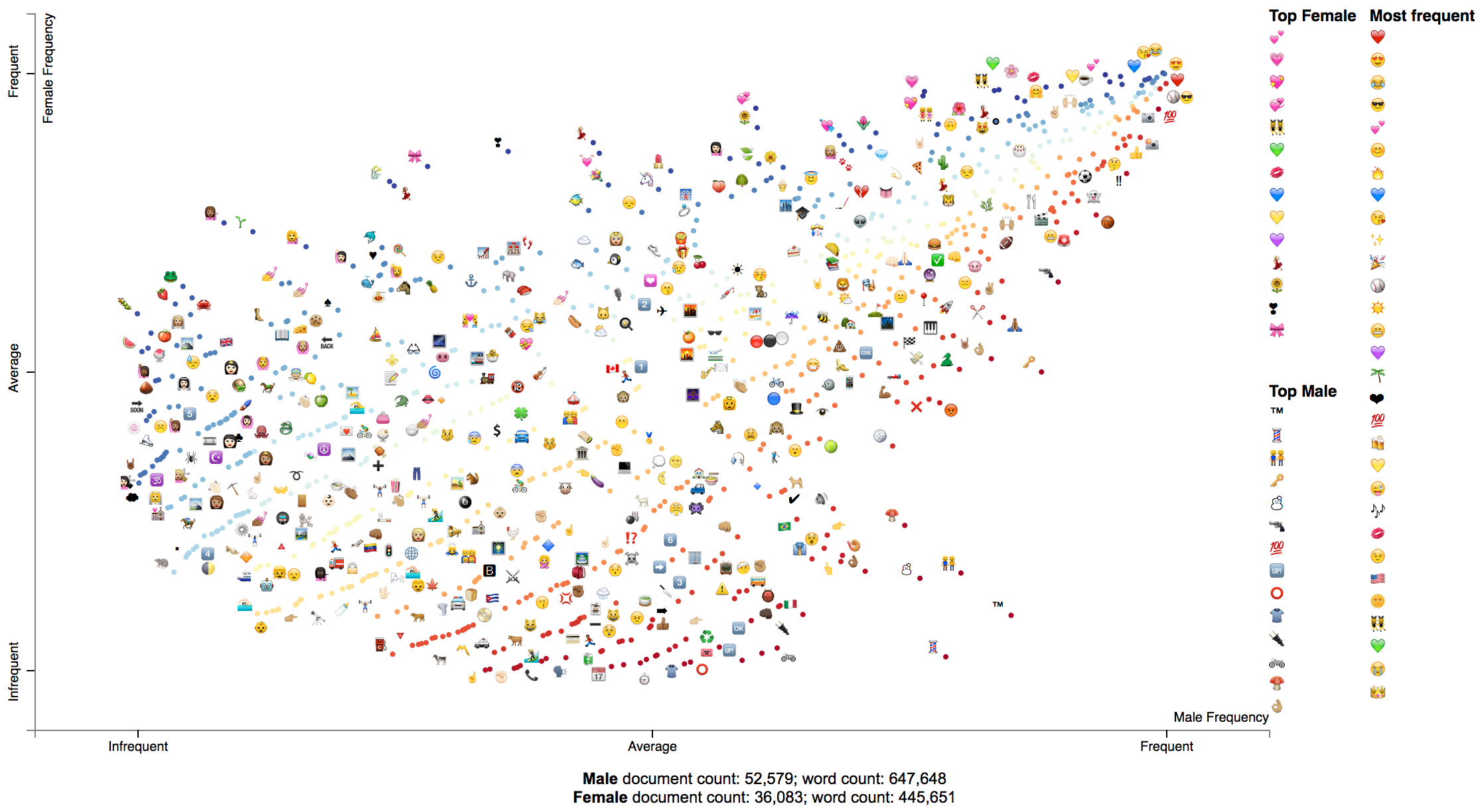](https://jasonkessler.github.io/EmojiGender.html)
### Visualizing SentencePiece Tokens
[SentencePiece](https://github.com/google/sentencepiece) tokenization is a subword tokenization technique which
relies on a language-model to produce optimized tokenization. It has been used in large, transformer-based contextual
language models.
Ensure to run `$ pip install sentencepiece` before running this example.
First, let's load the political convention data set as normal.
```python
import tempfile
import re
import scattertext as st
convention_df = st.SampleCorpora.ConventionData2012.get_data()
convention_df['parse'] = convention_df.text.apply(st.whitespace_nlp_with_sentences)
```
Next, let's train a SentencePiece tokenizer based on this data. The `train_sentence_piece_tokenizer` function trains
a SentencePieceProcessor on the data set and returns it. You can of course use any SentencePieceProcessor.
```python
def train_sentence_piece_tokenizer(documents, vocab_size):
'''
:param documents: list-like, a list of str documents
:vocab_size int: the size of the vocabulary to output
:return sentencepiece.SentencePieceProcessor
'''
import sentencepiece as spm
sp = None
with tempfile.NamedTemporaryFile(delete=True) as tempf:
with tempfile.NamedTemporaryFile(delete=True) as tempm:
tempf.write(('\n'.join(documents)).encode())
spm.SentencePieceTrainer.Train(
'--input=%s --model_prefix=%s --vocab_size=%s' % (tempf.name, tempm.name, vocab_size)
)
sp = spm.SentencePieceProcessor()
sp.load(tempm.name + '.model')
return sp
sp = train_sentence_piece_tokenizer(convention_df.text.values, vocab_size=2000)
```
Next, let's add the SentencePiece tokens as metadata when creating our corpus. In order to do this, pass
a `FeatsFromSentencePiece` instance into the `feats_from_spacy_doc` parameter. Pass the SentencePieceProcessor into
the constructor.
```python
corpus = st.CorpusFromParsedDocuments(convention_df,
parsed_col='parse',
category_col='party',
feats_from_spacy_doc=st.FeatsFromSentencePiece(sp)).build()
```
Now we can create the SentencePiece token scatter plot.
```python
html = st.produce_scattertext_explorer(
corpus,
category='democrat',
category_name='Democratic',
not_category_name='Republican',
sort_by_dist=False,
metadata=convention_df['party'] + ': ' + convention_df['speaker'],
term_scorer=st.RankDifference(),
transform=st.Scalers.dense_rank,
use_non_text_features=True,
use_full_doc=True,
)
```
[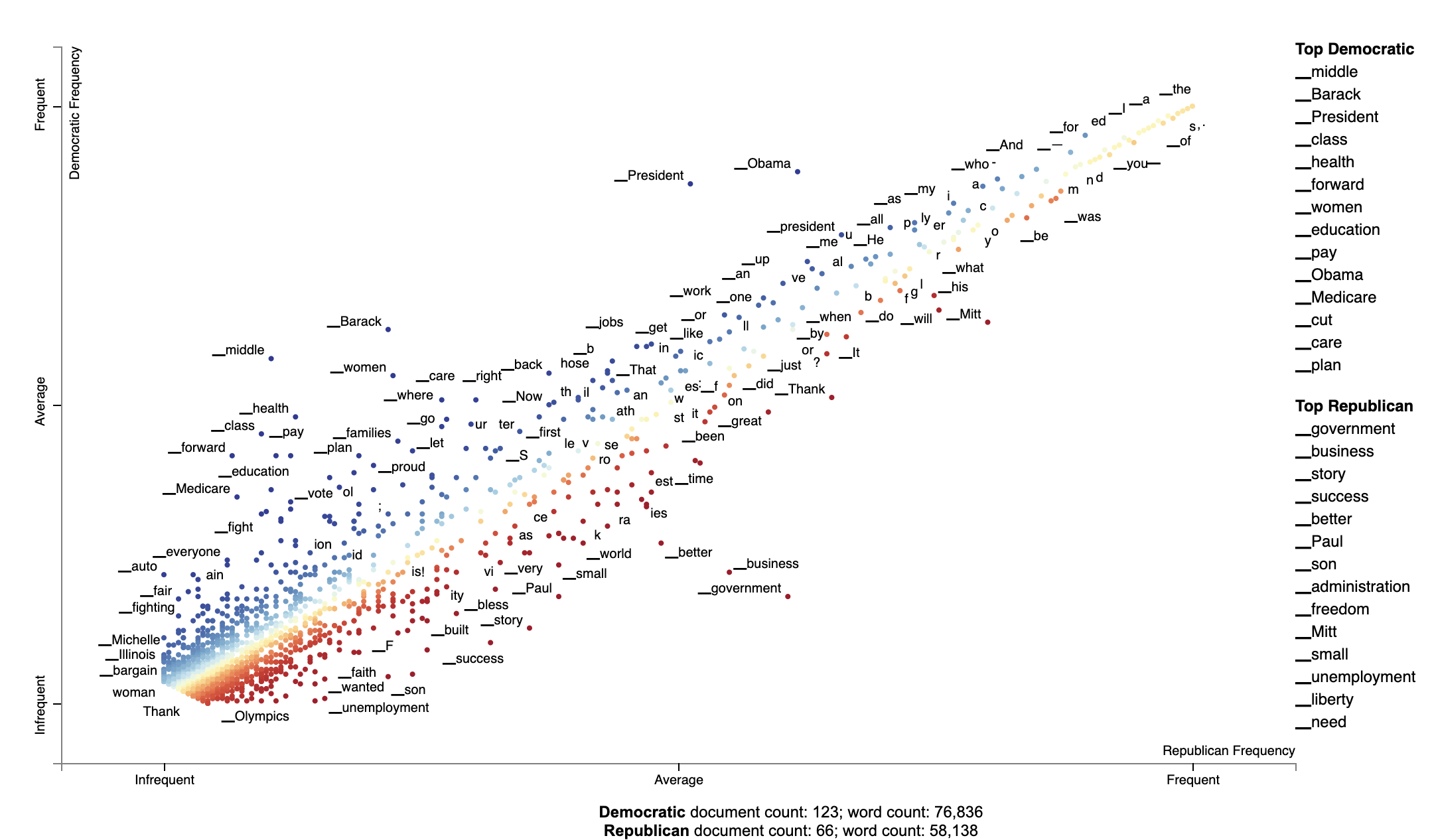](https://jasonkessler.github.io/demo_sentence_piece.html)
### Visualizing scikit-learn text classification weights
Suppose you'd like to audit or better understand
weights or importances given to bag-of-words features
by a classifier.
It's easy to use Scattertext to do, if you use a Scikit-learn-style classifier.
For example the [Lighting](http://contrib.scikit-learn.org/lightning/) package makes available
high-performance linear classifiers which are have Scikit-compatible interfaces.
First, let's import `sklearn`'s text feature extraction classes, the 20 Newsgroup
corpus, Lightning's Primal Coordinate Descent classifier, and Scattertext. We'll also
fetch the training portion of the Newsgroup corpus.
```python
from lightning.classification import CDClassifier
from sklearn.datasets import fetch_20newsgroups
from sklearn.feature_extraction.text import CountVectorizer, TfidfVectorizer
import scattertext as st
newsgroups_train = fetch_20newsgroups(
subset='train',
remove=('headers', 'footers', 'quotes')
)
```
Next, we'll tokenize our corpus twice. Once into tfidf features
which will be used to train the classifier, an another time into
ngram counts that will be used by Scattertext. It's important that
both vectorizers share the same vocabulary, since we'll need to apply the
weight vector from the model onto our Scattertext Corpus.
```python
vectorizer = TfidfVectorizer()
tfidf_X = vectorizer.fit_transform(newsgroups_train.data)
count_vectorizer = CountVectorizer(vocabulary=vectorizer.vocabulary_)
```
Next, we use the `CorpusFromScikit` factory to build a Scattertext Corpus object.
Ensure the `X` parameter is a document-by-feature matrix. The argument to the
`y` parameter is an array of class labels. Each label is an integer representing
a different news group. We the `feature_vocabulary` is the vocabulary used by the
vectorizers. The `category_names` are a list of the 20 newsgroup names which
as a class-label list. The `raw_texts` is a list of the text of newsgroup texts.
```python
corpus = st.CorpusFromScikit(
X=count_vectorizer.fit_transform(newsgroups_train.data),
y=newsgroups_train.target,
feature_vocabulary=vectorizer.vocabulary_,
category_names=newsgroups_train.target_names,
raw_texts=newsgroups_train.data
).build()
```
Now, we can train the model on `tfidf_X` and the categoricla response variable,
and capture feature weights for category 0 ("alt.atheism").
```python
clf = CDClassifier(penalty="l1/l2",
loss="squared_hinge",
multiclass=True,
max_iter=20,
alpha=1e-4,
C=1.0 / tfidf_X.shape[0],
tol=1e-3)
clf.fit(tfidf_X, newsgroups_train.target)
term_scores = clf.coef_[0]
```
Finally, we can create a Scattertext plot. We'll use the Monroe-style visualization, and automatically
select around 4000 terms that encompass the set of frequent terms, terms with high absolute scores,
and terms that are characteristic of the corpus.
```python
html = st.produce_frequency_explorer(
corpus,
'alt.atheism',
scores=term_scores,
use_term_significance=False,
terms_to_include=st.AutoTermSelector.get_selected_terms(corpus, term_scores, 4000),
metadata = ['/'.join(fn.split('/')[-2:]) for fn in newsgroups_train.filenames]
)
```
[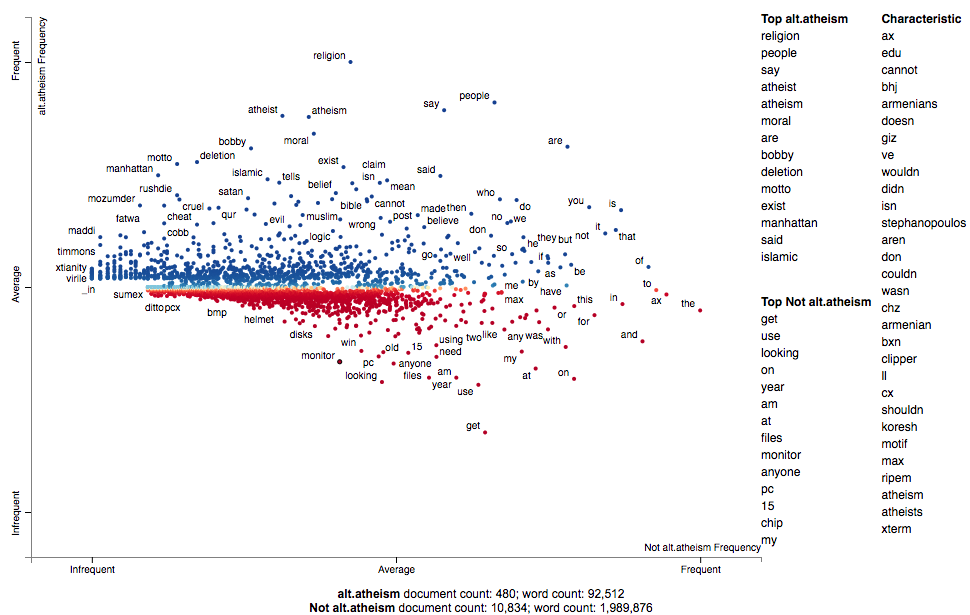](https://jasonkessler.github.io/demo_sklearn.html)
Let's take a look at the performance of the classifier:
```python
newsgroups_test = fetch_20newsgroups(subset='test',
remove=('headers', 'footers', 'quotes'))
X_test = vectorizer.transform(newsgroups_test.data)
pred = clf.predict(X_test)
f1 = f1_score(pred, newsgroups_test.target, average='micro')
print("Microaveraged F1 score", f1)
```
Microaveraged F1 score 0.662108337759. Not bad over a ~0.05 baseline.
### Creating lexicalized semiotic squares
Please see [Signo](http://www.signosemio.com/greimas/semiotic-square.asp) for an
introduction to semiotic squares.
Some variants of the semiotic square-creator are can be seen in this notebook, which studies
words and phrases in headlines that had low or high Facebook engagement and were published by
either BuzzFeed or the New York Times: [http://nbviewer.jupyter.org/github/JasonKessler/PuPPyTalk/blob/master/notebooks/Explore-Headlines.ipynb]
The idea behind the semiotic square is to express the relationship between two opposing
concepts and concepts things within a larger domain of a discourse.
Examples of opposed concepts life or death, male or female, or, in our example, positive or negative sentiment.
Semiotics squares are comprised of four "corners": the upper two corners are the opposing concepts,
while the bottom corners are the negation of the concepts.
Circumscribing the negation of a concept involves finding everything in the
domain of discourse that isn't associated with the concept. For example, in the
life-death opposition, one can consider the universe of discourse to be all
animate beings, real and hypothetical. The not-alive category will cover dead things,
but also hypothetical entities like fictional characters or sentient AIs.
In building lexicalized semiotic squares, we consider concepts to be documents labeled
in a corpus. Documents, in this setting, can belong to one of three categories: two labels corresponding
to the opposing concepts, a neutral category, indicating a document is in the same domain as
the opposition, but cannot fall into one of opposing categories.
In the example below positive and negative movie reviews are treated as the opposing categories,
while plot descriptions of the same movies are treated as the neutral category.
Terms associated with one of the two opposing categories (relative only to the other) are
listed as being associated with that category. Terms associated with a netural category
(e.g., not positive) are terms which are associated with the disjunction of the opposite
category and the neutral category. For example, not-positive terms are those most associated
with the set of negative reviews and plot descriptions vs. positive reviews.
Common terms among adjacent corners of the square are also listed.
An HTML-rendered square is accompanied by a scatter plot. Points on the plot are terms.
The x-axis is the Z-score of the association to one of the opposed concepts. The y-axis
is the Z-score how associated a term is with the neutral set of documents relative to the
opposed set. A point's red-blue color indicate the term's opposed-association, while
the more desaturated a term is, the more it is associated with the neutral set of documents.
```python
import scattertext as st
movie_df = st.SampleCorpora.RottenTomatoes.get_data()
movie_df.category = movie_df.category.apply\
(lambda x: {'rotten': 'Negative', 'fresh': 'Positive', 'plot': 'Plot'}[x])
corpus = st.CorpusFromPandas(
movie_df,
category_col='category',
text_col='text',
nlp=st.whitespace_nlp_with_sentences
).build().get_unigram_corpus()
semiotic_square = st.SemioticSquare(
corpus,
category_a='Positive',
category_b='Negative',
neutral_categories=['Plot'],
scorer=st.RankDifference(),
labels={'not_a_and_not_b': 'Plot Descriptions', 'a_and_b': 'Reviews'}
)
html = st.produce_semiotic_square_explorer(semiotic_square,
category_name='Positive',
not_category_name='Negative',
x_label='Fresh-Rotten',
y_label='Plot-Review',
neutral_category_name='Plot Description',
metadata=movie_df['movie_name'])
```
[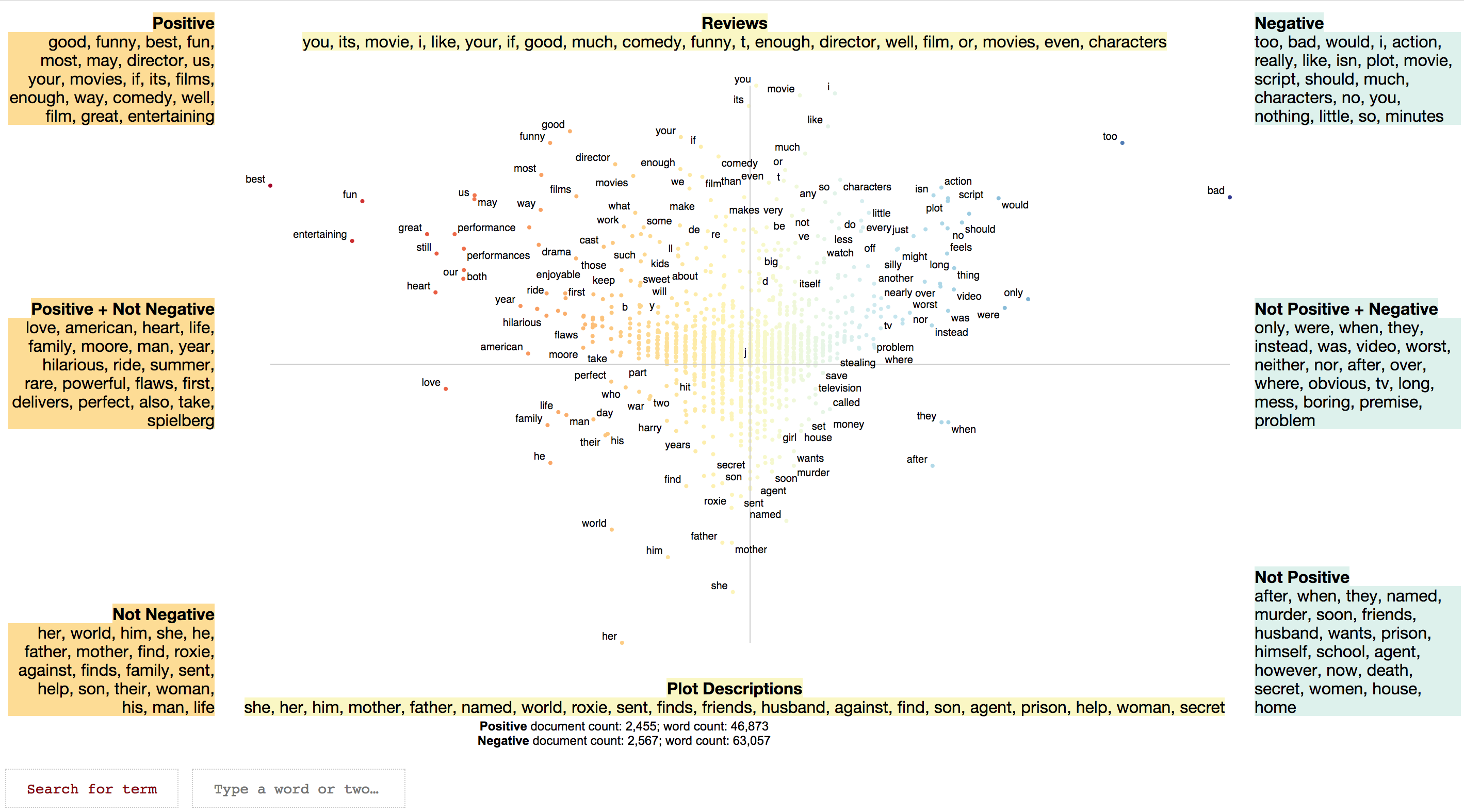](https://jasonkessler.github.io/demo_semiotic.html)
There are a number of other types of semiotic square construction functions.
### Visualizing Topic Models
A frequently requested feature of Scattertext has been the ability to visualize topic
models. While this capability has existed in some forms (e.g., the Empath visualization),
I've finally gotten around to implementing a concise API for such a visualization.
There are three main ways to visualize topic models using Scattertext.
The first is the simplest: manually entering topic models and visualizing them.
The second uses a Scikit-Learn pipeline to produce the topic models for visualization.
The third is a novel topic modeling technique, based on finding terms similar to a
custom set of seed terms.
#### Manually entered topic models
If you have already created a topic model, simply structure it as a dictionary.
This dictionary is keyed on string which serve as topic titles and are displayed
in the main scatterplot. The values are lists of words that belong to that topic. The words
that are in each topic list are bolded when they appear in a snippet.
Note that currently, there is no support for keyword scores.
For example, one might manually the following topic models to explore in the Convention
corpus:
```python
topic_model = {
'money': ['money','bank','banks','finances','financial','loan','dollars','income'],
'jobs':['jobs','workers','labor','employment','worker','employee','job'],
'patriotic':['america','country','flag','americans','patriotism','patriotic'],
'family':['mother','father','mom','dad','sister','brother','grandfather','grandmother','son','daughter']
}
```
We can use the `FeatsFromTopicModel` class to transform this topic model into one which
can be visualized using Scattertext. This is used just like any other feature builder,
and we pass the topic model object into `produce_scattertext_explorer`.
```
import scattertext as st
topic_feature_builder = st.FeatsFromTopicModel(topic_model)
topic_corpus = st.CorpusFromParsedDocuments(
convention_df,
category_col='party',
parsed_col='parse',
feats_from_spacy_doc=topic_feature_builder
).build()
html = st.produce_scattertext_explorer(
topic_corpus,
category='democrat',
category_name='Democratic',
not_category_name='Republican',
width_in_pixels=1000,
metadata=convention_df['speaker'],
use_non_text_features=True,
use_full_doc=True,
pmi_threshold_coefficient=0,
topic_model_term_lists=topic_feature_builder.get_top_model_term_lists()
)
```
[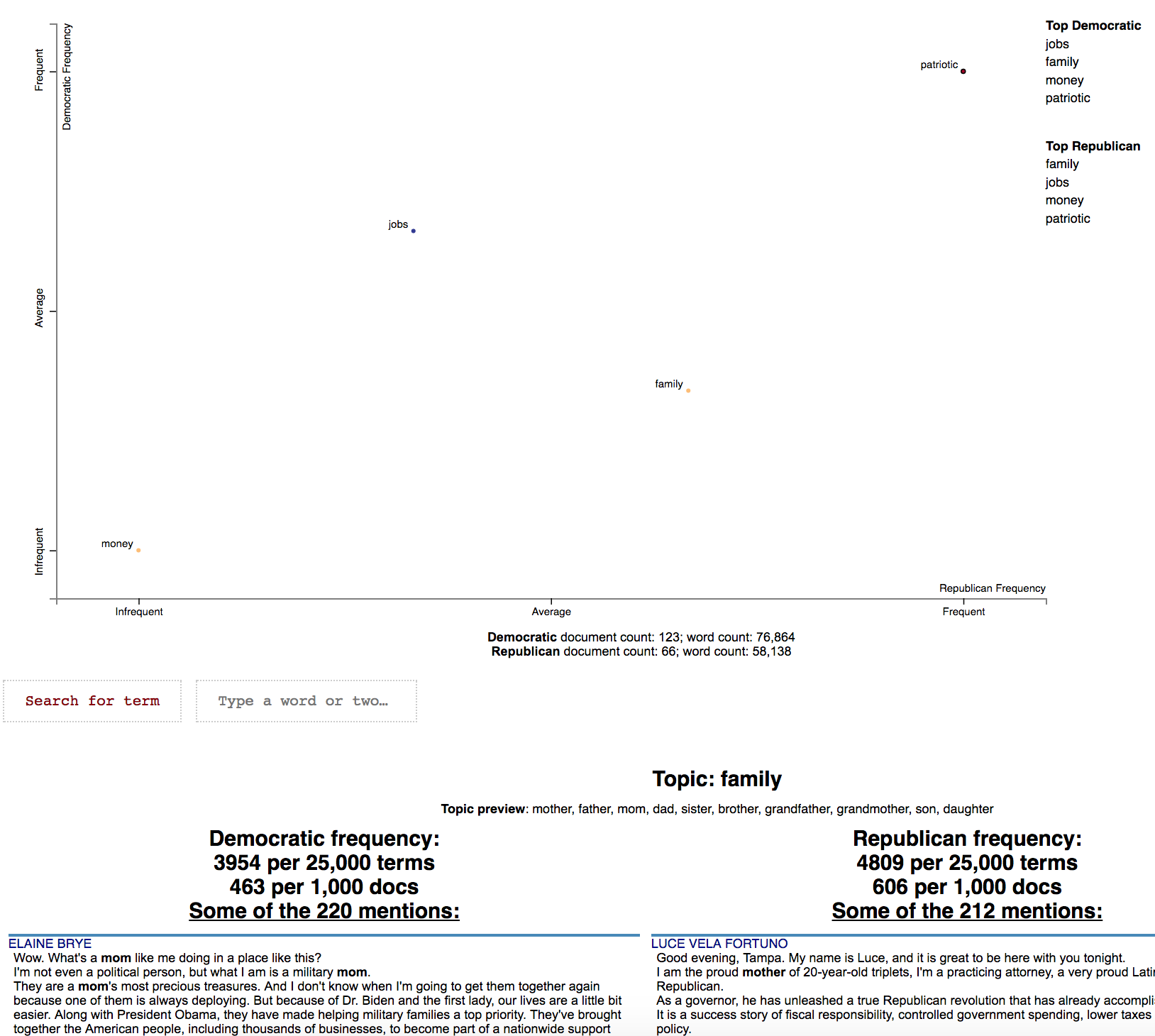](https://jasonkessler.github.io/demo_custom_topic_model.html)
#### Using Scikit-Learn for Topic Modeling
Since topic modeling using document-level coocurence generally produces poor results,
I've added a `SentencesForTopicModeling` class which allows clusterting by coocurence
at the sentence-level. It requires a `ParsedCorpus` object to be passed to its constructor,
and creates a term-sentence matrix internally.
Next, you can create a topic model dictionary like the one above by passing in a Scikit-Learn
clustering or dimensionality reduction pipeline. The only constraint is the last transformer
in the pipeline must populate a `components_` attribute.
The `num_topics_per_term` attribute specifies how many terms should be added to a list.
In the following example, we'll use NMF to cluster a stoplisted, unigram corpus of documents,
and use the topic model dictionary to create a `FeatsFromTopicModel`, just like before.
Note that in `produce_scattertext_explorer`, we make the `topic_model_preview_size` 20 in order to show
a preview of the first 20 terms in the topic in the snippet view as opposed to the default 10.
```python
from sklearn.decomposition import NMF
from sklearn.feature_extraction.text import TfidfTransformer
from sklearn.pipeline import Pipeline
convention_df = st.SampleCorpora.ConventionData2012.get_data()
convention_df['parse'] = convention_df['text'].apply(st.whitespace_nlp_with_sentences)
unigram_corpus = (st.CorpusFromParsedDocuments(convention_df,
category_col='party',
parsed_col='parse')
.build().get_stoplisted_unigram_corpus())
topic_model = st.SentencesForTopicModeling(unigram_corpus).get_topics_from_model(
Pipeline([
('tfidf', TfidfTransformer(sublinear_tf=True)),
('nmf', (NMF(n_components=100, alpha=.1, l1_ratio=.5, random_state=0)))
]),
num_terms_per_topic=20
)
topic_feature_builder = st.FeatsFromTopicModel(topic_model)
topic_corpus = st.CorpusFromParsedDocuments(
convention_df,
category_col='party',
parsed_col='parse',
feats_from_spacy_doc=topic_feature_builder
).build()
html = st.produce_scattertext_explorer(
topic_corpus,
category='democrat',
category_name='Democratic',
not_category_name='Republican',
width_in_pixels=1000,
metadata=convention_df['speaker'],
use_non_text_features=True,
use_full_doc=True,
pmi_threshold_coefficient=0,
topic_model_term_lists=topic_feature_builder.get_top_model_term_lists(),
topic_model_preview_size=20
)
```
[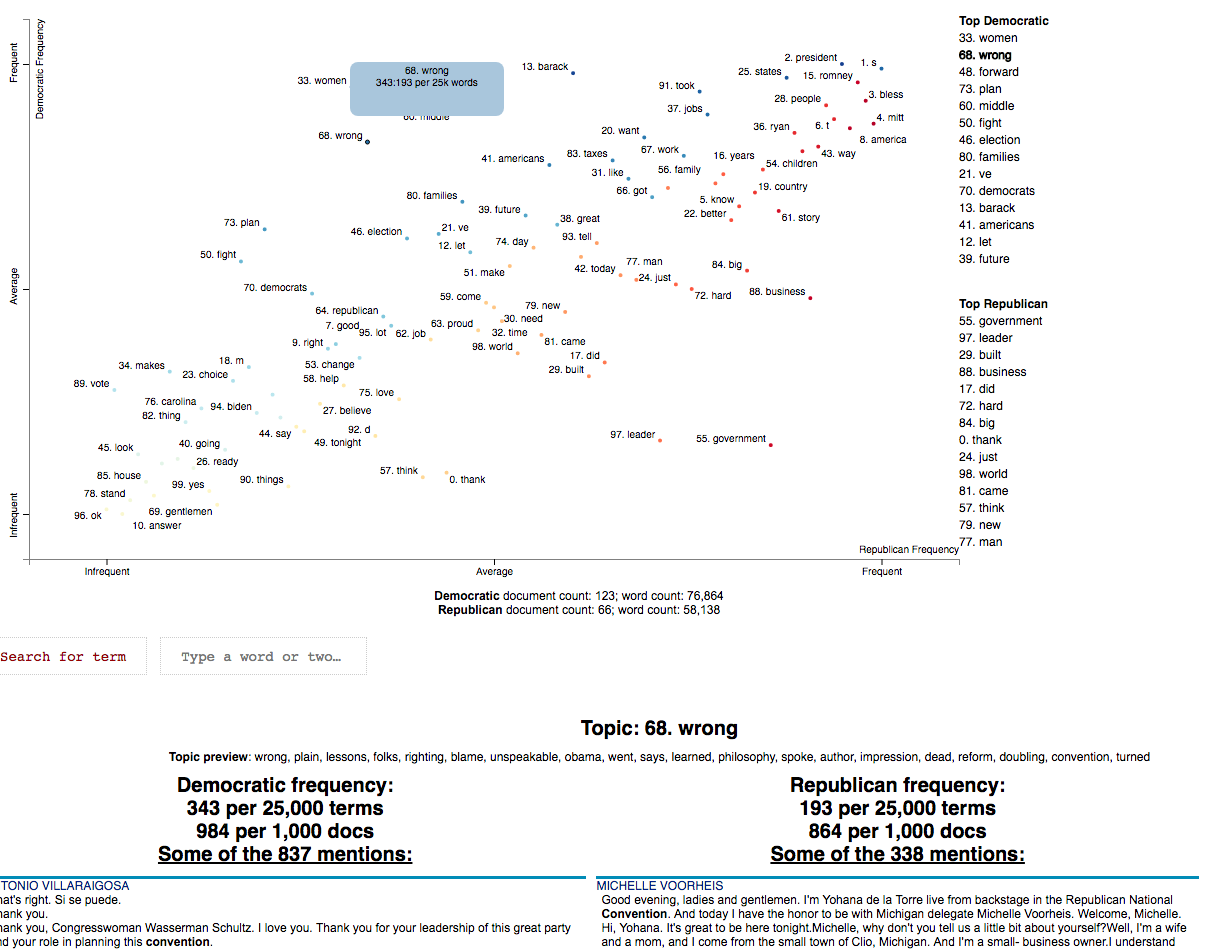](https://jasonkessler.github.io/demo_nmf_topic_model.html)
#### Using a Word List to Generate a Series of Topics
A surprisingly easy way to generate good topic models is to use a term scoring formula
to find words that are associated with sentences where a seed word occurs vs. where
one doesn't occur.
Given a custom term list, the `SentencesForTopicModeling.get_topics_from_terms` will
generate a series of topics. Note that the dense rank difference (`RankDifference`) works
particularly well for this task, and is the default parameter.
```python
term_list = ['obama', 'romney', 'democrats', 'republicans', 'health', 'military', 'taxes',
'education', 'olympics', 'auto', 'iraq', 'iran', 'israel']
unigram_corpus = (st.CorpusFromParsedDocuments(convention_df,
category_col='party',
parsed_col='parse')
.build().get_stoplisted_unigram_corpus())
topic_model = (st.SentencesForTopicModeling(unigram_corpus)
.get_topics_from_terms(term_list,
scorer=st.RankDifference(),
num_terms_per_topic=20))
topic_feature_builder = st.FeatsFromTopicModel(topic_model)
# The remaining code is identical to two examples above. See demo_word_list_topic_model.py
# for the complete example.
```
[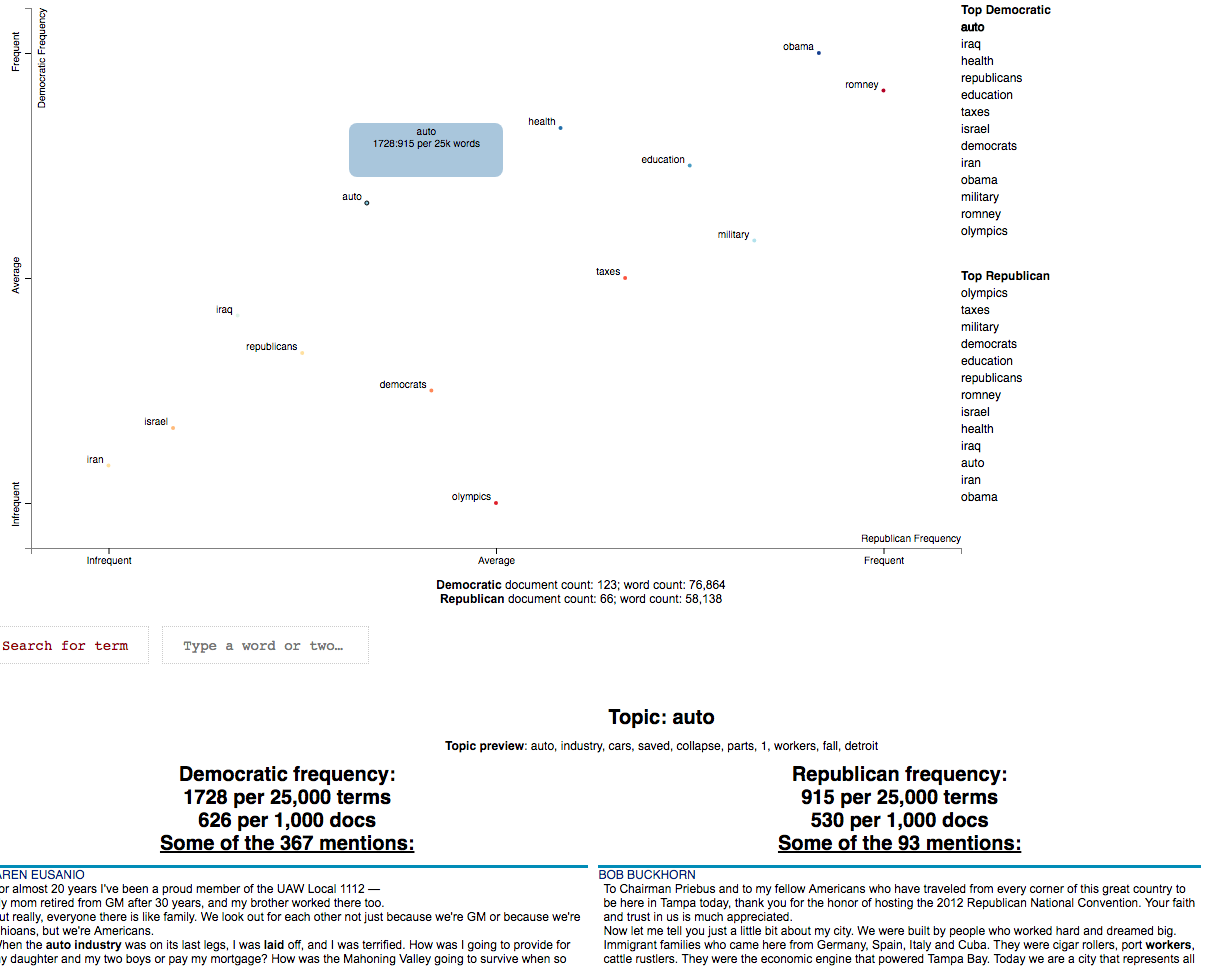](https://jasonkessler.github.io/demo_word_list_topic_model.html)
### Creating T-SNE-style word embedding projection plots
Scattertext makes it easy to create word-similarity plots using projections of word embeddings as the x and y-axes.
In the example below, we create a stop-listed Corpus with only unigram terms. The `produce_projection_explorer` function
by uses Gensim to create word embeddings and then projects them to two dimentions using Uniform Manifold Approximation and Projection (UMAP).
UMAP is chosen over T-SNE because it can employ the cosine similarity between two word vectors instead of just the euclidean distance.
```python
convention_df = st.SampleCorpora.ConventionData2012.get_data()
convention_df['parse'] = convention_df['text'].apply(st.whitespace_nlp_with_sentences)
corpus = (st.CorpusFromParsedDocuments(convention_df, category_col='party', parsed_col='parse')
.build().get_stoplisted_unigram_corpus())
html = st.produce_projection_explorer(corpus, category='democrat', category_name='Democratic',
not_category_name='Republican', metadata=convention_df.speaker)
```
In order to use custom word embedding functions or projection functions, pass models into the `word2vec_model`
and `projection_model` parameters. In order to use T-SNE, for example, use
`projection_model=sklearn.manifold.TSNE()`.
```python
import umap
from gensim.models.word2vec import Word2Vec
html = st.produce_projection_explorer(corpus,
word2vec_model=Word2Vec(size=100, window=5, min_count=10, workers=4),
projection_model=umap.UMAP(min_dist=0.5, metric='cosine'),
category='democrat',
category_name='Democratic',
not_category_name='Republican',
metadata=convention_df.speaker)
```
[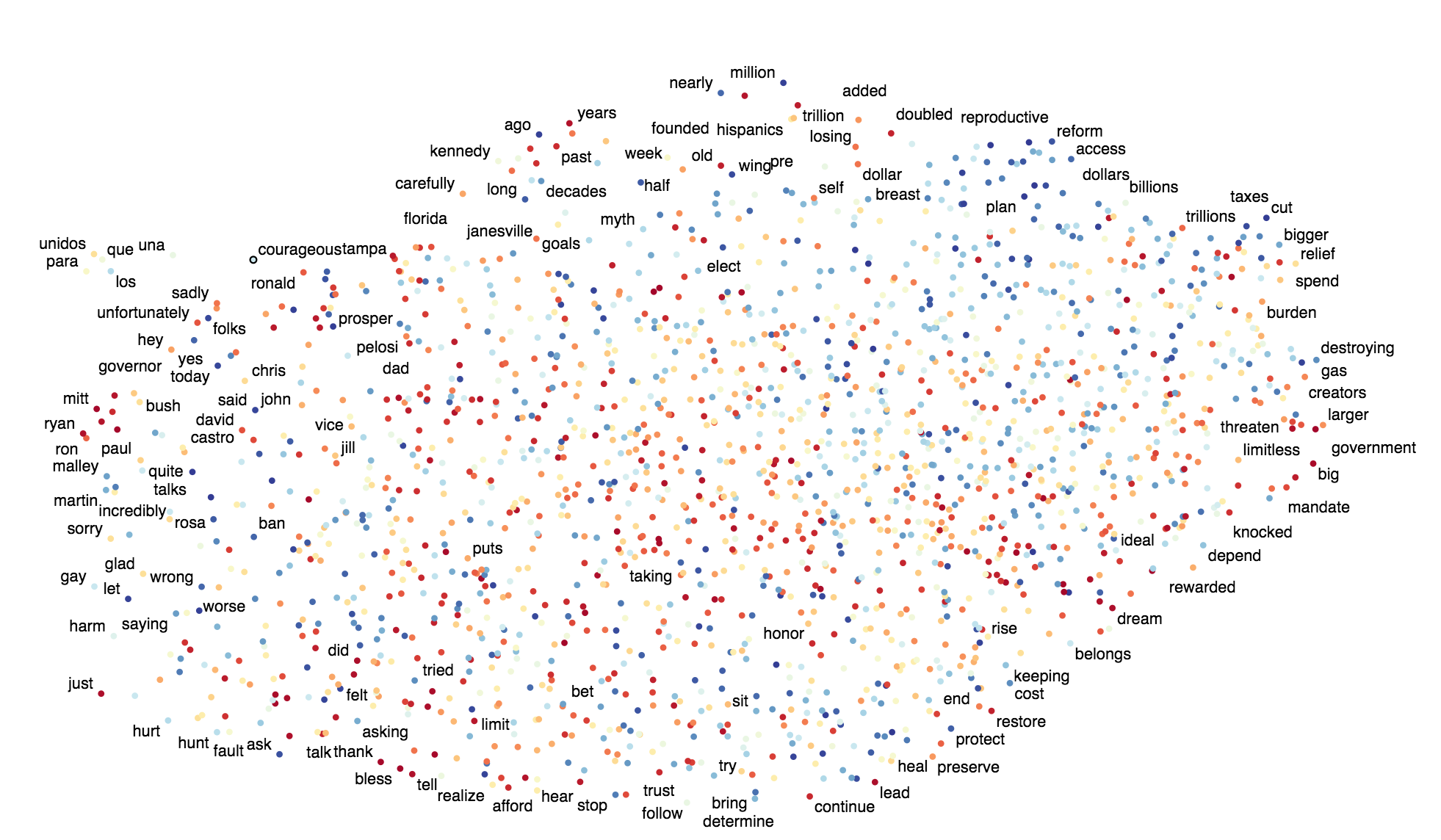](https://jasonkessler.github.io/demo_tsne_style.html)
### Using SVD to visualize any kind of word embeddings
Term positions can also be determined by the positions of terms according to the output of principal component analysis,
and `produce_projection_explorer` also supports this functionality. We'll look at how axes transformations ("scalers"
in Scattertext terminology) can make it easier to inspect the output of PCA.
We'll use the 2012 Conventions corpus for these visualizations. Only unigrams occurring in at least three documents
will be considered.
```pydocstring
>>> convention_df = st.SampleCorpora.ConventionData2012.get_data()
>>> convention_df['parse'] = convention_df['text'].apply(st.whitespace_nlp_with_sentences)
>>> corpus = (st.CorpusFromParsedDocuments(convention_df,
... category_col='party',
... parsed_col='parse')
... .build()
... .get_stoplisted_unigram_corpus()
... .remove_infrequent_words(minimum_term_count=3, term_ranker=st.OncePerDocFrequencyRanker))
```
Next, we use scikit-learn's tf-idf transformer to find very simple, sparse embeddings for all of these words. Since,
we input a #docs x #terms matrix to the transformer, we can transpose it to get a proper term-embeddings matrix, where each row
corresponds to a term, and the columns correspond to document-specific tf-idf scores.
```pydocstring
>>> from sklearn.feature_extraction.text import TfidfTransformer
>>> embeddings = TfidfTransformer().fit_transform(corpus.get_term_doc_mat())
>>> embeddings.shape
(189, 2159)
>>> corpus.get_num_docs(), corpus.get_num_terms()
(189, 2159)
>>> embeddings = embeddings.T
>>> embeddings.shape
(2159, 189)
```
Given these spare embeddings, we can apply sparse singular value decomposition to extract three factors. SVD outputs
factorizes the term embeddings matrix into three matrices, U, , and VT. Importantly, the matrix U provides the singular values
for each term, and VT provides them for each document, and is a vector of the singular values.
```pydocstring
>>> from scipy.sparse.linalg import svds
>>> U, S, VT = svds(embeddings, k = 3, maxiter=20000, which='LM')
>>> U.shape
(2159, 3)
>>> S.shape
(3,)
>>> VT.shape
(3, 189)
```
We'll look at the first two singular values, plotting each term such that the x-axis position is the first singular
value, and the y-axis term is the second. To do this, we make a "projection" data frame, where the `x` and `y`
columns store the first two singular values, and key the data frame on each term. This controls the term positions
on the chart.
```pydocstring
>>> x_dim = 0; y_dim = 1;
>>> projection = pd.DataFrame({'term':corpus.get_terms(),
... 'x':U.T[x_dim],
... 'y':U.T[y_dim]}).set_index('term')
```
We'll use the `produce_pca_explorer` function to visualize these. Note we include the projection object, and specify
which singular values were used for x and y (`x_dim` and `y_dim`) so we they can be labeled in the interactive
visualization.
```pydocstring
html = st.produce_pca_explorer(corpus,
category='democrat',
category_name='Democratic',
not_category_name='Republican',
projection=projection,
metadata=convention_df['speaker'],
width_in_pixels=1000,
x_dim=x_dim,
y_dim=y_dim)
```
Click for an interactive visualization.
[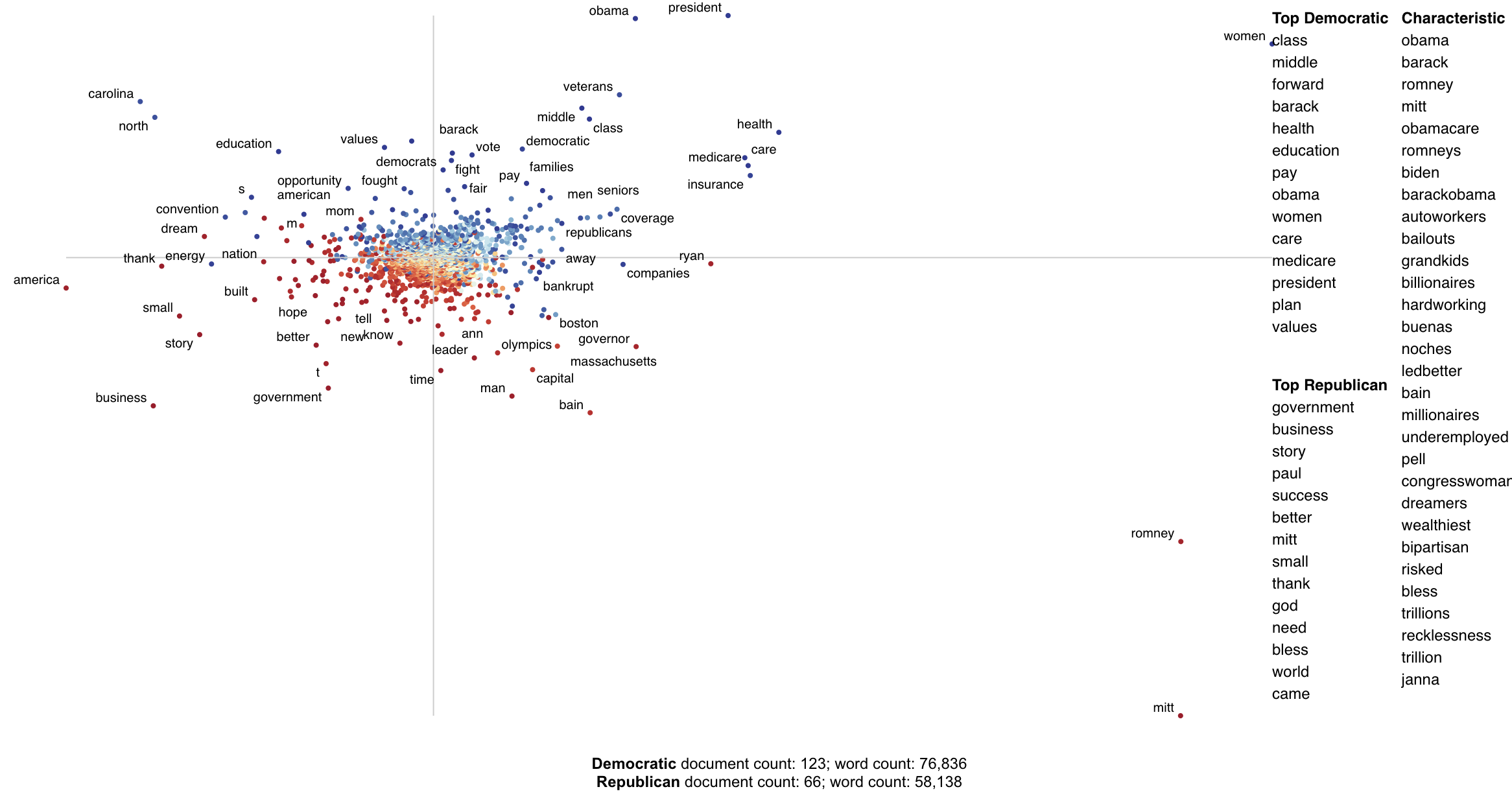](https://jasonkessler.github.io/demo_embeddings_svd_0_1.html)
We can easily re-scale the plot in order to make more efficient use of space. For example, passing in
`scaler=scale_neg_1_to_1_with_zero_mean` will make all four quadrants take equal area.
```pydocstring
html = st.produce_pca_explorer(corpus,
category='democrat',
category_name='Democratic',
not_category_name='Republican',
projection=projection,
metadata=convention_df['speaker'],
width_in_pixels=1000,
scaler=st.scale_neg_1_to_1_with_zero_mean,
x_dim=x_dim,
y_dim=y_dim)
```
Click for an interactive visualization.
[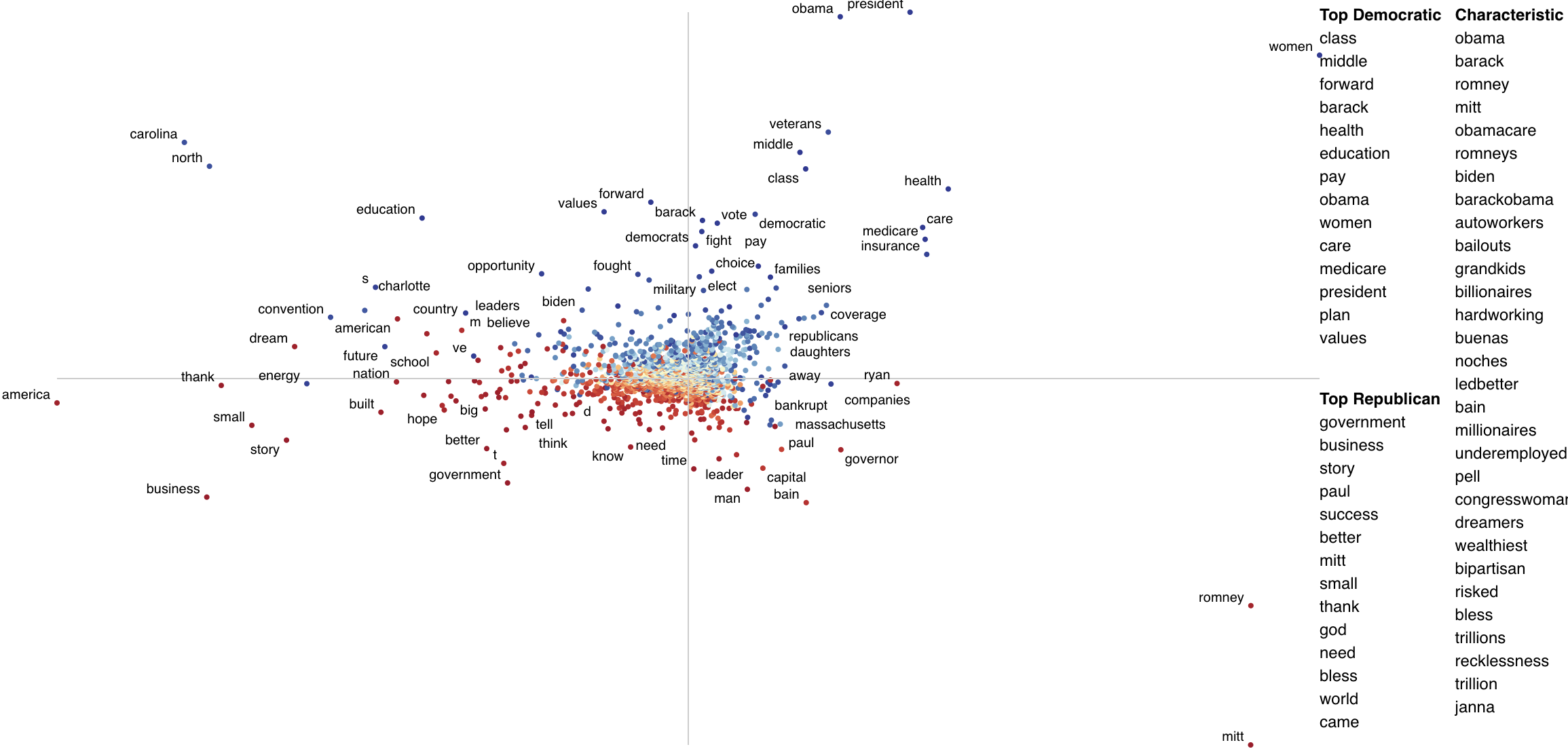](https://jasonkessler.github.io/demo_embeddings_svd_0_1_scale_neg_1_to_1_with_zero_mean.html)
## Examples
Please see the examples in the [PyData 2017 Tutorial](https://github.com/JasonKessler/Scattertext-PyData) on Scattertext.
## A note on chart layout
[Cozy: The Collection Synthesizer](https://github.com/uwplse/cozy) (Loncaric 2016) was used to help determine
which terms could be labeled without overlapping a circle or another label. It automatically built a data structure to efficiently store and query the locations of each circle and labeled term.
The script to build `rectangle-holder.js` was
```
fields ax1 : long, ay1 : long, ax2 : long, ay2 : long
assume ax1 < ax2 and ay1 < ay2
query findMatchingRectangles(bx1 : long, by1 : long, bx2 : long, by2 : long)
assume bx1 < bx2 and by1 < by2
ax1 < bx2 and ax2 > bx1 and ay1 < by2 and ay2 > by1
```
And it was called using
```
$ python2.7 src/main.py