Science Score: 67.0%
This score indicates how likely this project is to be science-related based on various indicators:
-
✓CITATION.cff file
Found CITATION.cff file -
✓codemeta.json file
Found codemeta.json file -
✓.zenodo.json file
Found .zenodo.json file -
✓DOI references
Found 2 DOI reference(s) in README -
✓Academic publication links
Links to: preprints.org, zenodo.org -
○Academic email domains
-
○Institutional organization owner
-
○JOSS paper metadata
-
○Scientific vocabulary similarity
Low similarity (11.4%) to scientific vocabulary
Repository
Sliding SIR Model for Epidemic Modelling
Basic Info
- Host: GitHub
- Owner: shwars
- License: mit
- Language: Jupyter Notebook
- Default Branch: master
- Size: 2.7 MB
Statistics
- Stars: 7
- Watchers: 2
- Forks: 8
- Open Issues: 8
- Releases: 1
Metadata Files
README.md
Sliding SIR Model for Epidemic Modelling
This repository contains code to perform estimation of effective reproductive number Rt of COVID epidemic based on public data. This code accompanies the following publications:
- Petrova, T.; Soshnikov, D.; Grunin, A. Estimation of Time-Dependent Reproduction Number for Global COVID-19 Outbreak. Preprints 2020, 2020060289 (doi: 10.20944/preprints202006.0289.v1).
- Blog post: Sliding SIR Model for Rt Estimation during COVID Pandemic <!-- (on [Towards Data Science][TDS]) -->
Citation
If you use any portion of this code in your research, please cite either this repository, or the following paper:
Petrova, T.; Soshnikov, D.; Grunin, A. Estimation of Time-Dependent Reproduction Number for Global COVID-19 Outbreak. Preprints 2020, 2020060289 (doi: 10.20944/preprints202006.0289.v1).

The code is distributed under MIT License
Running the Code
The easiest way to run the code is to clone the repository in [Azure Notebooks])https://soshnikov.com/azure/8-reasons-why-you-absolutely-need-azure-notebooks/), or use Visual Studio Codespaces to open the code.
 <!-- ?filepath=notebooks%2FSlidingSIR.ipynb -->
Provided Files
notebooks/EpiModelling.ipynbis the notebook that describes the basics of SIR epidemic modelling, and applies our Sliding SIR idea to the epidemic in Moscownotebooks/SlidingSIR.ipynbcontains the code that applies Sliding SIR to many countries based on publicly available data, and ties this to Apple Mobility Indexdatadirectory contains the snapshot of datasets used in our modelling. The code uses online publicly available datasets, but should they become unavailable - you would still be able to test the code with the data provided there
Some Results
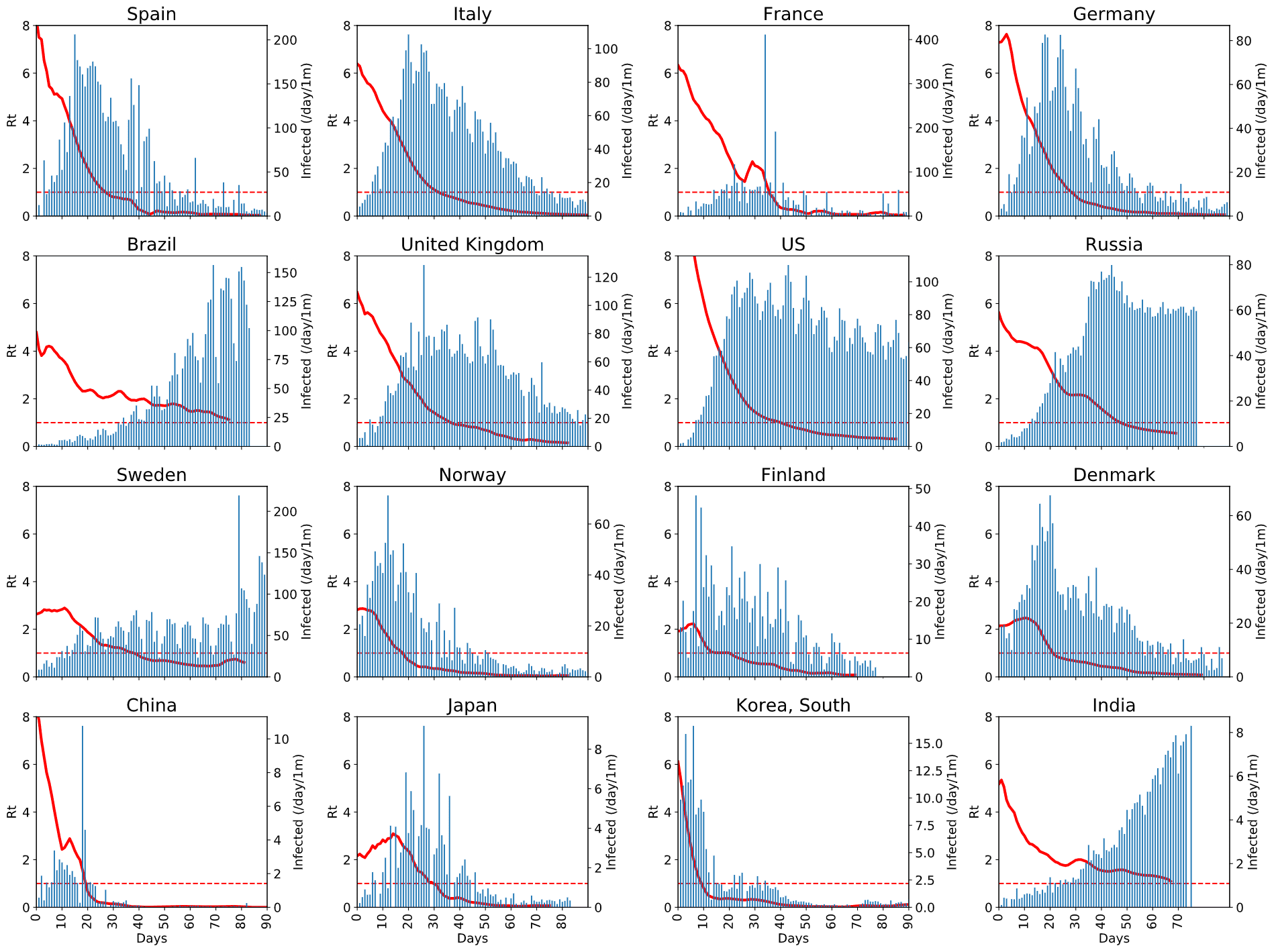
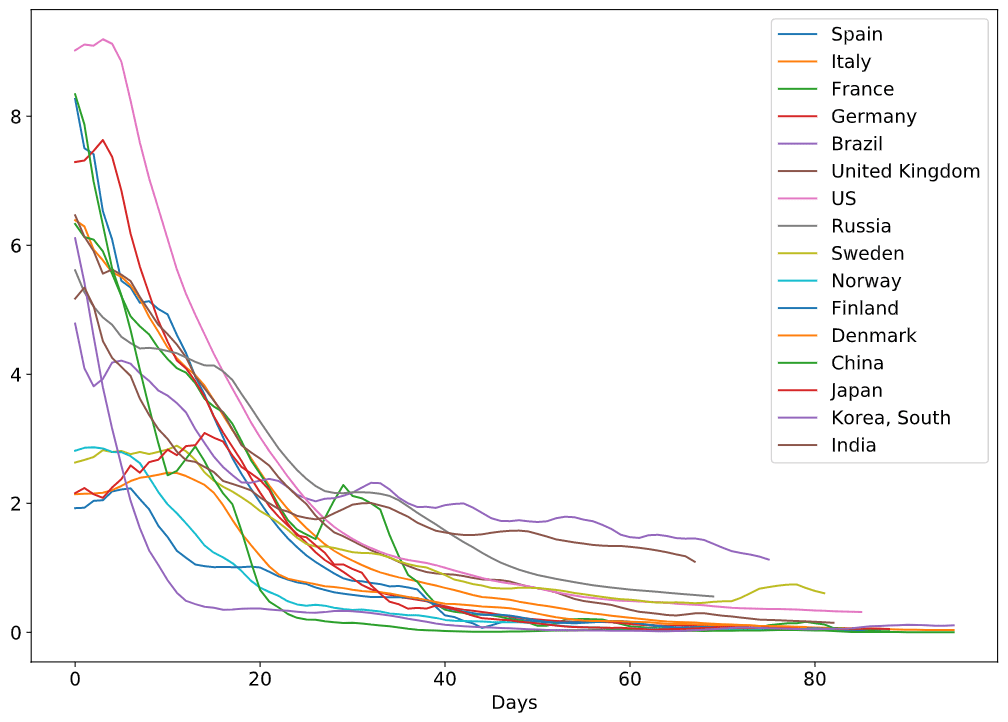
The methodology is described in this blog post or in the paper. Here are a few obtained results:
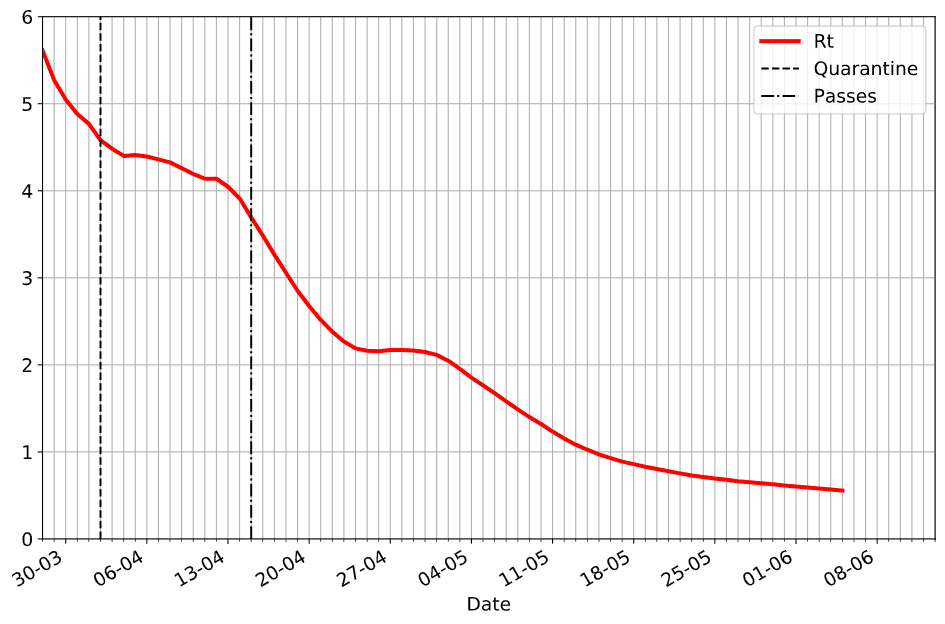
Rt Dynamics in Russia
Rt Dynamics vs. Daily Infected Population Worldwide
Rt Dynamics for Different Countries
Owner
- Name: Dmitri Soshnikov
- Login: shwars
- Kind: user
- Company: Microsoft
- Website: http://soshnikov.com
- Twitter: shwars
- Repositories: 98
- Profile: https://github.com/shwars
Cloud Developer Advocate, formerly SE/Technical Evangelist at Microsoft Russia, Associate Professor at MIPT, HSE and MAI, Co-founder of SHWARSICO and MAILabs
Citation (CITATION.cff)
# YAML 1.2
---
authors:
  -
    family-names: Soshnikov
    given-names: Dmitri
    orcid: "https://orcid.org/0000-0003-1021-091X"
  -
    family-names: Petrova
    given-names: Tatiana
    orcid: "https://orcid.org/0000-0001-5569-145X"
cff-version: "1.1.0"
doi: "10.5281/zenodo.5245225"
license: MIT
message: "If you use the code from this repository, please cite it."
title: "Sliding SIR Model for Epidemic Modelling"
version: "1.0"
...
GitHub Events
Total
Last Year
Dependencies
- matplotlib *
- numpy *
- pandas >=1.0.3
- scipy *