alginate-scaffold-3dprint
Science Score: 44.0%
This score indicates how likely this project is to be science-related based on various indicators:
-
✓CITATION.cff file
Found CITATION.cff file -
✓codemeta.json file
Found codemeta.json file -
✓.zenodo.json file
Found .zenodo.json file -
○DOI references
-
○Academic publication links
-
○Academic email domains
-
○Institutional organization owner
-
○JOSS paper metadata
-
○Scientific vocabulary similarity
Low similarity (8.4%) to scientific vocabulary
Repository
Basic Info
- Host: GitHub
- Owner: mcpvilapouca
- License: gpl-3.0
- Language: Fortran
- Default Branch: main
- Size: 4.92 MB
Statistics
- Stars: 0
- Watchers: 1
- Forks: 0
- Open Issues: 0
- Releases: 0
Metadata Files
README.md
Finite element simulation of the 3D printing of scaffolds
This repository includes a numerical framework for the 3D printing simulation of hydrogel scaffolds. The available .inp files are compatible with ABAQUS finite element software
bash
├── geometry
│   ├──  geometry_meshed.inp   ----->  nodal coordinates, nodal conections, node and element
│   │                                  set and surface definition
├── constitutive model
│   ├── umat_yeoh_visco_m.for  ----->  UMAT file with the visco-hyperelastic constitutive model
│   │                                   (Yeoh model with the generalized maxwell model)
│   ├── PARAM_UMAT.for   ----------->  file with parameters for the UMAT
│   ├── fibers1.inp   -------------->  files to define the 1st family of fibers orientation (currently not in use)
│   ├── fibers2.inp   -------------->  files to define the 2nd family fibers orientation (currently not in use)
├── print_10mmps  ------------------> ABAQUS steps to 'print' at 10mm/s
│   ├── step1.inp
│   ├── step2.inp
│   ├── step3.inp
│   ├── step4.inp
│   ├── step5.inp
├── print_5mmps  ------------------> ABAQUS steps to 'print' at 5mm/s
│   ├── step1.inp
│   ├── step2.inp
│   ├── step3.inp
│   ├── step4.inp
│   ├── step5.inp
└── .gitignore
To run the simulation, add all the files to a directory (choose only one of the printing speeds) and run the steps in sequence, with the commands:
abaqus job=step1 user=umat_yeoh_visco_m.for cpus=cpus_number
wait to finish before running step2
abaqus job=step2 oldjob=step1 user=umat_yeoh_visco_m.for cpus=cpus_number
repeat until step5
Note: the files fibers1.inp and fibers2.inp need to be in the directory although they are not influencing the material model
Geometry and Boundary Conditions
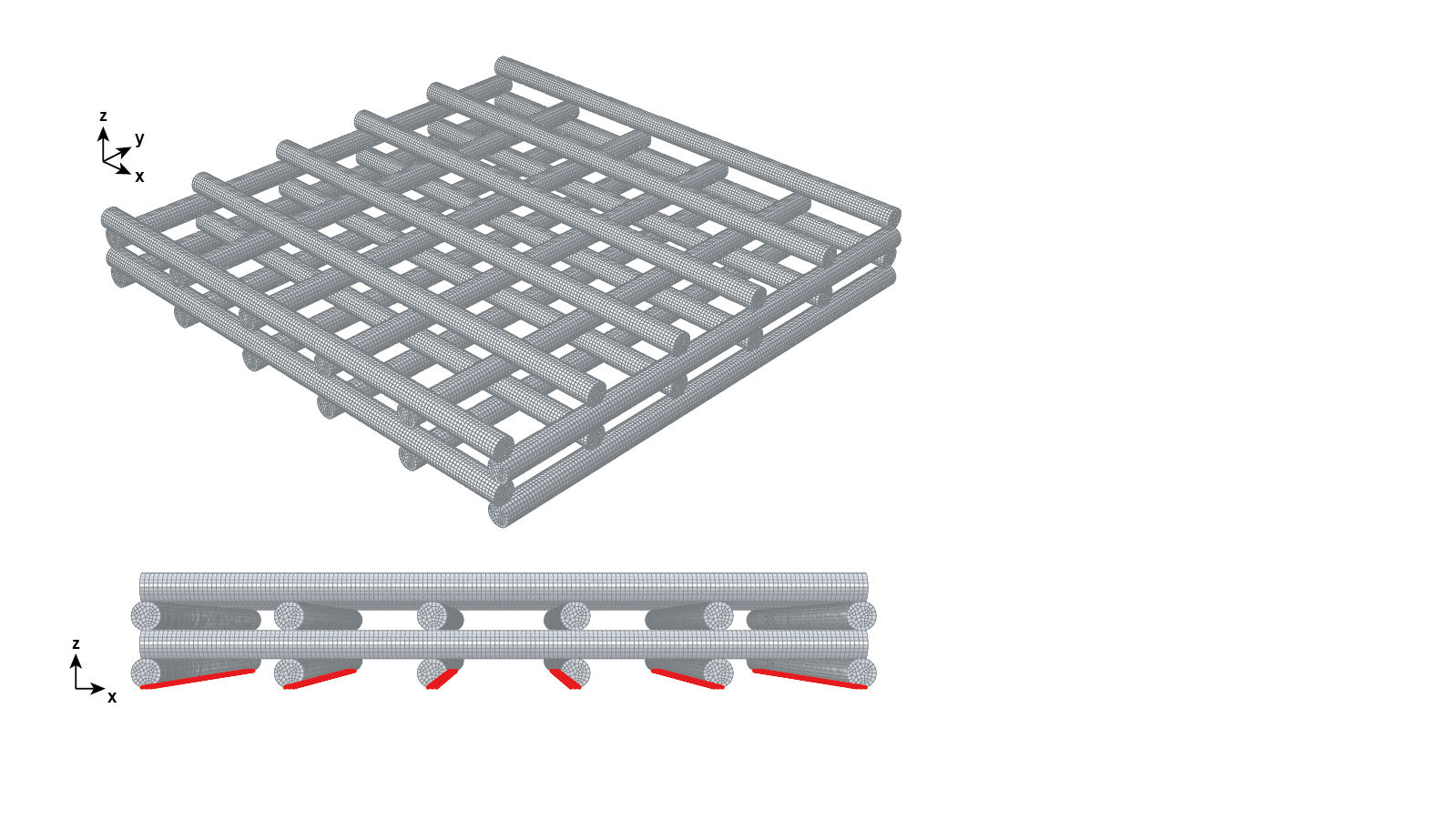
- The geometry represents a 4 layer scaffold, with a filament of 0.2mm, 6 filaments per layer and pore size of 0.8mm. Overall, a 5x5x0.8mm scaffold.
- The mesh includes 2255044 cubic finite elements (C3D8H)
- The nodes in red are fixed in the three directions
3D printing simulation
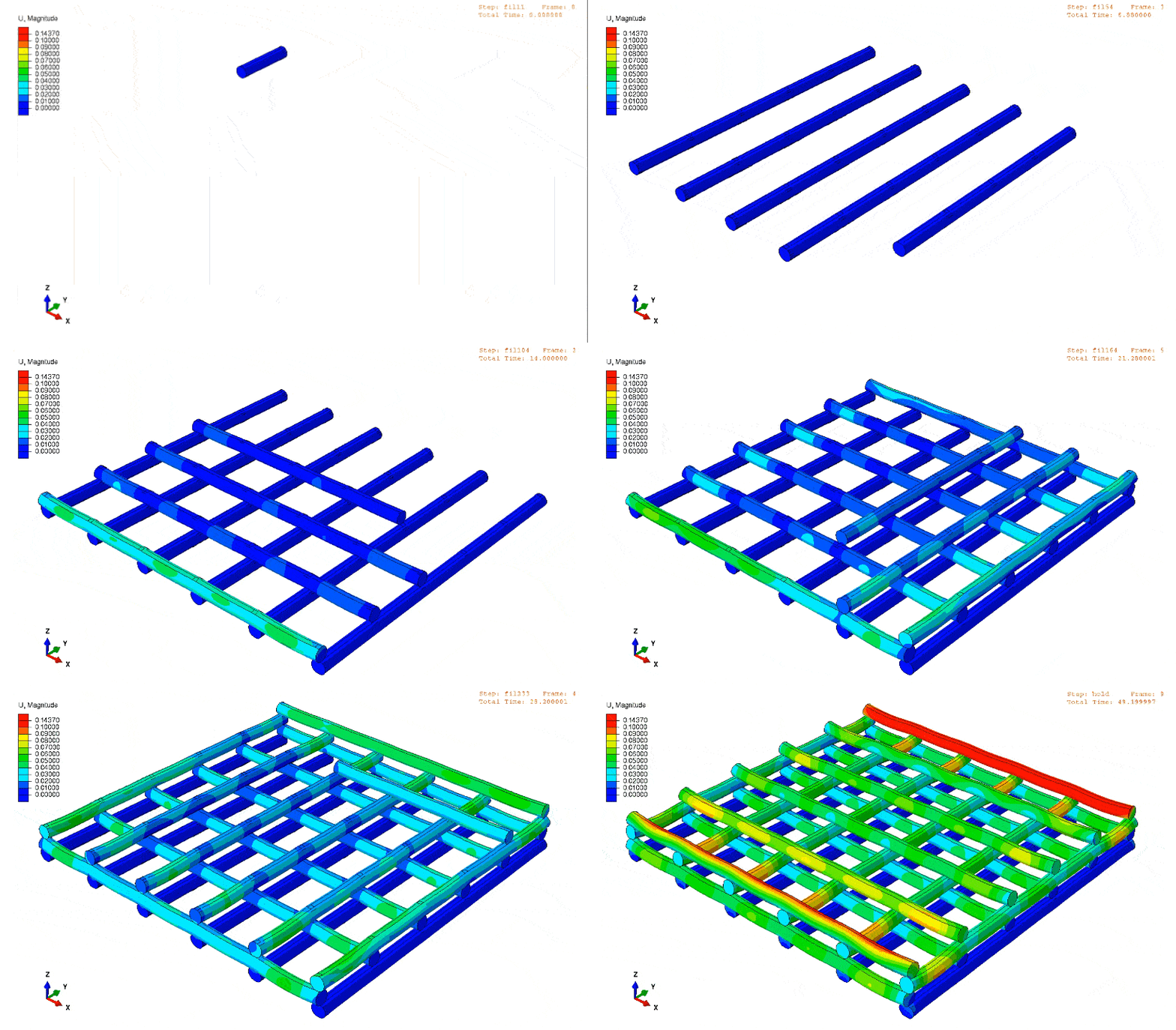
The material deposition is simulated using the ABAQUS *Model Change option, which allows to add element sets during the simulation. We divided each filament into 5 element sets and added each one in a different step. The only considered load is the self-weigh, which actuates almost immedialy after the element deposition.
The printing velocity is defined by the timing of the addition of each filament element section.
This simulation allows to predict the deformations that can arise due to the printing process of bioinks, such as hydrogels. These deformations can be significative and have an impact in the overall mechanical properties of the final configuration. This tool can be used as a predictive tool to choose the best printing speed and printing sequence, in terms of minimizing unwanted deformations.
The submitted files within the folder print10mmps or print5mmps can be easily changed to consider different printing velocities. We hope this tool will facilitate future analysis and can serve as a starting point for researchers, to further improve this work.
🔸 Please, cite this notebook if you use it within your research
Owner
- Name: Maria Vila Pouca
- Login: mcpvilapouca
- Kind: user
- Location: Porto
- Company: INEGI
- Repositories: 4
- Profile: https://github.com/mcpvilapouca
Mechanical Engineer Porto, Portugal
Citation (CITATION.cff)
cff-version: 1.2.0
message: "If you use this framework, please cite it as below."
authors:
- family-names: "Vila Pouca"
  given-names: "Maria"
  orcid: "https://orcid.org/0000-0003-3279-5285"
title: "Finite element framework for the 3D printing of bioink scaffolds"
date-released: 21-10-2022
url: "https://github.com/mcpvilapouca/alginate-scaffold-3Dprint"