self-driving-vehicle
Science Score: 44.0%
This score indicates how likely this project is to be science-related based on various indicators:
-
✓CITATION.cff file
Found CITATION.cff file -
✓codemeta.json file
Found codemeta.json file -
✓.zenodo.json file
Found .zenodo.json file -
○DOI references
-
○Academic publication links
-
○Academic email domains
-
○Institutional organization owner
-
○JOSS paper metadata
-
○Scientific vocabulary similarity
Low similarity (10.7%) to scientific vocabulary
Repository
Basic Info
- Host: GitHub
- Owner: Shreya62002
- License: mit
- Language: Python
- Default Branch: main
- Size: 14.3 MB
Statistics
- Stars: 0
- Watchers: 1
- Forks: 0
- Open Issues: 0
- Releases: 0
Metadata Files
README.md
Self Driving Vehicle
This project focuses on making a model of Self Driving Vehicle using Tabular Reinforcement Learning Techniques.
Description
Make a Reinforcement Learning (RL) Model for highway environment using Q learning.
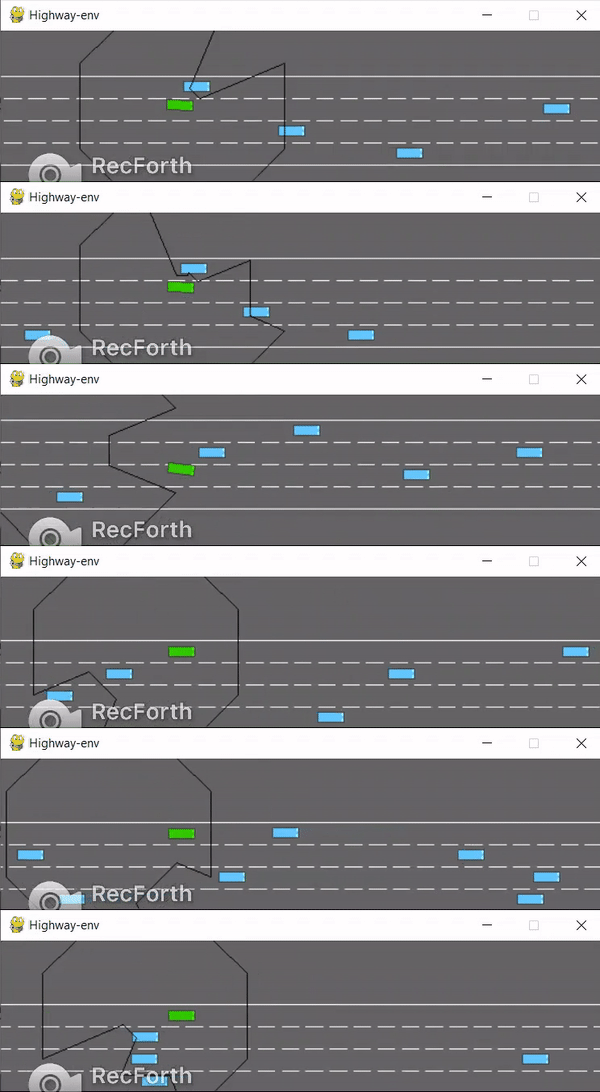
Implementation
Observation Space
We used LiDar observation to measure relative distances of ego vehicle from other vehicles. In this method we don't need separate x,y coordinates and velocities are also not required thus,reducing the state space .Also,this method gives accurate and consistent results.
State Space
All possible states of our environment includes relative distances between ego vehicle and other vehicles and angles or directions where other vehicles are present.This makes our state space too large so to reduce it we :\ 1)Took 16 angles out of which we picked up only 5 to reduce our state space .Took only front and side angles ignoring backward ones as while driving our priority is to avoid collision of our agent car from the ones infront of it.\ 2)Discretized distances by 0.2 to reduce state space .This step is necessary as it is difficult to work on continuous state space (large state space).
Action Space
Discrete Meta Actions
The full corresponding action space is defined in ACTIONS_ALL
ACTIONSALL = {\ 0: 'LANELEFT',\ 1: 'IDLE',\ 2: 'LANE_RIGHT',\ 3: 'FASTER',\ 4: 'SLOWER'\ }\ Out of the 5 available actions we trained our agent using 3 actions(LANE LEFT,IDLE,LANE RIGHT).We are planning to further extend the project using all 5 actions(i.e we will also invlove the role of velocities).
Method Used
Q learning
Q-learning is a model-free, off-policy reinforcement learning that will find the best course of action, given the current state of the agent.Model-free means that the agent uses predictions of the environment’s expected response to move forward. In the Q-Learning algorithm, the goal is to learn iteratively the optimal Q-value function using the Bellman Optimality Equation.
Environment
env =gym.make('highway-v0')
Reward
'collisionreward': -1\ 'lanechangereward': 0\ 'rightlanereward': 0.1\ 'highspeedreward': 0.4\ 'rewardspeed_range': [20, 30]\ Out of these 5 rewards which are defined we used only first 3 rewards in our code.
Graphs
Dependencies
- pip
- gym
- matplotlib
- NumPy # Installation
- Clone this repository
- Navigate to the cloned repository
- Run command $ pip install -e ./
Owner
- Name: Shreya Gupta
- Login: Shreya62002
- Kind: user
- Repositories: 3
- Profile: https://github.com/Shreya62002
Citation (CITATION.cff)
cff-version: 1.2.0
message: "If you use this software, please cite it as below."
authors:
- family-names: "Leurent"
  given-names: "Edouard"
title: "An Environment for Autonomous Driving Decision-Making"
version: 1.4
date-released: 2018-05-01
url: "https://github.com/eleurent/highway-env"
GitHub Events
Total
Last Year
Dependencies
- gym *
- jupyter-sphinx *
- matplotlib *
- numpy *
- pandas *
- pygame *
- pygments ==2.4.1
- pytest *
- scipy *
- sphinx_rtd_theme *
- sphinxcontrib-bibtex <2.0.0