lammpsstructures
Creating elastic structures using LAMMPS
Science Score: 54.0%
This score indicates how likely this project is to be science-related based on various indicators:
-
✓CITATION.cff file
Found CITATION.cff file -
✓codemeta.json file
Found codemeta.json file -
✓.zenodo.json file
Found .zenodo.json file -
○DOI references
-
✓Academic publication links
Links to: arxiv.org, rsc.org -
○Academic email domains
-
○Institutional organization owner
-
○JOSS paper metadata
-
○Scientific vocabulary similarity
Low similarity (11.1%) to scientific vocabulary
Repository
Creating elastic structures using LAMMPS
Basic Info
- Host: GitHub
- Owner: adguerra
- Language: Python
- Default Branch: main
- Size: 69.6 MB
Statistics
- Stars: 10
- Watchers: 1
- Forks: 3
- Open Issues: 0
- Releases: 0
Metadata Files
README.md
LAMMPSStructures
Intro
The goal of this repository is to document and provide some examples for a python package which facilitates the use of LAMMPS as a simulation tool for elastic materials. This python package does not simulate things on its own, rather, it contains a class and functions that allow you to write a set of files which can then be run with LAMMPS.
Elastic structures are traditionally simulated using a finite element software, which has the benefit that it can model complex geometries. However, often these softwares have a very hard time modeling contact and other complex boundary conditions. For some examples, when roots dig into soil, when cells jam on the surface of the Extra-Cellular Matrix, or when birds build a nest, there is a coupling either between many elastic bodies in contact, or between granular and elastic materials. These would all be very hard to simulate using a finite element software.
On the other hand, LAMMPS, a Discrete Element simulation software, is excellent at handling contact at the expense of geometrical complexity -- almost everything is treated as a sphere. In a couple of recent papers [1,2,3,4,5], I and others have shown that it is possible to get the best of both worlds. By "gluing" spheres together to form some simple geometries that can be endowed with elastic properties, we can have contact and elasticity in the same simulation. This repository, I hope, should contain everything you need to start doing this yourself.
Brief Tour
We have three main directories in this repo:
lammps_pypack: This contains the python package that we will use to make the files that will allow us to simulate elastic and granular materialsexamples: These are some examples of this package being used in action. Some of these examples are systems that we have studied in specific publications, but others are just examples that we thought would be intersting for future study, or which display the capacity of this tool.validation: Here there are some simulations which we validate either theoretically or against other simulations in COMSOL. This directory is comparatively scant, just because we have also performed validation as part of some of the studies cited earlier which use this tool 1,2,3,4,5
There are also some files which you might find useful:
Documentation.md: A brief description of all of the functions available in thelammpsWithPython.lammps_objecttool. More thorough descriptions are given in the actual function definitionsCITATION.cff: You can cite this if you use this tool in an academic setting. If you use simulations that are similar to any of the simulations in these publications 1,2,3,4,5, then cite the publication as well.
## How to use this tool
To begin to use this tool, clone this repository and pip install lammpsWithPython from within the lammps_pypack folder. You can then run an example file, or make a new file which sets up some simulation that you make.
Any time you use this tool, it will create a new folder with a name that you specify, and within that folder, it will write some files that LAMMPS will need to run a simulation. It will always write a file called in.main_file, which is the main input LAMMPS file that you will eventually run. This sets up the simulation, determines the dimensionality and size of your simulation box, etc. The tool may also create some secondary files which will be accessed by in.main_file. For example, if you want to insert a grain (a sphere) in your simulation box, you will call the add_grains command, and input to that command, among other things, the coordinates of those grains. When you do that, a new file will be written, called grains_*.txt where the asterisk is some integer (namely, 1 if this is the first time you have inserted grains, 2 if it is the second, etc.). Calling the add_grains command also writes a line to in.main_file (include grains_*.txt) which makes LAMMPS look in the grains_*.txt file for the locations of the grains. You therefore have to keep all of these files together, which is why they are all written together in a new folder every time you use the tool.
This multiple files business may seem complicated at first, but I hope that after you use this tool a couple of times, you'll appreciate that it creates a cleaner version of in.main_file, since long lists of particles and bonds are stored in other files.
To run the in.main_file of any of these simulations, you will first need to download and install LAMMPS. Once you have LAMMPS installed, you can go into the folder which contains in.main_file and input it to LAMMPS (something like lmp_serial -i in.main_file, this will depend on how lammps is built on your machine). This tool is currently set to run with the LAMMPS version which was released on June 23, 2022, and so if something doesn't work, let me know and I can try to adjust it! Or adjust it yourself (thats what Git is for right??).
Some Other Examples
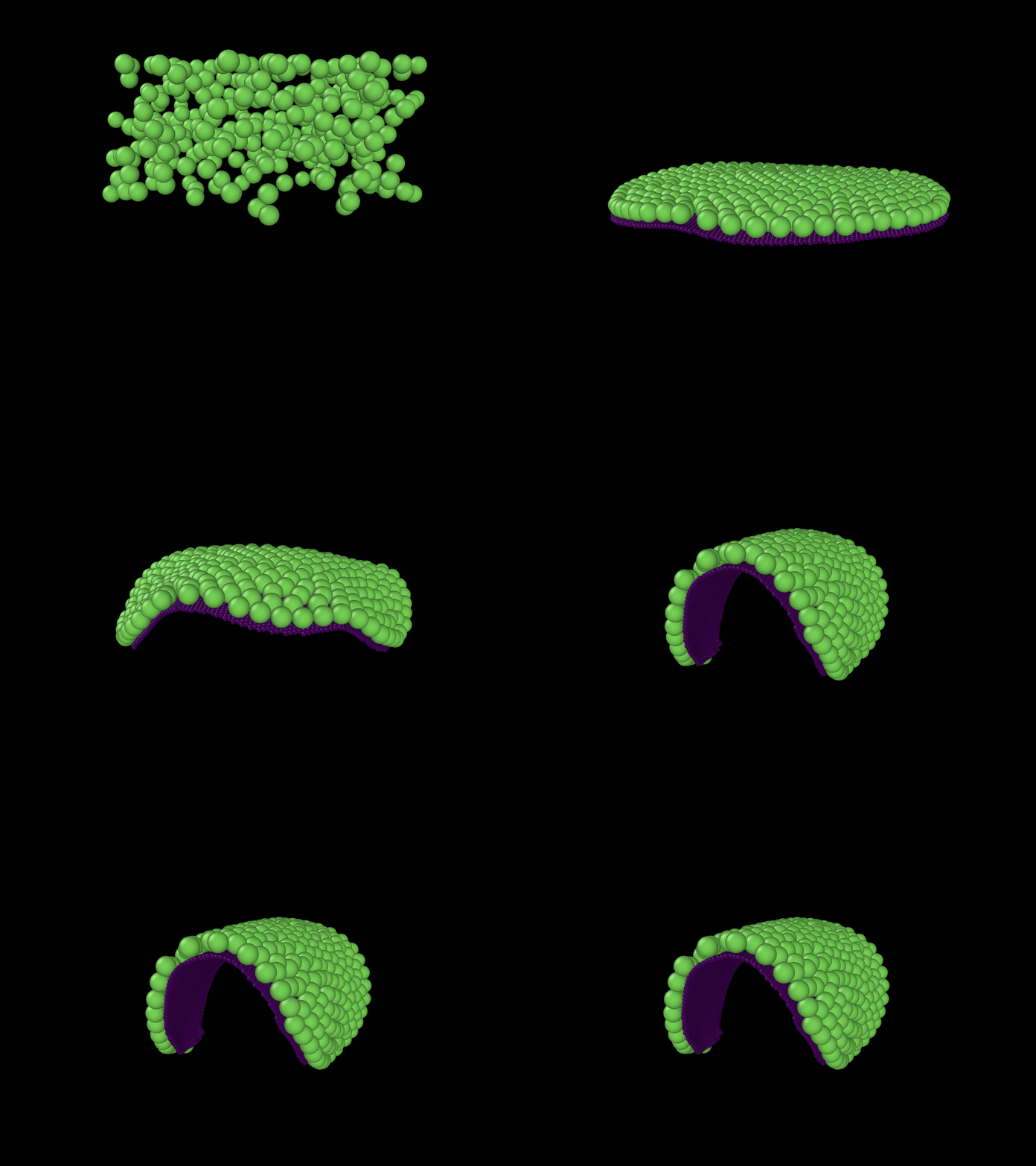
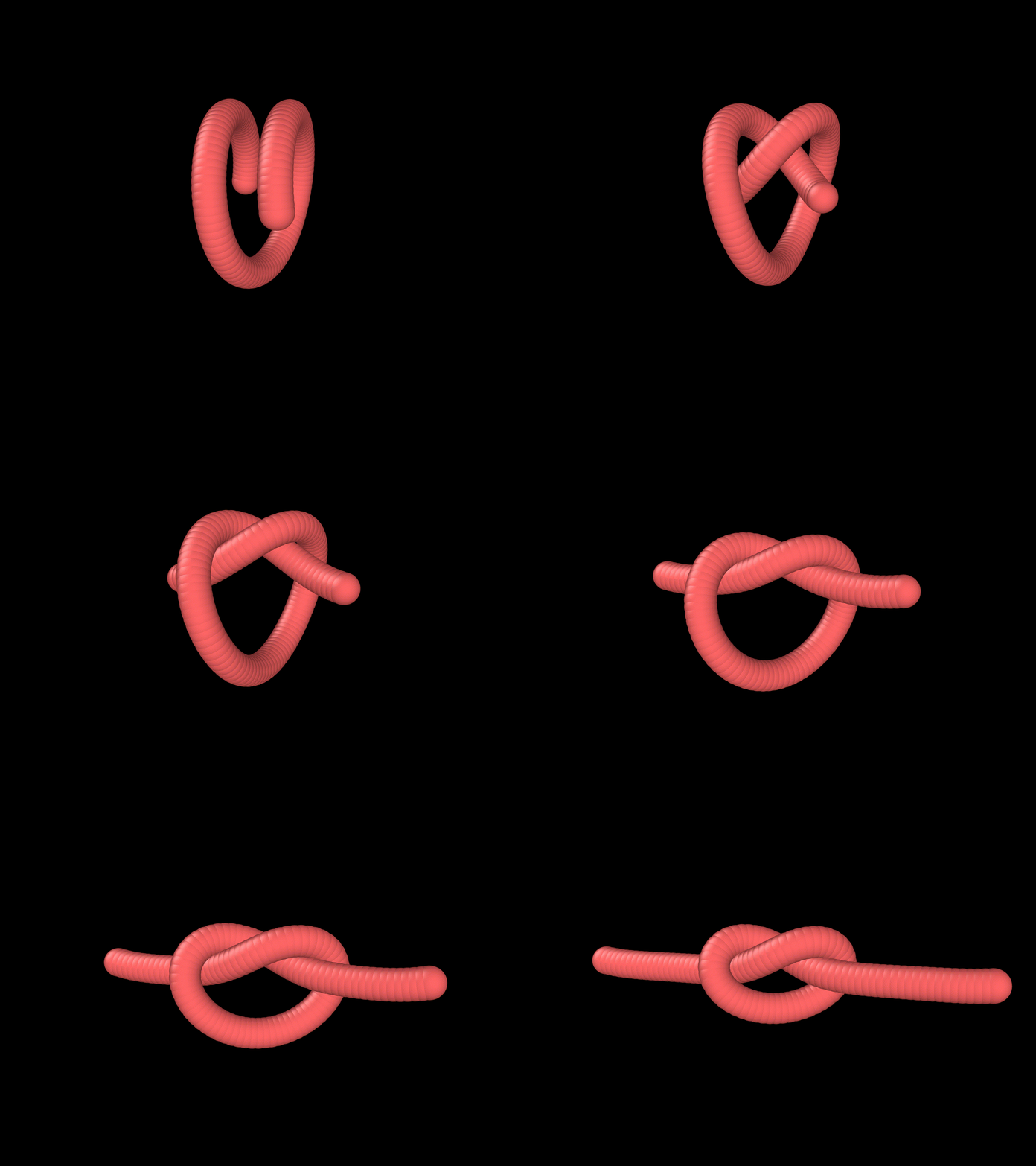
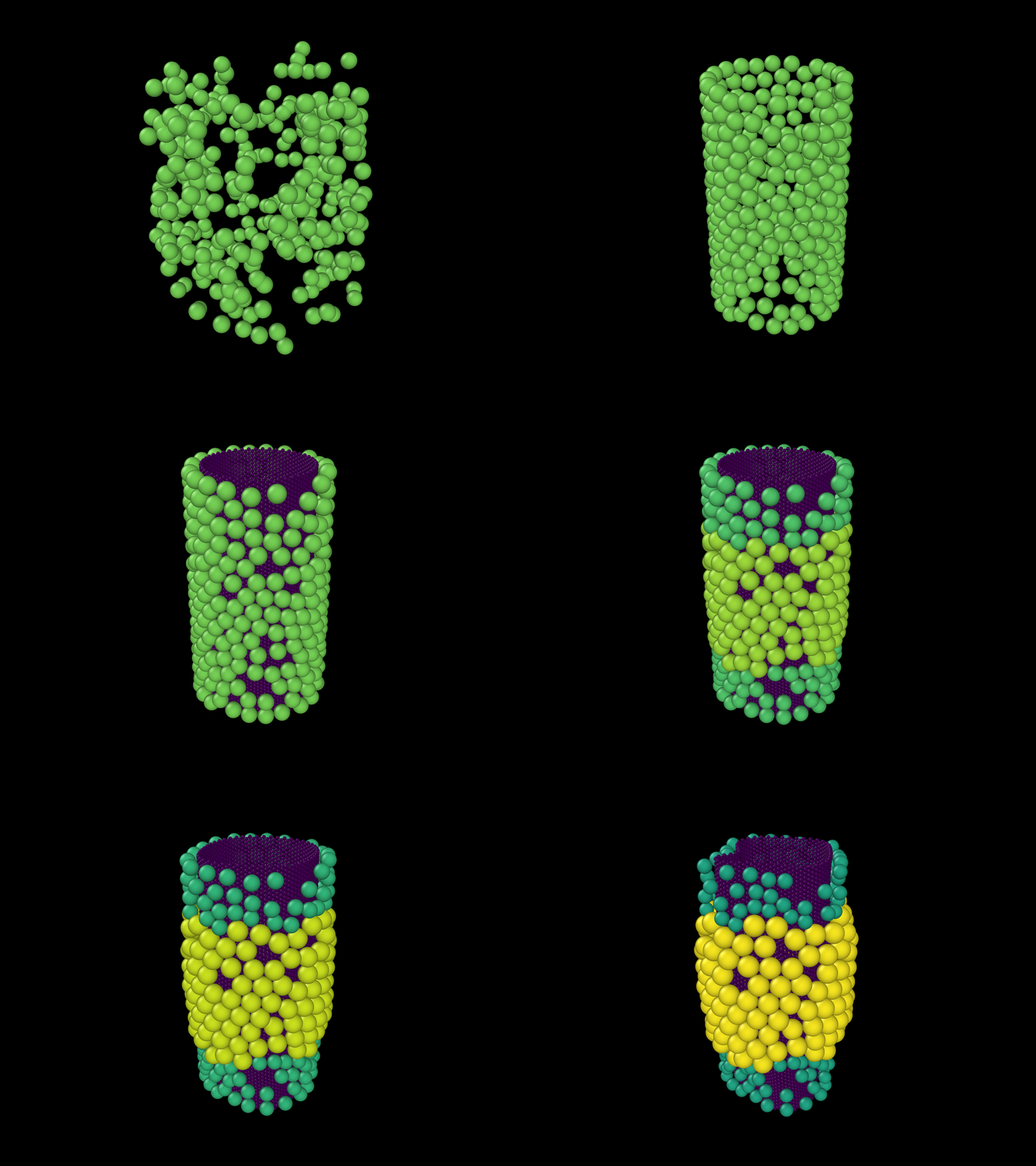
These examples show some simulations that I do not have examples of here, but that I thought were cool.
"Cells" growing on a manifold
Simulation of a knot
Frustrated growth on a cylinder
Citation (CITATION.cff)
# This CITATION.cff file was generated with cffinit.
# Visit https://bit.ly/cffinit to generate yours today!

cff-version: 1.2.0
title: LAMMPSStructures
message: >-
  If you use this software, please cite it using the
  metadata from this file.
type: software
authors:
  - given-names: Arman
    family-names: Guerra
    email: adguerra@bu.edu
    affiliation: Boston University
    orcid: 'https://orcid.org/0000-0001-7813-4955'
date-released: '2022-04-22'
GitHub Events
Total
- Watch event: 3
Last Year
- Watch event: 3