Recan
Recan: Python tool for analysis of recombination events in viral genomes - Published in JOSS (2020)
Science Score: 93.0%
This score indicates how likely this project is to be science-related based on various indicators:
-
○CITATION.cff file
-
✓codemeta.json file
Found codemeta.json file -
✓.zenodo.json file
Found .zenodo.json file -
✓DOI references
Found 23 DOI reference(s) in README and JOSS metadata -
✓Academic publication links
Links to: joss.theoj.org -
○Committers with academic emails
-
○Institutional organization owner
-
✓JOSS paper metadata
Published in Journal of Open Source Software
Keywords
Repository
genetic distance plotting for recombination events analysis
Basic Info
Statistics
- Stars: 10
- Watchers: 0
- Forks: 7
- Open Issues: 0
- Releases: 7
Topics
Metadata Files
README.md


Recan
recan [9] is a Python package which allows to construct genetic distance plots to explore and discover recombination events in viral genomes. This method has been previously implemented in desktop software tools: RAT[1], Simplot[2] and RDP4 [8].
Recan web version
Recan django-based web version is currently under development https://github.com/babinyurii/recan_gui
It is available at: http://yuriyb.pythonanywhere.com/
Requirements
To use recan, you will need:
- Python 3
- Biopython
- plotly
- pandas
- Jupyter notebook
Intallation
To install the package via pip run :
$ pip install recan
If you are going to use recan in JupyterLab, follow the insctructions to install the Jupyter Lab Plotly renderer
Usage example
The package is intended to be used in Jupyter notebook.
Import Simgen class from the recan package:
python
from recan.simgen import Simgen
create an object of the Simgen class. To initialize the object pass your alignment in fasta format as an argument:
python
sim_obj = Simgen("./datasets/hbv_C_Bj_Ba.fasta")
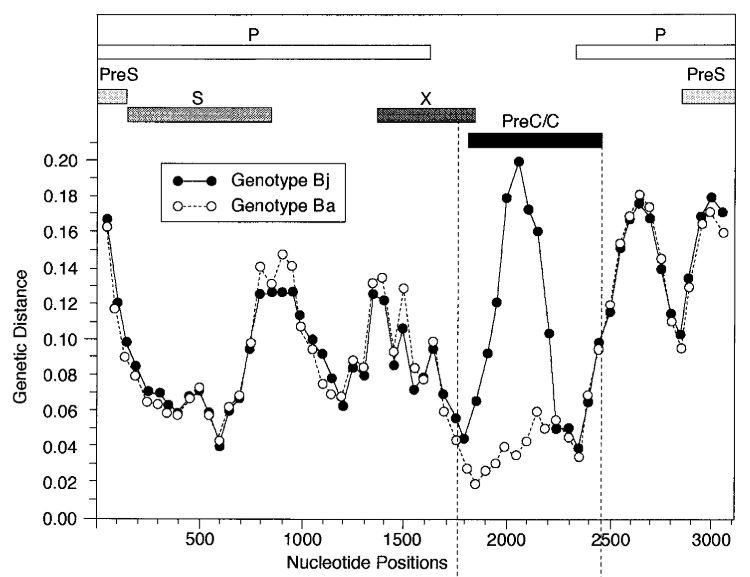
The input data are taken from the article by Sugauchi et al.(2002). This paper describes recombination event observed in hepatitis B virus isolates.
The object of the Simgen class has method get_info() which shows information about the alignment.
python
sim_obj.get_info()
index:  sequence id:
0   AB048704.1_genotype_C_
1   AB033555.1_Ba
2   AB010291.1_Bj
alignment length:  3215
We have three sequences in our alignment. Simgen class is based upon the MultipleSequenceAlignment class of the Biopython library. So, we treat our alignment as the array with nsamples and nfeatures, where 'samples' are sequences themselves, and the features are columns of nucleotides in the alignment. Index corresponds to the sequence. Note, that indices start with 0.
After you've created the object you can draw the similarity plot.
Call the method simgen() of the Simgen object to draw the plot. Pass the following parameters to the method:
- window: sliding window size. The number of nucleotides the sliding window will span. It has the value of 500 by default.
- shift: this is the step our window slides downstream the alignment. It's value is set to 250 by default
- pot_rec: the index of the potential recombinant. All the other sequences will be plotted as function of distance to that sequence. Use method get_info() to get the indices, especially if your alignment has many sequences.
The isolate of Ba genotype is the recombinant between the virus of C genotype and genotype Bj. Let's plot it. We set genotype Ba as the potential recombinant :
python
sim_obj.simgen(window=200, shift=50, pot_rec=1)
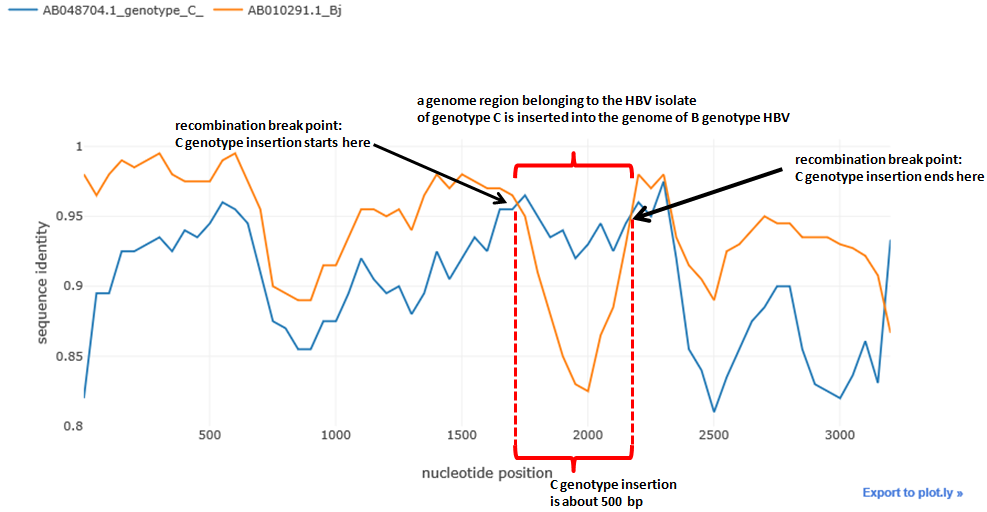
Potential recombinant is not shown in the plot, as the distances are calculated relative to it. The higher is the distance function (i.e. the closer to 1), the closer is the sequence to the recombinant and vice versa.
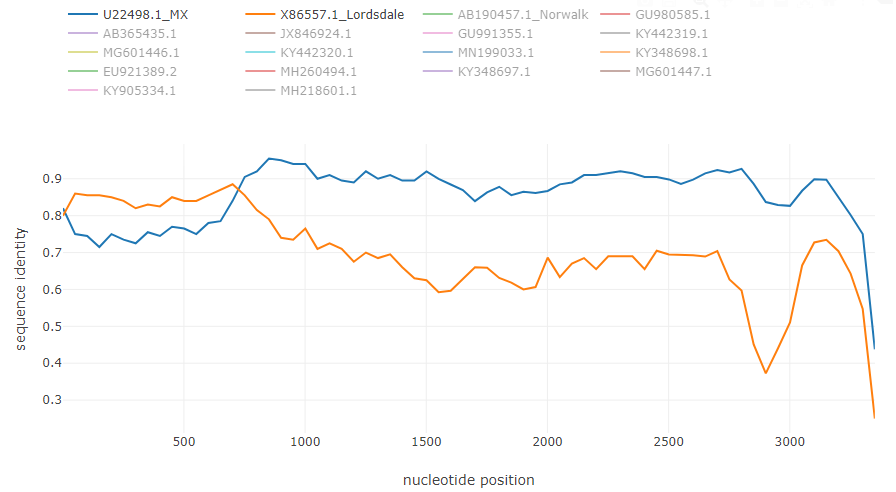
We can see typical 'crossover' of the distances which is the indicator of the possible recombination event. The distance of one isolate 'drops down' whereas the distance of the other remains the same of even gets closer to the potential recombinant, this abrupt drop shows that recombination could take place.
The picture from the article is shown below. It's just turned upside down relative to our plot, and instead of distance drop we see distance rising. Here Bj 'goes away' from the genotype C, whereas Ba keeps the same distance
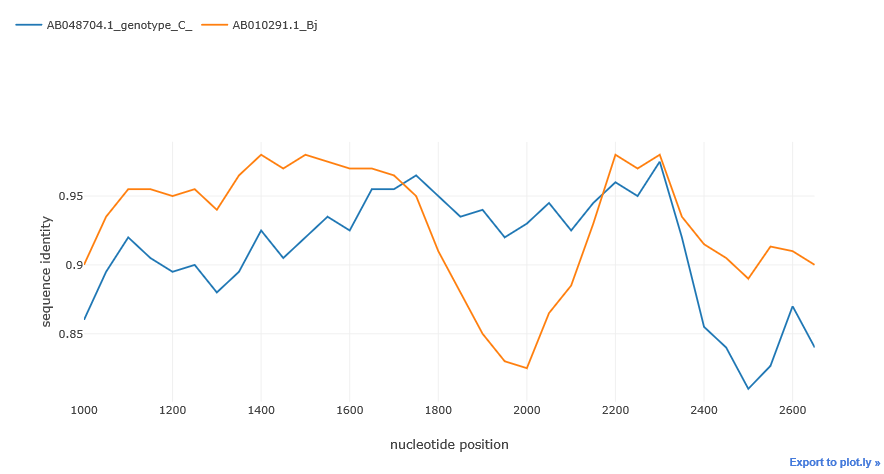
By default simgen() method plots the whole alignment. But after initial exploration, we can take a closer look at a particular region by passing the region parameter to the simgen method. We can slice the alignment by using this parameter. region must be a tuple or a list with two integers: the start and the end position of the alignment slice.
python
region = (start, end)
python
sim_obj.simgen(window=200, shift=50, pot_rec=1, region=(1000, 2700))
To customize the plot or just to export and store the data, use get_data() method. get_data() returns pandas DataFrame object with sequences as samples, and distances at given points as features.
python
sim_obj.get_data()

If optional paremeter df is set to False, get_data() returns a tuple containing list of ticks and a dictionary of lists. Each dictionary key is the sequence id, and lists under the keys contain the corresponding distances.
python
positions, data = sim_obj.get_data(df=False)
```
print(positions)
[1050, 1100, 1150, 1200, 1250, 1300, 1350, 1400, 1450, 1500, 1550, 1600, 1650, 1700, 1750, 1800, 1850, 1900, 1950, 2000, 2050, 2100, 2150, 2200, 2250, 2300, 2350, 2400, 2450, 2500, 2550, 2600, 2650, 2700]
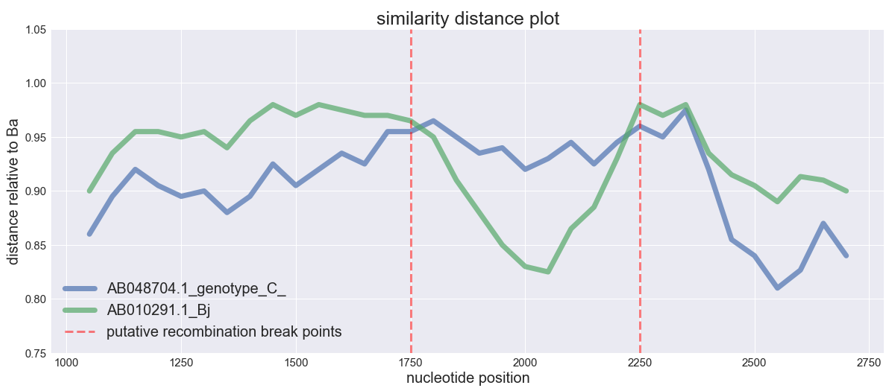
print(data) {'AB048704.1genotypeC': [0.88, 0.935, 0.925, 0.955, 0.955, 0.965, 0.95, 0.935, 0.94, 0.92, 0.9299999999999999, 0.945, 0.925, 0.945, 0.96, 0.95, 0.975, 0.9733333333333334, 0.96, 0.96], 'AB010291.1Bj': [0.98, 0.975, 0.97, 0.97, 0.965, 0.95, 0.91, 0.88, 0.85, 0.83, 0.825, 0.865, 0.885, 0.9299999999999999, 0.98, 0.97, 0.98, 0.9733333333333334, 0.96, 0.96]} ```
Once you've returned the data, you can easily customize the plot by using your favourite plotting library:
```python distdata = simobj.get_data()
import matplotlib.pyplot as plt import seaborn as sns sns.set()
figdist1 = plt.figure(figsize=(20, 8)) plt.plot(df.loc["AB048704.1genotypeC", : ], lw=7, alpha=0.7, label="AB048704.1genotypeC") plt.plot(df.loc["AB010291.1Bj", : ], lw=7, alpha=0.7, label="AB010291.1_Bj")
plt.ylim(0.75, 1.05) plt.title("similarity distance plot", fontsize=25) plt.ylabel("distance relative to Ba", fontsize=20) plt.xlabel("nucleotide position", fontsize=20) plt.xticks(fontsize=15) plt.yticks(fontsize=15)
plt.axvline(1750, alpha=0.5, color="red", lw=3, linestyle="dashed", label="putative recombination break points") plt.axvline(2250, alpha=0.5, color="red", lw=3, linestyle="dashed" )
plt.legend(prop={"size":20}) plt.show() ```
simgen() method has optional parameter dist which denoted method used to calculate pairwise distance. By default its value is set to pdist, so simgen() calculates simple pairwise distance.
Parameters for distance calculation methods:
pdist: pairwise distance (default)jcd: Jukes-Cantor distancek2p: Kimura 2-parameter distancetd: Tamura distance
python
sim_obj.simgen(window=200, shift=50, pot_rec=1, region=(1000, 2700), dist='k2p')
to save the distance data in csv format use the method save_data():
python
sim_obj.save_data(out_name="hbv_distance_data")
If there are about 20 or 30 sequences in the input file and their names are long, legend element may hide the plot. So, to be able to analyze many sequences at once, it's better to use short consice sequence names instead of long ones. Like this:
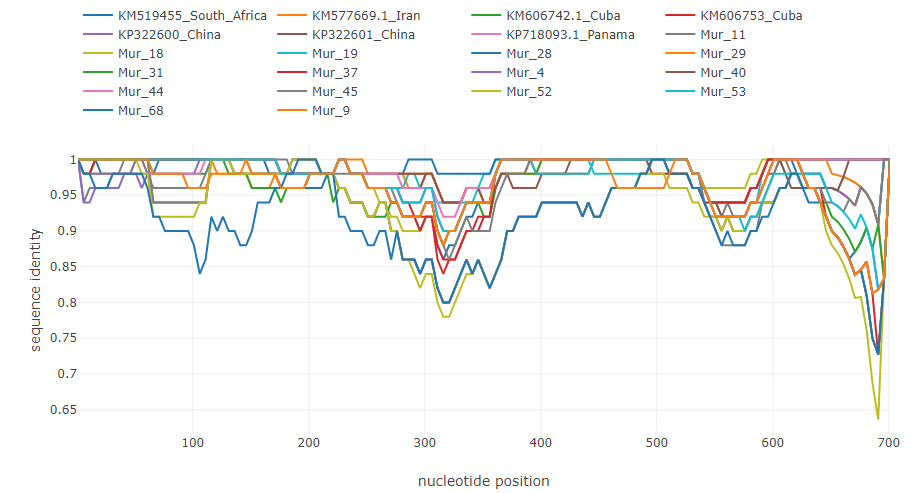
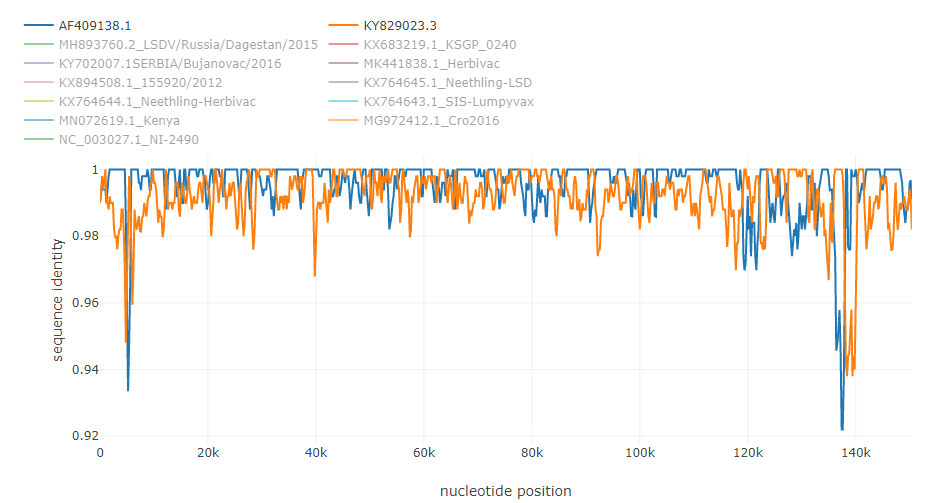
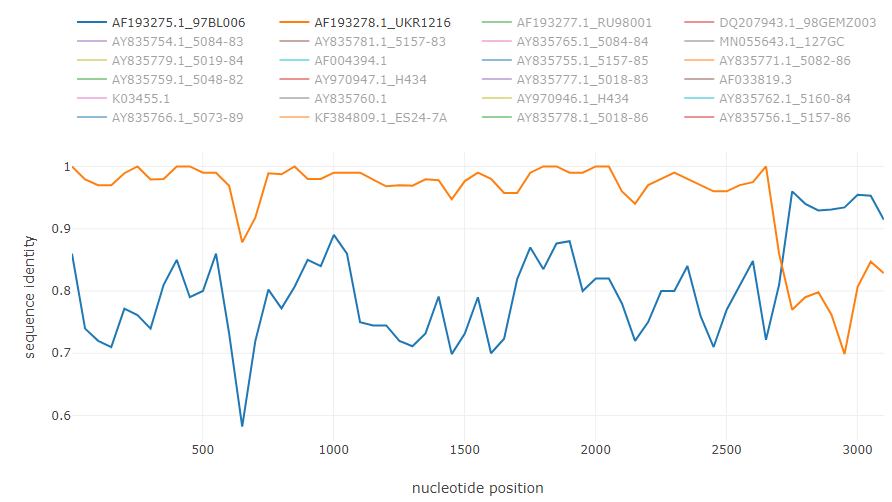
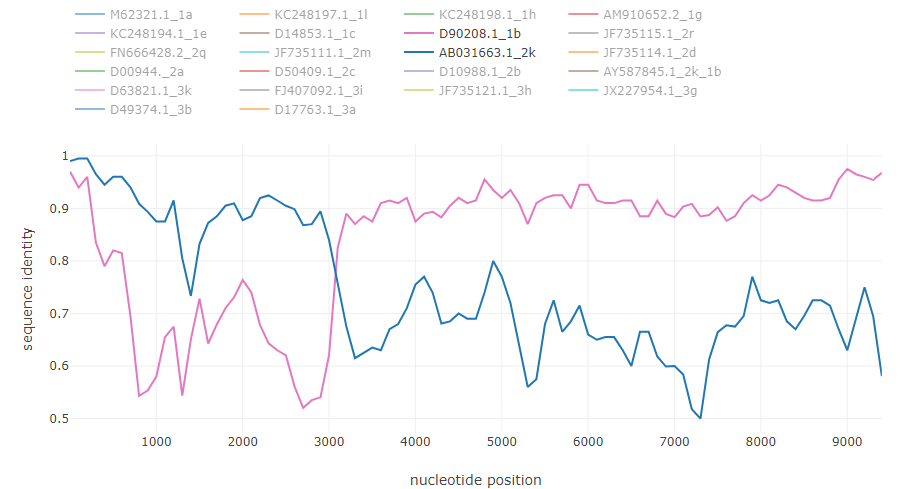
To illustrate how typical breakpoints may look like, here are shown some examples of previously described recombinations in the genomes of different viruses. The fasta alignments used are available at datasets folder.
Putative recombinations in the of 145000 bp genome of lumpy skin disease virus [4]:
Recombination in HIV genome [5]:
HCV intergenotype recombinant 2k/1b [6]:
Norovirus recombinant isolate [7]:
Some notes on usage
- the optimal window size is about 200-250 bp, the optimal window shift is typicall about 50-150 bp
- now distance calculation skips degenerate nucleotides and gaps and they do not influence the distance values
Automated tests
To verify the installation, go to the recan/test/ folder and run:
$ pytest test.py
Example datasets
To download the datasets use the following link: https://drive.google.com/drive/folders/1v2lg5yUDFw_fgSiulsA1uFeuzoGz0RjH?usp=sharing
References
- Recombination Analysis Tool (RAT): a program for the high-throughput detection of recombination. Bioinformatics, Volume 21, Issue 3, 1 February 2005, Pages 278–281, https://doi.org/10.1093/bioinformatics/bth500
- https://sray.med.som.jhmi.edu/SCRoftware/simplot/
- Hepatitis B Virus of Genotype B with or without Recombination with Genotype C over the Precore Region plus the Core Gene. Fuminaka Sugauchi et al. JOURNAL OF VIROLOGY, June 2002, p. 5985–5992. 10.1128/JVI.76.12.5985-5992.2002 https://jvi.asm.org/content/76/12/5985
- Sprygin A, Babin Y, Pestova Y, Kononova S, Wallace DB, Van Schalkwyk A, et al. (2018) Analysis and insights into recombination signals in lumpy skin disease virus recovered in the field. PLoS ONE 13(12): e0207480. https://doi.org/10.1371/journal.pone.0207480
- Liitsola, K., Holm K., Bobkov, A., Pokrovsky, V., Smolskaya,T., Leinikki,P., Osmanov,S. and Salminen,M. (2000) An AB recombinant and its parental HIV type 1 strains in the area of the former Soviet Union: low requirements for sequence identity in recombination. UNAIDS Virus Isolation Network. AIDS Res. Hum. Retroviruses, 16, 1047–1053.
- Smith, D. B., Bukh, J., Kuiken, C., Muerhoff, A. S., Rice, C. M., Stapleton, J. T., & Simmonds, P. (2014). Expanded classification of hepatitis C virus into 7 genotypes and 67 subtypes: Updated criteria and genotype assignment web resource. Hepatology, 59(1), 318–327. https://doi.org/10.1002/hep.26744
- Jiang,X., Espul,C., Zhong,W.M., Cuello,H. and Matson,D.O. (1999) Characterization of a novel human calicivirus that may be a naturally occurring recombinant. Arch. Virol., 144, 2377–2387.
- Martin, D. P., Murrell, B., Golden, M., Khoosal, A., & Muhire, B. (2015). RDP4: Detection and analysis of recombination patterns in virus genomes. Virus Evolution, 1(1), 1–5. https://doi.org/10.1093/ve/vev003
- Babin, Y., (2020). Recan: Python tool for analysis of recombination events in viral genomes. Journal of Open Source Software, 5(49), 2014. https://doi.org/10.21105/joss.02014
recan citations
- Characterization of SARS-CoV-2 P.1 (Gamma) Variant of Concern From Amazonas, Brazil. Zimerman RA et al. (2022). Comparative Genomics and Front. Med. 9:806611. https://doi.org/10.3389/fmed.2022.806611
- In book: Proceedings of the 4th International Conference on Big Data Analytics for Cyber-Physical System in Smart City - Volume 2. Chapter: Python Data Analysis Techniques in Administrative Information Integration Management System April 2023 https://doi.org/10.1007/978-981-99-1157-8_35
- Substantial viral diversity in bats and rodents from East Africa: insights into evolution, recombination, and cocirculation. Daxi Wang et al. 2024. Microbiome (2024) 12:72 https://doi.org/10.1186/s40168-024-01782-4
- Identification of Recombinant Aichivirus D in Cattle, Italy.Pellegrini, F et al. I Animals 2024, 14, 3315. https://doi.org/10.3390/ani14223315
Owner
- Name: Yuriy Babin
- Login: babinyurii
- Kind: user
- Repositories: 4
- Profile: https://github.com/babinyurii
JOSS Publication
Recan: Python tool for analysis of recombination events in viral genomes
Authors

National Medical Research Center for Tuberculosis and Infectious Diseases, Moscow, Russia
Editor
Will Rowe
Tags
virology recombinationGitHub Events
Total
- Push event: 2
Last Year
- Push event: 2
Committers
Last synced: 11 months ago
Top Committers
| Name | Commits | |
|---|---|---|
| Yuriy Babin | b****i@g****m | 263 |
| Бабин Юрий Юрьевич | b****n@p****t | 21 |
| Étienne Mollier | e****r@d****g | 1 |
Committer Domains (Top 20 + Academic)
Issues and Pull Requests
Last synced: 11 months ago
All Time
- Total issues: 15
- Total pull requests: 5
- Average time to close issues: 7 months
- Average time to close pull requests: 6 months
- Total issue authors: 7
- Total pull request authors: 3
- Average comments per issue: 2.0
- Average comments per pull request: 0.2
- Merged pull requests: 4
- Bot issues: 0
- Bot pull requests: 0
Past Year
- Issues: 0
- Pull requests: 0
- Average time to close issues: N/A
- Average time to close pull requests: N/A
- Issue authors: 0
- Pull request authors: 0
- Average comments per issue: 0
- Average comments per pull request: 0
- Merged pull requests: 0
- Bot issues: 0
- Bot pull requests: 0
Top Authors
Issue Authors
- betteridiot (9)
- sikuan (1)
- oktaykaplan (1)
- JmaJeremy (1)
- Zjianglin (1)
- ghost (1)
- antoine4ucsd (1)
Pull Request Authors
- babinyurii (3)
- emollier (1)
- will-rowe (1)
Top Labels
Issue Labels
Pull Request Labels
Packages
- Total packages: 1
-
Total downloads:
- pypi 13 last-month
- Total dependent packages: 0
- Total dependent repositories: 1
- Total versions: 5
- Total maintainers: 1
pypi.org: recan
recan: recombination analysis tool
- Homepage: https://github.com/babinyurii/recan
- Documentation: https://recan.readthedocs.io/
- License: MIT
-
Latest release: 0.1.5
published almost 4 years ago
Rankings
Maintainers (1)
Dependencies
- biopython *
- matplotlib *
- pandas *
- plotly *