Science Score: 67.0%
This score indicates how likely this project is to be science-related based on various indicators:
-
✓CITATION.cff file
Found CITATION.cff file -
✓codemeta.json file
Found codemeta.json file -
✓.zenodo.json file
Found .zenodo.json file -
✓DOI references
Found 6 DOI reference(s) in README -
✓Academic publication links
Links to: arxiv.org, springer.com, acm.org -
○Committers with academic emails
-
○Institutional organization owner
-
○JOSS paper metadata
-
○Scientific vocabulary similarity
Low similarity (8.8%) to scientific vocabulary
Keywords
Repository
Interpretability for sequence generation models 🐛 🔍
Basic Info
- Host: GitHub
- Owner: inseq-team
- License: apache-2.0
- Language: Python
- Default Branch: main
- Homepage: https://inseq.org
- Size: 7.64 MB
Statistics
- Stars: 432
- Watchers: 8
- Forks: 38
- Open Issues: 30
- Releases: 8
Topics
Metadata Files
README.md

Intepretability for Sequence Generation Models 🔍










Inseq is a Pytorch-based hackable toolkit to democratize access to common post-hoc interpretability analyses of sequence generation models.
Installation
Inseq is available on PyPI and can be installed with pip for Python >= 3.10, <= 3.12:
```bash
Install latest stable version
pip install inseq
Alternatively, install latest development version
pip install git+https://github.com/inseq-team/inseq.git ```
Install extras for visualization in Jupyter Notebooks and 🤗 datasets attribution as pip install inseq[notebook,datasets].
Dev Installation
To install the package, clone the repository and run the following commands: ```bash cd inseq make uv-download # Download and install the UV package manager make install # Installs the package and all dependencies ``` For library developers, you can use the `make install-dev` command to install all development dependencies (quality, docs, extras). After installation, you should be able to run `make fast-test` and `make lint` without errors.FAQ Installation
- Installing the `tokenizers` package requires a Rust compiler installation. You can install Rust from [https://rustup.rs](https://rustup.rs) and add `$HOME/.cargo/env` to your PATH. - Installing `sentencepiece` requires various packages, install with `sudo apt-get install cmake build-essential pkg-config` or `brew install cmake gperftools pkg-config`.Example usage in Python
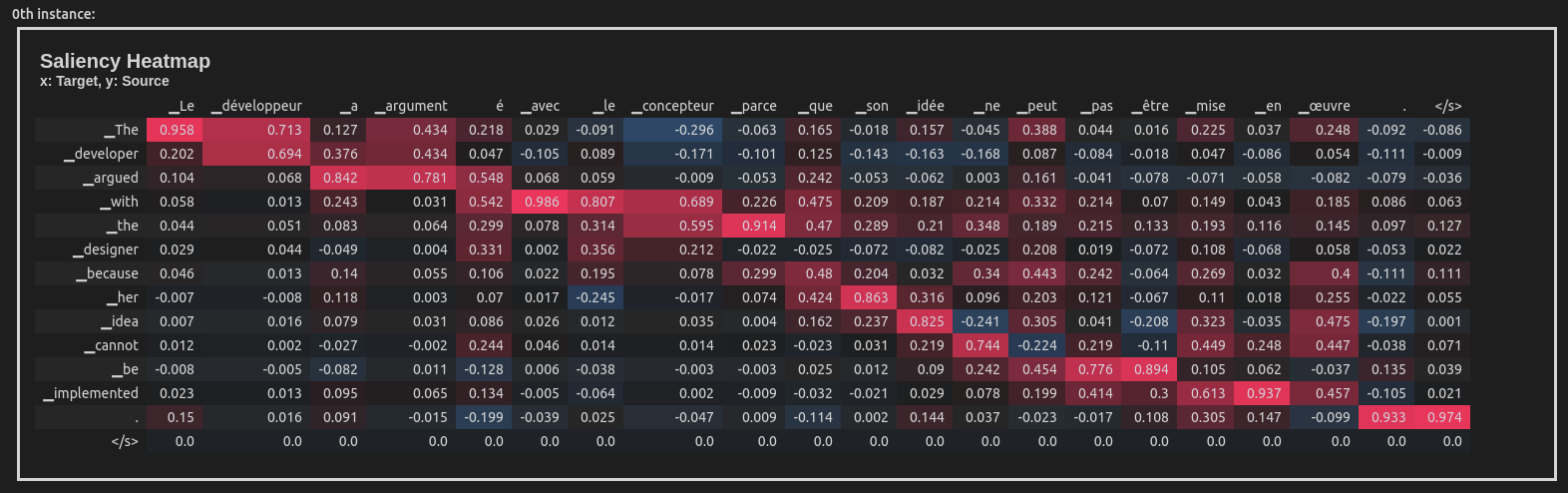
This example uses the Integrated Gradients attribution method to attribute the English-French translation of a sentence taken from the WinoMT corpus:
```python import inseq
model = inseq.loadmodel("Helsinki-NLP/opus-mt-en-fr", "integratedgradients") out = model.attribute( "The developer argued with the designer because her idea cannot be implemented.", n_steps=100 ) out.show() ```
This produces a visualization of the attribution scores for each token in the input sentence (token-level aggregation is handled automatically). Here is what the visualization looks like inside a Jupyter Notebook:
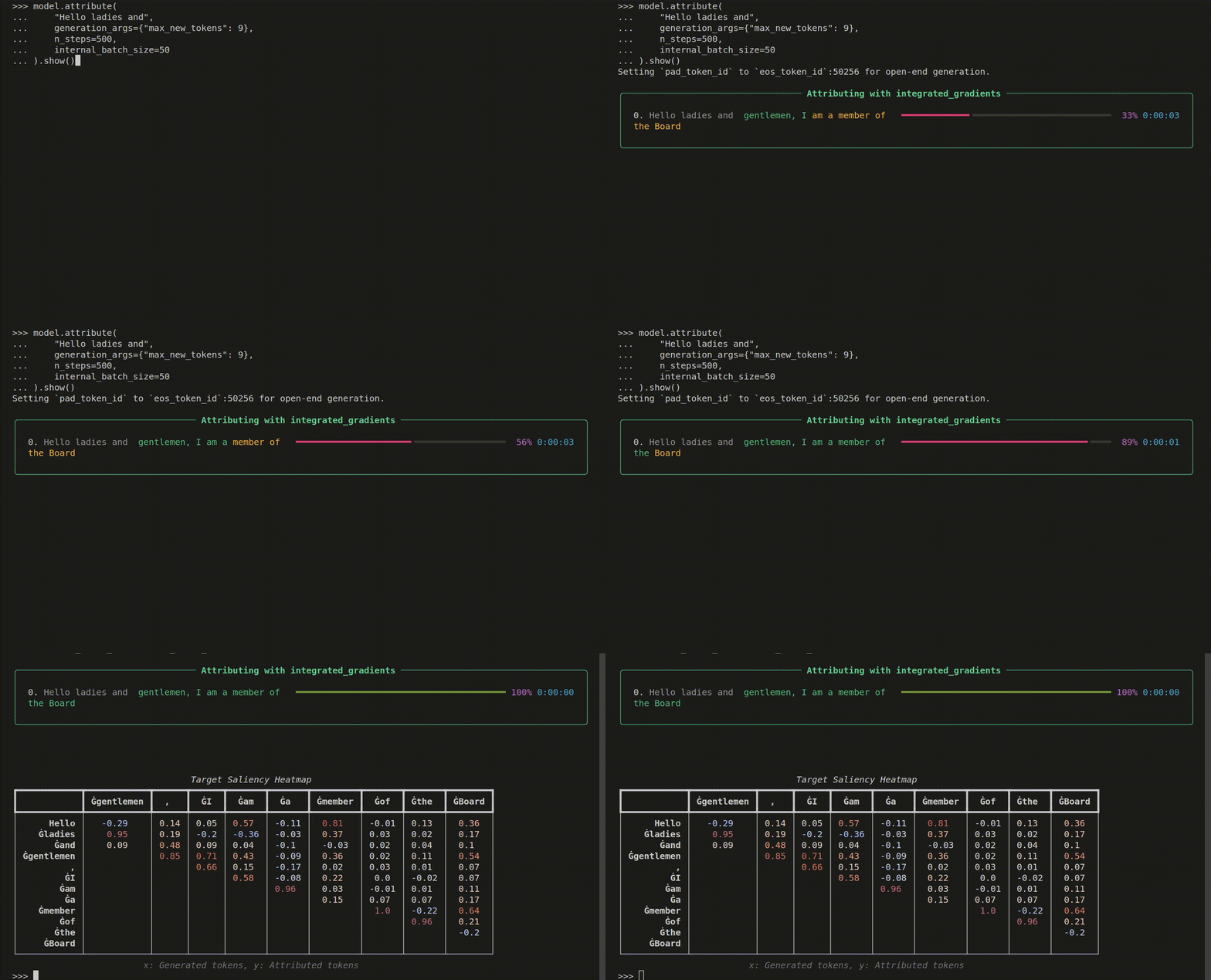
Inseq also supports decoder-only models such as GPT-2, enabling usage of a variety of attribution methods and customizable settings directly from the console:
```python import inseq
model = inseq.loadmodel("gpt2", "integratedgradients") model.attribute( "Hello ladies and", generationargs={"maxnewtokens": 9}, nsteps=500, internalbatchsize=50 ).show() ```
Features
🚀 Feature attribution of sequence generation for most
ForConditionalGeneration(encoder-decoder) andForCausalLM(decoder-only) models from 🤗 Transformers🚀 Support for multiple feature attribution methods, extending the ones supported by Captum
🚀 Post-processing, filtering and merging of attribution maps via
Aggregatorclasses.🚀 Attribution visualization in notebooks, browser and command line.
🚀 Efficient attribution of single examples or entire 🤗 datasets with the Inseq CLI.
🚀 Custom attribution of target functions, supporting advanced methods such as contrastive feature attributions and context reliance detection.
🚀 Extraction and visualization of custom scores (e.g. probability, entropy) at every generation step alongsides attribution maps.
Supported methods
Use the inseq.list_feature_attribution_methods function to list all available method identifiers and inseq.list_step_functions to list all available step functions. The following methods are currently supported:
Gradient-based attribution
saliency: Deep Inside Convolutional Networks: Visualising Image Classification Models and Saliency Maps (Simonyan et al., 2013)input_x_gradient: Deep Inside Convolutional Networks: Visualising Image Classification Models and Saliency Maps (Simonyan et al., 2013)integrated_gradients: Axiomatic Attribution for Deep Networks (Sundararajan et al., 2017)deeplift: Learning Important Features Through Propagating Activation Differences (Shrikumar et al., 2017)gradient_shap: A unified approach to interpreting model predictions (Lundberg and Lee, 2017)discretized_integrated_gradients: Discretized Integrated Gradients for Explaining Language Models (Sanyal and Ren, 2021)sequential_integrated_gradients: Sequential Integrated Gradients: a simple but effective method for explaining language models (Enguehard, 2023)
Internals-based attribution
attention: Attention Weight Attribution, from Neural Machine Translation by Jointly Learning to Align and Translate (Bahdanau et al., 2014)
Perturbation-based attribution
occlusion: Visualizing and Understanding Convolutional Networks (Zeiler and Fergus, 2014)lime: "Why Should I Trust You?": Explaining the Predictions of Any Classifier (Ribeiro et al., 2016)value_zeroing: Quantifying Context Mixing in Transformers (Mohebbi et al. 2023)reagent: ReAGent: A Model-agnostic Feature Attribution Method for Generative Language Models (Zhao et al., 2024)
Step functions
Step functions are used to extract custom scores from the model at each step of the attribution process with the step_scores argument in model.attribute. They can also be used as targets for attribution methods relying on model outputs (e.g. gradient-based methods) by passing them as the attributed_fn argument. The following step functions are currently supported:
logits: Logits of the target token.probability: Probability of the target token. Can also be used for log-probability by passinglogprob=True.entropy: Entropy of the predictive distribution.crossentropy: Cross-entropy loss between target token and predicted distribution.perplexity: Perplexity of the target token.contrast_logits/contrast_prob: Logits/probabilities of the target token when different contrastive inputs are provided to the model. Equivalent tologits/probabilitywhen no contrastive inputs are provided.contrast_logits_diff/contrast_prob_diff: Difference in logits/probability between original and foil target tokens pair, can be used for contrastive evaluation as in contrastive attribution (Yin and Neubig, 2022).pcxmi: Point-wise Contextual Cross-Mutual Information (P-CXMI) for the target token given original and contrastive contexts (Yin et al. 2021).kl_divergence: KL divergence of the predictive distribution given original and contrastive contexts. Can be restricted to most likely target token options using thetop_kandtop_pparameters.in_context_pvi: In-context Pointwise V-usable Information (PVI) to measure the amount of contextual information used in model predictions (Lu et al. 2023).mc_dropout_prob_avg: Average probability of the target token across multiple samples using MC Dropout (Gal and Ghahramani, 2016).top_p_size: The number of tokens with cumulative probability greater thantop_pin the predictive distribution of the model.
The following example computes contrastive attributions using the contrast_prob_diff step function:
```python import inseq
attributionmodel = inseq.loadmodel("gpt2", "inputxgradient")
Perform the contrastive attribution:
Regular (forced) target -> "The manager went home because he was sick"
Contrastive target -> "The manager went home because she was sick"
out = attributionmodel.attribute( "The manager went home because", "The manager went home because he was sick", attributedfn="contrastprobdiff", contrasttargets="The manager went home because she was sick", # We also visualize the corresponding step score stepscores=["contrastprobdiff"] ) out.show() ```
Refer to the documentation for an example including custom function registration.
Using the Inseq CLI
The Inseq library also provides useful client commands to enable repeated attribution of individual examples and even entire 🤗 datasets directly from the console. See the available options by typing inseq -h in the terminal after installing the package.
Three commands are supported:
inseq attribute: Wrapper for enablingmodel.attributeusage in console.inseq attribute-dataset: Extendsattributeto full dataset using Hugging Facedatasets.load_datasetAPI.inseq attribute-context: Detects and attribute context dependence for generation tasks using the approach of Sarti et al. (2023).
All commands support the full range of parameters available for attribute, attribution visualization in the console and saving outputs to disk.
inseq attribute example
The following example performs a simple feature attribution of an English sentence translated into Italian using a MarianNMT translation model from transformers. The final result is printed to the console.
```bash
inseq attribute \
--model_name_or_path Helsinki-NLP/opus-mt-en-it \
--attribution_method saliency \
--input_texts "Hello world this is Inseq\! Inseq is a very nice library to perform attribution analysis"
```
inseq attribute-dataset example
The following code can be used to perform attribution (both source and target-side) of Italian translations for a dummy sample of 20 English sentences taken from the FLORES-101 parallel corpus, using a MarianNMT translation model from Hugging Face transformers. We save the visualizations in HTML format in the file attributions.html. See the --help flag for more options.
```bash
inseq attribute-dataset \
--model_name_or_path Helsinki-NLP/opus-mt-en-it \
--attribution_method saliency \
--do_prefix_attribution \
--dataset_name inseq/dummy_enit \
--input_text_field en \
--dataset_split "train[:20]" \
--viz_path attributions.html \
--batch_size 8 \
--hide
```
inseq attribute-context example
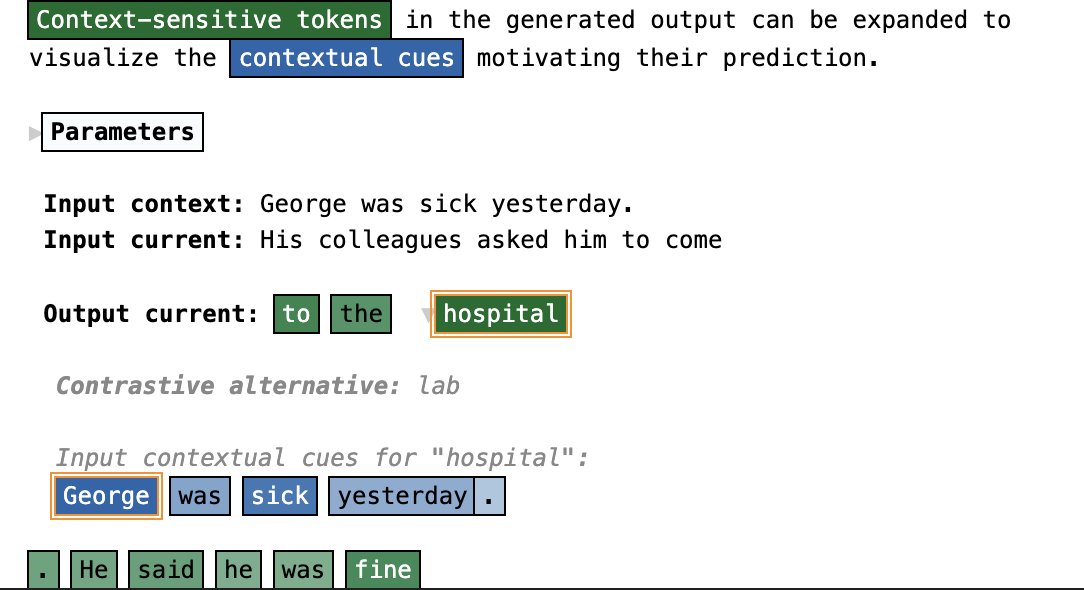
The following example uses a small LM to generate a continuation of input_current_text, and uses the additional context provided by input_context_text to estimate its influence on the the generation. In this case, the output "to the hospital. He said he was fine" is produced, and the generation of token hospital is found to be dependent on context token sick according to the contrast_prob_diff step function.
```bash
inseq attribute-context \
--model_name_or_path HuggingFaceTB/SmolLM-135M \
--input_context_text "George was sick yesterday." \
--input_current_text "His colleagues asked him to come" \
--attributed_fn "contrast_prob_diff"
```
**Result:**
Planned Development
⚙️ Support more attention-based and occlusion-based feature attribution methods (documented in #107 and #108).
⚙️ Interoperability with ferret for attribution plausibility and faithfulness evaluation.
⚙️ Rich and interactive visualizations in a tabbed interface using Gradio Blocks.
Contributing
Our vision for Inseq is to create a centralized, comprehensive and robust set of tools to enable fair and reproducible comparisons in the study of sequence generation models. To achieve this goal, contributions from researchers and developers interested in these topics are more than welcome. Please see our contributing guidelines and our code of conduct for more information.
Citing Inseq
If you use Inseq in your research we suggest including a mention of the specific release (e.g. v0.6.0) and we kindly ask you to cite our reference paper as:
```bibtex @inproceedings{sarti-etal-2023-inseq, title = "Inseq: An Interpretability Toolkit for Sequence Generation Models", author = "Sarti, Gabriele and Feldhus, Nils and Sickert, Ludwig and van der Wal, Oskar and Nissim, Malvina and Bisazza, Arianna", booktitle = "Proceedings of the 61st Annual Meeting of the Association for Computational Linguistics (Volume 3: System Demonstrations)", month = jul, year = "2023", address = "Toronto, Canada", publisher = "Association for Computational Linguistics", url = "https://aclanthology.org/2023.acl-demo.40", doi = "10.18653/v1/2023.acl-demo.40", pages = "421--435", }
```
Research using Inseq
Inseq has been used in various research projects. A list of known publications that use Inseq to conduct interpretability analyses of generative models is shown below.
[!TIP] Last update: August 2024. Please open a pull request to add your publication to the list.
2023
- Inseq: An Interpretability Toolkit for Sequence Generation Models (Sarti et al., 2023)
- Are Character-level Translations Worth the Wait? Comparing ByT5 and mT5 for Machine Translation (Edman et al., 2023)
- Response Generation in Longitudinal Dialogues: Which Knowledge Representation Helps? (Mousavi et al., 2023)
- Quantifying the Plausibility of Context Reliance in Neural Machine Translation (Sarti et al., 2023)
- A Tale of Pronouns: Interpretability Informs Gender Bias Mitigation for Fairer Instruction-Tuned Machine Translation (Attanasio et al., 2023)
- Attribution and Alignment: Effects of Local Context Repetition on Utterance Production and Comprehension in Dialogue (Molnar et al., 2023)
2024
- Assessing the Reliability of Large Language Model Knowledge (Wang et al., 2024)
- LLMCheckup: Conversational Examination of Large Language Models via Interpretability Tools (Wang et al., 2024)
- ReAGent: A Model-agnostic Feature Attribution Method for Generative Language Models (Zhao et al., 2024)
- Revisiting subword tokenization: A case study on affixal negation in large language models (Truong et al., 2024)
- Exploring NMT Explainability for Translators Using NMT Visualising Tools (Gonzalez-Saez et al., 2024)
- DETAIL: Task DEmonsTration Attribution for Interpretable In-context Learning (Zhou et al., 2024)
- Should We Fine-Tune or RAG? Evaluating Different Techniques to Adapt LLMs for Dialogue (Alghisi et al., 2024)
- Model Internals-based Answer Attribution for Trustworthy Retrieval-Augmented Generation (Qi, Sarti et al., 2024)
- NoNE Found: Explaining the Output of Sequence-to-Sequence Models When No Named Entity Is Recognized (dela Cruz et al., 2024)
Owner
- Name: Inseq
- Login: inseq-team
- Kind: organization
- Email: info@inseq.org
- Location: Netherlands
- Website: https://inseq.org
- Twitter: InseqLib
- Repositories: 2
- Profile: https://github.com/inseq-team
Interpretability for generative language models 🐛
Citation (CITATION.cff)
cff-version: "1.2.0"
date-released: 2023-02
message: "If you use this software, please cite it as follows."
title: "Inseq: An Interpretability Toolkit for Sequence Generation Models"
url: "https://github.com/inseq-team/inseq"
license: Apache-2.0
authors:
  - family-names: Sarti
    given-names: Gabriele
    orcid: "https://orcid.org/0000-0001-8715-2987"
  - family-names: Feldhus
    given-names: Nils
  - family-names: Sickert
    given-names: Ludwig
  - family-names: "van der Wal"
    given-names: Oskar
    orcid: "https://orcid.org/0000-0003-4087-3714"
  - family-names: Nissim
    given-names: Malvina
    orcid: "https://orcid.org/0000-0001-5289-0971"
  - family-names: Bisazza
    given-names: Arianna
    orcid: "https://orcid.org/0000-0003-1270-3048"
preferred-citation:
  type: article
  authors:
  - family-names: Sarti
    given-names: Gabriele
    orcid: "https://orcid.org/0000-0001-8715-2987"
  - family-names: Feldhus
    given-names: Nils
  - family-names: Sickert
    given-names: Ludwig
  - family-names: "van der Wal"
    given-names: Oskar
    orcid: "https://orcid.org/0000-0003-4087-3714"
  - family-names: Nissim
    given-names: Malvina
    orcid: "https://orcid.org/0000-0001-5289-0971"
  - family-names: Bisazza
    given-names: Arianna
    orcid: "https://orcid.org/0000-0003-1270-3048"
  booktitle: "Proceedings of the 61st Annual Meeting of the Association for Computational Linguistics (Volume 3: System Demonstrations)"
  month: 7
  title: "Inseq: An Interpretability Toolkit for Sequence Generation Models"
  year: 2023
  url: "https://aclanthology.org/2023.acl-demo.40"
  start: 421
  end: 435
  publisher: "Association for Computational Linguistics"
  address: "Toronto, Canada"
GitHub Events
Total
- Issues event: 16
- Watch event: 59
- Delete event: 1
- Issue comment event: 26
- Push event: 8
- Pull request event: 6
- Fork event: 3
- Create event: 3
Last Year
- Issues event: 16
- Watch event: 59
- Delete event: 1
- Issue comment event: 26
- Push event: 8
- Pull request event: 6
- Fork event: 3
- Create event: 3
Committers
Last synced: over 3 years ago
All Time
- Total Commits: 223
- Total Committers: 6
- Avg Commits per committer: 37.167
- Development Distribution Score (DDS): 0.552
Top Committers
| Name | Commits | |
|---|---|---|
| Gabriele Sarti | g****6@g****m | 100 |
| dependabot[bot] | 4****]@u****m | 94 |
| Ludwig Sickert | l****t@g****m | 25 |
| Gabriele Sarti | g****i@a****m | 2 |
| Ludwig Sickert | l****t@u****m | 1 |
| Nils Feldhus | f****p@g****m | 1 |
Committer Domains (Top 20 + Academic)
Issues and Pull Requests
Last synced: 12 months ago
All Time
- Total issues: 94
- Total pull requests: 124
- Average time to close issues: about 2 months
- Average time to close pull requests: 12 days
- Total issue authors: 38
- Total pull request authors: 14
- Average comments per issue: 2.4
- Average comments per pull request: 0.67
- Merged pull requests: 118
- Bot issues: 0
- Bot pull requests: 25
Past Year
- Issues: 13
- Pull requests: 7
- Average time to close issues: 7 days
- Average time to close pull requests: 3 days
- Issue authors: 9
- Pull request authors: 2
- Average comments per issue: 2.92
- Average comments per pull request: 0.29
- Merged pull requests: 7
- Bot issues: 0
- Bot pull requests: 0
Top Authors
Issue Authors
- gsarti (28)
- lsickert (5)
- acDante (5)
- Ningshiqi (4)
- nfelnlp (4)
- saxenarohit (4)
- Betswish (3)
- jumelet (3)
- DanielSc4 (3)
- SVC04 (3)
- rafikg (2)
- MoritzLaurer (2)
- frankdarkluo (2)
- martijnvanbeers (1)
- hadiasghari (1)
Pull Request Authors
- gsarti (92)
- dependabot[bot] (24)
- bbjoverbeek (2)
- Betswish (2)
- lsickert (2)
- niggoo (2)
- LuukSuurmeijer (2)
- xuan25 (2)
- casszhao (2)
- carschno (1)
- nfelnlp (1)
- DanielSc4 (1)
- g8a9 (1)
- yuzhaouoe (1)
Top Labels
Issue Labels
Pull Request Labels
Packages
- Total packages: 2
-
Total downloads:
- pypi 293 last-month
-
Total dependent packages: 1
(may contain duplicates) -
Total dependent repositories: 1
(may contain duplicates) - Total versions: 14
- Total maintainers: 1
proxy.golang.org: github.com/inseq-team/inseq
- Documentation: https://pkg.go.dev/github.com/inseq-team/inseq#section-documentation
- License: apache-2.0
-
Latest release: v0.6.0
published about 2 years ago
Rankings
pypi.org: inseq
Interpretability for Sequence Generation Models 🔍
- Documentation: https://inseq.readthedocs.io/
- License: Apache License Version 2.0, January 2004 http://www.apache.org/licenses/ TERMS AND CONDITIONS FOR USE, REPRODUCTION, AND DISTRIBUTION 1. Definitions. "License" shall mean the terms and conditions for use, reproduction, and distribution as defined by Sections 1 through 9 of this document. "Licensor" shall mean the copyright owner or entity authorized by the copyright owner that is granting the License. "Legal Entity" shall mean the union of the acting entity and all other entities that control, are controlled by, or are under common control with that entity. For the purposes of this definition, "control" means (i) the power, direct or indirect, to cause the direction or management of such entity, whether by contract or otherwise, or (ii) ownership of fifty percent (50%) or more of the outstanding shares, or (iii) beneficial ownership of such entity. "You" (or "Your") shall mean an individual or Legal Entity exercising permissions granted by this License. "Source" form shall mean the preferred form for making modifications, including but not limited to software source code, documentation source, and configuration files. "Object" form shall mean any form resulting from mechanical transformation or translation of a Source form, including but not limited to compiled object code, generated documentation, and conversions to other media types. "Work" shall mean the work of authorship, whether in Source or Object form, made available under the License, as indicated by a copyright notice that is included in or attached to the work (an example is provided in the Appendix below). "Derivative Works" shall mean any work, whether in Source or Object form, that is based on (or derived from) the Work and for which the editorial revisions, annotations, elaborations, or other modifications represent, as a whole, an original work of authorship. For the purposes of this License, Derivative Works shall not include works that remain separable from, or merely link (or bind by name) to the interfaces of, the Work and Derivative Works thereof. "Contribution" shall mean any work of authorship, including the original version of the Work and any modifications or additions to that Work or Derivative Works thereof, that is intentionally submitted to Licensor for inclusion in the Work by the copyright owner or by an individual or Legal Entity authorized to submit on behalf of the copyright owner. For the purposes of this definition, "submitted" means any form of electronic, verbal, or written communication sent to the Licensor or its representatives, including but not limited to communication on electronic mailing lists, source code control systems, and issue tracking systems that are managed by, or on behalf of, the Licensor for the purpose of discussing and improving the Work, but excluding communication that is conspicuously marked or otherwise designated in writing by the copyright owner as "Not a Contribution." "Contributor" shall mean Licensor and any individual or Legal Entity on behalf of whom a Contribution has been received by Licensor and subsequently incorporated within the Work. 2. Grant of Copyright License. Subject to the terms and conditions of this License, each Contributor hereby grants to You a perpetual, worldwide, non-exclusive, no-charge, royalty-free, irrevocable copyright license to reproduce, prepare Derivative Works of, publicly display, publicly perform, sublicense, and distribute the Work and such Derivative Works in Source or Object form. 3. Grant of Patent License. Subject to the terms and conditions of this License, each Contributor hereby grants to You a perpetual, worldwide, non-exclusive, no-charge, royalty-free, irrevocable (except as stated in this section) patent license to make, have made, use, offer to sell, sell, import, and otherwise transfer the Work, where such license applies only to those patent claims licensable by such Contributor that are necessarily infringed by their Contribution(s) alone or by combination of their Contribution(s) with the Work to which such Contribution(s) was submitted. If You institute patent litigation against any entity (including a cross-claim or counterclaim in a lawsuit) alleging that the Work or a Contribution incorporated within the Work constitutes direct or contributory patent infringement, then any patent licenses granted to You under this License for that Work shall terminate as of the date such litigation is filed. 4. Redistribution. You may reproduce and distribute copies of the Work or Derivative Works thereof in any medium, with or without modifications, and in Source or Object form, provided that You meet the following conditions: 1. You must give any other recipients of the Work or Derivative Works a copy of this License; and 2. You must cause any modified files to carry prominent notices stating that You changed the files; and 3. You must retain, in the Source form of any Derivative Works that You distribute, all copyright, patent, trademark, and attribution notices from the Source form of the Work, excluding those notices that do not pertain to any part of the Derivative Works; and 4. If the Work includes a "NOTICE" text file as part of its distribution, then any Derivative Works that You distribute must include a readable copy of the attribution notices contained within such NOTICE file, excluding those notices that do not pertain to any part of the Derivative Works, in at least one of the following places: within a NOTICE text file distributed as part of the Derivative Works; within the Source form or documentation, if provided along with the Derivative Works; or, within a display generated by the Derivative Works, if and wherever such third-party notices normally appear. The contents of the NOTICE file are for informational purposes only and do not modify the License. You may add Your own attribution notices within Derivative Works that You distribute, alongside or as an addendum to the NOTICE text from the Work, provided that such additional attribution notices cannot be construed as modifying the License. You may add Your own copyright statement to Your modifications and may provide additional or different license terms and conditions for use, reproduction, or distribution of Your modifications, or for any such Derivative Works as a whole, provided Your use, reproduction, and distribution of the Work otherwise complies with the conditions stated in this License. 5. Submission of Contributions. Unless You explicitly state otherwise, any Contribution intentionally submitted for inclusion in the Work by You to the Licensor shall be under the terms and conditions of this License, without any additional terms or conditions. Notwithstanding the above, nothing herein shall supersede or modify the terms of any separate license agreement you may have executed with Licensor regarding such Contributions. 6. Trademarks. This License does not grant permission to use the trade names, trademarks, service marks, or product names of the Licensor, except as required for reasonable and customary use in describing the origin of the Work and reproducing the content of the NOTICE file. 7. Disclaimer of Warranty. Unless required by applicable law or agreed to in writing, Licensor provides the Work (and each Contributor provides its Contributions) on an "AS IS" BASIS, WITHOUT WARRANTIES OR CONDITIONS OF ANY KIND, either express or implied, including, without limitation, any warranties or conditions of TITLE, NON-INFRINGEMENT, MERCHANTABILITY, or FITNESS FOR A PARTICULAR PURPOSE. You are solely responsible for determining the appropriateness of using or redistributing the Work and assume any risks associated with Your exercise of permissions under this License. 8. Limitation of Liability. In no event and under no legal theory, whether in tort (including negligence), contract, or otherwise, unless required by applicable law (such as deliberate and grossly negligent acts) or agreed to in writing, shall any Contributor be liable to You for damages, including any direct, indirect, special, incidental, or consequential damages of any character arising as a result of this License or out of the use or inability to use the Work (including but not limited to damages for loss of goodwill, work stoppage, computer failure or malfunction, or any and all other commercial damages or losses), even if such Contributor has been advised of the possibility of such damages. 9. Accepting Warranty or Additional Liability. While redistributing the Work or Derivative Works thereof, You may choose to offer, and charge a fee for, acceptance of support, warranty, indemnity, or other liability obligations and/or rights consistent with this License. However, in accepting such obligations, You may act only on Your own behalf and on Your sole responsibility, not on behalf of any other Contributor, and only if You agree to indemnify, defend, and hold each Contributor harmless for any liability incurred by, or claims asserted against, such Contributor by reason of your accepting any such warranty or additional liability. END OF TERMS AND CONDITIONS APPENDIX: How to apply the Apache License to your work To apply the Apache License to your work, attach the following boilerplate notice, with the fields enclosed by brackets "[]" replaced with your own identifying information. (Don't include the brackets!) The text should be enclosed in the appropriate comment syntax for the file format. We also recommend that a file or class name and description of purpose be included on the same "printed page" as the copyright notice for easier identification within third-party archives. Copyright 2021 The Inseq Team Licensed under the Apache License, Version 2.0 (the "License"); you may not use this file except in compliance with the License. You may obtain a copy of the License at http://www.apache.org/licenses/LICENSE-2.0 Unless required by applicable law or agreed to in writing, software distributed under the License is distributed on an "AS IS" BASIS, WITHOUT WARRANTIES OR CONDITIONS OF ANY KIND, either express or implied. See the License for the specific language governing permissions and limitations under the License.
-
Latest release: 0.6.0
published about 2 years ago
Rankings
Maintainers (1)
Dependencies
- actions/cache v3.0.11 composite
- actions/checkout v3 composite
- actions/setup-python v4.3.0 composite
- actions/first-interaction v1 composite
- release-drafter/release-drafter v5.15.0 composite
- python 3.10.0-slim-buster build
- 164 dependencies
- captum ^0.5.0
- datasets ^2.3.2
- ipykernel ^6.15.0
- ipywidgets ^8.0.0rc2
- joblib ^1.2.0
- json-tricks ^3.15.5
- matplotlib ^3.5.2
- numpy ^1.22.4
- poethepoet ^0.13.1
- protobuf ^3.20.2
- python >=3.8.1,<3.12
- rich ^10.13.0
- scikit-learn ^1.1.1
- scipy ^1.8.1
- torch ^1.13.0
- torchtyping ^0.1.4
- tqdm ^4.64.0
- transformers ^4.22.0
- aiohttp ==3.8.3 development
- aiosignal ==1.3.1 development
- alabaster ==0.7.12 development
- appnope ==0.1.3 development
- astroid ==2.12.13 development
- asttokens ==2.2.0 development
- async-timeout ==4.0.2 development
- attrs ==22.1.0 development
- babel ==2.11.0 development
- backcall ==0.2.0 development
- bandit ==1.7.4 development
- black ==22.10.0 development
- captum ==0.5.0 development
- certifi ==2022.9.24 development
- cffi ==1.15.1 development
- cfgv ==3.3.1 development
- charset-normalizer ==2.1.1 development
- click ==8.1.3 development
- colorama ==0.4.6 development
- comm ==0.1.1 development
- commonmark ==0.9.1 development
- contourpy ==1.0.6 development
- coverage ==6.5.0 development
- cycler ==0.11.0 development
- darglint ==1.8.1 development
- datasets ==2.7.1 development
- debugpy ==1.6.4 development
- decorator ==5.1.1 development
- dill ==0.3.6 development
- distlib ==0.3.6 development
- docutils ==0.17.1 development
- dparse ==0.6.2 development
- entrypoints ==0.4 development
- exceptiongroup ==1.0.4 development
- executing ==1.2.0 development
- filelock ==3.8.0 development
- flake8 ==5.0.4 development
- fonttools ==4.38.0 development
- frozenlist ==1.3.3 development
- fsspec ==2022.11.0 development
- gitdb ==4.0.10 development
- gitpython ==3.1.29 development
- huggingface-hub ==0.11.1 development
- identify ==2.5.9 development
- idna ==3.4 development
- imagesize ==1.4.1 development
- importlib-metadata ==5.1.0 development
- iniconfig ==1.1.1 development
- ipykernel ==6.18.2 development
- ipython ==8.7.0 development
- ipywidgets ==8.0.2 development
- isort ==5.10.1 development
- jedi ==0.18.2 development
- jinja2 ==3.1.2 development
- joblib ==1.2.0 development
- json-tricks ==3.16.1 development
- jupyter-client ==7.4.7 development
- jupyter-core ==5.1.0 development
- jupyterlab-widgets ==3.0.3 development
- kiwisolver ==1.4.4 development
- lazy-object-proxy ==1.8.0 development
- markdown ==3.4.1 development
- markupsafe ==2.1.1 development
- matplotlib ==3.6.2 development
- matplotlib-inline ==0.1.6 development
- mccabe ==0.7.0 development
- multidict ==6.0.2 development
- multiprocess ==0.70.14 development
- mypy-extensions ==0.4.3 development
- nest-asyncio ==1.5.6 development
- nodeenv ==1.7.0 development
- numpy ==1.23.5 development
- nvidia-cublas-cu11 ==11.10.3.66 development
- nvidia-cuda-nvrtc-cu11 ==11.7.99 development
- nvidia-cuda-runtime-cu11 ==11.7.99 development
- nvidia-cudnn-cu11 ==8.5.0.96 development
- packaging ==21.3 development
- pandas ==1.5.2 development
- parso ==0.8.3 development
- pastel ==0.2.1 development
- pathspec ==0.10.2 development
- pbr ==5.11.0 development
- pexpect ==4.8.0 development
- pickleshare ==0.7.5 development
- pillow ==9.3.0 development
- platformdirs ==2.5.4 development
- pluggy ==1.0.0 development
- poethepoet ==0.13.1 development
- pre-commit ==2.20.0 development
- prompt-toolkit ==3.0.33 development
- protobuf ==3.20.2 development
- psutil ==5.9.4 development
- ptyprocess ==0.7.0 development
- pure-eval ==0.2.2 development
- py ==1.11.0 development
- pyarrow ==10.0.1 development
- pycodestyle ==2.9.1 development
- pycparser ==2.21 development
- pyflakes ==2.5.0 development
- pygments ==2.13.0 development
- pylint ==2.15.7 development
- pyparsing ==3.0.9 development
- pytest ==7.2.0 development
- pytest-cov ==4.0.0 development
- python-dateutil ==2.8.2 development
- pytz ==2022.6 development
- pyupgrade ==2.38.4 development
- pywin32 ==305 development
- pyyaml ==6.0 development
- pyzmq ==24.0.1 development
- recommonmark ==0.7.1 development
- regex ==2022.10.31 development
- requests ==2.28.1 development
- responses ==0.18.0 development
- rich ==10.16.2 development
- ruamel-yaml ==0.17.21 development
- ruamel-yaml-clib ==0.2.7 development
- safety ==2.3.3 development
- scikit-learn ==1.1.3 development
- scipy ==1.9.3 development
- sentencepiece ==0.1.97 development
- setuptools ==65.6.3 development
- setuptools-scm ==7.0.5 development
- six ==1.16.0 development
- smmap ==5.0.0 development
- snowballstemmer ==2.2.0 development
- sphinx ==5.3.0 development
- sphinx-copybutton ==0.4.0 development
- sphinx-gitstamp ==0.3.3 development
- sphinx-markdown-tables ==0.0.17 development
- sphinx-rtd-theme ==1.1.1 development
- sphinxcontrib-applehelp ==1.0.2 development
- sphinxcontrib-devhelp ==1.0.2 development
- sphinxcontrib-htmlhelp ==2.0.0 development
- sphinxcontrib-jsmath ==1.0.1 development
- sphinxcontrib-qthelp ==1.0.3 development
- sphinxcontrib-serializinghtml ==1.1.5 development
- sphinxemoji ==0.2.0 development
- sphinxext-opengraph ==0.4.2 development
- stack-data ==0.6.2 development
- stevedore ==4.1.1 development
- threadpoolctl ==3.1.0 development
- tokenize-rt ==4.2.1 development
- tokenizers ==0.13.2 development
- toml ==0.10.2 development
- tomli ==2.0.1 development
- tomlkit ==0.11.6 development
- torch ==1.13.0 development
- torchtyping ==0.1.4 development
- tornado ==6.2 development
- tqdm ==4.64.1 development
- traitlets ==5.6.0 development
- transformers ==4.24.0 development
- typeguard ==2.13.3 development
- typing-extensions ==4.4.0 development
- urllib3 ==1.26.13 development
- virtualenv ==20.17.0 development
- wcwidth ==0.2.5 development
- wheel ==0.38.4 development
- widgetsnbextension ==4.0.3 development
- wrapt ==1.14.1 development
- xxhash ==3.1.0 development
- yarl ==1.8.1 development
- zipp ==3.11.0 development
- captum ==0.5.0
- certifi ==2022.9.24
- charset-normalizer ==2.1.1
- colorama ==0.4.6
- commonmark ==0.9.1
- contourpy ==1.0.6
- cycler ==0.11.0
- filelock ==3.8.0
- fonttools ==4.38.0
- huggingface-hub ==0.11.1
- idna ==3.4
- json-tricks ==3.16.1
- kiwisolver ==1.4.4
- matplotlib ==3.6.2
- numpy ==1.23.5
- nvidia-cublas-cu11 ==11.10.3.66
- nvidia-cuda-nvrtc-cu11 ==11.7.99
- nvidia-cuda-runtime-cu11 ==11.7.99
- nvidia-cudnn-cu11 ==8.5.0.96
- packaging ==21.3
- pastel ==0.2.1
- pillow ==9.3.0
- poethepoet ==0.13.1
- protobuf ==3.20.2
- pygments ==2.13.0
- pyparsing ==3.0.9
- python-dateutil ==2.8.2
- pyyaml ==6.0
- regex ==2022.10.31
- requests ==2.28.1
- rich ==10.16.2
- scipy ==1.9.3
- sentencepiece ==0.1.97
- setuptools ==65.6.3
- setuptools-scm ==7.0.5
- six ==1.16.0
- tokenizers ==0.13.2
- tomli ==2.0.1
- torch ==1.13.0
- torchtyping ==0.1.4
- tqdm ==4.64.1
- transformers ==4.24.0
- typeguard ==2.13.3
- typing-extensions ==4.4.0
- urllib3 ==1.26.13
- wheel ==0.38.4