https://github.com/giorgiaauroraadorni/gansformer
Generative Adversarial Transformers
Science Score: 10.0%
This score indicates how likely this project is to be science-related based on various indicators:
-
○CITATION.cff file
-
○codemeta.json file
-
○.zenodo.json file
-
○DOI references
-
✓Academic publication links
Links to: arxiv.org -
○Academic email domains
-
○Institutional organization owner
-
○JOSS paper metadata
-
○Scientific vocabulary similarity
Low similarity (8.0%) to scientific vocabulary
Last synced: 10 months ago
·
JSON representation
Repository
Generative Adversarial Transformers
Basic Info
Statistics
- Stars: 1
- Watchers: 0
- Forks: 0
- Open Issues: 0
- Releases: 0
Fork of dorarad/gansformer
Created over 4 years ago
· Last pushed over 4 years ago
https://github.com/GiorgiaAuroraAdorni/gansformer/blob/main/
[](https://paperswithcode.com/sota/image-generation-on-clevr?p=generative-adversarial-transformers) [](https://paperswithcode.com/sota/image-generation-on-cityscapes?p=generative-adversarial-transformers) [](https://paperswithcode.com/sota/image-generation-on-lsun-bedroom-256-x-256?p=generative-adversarial-transformers)     # GANformer: Generative Adversarial TransformersDrew A. Hudson* & C. Lawrence Zitnick
*_I wish to thank [Christopher D. Manning](https://nlp.stanford.edu/~manning/) for the fruitful discussions and constructive feedback in developing the Bipartite Transformer, especially when explored within the language representation area and also in the visual context, as well as for providing the kind financial support that allowed this work to happen!_ :sunflower:This is an implementation of the [GANformer](https://arxiv.org/pdf/2103.01209.pdf) model, a novel and efficient type of transformer, explored for the task of image generation. The network employs a _bipartite structure_ that enables long-range interactions across the image, while maintaining computation of linearly efficiency, that can readily scale to high-resolution synthesis. The model iteratively propagates information from a set of latent variables to the evolving visual features and vice versa, to support the refinement of each in light of the other and encourage the emergence of compositional representations of objects and scenes. In contrast to the classic transformer architecture, it utilizes multiplicative integration that allows flexible region-based modulation, and can thus be seen as a generalization of the successful StyleGAN network.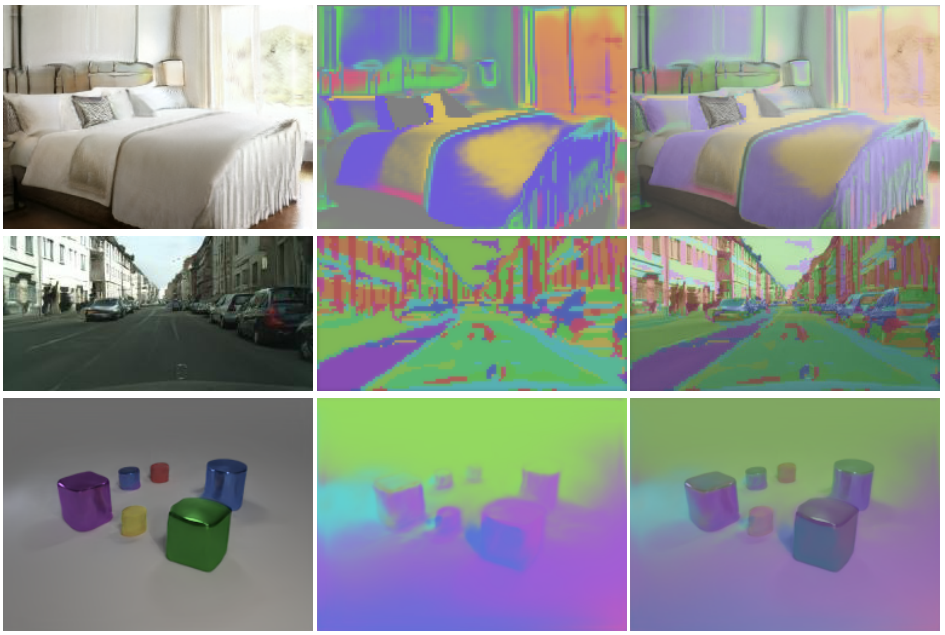

**Paper**: [https://arxiv.org/pdf/2103.01209](https://arxiv.org/pdf/2103.01209) **Contact**: dorarad@stanford.edu **Implementation**: [`network.py`](training/network.py) ## Update: Pytorch version will be released soon! :white_check_mark: Uploading initial code and readme :white_check_mark: Image sampling and visualization script :white_check_mark: Code clean-up and refacotiring, adding documentation :white_check_mark: Training and data-prepreation intructions :white_check_mark: Pretrained networks for all datasets :white_check_mark: Extra visualizations and evaluations Providing models trained for longer Releasing pre-trained models for high-resolutions (up to 1024 x 1024) Releasing Pytorch version Adding support for conditional image generation (will be added soon!) If you experience any issues or have suggestions for improvements or extensions, feel free to contact me either thourgh the issues page or at dorarad@stanford.edu. ## Bibtex ```bibtex @article{hudson2021ganformer, title={Generative Adversarial Transformers}, author={Hudson, Drew A and Zitnick, C. Lawrence}, journal={Proceedings of the 38th International Conference on Machine Learning, {ICML} 2021}, year={2021} } ``` ## Sample Images Using the pre-trained models (generated after training for ***5-7x*** less steps than StyleGAN2 models! Training our models for longer will improve the image quality further):
## Requirements
- Python 3.6 or 3.7 are supported. - We recommend TensorFlow 1.14 which was used for development, but TensorFlow 1.15 is also supported. - The code was tested with CUDA 10.0 toolkit and cuDNN 7.5. - We have performed experiments on Titan V GPU. We assume 12GB of GPU memory (more memory can expedite training). - See [`requirements.txt`](requirements.txt) for the required python packages and run `pip install -r requirements.txt` to install them. ## Quickstart & Overview A minimal example of using a pre-trained GANformer can be found at [`generate.py`](generate.py). When executed, the 10-lines program downloads a pre-trained modle and uses it to generate some images: ```python python generate.py --gpus 0 --model gdrive:bedrooms-snapshot.pkl --output-dir images --images-num 32 ``` You can use `--truncation-psi` to control the generated images quality/diversity trade-off. We recommend setting it to values in the range of `0.6-1.0`. We currently provide pretrained models for resolution 256×256 but keep training them and will release newer checkpoints as well as pretrained models for resolution 1024×1024 soon! We can train and evaluate new or pretrained model both quantitatively and qualitative with [`run_netowrk.py`](run_network.py). The model architecutre can be found at [`network.py`](training/network.py). The training procedure is implemented at [`training_loop.py`](training/training_loop.py). ## Data preparation We explored the GANformer model on 4 datasets for images and scenes: [CLEVR](https://cs.stanford.edu/people/jcjohns/clevr/), [LSUN-Bedrooms](https://www.yf.io/p/lsun), [Cityscapes](https://www.cityscapes-dataset.com/) and [FFHQ](https://github.com/NVlabs/ffhq-dataset). The model can be trained on other datasets as well. We trained the model on `256x256` resolution. Higher resolutions are supported too. The model will automatically adapt to the resolution of the images in the dataset. The [`prepare_data.py`](prepare_data.py) can either prepare the datasets from our catalog or create new datasets. ### Default Datasets To prepare the datasets from the catalog, run the following command: ```python python prepare_data.py --ffhq --cityscapes --clevr --bedrooms --max-images 100000 ``` See table below for details about the datasets in the catalog. **Useful options**: * `--data-dir` the output data directory (default: `datasets`) * `--shards-num` to select the number of shards for the data (default: adapted to each dataset) * `--max-images` to store only a subset of the dataset, in order to reduce the size of the stored `tfrecord` files (default: _max_). This can be particularly useful to save space in case of large datasets, such as LSUN-bedrooms (originaly contains 3M images) ### Custom Datasets You can also use the script to create new custom datasets. For instance: ```python python prepare_data.py --task
--images-dir --format png --ratio 0.7 --shards-num 5 ``` The script supports several formats: `png`, `jpg`, `npy`, `hdf5`, `tfds` and `lmdb`. ### Dataset Catalog | Dataset | # Images | Resolution | Dowhnload Size | TFrecords Size | Gamma | | :---------------: | :-------: | :-----------: | :------------: | :--------------: | :---: | | **FFHQ** | 70,000 | 256×256 | 13GB | 13GB | 10 | | **CLEVR** | 100,015 | 256×256 | 18GB | 15.5GB | 40 | | **Cityscapes** | 24,998 | 256×256 | 1.8GB | 8GB | 20 | | **LSUN-Bedrooms** | 3,033,042 | 256×256 | 42.8GB | Up to 480GB | 100 | Use `--max-images` to reduce the size of the `tfrecord` files. ## Training Models are trained by using the `--train` option. To fine-tune a pretrained GANformer model: ```python python run_network.py --train --gpus 0 --ganformer-default --expname clevr-pretrained --dataset clevr \ --pretrained-pkl gdrive:clevr-snapshot.pkl ``` We provide pretrained models for `bedrooms`, `cityscapes`, `clevr` and `ffhq`. To train a GANformer in its default configuration form scratch: ```python python run_network.py --train --gpus 0 --ganformer-default --expname clevr-scratch --dataset clevr ``` By defualt, models training is resumed from the latest snapshot. Use `--restart` to strat a new experiment, or `--pretrained-pkl` to select a particular snapshot to load. For comparing to state-of-the-art, we compute metric scores using 50,000 sample imaegs. To expedite training though, we recommend settings `--eval-images-num` to a lower number. Note though that this can impact the precision of the metrics, so we recommend using a lower value during training, and increasing it back up in the final evaluation. We support a large variety of command-line options to adjust the model, training, and evaluation. Run `python run_network.py -h` for the full list of options! we recommend exploring different values for `--gamma` when training on new datasets. If you train on resolution >= 512 and observe OOM issues, consider reducing `--minibatch-size` to a lower value. ### Logging * During training, sample images and attention maps will be generated and stored at results/ - (`--keep-samples`). * Metrics will also be regularly commputed and reported in a `metric- .txt` file. `--metrics` can be set to `fid` for FID, `is` for Inception Score and `pr` for Precision/Recall. * Tensorboard logs are also created (`--summarize`) that track the metrics, loss values for the generator and discriminator, and other useful statistics over the course of training. ### Baseline models The codebase suppors multiple baselines in addition to the GANformer. For instance, to run a vanilla GAN model: ```python python run_network.py --train --gpus 0 --baseline GAN --expname clevr-gan --dataset clevr ``` * **[Vanialla GAN](https://arxiv.org/abs/1406.2661)**: `--baseline GAN`, a standard GAN without style modulation. * **[StyleGAN2](https://arxiv.org/abs/1912.04958)**: `--baseline StyleGAN2`, with one global latent that modulates the image features. * **[k-GAN](https://arxiv.org/abs/1810.10340)**: `--baseline kGAN`, which generates multiple image layers independetly and then merge them into one shared image. * **[SAGAN]()**: `--baseline SAGAN`, which performs self-attention between all image features in low-resolution layer (e.g. `32x32`). ## Evaluation To evalute a model, use the `--eval` option: ```python python run_network.py --eval --gpus 0 --expname clevr-exp --dataset clevr ``` Add `--pretrained-pkl gdrive: -snapshot.pkl` to evalute a pretrained model. Below we provide the FID-50k scores for the GANformer (_using the pretrained checkpoints above_) as well as baseline models. Note that these scores are different than the scores reported in the StyleGAN2 paper since they run experiments for up to 7x more training steps (5k-15k kimg-steps in our experiments over all models, which takes about 3-4 days with 4 GPUs, vs 50-70k kimg-steps in their experiments, which take over 90 GPU-days). | Model | CLEVR | LSUN-Bedroom | FFHQ | Cityscapes | | :------------: | :----------: | :----------: | :--------: | :--------: | | **GAN** | 25.02 | 12.16 | 13.18 | 11.57 | | **kGAN** | 28.28 | 69.9 | 61.14 | 51.08 | | **SAGAN** | 26.04 | 14.06 | 16.21 | 12.81 | | **StyleGAN2** | 16.05 | 11.53 | 16.21 | 8.35 | | **VQGAN** | 32.60 | 59.63 | 63.12 | 173.80 | | **GANformer** | ***9.24*** | ***6.15*** | ***7.42*** | ***5.23*** | ### Model Change-log Compared to the original GANformer depicted in the paper, this repository make several additional improvments that contributed to the performance: * Use `--mapping_ltnt2ltnt` so that the latents communicate with each other directly through self-attention inside the mapping network before starting to generate the image. * Add an additional global latent (`--style`) to the `k` latent components, such that first the global latent modulates all the image features uniformly, and then the `k` latents modulate different regions based on the bipartite transformer's attention. The global latent is useful for coordinating holistic aspects of the image such as global lighting conditions, global style properties for e.g. faces, etc. * After making these changes, we observed no additional benefit from adding the transformer to the discriminator, and therefore for simplicity we disabled that. ## Visualization The code supports producing qualitative results and visualizations. For instance, to create attention maps for each layer: ```python python run_network.py --gpus 0 --eval --expname clevr-exp --dataset clevr --vis-layer-maps ``` Below you can see sample images and attention maps produced by the GANformer:
 ## Command-line Options In the following we list some of the most useful model options. ### Training * `--gamma`: We recommend exploring different values for the chosen dataset (default: `10`) * `--truncation-psi`: Controls the image quality/diversity trade-off. (default: `0.7`) * `--eval-images-num`: Number of images to compute metrics over. We recommend selecting a lower number to expedite training (default: `50,000`) * `--restart`: To restart training from sracth instead of resuming from the latest snapshot * `--pretrained-pkl`: To load a pretrained model, either a local one or from drive `gdrive:
-snapshot.pkl` for the datasets in the catalog. * `--data-dir` and `--result-dir`: Directory names for the datasets (`tfrecords`) and logging/results. ### Model (most useful) * `--transformer`: To add transformer layers to the generator (GANformer) * `--components-num`: Number of latent components, which will attend to the image. We recommend values in the range of `8-16` (default: `1`) * `--latent-size`: Overall latent size (default: `512`). The size of each latent component will then be `latent_size/components_num` * `--num-heads`: Number of attention heads (default: `1`) * `--integration`: Integration of information in the transformer layer, e.g. `add` or `mul` (default: `mul`) ### Model (others) * `--g-start-res` and `--g-end-res`: Start and end resolution for the transformer layers (default: all layers up to resolution 28) * `--kmeans`: Track and update image-to-latents assignment centroids, used in the duplex attention * `--mapping-ltnt2ltnt`: Perform self-attention over latents in the mapping network * `--use-pos`: Use trainable positional encodings for the latents. * `--style False`: To turn-off one-vector global style modulation (StyleGAN2). ### Visualization * **Sample imaegs** * `--vis-images`: Generate image samples * `--vis-latents`: Save source latent vectors * **Attention maps** * `--vis-maps`: Visualize attention maps of last layer and first head * `--vis-layer-maps`: Visualize attention maps of all layer and heads * `--blending-alpha`: Alpha weight when visualizing a bledning of images and attention maps * **Image interpolations** * `--vis-interpolations`: Generative interplations between pairs of source latents * `--interpolation-density`: Number of samples in between two end points of an interpolation (default: `8`) * **Others** * `--vis-noise-var`: Create noise variation visualization * `--vis-style-mix`: Create style mixing visualization Run `python run_network.py -h` for the full options list. ## Sample images (more examples) ## CUDA / Installation The model relies on custom TensorFlow ops that are compiled on the fly using [NVCC](https://docs.nvidia.com/cuda/cuda-compiler-driver-nvcc/index.html). To set up the environment e.g. for cuda-10.0: ```python export PATH=/usr/local/cuda-10.0/bin${PATH:+:${PATH}} export LD_LIBRARY_PATH=/usr/local/cuda10.0/lib64${LD_LIBRARY_PATH:+:${LD_LIBRARY_PATH}} ``` To test that your NVCC installation is working correctly, run: ```python nvcc test_nvcc.cu -o test_nvcc -run | CPU says hello. | GPU says hello. ``` ## Architecture Overview The GANformer consists of two networks: **Generator**: which produces the images (`x`) given randomly sampled latents (`z`). The latent z has a shape `[batch_size, component_num, latent_dim]`, where `component_num = 1` by default (Vanilla GAN, StyleGAN) but is > 1 for the GANformer model. We can define the latent components by splitting `z` along the second dimension to obtain `z_1,...,z_k` latent components. The generator likewise consists of two parts: * **Mapping network**: converts sampled latents from a normal distribution (`z`) to the intermediate space (`w`). A series of Feed-forward layers. The k latent components either are mapped independently from the `z` space to the `w` space or interact with each other through self-attention (optional flag). * **Synthesis network**: the intermediate latents w are used to guide the generation of new images. Images features begin from a small constant/sampled grid of `4x4`, and then go through multiple layers of convolution and up-sampling until reaching the desirable resolution (e.g. `256x256`). After each convolution, the image features are modulated (meaning that their variance and bias are controlled) by the intermediate latent vectors `w`. While in the StyleGAN model there is one global w vectors that controls all the features equally. The GANformer uses attention so that the k latent components specialize to control different regions in the image to create it cooperatively, and therefore perform better especially in generating images depicting multi-object scenes. * **Attention** can be used in several ways * **Simplex Attention**: when attention is applied in one direction only from the latents to the image features (**top-down**). * **Duplex Attention**: when attention is applied in the two directions: latents to image features (**top-down**) and then image features back to latents (**bottom-up**), so that each representation informs the other iteratively. * **Self Attention between latents**: can also be used so to each direct interactions between the latents. * **Self Attention between image features** (SAGAN model): prior approaches used attention directly between the image features, but this method does not scale well due to the quadratic number of features which becomes very high for high-resolutions. **Discriminator**: Receives and image and has to predict whether it is real or fake originating from the dataset or the generator. The model perform multiple layers of convolution and downsampling on the image, reducing the representation's resolution gradually until making final prediction. Optionally, attention can be incorporated into the discriminator as well where it has multiple (k) aggregator variables, that use attention to adaptively collect information from the image while being processed. We observe small improvements in model performance when attention is used in the discriminator, although note that most of the gain in using attention based on our observations arises from the generator. ## Codebase This codebase builds on top of and extends the great [StyleGAN2 repository](https://github.com/NVlabs/stylegan2) by Karras et al. The GANformer model can also be seen as a generalization of StyleGAN: while StyleGAN has one global latent vector that control the style of all image features globally, the GANformer has *k* latent vectors, that cooperate through attention to control regions within the image, and thereby better modeling images of multi-object and compositional scenes. If you have questions, comments or feedback, please feel free to contact me at dorarad@stanford.edu, Thank you! :)


Owner
- Name: GiorgiaAuroraAdorni
- Login: GiorgiaAuroraAdorni
- Kind: user
- Location: Lugano, Ticino, Switzerland
- Company: @IDSIA — USI / SUPSI
- Website: https://giorgiaadorni.carrd.co
- Twitter: GiorgiaAdorni
- Repositories: 13
- Profile: https://github.com/GiorgiaAuroraAdorni
Ph.D. Student @ IDSIA - Intelligent Tutoring and Assessment Systems in Education