pyxsec
Python framework to measure differential cross-sections of particle physics processes using classical- and quantum-computing based unfolding techniques.
Science Score: 44.0%
This score indicates how likely this project is to be science-related based on various indicators:
-
✓CITATION.cff file
Found CITATION.cff file -
✓codemeta.json file
Found codemeta.json file -
✓.zenodo.json file
Found .zenodo.json file -
○DOI references
-
○Academic publication links
-
○Academic email domains
-
○Institutional organization owner
-
○JOSS paper metadata
-
○Scientific vocabulary similarity
Low similarity (13.6%) to scientific vocabulary
Keywords
Repository
Python framework to measure differential cross-sections of particle physics processes using classical- and quantum-computing based unfolding techniques.
Basic Info
Statistics
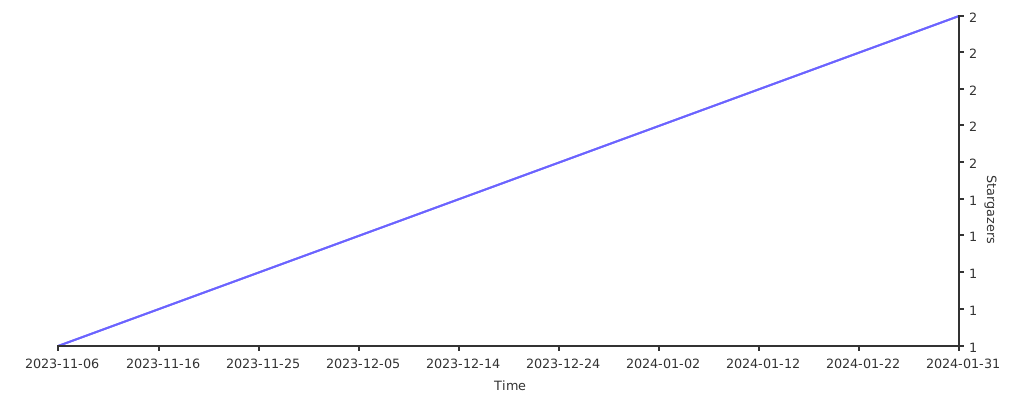
- Stars: 2
- Watchers: 3
- Forks: 0
- Open Issues: 0
- Releases: 1
Topics
Metadata Files
README.md
PyXSec
Table of contents
Introduction
PyXSec is a Python framework used to measure the differential cross-sections of particle physics processes using the unfolding technique. The peculiarity of this software is that you can perform this measurements using classical- and quantum-computing based techniques.
This software is currently based ROOT, but plans are work in progress to substitute it with NumPy and uproot.
For the moment the cross-sections can be measured using the following unfolding modules:
The idea at the base of this framework was inspired by the TTbarUnfold framework, developed by Marino Romano, which is widely used in particle physics analyses to measure cross-sections using classical unfolding techniques.
:warning: The project is currently work-in-progress and it is still not ready for production. See the contribution file if interested.
:warning: This project is not currently available on PyPI, but it will be very soon. Our idea is to let it be easily installable in order to keep analyses as clean as possible and doesn't require to clone the entire repository everytime for a new study.
Developer environment
To setup the environment for PyXSec development you need two dependencies:
To setup the conda conda environment to work with the repository (only the first time):
shell
conda create --name pyxsec-dev python==3.10
conda activate pyxsec-dev
pip install -r requirements.txt
pip cache purge && pip check
and every time you open a new shell:
shell
conda activate pyxsec-dev
How to use
The usage is very simple. You need an input XML configuration file with all the paths and the files needed for the measurement. An example is the following:
XML
<configuration>
    <data       file="PWGH7.AFII.root"  hpath="reco/2j2b_emu/DR_b1b2" />                      <!-- Data -->
    <sig        file="AFII.root"        hpath="reco/2j2b_emu/DR_b1b2" />                      <!-- Signal -->
    <bkg        file=""                 hpath="" />                                           <!-- Background -->
    <res        file="AFII.root"        hpath="reco/2j2b_emu/particle_DR_b1b2_vs_DR_b1b2" />  <!-- Response matrix -->
    <gen        file="AFII.root"        hpath="particle/2j2b_emu/particle_DR_b1b2" />         <!-- Theory distributions -->
    <lumi       value="138965.16" />                                                          <!-- Luminosity -->
    <br         value="1"/>                                                                   <!-- Branching ratio -->
    <do_total   value="0" />                                                                  <!-- Do total xsec -->
    <unfolding  method="SimNeal"        regularization="0" statErr="toys:Gauss" ntoys="0" />  <!-- Unfolding settings -->
    <spectrum   particle="2j2b_emu"     variable="DR_b1b2" />                                 <!-- Particle-level info -->
</configuration>
each ROOT file must have reco and particle/parton level tress well separated. Each tree must contain branches for each interested selection and each branch must contain variables distributions to be unfolded and response matrices.
A quick example about how to use the framework:
shell
python PyXSec.py --config="config.xml" --output="output.root"
:warning: This usage is still not supported, but this should be the final form of the framework signature.
Credits
Main developers
 Gianluca Bianco |
 Simone Gasperini |
Other contributors
 DrWatt |
Stargazers over time
Owner
- Name: Gianluca Bianco
- Login: JustWhit3
- Kind: user
- Location: Bologna, Italy
- Company: University of Bologna and INFN
- Website: https://justwhit3.github.io/
- Twitter: JustWhit33
- Repositories: 14
- Profile: https://github.com/JustWhit3
PhD student in particle physics at the University of Bologna and member of the CERN ATLAS experiment. Passionate about coding (C++ in particular)
Citation (CITATION.cff)
cff-version: 1.2.0
message: "If you use this software, please cite it as below."
authors:
  - family-names: "Bianco"
    given-names: "Gianluca"
  - family-names: "Gasperini"
    given-names: "Simone"
title: "PyXSec"
version: 0.0.1
doi: https://zenodo.org/doi/10.5281/zenodo.10131534
date-released: 2023-11-15
url: "https://github.com/JustWhit3/PyXSec"