kedro
Kedro is a toolbox for production-ready data science. It uses software engineering best practices to help you create data engineering and data science pipelines that are reproducible, maintainable, and modular.
Science Score: 54.0%
This score indicates how likely this project is to be science-related based on various indicators:
-
✓CITATION.cff file
Found CITATION.cff file -
✓codemeta.json file
Found codemeta.json file -
✓.zenodo.json file
Found .zenodo.json file -
○DOI references
-
○Academic publication links
-
✓Committers with academic emails
4 of 254 committers (1.6%) from academic institutions -
○Institutional organization owner
-
○JOSS paper metadata
-
○Scientific vocabulary similarity
Low similarity (14.1%) to scientific vocabulary
Keywords
Keywords from Contributors
Repository
Kedro is a toolbox for production-ready data science. It uses software engineering best practices to help you create data engineering and data science pipelines that are reproducible, maintainable, and modular.
Basic Info
- Host: GitHub
- Owner: kedro-org
- License: apache-2.0
- Language: Python
- Default Branch: main
- Homepage: https://kedro.org
- Size: 232 MB
Statistics
- Stars: 10,505
- Watchers: 104
- Forks: 961
- Open Issues: 162
- Releases: 63
Topics
Metadata Files
README.md












What is Kedro?
Kedro is a toolbox for production-ready data science. It uses software engineering best practices to help you create data engineering and data science pipelines that are reproducible, maintainable, and modular. You can find out more at kedro.org.
Kedro is an open-source Python framework hosted by the LF AI & Data Foundation.
How do I install Kedro?
To install Kedro from the Python Package Index (PyPI) run:
uv pip install kedro
It is also possible to install Kedro using conda:
conda install -c conda-forge kedro
Our Get Started guide contains full installation instructions, and includes how to set up Python virtual environments.
Installation from source
To access the latest Kedro version before its official release, install it from the main branch.
uv pip install git+https://github.com/kedro-org/kedro@main
What are the main features of Kedro?
| Feature | What is this? |
| -------------------- |----------------------------------------------------------------------------------------------------------------------------------------------------------------------------------------------------------------------------------------------------------------------------------------------------------------------------------------------------------------------------------------------------|
| Project Template | A standard, modifiable and easy-to-use project template based on Cookiecutter Data Science. |
| Data Catalog | A series of lightweight data connectors used to save and load data across many different file formats and file systems, including local and network file systems, cloud object stores, and HDFS. The Data Catalog also includes data and model versioning for file-based systems. |
| Pipeline Abstraction | Automatic resolution of dependencies between pure Python functions and data pipeline visualisation using Kedro-Viz. |
| Coding Standards | Test-driven development using pytest, produce well-documented code using Sphinx, create linted code with support for ruff and make use of the standard Python logging library. |
| Flexible Deployment | Deployment strategies that include single or distributed-machine deployment as well as additional support for deploying on Argo, Prefect, Kubeflow, AWS Batch, and Databricks. |
How do I use Kedro?
The Kedro documentation first explains how to install Kedro and then introduces key Kedro concepts.
You can then review the spaceflights tutorial to build a Kedro project for hands-on experience.
For new and intermediate Kedro users, there's a comprehensive section on how to visualise Kedro projects using Kedro-Viz.
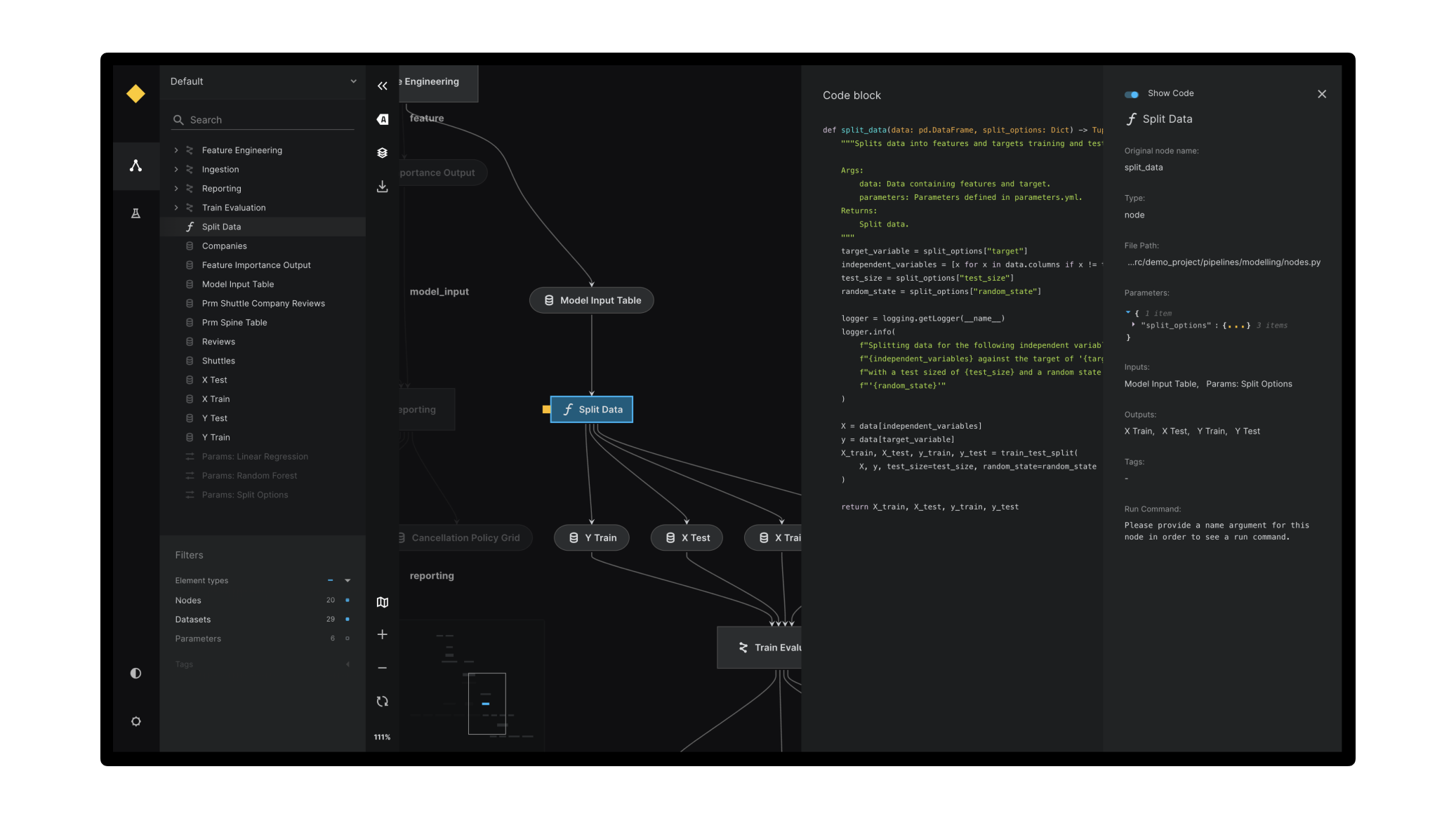 A pipeline visualisation generated using Kedro-Viz
Additional documentation explains how to work with Kedro and Jupyter notebooks, and there are a set of advanced user guides for advanced for key Kedro features. We also recommend the API reference documentation for further information.
Why does Kedro exist?
Kedro is built upon our collective best-practice (and mistakes) trying to deliver real-world ML applications that have vast amounts of raw unvetted data. We developed Kedro to achieve the following:
- To address the main shortcomings of Jupyter notebooks, one-off scripts, and glue-code because there is a focus on creating maintainable data science code
- To enhance team collaboration when different team members have varied exposure to software engineering concepts
- To increase efficiency, because applied concepts like modularity and separation of concerns inspire the creation of reusable analytics code
Find out more about how Kedro can answer your use cases from the product FAQs on the Kedro website.
The humans behind Kedro
The Kedro product team and a number of open source contributors from across the world maintain Kedro.
Can I contribute?
Yes! We welcome all kinds of contributions. Check out our guide to contributing to Kedro.
Where can I learn more?
There is a growing community around Kedro. We encourage you to ask and answer technical questions on Slack and bookmark the Linen archive of past discussions.
We keep a list of technical FAQs in the Kedro documentation and you can find a growing list of blog posts, videos and projects that use Kedro over on the awesome-kedro GitHub repository. If you have created anything with Kedro we'd love to include it on the list. Just make a PR to add it!
How can I cite Kedro?
If you're an academic, Kedro can also help you, for example, as a tool to solve the problem of reproducible research. Use the "Cite this repository" button on our repository to generate a citation from the CITATION.cff file.
Python version support policy
- The core Kedro Framework supports all Python versions that are actively maintained by the CPython core team. When a Python version reaches end of life, support for that version is dropped from Kedro. This is not considered a breaking change.
- The Kedro Datasets package follows the NEP 29 Python version support policy. This means that
kedro-datasetsgenerally drops Python version support beforekedro. This is becausekedro-datasetshas a lot of dependencies that follow NEP 29 and the more conservative version support approach of the Kedro Framework makes it hard to manage those dependencies properly.
☕️ Kedro Coffee Chat 🔶
We appreciate our community and want to stay connected. For that, we offer a public Coffee Chat format where we share updates and cool stuff around Kedro once every two weeks and give you time to ask your questions live.
Check out the upcoming demo topics and dates at the Kedro Coffee Chat wiki page.
Follow our Slack announcement channel to see Kedro Coffee Chat announcements and access demo recordings.
Owner
- Name: Kedro
- Login: kedro-org
- Kind: organization
- Email: info@lfaidata.foundation
- Location: United States of America
- Website: https://kedro.org/
- Repositories: 14
- Profile: https://github.com/kedro-org
Kedro is an open-source Python framework for creating reproducible, maintainable and modular data science code. It is hosted in incubation in LF AI & Data.
Citation (CITATION.cff)
cff-version: 1.2.0
message: If you use this software, please cite it as below.
authors:
- family-names: Alam
  given-names: Sajid
- family-names: Chan
  given-names: Nok Lam
- family-names: Couto
  given-names: Laura
- family-names: Dada
  given-names: Yetunde
  orcid: https://orcid.org/0000-0002-5273-954X
- family-names: Danov
  given-names: Ivan
- family-names: Datta
  given-names: Deepyaman
  orcid: https://orcid.org/0009-0006-7814-1446
- family-names: DeBold
  given-names: Tynan
- family-names: Gundaniya
  given-names: Jitendra
- family-names: Honoré-Rougé
  given-names: Yolan
- family-names: Kaiser
  given-names: Stephanie
- family-names: Kanchwala
  given-names: Rashida
- family-names: Katiyar
  given-names: Ankita
- family-names: Pilla
  given-names: Ravi Kumar
- family-names: Nguyen
  given-names: Huong
- family-names: Cano Rodríguez
  given-names: Juan Luis
  orcid: https://orcid.org/0000-0002-2187-161X
- family-names: Schwarzmann
  given-names: Joel
- family-names: Sorokin
  given-names: Dmitry
- family-names: Theisen
  given-names: Merel
- family-names: Zabłocki
  given-names: Marcin
- family-names: Brugman
  given-names: Simon
- family-names: Khaustova
  given-names: Elena
- family-names: Ko
  given-names: Elijah
title: Kedro
version: 1.0.0
date-released: 2025-07-22
url: https://github.com/kedro-org/kedro
Committers
Last synced: about 1 year ago
Top Committers
| Name | Commits | |
|---|---|---|
| Lorena Bălan | l****n@q****m | 208 |
| Deepyaman Datta | d****a@u****u | 158 |
| Merel Theisen | 4****t | 151 |
| Nok Lam Chan | n****n@q****m | 149 |
| Ankita Katiyar | 1****r | 108 |
| Kiyohito Kunii (Kiyo) | 8****o | 105 |
| Jo Stichbury | j****y@m****m | 99 |
| Lim Hoang | l****o@g****m | 95 |
| Andrii Ivaniuk | a****k@g****m | 94 |
| Antony Milne | 4****B | 90 |
| Dmitrii Deriabin | 4****B | 83 |
| Merel Theisen | 4****B | 83 |
| Sajid Alam | 9****B | 83 |
| dependabot[bot] | 4****] | 72 |
| Yetunde Dada | 4****a | 64 |
| Ahdra Merali | 9****B | 56 |
| Zain Patel | z****l@q****m | 51 |
| ElenaKhaustova | 1****a | 49 |
| Ivan Danov | i****v | 41 |
| Juan Luis Cano Rodríguez | j****o@m****m | 41 |
| Dmitry Sorokin | 4****S | 34 |
| L. R. Couto | 5****o | 34 |
| Zain Patel | 5****B | 32 |
| Anton Kirilenko | a****o@q****m | 32 |
| Gordon Wrigley | g****y@q****m | 27 |
| LorenaBalanQB | 4****B | 23 |
| CarolineMLynch | 1****h | 22 |
| Jannic | 3****r | 22 |
| Waylon Walker | w****n@w****m | 20 |
| Jiri Klein | 4****n | 19 |
| and 224 more... | ||
Committer Domains (Top 20 + Academic)
Issues and Pull Requests
Last synced: 10 months ago
All Time
- Total issues: 1,356
- Total pull requests: 1,584
- Average time to close issues: 6 months
- Average time to close pull requests: 12 days
- Total issue authors: 203
- Total pull request authors: 105
- Average comments per issue: 3.5
- Average comments per pull request: 1.84
- Merged pull requests: 1,136
- Bot issues: 205
- Bot pull requests: 92
Past Year
- Issues: 429
- Pull requests: 655
- Average time to close issues: 16 days
- Average time to close pull requests: 7 days
- Issue authors: 77
- Pull request authors: 49
- Average comments per issue: 1.27
- Average comments per pull request: 1.34
- Merged pull requests: 445
- Bot issues: 125
- Bot pull requests: 32
Top Authors
Issue Authors
- github-actions[bot] (205)
- merelcht (190)
- noklam (148)
- astrojuanlu (117)
- ElenaKhaustova (95)
- stichbury (77)
- ankatiyar (38)
- AhdraMeraliQB (29)
- deepyaman (24)
- yetudada (20)
- antonymilne (20)
- amandakys (19)
- DimedS (18)
- yury-fedotov (15)
- ravi-kumar-pilla (13)
Pull Request Authors
- merelcht (228)
- ElenaKhaustova (196)
- noklam (162)
- ankatiyar (155)
- dependabot[bot] (91)
- lrcouto (85)
- DimedS (73)
- deepyaman (60)
- AhdraMeraliQB (55)
- stichbury (52)
- SajidAlamQB (51)
- Huongg (42)
- idanov (42)
- astrojuanlu (36)
- ravi-kumar-pilla (34)
Top Labels
Issue Labels
Pull Request Labels
Dependencies
- actions/checkout v3 composite
- errata-ai/vale-action reviewdog composite
- actions/cache v3 composite
- actions/checkout v3 composite
- actions/setup-python v3 composite
- microsoft/setup-msbuild v1 composite
- github/issue-metrics v2 composite
- peter-evans/create-issue-from-file v4 composite
- actions/cache v3 composite
- actions/checkout v3 composite
- actions/setup-python v3 composite
- upsidr/merge-gatekeeper v1 composite
- jayqi/failed-build-issue-action v1 composite
- actions/cache v3 composite
- actions/checkout v3 composite
- actions/setup-python v3 composite
- microsoft/setup-msbuild v1 composite
- peter-evans/repository-dispatch v2 composite
- actions/cache v3 composite
- actions/checkout v3 composite
- actions/setup-python v3 composite
- microsoft/setup-msbuild v1 composite
- cimg/python 3.8 build
- PyYAML >=4.2,<7.0
- anyconfig >=0.10.0
- attrs >=21.3
- build >=0.7.0
- cachetools >=4.1
- click >=4.0
- cookiecutter >=2.1.1,<3.0
- dynaconf >=3.1.2,<4.0
- fsspec >=2021.4
- gitpython >=3.0
- importlib-metadata >=3.6,<7.0; python_version >= '3.8'
- importlib_metadata >=3.6,<5.0; python_version < '3.8'
- importlib_resources >=1.3,<7.0
- jmespath >=0.9.5
- more_itertools >=8.14.0
- omegaconf >=2.1.1
- parse >=1.19.0
- pip-tools >=6.5
- pluggy >=1.0,<1.3
- rich >=12.0,<14.0
- rope >=0.21,<2.0
- setuptools >=65.5.1
- toml >=0.10.0
- toposort >=1.5
- pip >=21.2
- twine *
- black * test
- ipython >=7.31.1,<8.0 test
- ipython * test
- jupyter * test
- jupyterlab * test
- jupyterlab_server >=2.11.1,<2.16.0 test
- kedro * test
- kedro-datasets * test
- kedro-telemetry >=0.3.1 test
- pytest * test
- pytest-cov * test
- pytest-mock >=1.7.1,<2.0 test
- black *
- ipython *
- jupyter *
- jupyterlab *
- jupyterlab_server >=2.11.1,<2.16.0
- kedro *
- kedro-telemetry >=0.3.1
- pytest *
- pytest-cov *
- pytest-mock >=1.7.1,<2.0
- ruff *
- traitlets <5.10.0