Science Score: 44.0%
This score indicates how likely this project is to be science-related based on various indicators:
-
✓CITATION.cff file
Found CITATION.cff file -
✓codemeta.json file
Found codemeta.json file -
✓.zenodo.json file
Found .zenodo.json file -
○DOI references
-
○Academic publication links
-
○Academic email domains
-
○Institutional organization owner
-
○JOSS paper metadata
-
○Scientific vocabulary similarity
Low similarity (11.3%) to scientific vocabulary
Keywords
Repository
LiaScript documentation course
Basic Info
- Host: GitHub
- Owner: LiaScript
- Language: Java
- Default Branch: master
- Homepage: https://liascript.github.io/course/?https://raw.githubusercontent.com/liaScript/docs/master/README.md
- Size: 26.4 MB
Statistics
- Stars: 21
- Watchers: 2
- Forks: 16
- Open Issues: 0
- Releases: 6
Topics
Metadata Files
README.md
https://github.com/user-attachments/assets/7cab2d61-5858-4b62-87bf-0598e44af2e7
LiaScript
To see this document as an interactive LiaScript rendered version, click on the following link/badge:
If you need help, feel free to ask us any questions in the chat:


--{{0}}--
With LiaScript, we tried to implement an extended Markdown format that should enable everyone to create, share, adapt, translate or correct online courses without the need of being a web-developer. We believe that a language-based approach, instead of a tooling-centered one, provides more flexibility, freedom of creativity, and sustainability. Therefore we tried to develop a simplistic syntax that extends the static Markdown with quizzes, animations, spoken text, automated visualization ASCII-art and much more. Everything has been woven around Markdown, so that the content can still be read and interpreted with any kind of editor or Markdown-interpreter.
What is LiaScript?
- a Markdown dialect for interactive courses and data-driven publishing,
- everything is implemented in Elm/JavaScript and runs directly within the browser (online),
- the interpreter itself is also a reader, which allows for storing documents as well as the progress,
- courses can also be taken offline, since the interpreter is also a progressive web app (PWA), that allows to store documents and progress directly within the browser (locally),
everything is private, we do not store any data about the courses nor the users and their progress
--{{1}}--There are a couple of problems that we currently see in the creation of Open educational resources (OER). One of them is isolation, that means people, who want to create content, are seldom connected via the applied technologies, instead, they are separated by platforms, authoring tools and used core technologies (programming languages). Furthermore, it is not possible to simply grab an educational website/project and to adapt its content for another audience. Additionally, it seems to be nearly impossible for people without a technical background to simply set up a small course. Thus, they stuck with Word, PowerPoint, and PDF, since they provide a simple continuation of the static formats people have used before the computer-era. "If I want to publish content for the computer, I want my audience to dive in, experiment, simulate, play with the content... but not only read."
{{1}}
Goals
- Simplicity: with a human-centered markup-language, anyone should be enabled to create and modify content.
- Interactive: the browser is the next operating systems and although content with LiaScript is developed within a "static" markup-language it should not be presented that way.
- Extendability: everything that is not part of LiaScript shall be embeddable and importable.
- Durability: platforms go down, the development of proprietary software/formats is discontinued, but LiaScript is not hosted on one platform (it can be hosted everywhere) and even without the LiaScript interpreter the content is still readable and interpretable with every editor; you could even print or engrave it on stone or clay. Furthermore, if you use some kind of versioning system (e.g. git) you can refer to any previous version of your course.
--{{2}}--
Imagine a world where everyone would have the same access to high quality educational content for free. Imagine all kind of schoolbooks, technical or scientific literature could become open-courSe projects and more interactive, with collaborating teachers and students. Everything that is required is a simple text-editor and a web-browser.
{{2}}

Tools
--{{0}}--
As already mentioned all you need to work with LiaScript is an text-editor, but it can be useful to apply one of the following tools. At least we apply them to see the result of a change within the course document immediately. You will see, that the development of online-courses will speed up, especially if there is no need for memorizing complex point and click sequences.
"Let the editor be your canvas and the keyboard your brush."
Editing
--{{0}}--
There are currently 2 plugins for the Atom Editor and Visual-Studio-Code available, which are intended to ease and simplify the development of online courses with LiaScript. Additionally you can use the LiveEditor, an entirely browser based application.
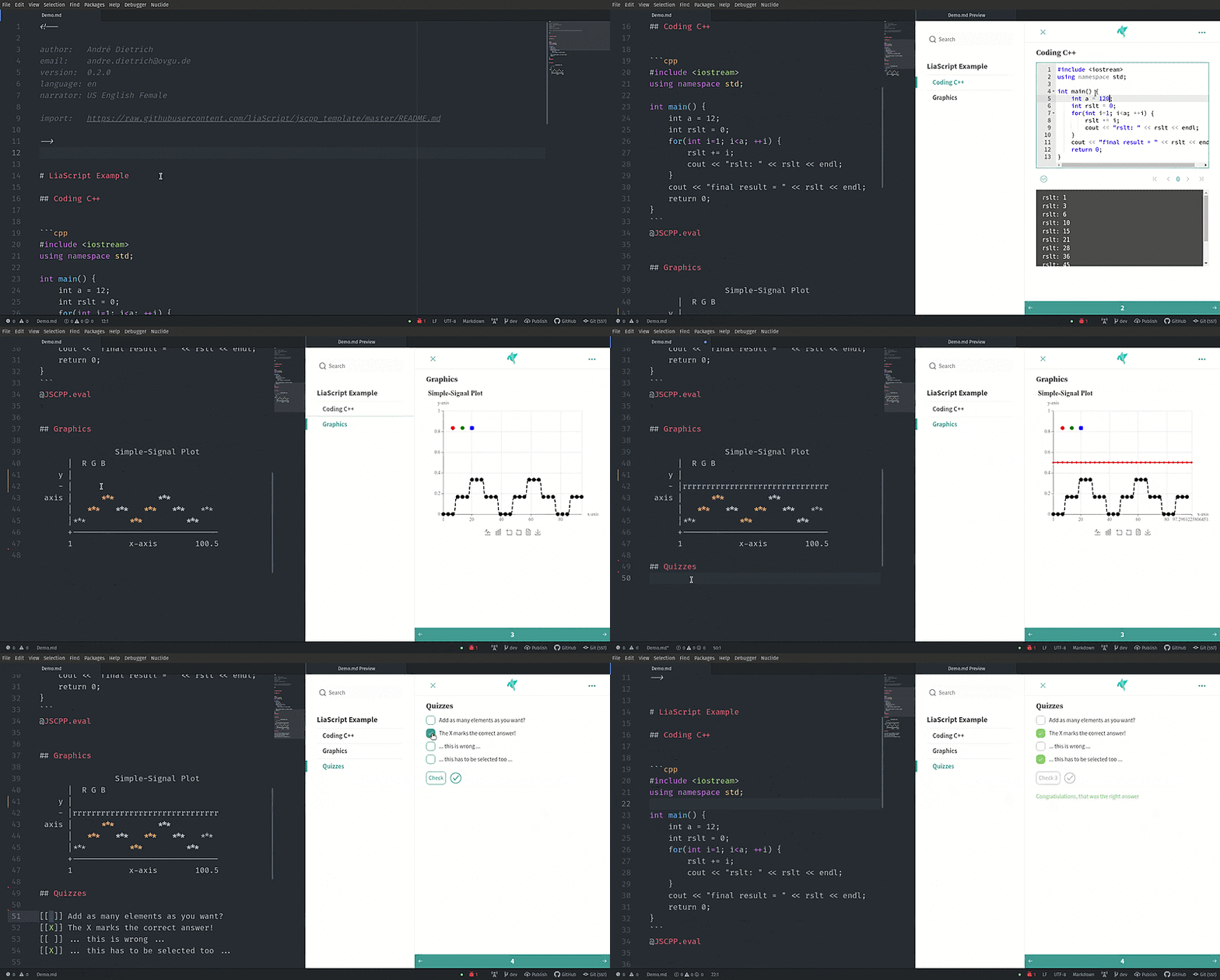
LiveEditor: Fully functional online editor, that looks like CodiMD, but is entirely browser based. With support for uploading images and videos and collaborative editing.
Atom: This is the free and open and official GitHub editor, with lots of plugins for various use cases.
- liascript-preview:
Is a tiny previewer that, if it was toggled (
Alt+L), updates the view on your course each time you save your document. - liascript-snippets:
If you start typing
liain your Markdown document you switch on a fuzzy search, that contains a lot of LiaScript help, examples, and snippets.
- liascript-preview:
Is a tiny previewer that, if it was toggled (
Detailed installation instructions can be found here.
Visual-Studio-Code: This is Microsoft's free popular editor with various plugins and extensions.
- liascript-preview:
Is a tiny previewer that, if it was toggled (
Alt+L), updates the view on your course each time you save your document. - liascript-snippets:
If you start typing
liain your Markdown document you switch on a fuzzy search, that contains a lot of LiaScript help, examples, and snippets.
- liascript-preview:
Is a tiny previewer that, if it was toggled (
Detailed installation instructions can be found here.
Using the GitHub builtin Web editor, you can install the following extension to preview your course while editing:
{{1}}
LiaScript-DevServer:
--{{1}}--
If you are used to another editor, you can also start a LiaScript development server locally. It works like the plugin for Atom and updates your course within your browser on every save, but this can also be used to monitor multiple projects. And you can also use it for testing purposes, as if you would deploy your projects.
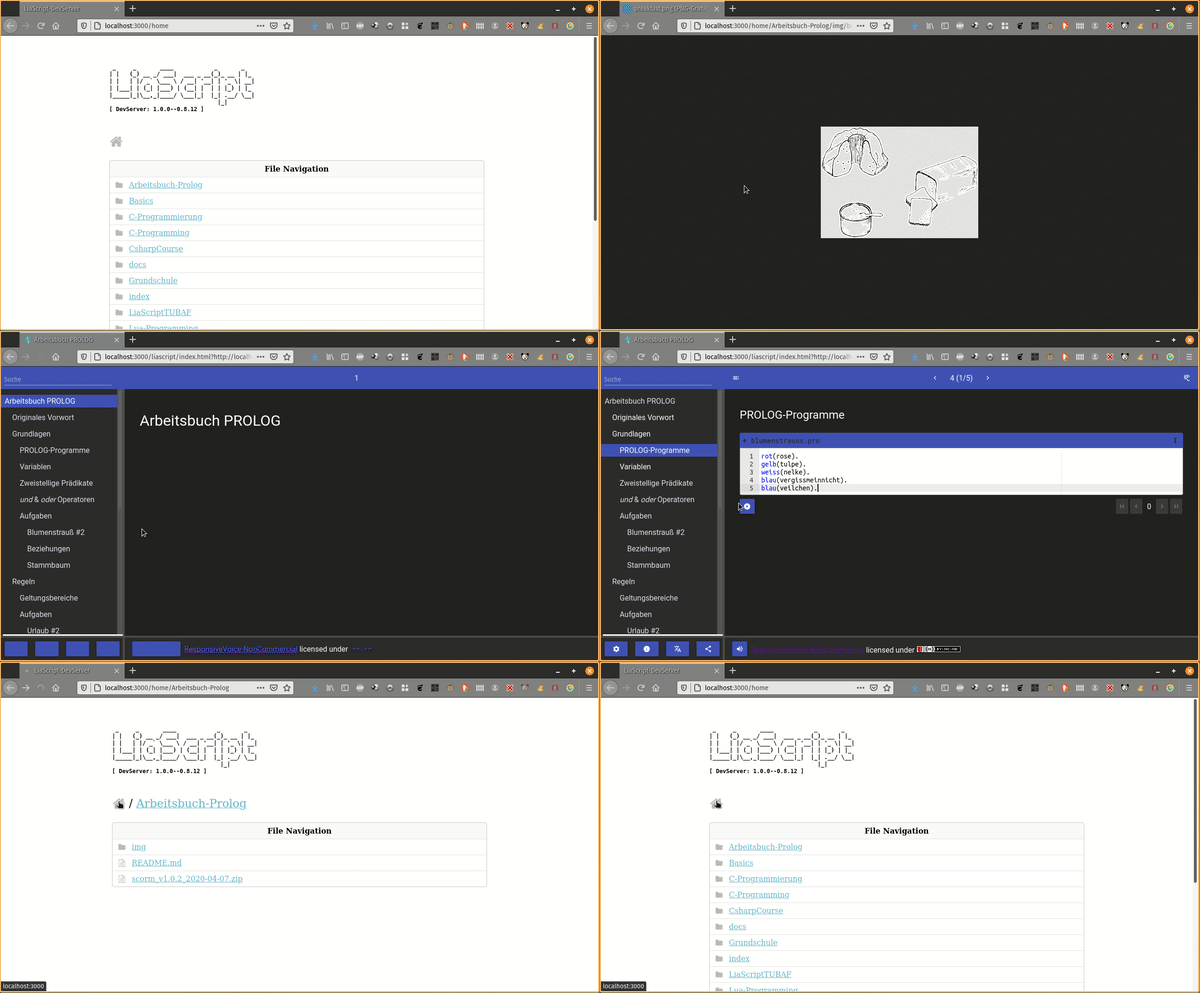
Get the project from:
- npmjs: https://www.npmjs.com/package/@liascript/devserver
- GitHub: https://github.com/LiaScript/LiaScript-DevServer
{{2}}
CodiLIA:
--{{2}}--
If you prefer to work with multiple authors simultaneously, then you should give CodiLIA a try. It is a fork of the collaborative editor CodiMD/HedgeDoc, but instead of a Markdown preview, you will have a LiaScript preview, and you can immediately publish your courses.
Project: https://github.com/liascript/codilia
Projects
--{{0}}--
The easiest way of importing a LiaScript into another website or
Learning Management System (LMS)
such as
Moodle,
ILIAS, or
OPAL, is via importing
an external website or if possible via an
iframe.
{{1}}
LiaScript-Exporter:
--{{1}}--
However, there might be cases where you want to store the progress within the LMS. We therefore have developed an experimental exporter, which allows to bundle your entire project as an SCORM compliant zip-file that can be imported into most common LMS. Other formats than SCORM can be added too, simply write us a mail or create an issue, if you require another one.
- npmjs: https://www.npmjs.com/package/@liascript/exporter
- GitHub: https://github.com/liascript/liascript-exporter
{{2}}
Preview-Lia:
--{{2}}--
If you want to refer to your own courses or to foreign ones on your personal
website or blog, you can make use of our "preview web component". This creates
preview cards, which are updated at client-side, so that there is no need to
manually update all information whenever there is a change in the course. Simply
add the script tag as depicted in the code-snippet and link to your courses
via the tag preview-lia.
``` html
...<preview-lia src="https://liascript.github.io/course/?https://raw.githubusercontent.com/liaScript/docs/master/README.md">
</preview-lia>
...
```
For more information visit the blog entry: Markdown just got a new preview tag
However, you can also use this to refer to your personal GitHub projects.
--{{3}}--
LiaScript was originally developed for supporting programming courses for embedded systems. You can see an example of the previous eLab remote laboratory installation.
{{3}}
--{{4}}--
Now it is the opposite, our main focus lays in the development of the Markup language, but parts of the old systems can still be used. Especially if you want to teach programming in (Java, C, C++, C#, Mono, Go and Python). The CodeRunner is an open-source project that enables remote compiling and execution of code. We apply it to teach procedural and object-oriented programming. You can either host your own server or use our free herokuapp:
{{4}}
CodeRunner:
GitHub: https://github.com/liascript/CodeRunner
Try the interactive LiaScript version at:
https://liascript.github.io/course/?https://github.com/liascript/CodeRunner
- Or if you want to import this functionality into your course, then add the following statement into the main header of your LiaScript course:
import: https://raw.githubusercontent.com/LiaScript/CodeRunner/master/README.md
Publishing
--{{0}}--
By now you should have a basic idea of what you can do with LiaScript, but probably not how you can publish your courses. The best way is actually to use GitHub, this way no prior versions of your course get lost, and you give others (you can even invite them) the opportunity to contribute to your project.
--{{1}}--
No further hosting is required, no further compilation step, the JavaScript interpreter of LiaScript does everything else directly within the browser at client-side.
--{{2}}--
As you can see from the example, it is also possible to refer to a specific
slide. You only have to add a # with the number of the slide, or you can add
the name of the specific slide as well.
--{{3}}--
You can also add additional tags to your project to make it discoverable. We
currently use three distinct categories: liascript to mark it to be related to
the projects, while the others liascript-course and liascript-template are
used to distinguish the projects into courses or extension, which can be added
to courses.
--{{4}}--
The same way you can also refer to courses that you have put into your DropBox, ownCloud, NextCloud, or if you have access to some old-fashioned web-space then you can also store all of your files there. You only have to make them publicly available and to refer to the raw or in other words, the text document. All other sources are loaded relative to this URL.
- Create a free account at https://github.com
- Refer to your projects as via a URL parameter:
https://LiaScript.github.io/course/?YOUR_RAW_COURSE_URL.md
- Example with reference to a specific slide:
https://liascript.github.io/course/?https://raw.githubusercontent.com/liaScript/docs/master/README.md#5
- Make your document discoverable by adding the tags
liascriptand orliascript-course,liascript-templateto make it appear in one of the following GitHub topics:
- general: https://github.com/topics/liascript
- free courses: https://github.com/topics/liascript-course
- extensions: https://github.com/topics/liascript-template
More information on tagging projects can be found here.
LiaBooks
--{{0}}--
However, we have no idea who is using LiaScript elsewhere, so it might be hard to find some resources online. From time to time we translate open-books into LiaScript and make them more interactive. You can see some of our the experiments at the following URL and use them as a source of inspiration:
https://github.com/LiaBooks

Full overview on courses via the topic
liascript-course:https://github.com/topics/liascript-course
LiaTemplates
--{{0}}--
If you tried out CodeRunner, you will have probably noticed that you can reuse
functionality from different courses, simply by using the keyword import:
within the main definition of your LiaScript document. Such a functionality is
defined with the help of macros. We will dive deeper into this feature at the
end of this document, but if you are interested you can inspect some of our
templates, which shall provide self-explaining courses of how to embed and use
the implemented macros.
https://github.com/LiaTemplates

Full overview on extensions via the topic
liascript-template:https://github.com/topics/liascript-template
Markdown-Syntax
--{{0}}--
This section is intended to give a brief overview on the basic Markdown syntax
elements. The only difference to common Markdown at this point is, that you can
define meta-information such as author, language, voice, etc. within a
HTML-comment at the beginning of every document. We will describe all of these
elements in more detail in section: Macros. All of these macros
start with a single word, which is followed by a colon. If you require more
space, like for comment: or link: you can use multiple lines, but every
following line has to start with an indentation.
Initial LIA-comment-tag for basic definitions:
``` XML <!--
author: Andre Dietrich
email: LiaScript@web.de
version: 0.0.1
language: en
narrator: US English Female
comment: Write a short abstract of your course, that might contain multiple lines and sentences.
script: https://javascriptresourseurl
script: https://anotherjavascriptresourse_url
link: https://somecssstuff https://andsomemore_css --> ```
--{{1}}--
The meta-information from your document is later shown within the information-section as well as within the home-section.
{{1}}

--{{2}}--
If you already know Markdown, then you can skip most of the content in this section. However, there are some slight differences that will be marked with a trailing star at the section title.
{{2}}
Something might be different 💫
Structuring
--{{0}}--
A course is structured as any other Markdown document with starting hash-tags, whereby the number of hash-tags is used to define the hierarchy of your document.
```markdown
Main Title
...
Section Title 1
...
Subsection Title
...
Section Title 2
```
--{{1}}--
Every section is presented separately. In contrast to most Markdown-parsers, LiaScript applies a two step-approach. Sections are parsed at first, which means that the parsers searches for patterns as depicted below. Parsing the content of a section is quite time-consuming, that is why the section-content gets only analyzed, if this specific section should be displayed to the user. However, this happens only at the first appearance, afterwards the resulting view is restored from a local cache.
{{1}}
Preprocessing pattern: ## foo bar
Semantic Correct HTML
--{{0}}--
As mentioned earlier, the preprocessor searches for patterns ## header at the beginning of a line to identify sections.
However, there might be cases where you want to have multiple different sections on one slide, with different headers.
Semantic HTML can help us to deal with this, especially the two HTML5 tags section and article.
``` markdown
Slide-Title
```
--{{1}}--
LiaScript will identify these HTML-tags and the content, such that the content within cannot be used as a separator. If you use these two semantic tags, your content is grouped in semantic correct way, which improves the readability if screen-readers are used or keyboard navigation is used.
--{{2}}--
When to use which tag might be philosophical question.
We can say, if you just want to structure your content with different sub-headers, then use <section>.
If your content represents a self-contained document, then use <article>.
However, the visually presented result will be the same, such that you could also
use a <div> to structure your content.
Sub-Titles 💫
--{{0}}--
There might be some cases, where you want to add further headings quickly. We therefore
apply the following syntax with underlining "equal signs" or "dashes". In
common Markdown, this alternative syntax is applied to define level-1 and
level-2 headings. We use it to create headings that are one level = or two
levels - below the main heading. However, these subsections will not be part
of the table of contents, and since their interpretation is slightly different
to common Markdown, you should use the method presented in the previous section.
```markdown ...
Section Title
Local Subsection
Local Sub-SubSection
```
Content blocks
--{{0}}--
How would you separate paragraphs or other content elements from each other, if you only have a type-writer? The easiest way is a spatial separation, and in Markdown this is done via an empty line. Thus, whenever you have blocks such as paragraphs, enumerations, or tables, it is common practice to separate them via a newline. This makes it easier for you to edit and structure your course, and it prevents the interpreter from too much work.
``` markdown This is a paragraph that consist only of one line.
Here comes another paragraph with multiple lines. And multiple sentences. ```
Text-Formatting 💫
--{{0}}--
How does text-highlighting work in a text file and thus within a paragraph? Well, Markdown defines some basic characters that can be used to surround a word or a collection of words. We tried to use the GitHub flavored Markdown style for simple formatting, thus simply use multiple asterisks or underscores to mark certain parts of a text.
*italic*-> italic<!-- class="notranslate"-->**bold**-> bold<!-- class="notranslate"-->***bold and italic ***-> **bold and italic **<!-- class="notranslate"-->_also italic_-> also italic<!-- class="notranslate"-->__also bold__-> also bold<!-- class="notranslate"-->___also bold and italic___-> also bold and italic<!-- class="notranslate"-->~strike~-> ~strike~<!-- class="notranslate"-->--{{1}}--We define some additions to common Markdown, such as underline and superscript, which can be defined with the following syntax:
{{1}}~~underline~~-> ~~underline~~<!-- class="notranslate"-->~~~strike and underline~~~-> ~~~strike and underline~~~<!-- class="notranslate"-->^superscript^-> ^superscript^<!-- class="notranslate"-->
Combinations
--{{0}}--
As you can see from the examples, you can combine and nest all elements freely.
**bold _bold italic_**-> bold bold italic<!-- class="notranslate"-->**~bold strike~ ~~bold underline~~**-> ~bold strike~ ~~bold underline~~<!-- class="notranslate"-->*~italic strike~ ~~italic underline~~*-> ~italic strike~ ~~italic underline~~<!-- class="notranslate"-->
Typography
--{{0}}--
It is now possible within a LiaScript Markdown to apply sequences of dashes for typography. A sequence of dashes is now translated into:
- single dash
---> Hyphen or minus sign - - double dash
----> En dash -- triple dash
-----> Em dash -----{{1}}--An Ellipsis is indicated by a sequence of three dots:
{{1}}...will be translated to the Unicode symbol ...
Quotes
--{{0}}--
Additionally single and double quotes are translated into their typographical counterparts, based on the defined language in the header of the course.
German, French, English or Welsh will be translated into different Unicode symbols.
"That's a 'magic' shoe." --> “That’s a ‘magic’ shoe.”
Applied quote translation as defined here: https://en.wikipedia.org/wiki/Quotation_mark
--{{1}}--
If you want o use the original characters, you will have to escape them, as shown also in the next section:
{{1}}
\" --> \"\
\' --> \'
{{2}}
` for double quotations. This will still use the language definition for that document, but you can also overwrite this per markdown block or quote: ``` markdownThat's a 'magic' shoe.\Das ist ein magischer Schuh.--- Et voici un autre example:C'est une chaussure magique.```That's a 'magic' shoe.\Das ist ein magischer Schuh.--- Et voici un autre example:C'est une chaussure magique.
Escape Characters
--{{0}}--
If you want to use asterisks, hash-tags, or other syntax elements within your document without applying their functionality, then you can escape or in other words indicate them with a starting backslash. If you want to escape a backslash, you will have to write two subsequent backslashes. But you do not have to use it, if there is only one asterisk within a line, this will be interpreted as a single character. So you will have to apply this kind of escaping only to prevent misunderstandings between you and the interpreter.
markdown
\*, \~, \_, \#, \{, \}, \[, \], \|, \`, \$, \@, \\, \<, \>, \", \'
Result: *, ~, _, #, {, }, [, ], |, `, \$, \@, \, <, >, \", \'
Symbols & Unicode 💫
--{{0}}--
One thing that we missed in standard Markdown, was an implementation for arrows. The verbatim text shows, how arrows are defined in our Markdown implementation with their result on the right.
-> ->, ->> ->>, >-> >->, <- <-, <-< <-<,
<<- <<-, <-> <->, => =>, <= <=, <=> <=>
--> -->, <-- <--, <--> <-->, ==> ==>, <== <==, <==> <==>
~> ~>, <~ <~
--{{1}}--
But you can also use some basic smileys. We will try to extend this partial support in the future.
{{1}}
:-) :-), ;-) ;-), :-D :-D, :-O :-O, :-( :-(, :-| :-|,
:-/ :-/, :-P :-P, :-* :-*, :') :'), :'( :'(
--{{2}}--
However, since LiaScript accepts Unicode, you can also copy and paste any kind of character including emojis.
References
The next section shows how external resources can be referenced and integrated.
Simple Links
--{{0}}--
There are two ways of adding links to a Markdown document, either by inlining the URL directly or you can name it (as shown in listing 2), by applying the typical brackets and parenthesis notation, the optional information is put in double quotes at the end of the URL. This optional information is used as a title attribute, and it is shown, when the user hovers the link with the mouse.
- Example of an URL-link -> http://goo.gl/fGXNvu
text-formatting can be applied also *** http://goo.gl/fGXNvu *** ->
*** http://goo.gl/fGXNvu ***
Naming the link (
[title](http://goo.gl/fGXNvu "optional info")) -> titleFor internal navigation you can refer to the slide number or to title with a starting
#
[next slide](#18)-> next slide[next slide](#preview-lia-💫)-> next slideIf your internal link includes parentheses or other characters, you can also use percent-encoding. An opening parentheses would then be written as
%28and a closing one as%29.For more information visit: https://developer.mozilla.org/en-US/docs/Glossary/percent-encoding
Preview-Lia 💫
--{{0}}--
LiaScript has an advanced preview link, that will load the remote course and
parse the meta-information such as title, version, comment, logo, email, tags,
form your main HTML-comment at the top of your document. To do this, you will
have to use [preview-lia] as the title of your link, which is followed by the
raw URL of your course document.
[preview-lia](https://raw.githubusercontent.com/LiaScript/docs/master/README.md)
--{{1}}--
You can use this technique also to create previews for other courses on your personal website or for other GitHub projects, as it was described in section Projects. For more information follow the link:
{{1}} https://liascript.github.io/blog/markdown-just-got-a-new-preview-tag/
QR-Codes 💫
--{{0}}--
Sometimes it might be required to have both, a link and a visual representation
of it as an QR-Codes. Similar to previews, you simply name your link
qr-code:
- Syntax:
[qr-code](https://LiaScript.github.io) - Example:
--{{1}}--
You can add further information to your link by adding a title. Markdown is also allowed within the link title. In case of an image or media link, the title will be used as a subtitle and displayed accordingly.
{{1}}
- Syntax:
[qr-code](https://LiaScript.github.io "Checkout the LiaScript website or the __[blog](https://liascript.github.io/blog/)__") - Example:
eMail & Telephone 💫
--{{0}}--
These are two additional link types that you can also use within the <a> tag, but LiaScript supports them natively.
{{1}}
- mailto:
[Write me a Mail](mailto:LiaScript@web.de) --> Write me a Mail
[LiaScript\@web.de](mailto:LiaScript@web.de) --> LiaScript\@web.de
--{{1}}--
The mailto link type does not need to be explained.
On most modern systems, clicking on such a link will open your email client and insert the email address after the colon directly into the recipient address field.
Since the \@ symbol is used for macro calls, this has to be escaped at the moment.
{{2}}
- tel:
[Call me](tel:+49-12345-67890) --> Call me
[+49-12345-67890](tel:+49-12345-67890) --> +49-12345-67890
--{{2}}--
The tel link type is lesser known and has been introduced for mobile phones.
Clicking on such a link will trigger the dial dialog, allowing you to call the pre-set number without any need for copy and paste.
Images 💫
--{{0}}--
Images are defined similar to links, but they are indicated with a starting exclamation mark.
--{{1}}--
The name of the link or the alt-text is not wasted, since it is not displayed anymore. Instead, it is displayed, if the image cannot be loaded for some reasons, and it is used by screen readers to give visually impaired people a hint, of what will be visible on the image. So please, don't leave it empty.
--{{2}}--
The URL can be either relative to your Markdown document or it can be absolute, which means it is pointing to an external resource.
--{{3}}--
The optional title in LiaScript is not only used as a title attribute, instead it is used as a real sub-title for all media links.
Image-notation: 
{{2}}
- relative URL:


- absolute URL:


--{{4}}--
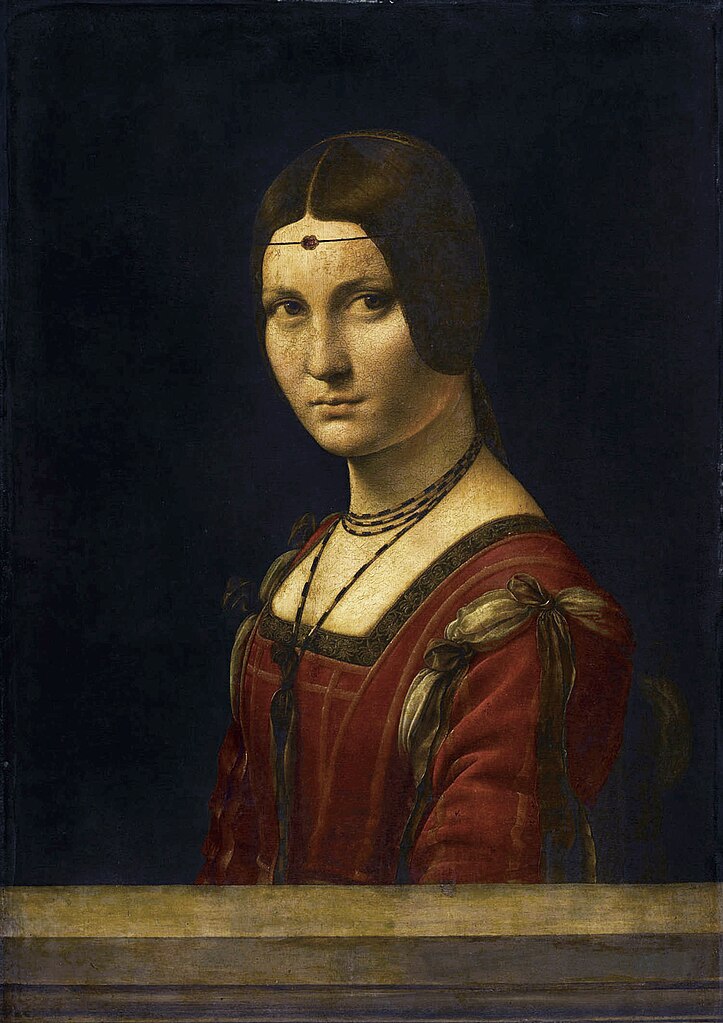
Note, that LiaScript is smart enough to scale your images to the optimal size. If your image is smaller than the current maximal applicable width, it is shown in full size. If it is larger, than it is scaled to fit in width and also in height. You can further click on all images to open them as modal and if the image is quite large, such as Leonardo's painting, then you can also zoom and inspect it, by hovering with the mouse or thumb.
--{{5}}--
Additionally, if you start a paragraph with an image, LiaScript expects it to be a floating object, which is depicted with a maximal size of 50% of your view-port, if it is not smaller than that.
{{5}}
``` markdown
Lorem ipsum dolor sit amet, consectetur adipisicing elit, ...
```
Lorem ipsum dolor
sit amet, consectetur adipisicing elit, sed do eiusmod tempor incididunt ut
labore et dolore magna aliqua. Ut enim ad minim veniam, quis nostrud
exercitation ullamco laboris nisi ut aliquip ex ea commodo consequat. Duis aute
irure dolor in reprehenderit in voluptate velit esse cillum dolore eu fugiat
nulla pariatur. Excepteur sint occaecat cupidatat non proident, sunt in culpa
qui officia deserunt mollit anim id est laborum. Lorem ipsum dolor sit amet,
consectetur adipisicing elit, sed do eiusmod tempor incididunt ut labore et
dolore magna aliqua. Ut enim ad minim veniam, quis nostrud exercitation ullamco
laboris nisi ut aliquip ex ea commodo consequat.
Galleries 💫
--{{0}}--
How would you interpret a paragraph full of images? We thought that the only reasonable depiction of this could be a gallery.
markdown


--{{1}}--
And we like this idea... You can click on every image and inspect it also with the zooming feature.
{{1}}




Audio 💫
--{{0}}--
If an exclamation mark indicates visual content, why not using a question mark to indicate auditive content. (From our perspective it resembles an ear.) Everything is similar to images and the URLs can be either relative or absolute.
- Syntax:
?[a horse](https://www.w3schools.com/html/horse.mp3 "hear a horse") - Example:
--{{1}}--
Additionally, you can also directly reference music from the SoundCloud website or from Music.YouTube. The associated song will be automatically embedded for you.
{{1}}
- Syntax:
?[soundcloud](https://soundcloud.com/glennmorrison/beethoven-moonlight-sonata) - Example:
Movies 💫
--{{0}}--
Images are marked with a starting exclamation mark before the link, audio by a
starting question mark and movies are made of images and sound, that is why you
combine both marks !?. Defining resources this way shows at least the links
correctly in other Markdown parsers or on GitHub. There is baked-in support for
YouTube, Vimeo,
PeerTube, DailyMotion and
TeacherTube, which means that you only have to
include the link and the resource will be embedded appropriately.
Movie-notation: !?[alt-text](movie-url)
- YouTube:
!?[The Future of Programming](https://www.youtube.com/watch?v=8pTEmbeENF4)
- relative path:
!?[Something about math](vid/math.mp4)
List of supported Video Platforms
--{{1}}--If you required more control over your video, such as autoplay, muted, start-time, and probably also size and colors, the you can also apply custom styling rules, then you should take a look at the following section:
{{1}}
So what is left?? 💫
--{{0}}--
If it is something else that you want to embed something else from another
website, then you should try out the link syntax with two starting question
marks. This means, LiaScript will try to use the oEmbed
service, which is offered by a couple of websites. If this succeeds, this will
embed only a specific part. If it fails, then LiaScript will at least try to
embed the website via an iframe.
Examples:
- SketchFab:
??[ear model](https://sketchfab.com/3d-models/ear-anatomy-468e2039bde34a3fabb9e90bff9cd56b)
- StoryMaps:
??[presentation](https://storymaps.arcgis.com/stories/583f8b48a857442cb8d27411c93a9664)
- CircuitJS:
??[Simulation: Non-inverting Amplifier](https://www.falstad.com/circuit/circuitjs.html?startCircuit=amp-noninvert.txt)
??Simulation: Non-inverting Amplifier
Galleries #2 💫
--{{0}}--
What you have seen previously with images is also possible with any kind of multimedia link. Simply put everything into one paragraph and LiaScript will automatically generate a gallery for you:
markdown
 ?[audio](url) !?[movie](url)
??[something else](url)
??[something else](url)
 ?a horse
!?Fun with Tables
??VTK VolumeContour
??Circuit simulation
??Bust of Nefertiti
?a horse
!?Fun with Tables
??VTK VolumeContour
??Circuit simulation
??Bust of Nefertiti
Markdown-Blocks
--{{0}}--
So far we had introduced Markdown only on a tiny level, which means, by now you should know how to emphasize words and phrases within a paragraph, how to add images and how you can use references to point to internal or external resources. But, all we did so far is to work with paragraphs. But as pointed out in the quote below, Markdown can do even more.
... Markdown’s syntax is comprised entirely of punctuation characters, which punctuation characters have been carefully chosen so as to look like what they mean. E.g., asterisks around a word actually look like *emphasis*. Markdown lists look like, well, lists. Even blockquotes look like quoted passages of text, assuming you’ve ever used email.
-- Markdown philosophy by John Gruber
--{{1}}--
Within the following part we will learn how to deal with Markdown blocks and how to format your content to define the following elements:
{{1}}
- Lists
- Blockquotes
- Tables
- HTML
- Code-Snippets
- Horizontal rules
Lists
--{{0}}--
The GitHub-flavored Markdown supports two types of lists, ordered and unordered ones, and so does LiaScript. If you every used a typewriter then the following syntax for lists would look natural to you. The only thing that matters here is the correct indentation.
Use spaces for correct indentation! Tabs are allowed too, but might be confusing, since editors tend to use varying lengths from 2 to 4 spaces to display them...
Unordered Lists
--{{0}}--
To define an unordered list, starting asterisks *, pluses +, and dashes -
can be used and mixed. If one point has more than one line, you can also use
multiple lines to define paragraphs. All other Markdown elements, you will get
to know, can be included in the same way.
Markdown-Syntax:
``` markdown * alpha + beta - gamma and delta
new Paragraph
- and another
important list
epsilon ```
--{{1}}--As you can see from the result, you can apply all Markdown styling elements freely. The starting characters will be interpreted equally, thus it makes no difference, if you use asterisks, pluses and dashes. To improve the readability of your document, we would recommend to stick with one format for every level. Starting with asterisks on the first level and dashes within the second level, etc.
{{1}}
Result:
- alpha
- beta
- gamma and delta
new Paragraph
- and another
important list
- epsilon
{{2}}
Note: At the moment it is required to separate blocks by at least one empty line. The following example will be interpreted as a single paragraph:
markdown
* this is one single
  - paragraph with a dash.
Whereby the following will result in a bullet point with another one nested
``` markdown * separate paragraph
- and this is a separate sub listing ```
Ordered Lists 💫
--{{0}}--
Ordered lists start with a number and a dot. As you can see from the example, the numbering is important. In contrast to the GitHub flavored Markdown or the original Markdown, where the list below would result in two separate lists, and the numbering for every list would start at 1, ignoring your numbering order. With the LiaScript interpretation you can separate your lists, add more explanations in between, or use animations to make certain parts appear or disappear.
Markdown-Syntax:
``` markdown 0. alpha 1. beta
Something else ...
- * gamma
- delta
- and epsilon
- probably zeta ```
Result:
- alpha
- beta
Something else ...
- * gamma
- delta
- and epsilon
- probably zeta
Blockquotes
--{{0}}--
If you, from time to time, reply to emails, than the following notation will
look quite familiar to you. To make use of quoted text, simply start a line with
a > greater than character.
Markdown-Syntax:
``` md
This was said some time ago ...
This was said even longer ago, I guess ...
- aleph
- beth ```
--{{1}}--
As you can see from the example, all Markdown elements can be used within a blockquote and vice versa. Everything you have learned so far can be easily combined, it could also be a gallery or an embedded object...
{{1}}
Result:
This was said some time ago ...
This was said even longer ago, I guess ...
- aleph
- beth
Citations 💫
--{{0}}--
Blockquotes are often used for citations, and so do we. You can use the
following pattern to mark a blockquote as a citation. Simply use two paragraphs
within a blockquote and start the second one with two dashes --.
LiaScript-Syntax:
```
“Live as if you were to die tomorrow. Learn as if you were to live forever.”
-- Mahatma Gandhi ```
--{{1}}--
The resulting blockquote looks slightly different. Furthermore, the paragraph
followed by dashes is put into and HTML cite-tag.
{{1}}
“Live as if you were to die tomorrow. Learn as if you were to live forever.”
-- Mahatma Gandhi
--{{2}}--
You can use this syntax, with starting dashes, everywhere within a LiaScript
document and your corresponding paragraph it will be rendered within a
cite-tag. But, at this time it will only affect the representation of
blockquotes. We are not sure yet, how this can also be applied to images,
tables, lists, etc.
{{2}}
``` md lorem ipsum ....
-- Some more citations ```
Tables
--{{0}}--
Tables, as we hope, are easy to interpret and to create. Simply use horizontal rules to separate cells. The header is always defined by the first line, while the second line is used to separate the table header from the body visually and to define the column alignment.
Markdown-format:
markdown
| Tables               |      Are      |  Cool |
| -------------------- |:-------------:| -----:|
| *** columns 3 is *** | right-aligned | $1600 |
| ** column 2 is **    |   centered    |   $12 |
| * zebra stripes *    |   are neat    |    $1 |
--{{1}}--
As you can see in the result, you can sort tables, by clicking onto the icon that appears on the right of every header cell. A table will then be either sorted ascending, descending, or not sorted, which means your initial row order will be restored.
{{1}}
Result:
| Tables | Are | Cool | | -------------------- |:-------------:| -----:| | *** columns 3 is *** | right-aligned | $1600 | | ** column 2 is ** | centered | $12 | | * zebra stripes * | are neat | $1 |
--{{2}}--
The position of the colon defines whether a column should be centered, aligned to the left or to the right. By default, if you do not use colons, all columns are aligned to the left.
{{2}}
- centered -->
:---: - right -->
---: - left -->
:---or---(default)
Tables <--> Data (Demo) 💫
--{{0}}--
But why stopping here? A table, in many cases, is just a representation of a dataset. If so, why not simply visualizing it accordingly and plot a graph, display a chart or a map, or whatever fits the most for your data. At the moment we apply simple rules to identify the nature of your dataset and thus choose a visual representation.
For more details have a look at section Fun With Tables, which provides and extensive overview onto all supported representation schemes.
--{{1}}--
The easiest and probably most obvious representation of a simple plot, would be
the following. A header with some names and columns that contain numbers. The
first column is interpreted as the main column and thus defines the x
values, the rest is up to you. A cell is then only associated with a number, if
the first "word", sequence of characters separated by a space, can be parsed
as a number. The 0km within this example gets ignored. So if you want certain
values to be ignored, simply attach something directly to the number, or add a
character in front of it.
{{1}}
md
| x's |  some y's  |                  dist |
| --- |:----------:| ---------------------:|
| 1   |    1 \$    |                 16 km |
| 2.2 |    2 \$    |                 12 km |
| 3.3 |    5 \$    |                  1 km |
| 4   | -12.333 \$ | 0km _will be ignored_ |
--{{2}}--
LiaScript identifies this pattern and automatically adds a button above the table, which allows to switch between the table and the "line chart" representation. You can modify the chart interactively and even download the resulting image.
{{2}}
| x's | some y's | dist | | --- |:----------:| ---------------------:| | 1 | 1 \$ | 16 km | | 2.2 | 2 \$ | 12 km | | 3.3 | 5 \$ | 1 km | | 4 | -12.333 \$ | 0km will be ignored |
--{{3}}--
A function cannot possess different y-values for one x-value, thus, if you have two or more equal x-values, the resulting plot will be a scatter plot.
{{3}}
markdown
| x's |  some y's  |  dist |
| --- |:----------:| -----:|
| 1   |    1 \$    | 16 km |
| 2.2 |    2 \$    | 12 km |
| 3.3 |    5 \$    |  1 km |
| 4   | -12.333 \$ | -5 km |
| 4   |            |     1 |
{{3}}
| x's | some y's | dist | | --- |:----------:| -----:| | 1 | 1 \$ | 16 km | | 2.2 | 2 \$ | 12 km | | 3.3 | 5 \$ | 1 km | | 4 | -12.333 \$ | -5 km | | 4 | | 1 |
--{{4}}--
Last but not least bar-charts. If the first column contains at least one cell, that cannot be parsed as a number while the others do have, then this table gets interpreted as a bar-chart. The first column thus defines your set of groups. It is now also possible to sort your table according to different columns, and to see this ordering also within the bar-chart representation.
{{4}}
markdown
| Animal          | weight in kg | Lifespan years | Mitogen |
| --------------- | ------------:| --------------:| -------:|
| Mouse           |        0.028 |             02 |      95 |
| Flying squirrel |        0.085 |             15 |      50 |
| Brown bat       |        0.020 |             30 |      10 |
| Sheep           |           90 |             12 |      95 |
| Human           |           68 |             70 |      10 |
{{4}}
| Animal | weight in kg | Lifespan years | Mitogen | | --------------- | ------------:| --------------:| -------:| | Mouse | 0.028 | 02 | 95 | | Flying squirrel | 0.085 | 15 | 50 | | Brown bat | 0.020 | 30 | 10 | | Sheep | 90 | 12 | 95 | | Human | 68 | 70 | 10 |
--{{5}}--
As mentioned earlier, this is only a brief introduction into this topic. So check out section Fun With Tables for a complete overview.
Editing
--{{0}}--
Editing tables might seem tedious, but actually it is not. There is a huge number of plugins for different editors that you can use, which do the formatting for you. You can use them to quickly navigate through your cells, and some even allow sorting.

Editors: Plugins
- Atom: markdown-table-editor
- VS-Code: Markdown Table
- Obsidian: Advanced Tables
HTML
--{{0}}--
You can also use plain HTML in your Markdown, if you miss something. It will mostly work pretty good, but it should be used with caution, since some interpreters apply different rules. Some interpret everything within an HTML tag as HTML, while others allow mixing. Thus, HTML can contain Markdown, which contains HTML, which contains... By the way, LiaScript allows mixing. Thus, keep in mind that newlines and indentation are still relevant.
Markdown-Syntax:
``` html
Test bold
and HTML bold works also inline
--{{1}}--
The result shows how the inline-CSS is applied to all nested Markdown elements. However, if you want to apply some styling to your document, LiaScript supports another minimal invasive way of doing that. We will describe this in detail in section Styling.
{{1}}
Result:
**bold**and HTML bold works also inline 
See the following list for an complete overview onto all HTML elements:
--{{2}}--
If you use custom HTML instead of Markdown, then no styling will be applied. You can of course create more complex content or tables, this way you can apply your own styling to all elements.
{{2}}
--{{3}}--
If you want to, you can also copy the generated LiaScript structure and use our classes. Most Browsers include an inspector, which can be used to interactively inspect the entire DOM-tree.
{{3}}
Open Inspector:
{{3}}
--{{4}}--
But, you can also import your own styles within the main document comment by
using the link definition. We will explain this in more details within the
macro section link.
{{4}}
``` md <!-- ... link: file.css ... -->
Main Title
```
Details & Summary
--{{0}}--
The details and summary tags are standard HTML tags and GitHub also supports
their usage with Markdown. These tags offer a neat way to define something what
is nowadays called accordion. Thus, your user can click on the summary text to
make the body of the details-tag appear.
Syntax:
``` md
!?If High School and College Textbooks Were Honest - Honest Ads
```
Result:
**Honest Textbook ads (click to enlarge)**
!?[If High School and College Textbooks Were Honest - Honest Ads](https://www.youtube.com/watch?v=lhSjYT7pWkw)<lia-keep> 💫
--{{0}}--
If you want to embed more complex HTML, and only HTML, without taking care about
indentation and formatting, then should use the lia-keep tag to surround your
code.
``` html
| Header 1 | Header 2 |
|---|---|
| Cell 1 | Cell 2 |
| Cell 3 |
--{{1}}--
As it is demonstrated in the result, everything within this tag will be treated as HTML only, no Markdown parsing will be applied and indentation will be checked.
{{1}}
Result:
| Header 1 | Header 2 |
|---|---|
| Cell 1 | Cell 2 |
| Cell 3 |
--{{2}}--
This way, you could for example also import even more complex HTML-tables, pictures with multiple sources for different screen-sizes, and more. With great power comes great responsibility. Thus, you will also be responsible for your styling.
Code
--{{0}}--
In Markdown, you can use a sequence of at least three subsequent backticks \`
to indicate a code-block that should not be treated as Markdown, but instead
contains some kind of code for which syntax-highlighting should be used, if
possible. The first word after the backticks is used as an indicator, for which
kind of syntax-highlighting should be applied.
`md
python
import time
Quick, count to ten!
for i in range(10):
# (but not too quick)
time.sleep(0.5)
print(i)
`
--{{1}}--
In case you are wondering, how to embed a code-block into a code-block with backticks? Three backticks are the minimum, thus you can surround your Markdown code-block example with a sequence of 4 or more backticks. If you start with four backticks, LiaScript will parse everything as code until it reaches a matching number of backticks.
{{1}}
``` python import time
Quick, count to ten!
for i in range(10): # (but not too quick) time.sleep(0.5) print(i) ```
--{{2}}--
However, we are still in the Markdown world with static code visualization. LiaScript has also support for interactive programming, thus all of your code-snippet can be made executable and editable. This will be described in more detail in section Interactive Coding.
Differences to Markdown 💫
--{{0}}--
Markdown also supports adding code by using tilde ~ characters instead of
backticks. This is at the moment not supported by LiaScript, but might be added
in the future.
md
~~~ javascript
var a = "b"
~~~
--{{1}}--
Additionally, it is also possible in standard Markdown to use indentation with at least 4 spaces to mark a block or a line as code. In LiaScript this is treated differently. You can use indentation to keep your document readable. The two indicators for text-to-speech in the example are treated equally by LiaScript, but another Markdown interpreter will interpret the second example as a single paragraph, while the indicator in the first example will be treated as code, and thus be easier to read with any other Markdown interpreter (including the representation on GitHub).
{{1}}
``` md This is not code ...
Any kind of text with a 4 space
indentation will be treated as code
in Markdown ...

            --{{1}}--
This text will be spoken out loud in LiaScript.
--{{2}}-- This text will be spoken out loud too. ```
Projects 💫
--{{0}}--
If you want to bundle a couple of code-blocks into something that mirrors a project, you can achieve this with the following syntax. All code-blocks are simply attached to each other, in order to indicate a grouping. If you separate them at least by one newline, they will be treated separately. This will be pretty neat, if we introduce the concept of interactive code-blocks.
`md
js -EvalScript.js
let who = data.firstname + " " + data.lastname;
if(data.online) {
who + " is online"; }
else {
who + " is NOT online"; }
json +Data.json
{
"firstname" : "Sammy",
"lastname" : "Shark",
"online" : true
}
`
--{{1}}--
You can define optional names within the head of your code-block. The starting
plus + and minus - symbols are used to indicate, if the resulting
code-blocks should be visible or hidden. However, you can change this, by
clicking onto the resulting title-bar to either maximize or minimize the
code-block.
{{1}}
``` js -EvalScript.js let who = data.firstname + " " + data.lastname;
if(data.online) {
who + " is online"; }
else {
who + " is NOT online"; }
json +Data.json
{
"firstname" : "Sammy",
"lastname" : "Shark",
"online" : true
}
```
--{{2}}--
If you do not add a plus or a minus as a prefix to your file, the plus is used as default.
Supported Languages 💫
--{{0}}--
In most cases you can simply add the name of the language or the common filename ending into the head of a code snippet. Most Markdown interpreters will use highlight.js for language rendering, since we require also an editor with syntax highlighting capabilities, we use ace. Thus, the language support might differ to other systems. We therefore apply a mapping, so that you can still use all highlight.js short-codes but also those of ace.
Overview: https://github.com/LiaScript/docs/blob/master/Code.md
JavaScript 💫
--{{0}}--
In contrast to common Markdown parsers or viewers, LiaScript allows you to include and execute JavaScript code. When combined with HTML elements, you are free to integrate whatever functionality you desire.
--{{1}}--
The last statement of your script also defines the result that will be shown, but only if it is not undefined.
You can also use console.log to log the script activities.
As the examples below show, you can combine your scripts with LiaScript animations, so they will only be executed in the right fragment/context.
However, you can do much more with scripts.
{{1}}
Checkout Section JavaScript for more information!
``` html Do some internal calculation , the next script contains an error .
{{2}}
```
Do some internal calculation , the next script contains an error: .
{{2-3}}
{{3}}
--{{4}}--
When discussing events, whether past, present, or future, your course may quickly become outdated. This is where scripts, as an initial building block, can shine. Using basic datetime calculations ensures precise determination of when events have occurred or will occur. Rather than relying solely on your calculations, users have the opportunity to inspect and validate your code by double-clicking on the highlighted script result. Even more, it is possible to modify the code, enabling them to double-check your findings and experiment with the results.
{{4}}
``` markdown Russia started its invasion of Ukraine . ```
{{4}}
Russia started its invasion of Ukraine .
--{{5}}--
We combined scripts with the Internationalization API, which enables appropriate formatting of outputs. The days output is not hardcoded in our code. If we change the locale to another language, such as in the following example, the result will be optimized for the Russian language. Furthermore, by using the embedded Google Translator functions, the locale will be automatically set according to the selected language.
{{5}}
--{{6}}--
Now, imagine that instead of performing simple calculations, a script could access any kind of real-world data and output it as either HTML or LiaScript. What's more, picture scripts being directly combined with input fields, and a change in one script triggering the execution of another. All of this is possible in LiaScript. We have re-imagined the usage of scripts as interactive powerhouses, and we will delve into the details in chapter JavaScript or JS-Components.
{{6}}
Horizontal rules 💫
--{{0}}--
At the moment it is possible to insert horizontal rules by adding lines with at
least 3 dashes, longer sequences of dashes are allowed too. Common Markdown also
allows to define such rules with asterisks *, but this is used in LiaScript to
group blocks, as we will described later...
Markdown-Syntax:
``` markdown some paragraph
something else
```
Result:
some paragraph
something else
Custom Styling
             <!-- style="color: red" -->
                      --{{0}}--
In order to support a nearly equal experience for all Markdown interpreters you should stick with the basic Markdown notation or use simple HTML-tags as much as possible, for example if you want to change the color of a sentence or a word.
--{{1}}--
However, LiaScript allows you also to inject attributes into all Markdown blocks and inline elements by attaching an HTML-comment to that specific object. If the content of this HTML-comment can be parsed as HTML-attributes, then these settings will be applied to the element attached.
{{1-2}}
markdown
<!--
style="color: red;" id = "elementID" class="foo bar"
-->
{{2}}
Further resources:
--{{2}}--
The following resources will give you a full overview onto the most common HTML attributes and onto styling elements. It might be pretty overwhelming at first glance, what is possible, but you will see, that with some basic elements you can already achieve a lot. And when it comes to HTML and styling, you can find examples for pretty much everything on your preferred search-engine, e.g. ecosia.
- HTML attributes:
Checkout the following link to get a full overview onto all HTML attributes, which you can also apply in LiaScript: w3schools: HTML Attribute Reference
- Styling with CSS:
In most cases inline-styling will be applied, the following website covers all CSS-Syntax elements, which then can be used simply by attaching comments in the following way:
<!-- style="color: red; font-size: 20px;" -->
Block-Styling
--{{0}}--
So what is actually a block in LiaScript or Markdown? Basically it is everything that is separated by a newline, such as a paragraph, a table, a code-block or a list. But it can also be a block of multiple blocks, such as a list, which may consist of different bullet points, where every bullet point can be a list of multiple blocks by itself.
Blocks:
- tables
- paragraphs
- lists (ordered/unordered)
- blockquotes
- horizontal rules
- HTML-blocks (if standing alone)
LiaScript-Extensions:
- comments
- citations
- effects
- quizzes
- surveys
- tables
- ASCII-Art & Charts
executable code-blocks and projects
--{{1}}--Settings for entire blocks can be set with a starting comment that includes all required HTML-attributes and can even contain animation settings. This can also be used to highlight specific elements of your slides.
{{1}}
LiaScript-Syntax:
``` markdown <!-- class = "animated rollIn" style = "animation-delay: 3s; color: purple" --> The whole text-block should appear in purple color and with a wobbling effect. Which is a bad example, please use it with caution ...
```
Result: (be patient)
The whole text-block should appear in purple color and with a wobbling effect. Which is a bad example, please use it with caution ...
--{{2}}--
Additionally, this method can be used to overwrite some aspects of all Markdown element. The example shows how you can change the background color for a certain element. This comes quite handy, if you want to emphasize further some parts of your document.
{{2}}
``` markdown <!-- style="background-color: tomato;"-->
Warning
You have to be aware, that this does not affect the font-color (dark/light mode). Try to use pastel colors, or overwrite the color manually with:
color: white;```
Warning
You have to be aware, that this does not affect the font-color (dark/light mode). Try to use pastel colors, or overwrite the color manually with:
color: white;
--{{3}}--
The following example depicts the interconnection of nested block-elements. For the entire table and also for all other blocks, it is possible to set the properties for width, font-color and font size, which will be applied onto every cell. And every cell can overwrite these values simply by adding a style-comment as the first element. These settings are even preserved, if you reorder the table.
{{3}}
markdown
               <!-- style="width: 50%; min-width: 400px; color: red; font-size:20px" -->
| <!-- style="background: azure"--> Header 1 | <!-- style="background: brown"--> Header 2        |
|:------------------------------------------ |:------------------------------------------------- |
| <!-- style="background: coral"--> Item 1   | <!-- style="background: rgb(12,12,111)"--> Item 2 |
| <!-- style="background: cyan" --> Item 3   | <!-- style="background: #b88608"--> Item 4        |
Result
<!-- style="width: 50%; min-width: 400px; color: red; font-size:20px" -->
| <!-- style="background: azure"--> Header 1 | <!-- style="background: brown"--> Header 2 | |:------------------------------------------ |:------------------------------------------------- | | <!-- style="background: coral"--> Item 1 | <!-- style="background: rgb(12,12,111)"--> Item 2 | | <!-- style="background: cyan" --> Item 3 | <!-- style="background: #b88608"--> Item 4 |
--{{4}}--
There are some special (internal) formats for changing the appearance of code-blocks and how to deal with tables. These topics will be handled separately.
Inline-Styling
--{{0}}--
So what are inline elements? These are basically all the tiny parts, such as single words, bold-text, links, inline-code, but also images and videos. In contrast to blocks where you attach the comment to front, inline elements can be modified by attaching a comment to the end. That's it ...
LiaScript-Syntax:
``` markdown This is an important<!-- style="color: red" --> part of the text<!-- style="color: green; font-size: 10rem;" -->.
 <!--
style = "width: 300px;
border: 10px solid;"
class = "animated infinite bounce"
-->
<!--
style = "width: 300px;
border: 10px solid;"
class = "animated infinite bounce"
-->
Some blurry and black-and-white video:
!?movie<!-- style = "filter: blur(2px); grayscale(80%);" --> ```
--{{1}}--
As you can see from the results, the entire bold text is treated as one block, whereby in the second case only the single word "text" gets modified.
{{1}}
Result:
This is an important<!-- style="color: red" --> part of the text<!-- style="color: green; font-size: 10rem;" -->.
 <!--
style = "width: 300px;
border: 10px solid;"
class = "animated infinite bounce"
-->
<!--
style = "width: 300px;
border: 10px solid;"
class = "animated infinite bounce"
-->
Some blurry and black-and-white video:
!?movie<!-- style = "filter: blur(2px) grayscale(80%);" -->
--{{2}}--
CSS is a pretty powerful tool and by using HTML-comments to tweak your Markdown, you can still read the document with any ordinary Markdown interpreter that simply ignores these comments.
Images and Styling
--{{0}}--
Styling images might happen quite often. However, you have to be aware of the fact, that the modal view functionality is only possible if LiaScript is in total control of the image. Thus, it will handle the optimal scaling for you and adds a click-event to switch to the modal view.
```markdown

 <!-- usemap="#workmap" -->
```
--{{1}}--
Thus, if you click onto the first image, you will be able to inspect it in more detail. If you click onto the second image, then a map associated with this image is in charge of it, which handles click-events differently.
{{1}}
Result

<!-- usemap="#workmap" -->
-- The example for the map was taken from w3schools.
What else can you do
--{{0}}--
The following examples present some useful application of combining attribute injection into LiaScript components.
Hiding Content
--{{0}}--
There might be use cases where you either want to show some parts only on GitHub and provide and alternative view at LiaScript. As it was shortly introduced in the sections before, you can add comments to the start of every block to add additional attributes. These attributes can also be used as a trigger to hide or show content.
``` markdown <!-- style="display:block" -->
```
--{{1}}--
The attributes within the comment will overwrite the attributes within the
block. Thus, if there would be more stuff within style, this will be overwritten
too, but other attributes like id that are not contained within the comment
won't be affected...
Customizing Multimedia
--{{0}}--
As you have seen previously sizing videos and applying CSS filters is easy. However, there might also be the case that you want to start a video from some special point or to play it automatically, when it appears.
--{{1}}--
If the video is yours, then you can use the following attributes autoplay and
muted to control the behavior and the additional fragment #t=4,12 attached
to the URL of the video, will tell the browser where to start and where to stop
the video. The stop-parameter should be optional.
{{1}}
markdown
!?[Something about math](vid/math.mp4#t=4,12)<!--
autoplay="true"
muted="true"
-->
--{{2}}--
The resulting video starts immediately at second 4 and stops at second 10, and of course it will be muted.
{{2}}
!?Something about math<!-- autoplay="true" muted="true" -->
Platform Diversity
--{{0}}--
However, if you are referencing other resource on platforms such as YouTube, Vimeo, DailyMotion, PeerTube or TeacherTube you can achieve something similar, but in a slightly different way. These settings have to be added to the URL of your resource and different platforms might have different capabilities.
--{{1}}--
In most cases, you can use something like &autoplay=1, &muted=true or
&mute=false as it is depicted below:
{{1}}
!?[Multimedia](url/...?autoplay=1&mute=1&start=1895&end=1905)
--{{2}}--
But, different platforms support different functionalities. Here is a link list of the different possible settings. For PeerTube and TeacherTube we could not find any settings so far.
{{2}}
URL Parameters:
- DailyMotion
- Vimeo
- YouTube
- PeerTube
- TeacherTube
Ignoreable Comments
--{{0}}--
As you have seen in the previous examples, you can use HTML comments to define certain settings within your course or to change the styling of elements.
--{{1}}--
However, since it is pretty difficult to separate ordinary comments from comments with HTML-parameters within, we have now added a special comment type, which is defined by at least three dashes.
{{1}}
markdown
<!---
  This is a comment, which will be ignored by the parser.
  It will not be rendered in the final document.
  It is only visible in the source code.
--->
--{{2}}--
At least means, that you can use more than three dashes...
{{2}}
markdown
<!---------------------------------------------------------
This style of comment might be visually more appealing ...
---------------------------------------------------------->
--{{3}}--
And of course this can be used to comment out content or settings.
{{3}}
markdown
<!--- style="color: red" class="to be ignored" --->
Lorem ipsum dolor sit amet, consectetur adipiscing elit.
Math & Formulas
--{{0}}--
The following will not work on GitHub, but most Markdown-interpreters do support formulas with a LaTeX-like syntax. As it is common in many Markdown dialects, such as in Pandoc-Markdown, you can apply dollar signs to surround a "math"-environment. Everything within the dollar signs belongs to the formula only, there is currently no nesting of other HTML or LiaScript/Markdown allowed.
--{{1}}--
Use single dollar signs to define an inline formula, which will be treated as an ordinary text element.
{{1}}
Inline math-mode $ \frac{a}{\sum{b+i}} $ -> $ \frac{a}{\sum{b+i}} $<!-- class="notranslate"-->
--{{2}}--
Use double dollar signs to indicate a formula-block. This way you can also use multiple lines to define a formula or a set of formulas that will furthermore be displayed larger.
{{2}}
--{{3}}--
Currently, we apply the KaTeX library for typesetting. If you are already familiar with LaTeX or MathJAX, as another alternative library, then you can start immediately to define formulas. If not, then check out some of the following resources.
{{3}}
via KaTeX: http://katex.org
Supported functions:
https://katex.org/docs/supported.html
- Alphabetically sorted features:
https://katex.org/docs/support_table.html
- Detexify: get the appropriate command by drawing symbols
http://detexify.kirelabs.org/classify.html
--{{4}}--
Sometimes it might be tedious to find the right, command for the intended symbol, if you can draw it, then you should give detexify a try.
Formula Playground
--{{0}}--
Alignment is a typical use case for formulas. The code below, shows how this can be achieved by using ampersands, which are used as an anchor for the center of a formula.
latex
\begin{split}
  a &=b+c \\
    &=e+f \\
    &=g+h+i+j\\
a+b+&c+d=12\\
\end{split}
@runFormula
--{{1}}--
If you want to number your formulas, we recommend using the \tag command to
add or overwrite the reference number. Automatic numbering does not work well at
the moment, since the formulas are rendered within a
web component, and it does
conflict with the LiaScript idea of animation, which we describe in a later part
of this series.
{{1}}
latex
\tag{33}
\begin{equation}
 a =b+c
\end{equation}
@runFormula
--{{2}}--
And finally it is possible to add some styling, but with
KaTeX-functionalities, this
includes some basic styling, with the same inline CSS, as we had described it in
section Custom Styling. (Can you spot the strange looking
german character Eszett.) And you can
mark elements as links with \href and add images with the command
\includegraphics.
{{2}}
latex
\begin{Bmatrix}
   a & b & c & d & e & f \\
   g & h & i & j & k & l \\
   m & n & o & p & q & r \\
   s & t & u & v & w & x \\
   y & z & ä & ö & ü &
   \htmlStyle{color: red; font-size: 26px}{ß}
\end{Bmatrix}
\\
\href{https://katex.org/docs/supported.html#html}{\KaTeX HTML support}
\\
\includegraphics[height=0.8em, totalheight=0.9em, width=0.9em, alt=KA logo]{https://katex.org/img/khan-academy.png}
@runFormula
Formula-Macros
--{{0}}--
Additionally, you can define custom macros, as it is supported by KaTeX. However, there are currently two options to define macros, which can be either local or global.
{{1}}
{{2}}
{{3}}
{{4}}
Chemical Formulas
--{{0}}--
LiaScript now supports rendering chemical formulas using KaTeX!
With this update, you can include chemical equations in your slides using the mhchem macros.
--{{1}}--
To display chemical equations, simply wrap your formula using the \ce{...} command. For example:
{{1}}
latex
$\ce{CO2 + C -> 2 CO}$
--{{2}}--
This will render as:
{{2}}
$\ce{CO2 + C -> 2 CO}$
{{3}}
For further details on the syntax and additional features provided by
mhchem, please refer to the official mhchem documentation.
Footnotes
--{{0}}--
Before moving on to the LiaScript specific features, such as quizzes, surveys, animations, ASCII-art, etc., we would like present a last feature that is common to many Markdown dialects and these are footnotes. So, what are footnotes in general and when to use them.
{{0-1}}
{{|> UK English Male}}Footnotes are notes at the foot of the page while endnotes are collected under a separate heading at the end of a chapter, volume, or entire work. Unlike footnotes, endnotes have the advantage of not affecting the layout of the main text, but may cause inconvenience to readers who have to move back and forth between the main text and the endnotes.
-- Wikipedia
--{{1}}--
In LiaScript a "section", which is defined by a header and a body, resembles a page. Thus, the body might contain a couple of footnote-marks, while the actual footnotes have to be defined at the end of the body. Other Markdown interpreters might define a more "wide-spread" usage of footnotes, but in LiaScript this is not possible at the moment. We parse/interpret only one section at a time and not the entire document. So keep this in mind when using footnotes.
{{1}}
``` markdown
header 3
body
body
body
footnotes
...
```
Standard-Footnotes
--{{0}}--
The standard way of creating footnotes is to attach a marker to important
elements within your sections. A marker is defined by brackets with a starting
^. Then you can insert numbers, symbols and words.
<!-- class="translate"-->
markdown
Something[^1] important[^2] about[^🦶] notes.
--{{1}}--
At the end of your body, you simply add a list with all indented remarks you want to add. This list starts with your markers, that are followed by a colon. Your notes or footnote-bodies can consist of multiple paragraphs and all other block-elements that you have mentioned so far, but they have to be indented with at least 2 spaces.
                        {{1}}
            <!-- class="translate"-->
``` markdown [^1]: Something and anything are concepts of existence in ontology, contrasting with the concept of nothing. Both are used to describe the understanding that what exists is not nothing without needing to address the existence of everything. The philosopher, David Lewis, has pointed out that these are necessarily vague terms, asserting that "ontological ...
-- Wikipedia
[^2]:> It is important to mention that anything can be added to a footnote
also some piece of code, images, videos, etc.
[^🦶]: Actually you are not forced to use numbers, you can use any kind of symbol or even words too.
_But, please be concise._
```
--{{2}}--
By clicking onto the footnote, all of your comments will be shown in a modal view in all view-modes. If you are in "textbook" mode, then these footnotes are additionally displayed at the very end of the current "page".
{{2}}
Result:
Something[^1] important[^2] about[^🦶] notes.
[^1]: Something and anything are concepts of existence in ontology, contrasting with the concept of nothing. Both are used to describe the understanding that what exists is not nothing without needing to address the existence of everything. The philosopher, David Lewis, has pointed out that these are necessarily vague terms, asserting that "ontological ...
-- Wikipedia
[^2]:> It is important to mention that anything can be added to a footnote
also some piece of code, images, videos, etc.
[^🦶]: Actually you are not forced to use numbers, you can use any kind of symbol or even words too.
_But, please stick to one explicit format._
Inline-Footnotes
--{{0}}--
The following idea of defining inline-footnotes was borrowed from LaTeX. If you want to add only some text without further Markdown-syntax then you can add this in parentheses to your footnote-mark. In this case it is not necessary to add a more sophisticated explanation to the end of the sections.
Inline Footnote [^x](__explanation__ in one line) => Inline Footnote^x
State
--{{0}}--
Some words about state. The LiaScript runtime-environment preserves the internal state of the following elements, depending on where you execute your courses and depending on the version.
- Tasks
- Quizzes
- Surveys
- Code
(<script>)--{{1}}--LiaScript currently runs in three different environments. You can either share and read courses via the project website, generate SCORM-packages, which can be uploaded to an LMS, or create self-containing websites.
{{1}}LiaScript PWA
--{{2}}--If you share your course via the website, then all the courses and the current course states are preserved within the Browser database IndexedDB locally. All of the states? Well ... the internal state of the previous components is only preserved, if your course has a version greater than or equal to
1.0.0. The default version is0.0.1, which means that the course is in development mode, and thus the structure of your course might change every time. If a user reloads the course, then all states are cleared.- Where: https://LiaScript.github.io/course/
- Source: liascript/src/typescript/connectors/Browser
SCORM 1.2
--{{3}}--SCORM stands for Sharable Content Object Reference Model and allows you to store the course state directly within every LMS that has support for SCORM 1.2. For this case you have to use our exporter, which translates your course into a "SCORM-compliant" zip-file. You can check if your LMS has support for SCORM, by visiting our LMS-overview.
- Where: https://github.com/LiaScript/LiaScript-Exporter#scorm12
- Source: liascript/src/typescript/connectors/SCORM1.2
- Does your LMS support SCORM 1.2: LMS-Overview
Base
--{{4}}--You can also use our exporter-tool to create single websites of your course. But, this "base" does only support to store user-settings, such as style, mode, etc. This "base-connector" is also used for the live-server and editors. If you are a developer and want to extend the LiaScript support to store state within your backend, then this is the right place to look at. This module provides an abstract class, to which all stateful data is sent. You can simply inherit from this class and implement the access to your system.
- Where: https://github.com/LiaScript/LiaScript-Exporter#web
Source: liascript/src/typescript/connectors/Base
--{{5}}--For more information on versioning and how to use it, check out section
versionwithin the macros section. But for now, it is okay to know, that you can adapt, restructure and share your courses freely, if you are in dev-mode. If your course is ready to be launched, use versioning to preserve the state of your users.
Tasks
--{{0}}--
Before we show you how to create quizzes, we would like to introduce tasks, which were also a source of inspiration for us, for developing a similar syntax for quizzes and surveys. The GitHub flavored Markdown offers a very intuitive way of creating check-lists or task-lists.
``` markdown Which topics did you master so far?
- [ ] Biology
- [ ] Chemistry
- [ ] Computer Science
[X] Something about LiaScript ```
--{{1}}--It is basically a list where the brackets are used to symbolize check-boxes and by using an upper- or lowercase x, it is possible to mark a checkbox as checked. In LiaScript however, it is possible for the user to manipulate these states, and they will be preserved if your document is in version 1 or greater.
{{1}}
Which topics did you master so far?
- [ ] Biology
- [ ] Chemistry
- [ ] Computer Science
- [X] Something about LiaScript
Tasks and Scripting
--{{0}}--
In case you are wondering where the "Script" in LiaScript comes from? We wanted to make documents more interactive, by embedding native support for scripting. Coding will become an essential skill in the future so why not using it to directly extend the native capabilities of static documents and its elements. Scripts can either be executed separately or they can be attached to tasks, quizzes, surveys, and code-snippets.
--{{1}}--
The example might look a bit weird for the moment, but it is only meant as a
demonstration. You can use scripting in LiaScript, if you want to, but it is not
required. Thus, whenever you change the state of the task-list, then the script
below gets executed and the @input-macro will be substituted by current input.
output="tasks" says, that the result is published under the topic "tasks",
thus, every script that contains an @input(\tasks`)` will be executed
afterwards as well with the changed input. Task-lists simply produces and array
with boolean values.
{{1}}
``` markdown What do you want to learn today?
- [X] Biology
- [ ] Chemistry
```
--{{2}}--
Depending on the input scripts can generate different results, it is even possible to return LiaScript code, which will be analyzed and rendered dynamically. If an empty string or undefined gets returned, then the script will not be visible to the user. We will describe all Lia-Scripting capabilities and features in more detail in a later chapter.
{{2}}
What do you want to learn today?
- [X] Biology
- [ ] Chemistry
--{{3}}--
If we are talking about embedding scripts, that perform some kind of calculation, data analysis, etc. Why shouldn't this be visible to the user as well? We all know what can happen when you cannot get access to primary data and the code that was used to analyze it. In LiaScript you can inspect these highlighted elements with rounded corners, which represent the result of a script, simply by double-clicking or double-tabbing. The user can manipulate them and observe the results, simply by changing the code. If the editor is closed, then the code gets reevaluated.
{{3}}
Europe's entire austerity policy after the debt crisis was based on wrong conclusions drawn from incorrect data and false calculations from a single Excel spreadsheet.
https://en.wikipedia.org/wiki/GrowthinaTimeof_Debt
--{{4}}--
But, this is enough for the moment, let us continue with quizzes...
Quizzes
--{{0}}--
Quizzes are an essential element of every online course, which allow students to reflect and test their knowledge. As mentioned before, we used the GitHub-flavored Markdown notation for tasks as an inspiration for quizzes.
--{{1}}--
Long story short, everything that is related to quizzes is defined as a combination of brackets with brackets or parentheses.
{{1-2}}
[[ ]][( )]--{{2}}--LiaScript currently supports 6 different types of quizzes and one, so-called generic type, which can be used to created custom quizzes of any kind.
{{2-3}}Multiple-Choice:
[[X|x| ]] ...Single-Choice:
[(X|x| )] ...Matrix: as a combination of multiple- and single-choice quizzes
Text-Quiz:
[[solution]]Selection-Quiz:
[[ opt. 1 | opt. 2 | (solution opt.) ]]Gap-Text everything: Use selection- and text-quizzes within Markdown-blocks
"Generic":
[[!]]--{{3}}--Additionally, it is possible to tweak every quiz with additional features, such as hints, a resolution that is presented if the users solves the quiz by their own or clicks onto the "show solution" button. And finally, as you have seen it with tasks, you can attach scripts to each quiz in order to implement more sophisticated quizzes or simply to log the output.
{{3}}Hints:
[[?]]Solutions: some arbitrary Markdown content
Associated scripts: to be executed, when the user clicks onto the "check"-button
Quiz Types
--{{0}}--
Within the following section we will introduce the 6 types of quizzes, which are currently supported by LiaScript. Additionally, you have to know that users cannot fail, by default it is possible to retry a quiz until it is solved, or the user clicks onto the resolve button. The only thing that is counted is the number of trials.
--{{1}}-- If testing knowledge becomes something deeply personal, without any limitation on the number of trials, why should anyone cheat at all. In this sense, LiaScript is meant to be a language for learning and education instead of assessment. But, if you want to, you can also tweak this by using scripts 😉. #### 1. Multiple-Choice --{{0}}-- A multiple-choice quiz can also be interpreted as a task list with a predefined solution. Thus, the only thing that has to be done, is to surround your "ASCII" checkboxes with additional brackets, which are followed by a line of Markdown/LiaScript. ``` markdown - [[ ]] Empty means not checked - [[X]] Uppercase `X` means checked ... - [[x]] ... and lowercase `x` too ... - [[ ]] **as defined in the first line** ... ``` --{{1}}-- As you can see from the example it does not matter, whether you use lowercase or uppercase `X` to mark a checked element. {{1}} ******************************************************************************** **Result:** - [[ ]] Empty means not checked - [[X]] Uppercase `X` means checked ... - [[x]] ... and lowercase `x` too ... - [[ ]] **as defined in the first line** ... ******************************************************************************** --{{2}}-- The starting dashes for quizzes are also optional, you can omit them and GitHub and other Markdown renderer will present a single paragraph. Or, you can also use an indentation of at least 4 spaces, which will be presented by other interpreters as code. However, all the following representations will be interpreted by LiaScript as the same quiz. {{2}} ``` markdown Without starting dashes (paragraph): [[ ]] Empty means not checked [[X]] Uppercase `X` means checked ... [[x]] ... and lowercase `x` too ... [[ ]] **as defined in the first line** ... With indentation of at least 4 spaces (code): [[ ]] Empty means not checked [[X]] Uppercase `X` means checked ... [[x]] ... and lowercase `x` too ... [[ ]] **as defined in the first line** ... ``` #### 2. Single-Choice --{{0}}-- If brackets are used to define checkboxes, why not using parentheses to indicate radio-buttons. In contrast to multiple-choice quizzes only one option can be selected. ``` markdown - [( )] Not selected - [(X)] **This one has to be selected** - [( )] ~~Do not select this one ...~~ ``` --{{1}}-- You can also omit the starting dashes and/or use indentation as with multiple-choice quizzes and use upper- or lowercase `X` to indicate the solution. {{1}} ******************************************************************************** **Result:** - [( )] Not selected - [(X)] **This one has to be selected** - [( )] ~~Do not select this one ...~~ ******************************************************************************** --{{2}}-- However, you can also define multiple possible solutions a user might select only one option, but multiple might be correct. {{2}} ``` markdown What is the correct spelling of H(D)D? [(X)] hard (**disk**) drive [( )] hard (**desk**) drive [(x)] hard (**disc**) drive ``` {{3}} ******************************************************************************** **Result:** What is the correct spelling of H(D)D? [(X)] hard (**disk**) drive [( )] hard (**desk**) drive [(x)] hard (**disc**) drive ******************************************************************************** --{{3}}-- Thus, if the user selects the first or the last option, the quiz will be marked as solved, or if the user clicks onto the "show solution" button, both options will be presented. {{4}} > ## How to create a true/false quiz? > > --{{4}}-- > Using single-choice quizzes, it is also possible to define something simple as > a True or False quiz. > > > ``` markdown > Do you know an easier way of creating quizzes? > > [( )] Yes > [(X)] No > ``` > > **Result:** > > Do you know an easier way of creating quizzes? > > [( )] Yes > [(X)] No #### 3. Matrix-Quiz --{{0}}-- You can also combine multiple single- and multiple-choice quizzes into one larger matrix-quiz. The "vector" quizzes are now simply defined as rows, whereby you have to define a custom header, which represent the solution options. It makes no real difference if you use parentheses or brackets within the header line, use brackets if you want to insert parenthesis and vice versa. {{0}} ``` markdown - [[male (der)] (female [die]) [neuter (das)]] - [ [X] [ ] [ ] ] Mann - German for man - [ ( ) (X) ( ) ] Frau - German for woman ``` --{{1}}-- However, within the quiz-body, which is contains the quiz-vectors as rows, the brackets and parenthesis make a difference. The first row gets presented as multiple-choice with checkboxes, while the second line defines a single-choice with radio buttons. {{1}} ******************************************************************************** Man or woman is obvious, but you guess the remaining German grammatical genders? [[male (der)] (female [die]) [neuter (das)]] [ [X] [ ] [ ] ] Mann - German for man [ ( ) (X) ( ) ] Frau - German for woman [ [X] [ ] [ ] ] Junge - German for boy [ ( ) ( ) (X) ] Mädchen - German for girl [ [X] [X] [ ] ] Paprika - German for bell pepper [ (X) (X) (X) ] Joghurt - German for yogurt ******************************************************************************** {{2}} > **Fun fact:** > > --{{2}}-- > The number of elements within a row does not necessarily have to match the > number of elements within the head. Although it might be rendered strangely, > this does not cause an error. You as a course designer can see, that there > might have a mistake occurred, but maybe you use it with a purpose. > > > ``` markdown > [[option 1] [option 2]] > [ [X] ] only with option 1 > [ [ ] [X] ] with two options > [ [X] [ ] [X]] with three options > ``` > > [[option 1] [option 2]] > [ [X] ] only with option 1 > [ [ ] [X] ] with two options > [ [X] [ ] [X]] with three options #### 4. Text-Quiz --{{0}}-- A simple text-input quiz is defined only by two brackets that contain the solution string. For these simple kind of quizzes, it is currently not allowed to add a starting dash, but you can use optional indentation. The reason for this is, that in the future we would like to extend the usage of text- and selection-quizzes to be used everywhere, within paragraphs or tables to from clozes. ``` markdown What did the fish say when he swam into the wall? [[dam]] ``` {{1}} ******************************************************************************** **Result:** What did the fish say when he swam into the wall? [[dam]] ******************************************************************************** --{{1}}-- The user input will be compared with your solution-string, and if and only if they are equal the quiz will be labelled as solved. For different reasons it might be necessary to clean up the input, in order to deal with different types of spelling, uppercase and lowercase, etc. Fort this purpose scripts can be associated to a quiz, see therefore section [Quizzes and Scripting](#Quizzes-and-Scripting). #### 5. Selection-Quiz --{{0}}-- Finally, a selection-quiz is a collection of LiaScript/Markdown options that are separated by vertical bars `|`. The solution is defined by the option or options that are surrounded by parenthesis. An option can be any kind of LiaScript inline element and since vertical bars `|` are used as separators, you can simplify the readability by using newlines. ``` markdown What is the derivative function of $f(x) = x^6$? [[ $f'(x) = 6$ | ( $f'(x) = 6x^5$ ) | $f'(x) = 5x^6$ ]] Can be also written as: [[ $f'(x) = 6$ | ( $f'(x) = 6x^5$ ) | $f'(x) = 5x^6$ | ( **This will be counted as correct too...** ) ]] ``` --{{1}}-- This type of quiz allows you to have multiple correct options and starting dashes are not supported yet, due to their future usage as native input elements for clozes. And you can use indentation, such as it is possible for all quizzes. {{1}} ******************************************************************************** **Result:** What is the derivative function of $f(x) = x^6$? [[ $f'(x) = 6$ | ( $f'(x) = 6x^5$ ) | $f'(x) = 5x^6$ ]] Can be also written as: [[ $f'(x) = 6$ | ( $f'(x) = 6x^5$ ) | $f'(x) = 5x^6$ | ( **This will be counted as correct too...** ) ]] ******************************************************************************** #### 6. Gap-Text Extreme --{{0}}-- Internally we call this type a multi-quiz, it allows to freely use text- and selection quizzes within all other kinds of Markdown-blocks to generate more complex test situations. {{1}} {{6}}
{{7}}
Last but not Least (ASCII-art)
--{{7}}--
Checkout what is possible in section ASCII-Art, but these are basically sketches and drawings based on a few ASCII-characters such as +, |, -, and some more.
To indicate such an image use a standard Markdown code-block and use ascii as the language prefix
markdown
<!-- data-show-partial-solution -->
``` ascii
                        .----------------------.
                       /                      /|
             .--------+----------------------+ +---------.
            /         |      " [[  24   ]] " |/         /|
  .--------+----------+----------+-----------+---------+ +----------.
 /         |         11          |      "[[   13   ]] "|/          /|
+----------+----------+----------+----------+----------+----------+ +
|      " [[   5   ]] "|          6          |          7          |/
+---------------------+---------------------+---------------------+
```
--{{8}}--
The LiaScript elements have to be placed into quotations, to separate them from the ASCII-art image, which is turned into an SVG image. To trick the interpreter from applying a single line text-input, we need to add a space before the actual input.
{{8}}
ascii
                        .----------------------.
                       /                      /|
             .--------+----------------------+ +---------.
            /         |      " [[  24   ]] " |/         /|
  .--------+----------+----------+-----------+---------+ +----------.
 /         |         11          |      "[[   13   ]] "|/          /|
+----------+----------+----------+----------+----------+----------+ +
|      " [[   5   ]] "|          6          |          7          |/
+---------------------+---------------------+---------------------+
0. Generic Quizzes
--{{0}}--
Generic quizzes can be used to define any kind of quiz. The course-developer can define own types of quizzes, whereby the following combination of brackets with an additional exclamation mark has to be associated with a script.
``` markdown [[!]] ```
--{{1}}--
This script does only generate a random number, outputs the result in an alert
and checks if the random value is less than 0.2. And if so, the quiz will be
marked as solved otherwise not. Thus, the last statement has to be true in
order to mark a quiz as solved, any other value will be accounted as false.
                        {{1}}
[[!]]
<script>
  const random = Math.random()

  alert("random value:"+ random)

  random < 0.2
</script>

                      --{{2}}--
The usage of associated scripts for quizzes will be described in detail in section Quizzes and Scripting.
Notes about Questions
--{{0}}--
Not all of the previous examples we have shown were perfect in the sense of accessibility. Although these quizzes look good "for us", they might not be perfectly for people that require a screen-reader to go through a course. However, you can improve your quizzes by asking your question as a paragraph, which is followed by your quiz. This way LiaScript will associate or label the quiz with your question.
``` markdown Ask a question as an ordinary Markdown paragraph, which is followed by what?
[[quiz]]
```
--{{1}}--
If your question requires more elements, then it is also possible to group it
with supplemental elements by putting it into a single HTML-element such as a
div. The div will get a unique ID and the question will be labeled with this
ID by using the
aria-labelledby attribute.
{{1}}
``` markdown
Ask a question as an ordinary Markdown paragraph, which is followed by what?
- important
- also relevant ...
- an image
[[quiz]]
```
Tweaks
--{{0}}--
All of the following elements can be added to any type of quiz that you have seen before. This includes and arbitrary number of hints, a more detailed solution or a custom script that handles the user input.
#### Hints --{{0}}-- To any type of quiz you can add as many hints as you want, the pattern is simply two brackets with an additional question mark. If you want to, you can also add starting dashes to the hints. ``` markdown What is $37 + 15$? [[52]] [[?]] the solution is larger than 50 [[?]] it is less than 55 [[?]] it should be an even number This is also a valid quiz ... [[52]] - [[?]] the solution is larger than 50 - [[?]] it is less than 55 - [[?]] it should be an even number ``` --{{1}}-- The user can reveal these hints, step by step by clicking onto the light bulb or "show hint" button. {{1}} ******************************************************************************** What is $37 + 15$? [[52]] [[?]] the solution is larger than 50 [[?]] it is less than 55 [[?]] it should be an even number ******************************************************************************** #### Solution --{{0}}-- And finally, some quizzes might require some more explanations, if they are solved or not. Therefore, simply use two "lines" that are defined by at least three asterisks to group your solution. The solution explanation can contain an arbitrary number of LiaScript elements. ```` markdown What is $37 + 15$? [[52]] [[?]] the solution is larger than 50 [[?]] it is less than 55 [[?]] it should be an even number *********************************************************************** 52 is the correct solution, you get this by adding: ``` ascii .------. | | | v | | (1) 37 3(7) | (3)x 37 + 15 + 1(5) | + (1)x + 15 ---- --> ------ --> | ------ --> ---- ?? (12) | (5)2 52 | | ==== '-------' carry ``` ??[MS-DOS Math Game](https://archive.org/embed/msdos_Super_Solvers_Teasure_MathStorm_1992) *********************************************************************** ```` --{{1}}-- In this case the solution contains an ASCII-art drawing, but it can be anything, such as a an image, a video, or even something like a small game {{1}} ******************************************************************************** What is $37 + 15$? [[52]] [[?]] the solution is larger than 50 [[?]] it is less than 55 [[?]] it should be an even number ****************************************************** 52 is the correct solution, you get this by adding: ``` ascii .------. | | | v | | (1) 37 3(7) | (3)x 37 + 15 + 1(5) | + (1)x + 15 ---- --> ------ --> | ------ --> ---- ?? (12) | (5)2 52 | | ==== '-------' carry ``` ??[MS-DOS Math Game](https://archive.org/embed/msdos_Super_Solvers_Teasure_MathStorm_1992) ******************************************************* ******************************************************************************** #### Randomization --{{0}}-- Currently it is only possible to randomize vector and matrix quizzes, that means that the order of rows can be shuffled. This happens only ones, when the slide is loaded for the first time, this includes also page reloads. Just by adding the option `data-randomize` to the comment attached to the head of the quiz. Other options might be added in the future. ``` markdown Are the options of the quiz in order? - [(X)] option 1 (yes) - [( )] option 2 (no) - [(X)] option 3 (maybe) - [( )] option 4 (I don't care) ``` --{{1}}-- If you reload the page, the order of the options will change, but not when you go to another slide and come back. {{1}}Further Settings
--{{0}}--
Next to randomization you can also use the following configuration options and also combine them:
{{1}}
Maximum Trials
data-max-trials--{{1}}--Pass an integer to
data-max-trialsand the quiz will be automatically solved after x wrong trials.
``` markdown What happens if you check 3 times the wrong answer?
<!-- data-max-trials="3"--> [( )] Absolutely nothing? [(X)] The quiz will be solved! ```
What happens if you check 3 times the wrong answer?
<!-- data-max-trials="3"--> [( )] Absolutely nothing? [(X)] The quiz will be solved!
{{2}}
Hide and reveal the solve button
data-solution-button--{{2}}--You can either use values such as
on|off,true|false,disable|enableto show or hide the solution button. By default it is alwayson, but it is also possible to pass an integer value to reveal this button at a certain user trial. In this case0is not interpreted as false, but that it should be immediately visible and1only after the first wrong trial.
``` markdown Can you reveal the solution button?
<!-- data-solution-button="off" --> [( )] YES [(X)] NO
How many trials are necessary to show the solution button?
<!-- data-solution-button="3" --> [[3]] ```
Can you reveal the solution button?
<!-- data-solution-button="off" --> [( )] YES [(X)] NO
How many trials are necessary to show the solution button?
<!-- data-solution-button="3" --> [[3]]
{{3}}
Hide and reveal the hint button
data-hint-button--{{3}}--This configuration options can be used similarly as the previous one, although there won't be many occasions to disable or enable the hint button when no hints were defined. However, you can use the numerical value to show hints only after a certain amount of wrong trials, thus
1will reveal the button only after the first wrong trial.
``` markdown How many trials are necessary to show the hints?
<!-- data-hint-button="2" --> [[2]] [[?]] The solution is smaller than 3 [[?]] Try an even number ```
How many trials are necessary to show the hints?
<!-- data-hint-button="2" --> [[2]] [[?]] The solution is smaller than 3 [[?]] Try an even number
{{4}}
Revealing Partial Solutions
data-show-partial-solution--{{4}}--If a quiz might have to many input options and you require a way to separate partially correct answers from wrong ones, then you need to use this attribute. It can be applied onto gap-texts and matrix-quizzes. In contrast to a gap-text, which can also contain single selections, in a matrix the entire row will be highlighted as correct or wrong.
md
  <!-- data-show-partial-solution -->
  ``` ascii
                          .----------------------.
                         /                      /|
               .--------+----------------------+ +---------.
              /         |      " [[  24   ]] " |/         /|
    .--------+----------+----------+-----------+---------+ +----------.
   /         |         11          |      "[[   13   ]] "|/          /|
  +----------+----------+----------+----------+----------+----------+ +
  |      " [[   5   ]] "|          6          |          7          |/
  +---------------------+---------------------+---------------------+
  ```
<!-- data-show-partial-solution -->
ascii
                          .----------------------.
                         /                      /|
               .--------+----------------------+ +---------.
              /         |      " [[  24   ]] " |/         /|
    .--------+----------+----------+-----------+---------+ +----------.
   /         |         11          |      "[[   13   ]] "|/          /|
  +----------+----------+----------+----------+----------+----------+ +
  |      " [[   5   ]] "|          6          |          7          |/
  +---------------------+---------------------+---------------------+
{{5}}
Scoring a quiz
data-score--{{5}}--The result of this setting will not be visible at all, instead it is used to score a quiz, if the course is exported into a SCORM package and uploaded to an LMS. Within an export every quiz is rated equally with a value of 1. It is possible to pass an integer or float value, e.g.
2,2.0,2.12345.{{6}}Combinations
--{{6}}--And as mentioned earlier, you can freely combine all of these configurations.
``` markdown You have only two trials, without a solution button ;-)
<!-- data-max-trials="2" data-solution-button="off" data-randomize --> [( )] Wrong [(X)] Right ```
You have only two trials, without a solution button ;-)
<!-- data-max-trials="2" data-solution-button="off" data-randomize --> [( )] Wrong [(X)] Right
Associated Scripts
--{{0}}--
The following section contains a list of use-cases and ideas how to use quizzes and scripts in association to generate a more complex user experience.
##### Cleaning up --{{0}}-- If you are using for example the text-quiz, and you want to react to different ways of spelling or to clean starting and trailing white-spaces. Then you can attach a script to your quiz. The `@input` is marker that will be substituted by the current user input. `trim` and `toLowerCase` are JavaScript functions/methods that are used to clean the input string. The last statement of your quiz-script defines if the quiz is marked as solved or not. Only if the last statement evaluates to `true` it is marked as solved, for any other value it is simply a failed trial. ``` markdown What did the fish say when he swam into the wall? [[dam]] ``` --{{1}}-- Try out the following quiz. You can now enter "damn" or "dam" in different ways, surrounded by spaces. {{1}} ******************************************************************************** What did the fish say when he swam into the wall? [[dam]] ******************************************************************************** ##### Quiz `@input`s --{{0}}-- `@input` will be replaced by the current state of the quiz that should be checked. If you are not sure, how the input might look like, you can always experiment with a simple `alert` that shows the current input. {{1}} ******************************************************************************** --- **Text-quiz:** --{{1}}-- The output or in LiaScript terms the `@input` gets substituted by a string, without apostrophes. This might look strange since you have to add apostrophes within the code, but all inputs are substituted without any additional type formatting, this way they can be used in different ways and even contain peaces of code. ``` markdown [[text]] ``` **Result:** [[text]] ******************************************************************************** {{2}} ******************************************************************************** --- **Selection-quiz:** --{{2}}-- A selection quiz is defined by a number that represents the current input, starting from `0`. The initial state is marked with `-1` to indicate that nothing has been selected so far. In this example `A` would be represented by `0`, `B` by `1`, `C` by `2` and so on. ``` markdown [[A|B|C|(D)]] ``` **Result:** [[A|B|C|(D)]] ******************************************************************************** {{3}} ******************************************************************************** --- **Multiple-choice:** --{{3}}-- A multiple-choice quiz is represented by an array of ones and zeros, whereby a `1` means checked and `0` the opposite. ``` markdown [[X]] A [[ ]] B [[X]] C ``` **Result:** [[X]] A [[ ]] B [[X]] C ******************************************************************************** {{4}} ******************************************************************************** --- **Single-choice:** --{{4}}-- A single-choice quizzes behave similar as selections, the state is represented by a number, starting from `0`, which represents the first option. A quiz that has been not touched by the user will return `-1` as input value. ``` markdown [(X)] 0 [( )] 1 [(X)] 2 ``` **Result:** [(X)] 0 [( )] 1 [(X)] 2 ******************************************************************************** {{5}} ******************************************************************************** --- **Matrix:** --{{5}}-- As matrices are arrays of "vector" quizzes, their input state is represented as an array of multiple-choice and single-choice states. Thus, a list of lists with zeros and ones as well as numbers. ``` markdown Weird, isn't it ;-) [[male (der)] (female [die]) [neuter (das)]] [ [X] [ ] [ ] ] Mann - German for man [ ( ) (X) ( ) ] Frau - German for woman [ [X] [ ] [ ] ] Junge - German for boy [ ( ) ( ) (X) ] Mädchen - German for girl [ [X] [X] [ ] ] Paprika - German for bell pepper [ (X) (X) (X) ] Joghurt - German for yogurt ``` **Result:** [[male (der)] (female [die]) [neuter (das)]] [ [X] [ ] [ ] ] Mann - German for man [ ( ) (X) ( ) ] Frau - German for woman [ [X] [ ] [ ] ] Junge - German for boy [ ( ) ( ) (X) ] Mädchen - German for girl [ [X] [X] [ ] ] Paprika - German for bell pepper [ (X) (X) (X) ] Joghurt - German for yogurt ******************************************************************************** {{6}} ******************************************************************************** --- **Generic:** --{{6}}-- In case of a generic quiz, the developer is responsible for defining and storing state. Thus, there will be no input. The only case where `@input` gets substituted by a value, is when the user clicks onto the resolve button. This is indicated by the input `true`. ``` markdown [[!]] ``` [[!]] ******************************************************************************** ##### Async & Errors --{{0}}-- There might be the rare case, where you have to send the user input to an external service to check them. Scripts in LiaScript can also define asynchronous code, as it is displayed within the example. ``` markdown What is $37 + 15$? [[52]] ``` --{{1}}-- In LiaScript, we can use some command strings that trigger a certain behavior, these are global to all scripts and will be described in more detail in section [Communication](#communication). {{1}} - `"LIA: wait"`: mark the script as still running - `"LIA: stop"`: halt the execution of the script --{{2}}-- Additionally, you can see a function-call within the example. `setTimeout` triggers the execution of the internally defined function, which performs an `alert` with the user input and then sends "true" back to the internal quiz-event handler. Every script is executed with an additional `send` object and `send.lia` means send this back to LiaScript. Thus, the result could also be evaluated by an external service, and this result will then be used to control the quiz. {{2}} - `send`: general object to for communicating with the LiaScript internal event-handler for a specific entity, for more information see section [Communication](#communication) --{{3}}-- Let us extend this example a little bit further. The `send` to `lia` can have two meanings, one if everything was ok while the second might be the result of an error. `send.lia` can have three values, the first is the message, the second one contains more detailed information about the result, which is not required at the moment, while the last value tells LiaScript if everything was ok or by using `false` that an error has occurred. The default value is always ok. {{3}} ``` markdown What is $37 + 15$? [[52]] ``` --{{4}}-- Thus, if you try out the following example, you will have to wait one second until the result is evaluated, which in this case always results in a solved quiz. But, if you do not add any input, then an error message will be displayed. {{4}} ******************************************************************************** **Result:** What is $37 + 15$? [[52]] ******************************************************************************** ##### Obfuscate Quizzes --{{0}}-- We would like to note, that this is only one method to obfuscate a quiz, by using JavaScript, in this case by using the function `btoa`. ``` markdown [[...]] ``` --{{1}}-- [`btoa`](https://developer.mozilla.org/en-US/docs/Web/API/btoa) creates a [Base64](https://developer.mozilla.org/en-US/docs/Glossary/Base64)-encoded ASCII string, while [`atob`](https://developer.mozilla.org/en-US/docs/Web/API/atob) does the opposite. You can try out to the following two scripts to encode and decode different strings. {{1}} * `btoa`: (Beautiful TO Awful) * `atob`: (Awful TO Beautiful) {{2}} ******************************************************************************** --{{2}}-- The result is a quiz, where it is not possible to see the solution immediately, simply by getting a glimpse onto the raw course document. **Result:** [[...]] ******************************************************************************** ##### Quizzes & Macros --{{0}}-- It might look tedious to create these trailing scripts and to add them again and again to your document, which makes a course harder to maintain and to develop. However, in LiaScript you can define macros, that can be used to solve repetitive tasks. --{{1}}-- As depicted in the example, you can define custom macros within an HTML-comment of a section or within the main comment at the head of every document. Wherever you write the macro `@customQuiz` within your document, this macro will be substituted by the content defined in the HTML-comment, which comes between `@customQuiz` and `@end`. For more information see section [Macros](#macros). {{1}} ``` markdown ##### Quizzes & Macros ... @customQuiz(c29sdXRpb24=) @customQuiz(NTI=) ``` --{{2}}-- You can further parameterize your macros, as you can see in the code, there is an `@0`, which can be interpreted as a placeholder that shall be substituted by the first parameter of your macro call. --{{3}}-- That's it, you can add as much as `@customQuiz`-macros and if you do some changes, you do not have to go through all scripts, but instead you only have to change one single macro. {{3}} ******************************************************************************** The solution should be "solution": @customQuiz(c29sdXRpb24=) What is $37 + 15$? @customQuiz(NTI=) ******************************************************************************** --{{4}}-- By defining macros it is furthermore possible to create LiaScript libraries that can imported into other courses, see therefore also section [Macros](#macros). ##### Final thoughts on wrong solution --{{0}}-- The quiz for adding two numbers was actually taken from the presentation of Greg Wilson, and it gives a good example for what scripts can be used for. Instead of logging and checking if an answer is correct or not, we should use it to assist students while they are learning and try to identify patterns in wrong answers. {{0-1}} !?[What Everyone in Tech Should Know About Teaching and Learning](https://www.youtube.com/watch?v=ewXvFQByRqY&start=717s) --{{1}}-- As you have seen it for [tasks](#tasks-and-scripting), the result of a script can also be published, in this case the topic is defined by the `output` attribute. {{1}} ``` markdown What is $37 + 15$? [[52]] ``` --{{2}}-- Other scripts can be defined, that are subscribed to the output of the quiz, see the different `@input` macro. These scripts are executed when the output of the previous script changes. Every script can be used to identify another pattern, since students can be wrong for different reasons. We need to identify such patterns and react properly instead of measuring only fail and success. {{2}} ``` markdown ``` --{{3}}-- With LiaScript you do not have to come up immediately with a perfect online course, you can adapt it in little steps and let it increasingly grow. {{3}} ******************************************************************************** What is $37 + 15$? This time you should make the mistakes 42 and 412. [[52]] ******************************************************************************** ##### Generic++ --{{0}}-- Ok, German articles behave strangely. This is a more complex example of a generic quiz that is connected to multiple scripts with an input, which are implemented with a single LiaScript macro. Do you know which German articles belong to which gender in which case? [[!]] | Case | Masculine | Feminine | Neuter | Plural | | --------- | ---------------- | ---------------- | ---------------- | ---------------- | | Nominativ | @article(11,der) | @article(21,die) | @article(31,das) | @article(41,die) | | Genitiv | @article(12,des) | @article(22,der) | @article(32,des) | @article(42,der) | | Dativ | @article(13,dem) | @article(23,der) | @article(33,dem) | @article(43,den) | | Accusativ | @article(14,den) | @article(24,die) | @article(34,das) | @article(44,die) | --{{1}}-- The following code-block shows how this quiz was actually implemented. {{1}} ``` markdown ##### Generic++ --{{0}}-- Ok, German articles behave strangely. This is a more complex example of a generic quiz that is connected to multiple scripts with an input, which are implemented with a single LiaScript macro. Do you know which German articles belong to which gender in which case? [[!]] | Case | Masculine | Feminine | Neuter | Plural | | --------- | ---------------- | ---------------- | ---------------- | ---------------- | | Nominativ | @article(11,der) | @article(21,die) | @article(31,das) | @article(41,die) | | Genitiv | @article(12,des) | @article(22,der) | @article(32,des) | @article(42,der) | | Dativ | @article(13,dem) | @article(23,der) | @article(33,dem) | @article(43,den) | | Accusativ | @article(14,den) | @article(24,die) | @article(34,das) | @article(44,die) | ``` ## Surveys & Classrooms --{{0}}-- A survey or questionnaire from our perspective is a quiz without a predefined solution. Thus, the syntax is the same to quizzes, but instead of a solution you have to provide options. If you use the [LiaScript-Exporter](https://www.npmjs.com/package/@liascript/exporter) to generate [SCORM-packages](https://en.wikipedia.org/wiki/Sharable_Content_Object_Reference_Model) of a course, then the state of the quizzes, surveys, and tasks will be stored within the LMS-backend. --{{1}}-- But, if you are also using [LiaScript](https://LiaScript.github.io) for your live presentations, you can also open a classroom directly from your Browser and create a shared experience, where all the connected peers will get the same and anonymous view. We will explain the classroom-idea in more detail at the end of this section. ### Text-Inputs --{{0}}-- As already mentioned, the difference to quizzes is, that you have to provide options or placeholders. In case of a text-input, you have to provide a placeholder, which consists of at least 3 underscores that are separated spaces. You can have a single text-input by using the following pattern: ``` markdown **This is a one liner, you can use commas `,` to separate your inputs:** [[___]] ``` {{1}} ******************************************************************************* --- **This is a one-liner, you can use `commas` to separate your inputs:** [[___]] ******************************************************************************* --{{1}}-- In this type of survey, you can use commas to separate different phrases or keyword/topics. Apply this for short comments or reactions only. --{{2}}-- Similar to text-quizzes, use the following syntax to define a text-survey, where the number of underlines defines the presented line numbers: {{2}} ``` markdown Please describe your opinion in a few sentences: [[___ ___ ___ ___]] [[______ ___ ___ ______]] ``` --{{3}}-- Thereby, it does not matter how many spaces you add or how long the underscore lines are, both definitions will result in the same `textarea` input. {{3}} ******************************************************************************* --- Please describe your opinion in a few sentences: [[___ ___ ___ ___]] ******************************************************************************* ### Single-Choice Vector --{{0}}-- And also this kind of survey is similar to a single choice quiz, but in this case, numbers within parenthesis are used to define some kind of variable identifier. That is why they do not have to be in order. ```markdown Select one option: [(1)] option 1 [(2)] option 2 [(3)] option 3 [(0)] option 0 ``` --{{1}}-- The result will look like the one presented below: {{1}} ******************************************************************************* Select one option: [(1)] option 1 [(2)] option 2 [(3)] option 3 [(0)] option 0 ******************************************************************************* But, instead of numbers, you can also define more complex option names. __There is only one difference, the options that start with numbers, will be plotted in the classroom presentation as distributions, whereby not numbers will be presented as categorical values.__ {{2}} ```markdown Select one option: - [(very good)] I like it very much - [(good)] It is ok - [(bad)] I don't like it - [(something else)] I am not sure ``` As you can see from the example, you can apply different styles for encoding surveys too. Either you use indentation, so that other Markdown interpreter will show it as code, or you use lists. {{2}} ******************************************************************************* Select one option: - [(very good)] I like it very much - [(good)] It is ok - [(bad)] I don't like it - [(something else)] I am not sure ******************************************************************************* ### Multi-Choice Vector --{{0}}-- Similar to multi-choice quizzes, you can define multi-choice survey vectors with a number in double square brackets. But, and this is also possible for all other kinds of surveys, you can define some kind of variable name with a starting colon. ```markdown What are your favorite colors? [[red]] is it red [[green]] green [[blue]] or blue [[dark purple]] last chance ;-) ``` --{{1}}-- Within a LiaScript classroom, this represents categorical values. {{1}} ******************************************************************************* What are your favorite colors? [[red]] is it red [[green]] green [[blue]] or blue [[dark purple]] no one likes purple ( last chance ;-) ) ******************************************************************************* --{{2}}-- If you want to turn this into a continuous representation, you have to work with starting numbers. {{2}} ******************************************************************************* ```markdown What are your favorite colors? - [[1 red]] is it red - [[2 green]] green - [[3 blue]] or blue - [[4 dark purple]] last chance ;-) ``` --- What are your favorite colors? - [[1 red]] is it red - [[2 green]] green - [[3 blue]] or blue - [[4 dark purple]] last chance ;-) ******************************************************************************* ### Single-Choice Matrix --{{0}}-- For defining survey blocks, you only have to have a header row, whose definition is also used by the trailing rows. __Markdown-format:__ ```markdown What is your opinion about LiaScript? [(totally)(agree)(unsure)(maybe not)(disagree)] [ ] LiaScript is great? [ ] I would use it to make online **courses**? [ ] I would use it for online **surveys**? ``` --- __Result:__ What is your opinion about LiaScript? [(totally)(agree)(unsure)(maybe not)(disagree)] [ ] LiaScript is great? [ ] I would use it to make online **courses**? [ ] I would use it for online **surveys**? --{{1}}-- And also in this case, again, you can use numbers to display the summary as categorical. --{{2}}-- As depicted below, the brackets `[ ]` do not have to match with the first line. {{1}} ******************************************************************************* __Markdown-format:__ ```markdown What is your opinion about LiaScript? - [(1 totally)(2 agree)(3 unsure)(4 maybe not)(5 disagree)] - [ ] LiaScript is great? - [ ] I would use it to make online **courses**? - [ ] I would use it for online **surveys**? ``` --- __Result:__ What is your opinion about LiaScript? - [(1 totally)(2 agree)(3 unsure)(4 maybe not)(5 disagree)] - [ ] LiaScript is great? - [ ] I would use it to make online **courses**? - [ ] I would use it for online **surveys**? ******************************************************************************* ### Multi-Choice Matrix --{{0}}-- The multi-choice blocks are self-explanatory and behave exactly as the single-choice blocks from the previous section. __Markdown-format:__ ```markdown [[1][2][3][4][5][6][7]] [ ] question 1 ? [ ] question 2 ? [ ] question 3 ? ``` --- __Result:__ [[1][2][3][4][5][6][7]] [ ] question 1 ? [ ] question 2 ? [ ] question 3 ? ### Surveys and Scripting --{{0}}-- As it was done with tasks and quizzes, you can also associate a script to every survey to change its behavior or to send the result to an external service. By default, you have to provide some input in order to submit the data. Within the following example, both cases are treated as errors, whether the user just hits the submit button or if only spaces and tabs will be entered. The script returns `true`, if the input matches your experience. Otherwise, an error message will be presented to the user, depending on the input length. If you just return `false`, then no information will be presented to the user. ``` markdown Please enter some spaces at first: [[___]] ``` --- __Result:__ [[___]] --{{1}}-- The input-data for different types of summaries is the same as for quizzes, but you can check the input always manually via [`alert`](https://www.w3schools.com/jsref/met_win_alert.asp) function. __Note that `console.log` will not work in this case at the moment.__ {{1}} ******************************************************************************* ``` markdown What are your favorite colors? [[1 red]] is it red [[2 green]] green [[3 blue]] or blue [[4 dark purple]] last chance ;-) ``` What are your favorite colors? [[1 red]] is it red [[2 green]] green [[3 blue]] or blue [[4 dark purple]] last chance ;-) ******************************************************************************* ### Classroom Experience We try to develop a simple classroom experience, light without any centralized authority or server. Therefore, we currently apply distributed [Web3.0](https://en.wikipedia.org/wiki/Web3) technologies, which synchronize the state of a classroom across multiple connected users/browsers. At the moment, we can synchronize and visualize quizzes and surveys and display an anonymous overview onto the results. Additionally every executable code can also be edited in collaborative mode. Last but not least, the current implementation of a LiaScript classroom offers a chat, that interprets the inputs as LiaScript. Thus, it is possible to add quizzes, surveys and even code into the chat. > # What is Synced? > > * Quizzes > * Surveys > * Executable code The basic idea is, if you join a room, you bring your data with you, if you leave the room then all of your data will be removed from the global state. Thus, nothing is stored nothing is logged, and you have the control over your data. All associated servers run only as relays. But, chat messages and collaborative changes to a code snippet will remain within the classroom as long as on user is within the room. If all leave the room, the chat and the collaborative changes are lost... #### I don't want Classrooms --{{0}}-- You can also disable this feature for your course, simply by adding the command `classroom: disable` or `classroom: false` to your main definition. ``` markdown # Title ``` #### Working with Classrooms --{{0}}-- If you are on the LiaScript website and if you have a course started, you can directly switch to the classroom settings by clicking onto the share button. {{0-1}}  --{{1}}-- When you click onto the classroom button, you should be presented with the classroom settings, where you have to choose one backend service. We would prefer to use [GunDB](https://gun.eco). Some services like [Beaker](https://beakerbrowser.com) require you to run your course from another browser, or you will have different settings. {{1-2}}  --{{2}}-- We provide different information for the different services that can be applied. However, what is similar to all is that you have to define a room name that must be unique. To help you, you can click onto the circle arrow symbol and a name will be generated randomly for you. The passwords are optional. {{2-3}}  --{{3}}-- If you then click onto connect and a connection could be established, the classroom settings will be closed automatically. Otherwise, an error message should be provided. If everything worked fine, you will see, at least one user within the classroom and the URL of your course will have changed. You can now either share the new URL, which contains all required configurations, or you can send the room name and the password and the course-URL separately to your peers. In this case, they will have to repeat these steps. {{3-4}}  --{{4}}-- In order to disconnect, you will have to go to the classroom settings again and click onto the disconnect button. Again, the URL of the course will change back to the original representation. {{4}}  {{3}} > __Note:__ > You can try this out, if you open LiaScript on different browsers and go back to the quizzes and surveys sections. > You should experiment a bit with the resulting presentations. > Additionally, try to disconnect and observe the effect on the connected instances. #### Classroom Experience --{{0}}-- The following video shows how to open, share, and close a LiaScript classroom. !?[LiaScript classroom demo](https://www.youtube.com/watch?v=Kjk6OblugXI&autoplay=true) #### Enabling the Classrooms in any LMS --{{0}}-- If you have exported your course to a [SCORM](https://en.wikipedia.org/wiki/Sharable_Content_Object_Reference_Model) or [IMS](https://www.imsglobal.org/activity/learning-tools-interoperability) package with the [LiaScript-Exporter](https://www.npmjs.com/package/@liascript/exporter) you can also establish classrooms between different users of the same course within a single [LMS](https://en.wikipedia.org/wiki/Learning_management_system) or between different ones, such as [Moodle](https://en.wikipedia.org/wiki/Moodle) or [ILIAS](https://en.wikipedia.org/wiki/ILIAS). --{{1}}-- By default, the classroom-feature is disabled within any exports, but as you can disable it for your course, it is also possible to enable it. Thus, at first, you have to enable this feature within your course, before you export it. {{1}} ``` markdown # Your Course ``` --{{2}}-- Secondly, the classroom name has to be truly unique and surrounded by quotations. By default, the URL of your Markdown file and the room-name are used to generate a unique ID for the classroom, which prevents collisions between different courses, which accidentally use the same room name. However, by surrounding the room-name with single or double quotation marks, you instruct [LiaScript](https://liascript.github.io) to use this specific room name and to ignore the course URL. __All the roommates have to enter exactly the same name for the classroom.__ That's it! {{2}} **Room name:** `"This has to be a truly unique name 129281715#123"` #### Future Classrooms --{{0}}-- As already mentioned, we currently only synchronize quizzes and surveys. Other elements will be added in the future, such as distributed pair-programming, user roles, asking questions, etc. {{0-1}} --{{1}}-- If you are interested in the implementation stuff, we build classrooms with the help of [CRDTs](https://en.wikipedia.org/wiki/Conflict-free_replicated_data_type) and try to make LiaScript as backend-agnostic as possible. You can add support for your own systems [here](https://github.com/LiaScript/LiaScript/tree/development/src/typescript/sync). {{1}} __Implementation:__ https://github.com/LiaScript/LiaScript/tree/development/src/typescript/sync ## Effects --{{0}}-- There are currently three types of effects that we call: 1. Animations 2. Comments via Text-to-Speech 3. and Playback functions --{{1}}-- All of these elements can be used inline and as block-level elements. Every effect is defined by two braces: {{1}} ``` markdown --{{1}}-- Spoken comments. {{1-2}} Blocks that appear at animation step 1 and disappear on step 2. {{|>}} To be read aloud when user clicks the on the play button... ``` --{{2}}-- Animations are only visible, and comments are read aloud in "Presentation" or "Slides" mode. If you set the mode to "Textbook", then all animations and comments will be displayed on one slide where you have placed them within the document. In the other two modes, they are revealed step by step with each click. {{3 |>}} > __You need to balance these features properly so that your course can be read in Textbook mode and used for presentations and more.__ ### Animations --{{0}}-- Animations are defined by two curly braces: one starting and one optional ending number. They can be associated with single blocks, multiple blocks, and also inline elements. `{{start-stop?}} | {start-stop?}{inline}` #### Block Animations --{{0}}-- Animations can be associated with blocks by adding two curly braces above the block. We recommend indenting the animation definition by at least 4 spaces. Other Markdown renderers will highlight this as code, making it easier to read. ``` markdown {{1}} This is an example for a *single* block animations. {{2-3}} This one will appear on animation step 2 and disappear on 3. {{4}} This is also ok, but it will look be harder to spot on GitHub. ``` --{{2}}-- Use a starting and an ending number, if you want the element to disappear at a certain point. __Result:__ {{1}} This is an example for a *single* block animations. {{2-3}} This one will appear on animation step 2 and disappear on 3. {{4}} This is also ok, but it will look be harder to spot on GitHub. #### Multi-Block Animations --{{0}}-- Similarly to quizzes, as described in section [Quiz-Solution](#solution), you can group multiple markdown blocks by lines of asterisks. Simply add the curly braces with the animation definition above the upper line. ``` markdown {{1-2}} ************************************ This is an example... | that | contains | |----------|----------| | multiple | blocks. | ************************************ {{2}}Owner
- Name: LiaScript
- Login: LiaScript
- Kind: organization
- Email: LiaScript@web.de
- Website: https://LiaScript.github.io
- Twitter: LiaScript
- Repositories: 28
- Profile: https://github.com/LiaScript
Open Educational Resources as they should be ...
Citation (citation.md)
<!--
author:   Your Name

email:    your@mail.org

version:  0.0.1

language: en

narrator: US English Female

comment:  Try to write a short comment about
          your course, multiline is also okay.

script:   https://cdnjs.cloudflare.com/ajax/libs/citation-js/0.5.5/citation.min.js
-->

# Course Main Title

<div class="citation-js">Q21972834</div>
GitHub Events
Total
- Create event: 2
- Release event: 25
- Issues event: 2
- Watch event: 5
- Issue comment event: 3
- Push event: 52
- Fork event: 2
Last Year
- Create event: 2
- Release event: 25
- Issues event: 2
- Watch event: 5
- Issue comment event: 3
- Push event: 52
- Fork event: 2
Issues and Pull Requests
Last synced: over 1 year ago
All Time
- Total issues: 3
- Total pull requests: 4
- Average time to close issues: 9 months
- Average time to close pull requests: about 13 hours
- Total issue authors: 3
- Total pull request authors: 4
- Average comments per issue: 2.33
- Average comments per pull request: 1.0
- Merged pull requests: 4
- Bot issues: 0
- Bot pull requests: 0
Past Year
- Issues: 1
- Pull requests: 0
- Average time to close issues: 39 minutes
- Average time to close pull requests: N/A
- Issue authors: 1
- Pull request authors: 0
- Average comments per issue: 3.0
- Average comments per pull request: 0
- Merged pull requests: 0
- Bot issues: 0
- Bot pull requests: 0
Top Authors
Issue Authors
- chgoe (1)
- mneuschaefer (1)
- pwab (1)
Pull Request Authors
- discdiver (2)
- janwirth (1)
- johnnycubides (1)
- rfuehrer (1)
Top Labels
Issue Labels
Pull Request Labels
Dependencies
- actions/checkout v4 composite
- actions/create-release v1 composite
- actions/upload-release-asset v1 composite
- actions/checkout v3 composite
- actions/setup-node v3 composite
- actions/setup-python v2 composite