b-cosification
[NeurIPS 2024] Code for the paper: B-cosification: Transforming Deep Neural Networks to be Inherently Interpretable.
Science Score: 54.0%
This score indicates how likely this project is to be science-related based on various indicators:
-
✓CITATION.cff file
Found CITATION.cff file -
✓codemeta.json file
Found codemeta.json file -
✓.zenodo.json file
Found .zenodo.json file -
○DOI references
-
✓Academic publication links
Links to: arxiv.org -
○Academic email domains
-
○Institutional organization owner
-
○JOSS paper metadata
-
○Scientific vocabulary similarity
Low similarity (11.0%) to scientific vocabulary
Keywords
Repository
[NeurIPS 2024] Code for the paper: B-cosification: Transforming Deep Neural Networks to be Inherently Interpretable.
Basic Info
- Host: GitHub
- Owner: shrebox
- License: apache-2.0
- Language: Jupyter Notebook
- Default Branch: main
- Homepage: http://arxiv.org/abs/2411.00715
- Size: 16.7 MB
Statistics
- Stars: 30
- Watchers: 4
- Forks: 0
- Open Issues: 0
- Releases: 4
Topics
Metadata Files
README.md
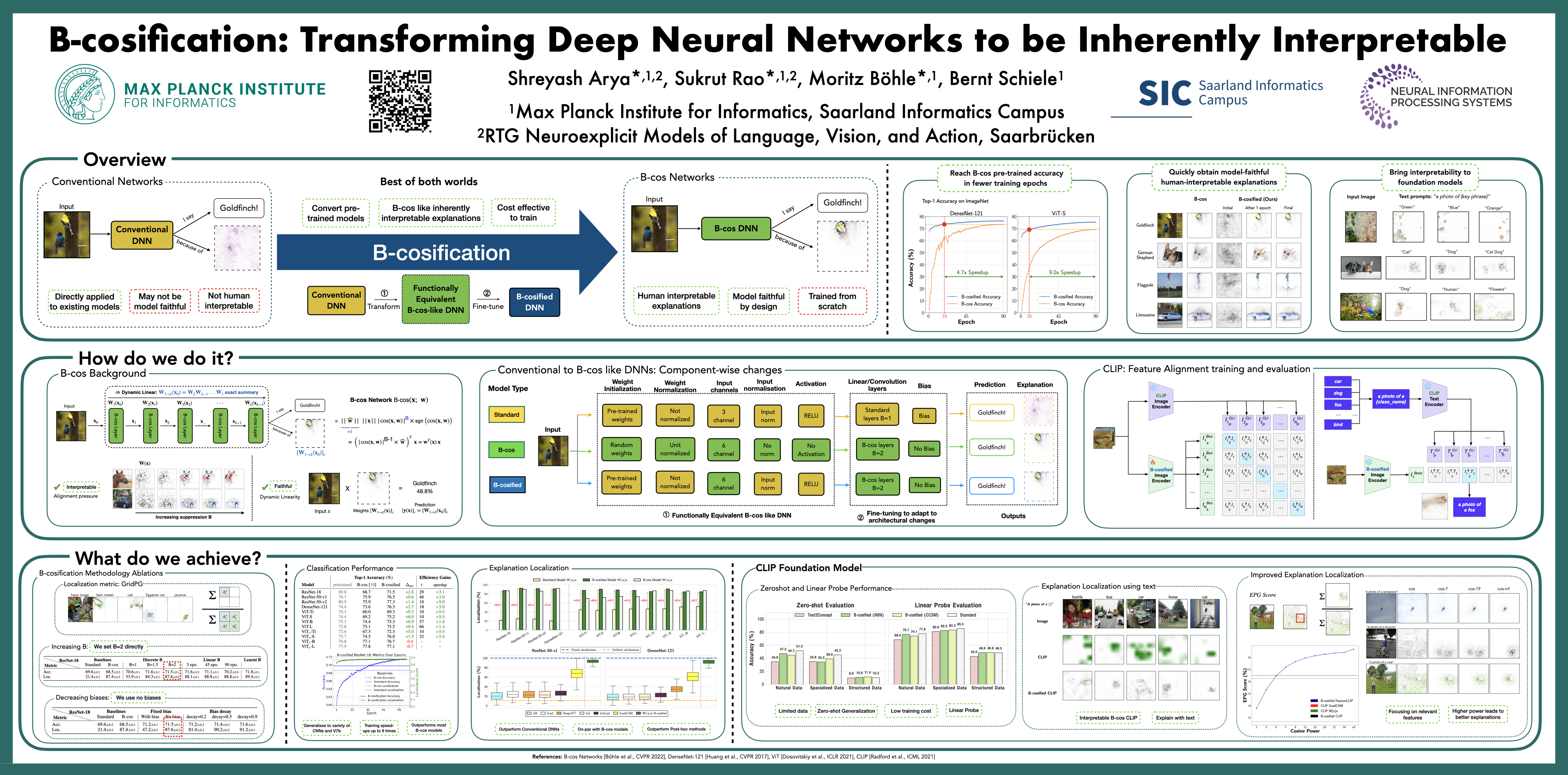
B-cosification: Transforming Deep Neural Networks to be Inherently Interpretable
Shreyash Arya*, Sukrut Rao*, Moritz Böhle*, Bernt Schiele
Neural Information Processing Systems (NeurIPS) 2024
Paper | OpenReview | Code | Poster | Slides | Video (5-mins, neptune.ai, Cohere)
Installation
Training Environment Setup
If you want to train your own B-cosified models using this repository or are interested in reproducing the results, you can set up the development environment as follows:
Using conda:
bash
conda env create -f environment.yml
conda activate bcosification
Using pip:
bash
conda create --name bcosification python=3.12
pip install -r requirements.txt
Setting Data Paths
You can either set the paths in bcos/settings.py or set the environment variables
1. DATA_ROOT
2. IMAGENET_PATH
3. CC3M_PATH
4. IMAGENET_RN50_ZEROSHOT_WEIGHTS_PATH (for zeroshot evaluation of CLIP models)
to the paths of the data directories.
For ImageNet, the
IMAGENET_PATHenvironment variable should point to the directory containing thetrainandvaldirectories.For CC3M, the
CC3M_PATHenvironment variable should point to the directory containing thetrainingandvalidationdirectories with*.tar,*_stats.json, and*.parquetfiles. For more instructions, please check here.For zeroshot evaluation of CLIP models during training, the
IMAGENET_RN50_ZEROSHOT_WEIGHTS_PATHenvironment variable should point to the weights provided in the release.
Usage
For evaluating or training the models, you can use the evaluate.py and train.py scripts, as follows:
Training
For single-GPU training:
bash
python train.py \
    --dataset ImageNet \
    --base_network bcosification \
    --experiment_name resnet_18
For distributed training:
bash
python run_with_submitit.py \
    --dataset ImageNet \
    --base_network vit_bcosification \
    --experiment_name bcosifyv2_bcos_simple_vit_ti_patch16_224_0.001_gapReorder-seed=5 \
    --distributed \
    --gpus 4 \
    --node 1 \
    --timeout 8 \
    --wandb_logger \
    --wandb_project bcosification \
    --explanation_logging
Evaluation
You can use evaluate the accuracy of the models on the ImageNet validation set using:
bash
python evaluate.py \
    --dataset ImageNet \
    --base_network bcosification \
    --experiment_name resnet_18 \
    --reload last
* base_network: bcosification for CNNs, or vit_bcosification for ViTs.
* experiment_name: check the List of experiments section below.
* To evaluate the pre-trained B-cosified ImageNet models, please follow the instructions given below in the Checkpoints section.
For evaluating B-cosified CLIP models, use CLIP Benchmark as follows:
Zeroshot:
bash
 python CLIP_benchmark/clip_benchmark/cli.py eval \
    --dataset=wds/imagenet1k \
    --model_type=bcos_clip \
    --output=benchmark_{dataset}_{model}_{task}.json \
    --dataset_root=https://huggingface.co/datasets/clip-benchmark/wds_{dataset_cleaned}/tree/main \
    --model=resnet_50_clip_b2_noBias_randomResizedCrop_sigLip_ImageNet_bcosification \
    --pretrained=experiments/ImageNet/clip_bcosification
Linear Probe:
bash
python CLIP_benchmark/clip_benchmark/cli.py eval \
    --task=linear_probe \
    --dataset=wds/imagenet1k \
    --model_type=bcos_clip \
    --output=benchmark_{dataset}_{model}_{task}.json \
    --dataset_root=https://huggingface.co/datasets/clip-benchmark/wds_{dataset_cleaned}/tree/main \
    --model=resnet_50_clip_b2_noBias_randomResizedCrop_sigLip_ImageNet_bcosification \
    --pretrained=experiments/ImageNet/clip_bcosification/ \
    --batch_size=512 \
    --fewshot_lr 0.1 \
    --fewshot_epochs 20 \
    --train_split train \
    --test_split test
--dataset: usewds/{dataset}for available Zeroshot and Linear Probe datasets.--model_type:bcos_clip,bcos_clip_cc3m,text2concept_clip,standard_clip.--model: for model typesbcos_clipandbcos_clip_cc3m, check the List of experiments section for model names; forstandard_clipuseRN50; fortext2concept_clipnot required.
Note: For CLIP models, automatic zeroshot evaluation is done at the start of every epoch.
Localisation
For localisation analysis of a trained model, localisation.py can be used as follows:
bash
python -m interpretability.analyses.localisation \
    --reload last \
    --analysis_config 500_3x3 \
    --explainer_name Ours \
    --smooth 15 \
    --batch_size 64 \
    --save_path "experiments/ImageNet/bcosification/resnet_18/"
* For ViTs, --analysis_config 500_2x2-stride=112 and --striding 112 are required.
* The results along with localisation plots are stored in the localisation_analysis directory automatically created in the experiments directory (--save_path).
For text-localisation using B-cosified CLIP model, text_localisation.py can be used as follows:
on an ImageNet image:
bash
python -m interpretability.analyses.text_localisation \
    --exp_name experiments/ImageNet/clip_bcosification/resnet_50_clip_b2_noBias_randomResizedCrop_sigLip_ImageNet_bcosification \
    --image_index 2 \
    --text_to_localize "green,blue,orange" \
    --save_path /path/to/save
--use_class_nameto localise the class name for a given ImageNet image.--save_pathis by default set to path provided by--exp_nameif not set.
on a random image:
bash
python -m interpretability.analyses.text_localisation \
    --exp_name experiments/ImageNet/clip_bcosification/resnet_50_clip_b2_noBias_randomResizedCrop_sigLip_ImageNet_bcosification \
    --random_img_path /path/to/image \
    --text_to_localize "green,blue,orange"
    --save_path /path/to/save
List of experiments:
- CNNs:
resnet18,resnet_50,resnet_50_V1,densenet_121 - ViTs:
bcosifyv2_{model_name}_0.001_lrWarmup_gapReorder``` {modelname} "vitctipatch114", "vitcspatch114", "vitcbpatch114", "vitclpatch114", "simplevittipatch16224", "simplevitspatch16224", "simplevitbpatch16224", "simplevitlpatch16_224"
Note: Only b and l models use lrWarmup in the final models.
``
* CLIP:resnet50clipb2noBiasrandomResizedCropsigLip{dataset}bcosification; where{dataset}is eitherImageNetorCC3M. Also, thebasenetworkfor CLIP models isclipbcosification`.
P.S. For more detailed training instructions, please also have a look at TRAINING.md from original B-cos-v2 repository.
Checkpoints
The checkpoints for the B-cosified ImageNet CNN and ViT pre-trained models are available here. For B-cosified CLIP pre-trained models, please check here.
- The checkpoints should be renamed to
last.ckpt. - The checkpoints should be placed under the path:
./experiments/{dataset}/{base_network}/{experiment_name}/{model_name}/last.ckpt.
Acknowledgements
This repository uses code from the following repositories:
License
This repository's code is licensed under the Apache 2.0 license which you can find in the LICENSE file.
The pre-trained models are trained on ImageNet (and are hence derived from it), which is licensed under the ImageNet Terms of access, which among others things, only allows non-commercial use of the dataset. It is therefore your responsibility to check whether you have permission to use the pre-trained models for your use case.
Citation
Please cite as follows:
tex
@inproceedings{arya2024bcosification,
 author = {Arya, Shreyash and Rao, Sukrut and B\"{o}hle, Moritz and Schiele, Bernt},
 booktitle = {Advances in Neural Information Processing Systems},
 editor = {A. Globerson and L. Mackey and D. Belgrave and A. Fan and U. Paquet and J. Tomczak and C. Zhang},
 pages = {62756--62786},
 publisher = {Curran Associates, Inc.},
 title = {B-cosification: Transforming Deep Neural Networks to be Inherently Interpretable},
 url = {https://proceedings.neurips.cc/paper_files/paper/2024/file/72d50a87b218d84c175d16f4557f7e12-Paper-Conference.pdf},
 volume = {37},
 year = {2024}
}
Owner
- Name: Shreyash Arya
- Login: shrebox
- Kind: user
- Location: Saarbrücken, Germany
- Company: Universität des Saarlandes
- Website: https://www.linkedin.com/in/shrebox/
- Twitter: shrebox
- Repositories: 78
- Profile: https://github.com/shrebox
Research Assistant at MPI-INF and DFKI | Graduate Student at Saarland Informatics Campus | Computer Science
Citation (CITATION.cff)
cff-version: 1.2.0
message: "Please cite as below."
preferred-citation:
  authors:
    - family-names: Arya
      given-names: Shreyash
      orcid: "https://orcid.org/0000-0002-2108-4579"
    - family-names: Rao
      given-names: Sukrut
      orcid: "https://orcid.org/0000-0001-8896-7619"
    - family-names: Böhle
      given-names: Moritz
      orcid: "https://orcid.org/0000-0002-5479-3769"
    - family-names: Schiele
      given-names: Bernt
      orcid: "https://orcid.org/0000-0001-9683-5237"
  title: "B-cosification: Transforming Deep Neural Networks to be Inherently Interpretable"
  type: conference-paper
  collection-title: "Advances in Neural Information Processing Systems"
  year: 2024
GitHub Events
Total
- Create event: 5
- Release event: 5
- Issues event: 2
- Watch event: 29
- Issue comment event: 4
- Push event: 15
- Public event: 1
Last Year
- Create event: 5
- Release event: 5
- Issues event: 2
- Watch event: 29
- Issue comment event: 4
- Push event: 15
- Public event: 1