k-means-constrained
K-Means clustering - constrained with minimum and maximum cluster size. Documentation: https://joshlk.github.io/k-means-constrained
Science Score: 44.0%
This score indicates how likely this project is to be science-related based on various indicators:
-
✓CITATION.cff file
Found CITATION.cff file -
✓codemeta.json file
Found codemeta.json file -
✓.zenodo.json file
Found .zenodo.json file -
○DOI references
-
○Academic publication links
-
○Committers with academic emails
-
○Institutional organization owner
-
○JOSS paper metadata
-
○Scientific vocabulary similarity
Low similarity (10.1%) to scientific vocabulary
Keywords
Repository
K-Means clustering - constrained with minimum and maximum cluster size. Documentation: https://joshlk.github.io/k-means-constrained
Basic Info
- Host: GitHub
- Owner: joshlk
- License: bsd-3-clause
- Language: Jupyter Notebook
- Default Branch: master
- Homepage: https://github.com/joshlk/k-means-constrained
- Size: 6.55 MB
Statistics
- Stars: 214
- Watchers: 5
- Forks: 45
- Open Issues: 1
- Releases: 2
Topics
Metadata Files
README.md



k-means-constrained
K-means clustering implementation whereby a minimum and/or maximum size for each cluster can be specified.
This K-means implementation modifies the cluster assignment step (E in EM)
by formulating it as a Minimum Cost Flow (MCF) linear network
optimisation problem. This is then solved using a cost-scaling
push-relabel algorithm and uses Google's Operations Research tools's
SimpleMinCostFlow
which is a fast C++ implementation.
This package is inspired by Bradley et al.. The original Minimum Cost Flow (MCF) network proposed by Bradley et al. has been modified so maximum cluster sizes can also be specified along with minimum cluster size.
The code is based on scikit-lean's KMeans
and implements the same API with modifications.
Ref: 1. Bradley, P. S., K. P. Bennett, and Ayhan Demiriz. "Constrained k-means clustering." Microsoft Research, Redmond (2000): 1-8. 2. Google's SimpleMinCostFlow C++ implementation
Installation
You can install the k-means-constrained from PyPI:
pip install k-means-constrained
It is supported on Python 3.10, 3.11, 3.12 and 3.13. Previous versions of k-means-constrained support older versions of Python and Numpy.
Example
More details can be found in the API documentation.
```python
from kmeansconstrained import KMeansConstrained import numpy as np X = np.array([[1, 2], [1, 4], [1, 0], ... [4, 2], [4, 4], [4, 0]]) clf = KMeansConstrained( ... nclusters=2, ... sizemin=2, ... sizemax=5, ... randomstate=0 ... ) clf.fitpredict(X) array([0, 0, 0, 1, 1, 1], dtype=int32) clf.clustercenters_ array([[ 1., 2.], [ 4., 2.]]) clf.labels_ array([0, 0, 0, 1, 1, 1], dtype=int32) ```
Code only
``` from k_means_constrained import KMeansConstrained import numpy as np X = np.array([[1, 2], [1, 4], [1, 0], [4, 2], [4, 4], [4, 0]]) clf = KMeansConstrained( n_clusters=2, size_min=2, size_max=5, random_state=0 ) clf.fit_predict(X) clf.cluster_centers_ clf.labels_ ```Time complexity and runtime
k-means-constrained is a more complex algorithm than vanilla k-means and therefore will take longer to execute and has worse scaling characteristics.
Given a number of data points $n$ and clusters $c$, the time complexity of: * k-means: $\mathcal{O}(nc)$ * k-means-constrained1: $\mathcal{O}((n^3c+n^2c^2+nc^3)\log(n+c)))$
This assumes a constant number of algorithm iterations and data-point features/dimensions.
If you consider the case where $n$ is the same order as $c$ ($n \backsim c$) then: * k-means: $\mathcal{O}(n^2)$ * k-means-constrained1: $\mathcal{O}(n^4\log(n)))$
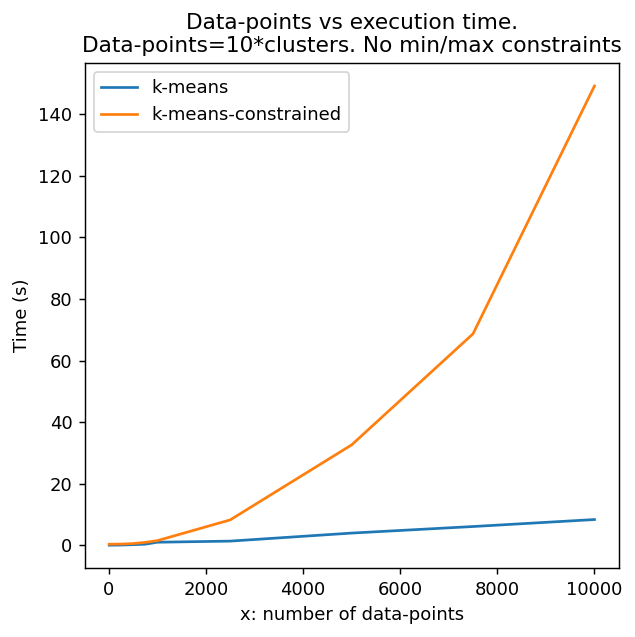
Below is a runtime comparison between k-means and k-means-constrained whereby the number of iterations, initializations, multi-process pool size and dimension size are fixed. The number of clusters is also always one-tenth the number of data points $n=10c$. It is shown above that the runtime is independent of the minimum or maximum cluster size, and so none is included below.
System details
* OS: Linux-5.15.0-75-generic-x86_64-with-glibc2.35 * CPU: AMD EPYC 7763 64-Core Processor * CPU cores: 120 * k-means-constrained version: 0.7.3 * numpy version: 1.24.2 * scipy version: 1.11.1 * ortools version: 9.6.2534 * joblib version: 1.3.1 * sklearn version: 1.3.01: Ortools states the time complexity of their cost-scaling push-relabel algorithm for the min-cost flow problem as $\mathcal{O}(n^2m\log(nC))$ where $n$ is the number of nodes, $m$ is the number of edges and $C$ is the maximum absolute edge cost.
Change log
- v0.7.6 (2025-06-30) Add Python v3.13 and Linux ARM support.
- v0.7.5 fix comment in README on Python version that is supported
- v0.7.4 compatible with Numpy +v2.1.1. Added Python 3.12 support and dropped Python 3.8 and 3.9 support (due to Numpy). Linux ARM support has been dropped as we use GitHub runners to build the package and ARM machines was being emulated using QEMU. This however was producing numerical errors. GitHub should natively support Ubuntu ARM images soon and then we can start to re-build them.
- v0.7.3 compatible with Numpy v1.23.0 to 1.26.4
Citations
If you use this software in your research, please use the following citation:
@software{Levy-Kramer_k-means-constrained_2018,
  author = {Levy-Kramer, Josh},
  month = apr,
  title = {{k-means-constrained}},
  url = {https://github.com/joshlk/k-means-constrained},
  year = {2018}
}
Owner
- Name: Josh Levy-Kramer
- Login: joshlk
- Kind: user
- Location: London, UK
- Repositories: 48
- Profile: https://github.com/joshlk
ML Research Engineer. Views are my own.
Citation (CITATION.cff)
cff-version: 1.2.0
message: "If you use this software, please cite it as below."
authors:
- family-names: "Levy-Kramer"
  given-names: "Josh"
  orcid: "https://orcid.org/0000-0002-4350-6197"
title: "k-means-constrained"
date-released: 2018-04-23
url: "https://github.com/joshlk/k-means-constrained"
GitHub Events
Total
- Issues event: 8
- Watch event: 26
- Delete event: 1
- Issue comment event: 7
- Push event: 17
- Pull request event: 3
- Fork event: 3
- Create event: 1
Last Year
- Issues event: 8
- Watch event: 26
- Delete event: 1
- Issue comment event: 7
- Push event: 17
- Pull request event: 3
- Fork event: 3
- Create event: 1
Committers
Last synced: about 1 year ago
Top Committers
| Name | Commits | |
|---|---|---|
| Josh Levy-Kramer | j****h@l****k | 247 |
| Esmail | e****l | 1 |
Committer Domains (Top 20 + Academic)
Issues and Pull Requests
Last synced: 11 months ago
All Time
- Total issues: 49
- Total pull requests: 13
- Average time to close issues: 3 months
- Average time to close pull requests: about 1 month
- Total issue authors: 47
- Total pull request authors: 4
- Average comments per issue: 2.69
- Average comments per pull request: 0.92
- Merged pull requests: 9
- Bot issues: 0
- Bot pull requests: 0
Past Year
- Issues: 4
- Pull requests: 2
- Average time to close issues: 7 days
- Average time to close pull requests: less than a minute
- Issue authors: 4
- Pull request authors: 1
- Average comments per issue: 0.25
- Average comments per pull request: 0.0
- Merged pull requests: 2
- Bot issues: 0
- Bot pull requests: 0
Top Authors
Issue Authors
- amks1 (2)
- mosikh (2)
- calebhallinan (1)
- ryanpeel (1)
- avranil26 (1)
- meteve (1)
- joamatab (1)
- esmail (1)
- PeterIlinovich (1)
- drcandacemakedamoore (1)
- ismail-khan-tajir (1)
- adinarayanaPalvadi (1)
- nsitlokeshjain (1)
- GiuliaFrigerio (1)
- Jhellewaard (1)
Pull Request Authors
- joshlk (10)
- bibblybobblyben (2)
- AdityaSavara (1)
- esmail (1)
Top Labels
Issue Labels
Pull Request Labels
Packages
- Total packages: 1
-
Total downloads:
- pypi 71,361 last-month
- Total docker downloads: 1,097
- Total dependent packages: 7
- Total dependent repositories: 9
- Total versions: 14
- Total maintainers: 1
pypi.org: k-means-constrained
K-Means clustering constrained with minimum and maximum cluster size
- Homepage: https://github.com/joshlk/k-means-constrained
- Documentation: https://joshlk.github.io/k-means-constrained/
- License: BSD 3-Clause
-
Latest release: 0.7.6
published about 1 year ago
Rankings
Maintainers (1)
Dependencies
- bump2version * development
- cython >=0.29 development
- nose * development
- numpydoc * development
- pandas >=1.0.4 development
- pytest >=5.1 development
- scikit-learn >=0.24.2 development
- setuptools * development
- sphinx * development
- sphinx-rtd-theme * development
- twine * development
- wheel * development
- joblib *
- numpy >=1.22.0
- ortools >=9.0.9048
- scipy >=1.6.3
- six *