splashsurf
Surface reconstruction library and CLI for particle data from SPH simulations, written in Rust.
Science Score: 75.0%
This score indicates how likely this project is to be science-related based on various indicators:
-
✓CITATION.cff file
Found CITATION.cff file -
✓codemeta.json file
Found codemeta.json file -
✓.zenodo.json file
Found .zenodo.json file -
✓DOI references
Found 2 DOI reference(s) in README -
○Academic publication links
-
✓Committers with academic emails
1 of 6 committers (16.7%) from academic institutions -
✓Institutional organization owner
Organization interactivecomputergraphics has institutional domain (animation.rwth-aachen.de) -
○JOSS paper metadata
-
○Scientific vocabulary similarity
Low similarity (14.2%) to scientific vocabulary
Keywords
Keywords from Contributors
Repository
Surface reconstruction library and CLI for particle data from SPH simulations, written in Rust.
Basic Info
- Host: GitHub
- Owner: InteractiveComputerGraphics
- License: mit
- Language: Rust
- Default Branch: main
- Homepage: https://splashsurf.physics-simulation.org/
- Size: 21.2 MB
Statistics
- Stars: 246
- Watchers: 5
- Forks: 24
- Open Issues: 8
- Releases: 16
Topics
Metadata Files
README.md









Surface reconstruction library and CLI for particle data from SPH simulations, written in Rust.
This repository consists of the following crates:
- 🛠️ splashsurf: Binary crate with a CLI (command line interface) to quickly run surface reconstructions of SPH particle data files from the terminal. Install with cargo install splashsurf.
- 🧰 splashsurf_lib: Library that implements the reconstruction pipeline used by the CLI. Allows integrating the reconstruction procedure directly into other Rust applications. Furthermore, it resembles a framework providing access to individual building blocks to create your own surface reconstruction pipeline.
- 🐍 pysplashsurf: Bindings to the CLI and library for Python. Install with pip install splashsurf and see the README for more details.
This page provides an overview of the CLI's features and high-level notes on implementation of the reconstruction method.


splashsurf is a tool to reconstruct surfaces meshes from SPH particle data.
The first image shows the visualization of a set of particles from an SPH fluid simulation from SPlisHSPlasH.
The particle radius is 0.025. As the rendering of a fluid should not look like a ball pit, a surface mesh has to be
reconstructed from this particle data. The next image shows a reconstructed surface mesh of the fluid produced by splashsurf
with a "smoothing length" of 2.2 times the particles radius and a cell size of 1.1 times the particle radius. The
third image shows a finer reconstruction with a cell size of 0.45 times the particle radius. These surface meshes can
then be fed into 3D rendering software such as Blender to generate beautiful water animations.
The result might look something like this:
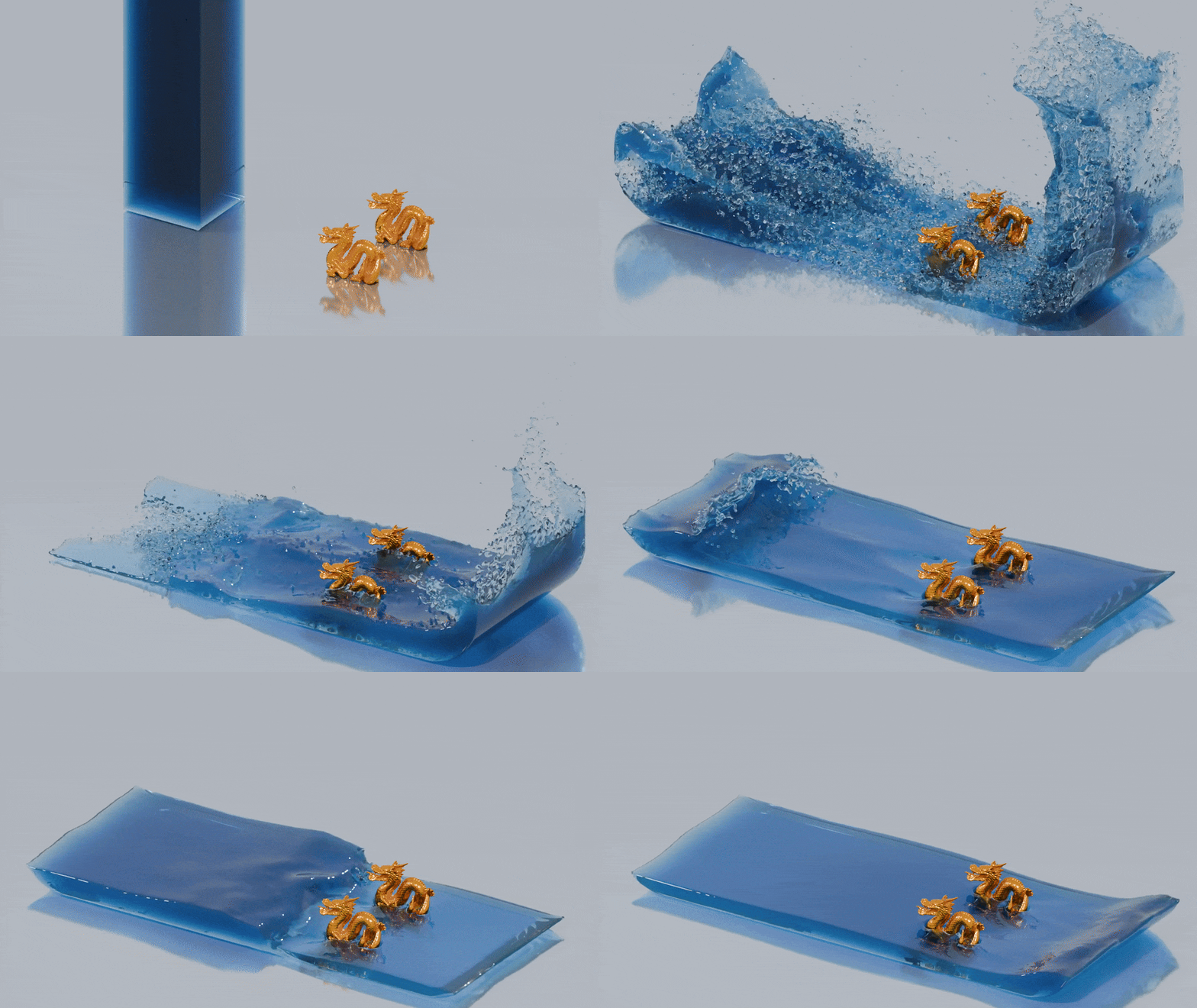
Note: This animation does not show the recently added smoothing features of the tool, for more recent rendering see this video.
Contents
- The splashsurf CLI
- Introduction
- Domain decomposition
- Subdomain grid-based decomposition
- Notes
- Installation
- Usage
- Recommended settings
- Weighted surface smoothing
- Benchmark example
- Sequences of files
- Input file formats
- VTK
- VTU
- BGEO
- PLY
- XYZ
- JSON
- Output file formats
- All command line options
- The reconstruct command
- The convert subcommand
- Citation
- Acknowledgements
- License
The splashsurf CLI
The following sections mainly focus on the CLI of splashsurf. For more information on the library, see the corresponding readme in the splashsurf_lib subfolder or the splashsurf_lib crate on crates.io.
Introduction
The splashsurf CLI provides a "fast" marching cubes based surface reconstruction for particle data from SPH fluid simulations (e.g., performed with SPlisHSPlasH).
The output of this tool is a (closed) triangle mesh of the fluid's surface.
At the moment, it supports computing normals on the surface using SPH gradients and interpolating scalar and vector attributes defined on the particles to the surface.
To get rid of the typical bumps from SPH simulations, it supports a weighted Laplacian smoothing approach detailed below.
As input, it supports reading particle positions from .vtk/.vtu, .bgeo, .ply, .json and binary .xyz (i.e., files containing a binary dump of a particle position array) files.
Required parameters to perform a reconstruction are the kernel radius (its compact support) and particle radius (to compute the volume of particles) used for the original SPH simulation as well as the marching cubes resolution (a default iso-surface threshold is pre-configured).
Domain decomposition
A naive dense marching cubes reconstruction allocating a full 3D array over the entire fluid domain quickly becomes infeasible for larger simulations.
Instead, one could use a global hashmap where only cubes that contain non-zero fluid density values are allocated.
This approach is used in splashsurf if domain decomposition is disabled completely.
However, a global hashmap does not lead to good cache locality and is not well suited for parallelization (even specialized parallel map implementations like dashmap have their performance limitations).
To improve on this situation splashsurf utilizes a domain decomposition approach.
Subdomain grid-based decomposition
Since version 0.10.0, splashsurf implements a domain decomposition approach called the "subdomain grid" approach, toggled with the --subdomain-grid=on flag (default since version 0.11.0).
Here, the goal is to divide the fluid domain into subdomains with a fixed number of marching cubes cells, by default 64x64x64 cubes.
For each subdomain, a dense 3D array is allocated for the marching cubes cells.
Of course, only subdomains that contain any fluid particles are actually allocated.
For subdomains that contain only a tiny number of fluid particles (less than 5% of the largest subdomain), a hashmap is used instead to not waste too much storage.
As most domains are dense, however, the marching cubes triangulation per subdomain is very fast as it can make full use of cache locality.
The triangulation per subdomain can be performed in parallel.
To stitch the resulting meshes together, we ensure that we perform floating point operations in the same order at the subdomain boundaries, thus guaranteeing identical values (this is possible without additional synchronization).
If the field values on the subdomain boundaries are identical from both sides, the marching cubes triangulations will be topologically compatible and can be merged in a post-processing step that can also run in parallel.
Overall, this approach should almost always be faster than the octree-based approach used before version 0.10.0.
Notes
For small numbers of fluid particles (i.e., in the low thousands or less) the domain decomposition may have worse performance due to the task-based parallelism and the additional overhead of domain decomposition and stitching. In this case, you can try to disable the domain decomposition. The reconstruction will then use a global approach parallelized using thread-local hashmaps. For larger quantities of particles, the decomposition approach is always expected to be faster.
Due to the use of hash maps and multi-threading (if enabled), the output of this implementation is not deterministic.
As shown below, the tool can handle the output of large simulations. However, it was not tested with a wide range of parameters and may not be totally robust against corner-cases or extreme parameters. If you experience problems, please report them together with your input data.
Installation
The command-line tool can be built from this repository but is also available on crates.io.
If you have a Rust toolchain installed you can install splashsurf with the command
bash
cargo install splashsurf
Alternatively you can install the Python bindings using pip:
pip install pysplashsurf
Please see the README of the Python bindings for more details.
Usage
Recommended settings
"Good" settings for the surface reconstruction depend on the original simulation and can be influenced by different conventions of different simulators.
The following parameters appear to work well with simulations performed with SPlisHSPlasH.
A typical set of parameters for the reconstruction is:
- particle-radius: the actual radius of the fluid particles in the simulation
- smoothing-length: the smoothing length used for the SPH kernel, usually set to 2.0 times the particle radius (this will use a cubic kernel with a compact support radius of 4.0 times the particle radius)
- surface-threshold: typically a value between 0.6 and 0.7 works well
- cube-size: usually should not be chosen larger than 1.0 to avoid artifacts (e.g., single particles reconstructed a rhomboids), start with a value in the range of 0.75 to 0.5 and decrease/increase it if the result is too coarse or the reconstruction takes too long.
Without further post-processing, these parameters usually lead to quite "bumpy" surfaces.
To obtain smoother surfaces, the parameters can be adjusted as follows:
- particle-radius: can be chosen a bit larger than the particle radius of the actual simulation. A radius around 1.4 to 1.6 times larger than the original SPH particle radius seems appropriate.
- smoothing-length: can be set around 1.2. Larger values smooth out the surface more but also artificially increase the fluid volume.
- surface-threshold: a good value depends on the selected particle-radius and smoothing-length and can be used to counteract a fluid volume increase e.g., due to a larger particle radius. In combination with the other recommended values a threshold of 0.6 seemed to work well.
However, a much more effective way is to perform surface smoothing as described below.
Weighted surface smoothing
The CLI implements the paper "Weighted Laplacian Smoothing for Surface Reconstruction of Particle-based Fluids" (Löschner, Böttcher, Jeske, Bender; 2023) which proposes a fast smoothing approach to avoid typical bumpy surfaces while preventing loss of volume that typically occurs with simple smoothing methods. The following images show a rendering of a typical surface reconstruction (on the right) with visible bumps due to the particles compared to the same surface reconstruction with weighted smoothing applied (on the left):


You can see this rendering in motion in this video.
To apply this smoothing, we recommend the following settings:
- --mesh-smoothing-weights=on: This enables the use of special weights during the smoothing process which preserve fluid details. For more information, we refer to the paper.
- --mesh-smoothing-iters=25: This enables smoothing of the output mesh. The individual iterations are relatively fast, and 25 iterations appeared to strike a good balance between an initially bumpy surface and potential over-smoothing.
- --mesh-cleanup=on/--decimate-barnacles=on: One of the options should be used when applying smoothing, otherwise artifacts can appear on the surface (for more details see the paper). The mesh-cleanup flag enables a general purpose marching cubes mesh cleanup procedure that removes small sliver triangles everywhere on the mesh. The decimate-barnacles enables a more targeted decimation that only removes specific triangle configurations that are problematic for the smoothing. The former approach results in a "nicer" mesh overall but can be slower than the latter.
- --normals-smoothing-iters=10: If normals are being exported (with --normals=on), this results in an even smoother appearance during rendering.
For the reconstruction parameters in conjunction with the weighted smoothing, we recommend parameters close to the simulation parameters.
That means selecting the same particle radius as in the simulation, a corresponding smoothing length (e.g., for SPlisHSPlasH a value of 2.0), a surface-threshold between 0.6 and 0.7 and a cube size usually between 0.5 and 1.0.
A full invocation of the tool might look like this:
splashsurf reconstruct particles.vtk -r=0.025 -l=2.0 -c=0.5 -t=0.6 --mesh-smoothing-weights=on --mesh-smoothing-iters=15 --normals=on --normals-smoothing-iters=10
Benchmark example
For example:
splashsurf reconstruct canyon_13353401_particles.xyz -r=0.011 -c=1.5 -l=2.0 -t=0.6
With these parameters, a scene with 13353401 particles is reconstructed in less than 3 seconds on an Apple M4 Pro (14 cores). The output is a mesh with 6069576 triangles.
[17:15:33.046][INFO] splashsurf v0.12.0 (splashsurf)
[17:15:33.046][INFO] Called with command line: splashsurf reconstruct canyon_13353401_particles.xyz -r=0.011 -c=1.5 -l=2.0 -t=0.6 --output-dir=out
[17:15:33.046][INFO] Using single precision (f32) for surface reconstruction.
[17:15:33.046][INFO] Reading particle dataset from "canyon_13353401_particles.xyz"...
[17:15:33.171][INFO] Successfully read dataset with 13353401 particle positions.
[17:15:33.175][INFO] Bounding box of particles with margin for levelset evaluation: [-25.006098, -5.014629, -40.06346] to [24.499493, 18.30621, 39.775795]
[17:15:33.175][INFO] The ghost margin volume per subdomain is 42.38% of the subdomain volume
[17:15:33.175][INFO] The ghost margin per subdomain is 3.03 MC cells or 0.05 subdomains wide
[17:15:33.175][INFO] Number of subdomains: 82156 (47x23x76)
[17:15:33.175][INFO] Number of MC cells per subdomain: 262144 (64x64x64)
[17:15:33.175][INFO] Number of MC cells globally: 21536702464 (3008x1472x4864)
[17:15:33.175][INFO] Starting classification of particles into subdomains.
[17:15:33.250][INFO] Starting computation of global density vector.
[17:15:34.415][INFO] Largest subdomain has 167861 particles.
[17:15:34.415][INFO] Subdomains with 8393 or less particles will be considered sparse.
[17:15:34.415][INFO] Starting reconstruction (level-set evaluation and local triangulation).
[17:15:35.551][INFO] Starting stitching of subdomain meshes to global mesh.
[17:15:35.598][INFO] Global mesh has 3038116 vertices and 6069576 triangles.
[17:15:35.658][INFO] Writing mesh with 3038116 vertices and 6069576 cells to "out/canyon_13353401_particles_surface.vtk"...
[17:15:35.770][INFO] Successfully wrote mesh to file.
[17:15:35.777][INFO] Successfully finished processing all inputs.
[17:15:35.777][INFO] Timings:
[17:15:35.777][INFO] reconstruct subcommand: 100.00%, 2731.05ms avg, 1 call (total: 2.731s)
[17:15:35.777][INFO]   surface reconstruction: 99.99%, 2730.84ms avg, 1 call (total: 2.731s)
[17:15:35.777][INFO]     loading particle positions: 4.57%, 124.71ms avg, 1 call (total: 0.125s)
[17:15:35.777][INFO]     compute minimum enclosing aabb: 0.14%, 3.87ms avg, 1 call (total: 0.004s)
[17:15:35.777][INFO]     surface reconstruction subdomain-grid: 89.94%, 2456.05ms avg, 1 call (total: 2.456s)
[17:15:35.777][INFO]       decomposition: 3.07%, 75.45ms avg, 1 call (total: 0.075s)
[17:15:35.777][INFO]         classifying particles: 30.15%, 22.75ms avg, 1 call (total: 0.023s)
[17:15:35.777][INFO]         merging TL per cell particle counters: 0.25%, 0.19ms avg, 1 call (total: 0.000s)
[17:15:35.777][INFO]         initializing flat subdomain data and index mapping: 0.06%, 0.05ms avg, 1 call (total: 0.000s)
[17:15:35.777][INFO]         copying particles to subdomains: 55.31%, 41.73ms avg, 1 call (total: 0.042s)
[17:15:35.777][INFO]         sort subdomain particles: 14.20%, 10.71ms avg, 1 call (total: 0.011s)
[17:15:35.777][INFO]       compute_global_density_vector: 47.41%, 1164.38ms avg, 1 call (total: 1.164s)
[17:15:35.777][INFO]         subdomain density computation: ≈100.00%, 11.76ms avg, 1275 calls (total: 14.997s)
[17:15:35.777][INFO]           collect subdomain data: 0.35%, 0.04ms avg, 1275 calls (total: 0.052s)
[17:15:35.777][INFO]           initialize particle filter: 0.14%, 0.02ms avg, 1275 calls (total: 0.020s)
[17:15:35.777][INFO]           neighborhood_search_spatial_hashing_flat_filtered: 93.14%, 10.95ms avg, 1275 calls (total: 13.968s)
[17:15:35.777][INFO]             sequential_generate_cell_to_particle_map_with_positions: 5.40%, 0.59ms avg, 1275 calls (total: 0.754s)
[17:15:35.777][INFO]             collect particle neighbors: 92.97%, 10.18ms avg, 1275 calls (total: 12.986s)
[17:15:35.777][INFO]           sequential_compute_particle_densities_filtered: 6.14%, 0.72ms avg, 1275 calls (total: 0.920s)
[17:15:35.777][INFO]           update global density values: 0.24%, 0.03ms avg, 1275 calls (total: 0.035s)
[17:15:35.777][INFO]       reconstruction: 46.29%, 1136.91ms avg, 1 call (total: 1.137s)
[17:15:35.777][INFO]         subdomain reconstruction (dense): ≈92.15%, 43.66ms avg, 313 calls (total: 13.664s)
[17:15:35.777][INFO]           density grid loop: 92.76%, 40.50ms avg, 313 calls (total: 12.675s)
[17:15:35.777][INFO]           mc triangulation loop: 7.02%, 3.06ms avg, 313 calls (total: 0.959s)
[17:15:35.777][INFO]         subdomain reconstruction (sparse): ≈7.85%, 1.21ms avg, 962 calls (total: 1.164s)
[17:15:35.777][INFO]           density grid loop: 61.65%, 0.75ms avg, 962 calls (total: 0.718s)
[17:15:35.777][INFO]           mc triangulation loop: 37.38%, 0.45ms avg, 962 calls (total: 0.435s)
[17:15:35.777][INFO]       stitching: 1.62%, 39.87ms avg, 1 call (total: 0.040s)
[17:15:35.777][INFO]         surface patch offset scan: 0.05%, 0.02ms avg, 1 call (total: 0.000s)
[17:15:35.777][INFO]         copy interior verts/tris and deduplicate exterior verts: 89.15%, 35.54ms avg, 1 call (total: 0.036s)
[17:15:35.777][INFO]     postprocessing: 0.00%, 0.02ms avg, 1 call (total: 0.000s)
[17:15:35.777][INFO]     write surface mesh to file: 4.11%, 112.32ms avg, 1 call (total: 0.112s)
[17:15:35.777][INFO]       write_vtk: 99.93%, 112.25ms avg, 1 call (total: 0.112s)
Sequences of files
You can either process a single file or let the tool automatically process a sequence of files.
A sequence of files is indicated by specifying a filename with a {} placeholder pattern in the name.
The tool will treat the placeholder as a (\d+) regex, i.e., a group matching to at least one digit.
This allows for any zero padding as well as non-zero padded incrementing indices.
All files in the input path matching this pattern will then be processed in natural sort order (i.e., silently skipping missing files in the sequence).
Note that the tool collects all existing filenames as soon as the command is invoked and does not update the list while running.
The first and last file of a sequences that should be processed can be specified with the -s/--start-index and/or -e/--end-index arguments.
By specifying the flag --mt-files=on, several files can be processed in parallel.
If this is enabled, you should also set --mt-particles=off as enabling both will probably degrade performance.
The combination of --mt-files=on and --mt-particles=off can be faster if many files with only few particles have to be processed.
The number of threads can be influenced using the --num-threads/-n argument or the RAYON_NUM_THREADS environment variable
NOTE: Currently, some functions do not have a sequential implementation and always parallelize over the particles or the mesh/domain. This includes: - the new "subdomain-grid" domain decomposition approach, as an alternative to the previous octree-based approach - some post-processing functionality (interpolation of smoothing weights, interpolation of normals and other fluid attributes)
Using the --mt-particles=off argument does not affect these parts of the surface reconstruction.
For now, it is therefore recommended to not parallelize over multiple files if this functionality is used.
Input file formats
VTK
Legacy VTK files with the ".vtk" extension are loaded using vtkio.
The VTK file is loaded as a big endian binary file and has to contain an "Unstructured Grid" with either f32 or f64 vertex coordinates.
Any other data or attributes are ignored except for those attributes that were specified with the --interpolate-attributes command line argument.
Currently supported attribute data types are scalar integers, floats, and three-component float vectors.
Only the first "Unstructured Grid" is loaded, other entities are ignored.
Not that currently only the "pure" v4.2 legacy format is supported as documented on here.
This corresponds to the --output-format vtk42 flag of the meshio convert tool.
VTU
VTK XML files with the ".vtu" extension are loaded using vtkio.
Currently only VTU files using ASCII or encoded binary are supported.
Files using "raw" binary sections (i.e., a <AppendedData encoding="raw">...</AppendedData> block) are not supported by vtkio at the moment.
BGEO
Files with the ".bgeo" extension are loaded using a custom parser.
Note, that only the "old" BGEOV format is supported (which is the format supported by "Partio").
Both uncompressed and (gzip) compressed files are supported.
Only points and their implicit position vector attributes are loaded from the file.
All other entities (e.g., vertices) and other attributes are ignored/discarded.
Notably, the parser supports BGEO files written by SPlisHSPlasH ("Partio export").
PLY
Files with the ".ply" extension are loaded using ply-rs.
The PLY file has to contain an element called "vertex" with the properties x, y and z of type f32/"Property::Float".
Any other properties or elements are ignored.
XYZ
Files with the ".xyz" extension are interpreted as raw bytes of f32 values in native endianness of the system.
Three consecutive f32s represent a (x,y,z) coordinate triplet of a fluid particle.
JSON
Files with the ".json" extension are interpreted as serializations of a Vec<[f32; 3]> where each three component array represents a particle position.
This corresponds to a JSON file with a structure like this, for example:
json
[
    [1.0, 2.0, 3.0],
    [1.0, 2.0, 3.0]
]
Output file formats
Currently, only VTK and OBJ formats are supported to store the reconstructed surface meshes. Both formats support output of normals, but only VTK supports additional fields such as interpolated scalar or vector fields. The file format is inferred from the extension of output filename.
All command line options
The reconstruct command
``` splashsurf-reconstruct (v0.13.0) - Reconstruct a surface from particle data
Usage: splashsurf reconstruct [OPTIONS] --particle-radius
Options: -q, --quiet Enable quiet mode (no output except for severe panic messages), overrides verbosity level -v... Print more verbose output, use multiple "v"s for even more verbose output (-v, -vv) -h, --help Print help -V, --version Print version
Input/output:
-o, --output-file
Numerical reconstruction parameters:
-r, --particle-radius
Advanced parameters:
-d, --double-precision=
Domain decomposition parameters:
--subdomain-grid=
Interpolation & normals:
--normals=
Mesh decimation and cleanup:
--mesh-cleanup=
Mesh smoothing:
--mesh-smoothing-iters
General postprocessing:
--generate-quads=
Debug options:
--check-mesh=
The convert subcommand
Allows conversion between particle file formats and between mesh file formats. For particles VTK, BGEO, PLY, XYZ, JSON -> VTK
is supported. For meshes only VTK, PLY -> VTK, OBJ is supported.
``` splashsurf-convert (v0.13.0) - Convert particle or mesh files between different file formats
Usage: splashsurf convert [OPTIONS] -o
Options:
--particles
Citation
To cite splashsurf you can use this BibTeX entry:
bibtex
@inproceedings {LBJB23,
  booktitle = {Vision, Modeling, and Visualization},
  title = {{Weighted Laplacian Smoothing for Surface Reconstruction of Particle-based Fluids}},
  author = {Löschner, Fabian and Böttcher, Timna and Rhys Jeske, Stefan and Bender, Jan},
  year = {2023},
  publisher = {The Eurographics Association},
  DOI = {10.2312/vmv.20231245}
}
Acknowledgements
This project contains notable contributions from the following people:
- Timna Böttcher (@timnaboettcher): co-developed the weighted smoothing approach
- Felix Kern (@Fek04): implemented the Python bindings for splashsurf
- Fabian Löschner (@w1th0utnam3): implemented most of the surface reconstruction library and CLI with the domain decomposition
License
For license information of this project, see the LICENSE file. The splashsurf logo is based on two graphics (1, 2) published on SVG Repo under a CC0 ("No Rights Reserved") license. The dragon model shown in the images on this page is part of the "Stanford 3D Scanning Repository".
Owner
- Name: Interactive Computer Graphics
- Login: InteractiveComputerGraphics
- Kind: organization
- Location: Germany
- Website: https://animation.rwth-aachen.de/
- Repositories: 12
- Profile: https://github.com/InteractiveComputerGraphics
Citation (CITATION.cff)
# This CITATION.cff file was generated with cffinit.
# Visit https://bit.ly/cffinit to generate yours today!

cff-version: 1.2.0
title: '"splashsurf" Surface Reconstruction Software'
message: >-
  If you use this software in your work, please consider
  citing it using these metadata.
type: software
authors:
  - family-names: Löschner
    given-names: Fabian
    affiliation: RWTH Aachen University
    orcid: 'https://orcid.org/0000-0001-6818-2953'
  - family-names: Böttcher
    given-names: Timna
    affiliation: RWTH Aachen University
    orcid: 'https://orcid.org/0009-0003-1024-6549'
url: 'https://splashsurf.physics-simulation.org'
abstract: >-
  Splashsurf is a surface reconstruction tool and framework
  for reconstructing surfaces from particle data.
license: MIT
version: 0.13.0
date-released: '2025-09-02'
GitHub Events
Total
- Create event: 14
- Release event: 1
- Issues event: 7
- Watch event: 96
- Delete event: 9
- Issue comment event: 15
- Push event: 90
- Pull request review comment event: 5
- Pull request event: 13
- Fork event: 5
Last Year
- Create event: 14
- Release event: 1
- Issues event: 7
- Watch event: 96
- Delete event: 9
- Issue comment event: 15
- Push event: 90
- Pull request review comment event: 5
- Pull request event: 13
- Fork event: 5
Committers
Last synced: about 1 year ago
Top Committers
| Name | Commits | |
|---|---|---|
| Fabian Löschner | f****r@r****e | 578 |
| dependabot[bot] | 4****] | 15 |
| rezural | 6****l | 3 |
| whiterabbit42k | 7****k | 1 |
| martin frances | m****7@h****m | 1 |
| Yoshiera | y****g@1****m | 1 |
Committer Domains (Top 20 + Academic)
Issues and Pull Requests
Last synced: 10 months ago
All Time
- Total issues: 10
- Total pull requests: 54
- Average time to close issues: almost 2 years
- Average time to close pull requests: about 1 month
- Total issue authors: 10
- Total pull request authors: 4
- Average comments per issue: 2.6
- Average comments per pull request: 0.59
- Merged pull requests: 12
- Bot issues: 0
- Bot pull requests: 41
Past Year
- Issues: 5
- Pull requests: 16
- Average time to close issues: 27 days
- Average time to close pull requests: 11 days
- Issue authors: 5
- Pull request authors: 4
- Average comments per issue: 2.0
- Average comments per pull request: 0.38
- Merged pull requests: 5
- Bot issues: 0
- Bot pull requests: 7
Top Authors
Issue Authors
- lgleim (1)
- whiterabbit42k (1)
- GUT2060 (1)
- pshrey795 (1)
- losanc (1)
- duburcqa (1)
- werner291 (1)
- mushroomfire (1)
- h3mosphere (1)
- Hassan-Bahrami (1)
Pull Request Authors
- dependabot[bot] (41)
- w1th0utnam3 (7)
- martinfrances107 (4)
- johnnynunez (2)
Top Labels
Issue Labels
Pull Request Labels
Packages
- Total packages: 3
-
Total downloads:
- cargo 44,109 total
- pypi 14,202 last-month
-
Total dependent packages: 1
(may contain duplicates) -
Total dependent repositories: 1
(may contain duplicates) - Total versions: 44
- Total maintainers: 3
crates.io: splashsurf_lib
Library for surface reconstruction of SPH particle data
- Homepage: https://splashsurf.physics-simulation.org
- Documentation: https://docs.rs/splashsurf_lib/
- License: MIT
-
Latest release: 0.13.0
published 10 months ago
Rankings
Maintainers (1)
crates.io: splashsurf
Command-line tool for surface reconstruction of SPH particle data
- Homepage: https://splashsurf.physics-simulation.org
- Documentation: https://docs.rs/splashsurf/
- License: MIT
-
Latest release: 0.13.0
published 10 months ago
Rankings
Maintainers (1)
pypi.org: pysplashsurf
Python bindings for splashsurf, a surface reconstruction library for SPH simulations.
- Homepage: https://splashsurf.physics-simulation.org/
- Documentation: https://pysplashsurf.readthedocs.io/
- License: mit
-
Latest release: 0.0.0
published over 1 year ago
Rankings
Maintainers (2)
Dependencies
- 187 dependencies
- anyhow 1.0
- bytemuck 1.9
- fern 0.6
- log 0.4
- num 0.4
- rayon 1.5
- splashsurf_lib 0.8
- structopt 0.3
- time 0.3.9
- anyhow 1.0
- arrayvec 0.7
- bitflags ^1.3.1
- bytemuck 1.9
- bytemuck_derive 1.1
- dashmap 5.2.0
- flate2 1.0
- fxhash 0.2
- itertools 0.10
- lazy_static 1.4
- log 0.4
- nalgebra 0.31
- nom 7.1
- num 0.4
- numeric_literals 0.2
- parking_lot 0.12
- ply-rs 0.1.3
- rayon 1.5
- rstar 0.9
- serde_json 1.0
- smallvec 1.8
- thiserror 1.0
- thread_local 1.1.4
- vtkio 0.6
- actions/checkout v3 composite
- mcr.microsoft.com/vscode/devcontainers/rust 1 build