ConformalPrediction
Predictive Uncertainty Quantification through Conformal Prediction for Machine Learning models trained in MLJ.
https://github.com/juliatrustworthyai/conformalprediction.jl
Science Score: 67.0%
This score indicates how likely this project is to be science-related based on various indicators:
-
✓CITATION.cff file
Found CITATION.cff file -
✓codemeta.json file
Found codemeta.json file -
✓.zenodo.json file
Found .zenodo.json file -
✓DOI references
Found 9 DOI reference(s) in README -
✓Academic publication links
Links to: arxiv.org -
○Committers with academic emails
-
○Institutional organization owner
-
○JOSS paper metadata
-
○Scientific vocabulary similarity
Low similarity (14.2%) to scientific vocabulary
Keywords
Keywords from Contributors
Repository
Predictive Uncertainty Quantification through Conformal Prediction for Machine Learning models trained in MLJ.
Basic Info
- Host: GitHub
- Owner: JuliaTrustworthyAI
- License: mit
- Language: Julia
- Default Branch: main
- Homepage: https://www.taija.org/ConformalPrediction.jl/
- Size: 12.3 MB
Statistics
- Stars: 142
- Watchers: 6
- Forks: 11
- Open Issues: 29
- Releases: 15
Topics
Metadata Files
README.md






ConformalPrediction
ConformalPrediction.jl is a package for Predictive Uncertainty Quantification (UQ) through Conformal Prediction (CP) in Julia. It is designed to work with supervised models trained in MLJ (Blaom et al. 2020). Conformal Prediction is easy-to-understand, easy-to-use and model-agnostic and it works under minimal distributional assumptions.
🏃 Quick Tour
First time here? Take a quick interactive tour to see what this package can do right on JuliaHub (To run the notebook, hit login and then edit).
This Pluto.jl 🎈 notebook won the 2nd Price in the JuliaCon 2023 Notebook Competition.
Local Tour
To run the tour locally, just clone this repo and start Pluto.jl as follows:
julia
] add Pluto
using Pluto
Pluto.run()
All notebooks are contained in docs/pluto.
📖 Background
Don’t worry, we’re not about to deep-dive into methodology. But just to give you a high-level description of Conformal Prediction (CP) upfront:
Conformal prediction (a.k.a. conformal inference) is a user-friendly paradigm for creating statistically rigorous uncertainty sets/intervals for the predictions of such models. Critically, the sets are valid in a distribution-free sense: they possess explicit, non-asymptotic guarantees even without distributional assumptions or model assumptions.
— Angelopoulos and Bates (2022)
Intuitively, CP works under the premise of turning heuristic notions of uncertainty into rigorous uncertainty estimates through repeated sampling or the use of dedicated calibration data.
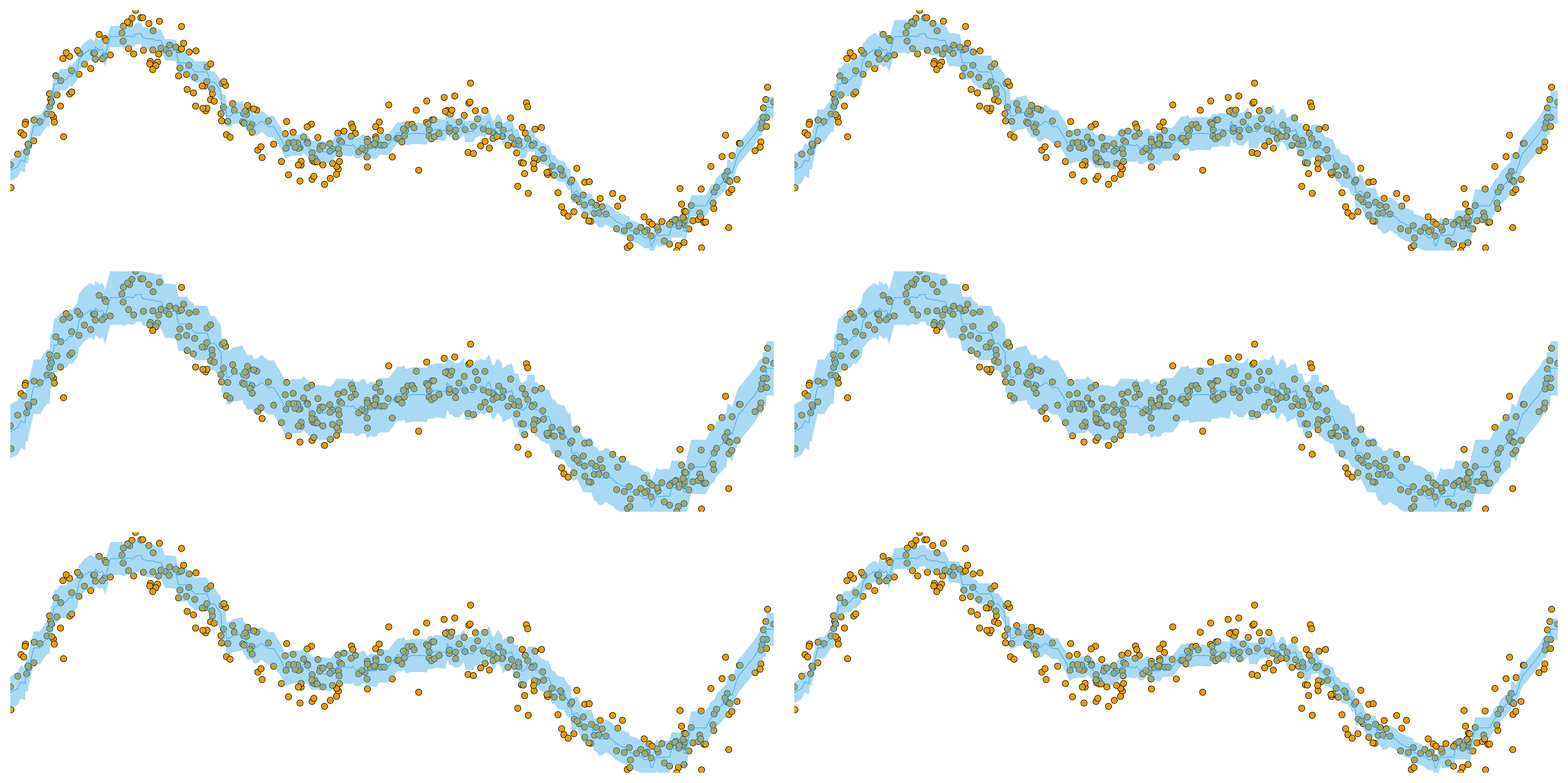
Conformal Prediction in action: prediction intervals at varying coverage rates. As coverage grows, so does the width of the prediction interval.
The animation above is lifted from a small blog post that introduces Conformal Prediction and this package in the context of regression. It shows how the prediction interval and the test points that it covers varies in size as the user-specified coverage rate changes.
🚩 Installation
You can install the latest stable release from the general registry:
julia
using Pkg
Pkg.add("ConformalPrediction")
The development version can be installed as follows:
julia
using Pkg
Pkg.add(url="https://github.com/juliatrustworthyai/ConformalPrediction.jl")
🔍 Usage Example
To illustrate the intended use of the package, let’s have a quick look at a simple regression problem. We first generate some synthetic data and then determine indices for our training and test data using MLJ:
``` julia using MLJ
Inputs:
N = 600 xmax = 3.0 using Distributions d = Uniform(-xmax, xmax) X = rand(d, N) X = reshape(X, :, 1)
Outputs:
noise = 0.5 fun(X) = sin(X) ε = randn(N) .* noise y = @.(fun(X)) + ε y = vec(y)
Partition:
train, test = partition(eachindex(y), 0.4, 0.4, shuffle=true) ```
We then import Symbolic Regressor (SymbolicRegression.jl) following the standard MLJ procedure.
julia
regressor = @load SRRegressor pkg=SymbolicRegression
model = regressor(
    niterations=50,
    binary_operators=[+, -, *],
    unary_operators=[sin],
)
To turn our conventional model into a conformal model, we just need to declare it as such by using conformal_model wrapper function. The generated conformal model instance can wrapped in data to create a machine. Finally, we proceed by fitting the machine on training data using the generic fit! method:
julia
using ConformalPrediction
conf_model = conformal_model(model)
mach = machine(conf_model, X, y)
fit!(mach, rows=train)
Predictions can then be computed using the generic predict method. The code below produces predictions for the first n samples. Each tuple contains the lower and upper bound for the prediction interval.
julia
show_first = 5
Xtest = selectrows(X, test)
ytest = y[test]
ŷ = predict(mach, Xtest)
ŷ[1:show_first]
5-element Vector{Tuple{Float64, Float64}}:
 (-0.04087262272113379, 1.8635644669554758)
 (0.04647464096907805, 1.9509117306456876)
 (-0.24248802236397216, 1.6619490673126376)
 (-0.07841928163933476, 1.8260178080372749)
 (-0.02268628324126465, 1.881750806435345)
For simple models like this one, we can call a custom Plots recipe on our instance, fit result and data to generate the chart below:
julia
using Plots
zoom = 0
plt = plot(mach.model, mach.fitresult, Xtest, ytest, lw=5, zoom=zoom, observed_lab="Test points")
xrange = range(-xmax+zoom,xmax-zoom,length=N)
plot!(plt, xrange, @.(fun(xrange)), lw=2, ls=:dash, colour=:darkorange, label="Ground truth")

We can evaluate the conformal model using the standard MLJ workflow with a custom performance measure. You can use either emp_coverage for the overall empirical coverage (correctness) or ssc for the size-stratified coverage rate (adaptiveness).
julia
_eval = evaluate!(mach; measure=[emp_coverage, ssc], verbosity=0)
display(_eval)
println("Empirical coverage: $(round(_eval.measurement[1], digits=3))")
println("SSC: $(round(_eval.measurement[2], digits=3))")
PerformanceEvaluation object with these fields:
  model, measure, operation, measurement, per_fold,
  per_observation, fitted_params_per_fold,
  report_per_fold, train_test_rows, resampling, repeats
Extract:
┌──────────────────────────────────────────────┬───────────┬─────────────┬──────
│ measure                                      │ operation │ measurement │ 1.9 ⋯
├──────────────────────────────────────────────┼───────────┼─────────────┼──────
│ ConformalPrediction.emp_coverage             │ predict   │ 0.953       │ 0.0 ⋯
│ ConformalPrediction.size_stratified_coverage │ predict   │ 0.953       │ 0.0 ⋯
└──────────────────────────────────────────────┴───────────┴─────────────┴──────
                                                               2 columns omitted

Empirical coverage: 0.953
SSC: 0.953
📚 Read on
If after reading the usage example above you are just left with more questions about the topic, that’s normal. Below we have have collected a number of further resources to help you get started with this package and the topic itself:
- Blog post introducing conformal classifiers: [Quarto], [TDS], [Forem].
- Blog post applying CP to a deep learning image classifier: [Quarto], [TDS], [Forem].
- The package docs and in particular the FAQ.
External Resources
- A Gentle Introduction to Conformal Prediction and Distribution-Free Uncertainty Quantification by Angelopoulos and Bates (2022) (pdf).
- Predictive inference with the jackknife+ by Barber et al. (2021) (pdf)
- Awesome Conformal Prediction repository by Valery Manokhin (repo).
- Documentation for the Python package MAPIE.
🔁 Status
This package is in its early stages of development and therefore still subject to changes to the core architecture and API.
Implemented Methodologies
The following CP approaches have been implemented:
Regression:
- Inductive
- Naive Transductive
- Jackknife
- Jackknife+
- Jackknife-minmax
- CV+
- CV-minmax
Classification:
- Inductive
- Naive Transductive
- Adaptive Inductive
The package has been tested for the following supervised models offered by MLJ.
Regression:
julia
keys(tested_atomic_models[:regression])
KeySet for a Dict{Symbol, Expr} with 8 entries. Keys:
  :ridge
  :lasso
  :evo_tree
  :nearest_neighbor
  :decision_tree_regressor
  :quantile
  :random_forest_regressor
  :linear
Classification:
julia
keys(tested_atomic_models[:classification])
KeySet for a Dict{Symbol, Expr} with 5 entries. Keys:
  :nearest_neighbor
  :evo_tree
  :random_forest_classifier
  :logistic
  :decision_tree_classifier
Implemented Evaluation Metrics
To evaluate conformal predictors we are typically interested in correctness and adaptiveness. The former can be evaluated by looking at the empirical coverage rate, while the latter can be assessed through metrics that address the conditional coverage (Angelopoulos and Bates 2022). To this end, the following metrics have been implemented:
emp_coverage(empirical coverage)ssc(size-stratified coverage)
There is also a simple Plots.jl recipe that can be used to inspect the set sizes. In the regression case, the interval width is stratified into discrete bins for this purpose:
julia
bar(mach.model, mach.fitresult, X)

🛠 Contribute
Contributions are welcome! A good place to start is the list of outstanding issues. For more details, see also the Contributor’s Guide. Please follow the SciML ColPrac guide.
🙏 Thanks
To build this package I have read and re-read both Angelopoulos and Bates (2022) and Barber et al. (2021). The Awesome Conformal Prediction repository (Manokhin 2022) has also been a fantastic place to get started. Thanks also to @aangelopoulos, @valeman and others for actively contributing to discussions on here. Quite a few people have also recently started using and contributing to the package for which I am very grateful. Finally, many thanks to Anthony Blaom (@ablaom) for many helpful discussions about how to interface this package to MLJ.jl.
🎓 References
Angelopoulos, Anastasios N., and Stephen Bates. 2022. “A Gentle Introduction to Conformal Prediction and Distribution-Free Uncertainty Quantification.” https://arxiv.org/abs/2107.07511.
Barber, Rina Foygel, Emmanuel J. Candès, Aaditya Ramdas, and Ryan J. Tibshirani. 2021. “Predictive Inference with the Jackknife+.” The Annals of Statistics 49 (1): 486–507. https://doi.org/10.1214/20-AOS1965.
Blaom, Anthony D., Franz Kiraly, Thibaut Lienart, Yiannis Simillides, Diego Arenas, and Sebastian J. Vollmer. 2020. “MLJ: A Julia Package for Composable Machine Learning.” Journal of Open Source Software 5 (55): 2704. https://doi.org/10.21105/joss.02704.
Manokhin, Valery. 2022. “Awesome Conformal Prediction.” https://doi.org/10.5281/zenodo.6467205; Zenodo. https://doi.org/10.5281/zenodo.6467205.
Owner
- Name: Taija
- Login: JuliaTrustworthyAI
- Kind: organization
- Location: Netherlands
- Repositories: 2
- Profile: https://github.com/JuliaTrustworthyAI
Home for repositories of the Taija (Trustworthy Artifical Intelligence in Julia) project.
Citation (CITATION.bib)
@misc{ConformalPrediction.jl,
	author  = {Patrick Altmeyer},
	title   = {ConformalPrediction.jl},
	url     = {https://github.com/juliatrustworthyai/ConformalPrediction.jl},
	version = {v0.1.0},
	year    = {2022},
	month   = {9}
}
GitHub Events
Total
- Issues event: 3
- Watch event: 7
- Issue comment event: 5
- Push event: 6
- Pull request event: 4
- Create event: 4
Last Year
- Issues event: 3
- Watch event: 7
- Issue comment event: 5
- Push event: 6
- Pull request event: 4
- Create event: 4
Committers
Last synced: about 1 year ago
Top Committers
| Name | Commits | |
|---|---|---|
| pat-alt | a****t@g****m | 259 |
| pasquale c. | 3****k@o****t | 30 |
| Moji | m****n@g****m | 12 |
| CompatHelper Julia | c****y@j****g | 10 |
| mojtaba farmanbar | m****r@k****l | 8 |
| John Waczak | j****k@g****m | 4 |
| rikhuijzer | r****r@p****e | 1 |
| pricklypointer | 1****r | 1 |
| github-actions[bot] | 4****] | 1 |
| Pietro Monticone | 3****e | 1 |
| Jafar Isbarov | c****v@g****m | 1 |
Committer Domains (Top 20 + Academic)
Issues and Pull Requests
Last synced: 11 months ago
All Time
- Total issues: 55
- Total pull requests: 79
- Average time to close issues: 2 months
- Average time to close pull requests: 10 days
- Total issue authors: 11
- Total pull request authors: 9
- Average comments per issue: 1.58
- Average comments per pull request: 1.03
- Merged pull requests: 52
- Bot issues: 0
- Bot pull requests: 33
Past Year
- Issues: 8
- Pull requests: 7
- Average time to close issues: N/A
- Average time to close pull requests: 9 days
- Issue authors: 5
- Pull request authors: 3
- Average comments per issue: 0.75
- Average comments per pull request: 1.29
- Merged pull requests: 2
- Bot issues: 0
- Bot pull requests: 4
Top Authors
Issue Authors
- pat-alt (41)
- ablaom (2)
- azev77 (2)
- Qfl3x (1)
- ceferisbarov (1)
- pasq-cat (1)
- bkamins (1)
- albertpod (1)
- tfiers (1)
- MojiFarmanbar (1)
- JuliaTagBot (1)
Pull Request Authors
- github-actions[bot] (42)
- pat-alt (38)
- MojiFarmanbar (6)
- pasq-cat (2)
- pricklypointer (2)
- pitmonticone (1)
- john-waczak (1)
- ceferisbarov (1)
- rikhuijzer (1)
Top Labels
Issue Labels
Pull Request Labels
Packages
- Total packages: 1
-
Total downloads:
- julia 1 total
- Total dependent packages: 1
- Total dependent repositories: 0
- Total versions: 14
juliahub.com: ConformalPrediction
Predictive Uncertainty Quantification through Conformal Prediction for Machine Learning models trained in MLJ.
- Homepage: https://www.taija.org/ConformalPrediction.jl/
- Documentation: https://docs.juliahub.com/General/ConformalPrediction/stable/
- License: MIT
-
Latest release: 0.1.13
published almost 2 years ago
Rankings
Dependencies
- actions/checkout v2 composite
- codecov/codecov-action v2 composite
- julia-actions/cache v1 composite
- julia-actions/julia-buildpkg v1 composite
- julia-actions/julia-docdeploy v1 composite
- julia-actions/julia-processcoverage v1 composite
- julia-actions/julia-runtest v1 composite
- julia-actions/setup-julia v1 composite
- JuliaRegistries/TagBot v1 composite
- julia-actions/RegisterAction latest composite