graphizy
Lightweight Python library for real time graph construction and analysis
Science Score: 44.0%
This score indicates how likely this project is to be science-related based on various indicators:
-
✓CITATION.cff file
Found CITATION.cff file -
✓codemeta.json file
Found codemeta.json file -
✓.zenodo.json file
Found .zenodo.json file -
○DOI references
-
○Academic publication links
-
○Academic email domains
-
○Institutional organization owner
-
○JOSS paper metadata
-
○Scientific vocabulary similarity
Low similarity (14.6%) to scientific vocabulary
Repository
Lightweight Python library for real time graph construction and analysis
Basic Info
- Host: GitHub
- Owner: cfosseprez
- License: other
- Language: Python
- Default Branch: main
- Size: 2.93 MB
Statistics
- Stars: 0
- Watchers: 0
- Forks: 0
- Open Issues: 0
- Releases: 1
Metadata Files
README.md





Graphizy
Graphizy is a powerful, fast, and flexible Python library for building and analyzing graphs from 2D spatial data. Designed for computational geometry and network visualization, it supports multiple graph types, real-time analysis, memory-enhanced temporal graphs, and comprehensive weight computation systems — all powered by OpenCV and igraph with a modern, unified API.
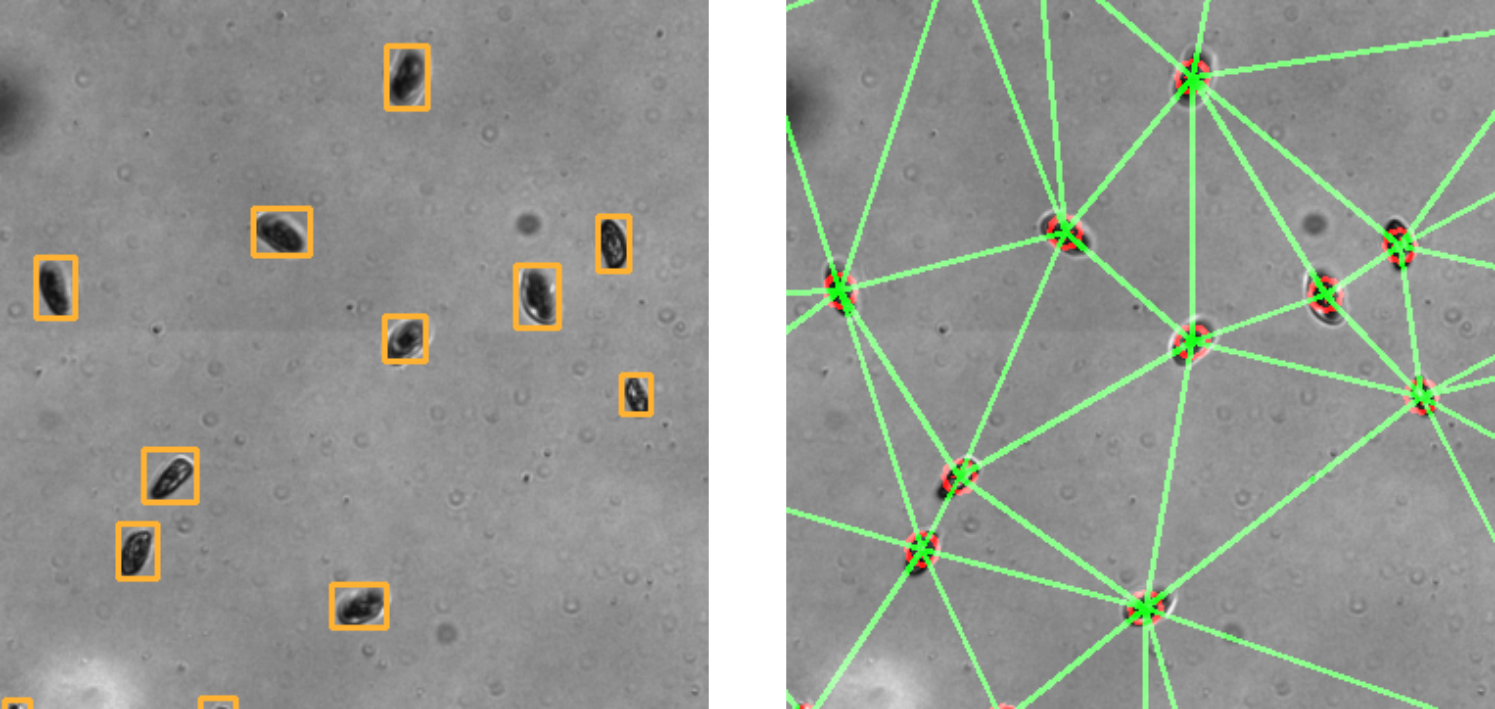
Convert spatial coordinates to analyzed graphs in milliseconds. Real-time graph analytics accessible through comprehensive igraph integration with enhanced memory and weight systems.
Documentation
## ✨ Key Features
One API for All Graphs Create Delaunay, k-NN, MST, Gabriel, Proximity, and even custom graphs with a single make_graph() call. Plugin-friendly, smart defaults, and fully type-safe.
Temporal Memory System Track how connections evolve over time. Use built-in memory features for persistence-aware analysis, temporal filtering, and age-based visualization.
Rich Graph Types, Easily Extended From spatial graphs to domain-specific topologies: support includes Delaunay triangulations, proximity graphs, k-nearest neighbors, MSTs, and custom plugins.
Instant Network Analysis Access over 200 igraph algorithms with real-time stats: clustering, centrality, components, and more. All robust to disconnections. NetworkX compatible.
Custom Weights, Real-Time Ready Define weights using distance, inverse, Gaussian, or custom formulas. Memory-aware weight updates and vectorized for performance.
Advanced Tools for Spatial & Temporal Insights Includes percolation thresholds, service accessibility, social dynamics, and time-aware community tracking — all tailored for dynamic networks.
Visualization & Streaming Visualize network memory with age-based coloring and transparency. Stream updates in real time, or export static snapshots. Comes with CLI tools and interactive demos.
🔄 Unified Graph Creation Interface
- Modern API: Single
make_graph()method for all graph types - Plugin System: Easily add custom graph algorithms
- Smart Defaults: Intelligent parameter handling with memory and weight integration
- Type Safety: Runtime configuration validation with detailed error messages
📊 Comprehensive Graph Types
- Delaunay Triangulation: Optimal triangular meshes from point sets
- Proximity Graphs: Connect nearby points based on distance thresholds
- K-Nearest Neighbors: Connect each point to its k closest neighbors
- Minimum Spanning Tree: Minimal connected graph with shortest total edge length
- Gabriel Graph: Geometric proximity graph (subset of Delaunay triangulation)
- Custom Graphs: Extensible plugin system for domain-specific algorithms
🧠 Advanced Memory Systems
- Temporal Analysis: Track connections across time steps for dynamic systems
- Smart Integration: Automatic memory updates with configurable retention policies
- Age-Based Visualization: Visual feedback showing connection persistence over time
- Performance Optimized: Vectorized operations for real-time applications
⚖️ Sophisticated Weight Computation
- Multiple Methods: Distance, inverse distance, Gaussian, and custom formulas
- Real-Time Computation: Optimized fast computers for high-performance applications
- Edge Attributes: Compute any edge attribute using mathematical expressions
- Memory Integration: Weight computation on memory-enhanced graph structures
📈 Comprehensive Graph Analysis
- igraph Integration: Full access to 200+ graph analysis algorithms
- Resilient Methods: Robust analysis that handles disconnected graphs gracefully
- Real-Time Statistics: Vertex count, edge count, connectivity, clustering, centrality
- Component Analysis: Detailed connectivity and community structure analysis
🎨 Advanced Visualization & Real-Time Processing
- Memory Visualization: Age-based coloring and transparency effects
- Real-Time Streaming: High-performance streaming with async support
- Flexible Configuration: Runtime-configurable parameters using type-safe dataclasses
- Interactive Demos: Built-in demonstrations and CLI tools
🚀 Installation
bash
pip install graphizy
For development:
bash
git clone https://github.com/cfosseprez/graphizy.git
cd graphizy
pip install -e .
⚡ Quick Start
Modern Unified Interface
```python from graphizy import Graphing, GraphizyConfig, generateandformat_positions
Generate sample data
data = generateandformatpositions(sizex=800, sizey=600, numparticles=100)
Configure and create grapher
config = GraphizyConfig(dimension=(800, 600)) grapher = Graphing(config=config)
Create different graph types using unified interface
delaunaygraph = grapher.makegraph("delaunay", data) proximitygraph = grapher.makegraph("proximity", data, proximitythresh=50.0) knngraph = grapher.makegraph("knn", data, k=4) mstgraph = grapher.makegraph("mst", data) gabrielgraph = grapher.make_graph("gabriel", data)
Visualize results
image = grapher.drawgraph(delaunaygraph) grapher.showgraph(image, "Delaunay Graph") grapher.savegraph(image, "delaunay.jpg") ```
Advanced Analysis with Modern API
```python
Comprehensive graph analysis
results = grapher.getgraphinfo(delaunay_graph) # This call is instantaneous
Print a clean, pre-formatted summary
print(results.summary())
Access specific metrics as properties (computed on first access)
print(f"Density: {results.density:.3f}") print(f"Diameter: {results.diameter}")
Use helper methods for deeper analysis
tophubs = results.gettopnby('degree', n=3) print(f"Top 3 hubs (by degree): {top_hubs}")
betweennessstats = results.getmetricstats('betweenness') print(f"Betweenness Centrality Stats: {betweennessstats}") ```
🧠 Memory-Enhanced Temporal Graphs
Track connections over time for dynamic system analysis:
```python import numpy as np
Initialize memory system
grapher.initmemorymanager(maxmemorysize=200, trackedgeages=True)
Simulate evolution over time with automatic memory integration
for iteration in range(100): # Update positions (e.g., particle movement) data[:, 1:3] += np.random.normal(0, 2, (len(data), 2))
# Create memory-enhanced graph (automatic with smart defaults)
memory_graph = grapher.make_graph("proximity", data, proximity_thresh=60.0)
# Automatically: use_memory=True, update_memory=True, compute_weights=True

# Visualize with age-based coloring every 10 iterations
if iteration % 10 == 0:
    memory_image = grapher.draw_memory_graph(
        memory_graph,
        use_age_colors=True,
        alpha_range=(0.3, 1.0)  # Older connections fade
    )
    grapher.save_graph(memory_image, f"memory_frame_{iteration:03d}.jpg")
Analyze memory evolution
memorystats = grapher.getmemoryanalysis() print(f"Total historical connections: {memorystats['totalconnections']}") print(f"Average edge age: {memorystats['edgeagestats']['avg_age']:.1f}") ```
⚖️ Advanced Weight Computation
Compute sophisticated edge weights with multiple methods:
```python
Initialize weight computation system
grapher.initweightcomputer(method="gaussian", target_attribute="similarity")
Create graphs with automatic weight computation
weightedgraph = grapher.makegraph("proximity", data, proximitythresh=70.0, computeweights=True)
Analyze edge weights
if 'similarity' in weightedgraph.es.attributes(): weights = weightedgraph.es['similarity'] print(f"Weight statistics: mean={np.mean(weights):.3f}, std={np.std(weights):.3f}")
Custom weight formulas
grapher.computeedgeattribute(weightedgraph, "customweight", method="formula", formula="1.0 / (1.0 + distance * 0.01)")
Real-time optimized weight computation
grapher.setupfastattributes( distance={"method": "distance", "target": "dist"}, strength={"method": "inversedistance", "target": "strength"} ) fastgraph = grapher.makegraph("delaunay", data, computeweights=False) grapher.computeallattributesfast(fastgraph) # High-performance computation ```
🔄 Automated Multi-Graph Processing
Process multiple graph types automatically with memory and weights:
```python
Configure automatic processing
grapher.setgraphtype(['delaunay', 'proximity', 'knn', 'mst']) grapher.updategraphparams('proximity', proximitythresh=60.0, metric='euclidean') grapher.updategraph_params('knn', k=5)
Initialize integrated systems
grapher.initmemorymanager(maxmemorysize=150, trackedgeages=True) grapher.initweightcomputer(method="distance", target_attribute="weight")
Process all graph types with full pipeline: graph → memory → weights
allgraphs = grapher.updategraphs(data) # Smart defaults: usememory=True, updatememory=True, compute_weights=True
Analyze results
for graphtype, graph in allgraphs.items(): if graph: info = grapher.getgraphinfo(graph) print(f"{graphtype}: {info['edgecount']} edges, density={info['density']:.3f}")
    # Check for computed weights
    if 'weight' in graph.es.attributes():
        weights = graph.es['weight']
        print(f"  Weights: avg={np.mean(weights):.3f}")
```
🎯 Graph Types Comparison
| Graph Type | Connectivity | Typical Edges | Use Case | Memory Compatible | Weight Compatible | |------------|--------------|---------------|----------|-------------------|-------------------| | Delaunay | Always | ~3n | Mesh generation, spatial analysis | ✅ | ✅ | | Proximity | Variable | ~distance² | Local neighborhoods, clustering | ✅ | ✅ | | K-NN | Variable | k×n | Machine learning, recommendation | ✅ | ✅ | | MST | Always | n-1 | Minimal connectivity, optimization | ✅ | ✅ | | Gabriel | Variable | ⊆ Delaunay | Wireless networks, geometric constraints | ✅ | ✅ | | Memory | Variable | Historical | Temporal analysis, evolution tracking | N/A | ✅ |
🏃♂️ Real-Time Streaming
High-performance real-time graph processing:
```python
Create stream manager for real-time processing
streammanager = grapher.createstreammanager( buffersize=1000, updateinterval=0.05, # 20 FPS automemory=True )
Add real-time visualization callback
def visualizecallback(graphs): if 'proximity' in graphs and graphs['proximity']: image = grapher.drawmemorygraph(graphs['proximity'], useagecolors=True) grapher.showgraph(image, "Real-time Graph", block=False)
streammanager.addcallback(visualizecallback) streammanager.start_streaming()
Feed real-time data
for frame in datastream: streammanager.push_data(frame)
Async streaming for high-performance applications
asyncmanager = grapher.createasyncstreammanager(buffer_size=2000)
... async processing
```
🔧 Plugin System
Easily extend Graphizy with custom graph types:
```python from graphizy import graphtypeplugin import igraph as ig
@graphtypeplugin( name="customalgorithm", description="Your custom graph algorithm", category="custom", parameters={ "threshold": {"type": "float", "default": 0.5, "description": "Algorithm threshold"} } ) def createcustomgraph(datapoints, dimension, **kwargs): # Your algorithm implementation # ... create igraph Graph return graph
Use immediately with unified interface
customgraph = grapher.makegraph("custom_algorithm", data, threshold=0.7) ```
📊 Performance & Scalability
- Real-time Processing: Handle 1000+ points at 60+ FPS
- Memory Efficiency: Optimized data structures with configurable memory limits
- Vectorized Operations: NumPy and OpenCV optimizations throughout
- Async Support: High-performance asynchronous streaming capabilities
- Smart Caching: Intelligent caching of expensive computations
🛠️ Advanced Configuration
Type-safe, runtime-configurable parameters:
```python
Comprehensive configuration
config = GraphizyConfig( dimension=(1200, 800), drawing={ "linecolor": (255, 0, 0), "pointcolor": (0, 255, 255), "linethickness": 2, "pointradius": 8 }, graph={ "proximitythreshold": 75.0, "distancemetric": "euclidean" }, memory={ "maxmemorysize": 200, "autoupdatefromproximity": True }, weight={ "autocomputeweights": True, "weightmethod": "gaussian" } )
grapher = Graphing(config=config)
Runtime updates
grapher.updateconfig( drawing={"linethickness": 3}, memory={"maxmemorysize": 300} ) ```
📚 Examples & Documentation
Comprehensive examples demonstrating all features:
1_basic_usage.py- Modern unified interface and all graph types2_graph_metrics.py- Advanced analysis with resilient methods3_advanced_memory.py- Memory systems and temporal analysis4_weight_computation.py- Weight systems and custom formulas5_add_new_graph_type.py- Plugin system and custom algorithms6_stream_example.py- Real-time streaming and async processing
```bash
Run examples
python examples/1basicusage.py python examples/2graphmetrics.py python examples/3advancedmemory.py
Interactive demo
python examples/0interactivedemo.py ```
🔬 Advanced Use Cases
Scientific Computing
```python
Particle physics simulations with temporal tracking
grapher.initmemorymanager(maxmemorysize=1000, trackedgeages=True) for timestep in simulation: particlegraph = grapher.makegraph("delaunay", particlepositions[timestep]) analyzeparticleinteractions(particlegraph) ```
Network Analysis
```python
Social network evolution with weight analysis
grapher.initweightcomputer(method="inversedistance", targetattribute="friendshipstrength") socialgraph = grapher.makegraph("proximity", userpositions, proximitythresh=influenceradius, compute_weights=True) ```
Computer Vision
```python
Feature point tracking in video streams
async for framefeatures in videostream: featuregraph = grapher.makegraph("knn", framefeatures, k=8) trackfeatureevolution(featuregraph) ```
📋 Requirements
- Python >= 3.8
- NumPy >= 1.20.0
- OpenCV >= 4.5.0
- python-igraph >= 0.9.0
- SciPy >= 1.7.0 (for KNN and MST)
- networkx >= 3.0 (for NetworkX bridge)
🧪 Development & Testing
```bash
Install development dependencies
pip install -e ".[dev]"
Run tests with coverage
pytest tests/ --cov=graphizy --cov-report=html
Code quality
black src/ flake8 src/ mypy src/graphizy/
Performance testing
python examples/benchmark_comparison.py ```
📈 Changelog
v0.1.17 (Current)
- ✅ Unified make_graph() Interface: Single method for all graph types
- ✅ Enhanced Memory Systems: Smart defaults and vectorized operations
- ✅ Advanced Weight Computation: Multiple methods with real-time optimization
- ✅ Resilient Analysis Methods: Robust handling of disconnected graphs
- ✅ Plugin System Enhancements: Advanced parameter validation and documentation
- ✅ Real-Time Streaming: Async support and performance optimizations
- ✅ Comprehensive Documentation: Updated examples and API reference
Previous Versions
- v0.1.16: Added MST and Gabriel graph types, enhanced memory visualization
- v0.1.15: Initial memory system and weight computation
- v0.1.14: Plugin system and custom graph types
- v0.1.13: Core graph types and visualization
🤝 Contributing
We welcome contributions! Please see our Contributing Guide for details.
- Fork the repository
- Create a feature branch (
git checkout -b feature/amazing-feature) - Add comprehensive tests for new functionality
- Ensure all tests pass (
pytest tests/) - Update documentation and examples
- Commit changes (
git commit -m 'Add amazing feature') - Push to branch (
git push origin feature/amazing-feature) - Open a Pull Request
📄 License
GPL-2.0-or-later License - see LICENSE file for details.
👨💻 Author
Charles Fosseprez
📧 Email: charles.fosseprez.pro@gmail.com
🐙 GitHub: @cfosseprez
📖 Documentation: graphizy.readthedocs.io
🙏 Acknowledgments
Built with powerful open-source libraries:
- OpenCV for high-performance computer vision operations
- igraph for comprehensive graph analysis algorithms
- NumPy for efficient numerical computations
- SciPy for scientific computing functions
Built with ❤️ for computational geometry, network analysis, and real-time graph processing
Owner
- Name: Charles Fosseprez
- Login: cfosseprez
- Kind: user
- Repositories: 1
- Profile: https://github.com/cfosseprez
3 meter, greenish eyes, charming
Citation (CITATION.cff)
cff-version: 1.2.0
message: If you use Graphizy, please cite it using the following metadata.
title: 'Graphizy: Spatial Graph Construction and Temporal Analysis'
authors:
- family-names: Fosseprez
  given-names: Charles
  orcid: https://orcid.org/0009-0000-4524-0399
version: 0.1.20
date-released: '2025-08-07'
repository-code: https://github.com/cfosseprez/graphizy
url: https://github.com/cfosseprez/graphizy
license: GPL 2.0 or later
type: software
GitHub Events
Total
- Push event: 33
Last Year
- Push event: 33
Packages
- Total packages: 1
-
Total downloads:
- pypi 219 last-month
- Total dependent packages: 0
- Total dependent repositories: 0
- Total versions: 14
- Total maintainers: 1
pypi.org: graphizy
Graphizy is a fast, flexible Python library for building and analyzing computational geometry-based graphs from 2D coordinates.
- Homepage: https://github.com/cfosseprez/graphizy
- Documentation: https://graphizy.readthedocs.io/en/latest/
- License: GPL-2.0-or-later
-
Latest release: 0.1.20
published 10 months ago
Rankings
Maintainers (1)
Dependencies
- actions/checkout v3 composite
- actions/setup-python v4 composite
- codecov/codecov-action v3 composite
- numpy >=1.20.0
- opencv-python >=4.5.0
- python-igraph >=0.9.0
- scipy >=1.7.0
- actions/checkout v4 composite
- actions/setup-python v5 composite
- peaceiris/actions-gh-pages v4 composite
- ipython *
- matplotlib >=3.5.0
- myst-parser >=2.0.0
- nbsphinx >=0.8.0
- numpy >=1.20.0
- opencv-python-headless >=4.5.0
- pillow *
- python-igraph >=0.9.0
- scipy >=1.7.0
- sphinx >=7.0.0,<8.0.0
- sphinx-copybutton >=0.5.2
- sphinx-rtd-theme >=2.0.0