nodeology
nodeology enables researchers—especially those without extensive programming experience—to quickly design and deploy full-stack AI workflows simply using prompt templates and existing functions.
Science Score: 54.0%
This score indicates how likely this project is to be science-related based on various indicators:
-
✓CITATION.cff file
Found CITATION.cff file -
✓codemeta.json file
Found codemeta.json file -
✓.zenodo.json file
Found .zenodo.json file -
○DOI references
-
✓Academic publication links
Links to: arxiv.org -
○Academic email domains
-
○Institutional organization owner
-
○JOSS paper metadata
-
○Scientific vocabulary similarity
Low similarity (17.6%) to scientific vocabulary
Repository
nodeology enables researchers—especially those without extensive programming experience—to quickly design and deploy full-stack AI workflows simply using prompt templates and existing functions.
Basic Info
Statistics
- Stars: 29
- Watchers: 2
- Forks: 3
- Open Issues: 1
- Releases: 0
Metadata Files
README.md
[!IMPORTANT] This package is actively in development, and breaking changes may occur.

🤖 Foundation AI-Enhanced Scientific Workflow
Foundation AI holds enormous potential for scientific research, especially in analyzing unstructured data, automating complex reasoning tasks, and simplifying human-computer interactions. However, integrating foundation AI models like LLMs and VLMs into scientific workflows poses challenges: handling diverse data types beyond text and images, managing model inaccuracies (hallucinations), and adapting general-purpose models to highly specialized scientific contexts.
nodeology addresses these challenges by combining the strengths of foundation AI with traditional scientific methods and expert oversight. Built on langgraph's state machine framework, it simplifies creating robust, AI-driven workflows through an intuitive, accessible interface. Originally developed at Argonne National Lab, the framework enables researchers—especially those without extensive programming experience—to quickly design and deploy full-stack AI workflows simply using prompt templates and existing functions as reusable nodes.
Key features include:
- Easy creation of AI-integrated workflows without complex syntax
- Flexible and composable node architecture for various tasks
- Seamless human-in-the-loop interactions for expert oversight
- Portable workflow templates for collaboration and reproducibility
- Quickly spin up simple chatbots for immediate AI interaction
- Built-in tracing and telemetry for workflow monitoring and optimization
🚀 Getting Started
Install the package
To use the latest development version:
bash
pip install git+https://github.com/xyin-anl/Nodeology.git
To use the latest release version:
bash
pip install nodeology
Access foundation models
Nodeology supports various cloud-based/local foundation models via LiteLLM, see provider list. Most of cloud-based models usage requires setting up API key. For example:
```bash
For OpenAI models
export OPENAIAPIKEY='your-api-key'
For Anthropic models
export ANTHROPICAPIKEY='your-api-key'
For Gemini models
export GEMINIAPIKEY='your-api-key'
For Together AI hosted open weight models
export TOGETHERAPIKEY='your-api-key' ```
💡 Tip: The field of foundation models is evolving rapidly with new and improved models emerging frequently. As of February 2025, we recommend the following models based on their strengths:
- gpt-4o: Excellent for broad general knowledge, writing tasks, and conversational interactions
- o3-mini: Good balance of math, coding, and reasoning capabilities at a lower price point
- anthropic/claude-3.7: Strong performance in general knowledge, math, science, and coding with well-constrained outputs
- gemini/gemini-2.0-flash: Effective for general knowledge tasks with a large context window for processing substantial information
- together_ai/deepseek-ai/DeepSeek-R1: Exceptional reasoning, math, science, and coding capabilities with transparent thinking processes
For Argonne Users: if you are within Argonne network, you will have access to OpenAI's models through Argonne's ARGO inference service and ALCF's open weights model inference service for free. Please check this link to see how to use them
Langfuse Tracing (Optional)
Nodeology supports Langfuse for observability and tracing of LLM/VLM calls. To use Langfuse:
- Set up a Langfuse account and get your API keys
- Configure Langfuse with your keys:
```bash
Set environment variables
export LANGFUSEPUBLICKEY='your-public-key' export LANGFUSESECRETKEY='your-secret-key' export LANGFUSE_HOST='https://cloud.langfuse.com' # Or your self-hosted URL ```
Or configure programmatically:
```python from nodeology.client import configure_langfuse
configurelangfuse( publickey='your-public-key', secret_key='your-secret-key', host='https://cloud.langfuse.com' # Optional ) ```
Chainlit Interface (Optional)
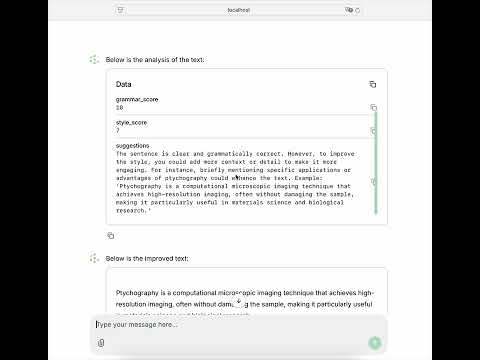
Nodeology supports Chainlit for creating chat-based user interfaces. To use this feature, simply set ui=True when running your workflow:
```python
Create your workflow
workflow = MyWorkflow()
Run with UI enabled
workflow.run(ui=True) ```
This will automatically launch a Chainlit server with a chat interface for interacting with your workflow. The interface preserves your workflow's state and configuration, allowing users to interact with it through a user-friendly chat interface.
When the Chainlit server starts, you can access the interface through your web browser at http://localhost:8000 by default.
🧪 Illustrating Examples
Writing Improvement
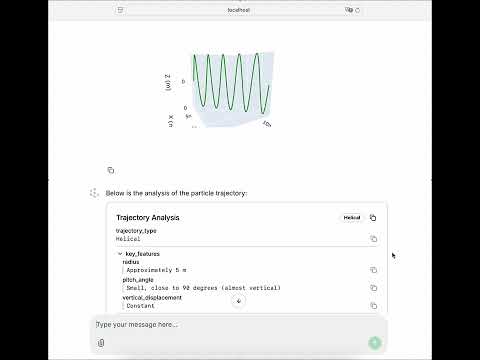
Trajectory Analysis
🔬 Scientific Applications
👥 Contributing & Collaboration
We welcome comments, feedbacks, bugs report, code contributions and research collaborations. Please refer to CONTRIBUTING.md
If you find nodeology useful and may inspire your research, please use the Cite this repository function
Owner
- Login: xyin-anl
- Kind: user
- Repositories: 1
- Profile: https://github.com/xyin-anl
Citation (CITATION.cff)
cff-version: 1.2.0
message: "If you use this software, please cite it as below."
authors:
- family-names: "Xiangyu"
  given-names: "Yin"
  orcid: "https://orcid.org/0000-0003-2868-1728"
title: "Nodeology"
version: 0.0.1
date-released: 2024-11-20
url: "https://github.com/xyin-anl/Nodeology"
GitHub Events
Total
- Issues event: 1
- Watch event: 27
- Push event: 18
- Public event: 1
- Fork event: 3
- Create event: 1
Last Year
- Issues event: 1
- Watch event: 27
- Push event: 18
- Public event: 1
- Fork event: 3
- Create event: 1
Packages
- Total packages: 1
-
Total downloads:
- pypi 45 last-month
- Total dependent packages: 0
- Total dependent repositories: 0
- Total versions: 3
- Total maintainers: 1
pypi.org: nodeology
Foundation AI-Enhanced Scientific Workflow
- Homepage: https://github.com/xyin-anl/nodeology
- Documentation: https://nodeology.readthedocs.io/
- License: other
-
Latest release: 0.0.3
published over 1 year ago
Rankings
Maintainers (1)
Dependencies
- langgraph *
- marker-pdf *
- openai *
- pytest *
- pyyaml *
- r2r *
- requests *
- typing-extensions *