Recent Releases of pot
pot - 0.9.5
This new release contains several new features, starting with a novel Gaussian Mixture Model Optimal Transport (GMM-OT) solver to compare GMM while enforcing the transport plan to remain a GMM, that benefits from a closed-form solution making it practical for high-dimensional matching problems. We also extended our general unbalanced OT solvers to support any non-negative reference measure in the regularization terms, before adding the novel translation invariant UOT solver showcasing a higher convergence speed. We also implemented several new solvers and enhanced existing ones to perform OT across spaces. These include a semi-relaxed FGW barycenter solver, coupled with new initialization heuristics for the inner divergence computation, to perform graph partitioning or dictionary learning. Followed by novel unbalanced FGW and Co-optimal transport solvers to promote robustness to outliers in such matching problems. And we finally updated the implementation of partial GW now supporting asymmetric structures and the KL divergence, while leveraging a new generic conditional gradient solver for partial transport problems enabling significant speed improvements. These latest updates required some modifications to the line search functions of our generic conditional gradient solver, paving the way for future improvements to other GW-based solvers. Last but not least, we implemented a pre-commit scheme to automatically correct common programming mistakes likely to be made by our future contributors.
This release also contains few bug fixes, concerning the support of any metric in ot.emd_1d / ot.emd2_1d, and the support of any weights in ot.gaussian.
Breaking change
- Custom functions provided as parameter
line_searchtoot.optim.generic_conditional_gradientmust now have the signatureline_search(cost, G, deltaG, Mi, cost_G, df_G, **kwargs), adding as inputdf_Gthe gradient of the regularizer evaluated at the transport planG. This change aims at improving speed of solvers having quadratic polynomial functions as regularizer such as the Gromov-Wassertein loss (PR #663).
New features
- New linter based on pre-commit using ruff, codespell and yamllint (PR #681)
- Added feature
mass=Truefornx.kl_div(PR #654) - Implemented Gaussian Mixture Model OT
ot.gmm(PR #649) - Added feature
semirelaxed_fgw_barycentersand generic FGW-related barycenter updatesupdate_barycenter_structureandupdate_barycenter_feature(PR #659) - Added initialization heuristics for sr(F)GW problems via
semirelaxed_init_plan, integrated in all sr(F)GW solvers (PR #659) - Improved
ot.plot.plot1D_mat(PR #649) - Added
nx.det(PR #649) nx.sqrtmis now broadcastable (takes ..., d, d) inputs (PR #649)- Restructured
ot.unbalancedmodule (PR #658) - Added
ot.unbalanced.lbfgsb_unbalanced2and add flexible reference measurecin all unbalanced solvers (PR #658) - Implemented Fused unbalanced Gromov-Wasserstein and unbalanced Co-Optimal Transport (PR #677)
- Notes before depreciating partial Gromov-Wasserstein function in
ot.partialmoved to ot.gromov (PR #663) - Create
ot.gromov._partialadd new featuresloss_fun = "kl_loss"andsymmetry=Falseto all solvers while increasing speed + updating adequatlyot.solvers(PR #663) - Added
ot.unbalanced.sinkhorn_unbalanced_translation_invariant(PR #676)
Closed issues
- Fixed
ot.gaussianignoring weights when computing means (PR #649, Issue #648) - Fixed
ot.emd_1dandot.emd2_1dincorrectly allowing any metric (PR #670, Issue #669)
Full Changelog: https://github.com/PythonOT/POT/compare/0.9.4...0.9.5
- Python
Published by cedricvincentcuaz over 1 year ago

pot - 0.9.4
This new release contains several new features and bug fixes. Among the new features
we have novel Quantized FGW solvers that can be used to speed up the computation of the FGW loss on large datasets or to promote a structure on the pairwise matrices. We also updated the continuous entropic mapping to provide efficient out-of-sample continuous mapping thanks to entropic regularization. We also have a new general unbalanced solvers for ot.solve and BFGS solver and illustrative example. Finally we have a new solver for the Low Rank Gromov-Wasserstein that can be used to compute the GW distance between two large scale datasets with a low rank approximation.
From a maintenance point of view, we now have a new option to install optional dependencies with pip install POT[all] and the specific backends or submodules' dependencies may also be installed individually. The pip options are: backend-jax, backend-tf, backend-torch, cvxopt, dr, gnn, plot, all. We also provide with this release support for NumPy 2.0 (the wheels should now be compatible with NumPy 2.0 and below). We also fixed several issues such as gradient sign errors for FGW solvers, empty weights for ot.emd2, and line-search in partial GW. We also split the test/test_gromov.py into test/gromov/ to make the tests more manageable.
New features
- NumPy 2.0 support is added (PR #629)
- New quantized FGW solvers
ot.gromov.quantized_fused_gromov_wasserstein,ot.gromov.quantized_fused_gromov_wasserstein_samplesandot.gromov.quantized_fused_gromov_wasserstein_partitioned(PR #603) ot.gromov._gw.solve_gromov_linesearchnow has an argument to specify if the matrices are symmetric in which case the computation can be done faster (PR #607).- Continuous entropic mapping (PR #613)
- New general unbalanced solvers for
ot.solveand BFGS solver and illustrative example (PR #620) - Add gradient computation with envelope theorem to sinkhorn solver of
ot.solvewithgrad='envelope'(PR #605). - Added support for Low rank Gromov-Wasserstein with
ot.gromov.lowrank_gromov_wasserstein_samples(PR #614) - Optional dependencies may now be installed with
pip install POT[all]The specific backends or submodules' dependencies may also be installed individually. The pip options are:backend-jax, backend-tf, backend-torch, cvxopt, dr, gnn, all. The installation of thecupybackend should be done with conda.
Closed issues
- Fix gpu compatibility of sr(F)GW solvers when
G0 is not None(PR #596) - Fix doc and example for lowrank sinkhorn (PR #601)
- Fix issue with empty weights for
ot.emd2(PR #606, Issue #534) - Fix a sign error regarding the gradient of
ot.gromov._gw.fused_gromov_wasserstein2andot.gromov._gw.gromov_wasserstein2for the kl loss (PR #610) - Fix same sign error for sr(F)GW conditional gradient solvers (PR #611)
- Split
test/test_gromov.pyintotest/gromov/(PR #619) - Fix (F)GW barycenter functions to support computing barycenter on 1 input + deprecate structures as lists (PR #628)
- Fix line-search in partial GW and change default init to the interior of partial transport plans (PR #602)
- Fix
ot.da.sinkhorn_lpl1_mmcompatibility with JAX (PR #592) - Fiw linesearch import error on Scipy 1.14 (PR #642, Issue #641)
- Upgrade supported JAX versions from jax<=0.4.24 to jax<=0.4.30 (PR #643)
New Contributors
- @WilliamBonvini made their first contribution in https://github.com/PythonOT/POT/pull/595
- @KrzakalaPaul made their first contribution in https://github.com/PythonOT/POT/pull/607
- @matthewfeickert made their first contribution in https://github.com/PythonOT/POT/pull/629
- @yikun-baio made their first contribution in https://github.com/PythonOT/POT/pull/602
- @SarahG-579462 made their first contribution in https://github.com/PythonOT/POT/pull/627
- @simon-forb made their first contribution in https://github.com/PythonOT/POT/pull/637
Full Changelog: https://github.com/PythonOT/POT/compare/0.9.3...0.9.4
- Python
Published by rflamary almost 2 years ago
pot - 0.9.3
Closed issues
- Fixed an issue with cost correction for mismatched labels in
ot.da.BaseTransportfit methods. This fix addresses the original issue introduced PR #587 (PR #593)
What's Changed
- tiny typos in doc by @gabrielfougeron in https://github.com/PythonOT/POT/pull/591
- Fix DA cost correction when cost limit is set to Inf by @kachayev in https://github.com/PythonOT/POT/pull/593
- [MRG] Release 0.9.3 by @rflamary in https://github.com/PythonOT/POT/pull/594
New Contributors
- @gabrielfougeron made their first contribution in https://github.com/PythonOT/POT/pull/591
Full Changelog: https://github.com/PythonOT/POT/compare/0.9.2...0.9.3
- Python
Published by rflamary over 2 years ago
pot - 0.9.2
This new release contains several new features and bug fixes. Among the new features we have a new solver for estimation of nearest Brenier potentials (SSNB) that can be used for OT mapping estimation (on small problems), new Bregman Alternated Projected Gradient solvers for GW and FGW, and new solvers for Bures-Wasserstein barycenters. We also provide a first solver for Low Rank Sinkhorn that will be ussed to provide low rak OT extensions in the next releases. Finally we have a new exact line-search for (F)GW solvers with KL loss that can be used to improve the convergence of the solvers.
We also have a new LazyTensor class that can be used to model OT plans and low rank tensors in large scale OT. This class is used to return the plan for the new wrapper for geomloss Sinkhorn solver on empirical samples that can lead to x10/x100 speedups on CPU or GPU and have a lazy implementation that allows solving very large problems of a few millions samples.
We also have a new API for solving OT problems from empirical samples with ot.solve_sample Finally we have a new API for Gromov-Wasserstein solvers with ot.solve_gromov function that centralizes most of the (F)GW methods with unified notation. Some example of how to use the new API below:
```python
Generate random data
xs, xt = np.random.randn(100, 2), np.random.randn(50, 2)
Solve OT problem with empirical samples
sol = ot.solvesample(xs, xt) # Exact OT betwen smaples with uniform weights sol = ot.solvesample(xs, xt, wa, wb) # Exact OT with weights given by user
sol = ot.solve_sample(xs, xt, reg= 1, metric='euclidean') # sinkhorn with euclidean metric
sol = ot.solve_sample(xs, xt, reg= 1, method='geomloss') # faster sinkhorn solver on CPU/GPU
sol = ot.solve_sample(x,x2, method='factored', rank=10) # compute factored OT
sol = ot.solve_sample(x,x2, method='lowrank', rank=10) # compute lowrank sinkhorn OT
valuebw = ot.solvesample(xs, xt, method='gaussian').value # Bures-Wasserstein distance
Solve GW problem
Cs, Ct = ot.dist(xs, xs), ot.dist(xt, xt) # compute cost matrices sol = ot.solve_gromov(Cs,Ct) # Exact GW between samples with uniform weights
Solve FGW problem
M = ot.dist(xs, xt) # compute cost matrix
Exact FGW between samples with uniform weights
sol = ot.solve_gromov(Cs, Ct, M, loss='KL', alpha=0.7) # FGW with KL data fitting
recover solutions objects
P = sol.plan # OT plan u, v = sol.potentials # dual variables value = sol.value # OT value
for GW and FGW
valuelinear = sol.valuelinear # linear part of the loss valuequad = sol.valuequad # quadratic part of the loss
```
Users are encouraged to use the new API (it is much simpler) but it might still be subjects to small changes before the release of POT 1.0.
We also fixed a number of issues, the most pressing being a problem of GPU memory allocation when pytorch is installed that will not happen now thanks to Lazy initialization of the backends. We now also have the possibility to deactivate some backends using environment which prevents POT from importing them and can lead to large import speedup.
New features
- Added support for Nearest Brenier Potentials (SSNB) (PR #526) + minor fix (PR #535)
- Tweaked
get_backendto ignoreNoneinputs (PR #525) - Callbacks for generalized conditional gradient in
ot.da.sinkhorn_l1l2_glare now vectorized to improve performance (PR #507) - The
linspacemethod of the backends now has thetype_asargument to convert to the same dtype and device. (PR #533) - The
convolutional_barycenter2dandconvolutional_barycenter2d_debiasedfunctions now work with different devices.. (PR #533) - New API for Gromov-Wasserstein solvers with
ot.solve_gromovfunction (PR #536) - New LP solvers from scipy used by default for LP barycenter (PR #537)
- Update wheels to Python 3.12 and remove old i686 arch that do not have scipy wheels (PR #543)
- Upgraded unbalanced OT solvers for more flexibility (PR #539)
- Add LazyTensor for modeling plans and low rank tensor in large scale OT (PR #544)
- Add exact line-search for
gromov_wassersteinandfused_gromov_wassersteinwith KL loss (PR #556) - Add KL loss to all semi-relaxed (Fused) Gromov-Wasserstein solvers (PR #559)
- Further upgraded unbalanced OT solvers for more flexibility and future use (PR #551)
- New API function
ot.solve_samplefor solving OT problems from empirical samples (PR #563) - Wrapper for
geomloss` solver on empirical samples (PR #571) - Add
stop_criterionfeature to (un)regularized (f)gw barycenter solvers (PR #578) - Add
fixed_structureandfixed_featuresto entropic fgw barycenter solver (PR #578) - Add new BAPG solvers with KL projections for GW and FGW (PR #581)
- Add Bures-Wasserstein barycenter in
ot.gaussianand example (PR #582, PR #584) - Domain adaptation method
SinkhornL1l2Transportnow supports JAX backend (PR #587) - Added support for Low-Rank Sinkhorn Factorization (PR #568)
Closed issues
- Fix line search evaluating cost outside of the interpolation range (Issue #502, PR #504)
- Lazily instantiate backends to avoid unnecessary GPU memory pre-allocations on package import (Issue #516, PR #520)
- Handle documentation and warnings when integers are provided to (f)gw solvers based on cg (Issue #530, PR #559)
- Correct independence of
fgw_barycenterstoinit_Candinit_X(Issue #547, PR #566) - Avoid precision change when computing norm using PyTorch backend (Discussion #570, PR #572)
- Create
ot/bregman/repository (Issue #567, PR #569) - Fix matrix feature shape in
entropic_fused_gromov_barycenters(Issue #574, PR #573) - Fix (fused) gromov-wasserstein barycenter solvers to support
kl_loss(PR #576)
New Contributors
- @laudavid made their first contribution in https://github.com/PythonOT/POT/pull/568
Full Changelog: https://github.com/PythonOT/POT/compare/0.9.1...0.9.2
- Python
Published by rflamary over 2 years ago
pot - 0.9.1
This new release contains several new features and bug fixes.
New features include a new submodule ot.gnn that contains two new Graph neural network layers (compatible with Pytorch Geometric) for template-based pooling of graphs with an example on graph classification. Related to this, we also now provide FGW and semi relaxed FGW solvers for which the resulting loss is differentiable w.r.t. the parameter alpha. Other contributions on the (F)GW front include a new solver for the Proximal Point algorithm that can be used to solve entropic GW problems (using the parameter solver="PPA"), new solvers for entropic FGW barycenters, novels Sinkhorn-based solvers for entropic semi-relaxed (F)GW, the possibility to provide a warm-start to the solvers, and optional marginal weights of the samples (uniform weights ar used by default). Finally we added in the submodule ot.gaussian and ot.da new loss and mapping estimators for the Gaussian Gromov-Wasserstein that can be used as a fast alternative to GW and estimates linear mappings between unregistered spaces that can potentially have different size (See the update linear mapping example for an illustration).
We also provide a new solver for the Entropic Wasserstein Component Analysis that is a generalization of the celebrated PCA taking into account the local neighborhood of the samples. We also now have a new solver in ot.smooth for the sparsity-constrained OT (last plot) that can be used to find regularized OT plans with sparsity constraints. Finally we have a first multi-marginal solver for regular 1D distributions with a Monge loss (see here).
The documentation and testings have also been updated. We now have nearly 95% code coverage with the tests. The documentation has been updated and some examples have been streamlined to build more quickly and avoid timeout problems with CircleCI. We also added an optional CI on GPU for the master branch and approved PRs that can be used when a GPU runner is online.
Many other bugs and issues have been fixed and we want to thank all the contributors, old and new, who made this release possible. More details below.
New features
- Gaussian Gromov Wasserstein loss and mapping (PR #498)
- Template-based Fused Gromov Wasserstein GNN layer in
ot.gnn(PR #488) - Make alpha parameter in semi-relaxed Fused Gromov Wasserstein differentiable (PR #483)
- Make alpha parameter in Fused Gromov Wasserstein differentiable (PR #463)
- Added the sparsity-constrained OT solver to
ot.smoothand addedprojection_sparse_simplextoot.utils(PR #459) - Add tests on GPU for master branch and approved PR (PR #473)
- Add
medianmethod to all inherited classes ofbackend.Backend(PR #472) - Update tests for macOS and Windows, speedup documentation (PR #484)
- Added Proximal Point algorithm to solve GW problems via a new parameter
solver="PPA"inot.gromov.entropic_gromov_wasserstein+ examples (PR #455) - Added features
warmstartandkwargsinot.gromov.entropic_gromov_wassersteinto respectively perform warmstart on dual potentials and pass parameters toot.sinkhorn(PR #455) - Added sinkhorn projection based solvers for FGW
ot.gromov.entropic_fused_gromov_wassersteinand entropic FGW barycenters + examples (PR #455) - Added features
warmstartTandkwargsto all CG and entropic (F)GW barycenter solvers (PR #455) - Added entropic semi-relaxed (Fused) Gromov-Wasserstein solvers in
ot.gromov+ examples (PR #455) - Make marginal parameters optional for (F)GW solvers in
._gw,._bregmanand._semirelaxed(PR #455) - Add Entropic Wasserstein Component Analysis (ECWA) in ot.dr (PR #486)
- Added feature Efficient Discrete Multi Marginal Optimal Transport Regularization + examples (PR #454)
Closed issues
- Fix gromov conventions (PR #497)
- Fix change in scipy API for
cdist(PR #487) - More permissive check_backend (PR #494)
- Fix circleci-redirector action and codecov (PR #460)
- Fix issues with cuda for ot.binarysearchcircle and with gradients for ot.slicedwassersteinsphere (PR #457)
- Major documentation cleanup (PR #462, PR #467, PR #475)
- Fix gradients for "Wasserstein2 Minibatch GAN" example (PR #466)
- Faster Bures-Wasserstein distance with NumPy backend (PR #468)
- Fix issue backend for ot.slicedwassersteinsphere ot.slicedwassersteinsphere_unif (PR #471)
- Fix issue with ot.barycenter_stabilized when used with PyTorch tensors and log=True (PR #474)
- Fix
utils.cost_normalizationfunction issue to work with multiple backends (PR #472) - Fix precision error on marginal sums and (Issue #429, PR #496)
New Contributors
- @kachayev made their first contribution in https://github.com/PythonOT/POT/pull/462
- @liutianlin0121 made their first contribution in https://github.com/PythonOT/POT/pull/459
- @francois-rozet made their first contribution in https://github.com/PythonOT/POT/pull/468
- @framunoz made their first contribution in https://github.com/PythonOT/POT/pull/472
- @SoniaMaz8 made their first contribution in https://github.com/PythonOT/POT/pull/483
- @tomMoral made their first contribution in https://github.com/PythonOT/POT/pull/494
- @x12hengyu made their first contribution in https://github.com/PythonOT/POT/pull/454
Full Changelog: https://github.com/PythonOT/POT/compare/0.9.0...0.9.1
- Python
Published by rflamary almost 3 years ago
pot - 0.9.0
This new release contains so many new features and bug fixes since 0.8.2 that we decided to make it a new minor release at 0.9.0.
The release contains many new features. First we did a major update of all Gromov-Wasserstein solvers that brings up to 30% gain in computation time (see PR #431) and allows the GW solvers to work on non symmetricmatrices. It also brings novel solvers for the veryefficient semi-relaxed GW problem that can be used to find the best re-weighting for one of the distributions. We also now have fast and differentiable solvers for Wasserstein on the circle and sliced Wasserstein on the sphere. We are also very happy to provide new OT barycenter solvers such as the Free support Sinkhorn barycenter and the Generalized Wasserstein barycenter. A new differentiable solver for OT across spaces that provides OT plans between samples and features simultaneously and called Co-Optimal Transport has also been implemented. Finally we began working on OT between Gaussian distributions and now provide differentiable estimation for the Bures-Wasserstein divergence and mappings.
Another important first step toward POT 1.0 is the implementation of a unified API for OT solvers with introduction of the ot.solve function that can solve (depending on parameters) exact, regularized and unbalanced OT and return a new OTResult object. The idea behind this new API is to facilitate exploring different solvers with just a change of parameter and get a more unified API for them. We will keep the old solvers API for power users but it will be the preferred way to solve problems starting from release 1.0.0. We provide below some examples of use for the new function and how to recover different aspects of the solution (OT plan, full loss, linear part of the loss, dual variables) :
```python
Solve exact ot
sol = ot.solve(M)
get the results
G = sol.plan # OT plan otloss = sol.value # OT value (full loss for regularized and unbalanced) otlosslinear = sol.valuelinear # OT value for linear term np.sum(sol.plan*M) alpha, beta = sol.potentials # dual potentials
direct plan and loss computation
G = ot.solve(M).plan ot_loss = ot.solve(M).value
OT exact with marginals a/b
sol2 = ot.solve(M, a, b)
regularized and unbalanced OT
solrkl = ot.solve(M, a, b, reg=1) # KL regularization solrl2 = ot.solve(M, a, b, reg=1, regtype='L2') solul2 = ot.solve(M, a, b, unbalanced=10, unbalancedtype='L2') solrkl_ukl = ot.solve(M, a, b, reg=10, unbalanced=10) # KL + KL
``` The function is fully compatible with backends and will be implemented for different types of distribution support (empirical distributions, grids) and OT problems (Gromov-Wasserstein) in the new releases. This new API is not yet presented in the kickstart part of the documentation as there is a small change that it might change when implementing new solvers but we encourage users to play with it.
Finally, in addition to those many new this release fixes 20 issues (some long standing) and we want to thank all the contributors who made this release so big. More details below.
New features
- Added feature to (Fused) Gromov-Wasserstein solvers herited from
ot.optimto support relative and absolute loss variations as stopping criterions (PR #431) - Added feature to (Fused) Gromov-Wasserstein solvers to handle asymmetric matrices (PR #431)
- Added semi-relaxed (Fused) Gromov-Wasserstein solvers in
ot.gromov+ examples (PR #431) - Added the spherical sliced-Wasserstein discrepancy in
ot.sliced.sliced_wasserstein_sphereandot.sliced.sliced_wasserstein_sphere_unif+ examples (PR #434) - Added the Wasserstein distance on the circle in
ot.lp.solver_1d.wasserstein_circle(PR #434) - Added the Wasserstein distance on the circle (for p>=1) in
ot.lp.solver_1d.binary_search_circle+ examples (PR #434) - Added the 2-Wasserstein distance on the circle w.r.t a uniform distribution in
ot.lp.solver_1d.semidiscrete_wasserstein2_unif_circle(PR #434) - Added Bures Wasserstein distance in
ot.gaussian(PR ##428) - Added Generalized Wasserstein Barycenter solver + example (PR #372), fixed graphical details on the example (PR #376)
- Added Free Support Sinkhorn Barycenter + example (PR #387)
- New API for OT solver using function
ot.solve(PR #388) - Backend version of
ot.partialandot.smooth(PR #388 and #449) - Added argument for warmstart of dual potentials in Sinkhorn-based methods in
ot.bregman(PR #437) - Added parameters method in
ot.da.SinkhornTransport(PR #440) ot.drnow uses the new Pymanopt API and POT is compatible with current Pymanopt (PR #443)- Added CO-Optimal Transport solver + examples (PR #447)
- Remove the redundant
nx.abs()at the end ofwasserstein_1d()(PR #448)
Closed issues
- Fixed an issue with the documentation gallery sections (PR #395)
- Fixed an issue where sinkhorn divergence did not have a gradients (Issue #393, PR #394)
- Fixed an issue where we could not ask TorchBackend to place a random tensor on GPU (Issue #371, PR #373)
- Fixed an issue where Sinkhorn solver assumed a symmetric cost matrix (Issue #374, PR #375)
- Fixed an issue where hitting iteration limits would be reported to stderr by std::cerr regardless of Python's stderr stream status (PR #377)
- Fixed an issue where the metric argument in ot.dist did not allow a callable parameter (Issue #378, PR #379)
- Fixed an issue where the max number of iterations in ot.emd was not allowed to go beyond 2^31 (PR #380)
- Fixed an issue where pointers would overflow in the EMD solver, returning an incomplete transport plan above a certain size (slightly above 46k, its square being roughly 2^31) (PR #381)
- Error raised when mass mismatch in emd2 (PR #386)
- Fixed an issue where a pytorch example would throw an error if executed on a GPU (Issue #389, PR #391)
- Added a work-around for scipy's bug, where you cannot compute the Hamming distance with a "None" weight attribute. (Issue #400, PR #402)
- Fixed an issue where the doc could not be built due to some changes in matplotlib's API (Issue #403, PR #402)
- Replaced Numpy C Compiler with Setuptools C Compiler due to deprecation issues (Issue #408, PR #409)
- Fixed weak optimal transport docstring (Issue #404, PR #410)
- Fixed error with parameter
log=TrueforSinkhornLpl1Transport(Issue #412, PR #413) - Fixed an issue about
warnparameter insinkhorn2(PR #417) - Fix an issue where the parameter
stopThrinempirical_sinkhorn_divergencewas rendered useless by subcalls that explicitly specifiedstopThr=1e-9(Issue #421, PR #422). - Fixed a bug breaking an example where we would try to make an array of arrays of different shapes (Issue #424, PR #425)
- Fixed an issue with the documentation gallery section (PR #444)
- Fixed issues with cuda variables for
line_search_armijoandentropic_gromov_wasserstein(Issue #445, #PR 446)
New Contributors
- @eloitanguy made their first contribution in https://github.com/PythonOT/POT/pull/372
- @stanleyjs made their first contribution in https://github.com/PythonOT/POT/pull/377
- @zdk123 made their first contribution in https://github.com/PythonOT/POT/pull/379
- @clecoz made their first contribution in https://github.com/PythonOT/POT/pull/386
- @eddardd made their first contribution in https://github.com/PythonOT/POT/pull/387
- @decarpentierg made their first contribution in https://github.com/PythonOT/POT/pull/398
- @tlacombe made their first contribution in https://github.com/PythonOT/POT/pull/423
- @arincbulgur made their first contribution in https://github.com/PythonOT/POT/pull/417
- @tgnassou made their first contribution in https://github.com/PythonOT/POT/pull/428
- @clbonet made their first contribution in https://github.com/PythonOT/POT/pull/434
- @chaosink made their first contribution in https://github.com/PythonOT/POT/pull/448
- @antoinecollas made their first contribution in https://github.com/PythonOT/POT/pull/449
Full Changelog: https://github.com/PythonOT/POT/compare/0.8.2...0.9.0
- Python
Published by rflamary about 3 years ago
pot - 0.8.2
This releases introduces several new notable features. The less important but most exiting one being that we now have a logo for the toolbox (color and dark background) :
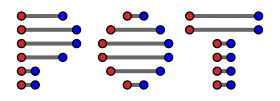
This logo is generated using with matplotlib and using the solution of an OT problem provided by POT (with ot.emd). Generating the logo can be done with a simple python script also provided in the documentation gallery.
New OT solvers include Weak OT and OT with factored coupling that can be used on large datasets. The Majorization Minimization solvers for non-regularized Unbalanced OT are now also available. We also now provide an implementation of GW and FGW unmixing and dictionary learning. It is now possible to use autodiff to solve entropic an quadratic regularized OT in the dual for full or stochastic optimization thanks to the new functions to compute the dual loss for entropic and quadratic regularized OT and reconstruct the OT plan on part or all of the data. They can be used for instance to solve OT problems with stochastic gradient or for estimating the dual potentials as neural networks.
On the backend front, we now have backend compatible functions and classes in the domain adaptation ot.da and unbalanced OT ot.unbalanced modules. This means that the DA classes can be used on tensors from all compatible backends. The free support Wasserstein barycenter solver is now also backend compatible.
Finally we have worked on the documentation to provide an update of existing examples in the gallery and and several new examples including GW dictionary learning and weak Optimal Transport.
New features
- Remove deprecated
ot.gpusubmodule (PR #361) - Update examples in the gallery (PR #359)
- Add stochastic loss and OT plan computation for regularized OT and backend examples(PR #360)
- Implementation of factored OT with emd and sinkhorn (PR #358)
- A brand new logo for POT (PR #357)
- Better list of related examples in quick start guide with
minigallery(PR #334) - Add optional log-domain Sinkhorn implementation in WDA to support smaller values of the regularization parameter (PR #336)
- Backend implementation for
ot.lp.free_support_barycenter(PR #340) - Add weak OT solver + example (PR #341)
- Add backend support for Domain Adaptation and Unbalanced solvers (PR #343)
- Add (F)GW linear dictionary learning solvers + example (PR #319)
- Add links to related PR and Issues in the doc release page (PR #350)
- Add new minimization-maximization algorithms for solving exact Unbalanced OT + example (PR #362)
Closed issues
- Fix mass gradient of
ot.emd2andot.gromov_wasserstein2so that they are centered (Issue #364, PR #363) - Fix bug in instantiating an
autogradfunctionValFunction(Issue #337, PR #338) - Fix POT ABI compatibility with old and new numpy (Issue #346, PR #349)
- Warning when feeding integer cost matrix to EMD solver resulting in an integer transport plan (Issue #345, PR #343)
- Fix bug where gromov_wasserstein2 does not perform backpropagation with CUDA tensors (Issue #351, PR #352)
- Python
Published by rflamary about 4 years ago
pot - 0.8.1.0
This is a bug fix release that will remove the benchmarks module form the installation and correct the documentation generation.
Closed issues
- Bug in documentation generation (tag VS master push, PR #332)
- Remove installation of the benchmarks in global namespace (Issue #331, PR #333)
- Python
Published by rflamary over 4 years ago
pot - 0.8.1
This release fixes several bugs and introduces two new backends: Cupy and Tensorflow. Note that the tensorflow backend will work only when tensorflow has enabled the Numpy behavior (for transpose that is not by default in tensorflow). We also introduce a simple benchmark on CPU GPU for the sinkhorn solver that will be provided in the backend documentation.
This release also brings a few changes in dependencies and compatibility. First we removed tests for Python 3.6 that will not be updated in the future. Also note that POT now depends on Numpy (>= 1.20) because a recent change in ABI is making the wheels non-compatible with older numpy versions. If you really need an older numpy POT will work with no problems but you will need to build it from source.
As always we want to that the contributors who helped make POT better (and bug free).
New features
- New benchmark for sinkhorn solver on CPU/GPU and between backends (PR #316)
- New tensorflow backend (PR #316)
- New Cupy backend (PR #315)
- Documentation always up-to-date with README, RELEASES, CONTRIBUTING and CODEOFCONDUCT files (PR #316, PR #322).
Closed issues
- Fix bug in older Numpy ABI (<1.20) (Issue #308, PR #326)
- Fix bug in
ot.distfunction when non euclidean distance (Issue #305, PR #306) - Fix gradient scaling for functions using
nx.set_gradients(Issue #309, PR #310) - Fix bug in generalized Conditional gradient solver and SinkhornL1L2 (Issue #311, PR #313)
- Fix log error in
gromov_barycenters(Issue #317, PR #3018)
- Python
Published by rflamary over 4 years ago
pot - 0.8.0
This new stable release introduces several important features.
First we now have an OpenMP compatible exact ot solver in ot.emd. The OpenMP version is used when the parameter numThreads is greater than one and can lead to nice speedups on multi-core machines.
Second we have introduced a backend mechanism that allows to use standard POT function seamlessly on Numpy, Pytorch and Jax arrays. Other backends are coming but right now POT can be used seamlessly for training neural networks in Pytorch. Notably we propose the first differentiable computation of the exact OT loss with ot.emd2 (can be differentiated w.r.t. both cost matrix and sample weights), but also for the classical Sinkhorn loss with ot.sinkhorn2, the Wasserstein distance in 1D with ot.wasserstein_1d, sliced Wasserstein with ot.sliced_wasserstein_distance and Gromov-Wasserstein with ot.gromov_wasserstein2 . Examples of how this new feature can be used are now available in the documentation where the Pytorch backend is used to estimate a minimal Wasserstein estimator, a Generative Network (GAN), for a sliced Wasserstein gradient flow and optimizing the Gromov-Wassersein distance. Note that the Jax backend is still in early development and quite slow at the moment, we strongly recommend for Jax users to use the OTT toolbox when possible. As a result of this new feature, the old ot.gpu submodule is now deprecated since GPU implementations can be done using GPU arrays on the torch backends.
Other novel features include implementation for Sampled Gromov Wasserstein and Pointwise Gromov Wasserstein, Sinkhorn in log space with method='sinkhorn_log', Projection Robust Wasserstein, and deviased Sinkorn barycenters.
This release will also simplify the installation process. We have now a pyproject.toml that defines the build dependency and POT should now build even when cython is not installed yet. Also we now provide pe-compiled wheels for linux aarch64 that is used on Raspberry PI and android phones and for MacOS on ARM processors.
Finally POT was accepted for publication in the Journal of Machine Learning Research (JMLR) open source software track and we ask the POT users to cite this paper from now on. The documentation has been improved in particular by adding a "Why OT?" section to the quick start guide and several new examples illustrating the new features. The documentation now has two version : the stable version https://pythonot.github.io/ corresponding to the last release and the master version https://pythonot.github.io/master that corresponds to the current master branch on GitHub.
As usual, we want to thank all the POT contributors (now 37 people have contributed to the toolbox). But for this release we thank in particular Nathan Cassereau and Kamel Guerda from the AI support team at IDRIS for their support to the development of the backend and OpenMP implementations.
New features
- OpenMP support for exact OT solvers (PR #260)
- Backend for running POT in numpy/torch + exact solver (PR #249)
- Backend implementation of most functions in
ot.bregman(PR #280) - Backend implementation of most functions in
ot.optim(PR #282) - Backend implementation of most functions in
ot.gromov(PR #294, PR #302) - Test for arrays of different type and device (CPU/GPU) (PR #304, #303)
- Implementation of Sinkhorn in log space with
method='sinkhorn_log'(PR #290) - Implementation of regularization path for L2 Unbalanced OT (PR #274)
- Implementation of Projection Robust Wasserstein (PR #267)
- Implementation of Debiased Sinkhorn Barycenters (PR #291)
- Implementation of Sampled Gromov Wasserstein and Pointwise Gromov Wasserstein (PR #275)
- Add
pyproject.tomland build POT without installing cython first (PR #293) - Lazy implementation in log space for sinkhorn on samples (PR #259)
- Documentation cleanup (PR #298)
- Two up-to-date documentations for stable release and for master branch.
- Building wheels on ARM for Raspberry PI and smartphones (PR #238)
- Update build wheels to new version and new pythons (PR #236, #253)
- Implementation of sliced Wasserstein distance (Issue #202, PR #203)
- Add minimal build to CI and perform pep8 test separately (PR #210)
- Speedup of tests and return run time (PR #262)
- Add "Why OT" discussion to the documentation (PR #220)
- New introductory example to discrete OT in the documentation (PR #191)
- Add templates for Issues/PR on Github (PR#181)
Closed issues
- Debug Memory leak in GAN example (#254)
- DEbug GPU bug (Issue #284, #287, PR #288)
- set_gradients method for JAX backend (PR #278)
- Quicker GAN example for CircleCI build (PR #258)
- Better formatting in Readme (PR #234)
- Debug CI tests (PR #240, #241, #242)
- Bug in Partial OT solver dummy points (PR #215)
- Bug when Armijo linesearch (Issue #184, #198, #281, PR #189, #199, #286)
- Bug Barycenter Sinkhorn (Issue 134, PR #195)
- Infeasible solution in exact OT (Issues #126,#93, PR #217)
- Doc for SUpport Barycenters (Issue #200, PR #201)
- Fix labels transport in BaseTransport (Issue #207, PR #208)
- Bug in
emd_1d, non respected bounds (Issue #169, PR #170) - Removed Python 2.7 support and update codecov file (PR #178)
- Add normalization for WDA and test it (PR #172, #296)
- Cleanup code for new version of
flake8(PR #176) - Fixed requirements in
setup.py(PR #174) - Removed specific MacOS flags (PR #175)
- Python
Published by rflamary over 4 years ago
pot - 0.7.0
This is the new stable release for POT. We made a lot of changes in the documentation and added several new features such as Partial OT, Unbalanced and Multi Sources OT Domain Adaptation and several bug fixes. One important change is that we have created the GitHub organization PythonOT that now owns the main POT repository https://github.com/PythonOT/POT and the repository for the new documentation is now hosted at https://PythonOT.github.io/.
This is the first release where the Python 2.7 tests have been removed. Most of the toolbox should still work but we do not offer support for Python 2.7 and will close related Issues.
A lot of changes have been done to the documentation that is now hosted on https://PythonOT.github.io/ instead of readthedocs. It was a hard choice but readthedocs did not allow us to run sphinx-gallery to update our beautiful examples and it was a huge amount of work to maintain. The documentation is now automatically compiled and updated on merge. We also removed the notebooks from the repository for space reason and also because they are all available in the example gallery. Note that now the output of the documentation build for each commit in the PR is available to check that the doc builds correctly before merging which was not possible with readthedocs.
The CI framework has also been changed with a move from Travis to Github Action which allows to get faster tests on Windows, MacOS and Linux. We also now report our coverage on Codecov.io and we have a reasonable 92% coverage. We also now generate wheels for a number of OS and Python versions at each merge in the master branch. They are available as outputs of this action. This will allow simpler multi-platform releases from now on.
In terms of new features we now have OTDA Classes for unbalanced OT, a new Domain adaptation class form multi domain problems (JCPOT), and several solvers to solve the Partial Optimal Transport problems.
This release is also the moment to thank all the POT contributors (old and new) for helping making POT such a nice toolbox. A lot of changes (also in the API) are comming for the next versions.
Features
- New documentation on https://PythonOT.github.io/ (PR #160, PR #143, PR #144)
- Documentation build on CircleCI with sphinx-gallery (PR #145,PR #146, #155)
- Run sphinx gallery in CI (PR #146)
- Remove notebooks from repo because available in doc (PR #156)
- Build wheels in CI (#157)
- Move from travis to GitHub Action for Windows, MacOS and Linux (PR #148, PR #150)
- Partial Optimal Transport (PR#141 and PR #142)
- Laplace regularized OTDA (PR #140)
- Multi source DA with target shift (PR #137)
- Screenkhorn algorithm (PR #121)
Closed issues
- Bug in Unbalanced OT example (Issue #127)
- Clean Cython output when calling setup.py clean (Issue #122)
- Various Macosx compilation problems (Issue #113, Issue #118, PR#130)
- EMD dimension mismatch (Issue #114, Fixed in PR #116)
- 2D barycenter bug for non square images (Issue #124, fixed in PR #132)
- Bad value in EMD 1D (Issue #138, fixed in PR #139)
- Log bugs for Gromov-Wassertein solver (Issue #107, fixed in PR #108)
- Weight issues in barycenter function (PR #106)
- Python
Published by rflamary about 6 years ago
pot - 0.7.0-beta0 test
This is a beta test pre release for the new version of POT.
Do not use in production.
- Python
Published by rflamary about 6 years ago
pot - 0.6 Year 3
This is the first official stable release of POT and this means a jump to 0.6! The library has been used in the wild for a while now and we have reached a state where a lot of fundamental OT solvers are available and tested. It has been quite stable in the last months but kept the beta flag in its Pypi classifiers until now.
Note that this release will be the last one supporting officially Python 2.7 (See https://python3statement.org/ for more reasons). For next release we will keep the travis tests for Python 2 but will make them non necessary for merge in 2020.
The features are never complete in a toolbox designed for solving mathematical problems and research but with the new contributions we now implement algorithms and solvers from 24 scientific papers (listed in the README.md file). New features include a direct implementation of the empirical Sinkhorn divergence, a new efficient (Cython implementation) solver for EMD in 1D and corresponding Wasserstein 1D. We now also have implementations for Unbalanced OT and a solver for Unbalanced OT barycenters. A new variant of Gromov-Wasserstein divergence called Fused Gromov-Wasserstein has been also contributed with exemples of use on structured data and computing barycenters of labeld graphs.
A lot of work has been done on the documentation with several new examples corresponding to the new features and a lot of corrections for the docstrings. But the most visible change is a new quick start guide for POT that gives several pointers about which function or classes allow to solve which specific OT problem. When possible a link is provided to relevant examples.
We will also provide with this release some pre-compiled Python wheels for Linux 64bit on github and pip. This will simplify the install process that before required a C compiler and numpy/cython already installed.
Finally we would like to acknowledge and thank the numerous contributors of POT that has helped in the past build the foundation and are still contributing to bring new features and solvers to the library.
Features
- Add compiled manylinux 64bits wheels to pip releases (PR #91)
- Add quick start guide (PR #88)
- Make doctest work on travis (PR #90)
- Update documentation (PR #79, PR #84)
- Solver for EMD in 1D (PR #89)
- Solvers for regularized unbalanced OT (PR #87, PR#99)
- Solver for Fused Gromov-Wasserstein (PR #86)
- Add empirical Sinkhorn and empirical Sinkhorn divergences (PR #80)
Closed issues
- Issue #59 fail when using "pip install POT" (new details in doc+ hopefully wheels)
- Issue #85 Cannot run gpu modules
- Issue #75 Greenkhorn do not return log (solved in PR #76)
- Issue #82 Gromov-Wasserstein fails when the cost matrices are slightly different
- Issue #72 Macosx build problem
- Python
Published by rflamary over 6 years ago
pot - 0.5.0 Year 2
POT is 2 years old! This release brings numerous new features to the toolbox as listed below but also several bug correction.
Among the new features, we can highlight a non-regularized Gromov-Wasserstein solver, a new greedy variant of sinkhorn, non-regularized, convolutional (2D) and free support Wasserstein barycenters and smooth and stochastic implementation of entropic OT.
POT 0.5 also comes with a rewriting of ot.gpu using the cupy framework instead of the unmaintained cudamat. Note that while we tried to keed changes to the minimum, the OTDA classes were deprecated. If you are happy with the cudamat implementation, we recommend you stay with stable release 0.4 for now.
The code quality has also improved with 92% code coverage in tests that is now printed to the log in the Travis builds. The documentation has also been greatly improved with new modules and examples/notebooks.
This new release is so full of new stuff and corrections thanks to the old and new POT contributors (you can see the list in the readme).
Features
- Add non regularized Gromov-Wasserstein solver (PR #41)
- Linear OT mapping between empirical distributions and 90\% test coverage (PR #42)
- Add log parameter in class EMDTransport and SinkhornLpL1Transport (PR #44)
- Add Markdown format for Pipy (PR #45)
- Test for Python 3.5 and 3.6 on Travis (PR #46)
- Non regularized Wasserstein barycenter with scipy linear solver and/or cvxopt (PR #47)
- Rename dataset functions to be more sklearn compliant (PR #49)
- Smooth and sparse Optimal transport implementation with entropic and quadratic regularization (PR #50)
- Stochastic OT in the dual and semi-dual (PR #52 and PR #62)
- Free support barycenters (PR #56)
- Speed-up Sinkhorn function (PR #57 and PR #58)
- Add convolutional Wassersein barycenters for 2D images (PR #64)
- Add Greedy Sinkhorn variant (Greenkhorn) (PR #66)
- Big ot.gpu update with cupy implementation (instead of un-maintained cudamat) (PR #67)
Deprecation
Deprecated OTDA Classes were removed from ot.da and ot.gpu for version 0.5 (PR #48 and PR #67). The deprecation message has been for a year here since 0.4 and it is time to pull the plug.
Closed issues
- Issue #35 : remove import plot from
ot/__init__.py(See PR #41) - Issue #43 : Unusable parameter log for EMDTransport (See PR #44)
- Issue #55 : UnicodeDecodeError: 'ascii' while installing with pip
- Python
Published by rflamary over 7 years ago
pot - 0.4 Community edition
This release contains a lot of contribution from new contributors.
Features
- Automatic notebooks and doc update (PR #27)
- Add gromov Wasserstein solver and Gromov Barycenters (PR #23)
- emd and emd2 can now return dual variables and have max_iter (PR #29 and PR #25)
- New domain adaptation classes compatible with scikit-learn (PR #22)
- Proper tests with pytest on travis (PR #19)
- PEP 8 tests (PR #13)
Closed issues
- emd convergence problem du to fixed max iterations (#24)
- Semi supervised DA error (#26)
- Python
Published by rflamary over 8 years ago
pot - Summer release
- emd* and sinkhorn* are now performed in parallel for multiple target distributions
- emd and sinkhorn are for OT matrix computation
- emd2 and sinkhorn2 are for OT loss computation
- new notebooks for emd computation and Wasserstein Discriminant Analysis
- relocate notebooks
- update documentation
- clean_zeros(a,b,M) for removimg zeros in sparse distributions
- GPU implementations for sinkhorn and group lasso regularization
- Python
Published by rflamary almost 9 years ago
pot - Version 0.2
- New dimensionality reduction method (WDA)
- Efficient method emd2 returns only tarnsport (in paralell if several histograms given)
- Python
Published by rflamary about 9 years ago
pot - New years resolution
- Add sphinx gallery for better documentation
- Small efficiency tweak in sinkhorn
- Add simple tic() toc() functions for timing
- Python
Published by rflamary over 9 years ago
pot - Still boiling
- correct important bug introduced in last release
- Python
Published by rflamary over 9 years ago
pot - still kicking
- numerical stabilization for sinkhorn (log domain and epsilon scaling)
- Python
Published by rflamary over 9 years ago
pot - V0.1.9 DA classes and mapping
- Add classes and examples for domain adaptation
- Joint OT matrix and mapping estimation
- Python
Published by rflamary over 9 years ago