docker-packing-box
Docker image gathering packers and tools for making datasets of packed executables and training machine learning models for packing detection
Science Score: 54.0%
This score indicates how likely this project is to be science-related based on various indicators:
-
✓CITATION.cff file
Found CITATION.cff file -
✓codemeta.json file
Found codemeta.json file -
✓.zenodo.json file
Found .zenodo.json file -
○DOI references
-
✓Academic publication links
Links to: arxiv.org, ieee.org -
○Academic email domains
-
○Institutional organization owner
-
○JOSS paper metadata
-
○Scientific vocabulary similarity
Low similarity (11.1%) to scientific vocabulary
Keywords
Repository
Docker image gathering packers and tools for making datasets of packed executables and training machine learning models for packing detection
Basic Info
Statistics
- Stars: 60
- Watchers: 1
- Forks: 15
- Open Issues: 6
- Releases: 0
Topics
Metadata Files
README.md

Packing Box 
Experimental toolkit for static detection of executable packing.

This Docker container is a CLI environment featuring a toolkit that gathers executable analyzers, packing detectors, packers and unpackers but also many tools for generating and manipulating datasets of packed and not-packed executables of different formats (including PE, ELF and Mach-O) for the sake of evaluating static detection techniques and tools, visualizing executables' layout and automating machine learning pipelines with the support of many algorithms.
See the Black Hat Arsenal presentations for demonstrations:
- Packing-Box: Playing with Executable Packing
- Packing-Box: Breaking Detectors & Visualizing Packing
- Packing-Box: Improving Detection of Executable Packing
Here is what you can see when you start up the Docker container.
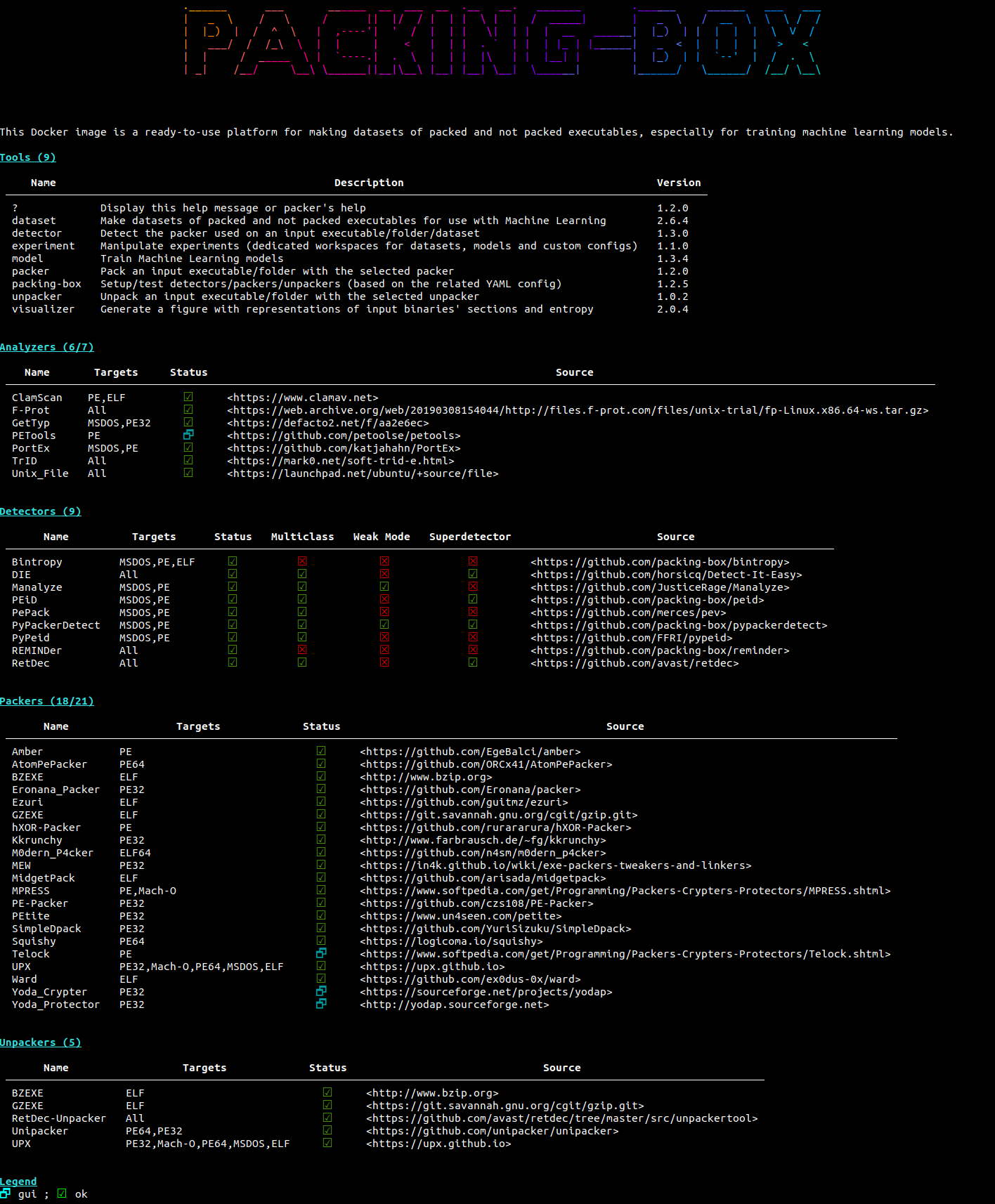
The various items integrated in the Packing-Box are defined in the very declarative and easy-to-use YAML format through different configuration files. This makes shaping the scope for evaluations and machine learning model training straightforward and practical for researchers.
:fast_forward: Quick Start
Building the image:
```console
docker build -t dhondta/packing-box .
[...]
<<
Starting it up with the current working directory mounted as /mnt/share in the container:
Windows
powershell
PS C:\> docker run -it -h packing-box -v ${pwd}:/mnt/share dhondta/packing-box
Linux
```bash
docker run -it -h packing-box -v pwd:/mnt/share dhondta/packing-box
```
:clipboard: Basics
Items Usage
Items are configured through the YAML configuration files. They consist in:
- analyzers.yml: utilities for analyzing files or more specifically packer trace
- detectors.yml: tools for analyzing and deciding whether an executable is packed or not
- packers.yml and unpackers.yml: self-explanatory
From within the Packing-Box, the packing-box tool allows to setup and test items.
Operation | Description | Command
:---:| --- | ---
setup | Setup an item from its YAML install definition | # packing-box setup detector die
test | Test an item using a built-in set of test samples | # packing-box test packer upx
Afterwards, items are available from the console.
console
$ die --help
<<snipped>>
$ upx --help
<<snipped>>
Mass Packing & Detection
Packers and detectors have their respective dedicated tools for mass operations, packer and detector. They work either on a single file, a complete folder or a special dataset instance (as of the abstraction defined in the pbox package).
console
$ packer upx path/to/executables --prefix "upx_"
<<snipped>>
For the detector tool, not selecting any detector will use those selected in detectors.yml as being part of the "superdetector". Moreover, the --binary option will consider whether the target executable is packed or not and not is precise packer.
console
$ detector path/to/single-executable -d die -d pypackerdetect
<<snipped>>
$ detector path/to/executables
<<snipped ; will use "superdetection">>
$ detector path/to/executables -d bintropy --binary
<<snipped ; in this case, as Bintropy only supports binary classification, --binary is necessary>>
Learning Pipeline
Machine Learning models are fine-tuned through the YAML configuration files. They consist in:
- algorithms.yml: the algorithms that are used with their static or dynamic parameters while training models
- features.yml: the characteristics to be considered while training and using models
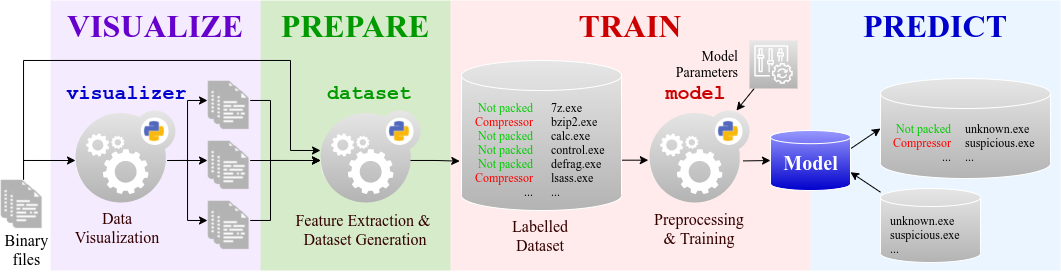
The PREPARE phase, especially feature engineering, is fine-tuned with the features YAML definition. Note that feature extraction is achieved with the pbox package of the Packing-Box while feature derivation and transformation is fine-tuned via the features YAML file.
The TRAIN phase is fine-tuned through the algorithms YAML file by setting the static and/or cross-validation parameters.
Dataset Manipulations
The PREPARE phase, especially dataset generation, is achieved with the dataset tool.
Operation | Description | Command
:---:| --- | ---
make 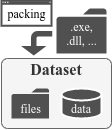 | Make a new dataset, either fully packed or mixed with not-packed samples |
 # dataset make dataset -f PE -n 200 -s /path/to/pe
merge 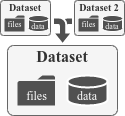 | Merge two datasets |
 # dataset merge dataset dataset2
select 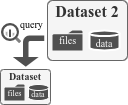 | Select a subset of a dataset to create a new one |
 # dataset select dataset dataset2 -q "format == 'PE32'"
update 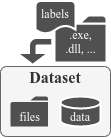 | Update a dataset with new samples given their labels |
 # dataset update dataset -l labels.json -s folder-of-executables
Data Visualization
The VISUALIZE phase can be performed with the dataset and visualizer tools.
In order to visualize feature values:
console
$ dataset plot test-mix byte_0_after_ep byte_1_after_ep --multiclass
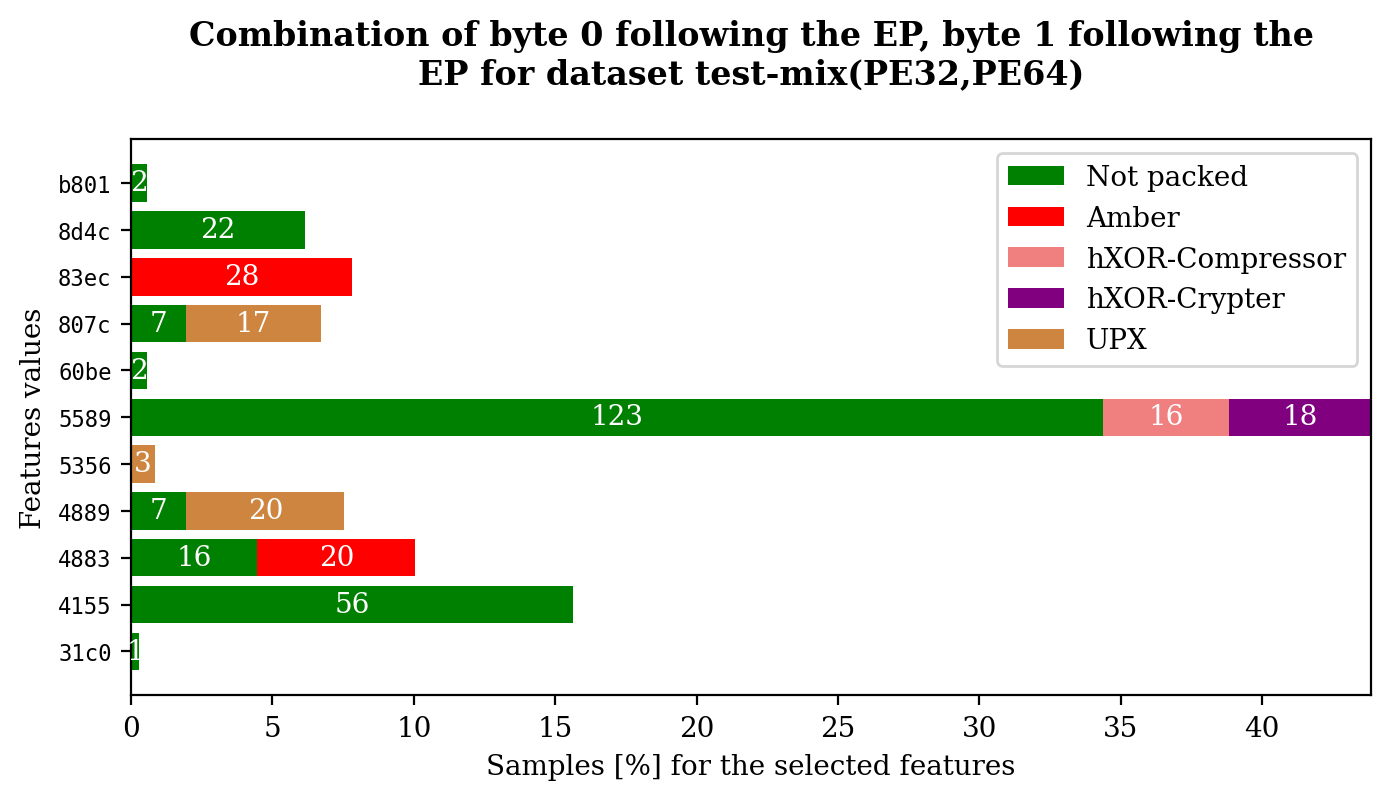
In order to visualize samples (aims to compare the not-packed and some packed versions):
console
$ visualizer plot "PsExec.exe$" dataset -s -l not-packed -l MEW -l RLPack -l UPX
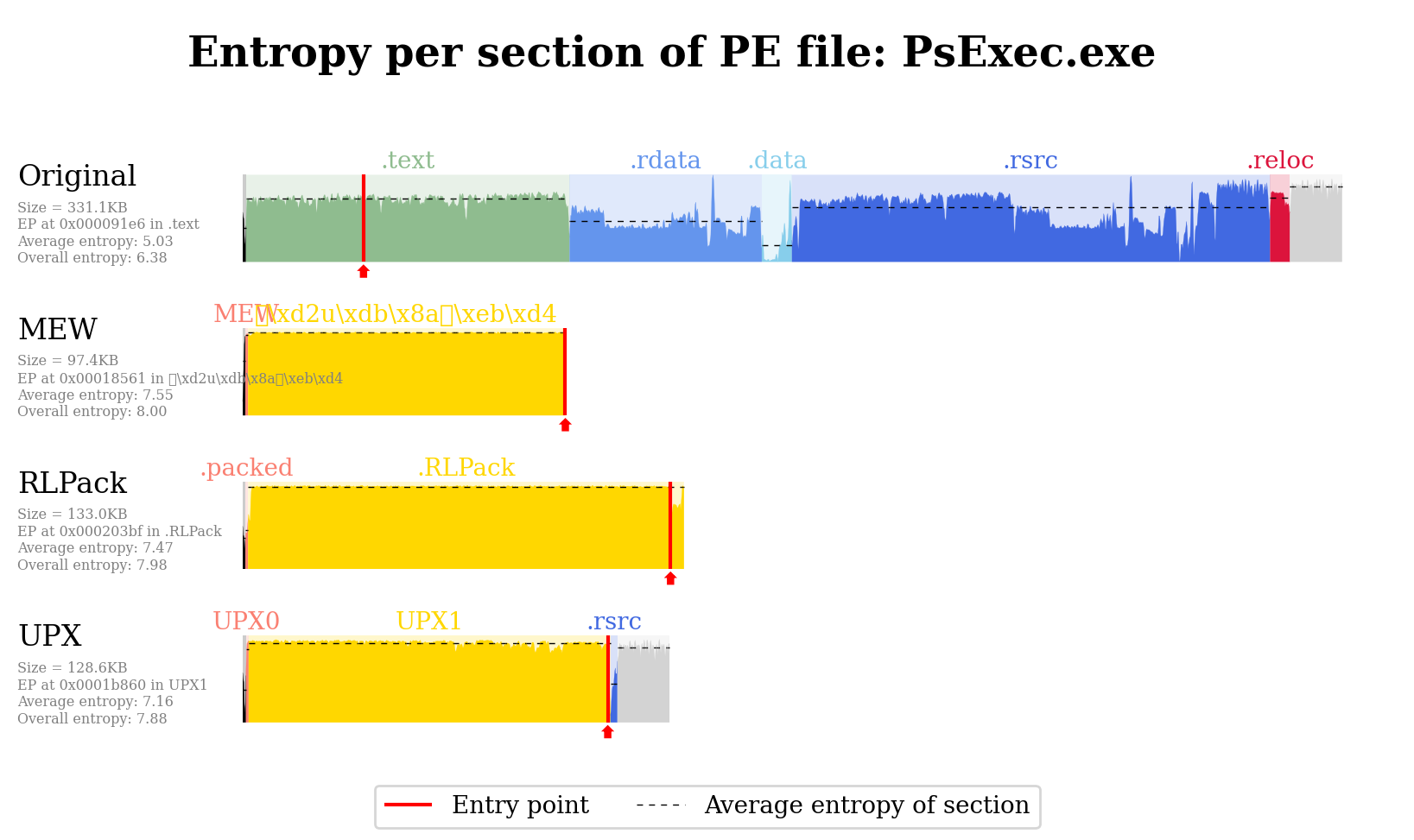
This will work for instance for a structure formatted as such:
folder/
  +-- not-packed/PsExec.exe
  +-- packed
        +-- MEW/mew_PsExec.exe
        +-- RLPack/rlpack_PsExec.exe
        +-- UPX/upx_PsExec.exe
Model Manipulations
The TRAIN and PREDICT phases of the pipeline are achieved with the model tool.
Operation | Description | Command
:---:| --- | ---
compare 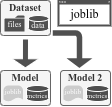 | Compare the performance metrics of multiple models |
 # model compare model --dataset dataset --model model2
test 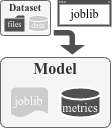 | Test a model on a given dataset |
 # model test model --name dataset
train 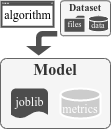 | Train a model given an algorithm and input dataset |
 # model train dataset --algorithm dt
:star: Related Projects
You may also like these:
- Awesome Executable Packing: A curated list of awesome resources related to executable packing.
- Bintropy: Analysis tool for estimating the likelihood that a binary contains compressed or encrypted bytes (inspired from this paper).
- Dataset of packed ELF files: Dataset of ELF samples packed with many different packers.
- Dataset of packed PE files: Dataset of PE samples packed with many different packers (fork of this repository).
- DSFF: Library implementing the DataSet File Format (DSFF).
- PEiD: Python implementation of the well-known Packed Executable iDentifier (PEiD).
- PyPackerDetect: Packing detection tool for PE files (fork of this repository).
- REMINDer: Packing detector using a simple heuristic (inspired from this paper).
:books: Related Readings
- arXiv - Experimental Toolkit for Manipulating Executable Packing
- Black Hat Arsenal EU 2022 - Packing-Box: Playing with Executable Packing
- Black Hat Arsenal EU 2023 - Packing-Box: Breaking Detectors & Visualizing Packing
- Medium Blog Post - Unpacking the Potential of "Packing Box"
:clap: Supporters

Citation (CITATIONS.bib)
@misc{dhondtPackingBox2024,
  title = {Packing-{{Box}}},
  author = {D'Hondt, Alexandre},
  year = {2024},
  abstract = {Docker image gathering many packing-related tools and for making datasets of packed executables for use with machine learning.},
  keywords = {elf,elf32,framework,mach-o,machine learning,packers,pe,pe32,platform,static analysis}
}

@inproceedings{dhondtExperimentalToolkitManipulating2024,
  title = {Experimental Toolkit for Manipulating Executable Packing},
  booktitle = {Risks and Security of Internet and Systems},
  author = {D'Hondt, Alexandre and Van Ouytsel, Charles Henry Bertrand and Legay, Axel},
  editor = {Ait Wakrime, Abderrahim and {Navarro-Arribas}, Guillermo and Cuppens, Fr{\'e}d{\'e}ric and Cuppens, Nora and Benaini, Redouane},
  year = {2024},
  month = jun,
  pages = {263--279},
  publisher = {Springer Nature Switzerland},
  doi = {10.1007/978-3-031-61231-2_17},
  abstract = {Executable packing is a well-known problematic especially in the field of malware analysis. It often consists in applying compression or encryption to a binary file and embedding a stub for reversing these transformations at runtime. This way, the packed executable is more difficult to reverse-engineer and/or is obfuscated, which is effective for evading static detection techniques. Many detection approaches, including machine learning, have been proposed in the literature so far, but most studies rely on questionable ground truths and do not provide any open implementation, making the comparison of state-of-the-art solutions tedious. We thus think that first solving the issue of repeatability shall help to compare existing executable packing static detection techniques. Given this challenge, we propose an experimental toolkit, named Packing Box, that leverages automation and containerization in an open source platform that brings a unified solution to the research community. We present our engineering approach for designing and implementing our solution. We then showcase it with a few basic experiments, including a performance evaluation of open source static packing detectors and training a model with machine learning pipeline automation. This introduces the toolset that will be used in further studies.},
  isbn = {978-3-031-61231-2},
  keywords = {machine learning,packer detection,packer identification,packing-box,toolkit}
}
GitHub Events
Total
- Commit comment event: 1
- Issues event: 29
- Watch event: 12
- Issue comment event: 45
- Push event: 100
- Pull request review event: 1
- Pull request event: 5
- Fork event: 5
Last Year
- Commit comment event: 1
- Issues event: 29
- Watch event: 12
- Issue comment event: 45
- Push event: 100
- Pull request review event: 1
- Pull request event: 5
- Fork event: 5
Issues and Pull Requests
Last synced: 10 months ago
All Time
- Total issues: 20
- Total pull requests: 3
- Average time to close issues: about 2 months
- Average time to close pull requests: 5 days
- Total issue authors: 5
- Total pull request authors: 2
- Average comments per issue: 1.75
- Average comments per pull request: 0.0
- Merged pull requests: 3
- Bot issues: 0
- Bot pull requests: 0
Past Year
- Issues: 18
- Pull requests: 3
- Average time to close issues: 9 days
- Average time to close pull requests: 5 days
- Issue authors: 3
- Pull request authors: 2
- Average comments per issue: 1.5
- Average comments per pull request: 0.0
- Merged pull requests: 3
- Bot issues: 0
- Bot pull requests: 0
Top Authors
Issue Authors
- AlexVanMechelen (12)
- cybersecurity-dev (11)
- jramhani (11)
- clement-alloin-afk (4)
- dhondta (3)
Pull Request Authors
- AlexVanMechelen (30)
- jramhani (5)
- cybersecurity-dev (2)
- clement-alloin-afk (1)
Top Labels
Issue Labels
Pull Request Labels
Dependencies
- base latest build
- customized latest build
- ubuntu 22.04 build
- jinja2 <3.1.0
- mkdocs ==1.2.3
- mkdocs-bootswatch *
- mkdocs-material *
- mkdocs-rtd-dropdown *
- pymdown-extensions *