Recent Releases of global-indicators
global-indicators - v4.9.0
Implemented optional generation of scorecard statistics, as described here on our wiki.
This addresses #544, supporting users who wish to streamline production of their scorecard reports (as requested by @eugenrb).
Additional routine software patches were applied also, updating NiceGUI, PyGeoMeta etc.
- Jupyter Notebook
Published by carlhiggs 12 months ago

global-indicators - v4.8.6
What's Changed
- Update docker by @carlhiggs in https://github.com/healthysustainablecities/global-indicators/pull/552
Full Changelog: https://github.com/healthysustainablecities/global-indicators/compare/v4.8.5...v4.8.6
- Jupyter Notebook
Published by carlhiggs about 1 year ago
global-indicators - v4.8.5
What's Changed
- Correct shaping of Arabic and Persian in Matplotlib plots by @carlhiggs in https://github.com/healthysustainablecities/global-indicators/pull/541
Full Changelog: https://github.com/healthysustainablecities/global-indicators/compare/v4.8.4...v4.8.5
- Jupyter Notebook
Published by carlhiggs about 1 year ago
global-indicators - v4.8.4
What's Changed
- validated Arabic translation and enhanced formatting for right-to-left scripts (relates to #478)
- standalone policy reports can now be generated in Arabic
- spatial/combined reports require further amendments for correct right-to-left script representation
- software environment patches
- updated wiki help links in software and GUI
Full Changelog: https://github.com/healthysustainablecities/global-indicators/compare/v4.8.3...v4.8.4
- Jupyter Notebook
Published by carlhiggs about 1 year ago
global-indicators - v4.8.3
Addresses - #533 (spatial figure annotations are reproduced when generating multiple spatial templates; not skipped after first) - #526 (implements a JSON schema default) - #528 (fall back for non-defined summaries)
- Jupyter Notebook
Published by carlhiggs over 1 year ago
global-indicators - v4.8.2
Addressed some minor report formatting aspects:
523
522
521
520
What's Changed
- Template reporting by @carlhiggs in https://github.com/healthysustainablecities/global-indicators/pull/524
Full Changelog: https://github.com/healthysustainablecities/global-indicators/compare/v4.8.1...v4.8.2
- Jupyter Notebook
Published by carlhiggs over 1 year ago
global-indicators - v4.8.1
What's Changed
- Update translations, walkability map caption, and software version number by @carlhiggs in https://github.com/healthysustainablecities/global-indicators/pull/519
Full Changelog: https://github.com/healthysustainablecities/global-indicators/compare/v4.8.0...v4.8.1
- Jupyter Notebook
Published by carlhiggs over 1 year ago
global-indicators - v4.8.0
This is an important update with improvements for reporting of policy indicators, including:
- policy quality scores are now correctly presented with half-score decimal points where these are required (e.g. 16.5/62 was previously incorrectly truncated to16/62; this representation has been corrected) (#515 )
- if policies are not identified, the reporting checklist now records these as 'X' instead of '-' (#514)
- distinct summaries for policy, spatial, and policy-spatial combined reports can now be tailored for the respective templates (#513)
- a stand-alone function
ghsci.generate_policy_report(xlsx, options)is now provided to allow generation of policy indicator reports without need to configure and analyse a study region (#462) - draft policy indicator reports can also now be generated as required from within the GHSCI app by selecting an xlsx file (however, customisation still requires command line usage) (#462)
It is recommended that users who have generated policy reports using the updated templates (since October 2023) consider re-preparing their reports using the updated formatting. All users may consider regenerating reports to use customised summaries for the various policy and spatial indicator templates.
@MelanieLowe @healthysustainablecities/ghsci-software-working-group
Any questions about this release may be posted in the discussion post for this release on the Discussions page.
What's Changed
- Policy checks by @carlhiggs in https://github.com/healthysustainablecities/global-indicators/pull/516
Full Changelog: https://github.com/healthysustainablecities/global-indicators/compare/v4.7.3...v4.8.0
- Jupyter Notebook
Published by carlhiggs over 1 year ago
global-indicators - v4.7.3
What's Changed
- updated Docker environment by @carlhiggs in https://github.com/healthysustainablecities/global-indicators/pull/505
- Enhancements (a bug and some features) by @carlhiggs in https://github.com/healthysustainablecities/global-indicators/pull/512
Full Changelog: https://github.com/healthysustainablecities/global-indicators/compare/v4.7.2...v4.7.3
- Jupyter Notebook
Published by carlhiggs over 1 year ago
global-indicators - v4.7.2
What's Changed
Updated GHSCI app Docker image, including support for OSMnx 2.0 as per #495
Full Changelog: https://github.com/healthysustainablecities/global-indicators/compare/v4.7.1...v4.7.2
- Jupyter Notebook
Published by carlhiggs over 1 year ago
global-indicators - Updated FigShare workflow
I updated the FigShare workflow file for uploading new releases to FigShare --- this still contained our previous organization name, which was why the upload of releases was failing. This should now be corrected, although I need to make a new release to trigger the workflow in order to test this!
- Jupyter Notebook
Published by carlhiggs over 1 year ago
global-indicators - v4.7.0
What's Changed
Updated GHSCI software environment dependencies (software version is now 4.7.0) moved towards https://github.com/healthysustainablecities/global-indicators/issues/495 (updated OSMnx to 1.9.4) addressed https://github.com/healthysustainablecities/global-indicators/issues/496 improving web app user experience. added improved feedback for users on identifying and correcting invalid YAML, and CI test to detect both valid and invalid YAML as per https://github.com/healthysustainablecities/global-indicators/issues/497
and other general enhancements by @carlhiggs in * https://github.com/healthysustainablecities/global-indicators/pull/492 * https://github.com/healthysustainablecities/global-indicators/pull/493 * https://github.com/healthysustainablecities/global-indicators/pull/498
Full Changelog: https://github.com/healthysustainablecities/global-indicators/compare/v4.6.1...v4.7.0
- Jupyter Notebook
Published by carlhiggs over 1 year ago
global-indicators - v4.6.1
What's Changed
- Added a tooltip to the study region button in the GHSCI app with @jiy… by @carlhiggs in https://github.com/healthysustainablecities/global-indicators/pull/484
- updated app to provide more informative error messages, and a way to … by @carlhiggs in https://github.com/healthysustainablecities/global-indicators/pull/488
- Updated Catalan and Spanish translations, with minor report layout and GUI updates by @carlhiggs, with thanks to @JaviMolina-Garcia and @dapugacheva in https://github.com/healthysustainablecities/global-indicators/pull/489
Full Changelog: https://github.com/healthysustainablecities/global-indicators/compare/v4.6.0...v4.6.1
- Jupyter Notebook
Published by carlhiggs over 1 year ago
global-indicators - v4.6.0
What's Changed
- Enhancements by @carlhiggs in https://github.com/healthysustainablecities/global-indicators/pull/455
- merge main into enhancements by @carlhiggs in https://github.com/healthysustainablecities/global-indicators/pull/461
- fix links post repo move by @gboeing in https://github.com/healthysustainablecities/global-indicators/pull/460
- Enhancements by @carlhiggs in https://github.com/healthysustainablecities/global-indicators/pull/466
- Enhancements by @carlhiggs in https://github.com/healthysustainablecities/global-indicators/pull/468
- Enhancements by @carlhiggs in https://github.com/healthysustainablecities/global-indicators/pull/471
- Enhancements by @carlhiggs in https://github.com/healthysustainablecities/global-indicators/pull/473
- Allow command line dropping of database as per #475 by @carlhiggs in https://github.com/healthysustainablecities/global-indicators/pull/477
- updated Catalan and Spanish translations by @carlhiggs in https://github.com/healthysustainablecities/global-indicators/pull/479
- updated Finnish translation, and added fix to address #480 by @carlhiggs in https://github.com/healthysustainablecities/global-indicators/pull/481
- Enhancements by @carlhiggs in https://github.com/healthysustainablecities/global-indicators/pull/482
- updated policy report generation to more flexibly specify required cu… by @carlhiggs in https://github.com/healthysustainablecities/global-indicators/pull/483
Full Changelog: https://github.com/healthysustainablecities/global-indicators/compare/v4.5.3...v4.6.0
- Jupyter Notebook
Published by carlhiggs almost 2 years ago
global-indicators - v4.5.3
What's Changed
- added in example image used in reports unintentionally omitted by @carlhiggs in https://github.com/global-healthy-liveable-cities/global-indicators/pull/444
- Corrected error in a particularly part of analysis.R; referred to r.h… by @carlhiggs in https://github.com/global-healthy-liveable-cities/global-indicators/pull/445
- corrected error in analysis.R that wasn't about r.header (which is a … by @carlhiggs in https://github.com/global-healthy-liveable-cities/global-indicators/pull/447
Full Changelog: https://github.com/global-healthy-liveable-cities/global-indicators/compare/v4.5.2...v4.5.3
- Jupyter Notebook
Published by carlhiggs about 2 years ago
global-indicators - v4.5.2
Improved text wrapping to optionally support wrapping on characters instead of words for languages using ideograms (e.g. Chinese and Japanese), so that translated reports are correctly formatted in these languages. (see #433)
Also updated software dependencies and made minor tweaks to UI and Jupter Lab example notebook phrasing.
What's Changed
- improved warning message for attempt to generate report for language … by @carlhiggs in https://github.com/global-healthy-liveable-cities/global-indicators/pull/432
- Enhancements by @carlhiggs in https://github.com/global-healthy-liveable-cities/global-indicators/pull/437
- added manual override of language validation check when generating re… by @carlhiggs in https://github.com/global-healthy-liveable-cities/global-indicators/pull/439
- Enhancements by @carlhiggs in https://github.com/global-healthy-liveable-cities/global-indicators/pull/440
- updated some translation details in report template by @carlhiggs in https://github.com/global-healthy-liveable-cities/global-indicators/pull/443
Full Changelog: https://github.com/global-healthy-liveable-cities/global-indicators/compare/v4.5.1...v4.5.2
- Jupyter Notebook
Published by carlhiggs about 2 years ago
global-indicators - v4.5.1
This release includes support for the new reporting templates for the Global Observatory of Healthy and Sustainable Cities' 1000 Cities Challenge.
Major issues addressed are described in the closed pull request here.
As a result of the reporting template updates, phrases in our reports have changed and translations for existing languages require validation. Additionally, we have added preliminary support for approximately 30 languages at time of writing with more planned, however most of these are also awaiting final validation. Validated translations for languages other than English will be added periodically over the coming weeks and months.
If you are interested in validating translations for the project, or in having support for your language, please let us know through a github issue.
To list the available validated languages for reporting, if using Python within our Dockerised GHSCI software environment, run:
import ghsci
ghsci.get_languages()
What's Changed
- Updated GTFS analysis to address stop duplication across modes and provide more informative feed output as per #385 by @carlhiggs in https://github.com/global-healthy-liveable-cities/global-indicators/pull/386
- Update packages and methods for 2024 by @carlhiggs in https://github.com/global-healthy-liveable-cities/global-indicators/pull/384
- addressed frequncies.txt misreading, to ensure the copy read by gtfs-lite is used, as per #389 by @carlhiggs in https://github.com/global-healthy-liveable-cities/global-indicators/pull/390
- merging main branch (with 2024 package updates) into enhancements branch by @carlhiggs in https://github.com/global-healthy-liveable-cities/global-indicators/pull/391
- Update enhancements 2024 by @carlhiggs in https://github.com/global-healthy-liveable-cities/global-indicators/pull/392
- Jupyter Lab and Software set up on GitHub adjustments from issue #375 by @dapugacheva in https://github.com/global-healthy-liveable-cities/global-indicators/pull/387
- New reports by @carlhiggs in https://github.com/global-healthy-liveable-cities/global-indicators/pull/398
- Enhancements by @carlhiggs in https://github.com/global-healthy-liveable-cities/global-indicators/pull/400
- Webapp minor changes and conflicts solved by @rychennn in https://github.com/global-healthy-liveable-cities/global-indicators/pull/403
- Update packages and methods for 2024 by @carlhiggs in https://github.com/global-healthy-liveable-cities/global-indicators/pull/407
- Enhancements by @carlhiggs in https://github.com/global-healthy-liveable-cities/global-indicators/pull/426
- Merging changes in main (to citation) to enhancements by @carlhiggs in https://github.com/global-healthy-liveable-cities/global-indicators/pull/430
- Enhancements by @carlhiggs in https://github.com/global-healthy-liveable-cities/global-indicators/pull/429
New Contributors
- @dapugacheva made their first contribution in https://github.com/global-healthy-liveable-cities/global-indicators/pull/387
- @rychennn made their first contribution in https://github.com/global-healthy-liveable-cities/global-indicators/pull/403
Full Changelog: https://github.com/global-healthy-liveable-cities/global-indicators/compare/4.4.10...v4.5.1
- Jupyter Notebook
Published by carlhiggs about 2 years ago
global-indicators - 4.4.10
Adds a new 'interpolatestoptimes' option for GTFS feeds to deal with the possible case of stop_times.txt missing departure times values. If that's the case, analysis of regular service frequencies cannot proceed accurately for that GTFS feed. As per the GTFS reference specification, missing departure or arrival times may be interpolated using the stop sequence start and end times within each trip id.
The new interpolate_stop_times option/function if set fills null arrival and departure values using a linear interpolation according to the provided stop sequence start and end times within each trip_id. This is an approximation based on the available information, and results may still differ from the actual service frequencies at these stops. However, in the absence of further information, a user may judge it as an adequate approximation (using the values implicit in the data itself), in which case it would allow analysis to proceed.
What's Changed
- Enhancements by @carlhiggs in https://github.com/global-healthy-liveable-cities/global-indicators/pull/360
Full Changelog: https://github.com/global-healthy-liveable-cities/global-indicators/compare/v4.4.9...4.4.10
- Jupyter Notebook
Published by carlhiggs almost 3 years ago
global-indicators - v4.4.9
What's Changed
- Enhancements by @carlhiggs in https://github.com/global-healthy-liveable-cities/global-indicators/pull/358
Full Changelog: https://github.com/global-healthy-liveable-cities/global-indicators/compare/v4.4.8...v4.4.9
- Jupyter Notebook
Published by carlhiggs almost 3 years ago
global-indicators - v4.4.8
What's Changed
- Enhancements by @carlhiggs in https://github.com/global-healthy-liveable-cities/global-indicators/pull/352
Full Changelog: https://github.com/global-healthy-liveable-cities/global-indicators/compare/v4.4.7...v4.4.8
- Jupyter Notebook
Published by carlhiggs about 3 years ago
global-indicators - v4.4.7
What's Changed
- Enhancements by @carlhiggs in https://github.com/global-healthy-liveable-cities/global-indicators/pull/345
Full Changelog: https://github.com/global-healthy-liveable-cities/global-indicators/compare/v4.4.6...v4.4.7
- Jupyter Notebook
Published by carlhiggs about 3 years ago
global-indicators - v4.4.6
What's Changed
- Resolved issue with parsing GTFS modes as per #326 https://github.com/global-healthy-liveable-cities/global-indicators/commit/1bdede9ae037691c946cc6afd885d03eb4d46d23
- Attempting a pull request to evaluate GH Actions workflow changes for more unittests by @carlhiggs in https://github.com/global-healthy-liveable-cities/global-indicators/pull/341
Full Changelog: https://github.com/global-healthy-liveable-cities/global-indicators/compare/v4.4.5...v4.4.6
- Jupyter Notebook
Published by carlhiggs about 3 years ago
global-indicators - v4.4.5
What's Changed
- Enhancements by @carlhiggs in https://github.com/global-healthy-liveable-cities/global-indicators/pull/339
Full Changelog: https://github.com/global-healthy-liveable-cities/global-indicators/compare/v4.4.4...v4.4.5
- Jupyter Notebook
Published by carlhiggs about 3 years ago
global-indicators - v4.4.4
What's Changed
- Enhancements by @carlhiggs in https://github.com/global-healthy-liveable-cities/global-indicators/pull/330
- merged with main and updated policy review checklist by @carlhiggs in https://github.com/global-healthy-liveable-cities/global-indicators/pull/334
Full Changelog: https://github.com/global-healthy-liveable-cities/global-indicators/compare/v4.4.3...v4.4.4
- Jupyter Notebook
Published by carlhiggs about 3 years ago
global-indicators - v4.4.3
What's Changed
- Enhancements by @carlhiggs in https://github.com/global-healthy-liveable-cities/global-indicators/pull/329
Full Changelog: https://github.com/global-healthy-liveable-cities/global-indicators/compare/v4.4.2...v4.4.3
- Jupyter Notebook
Published by carlhiggs about 3 years ago
global-indicators - v4.4.2
This release has updated the region configuration template. This is now better documented, with more guidance, standalone (no need to edit datasets.yml), all options present but commented out if optional (and guidance provided on how to use them). There are also more informative errors now.
You can also initialise a new study region now withing Python using the ghsci module, and drop a database within Python too.
For example,
``` from subprocesses import ghsci codename = 'yourstudyregion_codename'
Initialise configuration file for your region
r = ghsci.Region(codename)
Now, you need to source and download data, documenting metadata and file paths in the configuration file
Once that is completed, you can proceed:
r.analysis() r.generate()
if you've analysed and generated results for other study regions, you can compare the main results
r.compare('anotherpreviouslyprocessed_codename')
if for some reason you want to drop the database for your study region to start again:
r.drop()
You will be asked if you really want to do this! It requires entering "ghscic" to confirm
This doesn't remove any generated files or folders - you'll have to remove those yourself, if you want to
```
What's Changed
- Enhancements by @carlhiggs in https://github.com/global-healthy-liveable-cities/global-indicators/pull/320
Full Changelog: https://github.com/global-healthy-liveable-cities/global-indicators/compare/v4.4.1...v4.4.2
- Jupyter Notebook
Published by carlhiggs about 3 years ago
global-indicators - v4.4.1
What's Changed
- Enhancements by @carlhiggs in https://github.com/global-healthy-liveable-cities/global-indicators/pull/307
Full Changelog: https://github.com/global-healthy-liveable-cities/global-indicators/compare/v4.4.0...v4.4.1
- Jupyter Notebook
Published by carlhiggs about 3 years ago
global-indicators - v4.4.0
This update adds a number of enhancements, including:
- updates usage instructions providing guidance on how to use the web app graphical user interface or iPython notebook in Jupyter Lab (with guidance on quickly creating custom interactive choropleth maps)
- allow for optional import of intersection data (eg official data, or externally processed; #30
- @VuokkoH you might be interested in this one!
- allow for defining population, urban region, gtfs etc datasets in region configuration file directly (#298)
- this makes configuration easier in general; the provided example now follows this format
- users can provide their own population data using vector files (#298)
- this also means that indicator analyses can be conducted for demographic subgroups (eg. age group specific indicators)
- Reports can be prepared for custom aggregation scales when configured with alternative vector data (#293)
- The analysis workflow can optionally be run as methods of the ghsci.Region class (#296)
The latter point makes working using Python scripts directly much simpler, for example, to run the example analysis:
from subprocesses import ghsci
r = ghsci.Region('example_ES_Las_Palmas_2023')
r.analysis() # run analyses
r.generate() # generate resources
comparison = "the codename for some preivously prepared region"
comparison = r.compare(comparison) # export a quick regional comparion to csv
comparions # display the dataframe comparison
To do the above for one's own study region of course requires configuration. However, this is now more straightforward requiring modification of just a region yml file. (eg. copy and modify the example region file).
In addition, software versions in the Docker environment have been incremented, and two new packages added (pyrosm and momepy) that may later assist with more flexible ways of loading networks (e.g. using pbf, or ones own network data). The functions to make use of these packages haven't yet been implemented, but the software environment should support this in future, helping to address #158
What's Changed
- Enhancements by @carlhiggs in https://github.com/global-healthy-liveable-cities/global-indicators/pull/292
- Enhancements by @carlhiggs in https://github.com/global-healthy-liveable-cities/global-indicators/pull/297
- Enhancements by @carlhiggs in https://github.com/global-healthy-liveable-cities/global-indicators/pull/299
- updated the example jupyter notebook by @carlhiggs in https://github.com/global-healthy-liveable-cities/global-indicators/pull/300
- Enhancements by @carlhiggs in https://github.com/global-healthy-liveable-cities/global-indicators/pull/301
- added in the option to load external data to represent intersections… by @carlhiggs in https://github.com/global-healthy-liveable-cities/global-indicators/pull/303
- Updated Docker image and version by @carlhiggs in https://github.com/global-healthy-liveable-cities/global-indicators/pull/304
Full Changelog: https://github.com/global-healthy-liveable-cities/global-indicators/compare/v4.3.0...v4.4.0
- Jupyter Notebook
Published by carlhiggs about 3 years ago
global-indicators - v4.3.0
This release contains a number of enhancements to the software.
The main one is, the Global Healthy and Sustainable City Indicators (GHSCI) software can be run in different ways according to user needs (#259)
- use keywords (with instructions given): configure, analysis, generate, compare
- use Jupyter Lab (example notebook is provided; type lab)
- import as python modules (provided Jupyter notebook illustrates how this is done)
- run as a graphical user interface in web browser (type ghsci; see #283)
Facilitating the above was refactoring to allow for regions to be defined as a class (#276).
A full annotated example is now provided in a jupyter notebook, and this includes an example for configuring and running a sensitivity analysis comparison (#288).
In addition, issues with some GTFS feeds processing files where calendar dates is used instead of calendar.txt was addressed (#275), along with some associated issues introduced while conducting this refactoring (#280, #281, #282).
Additionally,
- the instructions provided when the software is first launched have been improved and simplified, with the further addition of a help command that when entered will display the instructions again.
- and supporting future development, a basic Github Actions workflow for continuous integration has been implemented, to run code tests upon pull requests to the main branch
Enjoy!
What's Changed
- Addressing linux-related issues and simplifying instructions display by @carlhiggs in https://github.com/global-healthy-liveable-cities/global-indicators/pull/257
- Enhancements by @carlhiggs in https://github.com/global-healthy-liveable-cities/global-indicators/pull/263
- Create tests.yml by @carlhiggs in https://github.com/global-healthy-liveable-cities/global-indicators/pull/285
- Enhancements by @carlhiggs in https://github.com/global-healthy-liveable-cities/global-indicators/pull/284
Full Changelog: https://github.com/global-healthy-liveable-cities/global-indicators/compare/v4.2.1...v4.3.0
- Jupyter Notebook
Published by carlhiggs about 3 years ago
global-indicators - v4.2.1
This addresses - #251 - #248 - #245
But also adds in more informative user instructions.
Now, when the process is run it displays the software name, version, and links to our websites. Once the Docker image has loaded, it displays instructions for use and a clean user prompt (just a "# " symbol).
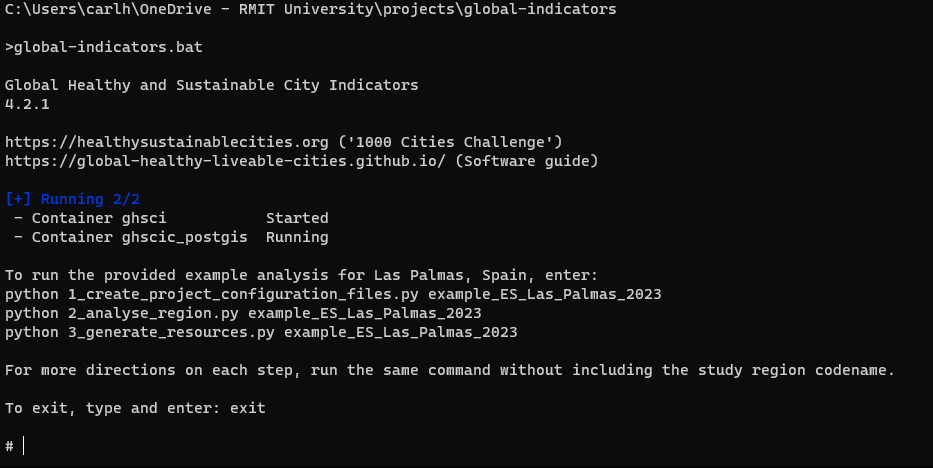
The user instructions are in an instructions.sh shell script -- its possible we could set the prompt itself to be the instructions (but I couldn't get that to work immediately, so didn't bother), or get this script to display after each time a script is run.
I'm not sure about either of those options (probably a better use of time would be to write a mini-wrapper application that meant users didn't have to see/write 'python' at all). But for now, there is more guidance --- including on how to exit.
After running the analysis script, there is also more information provided now -- how to run the generate resources script for this city specifically (so users can copy and paste instead of typing), as well as how to access the postgis database, for those interested.
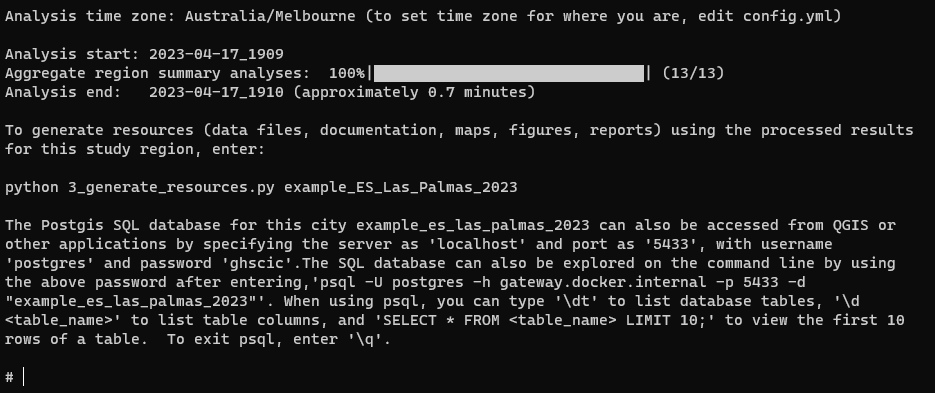
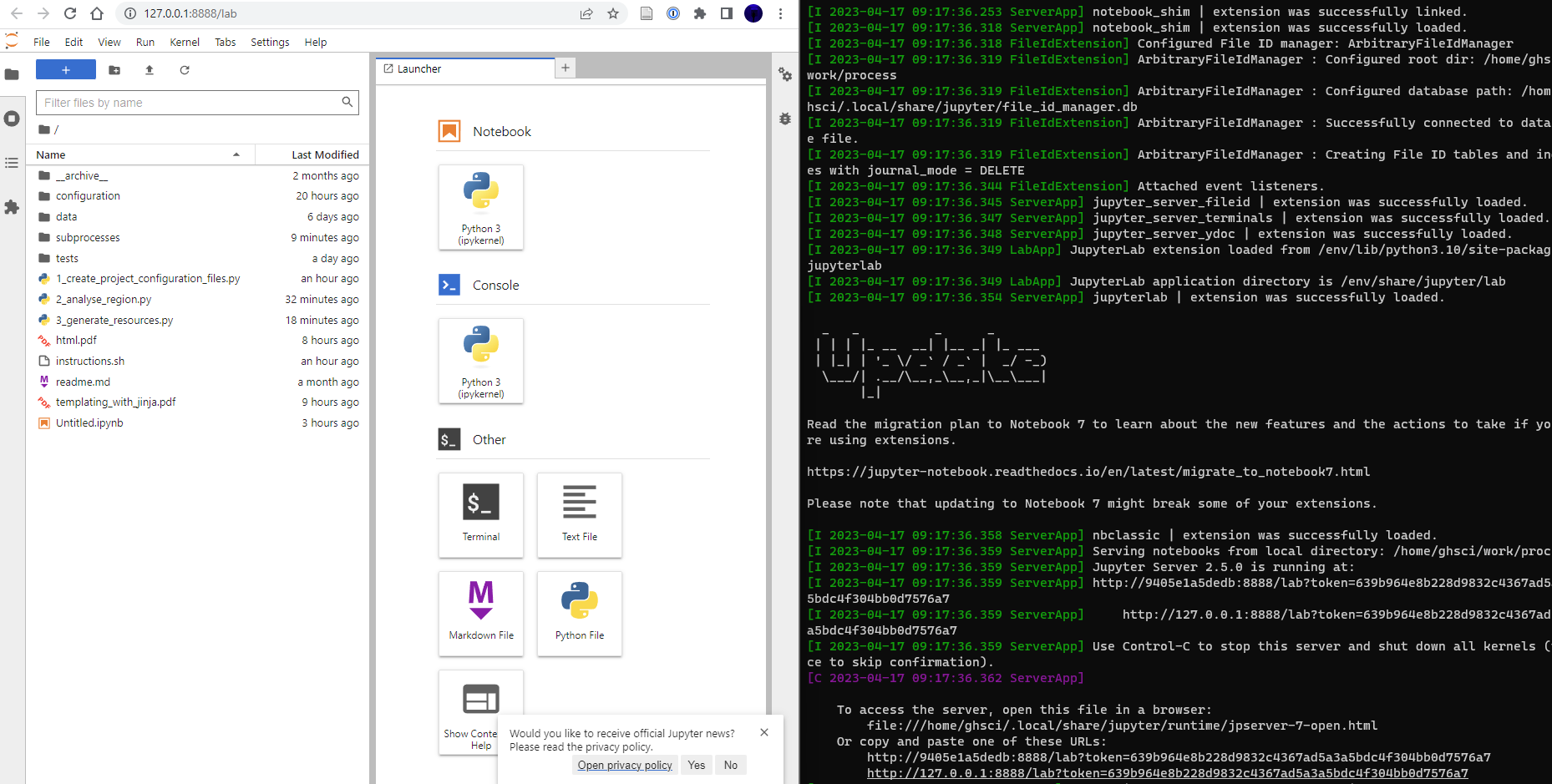
Behind the scenes allows the possibility for those enthusiastic to launch into Jupyter Lab (although its not documented - just have to write 'jupyter' as an argument when launching the process: ./global-indicators.bat jupyter (Windows) or ./global-indicators.sh jupyter (Mac, Linux) . We could later develop an example workflow using Jupyter as an alternative for those who like to work that way.
- Jupyter Notebook
Published by carlhiggs over 3 years ago
global-indicators - v4.2.0
This release allows users to generate maps/figures/reports for their cities, without further need to modify the report configuration spreadsheet.
The provided example city's configuration file demonstrates the full set of new 'reporting' parameters supporting generating resoures with prose in different languages. However, if a user has a recent version of the study region configuration file this should still work, using English as a default.
The example configuration file includes a demonstration of set up for English, Spanish and Chinese outputs; however, because the simplified Chinese character font is not included in the repository it will advise the user they need to download this to output resources using Chinese characters.
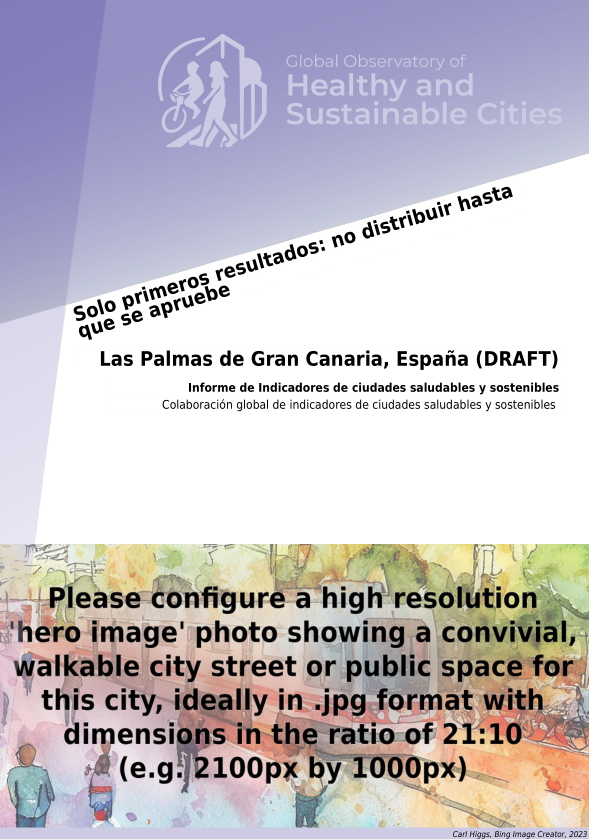
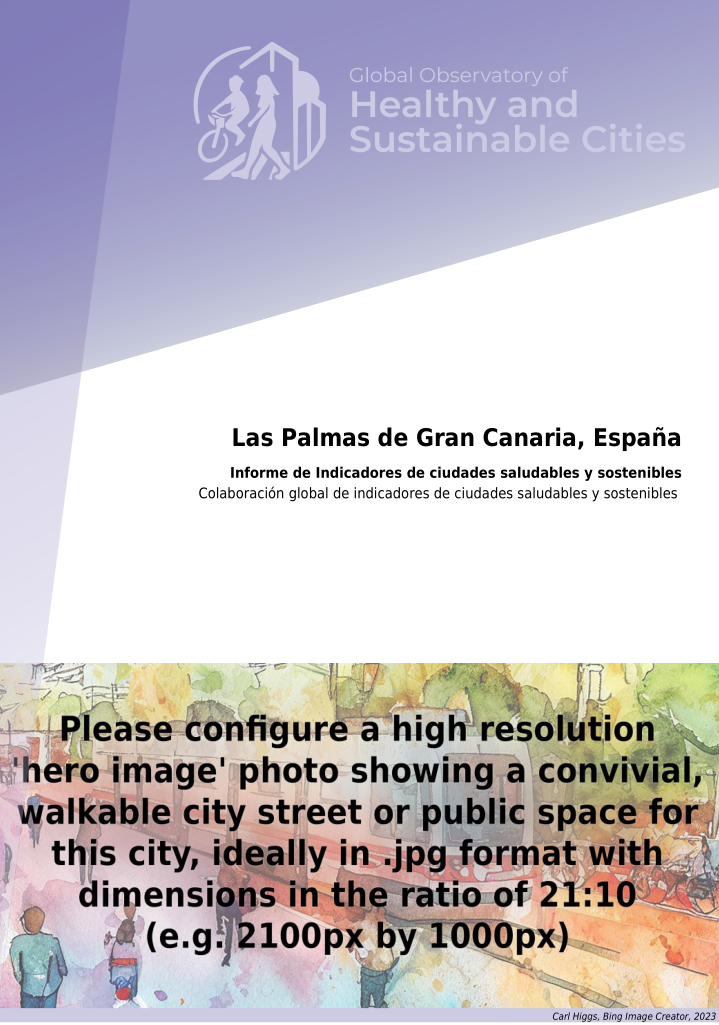
Additionally, there are now placeholder images included for the example, and updated styling, along with an option to specify whether the report is publication-ready (by default, this is False). Here is the front page of the new report in Spanish (for simplicity, the warning of 'DRAFT' is used for all languages, in addition to some language-specific warnings on the front page):
Here is the example city report with the publication_ready set as True (of course, that's not true - its just an example!):
This release also addresses a bug in the previous v4.1.0 relating to a change in the version of Pandas included in the Docker image, with consequent deprecation of a method used (#246). This has been modified to use the newer syntax.
I think this new release adds a lot of value and utility -- in addition to the reports, users can generate maps and figures without further configuration, which is a big win.
Enjoy!
- Jupyter Notebook
Published by carlhiggs over 3 years ago
global-indicators - v4.1.0
This is an important update, as per discussion in #235. In particular, it addresses an issue introduced during refactoring in October 2022, where the default scale of walkable neighbourhood analysis was reduced from 1000 to 100 metre catchments. It is recommended that all users update to use this version of the software, which also introduces more comprehensive and informative reporting outputs.
It addresses the following issues (a number of enhancements, but also a couple of bugs):
- #243
- #242
- #239
- #238
- #237 (although this included Jupyter notebook; Jupyter Lab would be preferable - for a future update)
- #236 (included directions for this)
- #233
- #231
- #230
- doesn't resolve #172, but mitigates this through addressing #216 (more efficient for ARM64)
- doesn't resolve #158, but moves towards enabling this via #216 (networks can be loaded from postgis database if matching required schema; we just need to provide a means for users to store custom network using the required schema)
Metadata and updates to config.yml required
The v4.1.0 release of the software added in creation of metadata files (ISO19115 xml, and yml) to accompany the generated data resources, in addition to data dictionaries. If you've ever created metadata, you'll know that this is a big task, so should prove useful when it comes to publishing and sharing data.
This minor release updated the project configuration file `config.yml with the curent software version, so that this can be included in the generated outputs.
To produce the metadata files required the addition of some new fields to the 'documentation' section of the project config.yml file template, and users will have to add these in to their project configuration file if this was generated using a version of the software prior to 4.1.0.
Your config.yml file is up to date if it contains the following entries in the documentation section:
yaml
documentation:
    authors: Global Healthy Liveable Cities Indicator Study Collaboration
    # Authors of project (for metadata)
    url:
    # Your URL (optional;  for metadata)
    individualname:
    # Name of contact person for analysis (for metadata)
    positionname:
    # Position of contact person conducting analysis (for metadata)
    email:
    # Contact e-mail (for metadata)
    version: 4.1.0
    # Edition of Global Healthy and Sustainable City Indicators software used (for metadata)
- Jupyter Notebook
Published by carlhiggs over 3 years ago
global-indicators - v4.0.1
Fixed typo (regions_config instead of region_config) in 03createnetworkresources.py subprocess
- Jupyter Notebook
Published by carlhiggs over 3 years ago
global-indicators - v4.0.0
This release simplifies and guides the configuration process for new regions. While the structure of configuration files for regions is essentially the same, the location where these is stored is changed along with file naming convention (see examples now found in configuration/regions to see how this is now handled): - regions now use seperate region configuration files as per #225 - new region configuration files are initialised when running the project configuration script - the initialised configuration file contains descriptions and examples to guide the user - users are guided to provide a sensible naming schema to avoid ambiguity (e.g. AUMelbourne2023, indicates an analysis for the Australian city Melbourne targetting 2023). This name is now used for the output folder for a city's anlaysis and in naming the output resources, as per #219 - re-processing existing study regions (should that be required) is now faster, with additional checks in place to avoid re-creating resources - Retrieval of network data using OSMnx now matches the publication data of OpenStreetMap data (as per #158) - the final report step is renamed as '3generateresources.py' as it will produce not just reports, but also maps, figures, scorecards and validation reports - avoided an issue with SQL server timeout for larger cities (#212)
- Jupyter Notebook
Published by carlhiggs over 3 years ago
global-indicators - v3.1.0
This release refines the previous v3.0.0 pre-release, to make it ready for users to run analysis and reporting for the example city of Las Palmas with the downloaded code: - include a basic set of fonts used in reporting (DejaVu Sans Condensed) - running report generation doesn't need users to add a '--city' tag; it is run just like the analyse regions step - updated some documentation to ensure the recent changes were reflected - improved the listing of regions when the analyse regions script is run without a city codename
This is now good to download and run. However, it is emphasised that this new release (v3.*) has tweaked the region and data configuration files.
Here is a snippet of an older configuration for Santiago de Chile:
yaml
santiago:
    full_locale: Santiago
    year: 2022
    region: CL
    country: Chile
    continent: South America
    utm: 19S
    crs_name: SIRGAS-Chile 2002 / UTM zone 19S
    crs_standard: EPSG
    crs_srid: 5361
    area_data: "./data/Chile - Metropolitana de Santiago - 2020 - EPSG5361.geojson"
    area_data_source: La Subsecretaría de Desarrollo Regional y Administrativo (Subdere)
    area_data_source_url: https://datos.gob.cl/dataset/15883 (https://www.ide.cl/descargas/capas/subdere/DivisionPoliticoAdministrativa2020.zip)
    area_data_licence: Creative Commons Non-Commercial (Any)
    area_data_licence_url: http://creativecommons.org/licenses/by-nc/2.0/
    not_urban_intersection:
    note:
There are now sub-headings to make the set up more logical, and double negatives like 'not urban intersection' have been renamed be easier to understand:
yaml
santiago_2022:
  name: Santiago
  year: 2022
  country: Chile
  country_code: CL
  continent: South America
  crs:
    name: SIRGAS-Chile 2002 / UTM zone 19S
    standard: EPSG
    srid: 5361
    utm: 19S
  study_region_boundary:
    data: region_boundaries/Chile/Chile - Metropolitana de Santiago - 2020 - EPSG5361.geojson
    source: "La Subsecretar\xEDa de Desarrollo Regional y Administrativo (Subdere)"
    publication_date: 2022-10-12
    url: https://datos.gob.cl/dataset/15883 (https://www.ide.cl/descargas/capas/subdere/DivisionPoliticoAdministrativa2020.zip)
    licence: Creative Commons Non-Commercial (Any)
    licence_url: http://creativecommons.org/licenses/by-nc/2.0/
    ghsl_urban_intersection: true
There is a helper script to update region files located in the configuration folder, remap_yml_config.py. If you had been running an earlier version, you can run it from that folder like python remap_yml_config.py, and it will save a copy of your older regions.yml and should create a new version with the new mapping. There are a few new fields you should add data for (e.g. as above, publication date for study region boundary).
Further detailed usage directions and videos are being prepared and will be published shortly.
- Jupyter Notebook
Published by carlhiggs over 3 years ago
global-indicators -
This is a 'pre-release' for v3.0.0 --- it has some breaking changes, in particular that I've restructured the folders and region configuration file to make things easier for users to get up and running.
Changes include:
- When a subprocess fails, advise the user and exit the process #206
- Introduce data configuration checks to elegently advise if configuration is mis-specified #205
- Simplify/clean up folders #203
- Create data sub-folders to guide configuration/data gathering #188
- Include small example region data and configuration as demo and for tests #189
- now includes example data and configuration for Las Palmas de Gran Canarias, which with a mock up template for a policy review [pending update to new style for that, and noting this review hasn't been done for this city] it will allow for the full process to be demonstrated, e.g. in videos or in a workshop that a user can run while watching, and then adapt for their own purposes). Its a small city, so the data excerpts are relatively compact.
I think the last one is the exciting bit. I've run this for a few cities now, including generating reports for Ghent, Valencia and Las Palmas de Gran Canaria with different configurations. I think its okay to put it as a pre-release. The additional guidance from readme files and for configuration files will help people, and help us with creating training / workshop materials.
- Jupyter Notebook
Published by carlhiggs over 3 years ago
global-indicators - v2.0.0
This release advances on v1.0.0, which specifically was designed for the 25 city study published in https://10.1016/S2214-109X(22)00072-9.
Broadly, it streamlines the configuration and running of the analysis process for new cities.
Updates include:
- Consolidate configuration #144
- 'Pre-process' is currently treated as external, but is actually just first step of processing #145
- Rename processing scripts to make purpose and sequential order more clear #151
- Aggregation script for 1000 cities challenge should just aggregate one city, not many #152
- Configuration files in repo should be templates, with a script to generate copies for users to modify #154
- uses Docker compose to launch ghsci and ghsci_postgis containers as 'global-indicators', and attach to ghsci ; can latter support #165
- more elegant start (if the spatial database is already running, it doesn't say 'error'; it knows its fine); relates to the spirit of #165
- Excerpt files to .pbf instead of .osm, if possible (smaller file size, faster processing) #191
- all output is now logged to text .log file in study region-specific folder #190
- the big change --- the process is now 3-steps - easy!:
- configuration
- analysis
- reporting
- the analysis progress bar runs smoothly
- renamed the 'pre_process' folder to 'subprocesses', and the neighbourhood analysis and aggregation scripts have been moved there
- updated documentation to reflect the above
More work is to be done, but this release can be used for analysing new urban regions.
- Jupyter Notebook
Published by carlhiggs over 3 years ago
global-indicators - v1.0.0
An open-source tool for estimation of pedestrian accessibility indicators for cities worldwide using open data, such as OpenStreetMap (OSM), the Global Human Settlement Layer (GHSL), and GTFS feeds (where available).
This software was first described in: Liu S, Higgs C, Arundel J, Boeing G, Cerdera N, Moctezuma D, Cerin E, Adlakha D, Lowe M, Giles-Corti B. A Generalized Framework for Measuring Pedestrian Accessibility around the World Using Open Data. Geographical Analysis. 2021. en. doi:10.1111/gean.12290.
It was specifically developed and used for an analysis of 25 cities in diverse settings internationally, published in Boeing G, Higgs C, Liu S, Giles-Corti B, Sallis JF, Cerin E, Lowe M, Adlakha D, Hinckson E, Moudon AV, Salvo D, Adams MA, Barrozo LV, Bozovic T, Delclòs-Alió X, Dygrýn J, Ferguson S, Gebel K, Ho TP, Lai P-C, Martori JC, Nitvimol K, Queralt A, Roberts JD, Sambo GH, Schipperijn J, Vale D, Van de Weghe N, Vich G, Arundel J. Using open data and open-source software to develop spatial indicators of urban design and transport features for achieving healthy and sustainable cities. The Lancet Global Health. 2022 2022/06//;10(6):e907-e918. en. doi:10.1016/S2214-109X(22)00072-9.
- Jupyter Notebook
Published by carlhiggs almost 4 years ago