Science Score: 67.0%
This score indicates how likely this project is to be science-related based on various indicators:
-
✓CITATION.cff file
Found CITATION.cff file -
✓codemeta.json file
Found codemeta.json file -
✓.zenodo.json file
Found .zenodo.json file -
✓DOI references
Found 3 DOI reference(s) in README -
✓Academic publication links
Links to: zenodo.org -
○Academic email domains
-
○Institutional organization owner
-
○JOSS paper metadata
-
○Scientific vocabulary similarity
Low similarity (13.7%) to scientific vocabulary
Repository
Python HF Raytracing Tool for the Ionosphere
Basic Info
- Host: GitHub
- Owner: victoriyaforsythe
- License: mit
- Language: Python
- Default Branch: main
- Size: 2.74 MB
Statistics
- Stars: 4
- Watchers: 1
- Forks: 1
- Open Issues: 0
- Releases: 2
Metadata Files
README.md
PyRayHF (Python HF Ray Tracer for the Ionosphere)


PyRayHF is a Python-based software package for analytic HF raytracing through the ionosphere.
For a given electron density profile and the magnetic field it calculates virtual heights for the upward-propagating HF rays in ordinary (O) and extraodinary (X) modes.
A key advantage of PyRayHF is its efficiency: it calculater the virtual heigh simultaneousely for all given ionosonde freqeuncies.
Installation
PyRayHF can be installed from PyPI, which will handle all dependencies:
pip install PyRayHF
Alternatively, you can clone and install it from GitHub:
git clone https://github.com/victoriyaforsythe/PyRayHF.git
cd PyRayHF
python -m build .
pip install .
See the documentation for details about the required dependencies.
Example Workflow
- Provide input arrays for one vertical ionospheric profile, where $den$, $bmag$, $bpsi$, and $alt$ are the arrays of the same length, referring to electron density in m$^{-3}$, strength of the magnetic field in Tesla, angle of the magnetic field to the vertical in degrees, altitude in km. Provide the array of frequencies $freq$ at which you would like to sample this profile, that will be the frequencies of the HF sounder.
Below are the input arrays generated by PyIRI in ExampleGenerateInput_Arrays.

- Compute virtual height for the ordinary 'O' propagation mode. A low number of vertical grid points is sufficient for O-mode (e.g., 200).
mode = 'O'
n_points = 200
vh_O = PyRayHF.library.vertical_forward_operator(input_arrays['freq'],
                                            input_arrays['den'],
                                            input_arrays['bmag'],
                                            input_arrays['bpsi'],
                                            input_arrays['alt'],
                                            mode,
                                            n_points)
- Compute virtual height for the extraordinary 'X' propagation mode. A high number of vertical grid points is recommended for X-mode (e.g., 20000), since the result may be noisy at low resolution.
mode = 'X'
n_points = 20000
vh_X = PyRayHF.library.vertical_forward_operator(input_arrays['freq'],
                                            input_arrays['den'],
                                            input_arrays['bmag'],
                                            input_arrays['bpsi'],
                                            input_arrays['alt'],
                                            mode,
                                            n_points)
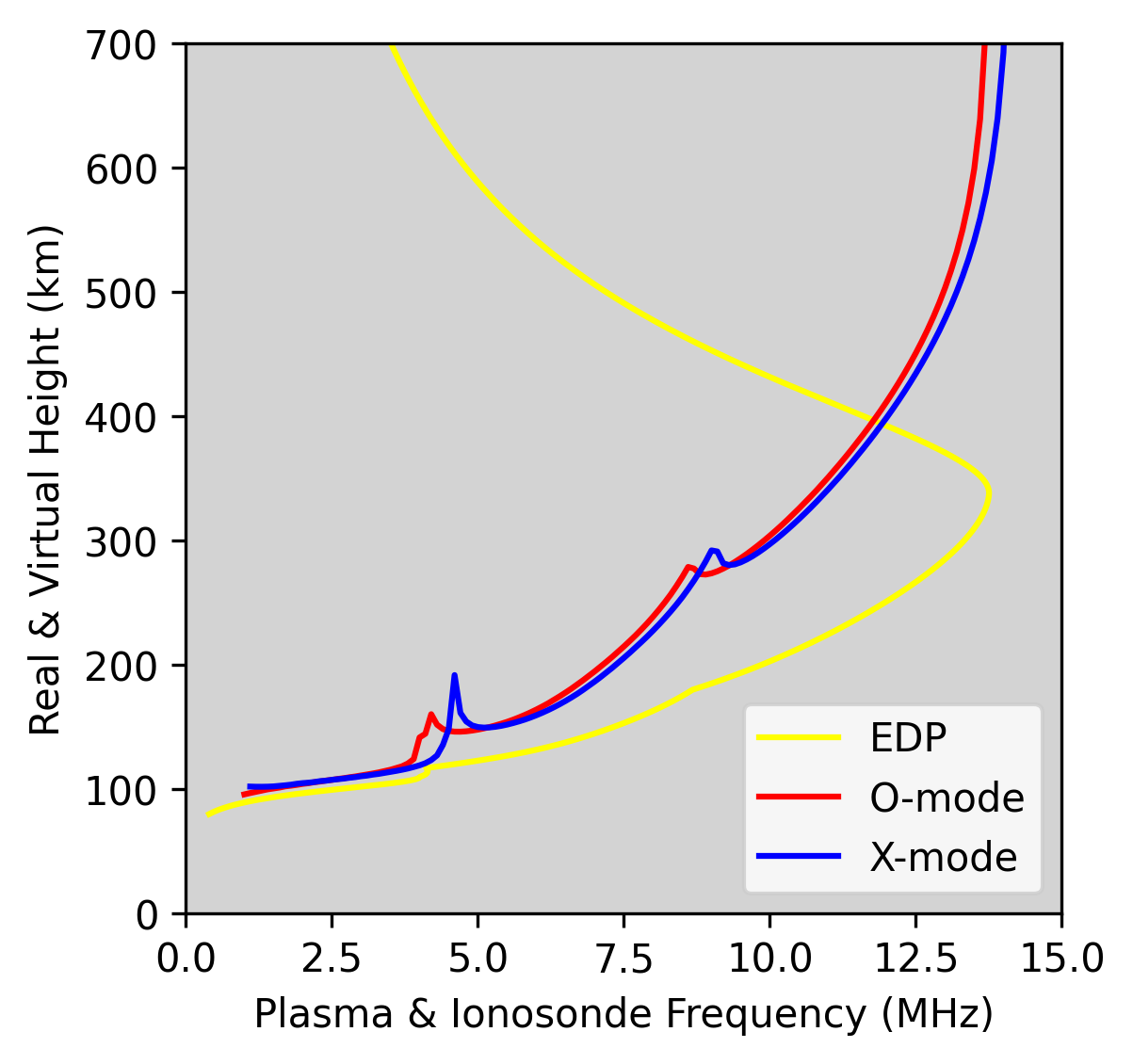
Virtual Height Calculation Overview
The virtual height is the apparent reflection height of a radio wave in the ionosphere, assuming the wave travels at the speed of light in a vacuum. In reality, the wave slows down due to the ionospheric plasma, and this effect is captured using the group refractive index.
To compute the virtual height, we integrate the group refractive index over the real height profile. This process uses several physical quantities, all of which can be derived from models or measurements:
- Electron Density: Used to compute the plasma frequency. This quantity is the primary factor affecting wave propagation.
- Magnetic Field Strength: Needed to calculate the gyrofrequency, which affects how the wave interacts with the ionized medium.
- Magnetic Field Angle: The angle between the wave vector and the magnetic field line influences wave polarization and refraction.
Using these parameters, we compute:
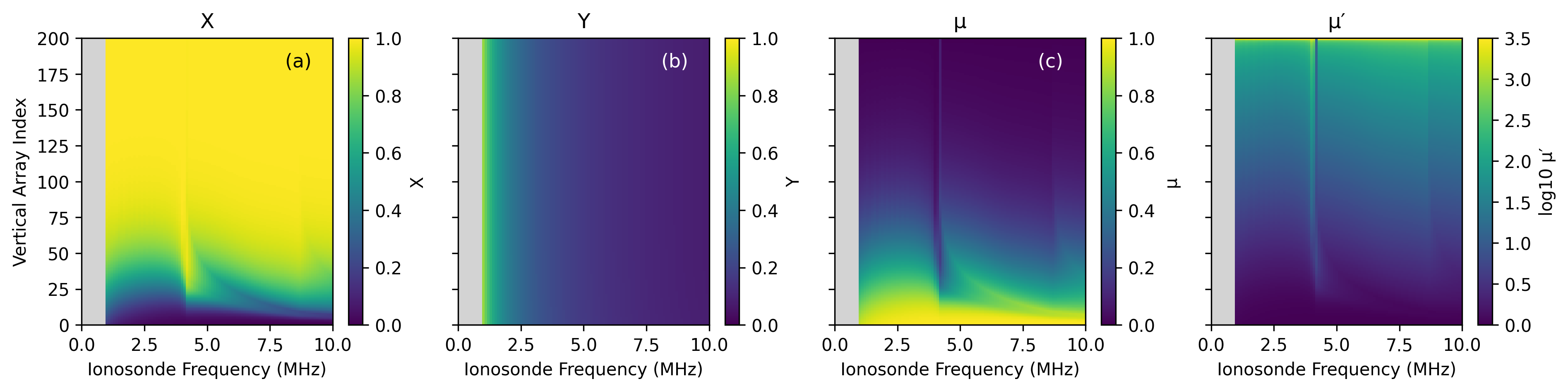
- X: The ratio of plasma frequency squared to wave frequency squared. This determines how strongly the plasma affects wave propagation.
- Y: The ratio of gyrofrequency to wave frequency. This captures the influence of the magnetic field.
- Refractive Index (mu): Describes how much the wave is slowed down by the medium.
- Group Refractive Index (mu_prime): Represents how the wave packet travels, and is derived from the refractive index.
Once the group refractive index profile is known, it is integrated over the height range of interest to obtain the virtual height. This value corresponds to the height at which the wave would appear to reflect if it were traveling through a vacuum.
Why a Stretched Grid is Needed
In standard numerical modeling, it is common to use a uniform vertical grid, where points are evenly spaced in altitude. However, when calculating the virtual height in the ionosphere, this approach can lead to poor resolution near the reflection height.
The reflection height is the point where the radio wave slows down dramatically and turns back due to the changing refractive index. Around this region, the group refractive index varies rapidly with altitude, and most of the contribution to the virtual height integral comes from this narrow layer.
A uniform grid may not have enough points in this critical region, resulting in large numerical errors and an inaccurate estimate of the virtual height. This is especially problematic when the wave frequency is close to the local plasma frequency, where the integrand becomes sharply peaked.
To solve this, we use a stretched vertical grid. This grid places more points near the reflection region and fewer points in regions where the variation is smooth. By concentrating resolution where it is most needed, the stretched grid ensures accurate integration of the group refractive index, while keeping the total number of points manageable. This approach improves both efficiency and precision, making it ideal for ionospheric ray tracing and virtual height modeling.
Grid Construction for Virtual Height Calculation
For each ionosonde frequency, we interpolate the electron density profile (EDP)—converted into plasma frequency—to determine the height at which the ionosonde frequency equals the local plasma frequency. This height is referred to as the reflection height, and it marks the upper boundary for the integration in virtual height calculation.
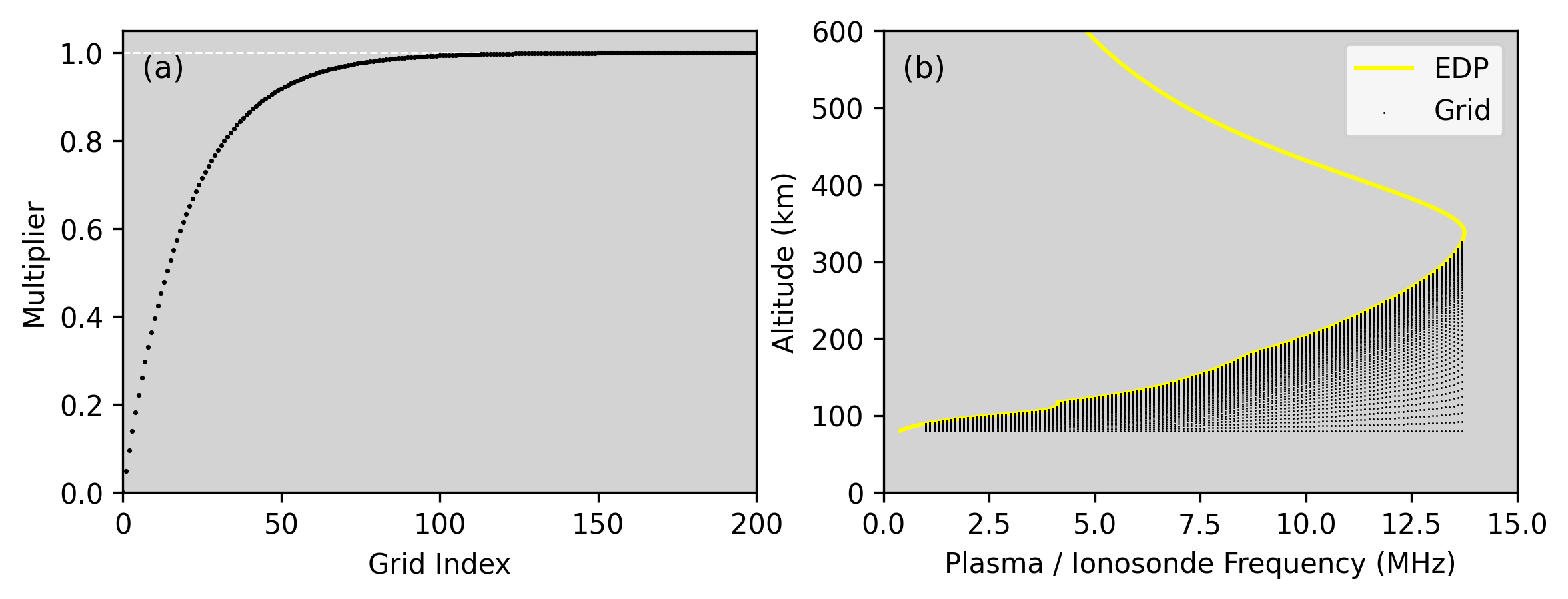
Once the reflection height is known, we construct a new vertical grid tailored to that specific frequency. This is achieved using a stretched grid function that varies smoothly from 0 to 1. The function concentrates points near the top of the grid—close to the reflection height—where resolution is most critical.
We apply this function by multiplying it by the altitude range of interest: from the minimum altitude (e.g., 80 km) to the reflection height.
This results in a resampled array of altitudes, with a fixed number of points, N_points.
The figures below show the multiplier obtained from the stretched grid function and the locations of the new stretched grid relative to the reflection height for each ionosonde frequency, plotted on the same x-axis as the plasma frequency. This new grid ensures fine resolution near the reflection height while minimizing unnecessary points at lower altitudes.
By repeating this process for each ionosonde frequency, we form a 2D matrix of altitudes with dimensions [N_frequency, N_points].
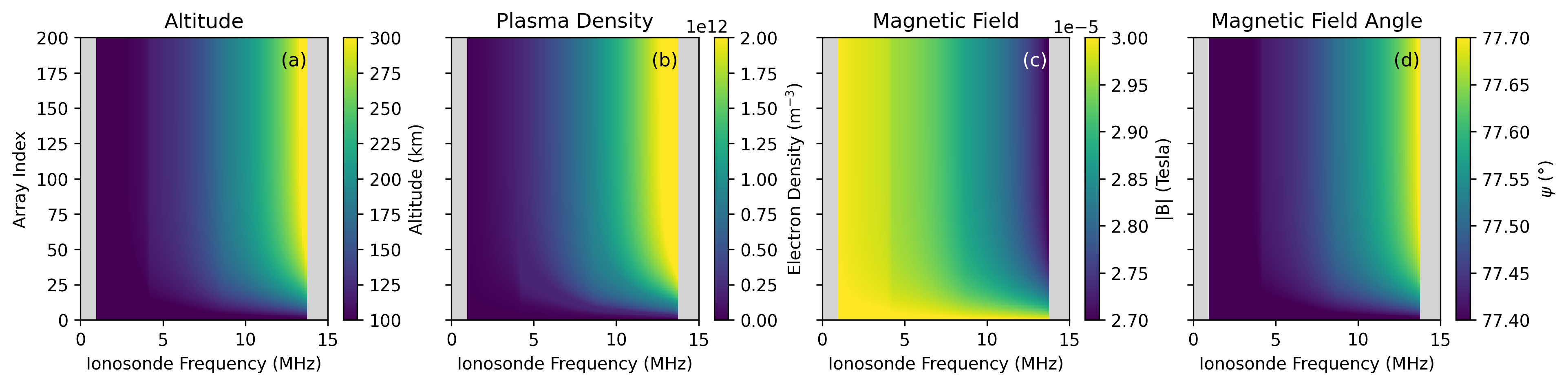
At this stage, we interpolate all input parameters—such as electron density, magnetic field strength, and angle—onto this new grid.
This ensures that every virtual height calculation uses accurately aligned input data, matched to the specific resolution needs of the ray's path at that frequency.
The following figures present the input data converted into 2D arrays, where the x-axis represents the ionosonde frequency and the y-axis corresponds to the vertical grid index, with a size of N_points.
The first figure displays the altitude of each grid point. The subsequent figures show the interpolated plasma density, magnetic field strength, and magnetic field angle.
The following figures present the computed X, Y, Refractive Index (mu), and Group Refractive Index (mu_prime) parameters for O-mode.
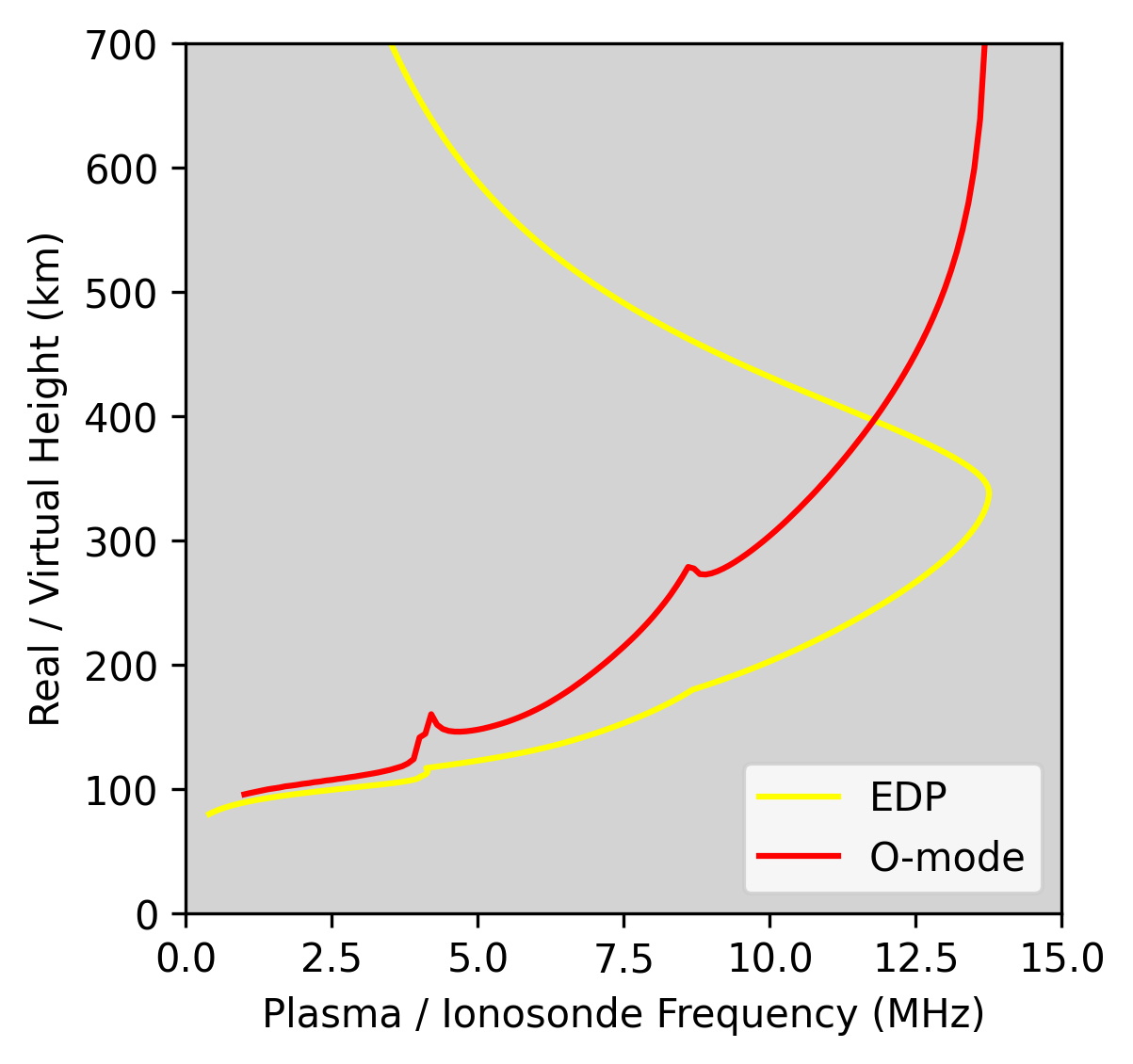
The group refractive index Group Refractive Index (mu_prime) is multiplied with a matrix that contains the distances between the grid points and summed over the second axis, obtaining the virtual height, shown with red curves on the figure below.
See the tutorials folder for mode detailed examples.
Example: Compute and Fit Virtual Heights Using PyRayHF
This example demonstrates how to compute ionospheric virtual heights using the PyRayHF library and perform parameter inversion to fit synthetic observations.
Workflow Overview:
1) Load Input Arrays: Load a set of pre-generated ionospheric input arrays from Exampleinput.p, which were created using the PyIRI library (see tutorials). 2) Generate Background Model Compute the virtual height (vhback) and electron density profile (EDPback) for the ordinary ('O') propagation mode using **modelVH. This serves as the background model for later minimization. 3) Create Synthetic Observations Simulate a "truth" scenario by modifying the F2-layer parameters (increase peak density by 20%, lower peak height by 20%, and increase bottomside thickness by 10%). Generate corresponding virtual heights and electron densities using the same modelVH function. 4) Preprocess Observations Filter out any NaN values from the synthetic virtual height data to ensure the minimization function can run properly. 5) Minimize and Fit Parameters Use **minimizeparameters with brute-force optimization to find F2-layer parameters that best reproduce the synthetic virtual height observations. The method searches over a range of values with a 30% perturbation margin and step size of 1 km.
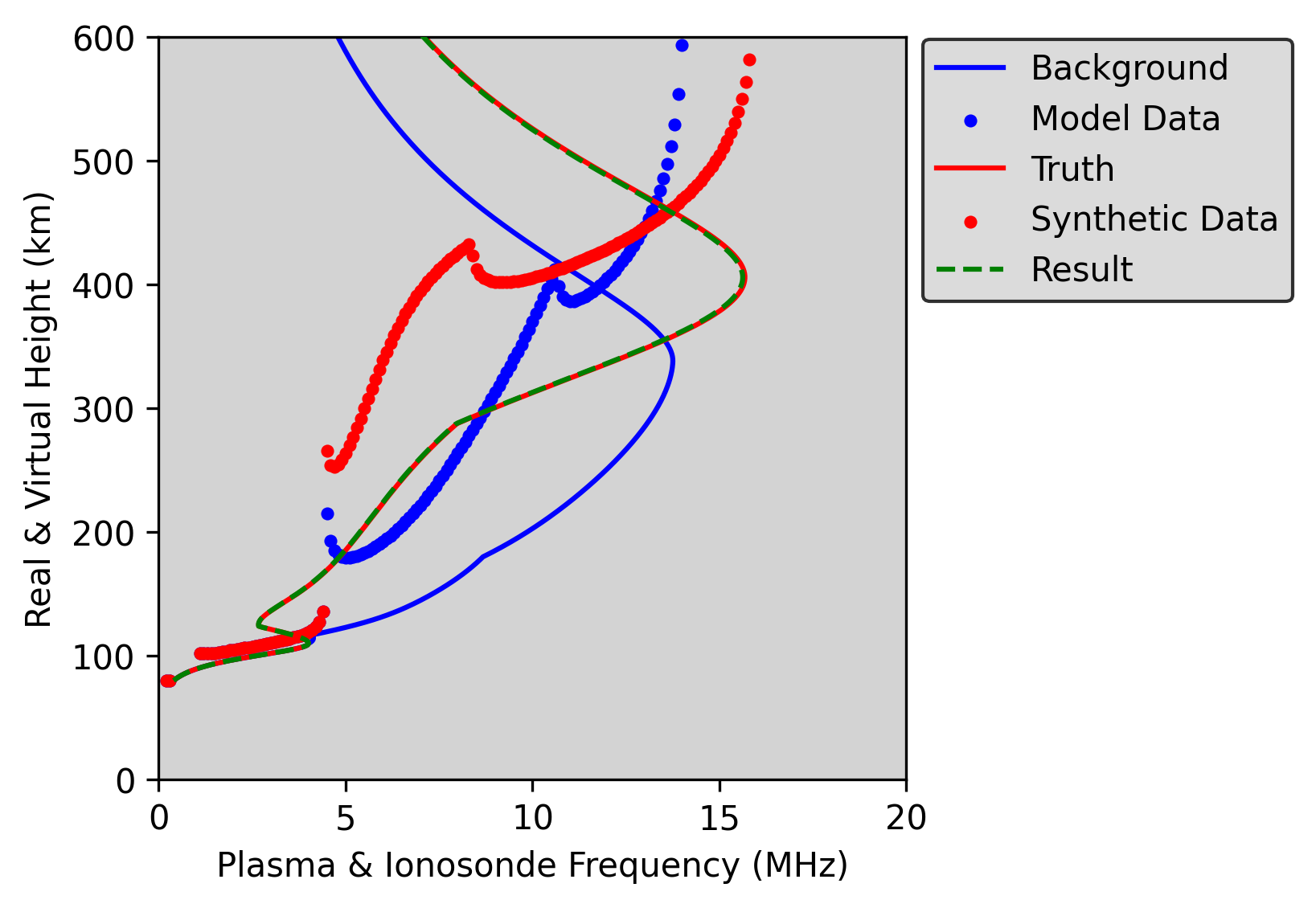
The notebook for this example can be found at tutorials.
Owner
- Login: victoriyaforsythe
- Kind: user
- Repositories: 1
- Profile: https://github.com/victoriyaforsythe
Citation (CITATION.cff)
cff-version: 0.0.2
message: "If you use this software, please cite it as below."
authors:
  - family-names: Forsythe
    given-names: Victoriya V.
    orcid: https://orcid.org/0000-0003-0894-2951
    affiliation: U.S. Naval Research Laboratory
  - family-names: Burrell
    given-names: Angeline G.
    orcid: https://orcid.org/0000-0001-8875-9326
    affiliation: U.S. Naval Research Laboratory
title: victoriyaforsythe/PyRayHF: v0.0.2
version: v0.0.2
date-released: 2025-06-12
GitHub Events
Total
- Release event: 2
- Watch event: 4
- Delete event: 1
- Issue comment event: 2
- Push event: 29
- Pull request review event: 4
- Pull request review comment event: 5
- Pull request event: 3
- Fork event: 1
- Create event: 4
Last Year
- Release event: 2
- Watch event: 4
- Delete event: 1
- Issue comment event: 2
- Push event: 29
- Pull request review event: 4
- Pull request review comment event: 5
- Pull request event: 3
- Fork event: 1
- Create event: 4
Issues and Pull Requests
Last synced: 11 months ago
All Time
- Total issues: 0
- Total pull requests: 7
- Average time to close issues: N/A
- Average time to close pull requests: 35 minutes
- Total issue authors: 0
- Total pull request authors: 1
- Average comments per issue: 0
- Average comments per pull request: 0.43
- Merged pull requests: 6
- Bot issues: 0
- Bot pull requests: 0
Past Year
- Issues: 0
- Pull requests: 7
- Average time to close issues: N/A
- Average time to close pull requests: 35 minutes
- Issue authors: 0
- Pull request authors: 1
- Average comments per issue: 0
- Average comments per pull request: 0.43
- Merged pull requests: 6
- Bot issues: 0
- Bot pull requests: 0
Top Authors
Issue Authors
Pull Request Authors
- victoriyaforsythe (7)
Top Labels
Issue Labels
Pull Request Labels
Packages
- Total packages: 1
-
Total downloads:
- pypi 13 last-month
- Total dependent packages: 0
- Total dependent repositories: 0
- Total versions: 2
- Total maintainers: 2
pypi.org: pyrayhf
Python HF Raytracing for Ionosphere
- Documentation: https://PyRayHF.readthedocs.io/en/latest/
- License: MIT License Copyright (c) 2023 victoriyaforsythe Permission is hereby granted, free of charge, to any person obtaining a copy of this software and associated documentation files (the "Software"), to deal in the Software without restriction, including without limitation the rights to use, copy, modify, merge, publish, distribute, sublicense, and/or sell copies of the Software, and to permit persons to whom the Software is furnished to do so, subject to the following conditions: The above copyright notice and this permission notice shall be included in all copies or substantial portions of the Software. THE SOFTWARE IS PROVIDED "AS IS", WITHOUT WARRANTY OF ANY KIND, EXPRESS OR IMPLIED, INCLUDING BUT NOT LIMITED TO THE WARRANTIES OF MERCHANTABILITY, FITNESS FOR A PARTICULAR PURPOSE AND NONINFRINGEMENT. IN NO EVENT SHALL THE AUTHORS OR COPYRIGHT HOLDERS BE LIABLE FOR ANY CLAIM, DAMAGES OR OTHER LIABILITY, WHETHER IN AN ACTION OF CONTRACT, TORT OR OTHERWISE, ARISING FROM, OUT OF OR IN CONNECTION WITH THE SOFTWARE OR THE USE OR OTHER DEALINGS IN THE SOFTWARE.
-
Latest release: 0.0.2
published about 1 year ago
Rankings
Dependencies
- actions/checkout v3 composite
- actions/setup-python v4 composite
- actions/checkout v3 composite
- actions/setup-python v4 composite
- numpy *
- pytest *