gstools
GSTools - A geostatistical toolbox: random fields, variogram estimation, covariance models, kriging and much more
Science Score: 67.0%
This score indicates how likely this project is to be science-related based on various indicators:
-
✓CITATION.cff file
Found CITATION.cff file -
✓codemeta.json file
Found codemeta.json file -
✓.zenodo.json file
Found .zenodo.json file -
✓DOI references
Found 15 DOI reference(s) in README -
✓Academic publication links
Links to: zenodo.org -
○Committers with academic emails
-
○Institutional organization owner
-
○JOSS paper metadata
-
○Scientific vocabulary similarity
Low similarity (12.3%) to scientific vocabulary
Keywords
Repository
GSTools - A geostatistical toolbox: random fields, variogram estimation, covariance models, kriging and much more
Basic Info
- Host: GitHub
- Owner: GeoStat-Framework
- License: lgpl-3.0
- Language: Python
- Default Branch: main
- Homepage: https://geostat-framework.org
- Size: 17.7 MB
Statistics
- Stars: 612
- Watchers: 16
- Forks: 75
- Open Issues: 24
- Releases: 29
Topics
Metadata Files
README.md
Welcome to GSTools








Get in Touch!


Youtube Tutorial on GSTools
Purpose
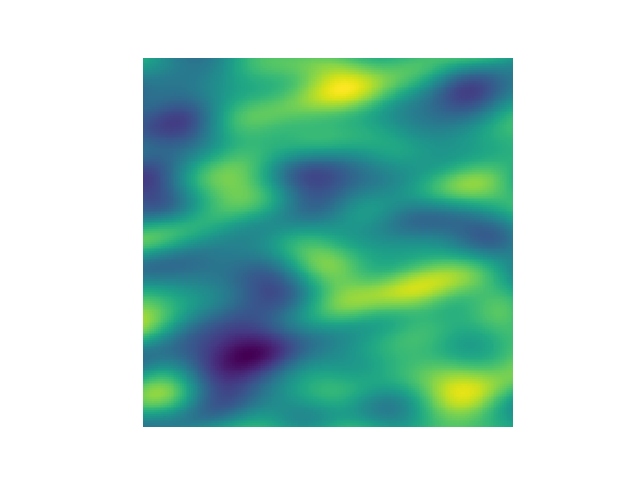
GSTools provides geostatistical tools for various purposes: - random field generation, including periodic boundaries - simple, ordinary, universal and external drift kriging - conditioned field generation - incompressible random vector field generation - (automated) variogram estimation and fitting - directional variogram estimation and modelling - data normalization and transformation - many readily provided and even user-defined covariance models - metric spatio-temporal modelling - plurigaussian field simulations (PGS) - plotting and exporting routines
Installation
conda
GSTools can be installed via conda on Linux, Mac, and Windows. Install the package by typing the following command in a command terminal:
conda install gstools
In case conda forge is not set up for your system yet, see the easy to follow instructions on conda forge. Using conda, the parallelized version of GSTools should be installed.
pip
GSTools can be installed via pip on Linux, Mac, and Windows. On Windows you can install WinPython to get Python and pip running. Install the package by typing the following command in a command terminal:
pip install gstools
To install the latest development version via pip, see the documentation. One thing to point out is that this way, the non-parallel version of GSTools is installed. In case you want the parallel version, follow these easy steps.
Citation
If you are using GSTools in your publication please cite our paper:
Müller, S., Schüler, L., Zech, A., and Heße, F.: GSTools v1.3: a toolbox for geostatistical modelling in Python, Geosci. Model Dev., 15, 3161–3182, https://doi.org/10.5194/gmd-15-3161-2022, 2022.
You can cite the Zenodo code publication of GSTools by:
Sebastian Müller & Lennart Schüler. GeoStat-Framework/GSTools. Zenodo. https://doi.org/10.5281/zenodo.1313628
If you want to cite a specific version, have a look at the Zenodo site.
Documentation for GSTools
You can find the documentation under geostat-framework.readthedocs.io.
Tutorials and Examples
The documentation also includes some tutorials, showing the most important use cases of GSTools, which are
- Random Field Generation
- The Covariance Model
- Variogram Estimation
- Random Vector Field Generation
- Kriging
- Conditioned random field generation
- Field transformations
- Geographic Coordinates
- Spatio-Temporal Modelling
- Normalizing Data
- Plurigaussian Field Generation (PGS)
- Miscellaneous examples
The associated python scripts are provided in the examples folder.
Spatial Random Field Generation
The core of this library is the generation of spatial random fields. These fields are generated using the randomisation method, described by Heße et al. 2014.
Examples
Gaussian Covariance Model
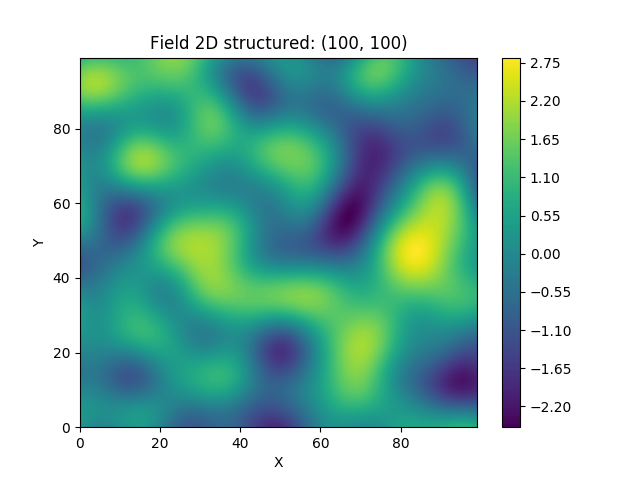
This is an example of how to generate a 2 dimensional spatial random field with a gaussian covariance model.
```python import gstools as gs
structured field with a size 100x100 and a grid-size of 1x1
x = y = range(100) model = gs.Gaussian(dim=2, var=1, lenscale=10) srf = gs.SRF(model) srf((x, y), meshtype='structured') srf.plot() ```
GSTools also provides support for geographic coordinates. This works perfectly well with cartopy.
```python import matplotlib.pyplot as plt import cartopy.crs as ccrs import gstools as gs
define a structured field by latitude and longitude
lat = lon = range(-80, 81) model = gs.Gaussian(latlon=True, lenscale=777, geoscale=gs.KM_SCALE) srf = gs.SRF(model, seed=12345) field = srf.structured((lat, lon))
Orthographic plotting with cartopy
ax = plt.subplot(projection=ccrs.Orthographic(-45, 45)) cont = ax.contourf(lon, lat, field, transform=ccrs.PlateCarree()) ax.coastlines() ax.set_global() plt.colorbar(cont) ```

A similar example but for a three dimensional field is exported to a VTK file, which can be visualized with ParaView or PyVista in Python:
```python import gstools as gs
structured field with a size 100x100x100 and a grid-size of 1x1x1
x = y = z = range(100) model = gs.Gaussian(dim=3, lenscale=[16, 8, 4], angles=(0.8, 0.4, 0.2)) srf = gs.SRF(model) srf((x, y, z), meshtype='structured') srf.vtkexport('3dfield') # Save to a VTK file for ParaView
mesh = srf.to_pyvista() # Create a PyVista mesh for plotting in Python mesh.contour(isosurfaces=8).plot() ```

Estimating and Fitting Variograms
The spatial structure of a field can be analyzed with the variogram, which contains the same information as the covariance function.
All covariance models can be used to fit given variogram data by a simple interface.
Example
This is an example of how to estimate the variogram of a 2 dimensional unstructured field and estimate the parameters of the covariance model again.
```python import numpy as np import gstools as gs
generate a synthetic field with an exponential model
x = np.random.RandomState(19970221).rand(1000) * 100. y = np.random.RandomState(20011012).rand(1000) * 100. model = gs.Exponential(dim=2, var=2, len_scale=8) srf = gs.SRF(model, mean=0, seed=19970221) field = srf((x, y))
estimate the variogram of the field
bincenter, gamma = gs.varioestimate((x, y), field)
fit the variogram with a stable model. (no nugget fitted)
fitmodel = gs.Stable(dim=2) fitmodel.fitvariogram(bincenter, gamma, nugget=False)
output
ax = fitmodel.plot(xmax=max(bincenter)) ax.scatter(bincenter, gamma) print(fit_model) ```
Which gives:
python
Stable(dim=2, var=1.85, len_scale=7.42, nugget=0.0, anis=[1.0], angles=[0.0], alpha=1.09)

Kriging and Conditioned Random Fields
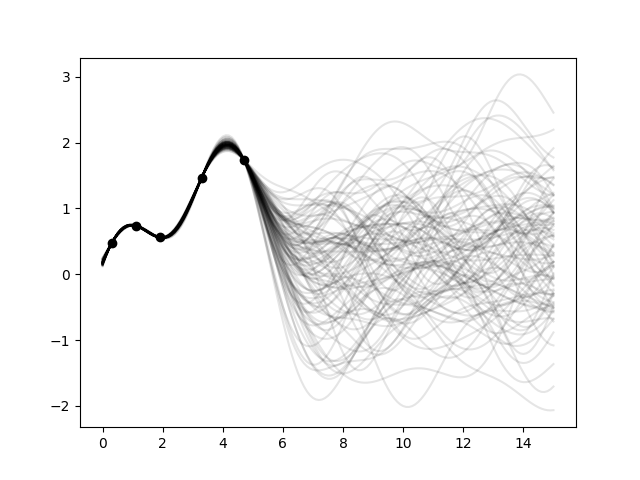
An important part of geostatistics is Kriging and conditioning spatial random fields to measurements. With conditioned random fields, an ensemble of field realizations with their variability depending on the proximity of the measurements can be generated.
Example
For better visualization, we will condition a 1d field to a few "measurements", generate 100 realizations and plot them:
```python import numpy as np import matplotlib.pyplot as plt import gstools as gs
conditions
condpos = [0.3, 1.9, 1.1, 3.3, 4.7] condval = [0.47, 0.56, 0.74, 1.47, 1.74]
conditioned spatial random field class
model = gs.Gaussian(dim=1, var=0.5, lenscale=2) krige = gs.krige.Ordinary(model, condpos, condval) condsrf = gs.CondSRF(krige)
same output positions for all ensemble members
gridpos = np.linspace(0.0, 15.0, 151) condsrf.setpos(gridpos)
seeded ensemble generation
seed = gs.random.MasterRNG(20170519) for i in range(100): field = condsrf(seed=seed(), store=f"field{i}") plt.plot(gridpos, field, color="k", alpha=0.1) plt.scatter(condpos, cond_val, color="k") plt.show() ```
User Defined Covariance Models
One of the core-features of GSTools is the powerful CovModel class, which allows to easy define covariance models by the user.
Example
Here we re-implement the Gaussian covariance model by defining just a
correlation function, which takes a non-dimensional distance h = r/l:
```python import numpy as np import gstools as gs
use CovModel as the base-class
class Gau(gs.CovModel): def cor(self, h): return np.exp(-h**2) ```
And that's it! With Gau you now have a fully working covariance model,
which you could use for field generation or variogram fitting as shown above.
Have a look at the documentation for further information on incorporating optional parameters and optimizations.
Incompressible Vector Field Generation
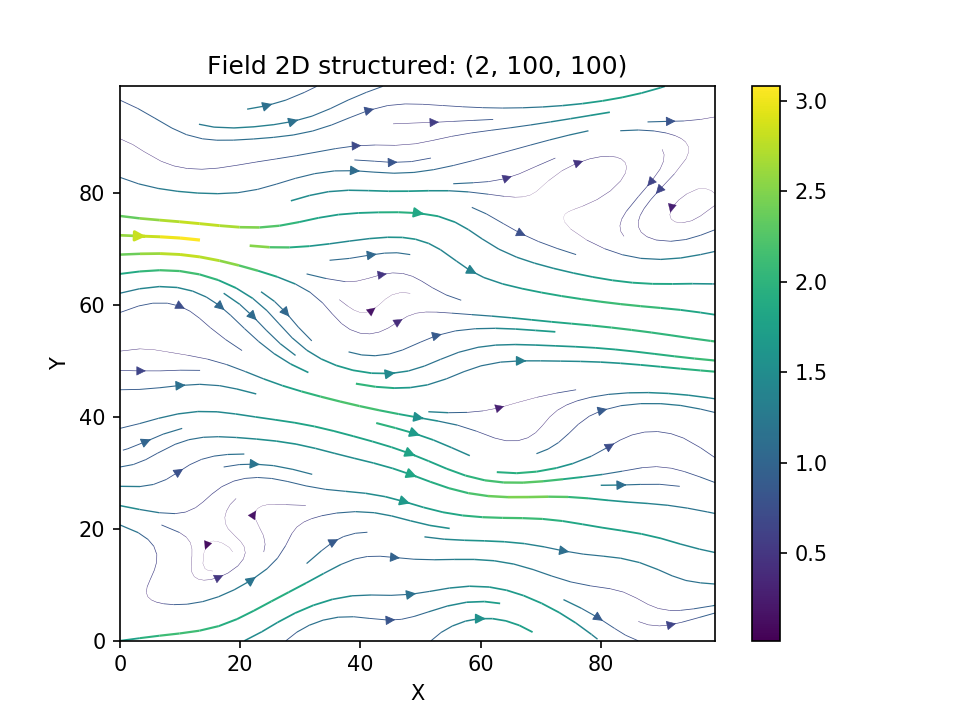
Using the original Kraichnan method, incompressible random spatial vector fields can be generated.
Example
python
import numpy as np
import gstools as gs
x = np.arange(100)
y = np.arange(100)
model = gs.Gaussian(dim=2, var=1, len_scale=10)
srf = gs.SRF(model, generator='VectorField', seed=19841203)
srf((x, y), mesh_type='structured')
srf.plot()
yielding
Plurigaussian Field Simulation (PGS)
With PGS, more complex categorical (or discrete) fields can be created.
Example
```python import gstools as gs import numpy as np import matplotlib.pyplot as plt
N = [180, 140]
x, y = range(N[0]), range(N[1])
we need 2 SRFs
model = gs.Gaussian(dim=2, var=1, len_scale=5) srf = gs.SRF(model) field1 = srf.structured([x, y], seed=20170519) field2 = srf.structured([x, y], seed=19970221)
with lithotypes, we prescribe the categorical data and its relations
here, we use 2 categories separated by a rectangle.
rect = [40, 32] lithotypes = np.zeros(N) lithotypes[ N[0] // 2 - rect[0] // 2 : N[0] // 2 + rect[0] // 2, N[1] // 2 - rect[1] // 2 : N[1] // 2 + rect[1] // 2, ] = 1
pgs = gs.PGS(2, [field1, field2]) P = pgs(lithotypes)
fig, axs = plt.subplots(1, 2) axs[0].imshow(lithotypes, cmap="copper") axs[1].imshow(P, cmap="copper") plt.show() ```

VTK/PyVista Export
After you have created a field, you may want to save it to file, so we provide
a handy VTK export routine using the .vtk_export() or you could
create a VTK/PyVista dataset for use in Python with to .to_pyvista() method:
python
import gstools as gs
x = y = range(100)
model = gs.Gaussian(dim=2, var=1, len_scale=10)
srf = gs.SRF(model)
srf((x, y), mesh_type='structured')
srf.vtk_export("field") # Saves to a VTK file
mesh = srf.to_pyvista() # Create a VTK/PyVista dataset in memory
mesh.plot()
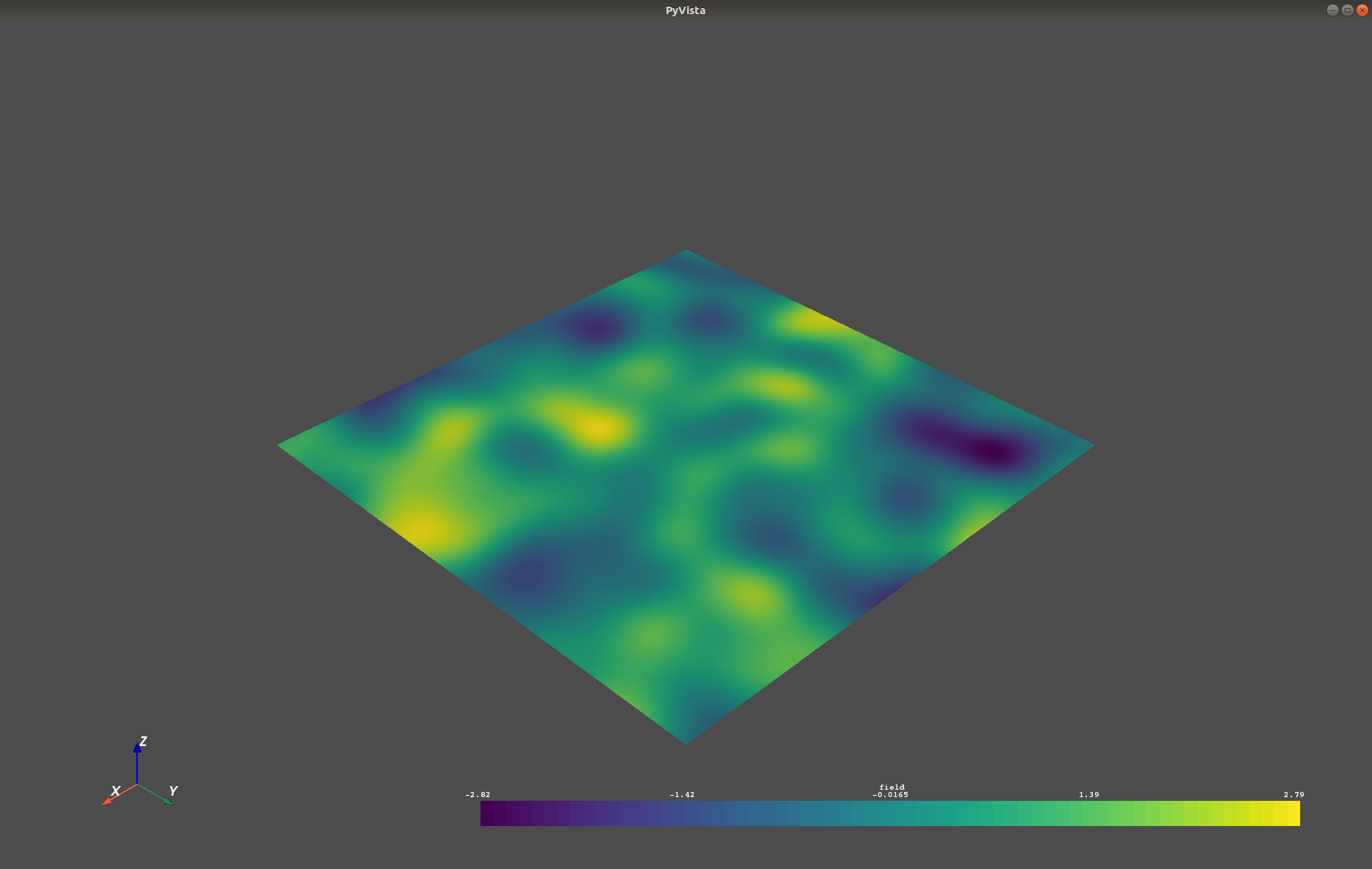
Which gives a RectilinearGrid VTK file field.vtr or creates a PyVista mesh
in memory for immediate 3D plotting in Python.
Requirements:
Optional
Contact
You can contact us via info@geostat-framework.org.
License
LGPLv3 © 2018-2025
Owner
- Name: GeoStat Framework
- Login: GeoStat-Framework
- Kind: organization
- Email: info@geostat-framework.org
- Location: UFZ Leipzig
- Website: https://geostat-framework.org
- Twitter: GSFramework
- Repositories: 7
- Profile: https://github.com/GeoStat-Framework
Python framework for geostatistical simulations
Citation (CITATION.bib)
@Article{gmd-15-3161-2022,
AUTHOR = {M\"uller, S. and Sch\"uler, L. and Zech, A. and He{\ss}e, F.},
TITLE = {\texttt{GSTools} v1.3: a toolbox for geostatistical modelling in Python},
JOURNAL = {Geoscientific Model Development},
VOLUME = {15},
YEAR = {2022},
NUMBER = {7},
PAGES = {3161--3182},
URL = {https://gmd.copernicus.org/articles/15/3161/2022/},
DOI = {10.5194/gmd-15-3161-2022}
}
GitHub Events
Total
- Create event: 12
- Release event: 2
- Issues event: 17
- Watch event: 50
- Delete event: 10
- Issue comment event: 39
- Push event: 62
- Pull request event: 18
- Pull request review event: 23
- Pull request review comment event: 22
- Fork event: 5
Last Year
- Create event: 12
- Release event: 2
- Issues event: 17
- Watch event: 50
- Delete event: 10
- Issue comment event: 39
- Push event: 62
- Pull request event: 18
- Pull request review event: 23
- Pull request review comment event: 22
- Fork event: 5
Committers
Last synced: over 2 years ago
Top Committers
| Name | Commits | |
|---|---|---|
| MuellerSeb | m****b@p****e | 1,250 |
| LSchueler | l****r@u****e | 201 |
| LSchueler | m****m@p****e | 164 |
| banesullivan | b****i@g****m | 12 |
| Dominic Jodoin | d****c@t****m | 4 |
| Lennart Schüler | L****r | 4 |
| Ryan Russell | g****t@r****g | 3 |
| Mike Taves | m****s@g****m | 2 |
| Tobias Glaubach | 3****h | 1 |
Committer Domains (Top 20 + Academic)
Issues and Pull Requests
Last synced: 11 months ago
All Time
- Total issues: 74
- Total pull requests: 92
- Average time to close issues: 4 months
- Average time to close pull requests: about 1 month
- Total issue authors: 29
- Total pull request authors: 9
- Average comments per issue: 1.95
- Average comments per pull request: 2.4
- Merged pull requests: 67
- Bot issues: 0
- Bot pull requests: 2
Past Year
- Issues: 10
- Pull requests: 22
- Average time to close issues: 5 days
- Average time to close pull requests: 2 months
- Issue authors: 6
- Pull request authors: 5
- Average comments per issue: 1.1
- Average comments per pull request: 1.68
- Merged pull requests: 8
- Bot issues: 0
- Bot pull requests: 2
Top Authors
Issue Authors
- MuellerSeb (37)
- LSchueler (4)
- MatusGasparik (3)
- mmaelicke (2)
- donhalmina (2)
- flydream0428 (2)
- rkenko (2)
- LanPeng-94 (2)
- rlsandovalp (1)
- Jimmy-KL (1)
- rhugonnet (1)
- jwtxwd (1)
- tkschuler (1)
- peter-pazak (1)
- Michael-P-Crisp (1)
Pull Request Authors
- MuellerSeb (63)
- LSchueler (26)
- dependabot[bot] (2)
- EJRicketts (2)
- mwtoews (2)
- eumiro (1)
- ibkvictor (1)
- joshua-benabou (1)
- ryanrussell (1)
Top Labels
Issue Labels
Pull Request Labels
Packages
- Total packages: 4
-
Total downloads:
- pypi 13,459 last-month
- Total docker downloads: 610
-
Total dependent packages: 9
(may contain duplicates) -
Total dependent repositories: 17
(may contain duplicates) - Total versions: 95
- Total maintainers: 3
pypi.org: gstools
GSTools: A geostatistical toolbox.
- Homepage: https://geostat-framework.org/#gstools
- Documentation: https://gstools.readthedocs.io
- License: GNU Lesser General Public License v3 (LGPLv3)
-
Latest release: 1.7.0
published about 1 year ago
Rankings
Maintainers (3)
proxy.golang.org: github.com/GeoStat-Framework/GSTools
- Documentation: https://pkg.go.dev/github.com/GeoStat-Framework/GSTools#section-documentation
- License: lgpl-3.0
-
Latest release: v1.7.0
published about 1 year ago
Rankings
proxy.golang.org: github.com/geostat-framework/gstools
- Documentation: https://pkg.go.dev/github.com/geostat-framework/gstools#section-documentation
- License: lgpl-3.0
-
Latest release: v1.7.0
published about 1 year ago
Rankings
conda-forge.org: gstools
GeoStatTools provides geostatistical tools for various purposes: - random field generation - simple, ordinary, universal and external drift kriging - conditioned field generation - incompressible random vector field generation - (automatted) variogram estimation and fitting - directional variogram estimation and modelling - data normalization and transformation - many readily provided and even user-defined covariance models - metric spatio-temporal modelling - plotting and exporting routines
- Homepage: https://github.com/GeoStat-Framework/GSTools
- License: LGPL-3.0-or-later
-
Latest release: 1.4.1
published over 3 years ago
Rankings
Dependencies
- actions/checkout v2 composite
- actions/download-artifact v2 composite
- actions/setup-python v2 composite
- actions/upload-artifact v2 composite
- pypa/cibuildwheel v2.11.2 composite
- pypa/gh-action-pypi-publish release/v1 composite