F1Method.jl-d5605bae-6d76-11e9-2fd7-71bcf42edbaa
Last mirrored from https://github.com/briochemc/F1Method.jl.git on 2019-11-18T21:18:04.854-05:00 by @UnofficialJuliaMirrorBot via Travis job 481.12 , triggered by Travis cron job on branch "master"
https://gitlab.com/UnofficialJuliaMirror/F1Method.jl-d5605bae-6d76-11e9-2fd7-71bcf42edbaa
Science Score: 41.0%
This score indicates how likely this project is to be science-related based on various indicators:
-
✓CITATION.cff file
Found CITATION.cff file -
○codemeta.json file
-
○.zenodo.json file
-
✓DOI references
Found 3 DOI reference(s) in README -
✓Academic publication links
Links to: zenodo.org -
○Academic email domains
-
○Institutional organization owner
-
○JOSS paper metadata
-
○Scientific vocabulary similarity
Low similarity (14.9%) to scientific vocabulary
Repository
Last mirrored from https://github.com/briochemc/F1Method.jl.git on 2019-11-18T21:18:04.854-05:00 by @UnofficialJuliaMirrorBot via Travis job 481.12 , triggered by Travis cron job on branch "master"
Basic Info
- Host: gitlab.com
- Owner: UnofficialJuliaMirror
- Default Branch: master
Statistics
- Stars: 0
- Forks: 0
- Open Issues:
- Releases: 0
Metadata Files
README.md
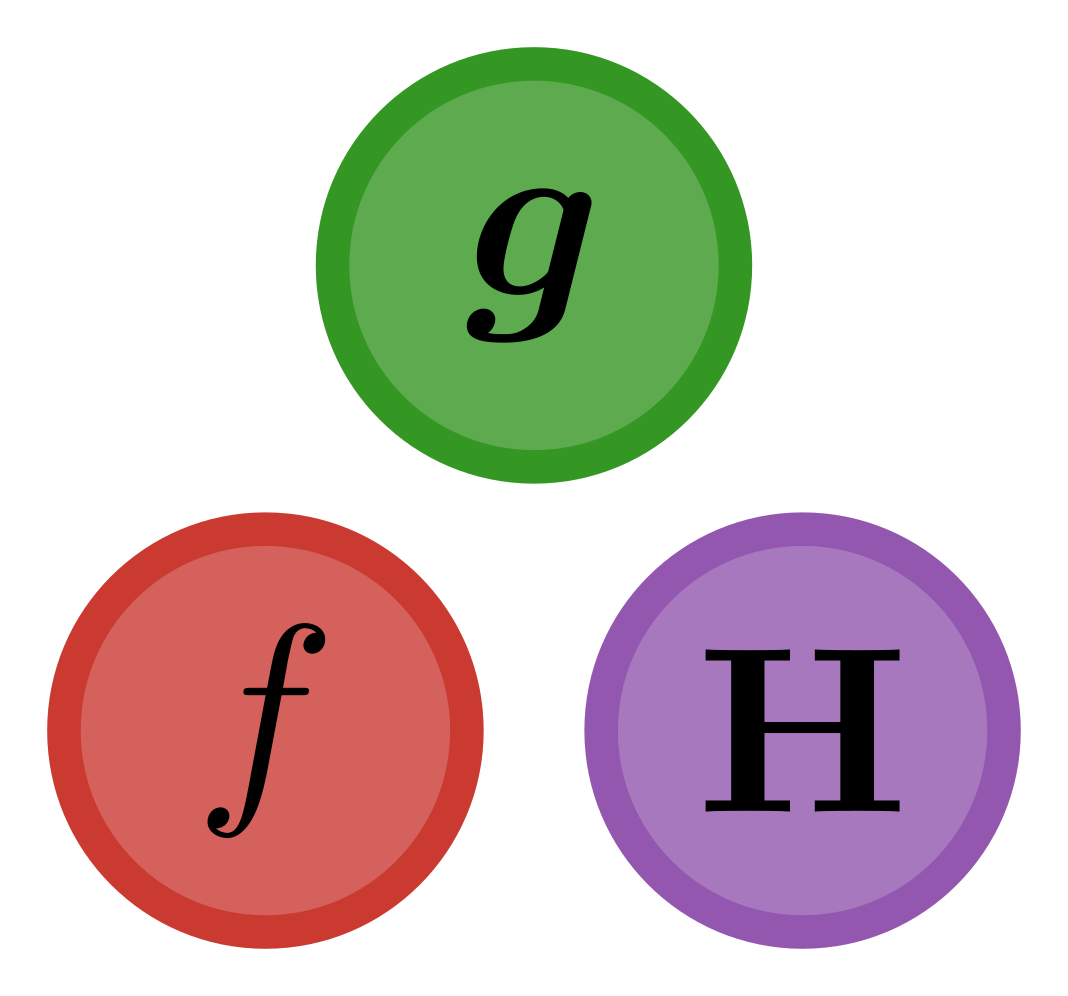
F-1 algorithm


This package implements the F-1 algorithm described in Pasquier and Primeau (in review for publication in the SIAM Journal on Scientific Computing). It allows for efficient quasi-auto-differentiation of an objective function defined implicitly by the solution of a steady-state problem.
Consider a discretized system of nonlinear partial differential equations that takes the form
F(x,p) = 0
where x is a column vector of the model state variables and p is a vector of parameters.
The F-1 algorithm then allows for an efficient computation of both the gradient vector and the Hessian matrix of a generic objective function defined by
objective(p) = f(s(p),p)
where s(p) is the steady-state solution of the system, i.e., such that F(s(p),p) = 0 and where f(x,p) is for example a measure of the mismatch between observed state, parameters, and observations.
Optimizing the model is then simply done by minimizing objective(p).
(See Pasquier and Primeau (in review for publication in the SIAM Journal on Scientific Computing), for more details.)
Advantages of the F-1 algorithm
The F-1 algorithm is easy to use, gives accurate results, and is computationally fast:
- Easy — The F-1 algorithm basically just needs the user to provide a solver (for finding the steady-state), the mismatch function,
f, the state function,F, and their derivatives,∇ₓfand∇ₓFw.r.t. the statex. (Note these derivatives can be computed numerically, via the ForwardDiff package for example.) - Accurate — Thanks to dual and hyperdual numbers, the accuracy of the gradient and Hessian, as computed by the F-1 algorithm, are close to machine precision. (The F-1 algorithm uses the DualNumbers and HyperDualNumbers packages.)
- Fast — The F-1 algorithm is as fast as if you derived analytical formulas for every first and second derivatives and used those in the most efficient way.
This is because the bottleneck of such computations is the number of matrix factorizations, and the F-1 algorithm only requires a single one. In comparison, standard autodifferentiation methods that take the steady-state solver as a black box would require order
morm^2factorizations, wheremis the number of parameters.
What's needed?
A requirement of the F-1 algorithm is that the Jacobian matrix A = ∇ₓf can be created, stored, and factorized.
To use the F-1 algorithm, the user must:
- Make sure that there is a suitable algorithm
algto solve the steady-state equation - overload the
solvefunction and theSteadyStateProblemconstructor from DiffEqBase. (An example is given in the CI tests — see, e.g., thetest/simple_setup.jlfile.) - Provide the derivatives of
fandFwith respect to the state,x.
A concrete example
Make sure you have overloaded solve from DiffEqBase
(an example of how to do this is given in the documentation).
Once initial values for the state, x, and parameters, p, are chosen, simply initialize the required memory cache, mem via
```julia
Initialize the cache for storing reusable objects
mem = F1Method.initialize_mem(x, p) ```
wrap the functions into functions of p only via
```julia
Wrap the objective, gradient, and Hessian functions
objective(p) = F1Method.objective(f, F, ∇ₓF, mem, p, myAlg(); myoptions...) gradient(p) = F1Method.gradient(f, F, ∇ₓf, ∇ₓF, mem, p, myAlg(); myoptions...) hessian(p) = F1Method.hessian(f, F, ∇ₓf, ∇ₓF, mem, p, myAlg(); my_options...) ```
and compute the objective, gradient, or Hessian via either of
```julia objective(p)
gradient(p)
hessian(p) ```
That's it. You were told it was simple, weren't you? Now you can test how fast and accurate it is! (Or trust our published work, Pasquier and Primeau (in review for publication in the SIAM Journal on Scientific Computing).)
Citing the software
If you use this package, or implement your own package based on the F-1 algorithm please cite us. If you use the F-1 algorithm, please cite Pasquier and Primeau (in review for publication in the SIAM Journal on Scientific Computing). If you also use this package directly, please cite us using the CITATION.bib, which contains a bibtex entry for the software.
Citation (CITATION.bib)
@misc{F1Method.jl-2019,
  author       = {Beno\^{i}t Pasquier},
  title        = {{F1Method.jl: A julia package for computing the gradient and Hessian of an objective function defined implicitly by the solution to a steady-state problem}},
  month        = may,
  year         = 2019,
  doi          = {10.5281/zenodo.2667835}
}

@article{Pasquier_et_al_2019,
  author       = {Beno\^{i}t Pasquier and Fran\c{c}ois Primeau and J. Keith Moore},
  title        = {{The F-1 method: An efficient algorithm for computing the
  Hessian matrix for parameter optimization and sensitivity analysis
  in models described by a steady-state system of nonlinear PDEs}},
  year         = {In preparation}
}