DiffEqFlux.jl-aae7a2af-3d4f-5e19-a356-7da93b79d9d0
Last mirrored from https://github.com/JuliaDiffEq/DiffEqFlux.jl.git on 2019-11-18T20:17:59.354-05:00 by @UnofficialJuliaMirrorBot via Travis job 481.9 , triggered by Travis cron job on branch "master"
https://gitlab.com/UnofficialJuliaMirror/DiffEqFlux.jl-aae7a2af-3d4f-5e19-a356-7da93b79d9d0
Science Score: 28.0%
This score indicates how likely this project is to be science-related based on various indicators:
-
✓CITATION.cff file
Found CITATION.cff file -
○codemeta.json file
-
○.zenodo.json file
-
○DOI references
-
✓Academic publication links
Links to: arxiv.org -
○Academic email domains
-
○Institutional organization owner
-
○JOSS paper metadata
-
○Scientific vocabulary similarity
Low similarity (10.7%) to scientific vocabulary
Repository
Last mirrored from https://github.com/JuliaDiffEq/DiffEqFlux.jl.git on 2019-11-18T20:17:59.354-05:00 by @UnofficialJuliaMirrorBot via Travis job 481.9 , triggered by Travis cron job on branch "master"
Basic Info
- Host: gitlab.com
- Owner: UnofficialJuliaMirror
- Default Branch: master
Statistics
- Stars: 0
- Forks: 0
- Open Issues:
- Releases: 0
Metadata Files
README.md
DiffEqFlux.jl


DiffEqFlux.jl fuses the world of differential equations with machine learning by helping users put diffeq solvers into neural networks. This package utilizes DifferentialEquations.jl and Flux.jl as its building blocks to support research in Scientific Machine Learning and neural differential equations in traditional machine learning.
Problem Domain
DiffEqFlux.jl is not just for neural ordinary differential equations. DiffEqFlux.jl is for neural differential equations. As such, it is the first package to support and demonstrate:
- Stiff neural ordinary differential equations (neural ODEs)
- Neural stochastic differential equations (neural SDEs)
- Neural delay differential equations (neural DDEs)
- Neural partial differential equations (neural PDEs)
- Neural jump stochastic differential equations (neural jump diffusions)
- Hybrid neural differential equations (neural DEs with event handling)
with high order, adaptive, implicit, GPU-accelerated, Newton-Krylov, etc. methods. For examples, please refer to the release blog post. Additional demonstrations, like neural PDEs and neural jump SDEs, can be found at this blog post (among many others!).
Do not limit yourself to the current neuralization. With this package, you can explore various ways to integrate the two methodologies:
- Neural networks can be defined where the “activations” are nonlinear functions described by differential equations.
- Neural networks can be defined where some layers are ODE solves
- ODEs can be defined where some terms are neural networks
- Cost functions on ODEs can define neural networks
Citation
If you use DiffEqFlux.jl or are influenced by its ideas for expanding beyond neural ODEs, please cite:
@article{DBLP:journals/corr/abs-1902-02376,
  author    = {Christopher Rackauckas and
               Mike Innes and
               Yingbo Ma and
               Jesse Bettencourt and
               Lyndon White and
               Vaibhav Dixit},
  title     = {DiffEqFlux.jl - {A} Julia Library for Neural Differential Equations},
  journal   = {CoRR},
  volume    = {abs/1902.02376},
  year      = {2019},
  url       = {http://arxiv.org/abs/1902.02376},
  archivePrefix = {arXiv},
  eprint    = {1902.02376},
  timestamp = {Tue, 21 May 2019 18:03:36 +0200},
  biburl    = {https://dblp.org/rec/bib/journals/corr/abs-1902-02376},
  bibsource = {dblp computer science bibliography, https://dblp.org}
}
Example Usage
For an overview of what this package is for, see this blog post.
Optimizing parameters of an ODE
First let's create a Lotka-Volterra ODE using DifferentialEquations.jl. For more details, see the DifferentialEquations.jl documentation
julia
using DifferentialEquations
function lotka_volterra(du,u,p,t)
  x, y = u
  α, β, δ, γ = p
  du[1] = dx = α*x - β*x*y
  du[2] = dy = -δ*y + γ*x*y
end
u0 = [1.0,1.0]
tspan = (0.0,10.0)
p = [1.5,1.0,3.0,1.0]
prob = ODEProblem(lotka_volterra,u0,tspan,p)
sol = solve(prob,Tsit5())
using Plots
plot(sol)
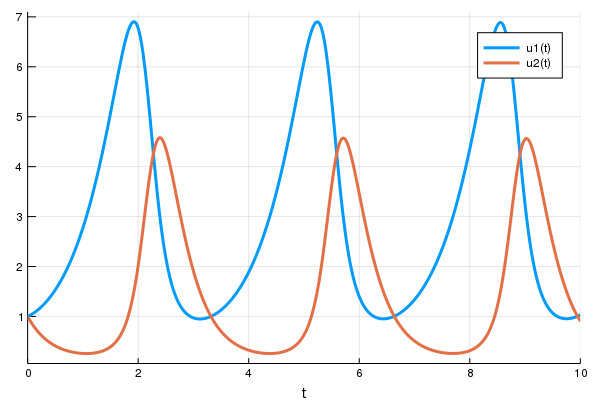
Next we define a single layer neural network that uses the diffeq_adjoint layer
function that takes the parameters and returns the solution of the x(t)
variable. Note that the diffeq_adjoint is usually preferred for ODEs, but does not
extend to other differential equation types (see the performance discussion section for
details). Instead of being a function of the parameters, we will wrap our
parameters in param to be tracked by Flux:
```julia using Flux, DiffEqFlux p = param([2.2, 1.0, 2.0, 0.4]) # Initial Parameter Vector params = Flux.Params([p])
function predictadjoint() # Our 1-layer neural network diffeqadjoint(p,prob,Tsit5(),saveat=0.0:0.1:10.0) end ```
Next we choose a loss function. Our goal will be to find parameter that make
the Lotka-Volterra solution constant x(t)=1, so we defined our loss as the
squared distance from 1:
julia
loss_adjoint() = sum(abs2,x-1 for x in predict_adjoint())
Lastly, we train the neural network using Flux to arrive at parameters which optimize for our goal:
``julia
data = Iterators.repeated((), 100)
opt = ADAM(0.1)
cb = function () #callback function to observe training
display(loss_adjoint())
# usingremaketo re-create ourprobwith current parametersp`
display(plot(solve(remake(prob,p=Flux.data(p)),Tsit5(),saveat=0.0:0.1:10.0),ylim=(0,6)))
end
Display the ODE with the initial parameter values.
cb()
Flux.train!(loss_adjoint, params, data, opt, cb = cb) ```
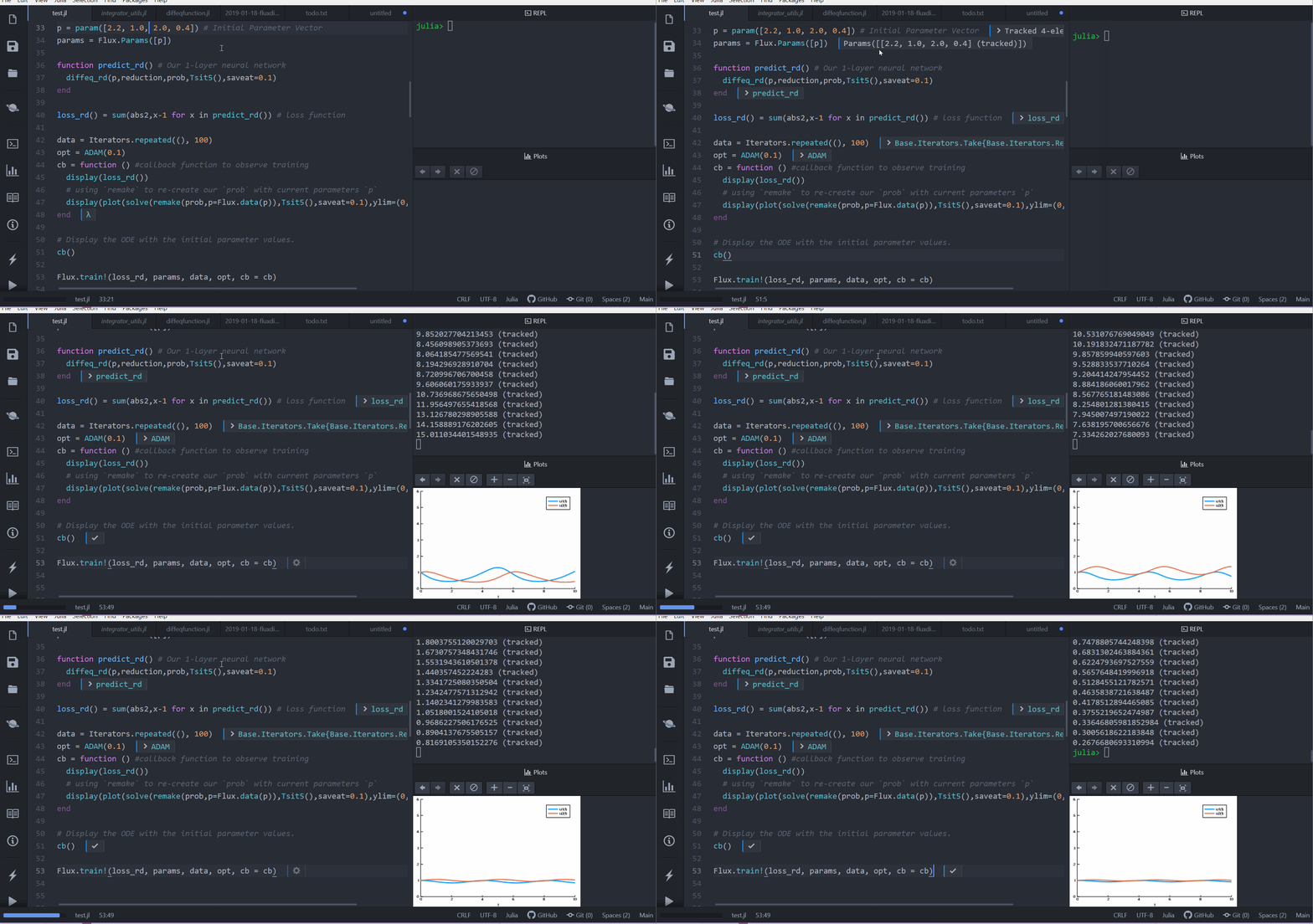
Note that by using anonymous functions, this diffeq_adjoint can be used as a
layer in a neural network Chain, for example like
julia
m = Chain(
  Conv((2,2), 1=>16, relu),
  x -> maxpool(x, (2,2)),
  Conv((2,2), 16=>8, relu),
  x -> maxpool(x, (2,2)),
  x -> reshape(x, :, size(x, 4)),
  # takes in the ODE parameters from the previous layer
  p -> diffeq_adjoint(p,prob,Tsit5(),saveat=0.1),
  Dense(288, 10), softmax) |> gpu
or
julia
m = Chain(
  Dense(28^2, 32, relu),
  # takes in the initial condition from the previous layer
  x -> diffeq_rd(p,prob,Tsit5(),saveat=0.1,u0=x)),
  Dense(32, 10),
  softmax)
Similarly, diffeq_adjoint, a O(1) memory adjoint implementation, can be
replaced with diffeq_rd for reverse-mode automatic differentiation or
diffeq_fd for forward-mode automatic differentiation. diffeq_fd will
be fastest with small numbers of parameters, while diffeq_adjoint will
be the fastest when there are large numbers of parameters (like with a
neural ODE). See the layer API documentation for details.
Using Other Differential Equations
Other differential equation problem types from DifferentialEquations.jl are supported. For example, we can build a layer with a delay differential equation like:
```julia function delaylotkavolterra(du,u,h,p,t) x, y = u α, β, δ, γ = p du[1] = dx = (α - βy)h(p,t-0.1)[1] du[2] = dy = (δx - γ)y end h(p,t) = ones(eltype(p),2) prob = DDEProblem(delaylotkavolterra,[1.0,1.0],h,(0.0,10.0),constant_lags=[0.1])
p = param([2.2, 1.0, 2.0, 0.4]) params = Flux.Params([p]) function predictrddde() Array(diffeqrd(p,prob,MethodOfSteps(Tsit5()),saveat=0.1)) end lossrddde() = sum(abs2,x-1 for x in predictrddde()) lossrd_dde() ```
Notice that we used mutating reverse-mode to handle a small delay differential equation, a strategy that can be good for small equations (see the performance discussion for more details on other forms).
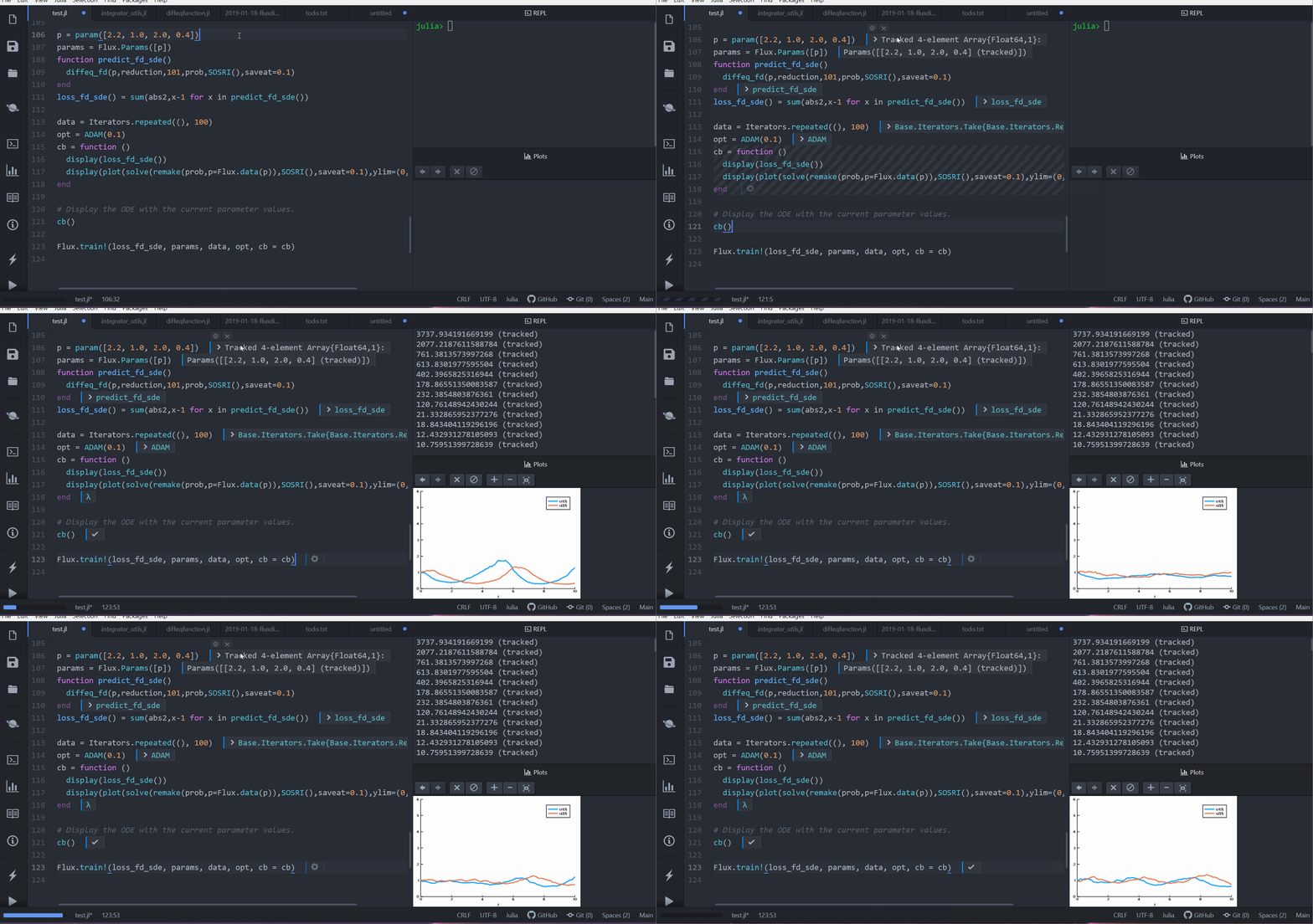
Or we can use a stochastic differential equation. Here we demonstrate
diffeq_fd for forward-mode automatic differentiation of a small differential
equation:
```julia function lotkavolterranoise(du,u,p,t) du[1] = 0.1u[1] du[2] = 0.1u[2] end prob = SDEProblem(lotkavolterra,lotkavolterra_noise,[1.0,1.0],(0.0,10.0))
p = param([2.2, 1.0, 2.0, 0.4]) params = Flux.Params([p]) function predictfdsde() diffeqfd(p,Array,202,prob,SOSRI(),saveat=0.1) end lossfdsde() = sum(abs2,x-1 for x in predictfdsde()) lossfd_sde()
data = Iterators.repeated((), 100) opt = ADAM(0.1) cb = function () display(lossfdsde()) display(plot(solve(remake(prob,p=Flux.data(p)),SOSRI(),saveat=0.1),ylim=(0,6))) end
Display the ODE with the current parameter values.
cb()
Flux.train!(lossfdsde, params, data, opt, cb = cb) ```
Neural Ordinary Differential Equations
We can use DiffEqFlux.jl to define, solve, and train neural ordinary differential
equations. A neural ODE is an ODE where a neural network defines its derivative
function. Thus for example, with the multilayer perceptron neural network
Chain(Dense(2,50,tanh),Dense(50,2)), the best way to define a neural ODE by hand
would be to use non-mutating adjoints, which looks like:
julia
p = DiffEqFlux.destructure(model)
dudt_(u::TrackedArray,p,t) = DiffEqFlux.restructure(model,p)(u)
dudt_(u::AbstractArray,p,t) = Flux.data(DiffEqFlux.restructure(model,p)(u))
prob = ODEProblem(dudt_,x,tspan,p)
my_neural_ode_prob = diffeq_adjoint(p,prob,args...;u0=x,kwargs...)
(DiffEqFlux.restructure and DiffEqFlux.destructure are helper functions
which transform the neural network to use parameters p)
A convenience function which handles all of the details is neural_ode. To
use neural_ode, you give it the initial condition, the internal neural
network model to use, the timespan to solve on, and any ODE solver arguments.
For example, this neural ODE would be defined as:
julia
tspan = (0.0f0,25.0f0)
x -> neural_ode(model,x,tspan,Tsit5(),saveat=0.1)
where here we made it a layer that takes in the initial condition and spits out an array for the time series saved at every 0.1 time steps.
Training a Neural Ordinary Differential Equation
Let's get a time series array from the Lotka-Volterra equation as data:
```julia u0 = Float32[2.; 0.] datasize = 30 tspan = (0.0f0,1.5f0)
function trueODEfunc(du,u,p,t) trueA = [-0.1 2.0; -2.0 -0.1] du .= ((u.^3)'trueA)' end t = range(tspan[1],tspan[2],length=datasize) prob = ODEProblem(trueODEfunc,u0,tspan) ode_data = Array(solve(prob,Tsit5(),saveat=t)) ```
Now let's define a neural network with a neural_ode layer. First we define
the layer:
julia
dudt = Chain(x -> x.^3,
             Dense(2,50,tanh),
             Dense(50,2))
n_ode(x) = neural_ode(dudt,x,tspan,Tsit5(),saveat=t,reltol=1e-7,abstol=1e-9)
Here we used the x -> x.^3 assumption in the model. By incorporating structure
into our equations, we can reduce the required size and training time for the
neural network, but a good guess needs to be known!
From here we build a loss function around it. We will use the L2 loss of the network's output against the time series data:
julia
function predict_n_ode()
  n_ode(u0)
end
loss_n_ode() = sum(abs2,ode_data .- predict_n_ode())
and then train the neural network to learn the ODE:
```julia data = Iterators.repeated((), 1000) opt = ADAM(0.1) cb = function () #callback function to observe training display(lossnode()) # plot current prediction against data curpred = Flux.data(predictnode()) pl = scatter(t,odedata[1,:],label="data") scatter!(pl,t,cur_pred[1,:],label="prediction") display(plot(pl)) end
Display the ODE with the initial parameter values.
cb()
ps = Flux.params(dudt) Flux.train!(lossnode, ps, data, opt, cb = cb) ```
Use with GPUs
Note that the differential equation solvers will run on the GPU if the initial condition is a GPU array. Thus for example, we can define a neural ODE by hand that runs on the GPU:
```julia u0 = Float32[2.; 0.] |> gpu dudt = Chain(Dense(2,50,tanh),Dense(50,2)) |> gpu
p = DiffEqFlux.destructure(model) dudt(u::TrackedArray,p,t) = DiffEqFlux.restructure(model,p)(u) dudt(u::AbstractArray,p,t) = Flux.data(DiffEqFlux.restructure(model,p)(u)) prob = ODEProblem(ODEfunc, u0,tspan)
Runs on a GPU
sol = solve(prob,Tsit5(),saveat=0.1) ```
and the diffeq layer functions can be used similarly. Or we can directly use
the neural ODE layer function, like:
julia
x -> neural_ode(gpu(dudt),gpu(x),tspan,Tsit5(),saveat=0.1)
Mixed Neural DEs
You can also mix a known differential equation and a neural differential equation, so that the parameters and the neural network are estimated simultaniously. Here's an example of doing this with both reverse-mode autodifferentiation and with adjoints:
```julia using DiffEqFlux, Flux, OrdinaryDiffEq
--- Reverse-mode AD ---
tspan = (0.0f0,25.0f0) u0 = Tracker.param(Float32[0.8; 0.8])
ann = Chain(Dense(2,10,tanh), Dense(10,1)) p = param(Float32[-2.0,1.1])
function dudt(u::TrackedArray,p,t) x, y = u Flux.Tracker.collect( [ann(u)[1], p[1]y + p[2]x*y]) end function dudt(u::AbstractArray,p,t) x, y = u [Flux.data(ann(u)[1]), p[1]y + p[2]x*y] end
prob = ODEProblem(dudt,u0,tspan,p) diffeqrd(p,prob,Tsit5())
function predictrd() Flux.Tracker.collect(diffeqrd(p,prob,Tsit5(),u0=u0)) end lossrd() = sum(abs2,x-1 for x in predictrd()) loss_rd()
data = Iterators.repeated((), 10) opt = ADAM(0.1) cb = function () display(loss_rd()) #display(plot(solve(remake(prob,u0=Flux.data(u0),p=Flux.data(p)),Tsit5(),saveat=0.1),ylim=(0,6))) end
Display the ODE with the current parameter values.
cb()
Flux.train!(loss_rd, params(ann,p,u0), data, opt, cb = cb)
--- Partial Neural Adjoint ---
u0 = param(Float32[0.8; 0.8]) tspan = (0.0f0,25.0f0)
ann = Chain(Dense(2,10,tanh), Dense(10,1))
p1 = Flux.data(DiffEqFlux.destructure(ann)) p2 = Float32[-2.0,1.1] p3 = param([p1;p2]) ps = Flux.params(p3,u0)
function dudt(du,u,p,t) x, y = u du[1] = DiffEqFlux.restructure(ann,p[1:41])(u)[1] du[2] = p[end-1]y + p[end]x end prob = ODEProblem(dudt,u0,tspan,p3) diffeq_adjoint(p3,prob,Tsit5(),u0=u0,abstol=1e-8,reltol=1e-6)
function predictadjoint() diffeqadjoint(p3,prob,Tsit5(),u0=u0,saveat=0.0:0.1:25.0) end lossadjoint() = sum(abs2,x-1 for x in predictadjoint()) loss_adjoint()
data = Iterators.repeated((), 10) opt = ADAM(0.1) cb = function () display(loss_adjoint()) #display(plot(solve(remake(prob,p=Flux.data(p3),u0=Flux.data(u0)),Tsit5(),saveat=0.1),ylim=(0,6))) end
Display the ODE with the current parameter values.
cb()
Flux.train!(loss_adjoint, ps, data, opt, cb = cb) ```
Neural Differential Equations for Non-ODEs: Neural SDEs, Neural DDEs, etc.
With neural stochastic differential equations, there is once again a helper form neural_dmsde which can
be used for the multiplicative noise case (consult the layers API documentation, or
this full example using the layer function).
However, since there are far too many possible combinations for the API to support, in many cases you will want to
performantly define neural differential equations for non-ODE systems from scratch. For these systems, it is generally
best to use diffeq_rd with non-mutating (out-of-place) forms. For example, the following defines a neural SDE with
neural networks for both the drift and diffusion terms:
julia
dudt_(u,p,t) = model(u)
g(u,p,t) = model2(u)
prob = SDEProblem(dudt_,g,param(x),tspan,nothing)
where model and model2 are different neural networks. The same can apply to a neural delay differential equation.
Its out-of-place formulation is f(u,h,p,t). Thus for example, if we want to define a neural delay differential equation
which uses the history value at p.tau in the past, we can define:
julia
dudt_(u,h,p,t) = model([u;h(t-p.tau)])
prob = DDEProblem(dudt_,u0,h,tspan,nothing)
Neural SDE Example
First let's build training data from the same example as the neural ODE:
```julia using Flux, DiffEqFlux, StochasticDiffEq, Plots, DiffEqBase.EnsembleAnalysis
u0 = Float32[2.; 0.] datasize = 30 tspan = (0.0f0,1.0f0)
function trueODEfunc(du,u,p,t) trueA = [-0.1 2.0; -2.0 -0.1] du .= ((u.^3)'trueA)' end t = range(tspan[1],tspan[2],length=datasize) mp = Float32[0.2,0.2] function truenoisefunc(du,u,p,t) du .= mp.*u end prob = SDEProblem(trueODEfunc,truenoisefunc,u0,tspan) ```
For our dataset we will use DifferentialEquations.jl's parallel ensemble interface to generate data from the average of 100 runs of the SDE:
```julia
Take a typical sample from the mean
ensembleprob = EnsembleProblem(prob) ensemblesol = solve(ensembleprob,SOSRI(),trajectories = 100) ensemblesum = EnsembleSummary(ensemblesol) sdedata = Array(timeseriespointmean(ensemble_sol,t)) ```
Now we build a neural SDE. For simplicity we will use the neural_dmsde
multiplicative noise neural SDE layer function:
julia
dudt = Chain(x -> x.^3,
             Dense(2,50,tanh),
             Dense(50,2))
ps = Flux.params(dudt)
n_sde = x->neural_dmsde(dudt,x,mp,tspan,SOSRI(),saveat=t,reltol=1e-1,abstol=1e-1)
Let's see what that looks like:
```julia pred = n_sde(u0) # Get the prediction using the correct initial condition
dudt(u,p,t) = Flux.data(dudt(u)) g(u,p,t) = mp.*u nprob = SDEProblem(dudt,g,u0,(0.0f0,1.2f0),nothing)
ensemblenprob = EnsembleProblem(nprob) ensemblensol = solve(ensemblenprob,SOSRI(),trajectories = 100) ensemblensum = EnsembleSummary(ensemblensol) p1 = plot(ensemblensum, title = "Neural SDE: Before Training") scatter!(p1,t,sde_data',lw=3)
scatter(t,sde_data[1,:],label="data") scatter!(t,Flux.data(pred[1,:]),label="prediction") ```
Now just as with the neural ODE we define a loss function:
```julia function predictnsde() nsde(u0) end lossnsde1() = sum(abs2,sdedata .- predictnsde()) lossnsde10() = sum([sum(abs2,sdedata .- predictnsde()) for i in 1:10]) Flux.back!(lossn_sde1())
data = Iterators.repeated((), 10) opt = ADAM(0.025) cb = function () #callback function to observe training sample = predictnsde() # loss against current data display(sum(abs2,sdedata .- sample)) # plot current prediction against data curpred = Flux.data(sample) pl = scatter(t,sdedata[1,:],label="data") scatter!(pl,t,curpred[1,:],label="prediction") display(plot(pl)) end
Display the SDE with the initial parameter values.
cb() ```
Here we made two loss functions: one which uses single runs of the SDE and another which uses multiple runs. This is beceause an SDE is stochastic, so trying to fit the mean to high precision may require a taking the mean of a few trajectories (the more trajectories the more precise the calculation is). Thus to fit this, we first get in the general area through single SDE trajectory backprops, and then hone in with the mean:
julia
Flux.train!(loss_n_sde1 , ps, Iterators.repeated((), 100), opt, cb = cb)
Flux.train!(loss_n_sde10, ps, Iterators.repeated((), 20), opt, cb = cb)
And now we plot the solution to an ensemble of the trained neural SDE:
```julia dudt(u,p,t) = Flux.data(dudt(u)) g(u,p,t) = mp.*u nprob = SDEProblem(dudt,g,u0,(0.0f0,1.2f0),nothing)
ensemblenprob = EnsembleProblem(nprob) ensemblensol = solve(ensemblenprob,SOSRI(),trajectories = 100) ensemblensum = EnsembleSummary(ensemblensol) p2 = plot(ensemblensum, title = "Neural SDE: After Training", xlabel="Time") scatter!(p2,t,sde_data',lw=3,label=["x" "y" "z" "y"])
plot(p1,p2,layout=(2,1)) ```

(note: for simplicity we have used a constant mp vector, though once can param and
train this value as well.)
Try this with GPUs as well!
Neural Jump Diffusions (Neural Jump SDE) and Neural Partial Differential Equations (Neural PDEs)
For the sake of not having a never-ending documentation of every single combination of CPU/GPU with every layer and every neural differential equation, we will end here. But you may want to consult this blog post which showcases defining neural jump diffusions and neural partial differential equations.
A Note About Performance
DiffEqFlux.jl implements all interactions of automatic differentiation systems to satisfy completeness, but that does not mean that every combination is a good combination.
Performance tl;dr
- Use
diffeq_adjointwith an out-of-place non-mutating functionf(u,p,t)on ODEs without events. - Use
diffeq_rdwith an out-of-place non-mutating function (f(u,p,t)on ODEs/SDEs,f(du,u,p,t)for DAEs,f(u,h,p,t)for DDEs, and consult the docs for other equations) for non-ODE neural differential equations or ODEs with events - If the neural network is a sufficiently small (or non-existant) part of the differential equation, consider
diffeq_fdwith the mutating form (f(du,u,p,t)). - Always use GPUs if the majority of the time is in larger kernels (matrix multiplication, PDE convolutions, etc.)
Extended Performance Discussion
The major options to keep in mind are:
- in-place vs out-of-place: for ODEs this amounts to
f(du,u,p,t)mutatingduvsdu = f(u,p,t). In almost all scientific computing scenarios with floating point numbers,f(du,u,p,t)is highly preferred. This extends to dual numbers and thus forward difference (diffeq_fd). However, reverse-mode automatic differentiation as implemented by Flux.jl's Tracker.jl does not allow for mutation on itsTrackedArraytype, meaning that mutation is supported byArray{TrackedReal}. This fallback is exceedingly slow due to the large trace that is created, and thus out-of-place (f(u,p,t)for ODEs) is preferred in this case. - For adjoints, this fact is complicated due to the choices in the
SensitivityAlg. See the adjoint SensitivityAlg options for more details. Whenautojacvec=true, a backpropogation is performed by Tracker in the intermediate steps, meaning the rule about mutation applies. However, the majority of the computation is not htev^T*Jcomputation of the backpropogation, so it is not always obvious to determine the best option given that mutation is slow for backprop but is much faster for large ODEs with many scalar operations. But the latter portion of that statement is the determiner: if there are sufficiently large operations which are dominating the runtime, then the backpropogation can be made trivial by using mutation, and thusf(u,p,t)is more efficient. One example which falls into this case is the neural ODE which has large matrix multiply operations. However, if the neural network is a small portion of the equation and there is heavy reliance on directly specified nonlinear forms in the differential equation,f(du,u,p,t)with the optionsense=SensitivityAlg(autojacvec=false)may be preferred. diffeq_adjointcurrently only applies to ODEs, though continued development will handle other equations in the future.diffeq_adjointhas O(1) memory with the defaultbacksolve. However, it is known that this is unstable on many equations with high enough stiffness (this is a fundamental fact of the numerics, see the blog post for details and an example. Likewise, this instability is not often seen when training a neural ODE against real data. Thus it is recommended to try with the default options first, and then setbacksolve=falseif unstable gradients are found. Whenbacksolve=falseis set, this will trigger theSensitivityAlgto use checkpointed adjoints, which are more stable but take more computation.- When the equation has small enough parameters, or they are not confined to large operations,
diffeq_fdwill be the fastest. However, as it is well-known, forward-mode AD does not scale well for calculating the gradient with respect to large numbers of parameters, and thus it will not scale well in cases like the neural ODE.
API Documentation
DiffEq Layer Functions
diffeq_rd(p,prob, args...;u0 = prob.u0, kwargs...)uses Flux.jl's reverse-mode AD through the differential equation solver with parameterspand initial conditionu0. The rest of the arguments are passed to the differential equation solver. The return is the DESolution. Note: if you use this function, it is much better to use the allocating out of place form (f(u,p,t)for ODEs) than the in place form (f(du,u,p,t)for ODEs)!diffeq_fd(p,reduction,n,prob,args...;u0 = prob.u0, kwargs...)uses ForwardDiff.jl's forward-mode AD through the differential equation solver with parameterspand initial conditionu0.nis the output size where the return value isreduction(sol). The rest of the arguments are passed to the differential equation solver.diffeq_adjoint(p,prob,args...;u0 = prob.u0, kwargs...)uses adjoint sensitivity analysis to "backprop the ODE solver" via DiffEqSensitivity.jl. The return is the time series of the solution as an array solved with parameterspand initial conditionu0. The rest of the arguments are passed to the differential equation solver or handled by the adjoint sensitivity algorithm (for more details on sensitivity arguments, see the diffeq documentation).
Neural DE Layer Functions
neural_ode(model,x,tspan,args...;kwargs...)defines a neural ODE layer wheremodelis a Flux.jl model,xis the initial condition,tspanis the time span to integrate, and the rest of the arguments are passed to the ODE solver. The parameters should be implicit in themodel.neural_dmsde(model,x,mp,tspan,args...;kwargs)defines a neural multiplicative SDE layer wheremodelis a Flux.jl model,xis the initial condition,tspanis the time span to integrate, and the rest of the arguments are passed to the SDE solver. The noise is assumed to be diagonal multiplicative, i.e. the Wiener term ismp.*u.*dWfor some array of noise constantsmp.
Citation (CITATION.bib)
@article{DBLP:journals/corr/abs-1902-02376,
  author    = {Christopher Rackauckas and
               Mike Innes and
               Yingbo Ma and
               Jesse Bettencourt and
               Lyndon White and
               Vaibhav Dixit},
  title     = {DiffEqFlux.jl - {A} Julia Library for Neural Differential Equations},
  journal   = {CoRR},
  volume    = {abs/1902.02376},
  year      = {2019},
  url       = {http://arxiv.org/abs/1902.02376},
  archivePrefix = {arXiv},
  eprint    = {1902.02376},
  timestamp = {Tue, 21 May 2019 18:03:36 +0200},
  biburl    = {https://dblp.org/rec/bib/journals/corr/abs-1902-02376},
  bibsource = {dblp computer science bibliography, https://dblp.org}
}

@article{DifferentialEquations.jl-2017,
 author = {Rackauckas, Christopher and Nie, Qing},
 doi = {10.5334/jors.151},
 journal = {The Journal of Open Source Software},
 keywords = {Applied Mathematics},
 note = {Exported from https://app.dimensions.ai on 2019/05/05},
 number = {1},
 pages = {},
 title = {DifferentialEquations.jl – A Performant and Feature-Rich Ecosystem for Solving Differential Equations in Julia},
 url = {https://app.dimensions.ai/details/publication/pub.1085583166 and http://openresearchsoftware.metajnl.com/articles/10.5334/jors.151/galley/245/download/},
 volume = {5},
 year = {2017}
}

@article{Flux.jl-2018,
  author    = {Michael Innes and
               Elliot Saba and
               Keno Fischer and
               Dhairya Gandhi and
               Marco Concetto Rudilosso and
               Neethu Mariya Joy and
               Tejan Karmali and
               Avik Pal and
               Viral Shah},
  title     = {Fashionable Modelling with Flux},
  journal   = {CoRR},
  volume    = {abs/1811.01457},
  year      = {2018},
  url       = {http://arxiv.org/abs/1811.01457},
  archivePrefix = {arXiv},
  eprint    = {1811.01457},
  timestamp = {Thu, 22 Nov 2018 17:58:30 +0100},
  biburl    = {https://dblp.org/rec/bib/journals/corr/abs-1811-01457},
  bibsource = {dblp computer science bibliography, https://dblp.org}
}

@article{innes:2018,
  author    = {Mike Innes},
  title     = {Flux: Elegant Machine Learning with Julia},
  journal   = {Journal of Open Source Software},
  year      = {2018},
  doi       = {10.21105/joss.00602},
}