verdd
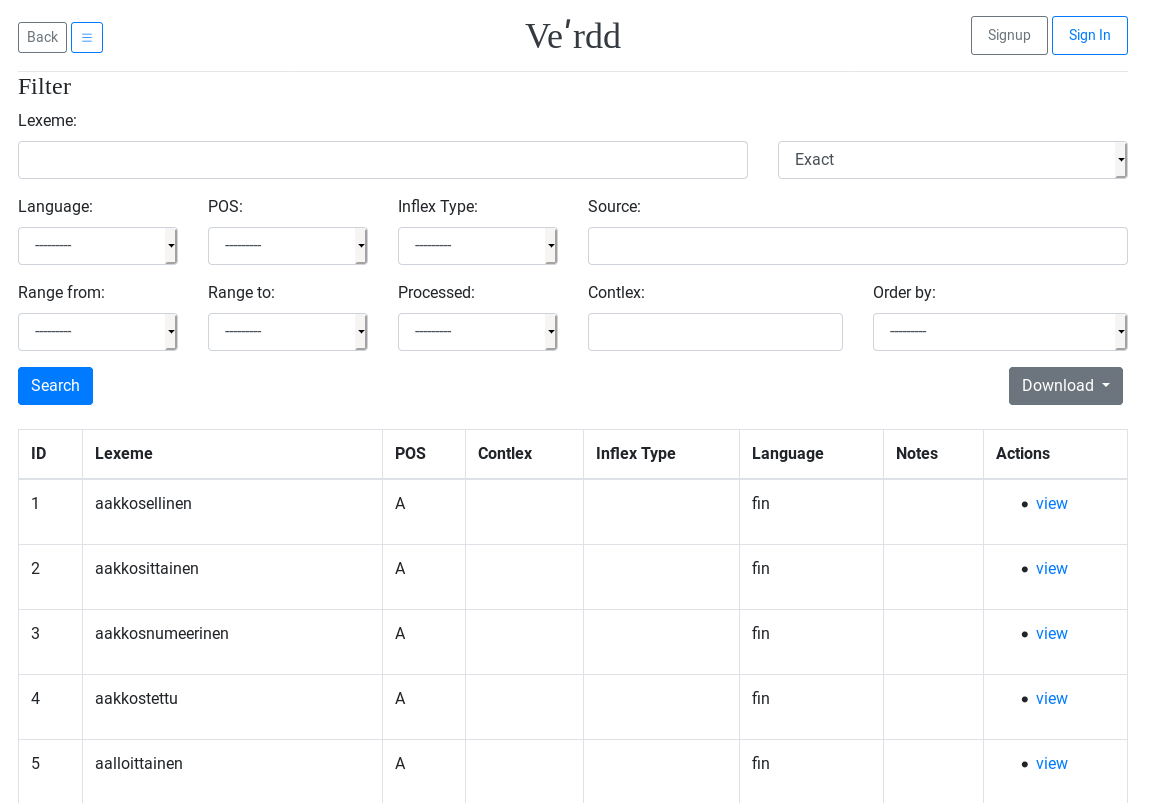
Veʹrdd is an open-source dictionary editing framework with the focus on low-resourced and endangered languages. The framework is mainly built to facilitate collecting, importing, editing and exporting dictionaries while allowing the involvement of the native speakers to contribute easily to the preservation of the language and construction of the dictionary.
Science Score: 54.0%
This score indicates how likely this project is to be science-related based on various indicators:
-
✓CITATION.cff file
Found CITATION.cff file -
✓codemeta.json file
Found codemeta.json file -
✓.zenodo.json file
Found .zenodo.json file -
○DOI references
-
✓Academic publication links
Links to: researchgate.net -
○Academic email domains
-
○Institutional organization owner
-
○JOSS paper metadata
-
○Scientific vocabulary similarity
Low similarity (8.2%) to scientific vocabulary
Keywords
Repository
Veʹrdd is an open-source dictionary editing framework with the focus on low-resourced and endangered languages. The framework is mainly built to facilitate collecting, importing, editing and exporting dictionaries while allowing the involvement of the native speakers to contribute easily to the preservation of the language and construction of the dictionary.
Basic Info
- Host: GitHub
- Owner: mokha
- License: apache-2.0
- Language: Python
- Default Branch: master
- Homepage: https://akusanat.com/verdd/
- Size: 1.3 MB
Statistics
- Stars: 6
- Watchers: 3
- Forks: 1
- Open Issues: 0
- Releases: 0
Topics
Metadata Files
README.md
Veʹrdd
Veʹrdd is an open-source dictionary editing framework with the focus on low-resourced and endangered languages. The framework is mainly built to facilitate collecting, importing, editing and exporting dictionaries while allowing the involvement of the native speakers to contribute easily to the preservation of the language and construction of the dictionary.
The framework is built in Django and has a web-interface along with a list of terminal commands such as exporting the information to Giella and Apertium XMLs, and LaTeX.
Features
Veʹrdd is rich in features, the main ones are: - Ability to visually add, edit, annotate, approve and delete dictionary entries such as lexemes, stems, relations (e.g. translations) and mini-paradigms. - Use of transducers and UralicNLP to automatically generate mini-paradigms. - Search and filter lexemes and relations. - Bulk approve lexemes and relations. - Logging all actions and reverting back to previous instances in case of an error. - Link lexemes to external sources for further information. - Automatically import dictionary entries from Giella's and Apertium's XML, LEXC and CSV files. - Automatically export stored information in Veʹrdd in Giella's and Apertium's XML, LEXC and CSV formats. - Automatically export a printable dictionary (in LaTeX).
For further information (e.g. installation, usages and localization), visit the wiki.
Contributors
Publications
- Alnajjar, K., Hämäläinen, M., Rueter, J., & Partanen, N. (2020). Ve’rdd. Narrowing the Gap between Paper Dictionaries, Low-Resource NLP and Community Involvement. In M. Ptaszynski, & B. Ziolko (Eds.), Proceedings of the 28th International Conference on Computational Linguistics: System Demonstrations International Committee on Computational Linguistics.
- Alnajjar, K., Hämäläinen, M., & Rueter, J. (2020). On Editing Dictionaries for Uralic Languages in an Online Environment. In Proceedings of the Sixth International Workshop on Computational Linguistics of Uralic Languages (pp. 26–30). Stroudsburg, PA: The Association for Computational Linguistics.
- Alnajjar, K., Hämäläinen, M., Partanen, N., & Rueter, J. (2019). The Open Dictionary Infrastructure for Uralic Languages. In Электронная Письменность Народов Российской Федерации: Опыт, Проблемы И Перспективы (pp. 49-51). Ufa: Башкирская энциклопедия.
Owner
- Name: Khalid Alnajjar
- Login: mokha
- Kind: user
- Location: Finland, Helsinki
- Website: https://www.khalidalnajjar.com
- Repositories: 4
- Profile: https://github.com/mokha
Citation (CITATION.cff)
# This CITATION.cff file was generated with cffinit.
# Visit https://bit.ly/cffinit to generate yours today!

cff-version: 1.2.0
title: Ve'rdd
message: >-
  If you use this software, please cite it using the
  metadata from this file.
type: software
authors:
  - given-names: Khalid
    family-names: Alnajjar
  - given-names: Mika
    family-names: Hämäläinen
  - given-names: Jack
    family-names: Rueter
  - given-names: Niko
    family-names: Partanen
repository-code: 'https://github.com/mokha/verdd'
date-released: '2020-10-16'
preferred-citation:
  type: article
  authors:
  - family-names: "Alnajjar"
    given-names: "Khalid"
  - family-names: "Hämäläinen"
    given-names: "Mika"
  - family-names: "Rueter"
    given-names: "Jack"
  - family-names: "Partanen"
    given-names: "Niko"
  journal: "Proceedings of the 28th International Conference on Computational Linguistics: System Demonstrations"
  title: "Ve'rdd. Narrowing the Gap between Paper Dictionaries, Low-Resource NLP and Community Involvement."
  year: 2020
GitHub Events
Total
- Issues event: 1
- Watch event: 1
- Delete event: 2
- Push event: 4
- Pull request event: 1
- Create event: 2
Last Year
- Issues event: 1
- Watch event: 1
- Delete event: 2
- Push event: 4
- Pull request event: 1
- Create event: 2
Dependencies
- Django ==2.2.1
- django-allauth ==0.39.1
- django_crispy_forms ==1.9.2
- django_debug_toolbar ==1.11
- django_filter ==2.1.0
- django_simple_history ==2.7.2
- django_widget_tweaks ==1.4.3
- djangorestframework ==3.11.1
- hfst ==3.15.0.0b0
- lxml ==4.3.3
- mikatools ==0.0.6
- python-decouple ==3.3
- requests ==2.22.0
- tqdm ==4.36.1
- uralicNLP ==1.2.2
- xmlschema ==1.2.2