blocks
A Juptyer notebook on visualizing classification structure of large-scale classifiers
Science Score: 28.0%
This score indicates how likely this project is to be science-related based on various indicators:
-
✓CITATION.cff file
Found CITATION.cff file -
○codemeta.json file
-
○.zenodo.json file
-
○DOI references
-
✓Academic publication links
Links to: arxiv.org -
○Academic email domains
-
○Institutional organization owner
-
○JOSS paper metadata
-
○Scientific vocabulary similarity
Low similarity (8.5%) to scientific vocabulary
Repository
A Juptyer notebook on visualizing classification structure of large-scale classifiers
Basic Info
- Host: GitHub
- Owner: bilalsal
- License: bsd-2-clause
- Language: Jupyter Notebook
- Default Branch: master
- Size: 7.34 MB
Statistics
- Stars: 5
- Watchers: 1
- Forks: 1
- Open Issues: 0
- Releases: 0
Metadata Files
README.md
Visualizing Classification Structure of Large-scale Classifiers
This project aims to visualize class similarities in large-scale classifiers such as deep neural networks. These similarities usually define a hierarchical structure over the classes. Understanding this structure helps explain the classifier's behaviour and its errors because it largely influences the features the classifier learns.
Example Notebook
Explore the classification structure in MIT Places365, classified using ResNet-18 as implemented in PyTorch.
View Jupyter Notebook
3-min Talk
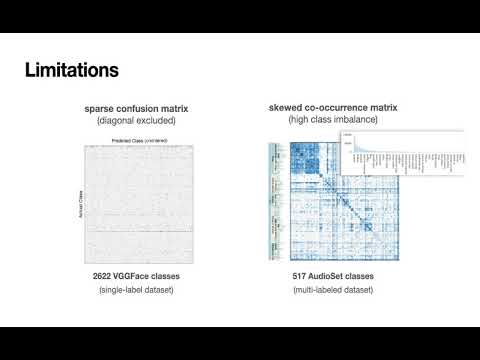
Example of Classification Structure
Below are class similarity matrices computed for two large-scale classifiers.
AudioSet Class Similarity Matrix
Each row / column is one of 527 classes (audio events) from Google's AudioSet. The dataset is multi-labeled with high class imbalance. The major similarity groups exposed by visualizing the matrix are music, inside, organism, and outside. This suggests that the CNN develops shared features that characterize each of these groups.

VGGFace Class Similarity Matrix
Each row / column is one of 2622 classes (celebrities) from Oxford's VGGFace Dataset. Male vs. female celebrities define the major two blocks in the matrix. Prominent subgroups in these blocks are based on wrinkles and hair / skin color. Chromaticity defines two of these sub-groups (split marked in red), and indicates that the CNN uses unreliable features to recognize the corresponding celebrities.

Article and BibTex
Here is an article describing how we compute class similarity and how we visualize the class similarity matrix, with examples on five datasets. The article is accepted to the WHI Workshop @ICML 2020.
Here is a poster summarizing the work, presented at the XC Workshop @ICML 2020.
You can cite the article as follows:
@inproceedings{whi2020visualizing,
  title={Visualizing Classification Structure of Large-Scale Classifiers},
  author={Bilal Alsallakh and Zhixin Yan and Shabnam Ghaffarzadegan and Zeng Dai and Ren, Liu},
  booktitle={ICML Workshop on Human Interpretability in Machine Learning (WHI)},
  year={2020},
}
Thank You
If you have any suggestions or feedback, we will be happy to hear from you!
Owner
- Name: Bilal Alsallakh
- Login: bilalsal
- Kind: user
- Company: Vienna University of Technology
- Repositories: 19
- Profile: https://github.com/bilalsal
Citation (citation.txt)
@inproceedings{alsallakh2018Understanding,
  title={Visualizing Classification Structure of Large-Scale Classifiers Bilal Alsallakh},
  author={Bilal Alsallakh and Zhixin Yan and Shabnam Ghaffarzadegan and Zeng Dai and Ren, Liu},
  booktitle={ICML Workshop on Human Interpretability in Machine Learning (WHI)},
  year={2020},
}