fenics.jl-186dfeec-b415-5c13-8e76-5fbf19f56f9b
Last mirrored from https://github.com/JuliaDiffEq/FEniCS.jl.git on 2019-11-18T21:19:59.931-05:00 by @UnofficialJuliaMirrorBot via Travis job 481.12 , triggered by Travis cron job on branch "master"
https://github.com/unofficialjuliamirror/fenics.jl-186dfeec-b415-5c13-8e76-5fbf19f56f9b
Science Score: 18.0%
This score indicates how likely this project is to be science-related based on various indicators:
-
✓CITATION.cff file
Found CITATION.cff file -
○codemeta.json file
-
○.zenodo.json file
-
○DOI references
-
○Academic publication links
-
○Academic email domains
-
○Institutional organization owner
-
○JOSS paper metadata
-
○Scientific vocabulary similarity
Low similarity (15.6%) to scientific vocabulary
Repository
Last mirrored from https://github.com/JuliaDiffEq/FEniCS.jl.git on 2019-11-18T21:19:59.931-05:00 by @UnofficialJuliaMirrorBot via Travis job 481.12 , triggered by Travis cron job on branch "master"
Basic Info
- Host: GitHub
- Owner: UnofficialJuliaMirror
- License: other
- Language: Julia
- Default Branch: master
- Size: 268 KB
Statistics
- Stars: 0
- Watchers: 1
- Forks: 0
- Open Issues: 0
- Releases: 0
Metadata Files
README.md
FEniCS.jl




FEniCS.jl is a wrapper for the FEniCS library for finite element discretizations of PDEs. This wrapper includes three parts:
- Installation and direct access to FEniCS via a Conda installation. Alternatively one may use their current FEniCS installation.
- A low-level development API and provides some functionality to make directly dealing with the library a little bit easier, but still requires knowledge of FEniCS itself. Interfaces have been provided for the main functions and their attributes, and instructions to add further ones can be found here.
- A high-level API for usage with DifferentialEquations which has not been implemented yet.
Various gists/jupyter notebooks have been created to provide a brief overview of the overall functionality, and of any differences between the pythonic FEniCS and the julian wrapper. DifferentialEquations.jl ecosystem. Paraview can also be used to visualize various results just like in FEniCS (see below).
Installation Instructions
To get the wrapper on your system,providing a FEniCS installation exists, follow the below steps:
Add PyCall with the correct python environment corresponding to FEniCS. Then simply add FEniCS.jl using Pkg.add("FEniCS")
Alternatively, one can install Docker and then run the following command
sh
docker run -ti ysimillides/fenics-julia-docker
and once inside, 'julia' can be accessed by calling
sh
julia
Once inside the julia environment, simply add FEniCS with Pkg.add("FEniCS"). All other dependencies are handled by the docker image.
Note: Any suggestions/improvements/comments etc are always welcomed and can be made either on GitHub or via the gitter channel above. This wrapper was originally started via the Google Summer of Code program along with the help of Chris Rackauckas and Bart Janssens. This was continued via GSoC '18 along with the help of Chris Rackauckas and Timo Betcke.
Tutorial
Below is a small demonstration of how a user would use our code to solve the Poisson equation with Dirichlet conditions. This directly mirrors one of the tutorials FEniCS provides
julia
using FEniCS
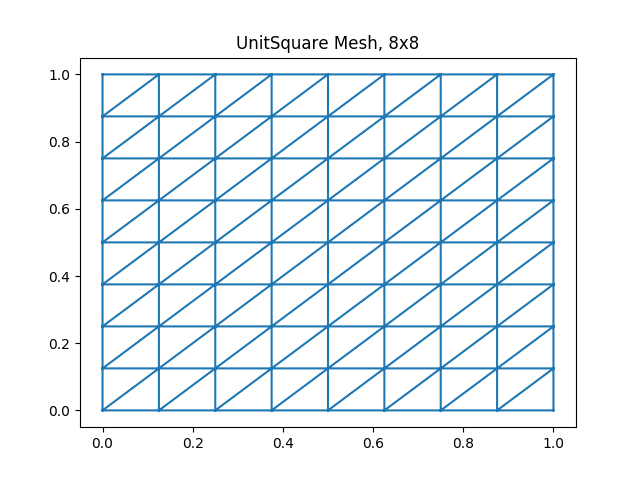
mesh = UnitSquareMesh(8,8)
V = FunctionSpace(mesh,"P",1)
u_D = Expression("1+x[0]*x[0]+2*x[1]*x[1]", degree=2)
u = TrialFunction(V)
bc1 = DirichletBC(V,u_D, "on_boundary")
v = TestFunction(V)
f = Constant(-6.0)
a = dot(grad(u),grad(v))*dx
L = f*v*dx
U = FeFunction(V)
lvsolve(a,L,U,bc1) #linear variational solver
errornorm(u_D, U, norm="L2")
get_array(L) #this returns an array for the stiffness matrix
get_array(U) #this returns an array for the solution values
vtkfile = File("poisson/solution.pvd")
vtkfile << U.pyobject #exports the solution to a vtkfile
We can also plot the solution (this relies on FEniCS backend for plotting) or import it from our file into Paraview:
```julia import PyPlot # plotting won't work if PyPlot is not imported FEniCS.Plot(U) FEniCS.Plot(mesh)
```

See the examples directory for more examples.
Owner
- Name: Unofficial Julia Mirror
- Login: UnofficialJuliaMirror
- Kind: organization
- Website: https://github.com/UnofficialJuliaMirror/MirrorUpdater.jl
- Repositories: 3
- Profile: https://github.com/UnofficialJuliaMirror
Mirror of all registered Julia packages. Updated weekly by @UnofficialJuliaMirrorBot. See also: @UnofficialJuliaMirrorSnapshots.
Citation (CITATION.bib)
@article{DifferentialEquations.jl-2017,
 author = {Rackauckas, Christopher and Nie, Qing},
 doi = {10.5334/jors.151},
 journal = {The Journal of Open Source Software},
 keywords = {Applied Mathematics},
 note = {Exported from https://app.dimensions.ai on 2019/05/05},
 number = {1},
 pages = {},
 title = {DifferentialEquations.jl – A Performant and Feature-Rich Ecosystem for Solving Differential Equations in Julia},
 url = {https://app.dimensions.ai/details/publication/pub.1085583166 and http://openresearchsoftware.metajnl.com/articles/10.5334/jors.151/galley/245/download/},
 volume = {5},
 year = {2017}
}