pyfastani
Cython bindings and Python interface to FastANI, a method for fast whole-genome similarity estimation.
Science Score: 77.0%
This score indicates how likely this project is to be science-related based on various indicators:
-
✓CITATION.cff file
Found CITATION.cff file -
✓codemeta.json file
Found codemeta.json file -
✓.zenodo.json file
Found .zenodo.json file -
✓DOI references
Found 6 DOI reference(s) in README -
✓Academic publication links
Links to: biorxiv.org, nature.com -
✓Committers with academic emails
2 of 2 committers (100.0%) from academic institutions -
○Institutional organization owner
-
○JOSS paper metadata
-
○Scientific vocabulary similarity
Low similarity (10.5%) to scientific vocabulary
Keywords
Repository
Cython bindings and Python interface to FastANI, a method for fast whole-genome similarity estimation.
Basic Info
Statistics
- Stars: 23
- Watchers: 3
- Forks: 2
- Open Issues: 0
- Releases: 13
Topics
Metadata Files
README.md
🐍⏩🧬 PyFastANI 
Cython bindings and Python interface to FastANI, a method for fast whole-genome similarity estimation. *Now with multithreading!***













🗺️ Overview
FastANI is a method published in 2018 by Chirag Jain et al.[1] for high-throughput computation of whole-genome Average Nucleotide Identity (ANI). It uses MashMap to compute orthologous mappings without the need for expensive alignments.
pyfastani is a Python module, implemented using the Cython
language, that provides bindings to FastANI. It directly interacts with the
FastANI internals, which has the following advantages over CLI wrappers:
- simpler compilation: FastANI requires several additional libraries,
which make compilation of the original binary non-trivial. In PyFastANI,
libraries that were needed for threading or I/O are provided as stubs,
and
Boost::mathheaders are vendored so you can build the package without hassle. Or even better, just install from one of the provided wheels! - single dependency: If your software or your analysis pipeline is
distributed as a Python package, you can add
pyfastanias a dependency to your project, and stop worrying about the FastANI binary being present on the end-user machine. - sans I/O: Everything happens in memory, in Python objects you control, making it easier to pass your sequences to FastANI without needing to write them to a temporary file.
- multi-threading: Genome query resolves the fragment mapping step in parallel, leading to shorter querying times even with a single genome.
This library is still a work-in-progress, and in an experimental stage, but it should already pack enough features to be used in a standard pipeline.
🔧 Installing
PyFastANI can be installed directly from PyPI,
which hosts some pre-built CPython wheels for x86-64 Unix platforms, as well
as the code required to compile from source with Cython:
console
$ pip install pyfastani
In the event you have to compile the package from source, all the required libraries are vendored in the source distribution, so you'll only need a C/C++ compiler.
Otherwise, PyFastANI is also available as a Bioconda
package:
console
$ conda install -c bioconda pyfastani
💡 Example
The following snippets show how to compute the ANI between two genomes,
with the reference being a draft genome. For one-to-many or many-to-many
searches, simply add additional references with m.add_draft before indexing.
Note that any name can be given to the reference sequences, this will just
affect the name attribute of the hits returned for a query.
🔬 Biopython
Biopython does not let us access to the sequence directly, so we need to
convert it to bytes first with the bytes builtin function. For older
versions of Biopython (earlier than 1.79), use record.seq.encode()
instead of bytes(record.seq).
```python import pyfastani import Bio.SeqIO
sketch = pyfastani.Sketch()
add a single draft genome to the mapper, and index it
ref = list(Bio.SeqIO.parse("vendor/FastANI/data/Shigellaflexneri2a01.fna", "fasta")) sketch.adddraft("S. flexneri", (bytes(record.seq) for record in ref))
index the sketch and get a mapper
mapper = sketch.index()
read the query and query the mapper
query = Bio.SeqIO.read("vendor/FastANI/data/EscherichiacolistrK12MG1655.fna", "fasta") hits = mapper.query_sequence(bytes(query.seq))
for hit in hits: print("E. coli K12 MG1655", hit.name, hit.identity, hit.matches, hit.fragments) ```
🧪 Scikit-bio
Scikit-bio lets us access to the sequence directly as a numpy array, but
shows the values as byte strings by default. To make them readable as
char (for compatibility with the C code), they must be cast with
seq.values.view('B').
```python import pyfastani import skbio.io
sketch = pyfastani.Sketch()
ref = list(skbio.io.read("vendor/FastANI/data/Shigellaflexneri2a01.fna", "fasta")) sketch.adddraft("Shigellaflexneri2a_01", (seq.values.view('B') for seq in ref))
mapper = sketch.index()
read the query and query the mapper
query = next(skbio.io.read("vendor/FastANI/data/EscherichiacolistrK12MG1655.fna", "fasta")) hits = mapper.query_genome(query.values.view('B'))
for hit in hits: print("E. coli K12 MG1655", hit.name, hit.identity, hit.matches, hit.fragments) ```
⏱️ Benchmarks
In the original FastANI tool, multi-threading was only used to improve the
performance of many-to-many searches: each thread would have a chunk of the
reference genomes, and querying would be done in parallel for each reference.
However, with a small set of reference genomes, there may not be enough for
all the threads to work, so it cannot scale with a large number of threads. In
addition, this causes the same query genome to be hashed several times, which
is not optimal. In pyfastani, multi-threading is used to compute the hashes and mapping of query genome fragments. This allows parallelism to be useful even
when a only few reference genomes are available.
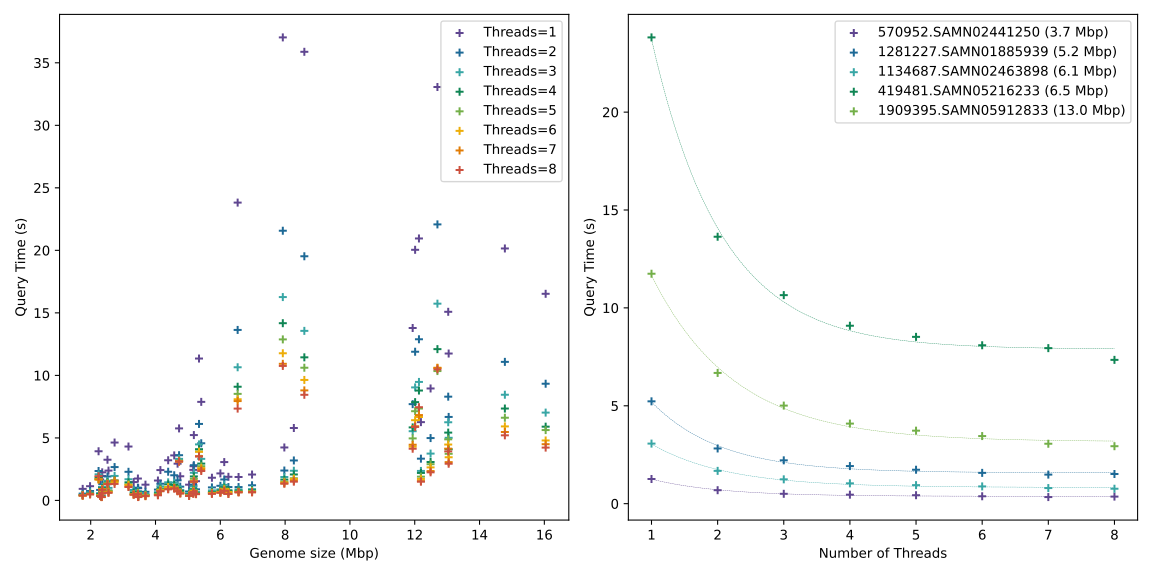
The benchmarks below show the time for querying a single genome (with
Mapper.query_draft) using a variable number of threads. Benchmarks
were run on a i7-8550U CPU running @1.80GHz with 4 physical / 8 logical
cores, using 50 bacterial genomes from the proGenomes database.
For clarity, only 5 randomly-selected genomes are shown on the second graph. Each run was repeated 3 times.
🔖 Citation
If you found PyFastANI useful, please cite our paper, as well as the original FastANI paper.
To cite PyFastANI:
Martin Larralde, Georg Zeller, Laura M. Carroll. 2025. PyOrthoANI, PyFastANI, and Pyskani: a suite of Python libraries for computation of average nucleotide identity. NAR Genomics and Bioinformatics 7(3):lqaf095. doi:10.1093/nargab/lqaf095.
To cite FastANI:
Chirag Jain, Luis M Rodriguez-R, Adam M Phillippy, Konstantinos T Konstantinidis, Srinivas Aluru. 2018. High throughput ANI analysis of 90K prokaryotic genomes reveals clear species boundaries. Nature Communications 9(1):5114. doi:10.1038/s41467-018-07641-9.
🔎 See Also
Computing ANI for metagenomic sequences? You may be interested in
pyskani, a Python package for computing ANI
using the skani method
developed by Jim Shaw
and Yun William Yu.
💭 Feedback
⚠️ Issue Tracker
Found a bug ? Have an enhancement request ? Head over to the GitHub issue tracker if you need to report or ask something. If you are filing in on a bug, please include as much information as you can about the issue, and try to recreate the same bug in a simple, easily reproducible situation.
🏗️ Contributing
Contributions are more than welcome! See
CONTRIBUTING.md
for more details.
⚖️ License
This library is provided under the MIT License.
The FastANI code was written by Chirag Jain
and is distributed under the terms of the
Apache License 2.0,
unless otherwise specified in vendored sources. See vendor/FastANI/LICENSE
for more information.
The cpu_features code was written by Guillaume Chatelet
and is distributed under the terms of the Apache License 2.0.
See vendor/cpu_features/LICENSE for more information.
The Boost::math headers were written by Boost Libraries contributors
and is distributed under the terms of the Boost Software License.
See vendor/boost-math/LICENSE for more information.
This project is in no way not affiliated, sponsored, or otherwise endorsed by the original FastANI authors. It was developed by Martin Larralde during his PhD project at the European Molecular Biology Laboratory in the Zeller team.
📚 References
Owner
- Name: Martin Larralde
- Login: althonos
- Kind: user
- Location: Heidelberg, Germany
- Company: EMBL / LUMC, @zellerlab
- Twitter: althonos
- Repositories: 91
- Profile: https://github.com/althonos
PhD candidate in Bioinformatics, passionate about programming, SIMD-enthusiast, Pythonista, Rustacean. I write poems, and sometimes they are executable.
Citation (CITATION.cff)
# This CITATION.cff file was generated with cffinit.
# Visit https://bit.ly/cffinit to generate yours today!

cff-version: 1.2.0
title: PyFastANI
message: >-
  If you use this software, please cite it using the
  metadata from this file.
type: software
authors:
  - given-names: Martin
    family-names: Larralde
    email: martin.larralde@embl.de
    affiliation: Leiden University Medical Center
    orcid: 'https://orcid.org/0000-0002-3947-4444'
  - given-names: Georg
    family-names: Zeller
    affiliation: Leiden University Medical Center
    orcid: 'https://orcid.org/0000-0003-1429-7485'
  - given-names: Laura
    name-particle: M.
    family-names: Carroll
    affiliation: Umeå University
    orcid: 'https://orcid.org/0000-0002-3677-0192'
identifiers:
  - type: doi
    value: 10.1101/2025.02.13.638148
    description: bioRxiv preprint
  - type: doi
    value: 10.1093/nargab/lqaf095
    description: NAR Genomics & Bioinformatics paper
repository-code: 'https://github.com/althonos/pyfastani'
abstract: >-
  The average nucleotide identity (ANI) metric has become
  the gold standard for prokaryotic species delineation in
  the genomics era. The most popular ANI algorithms are
  available as command-line tools and/or web applications,
  making it inconvenient or impossible to incorporate them
  into bioinformatic workflows, which utilize the popular
  Python programming language. Here, we present PyOrthoANI,
  PyFastANI, and Pyskani, Python libraries for three popular
  ANI computation methods. ANI values produced by
  PyOrthoANI, PyFastANI, and Pyskani are virtually identical
  to those produced by OrthoANI, FastANI, and skani,
  respectively. All three libraries integrate seamlessly
  with BioPython, making it easy and convenient to use,
  compare, and benchmark popular ANI algorithms within
  Python-based workflows.
keywords:
  - python
  - library
  - average nucleotide identity
  - ANI
license: MIT
preferred-citation:
  type: article
  authors:
  - given-names: Martin
    family-names: Larralde
    email: martin.larralde@embl.de
    affiliation: Leiden University Medical Center
    orcid: 'https://orcid.org/0000-0002-3947-4444'
  - given-names: Georg
    family-names: Zeller
    affiliation: Leiden University Medical Center
    orcid: 'https://orcid.org/0000-0003-1429-7485'
  - given-names: Laura
    name-particle: M.
    family-names: Carroll
    affiliation: Umeå University
    orcid: 'https://orcid.org/0000-0002-3677-0192'
  doi: "10.1093/nargab/lqaf095"
  journal: "NAR Genomics and Bioinformatics"
  volume: 7
  issue: 3
  title: "PyOrthoANI, PyFastANI, and Pyskani: a suite of Python libraries for computation of average nucleotide identity"
  year: 2025
  month: 9
GitHub Events
Total
- Release event: 2
- Watch event: 4
- Delete event: 1
- Push event: 35
- Pull request event: 1
- Fork event: 1
- Create event: 3
Last Year
- Release event: 2
- Watch event: 4
- Delete event: 1
- Push event: 35
- Pull request event: 1
- Fork event: 1
- Create event: 3
Committers
Last synced: 12 months ago
Top Committers
| Name | Commits | |
|---|---|---|
| Martin Larralde | m****e@e****e | 234 |
| Laura Carroll | l****7@c****u | 1 |
Committer Domains (Top 20 + Academic)
Issues and Pull Requests
Last synced: 12 months ago
All Time
- Total issues: 0
- Total pull requests: 0
- Average time to close issues: N/A
- Average time to close pull requests: N/A
- Total issue authors: 0
- Total pull request authors: 0
- Average comments per issue: 0
- Average comments per pull request: 0
- Merged pull requests: 0
- Bot issues: 0
- Bot pull requests: 0
Past Year
- Issues: 0
- Pull requests: 0
- Average time to close issues: N/A
- Average time to close pull requests: N/A
- Issue authors: 0
- Pull request authors: 0
- Average comments per issue: 0
- Average comments per pull request: 0
- Merged pull requests: 0
- Bot issues: 0
- Bot pull requests: 0
Top Authors
Issue Authors
Pull Request Authors
Top Labels
Issue Labels
Pull Request Labels
Packages
- Total packages: 1
-
Total downloads:
- pypi 646 last-month
- Total dependent packages: 0
- Total dependent repositories: 1
- Total versions: 12
- Total maintainers: 2
pypi.org: pyfastani
Cython bindings and Python interface to FastANI, a method for fast whole-genome similarity estimation.
- Documentation: https://pyfastani.readthedocs.io/en/stable/
- License: MIT License Copyright (c) 2021-2025 Martin Larralde <martin.larralde@embl.de> Permission is hereby granted, free of charge, to any person obtaining a copy of this software and associated documentation files (the "Software"), to deal in the Software without restriction, including without limitation the rights to use, copy, modify, merge, publish, distribute, sublicense, and/or sell copies of the Software, and to permit persons to whom the Software is furnished to do so, subject to the following conditions: The above copyright notice and this permission notice shall be included in all copies or substantial portions of the Software. THE SOFTWARE IS PROVIDED "AS IS", WITHOUT WARRANTY OF ANY KIND, EXPRESS OR IMPLIED, INCLUDING BUT NOT LIMITED TO THE WARRANTIES OF MERCHANTABILITY, FITNESS FOR A PARTICULAR PURPOSE AND NONINFRINGEMENT. IN NO EVENT SHALL THE AUTHORS OR COPYRIGHT HOLDERS BE LIABLE FOR ANY CLAIM, DAMAGES OR OTHER LIABILITY, WHETHER IN AN ACTION OF CONTRACT, TORT OR OTHERWISE, ARISING FROM, OUT OF OR IN CONNECTION WITH THE SOFTWARE OR THE USE OR OTHER DEALINGS IN THE SOFTWARE.
-
Latest release: 0.6.1
published over 1 year ago
Rankings
Dependencies
- auditwheel *
- codecov *
- coverage *
- cython *
- setuptools >=46.4.0
- wheel *
- biopython *
- matplotlib *
- numpy *
- palettable *
- pandas *
- rich *
- scipy *
- cython *
- ipykernel *
- ipython *
- nbsphinx *
- pygments *
- pygments-style-monokailight *
- recommonmark *
- semantic_version *
- setuptools >=46.4
- sphinx *
- KSXGitHub/github-actions-deploy-aur v2.2.5 composite
- actions/checkout v2 composite
- actions/checkout v1 composite
- actions/download-artifact v2 composite
- actions/setup-python v2 composite
- actions/upload-artifact v2 composite
- addnab/docker-run-action v2 composite
- docker/setup-qemu-action v1 composite
- pypa/gh-action-pypi-publish master composite
- rasmus-saks/release-a-changelog-action v1.0.1 composite
- actions/cache v2 composite
- actions/checkout v2 composite
- actions/setup-python v2 composite
- codecov/codecov-action v1 composite