neuralnetdiffeq.jl-8faf48c0-8b73-11e9-0e63-2155955bfa4d
Last mirrored from https://github.com/JuliaDiffEq/NeuralNetDiffEq.jl.git on 2019-11-19T02:22:12.567-05:00 by @UnofficialJuliaMirrorBot via Travis job 481.25 , triggered by Travis cron job on branch "master"
https://github.com/unofficialjuliamirror/neuralnetdiffeq.jl-8faf48c0-8b73-11e9-0e63-2155955bfa4d
Science Score: 28.0%
This score indicates how likely this project is to be science-related based on various indicators:
-
✓CITATION.cff file
Found CITATION.cff file -
○codemeta.json file
-
○.zenodo.json file
-
○DOI references
-
✓Academic publication links
Links to: arxiv.org -
○Academic email domains
-
○Institutional organization owner
-
○JOSS paper metadata
-
○Scientific vocabulary similarity
Low similarity (11.3%) to scientific vocabulary
Repository
Last mirrored from https://github.com/JuliaDiffEq/NeuralNetDiffEq.jl.git on 2019-11-19T02:22:12.567-05:00 by @UnofficialJuliaMirrorBot via Travis job 481.25 , triggered by Travis cron job on branch "master"
Basic Info
- Host: GitHub
- Owner: UnofficialJuliaMirror
- License: other
- Language: Julia
- Default Branch: master
- Size: 121 KB
Statistics
- Stars: 0
- Watchers: 0
- Forks: 0
- Open Issues: 0
- Releases: 0
Metadata Files
README.md
NeuralNetDiffEq


The repository is for the development of neural network solvers of differential equations. It utilizes techniques like neural stochastic differential equations to make it practical to solve high dimensional PDEs of the form:
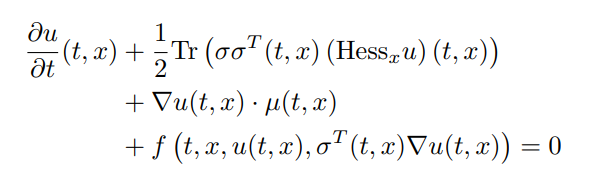
Additionally it utilizes neural networks as universal function approximators to solve ODEs. These are techniques of a field becoming known as Scientific Machine Learning (Scientific ML), encapsulated in a maintained repository.
Examples
Solving the 100 dimensional Black-Scholes-Barenblatt Equation
In this example we will solve a Black-Scholes-Barenblatt equation of 100 dimensions. The Black-Scholes-Barenblatt equation is a nonlinear extension to the Black-Scholes equation which models uncertain volatility and interest rates derived from the Black-Scholes equation. This model results in a nonlinear PDE whose dimension is the number of assets in the portfolio. The PDE is of the form:
To solve it using the TerminalPDEProblem, we write:
julia
d = 100 # number of dimensions
X0 = repeat([1.0f0, 0.5f0], div(d,2)) # initial value of stochastic state
tspan = (0.0f0,1.0f0)
r = 0.05f0
sigma = 0.4f0
f(X,u,σᵀ∇u,p,t) = r * (u - sum(X.*σᵀ∇u))
g(X) = sum(X.^2)
μ(X,p,t) = zero(X) #Vector d x 1
σ(X,p,t) = Diagonal(sigma*X.data) #Matrix d x d
prob = TerminalPDEProblem(g, f, μ, σ, X0, tspan)
As described in the API docs, we now need to define our NNPDENS algorithm
by giving it the Flux.jl chains we want it to use for the neural networks.
u0 needs to be a d dimensional -> 1 dimensional chain, while σᵀ∇u
needs to be d+1 dimensional to d dimensions. Thus we define the following:
julia
hls  = 10 + d #hide layer size
opt = Flux.ADAM(0.001)
u0 = Flux.Chain(Dense(d,hls,relu),
                Dense(hls,hls,relu),
                Dense(hls,1))
σᵀ∇u = Flux.Chain(Dense(d+1,hls,relu),
                  Dense(hls,hls,relu),
                  Dense(hls,hls,relu),
                  Dense(hls,d))
pdealg = NNPDENS(u0, σᵀ∇u, opt=opt)
And now we solve the PDE. Here we say we want to solve the underlying neural
SDE using the Euler-Maruyama SDE solver with our chosen dt=0.2, do at most
150 iterations of the optimizer, 100 SDE solves per loss evaluation (for averaging),
and stop if the loss ever goes below 1f-6.
julia
ans = solve(prob, pdealg, verbose=true, maxiters=150, trajectories=100,
                            alg=EM(), dt=0.2, pabstol = 1f-6)
Solving a 100 dimensional Hamilton-Jacobi-Bellman Equation
In this example we will solve a Hamilton-Jacobi-Bellman equation of 100 dimensions.
The Hamilton-Jacobi-Bellman equation is the solution to a stochastic optimal
control problem. Here, we choose to solve the classical Linear Quadratic Gaussian
(LQG) control problem of 100 dimensions, which is governed by the SDE
dX_t = 2sqrt(λ)c_t dt + sqrt(2)dW_t where c_t is a control process. The solution
to the optimal control is given by a PDE of the form:
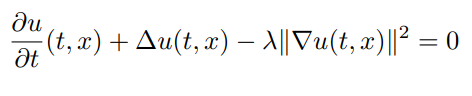
with terminating condition g(X) = log(0.5f0 + 0.5f0*sum(X.^2)). To solve it
using the TerminalPDEProblem, we write:
```julia d = 100 # number of dimensions X0 = fill(0.0f0,d) # initial value of stochastic control process tspan = (0.0f0, 1.0f0) λ = 1.0f0
g(X) = log(0.5f0 + 0.5f0sum(X.^2)) f(X,u,σᵀ∇u,p,t) = -λsum(σᵀ∇u.^2) μ(X,p,t) = zero(X) #Vector d x 1 λ σ(X,p,t) = Diagonal(sqrt(2.0f0)*ones(Float32,d)) #Matrix d x d prob = TerminalPDEProblem(g, f, μ, σ, X0, tspan) ```
As described in the API docs, we now need to define our NNPDENS algorithm
by giving it the Flux.jl chains we want it to use for the neural networks.
u0 needs to be a d dimensional -> 1 dimensional chain, while σᵀ∇u
needs to be d+1 dimensional to d dimensions. Thus we define the following:
```julia hls = 10 + d #hidden layer size opt = Flux.ADAM(0.01) #optimizer
sub-neural network approximating solutions at the desired point
u0 = Flux.Chain(Dense(d,hls,relu), Dense(hls,hls,relu), Dense(hls,1))
sub-neural network approximating the spatial gradients at time point
σᵀ∇u = Flux.Chain(Dense(d+1,hls,relu), Dense(hls,hls,relu), Dense(hls,hls,relu), Dense(hls,d)) pdealg = NNPDENS(u0, σᵀ∇u, opt=opt) ```
And now we solve the PDE. Here we say we want to solve the underlying neural
SDE using the Euler-Maruyama SDE solver with our chosen dt=0.2, do at most
100 iterations of the optimizer, 100 SDE solves per loss evaluation (for averaging),
and stop if the loss ever goes below 1f-2.
```julia @time ans = solve(prob, pdealg, verbose=true, maxiters=100, trajectories=100, alg=EM(), dt=0.2, pabstol = 1f-2)
```
API Documentation
Solving High Dimensional PDEs with Neural Networks
To solve high dimensional PDEs, first one should describe the PDE in terms of
the TerminalPDEProblem with constructor:
julia
TerminalPDEProblem(g,f,μ,σ,X0,tspan,p=nothing)
which describes the semilinear parabolic PDE of the form:
with terminating condition u(tspan[2],x) = g(x). These methods solve the PDE in
reverse, satisfying the terminal equation and giving a point estimate at
u(tspan[1],X0). The dimensionality of the PDE is determined by the choice
of X0, which is the initial stochastic state.
To solve this PDE problem, there exists two algorithms:
NNPDENS(u0,σᵀ∇u;opt=Flux.ADAM(0.1)): Uses a neural stochastic differential equation which is then solved by the methods available in DifferentialEquations.jl Thealgkeyword is required for specifying the SDE solver algorithm that will be used on the internal SDE. All of the other keyword arguments are passed to the SDE solver.NNPDEHan(u0,σᵀ∇u;opt=Flux.ADAM(0.1)): Uses the stochastic RNN algorithm from Han. Only applicable whenμandσresult in a non-stiff SDE where low order non-adaptive time stepping is applicable.
Here, u0 is a Flux.jl chain with d dimensional input and 1 dimensional output.
For NNPDEHan, σᵀ∇u is an array of M chains with d dimensional input and
d dimensional output, where M is the total number of timesteps. For NNPDENS
it is a d+1 dimensional input (where the final value is time) and d dimensional
output. opt is a Flux.jl optimizer.
Each of these methods has a special keyword argument pabstol which specifies
an absolute tolerance on the PDE's solution, and will exit early if the loss
reaches this value. Its defualt value is 1f-6.
Solving ODEs with Neural Networks
For ODEs, see the DifferentialEquations.jl documentation
for the nnode(chain,opt=ADAM(0.1)) algorithm, which takes in a Flux.jl chain
and optimizer to solve an ODE. This method is not particularly efficient, but
is parallel. It is based on the work of:
Owner
- Name: Unofficial Julia Mirror
- Login: UnofficialJuliaMirror
- Kind: organization
- Website: https://github.com/UnofficialJuliaMirror/MirrorUpdater.jl
- Repositories: 3
- Profile: https://github.com/UnofficialJuliaMirror
Mirror of all registered Julia packages. Updated weekly by @UnofficialJuliaMirrorBot. See also: @UnofficialJuliaMirrorSnapshots.
Citation (CITATION.bib)
@article{DifferentialEquations.jl-2017,
 author = {Rackauckas, Christopher and Nie, Qing},
 doi = {10.5334/jors.151},
 journal = {The Journal of Open Source Software},
 keywords = {Applied Mathematics},
 note = {Exported from https://app.dimensions.ai on 2019/05/05},
 number = {1},
 pages = {},
 title = {DifferentialEquations.jl – A Performant and Feature-Rich Ecosystem for Solving Differential Equations in Julia},
 url = {https://app.dimensions.ai/details/publication/pub.1085583166 and http://openresearchsoftware.metajnl.com/articles/10.5334/jors.151/galley/245/download/},
 volume = {5},
 year = {2017}
}